Jump to ratings and reviews
Rate this book

The Metropolis Case

Rate this book
From the smoky music halls of 1860s Paris to the tumbling skyscrapers of twenty-first-century New York, a sweeping tale of passion, music, and the human heart’s yearning for connection.

Martin is a forty-year-old lawyer who, despite his success, feels disoriented and disconnected from his life in post-9/11 Manhattan. But even as he comes to terms with the missteps of his past, he questions whether his life will feel more genuine going forward.

Decades earlier, in the New York of the 1960s, Anna is destined to be a grande dame of the international stage. As she steps into the spotlight, however, she realizes that the harsh glare of fame may be more than she bargained for.

Maria is a tall, awkward, ostracized teenager desperate to break free from the doldrums of 1970s Pittsburgh. When the operatic power of her extraordinary voice leads Maria to Juilliard, New York seems to hold possibilities that are both exhilarating and uncertain.

Lucien is a young Parisian at the birth of the modern era, racing through the streets of Europe in an exuberant bid to become a singer for the ages. When tragedy leads him to a magical discovery, Lucien embarks on a journey that will help him—and Martin, Maria, and Anna—learn that it’s not how many breaths you take, it’s what you do with those you’re given.

This unlikely quartet is bound together across centuries and continents by the strange and spectacular history of Richard Wagner’s masterpiece opera Tristan and Isolde. Grandly operatic in scale, their story is one of music and magic, love and death, betrayal and fate. Matthew Gallaway’s riveting debut will have readers spellbound from the opening page to its breathtaking conclusion.

374 pages, Hardcover

First published December 10, 2010

98 people are currently reading
1250 people want to read

About the author

Matthew Gallaway

4 books80 followers
Matthew Gallaway is the author of #gods and The Metropolis Case, which was praised by the New York Times for being “driven by exuberance and morbidity, fatalism and erotic energy.” He lives in the Washington Heights neighborhood of New York City with his partner and many cats. Previously he worked as a record-store clerk while earning a law degree from NYU and was a member of the indie rock band Saturnine.

Ratings & Reviews

What do you think?
Rate this book

Friends & Following

Create a free account to discover what your friends think of this book!

Community Reviews

5 stars
141 (19%)
4 stars
245 (34%)
3 stars
199 (27%)
2 stars
102 (14%)
1 star
32 (4%)
Displaying 1 - 30 of 194 reviews
Profile Image for Jaidee .
764 reviews1,498 followers
October 23, 2019
5 "imperfectly delicious, emotionally resonant and unapologetically melodramatic" stars!!!

2016 Gold Award - Most favorite book of the Year !!

Please listen to this as you read my review:
https://www.youtube.com/watch?v=RLoHc...

I want to shout from the rooftops. I want to give all of my Goodreads friends a copy. I want to read this a hundred times. I love and adore this book. Made me cry, made me laugh, made me despair, made me hope, made me love and did it over and over and over again.

I read 20 percent prior to our trip to Belize and knew I had found a sloppy masterpiece and saved the remainder for our trip. We were lucky to find a secluded virgin beach with a small cove and I curled up and read the remainder on three visits.

This is my fourth 5 star read so far this year and it seems to be the culmination of a bizarre tetralogy:

Love in the Time of Cholera by Gabriel García Márquez astounded me with its poetic decay.

Long Man by Amy Greene resonated with my melancholy nature.

Outline by Rachel Cusk helped me access my cerebral aspects.

but this book, this book, this book was something that was written, it seemed, just for me!!!

Elements of high emotion, deep love, passion for opera and artistry and search for meaning within art, magic and the power of relationship.

I found this book through a google search around fiction revolving around my favorite Opera: Tristan and Isolde (which is what my avatar is by the way :) and here this book showed up in all of its messy beauty. I saw my first performance of this masterpiece when I was 25 and I can say that I have never witnessed anything as powerful and sumptuous and sad than this. I limit myself to listening to this work in its entirety to three or four times a year or I would not be able to function. I would turn mad, obsessive like the people in this book....maybe.

4 people haunted and impacted by Wagner's opera. We travel across centuries from Paris, to Vienna, to Munich, to Pittsburgh, to New York. 4 lost people that are haunted, possessed and destined to take part in the larger drama of Tristan and Isolde. 2 men and 2 women- all lost, yearning for love, beauty and the need to connect and yield with something larger than themselves.

This is a debut work by an author and this astounds me. I have not stopped thinking about this book. I want you all to read this even if it does not resonate with you as it deeply did me.

I want to leave you with a few gorgeous passages:

" The next morning, Lucien woke up groggy; they had enjoyed more than a few glasses of absinthe before going to bed, which in combination with so many kisses and caresses never failed to leave him with the sense of having spent hours in a moonlit field of wildflowers, pressed hard against the wet earth and staring up through the blossoms at the slowly spinning stars" or

" The sad wistfulness that came from constant exposure to a story of love and death was a component but in no way explained the overwhelming sense of futility under which they labored, as if they were required each day to explain the ultimate purpose of life while knowing that the previous day's answer was no longer viable" or

" Lucien moved into position to wait for his cue and as he listened to the first breath of the cellos, he could almost hear his father and dead mother talking, while in the cascade of strings that followed he felt his heart beating in time with that of Eduard and imagined them still together in the night." or

" As the applause continued, he was reminded of certain mornings in Vienna- especially after he'd just arrived- when he would wake up next to Eduard and for a little while feel sated and content, and for the first time he understood the consummating power of performance and how- as with romantic love- he had grasped this only after years of searching, of craving somethin he could not have described until after it was found"

Finally and (oh so fucking true!!!)

" Maria had no doubt that those who had seen this performance would never forget how the opera can make and alter history, and how, on this night, history had been made and altered"

Mr. Galloway like Maria I felt the same way about your big, wonderful, mash-up of a first novel.

Wow just wow!!!!
Profile Image for Suz.
1,557 reviews856 followers
June 28, 2018
I finished this book more than a week ago and have still not reviewed. I loved this book but found it hard to review, I'd been thinking about it and just didn't know how. I was actually putting it off until this quiet Sunday. This book would not have crossed my path if it wasn’t for Goodreads, and more specifically, my friend Jaidee. Jaidee knows a lot of stuff.

Sometimes I write notes about my books, and the title of this one in my notebook was ‘Jaidee’s Book’ as I couldn’t remember the title at the time, and to be honest, it was the way I thought of it. I recommended my favourite book to him Golden Boy (he hated it) and I decided to read his favourite read of 2016. Lucky I. Loved it.

I know nothing of Opera music, and rarely read historical themes, but boy was I treated this time around. This is a lovely, well deserving five melancholy stars. So glad I stepped out of the square to try something new.

Stories weaved within each other through Opera – Tristan and Isolde. Art, culture, architecture, song and creation. I know nothing of music really, but adored the theme of love and life that it means to people who can sing and create and produce. Love – lost and found – searching, being understood; or not. It was very dramatic, tragic; every chapter ended with a very different and thought provoking philosophical comment.

Each thread of the story did not necessarily have a strong unputtdownable plot in a way, but a sharing of stories in a slow burning communal way which was told over generations.

Read this https://www.goodreads.com/review/show..., you’ll get a better picture than my in-eloquent ramblings! I find that my thoughts on a book are just that, thoughts not summaries.

This was from Eduard's story, and was one of many that I loved: ".. he was less likely to find himself in tears, and his dreams were no longer filled with endless hallways through which he ran panicked, unable to ever find the door."

So glad I read it. So interested to see what Matthew Gallaway writes for us next.
Profile Image for Sketchbook.
698 reviews265 followers
December 15, 2024
A reinvention of "The Makropulos Case." But Gallaway imposes his personal vision which encompasses Richard Wagner, AIDS, the Paris Commune and the 9/11 attacks. Within a compelling sexual labyrinth that weaves through Time with timeless characters, he explores love & loneliness, desire & despair, and other-worldly elixirs.

Rustling our imagination are twins separated at birth, lost parents, a scientist who concocts a potion, a 'sleeping prince' who awakens to reveal a secret. In sum, careerist New Yorkers- lumbered with baggage, past and present - discover a link among themselves and to an opera singer who knew European stages over 100 years ago.

As with air and water, says a young vulnerable who's looking for love, there's "no point making distinctions between art and love." He wants both. Is he asking for too much? In this connecting struggle lives are shaped by the "love-glance motive" -- to borrow a phrase from opera buff Milton Cross.

Finale: Gallaway offers a daring sequence - a duet of 'operatic' release that's a bit of the terrific. It may bollox those who incorrectly perceive this as realism, for here's a romantic fable on the nature of loving with a salute to any comedy of errors.
Profile Image for Barbara.
108 reviews
January 24, 2011
This is just an extraordinary novel. Possibly one of the best novels I've read in a very, very long time. Once in a blue moon, if you're really lucky, you'll encounter a work of art (a painting, a piece of music, a book, a film) that changes your life in some way or, at the very least, changes the way you think about life. The Metropolis Case did that for me. Matthew Gallaway's magnificent prose on life, death, love, loss, pain, loneliness, and passion is so elegant and beautiful and helped me to realize that beauty, light, and color can be seen even in our darkest moments.

I found the story to be absolutely stunning. The stories of the four main characters - Martin, Anna, Maria, and Lucien are told so vividly and when we start seeing how each of these characters' lives are intertwined, the magic really starts to happen. Wagner's opera, Tristan and Isolde, is the thread that connects each of these characters, and their connections to each other are as powerful as the opera itself.

It's not necessary for me write what the story is about in this review, because that is included here on Goodreads in the description of the book and in many reviews of the book, so I will just say that the story is brilliant, interesting, magical, funny, intelligent, and a lot of fun.

In addition to telling a great story, Mr. Gallaway really knows how to develop incredibly believable characters. I was able to relate to all of the characters because they are so human with their vulnerabilities, their desires, their passions, and even their empty feelings when their needs and wants are not fulfilled. I really liked all of these people so much -- I was able to see their inner beauty which created such a sense of compassion within me.

Another wonderful treat is that we are taken to some fantastic cities during various time periods -- Paris, Munich, and Vienna in the mid-19th century, New York in the 60s and 70s and contemporary New York, Pittsburgh in the 70s, and we even get a "behind the scenes" glance at a Wagner Festival in Bayreuth. And while opera plays a crucial role in this book, we also get some pretty great rock music as well.

I strongly recommend this book to everyone who loves a great story about a very interesting and eclectic group of people. You absolutely do not have to be an opera fan to enjoy this novel, you simply have to be a fan of great books.

Although I received this book through a Goodreads' First Reads contest, I was not required to write a review, and certainly not required to write a "positive" review. I truly loved The Metropolis Case.

Thank you to Crown/Random Publishing and Goodreads for choosing me as a First Reads winner of this awesome book, and thank you to Matthew Gallaway for writing such a wonderful novel.


Posted 1/11/11 -- I just started reading this book last night and I did not want to put it down. I'm only one-third of the way through The Metropolis Case but I already love all of the characters, and Matthew Gallaway is an absolutely beautiful writer. I feel as though I'm reading poetry while reading this book -- Mr. Gallaway's descriptions of human emotions are just brilliant. It's hard to believe this is his first novel, but I certainly hope it is not his last because at this point I am absolutely loving his work.


Profile Image for Schmacko.
262 reviews74 followers
May 26, 2011
Here is an engaging first story, a fiction written by a one-time indie rocker who is obviously obsessed with…get ready for this…Wagner’s Tristan and Isolde.

Most everyone I know is obsessed with one or two pieces of art or bits of popular culture. That passion can be for Vincent Van Gough or Britney Spears. There may be some snobby people who insist that one fixation is more merit-worthy, more desirable. But in truth, the effects of rapturous obsession is pretty universal whether it’s for comic books, William Shakespeare, 1950s salt shakers, or my own 1300+ CDs and 5 gigabytes of digital music.

(And I might as well mention that I have a few other stimulations – Sondheim, modern playwrights, purple glass, cooking, and reading.)

Matthew Gallaway once played guitar for the critically praised band Saturnine, so his knowledge of music is sound. What’s surprising is that his love took a turn toward Wagner, who was a loud, Germanic, political man who wrote bombastic and sometimes audience challenging opera and classical pieces. Wagner’s hardest work, most would agree, is Tristan and Isolde, a big, blasting piece full of melancholy and death, nearly impossible for most singers, but not particularly a toe tapper.

In Gallaway’s book, Herr Wagner has come to 1850s Paris to try to produce his new opera. There is a young man Lucien, who is enamored of Wagner’s music and of the idea of signing opera for a living. He will become central to Tristan an Isolde’s history. He will also secure a rare first manuscript of the difficult score. Lucien and that manuscript will in turn affect the lives of an early 20th century American soprano and of two tragic kids who grew up in the same Pennsylvania town in the 1970s.

Musical comedienne Annie Russell once said, “But that’s the beauty of opera; you can do anything so long as you sing it.”

It’s true in The Metropolis Case. They do anything. There are threads of political intrigue, homosexuality, incest, violence, natural disaster and other tragedies of humankind and of fate. Gallaway’s talent for spinning an engaging tale – with warm and relatable characters – in the midst of this miasma is amazing. Even his schlocky first chapter – a messy, slang-laden email – doesn’t take away from the fact that the rest of the book is intriguing. Exactly how and why these four lives intersect make up the brunt of the mystery driving the novel. For me to reveal any of it would take a bit of the fun away from other readers.

That being said – besides the weird email that starts the novel (thank God Gallaway drops that stylistic conceit quickly) – there is a bit of unevenness about the novel. Though it has three “acts” splitting all four character’s lives, the tone and engagement of each narrative ebbs and wanes unevenly. Some major events connect the people, and some don’t; the choice seems arbitrary rather than artful. Finally, something purely magical happens; it’s something you’ll never, never, never see coming. In many circles, this literary trick might be considered a deus ex machina; to other readers, it seems like a supremely sloppy gimmick to wrap up the story. However, I defy anyone who’d say that this plot point was well structured or sufficiently foreshadowed. To me, though, it’s messy, but it’s also forgivable for a first novel, especially one that is so rapturous about its subject and so loving of its players.
Profile Image for Kat.
292 reviews27 followers
April 22, 2011
(3.5 stars) -- he did make me cry.

Conflicting thoughts about this one. I can forgive the over-the-top deus-ex-machina contrivances, given that the book functions as a sort of literary opera. And not being an opera buff myself, I give the book credit for making me thoroughly intrigued by Tristan & Isolde. I was carried along quickly by the tone, and I was interested in the characters' lives. However, the characters inner, emotional lives are laid out in a series of heavy-handed pronouncements that can sometimes feel pompous and forced. Yes, I feel the author says some very emotionally authentic things. And sometimes there is a definite ring of truth to his passages. But the sheer amount of this pontificating frustrated me.

As a tiny SPOILER warning - there is a huge theme of loss and death running through the work. It almost feels like the author sat down and made a list of every kind of interpersonal loss he could imagine and slotted them in one by one. Loss of parents, lovers, siblings, children, career, country, pets - the constant tragedy coupled with the melodramatic (or operatic, I suppose) story elements combined to form something that was occasionally affecting, but often veered into something that felt forced or emotionally manipulative, or occasionally even absurd.


As a parting frustration: the author spent the entirety of the book mining the emotional depths for dark introspection. But he ducks out of what I felt would have been the most jarring and complicated character confrontation of the book, pages from the end. Its a small thing, but it irked me.
Profile Image for Kathy.
3,859 reviews289 followers
Read
November 15, 2018
I am unable to continue reading this book at this time. It is hard work.
The various stories woven together yield high points with talented and loving characters and some characters hard to understand or like. Initially one thinks elevated operatic and/or theatrical themes, but then to be thwarted and dumped in a stew.
Maybe a bit like walking into a suburban movie theatre that has 12 movies running and you get up and walk out and try the next door, etc. looking for something you may like or at least understand.
Tristan and Isolde is at the core, unifying the stories of four? central characters. I'm quitting early, so I can't guarantee the number or how this will come together later.
This is my first reading of Matthew Gallaway, and I am stepping out at the point the character based on himself, most likely, is just too untrustworthy for me to follow. Who watches the Twin Towers collapse and decides not to leave the area but rather opens a bottle of bourbon and plays a favorite LP?
Profile Image for Unsolved ☕︎ Mystery .
479 reviews108 followers
Read
February 21, 2017

I won this book through Goodreads First Reads Giveaway. Thank you very much. =)

- My Description -
This book is about a group of people at different times, in different decades. They all have something in common, their love of music.

- My Review -
I was 162 pages in and I wasn't able to finish it. I've been reading this on and off over the last few months, hoping I'd get more into it.

While the book was better then I thought it would be, it didn't hold my interest enough for me to finish it.

It's really too bad. It had such promise.
Maybe this book would be better suited with someone else...

Since I didn't finish, there will not be a rating.
Profile Image for Forrest.
10 reviews2 followers
August 10, 2019
No real plot ever seemed to materialize. The author's insistence on breaking up sentences -- whenever he felt like it -- with hyphens, extending them into run-ons that -- having lost their point -- meandered through overwrought language and the characters' pretentious introspections, made the novel -- on the whole -- agonizing to finish. The characters were always sharing knowing winks and blinks, smiling wanly, grinning washfully, nodding slyly... The invocation of magic 2/3 of the way through was abrupt and unsubstantiated early on. Just had a very, very difficult time trudging through to the end.
Profile Image for Meaghan O'Connell.
Author 6 books283 followers
January 2, 2011
I read this book, swallowed it whole, really, in a couple of days. Which character was my favorite changed every few chapters, and I loved whirling through this book with them. i love gallaway--he's incisive and hilarious while at the same time underlining everything he writes with enormous compassion. He's one of the good ones, and this book reflects that. i think this book should be a MOVIE, RIGHT???

also i loved googling all of the chapter titles. it was a nice way to prolong the book when i wasn't ready for it to end.

READ IT.
Profile Image for Sammy.
954 reviews33 followers
March 21, 2024
This is one of the hardest reviews I have ever had to write. As a general rule, I do not write overly negative reviews, particularly not for first-time novelists. As someone who would like to be a novelist myself, I have little desire to leave public dismissals of others, nor do I think that the subjectivity of taste mandates it. Most of the time. However, I found "The Metropolis Case" to be such an appalling book, particularly given I was so excited to read it, that I would hate for others to spend time and money upon it.

The plot, in brief, centres on the stories of four people: a middle-aged man in contemporary Manhattan dealing with aging and changes of personal taste; a renowned opera singer at the peak of her career, and her young protege who fights the odds to become a star herself; and a mysterious young Frenchman in the 19th century whose father has incredible goals. Their plots all gradually spiral around the core subjects of opera, New York City, and unexpected human connections. Those are literally three of my favourite things in the world, so I was anticipating adoring this novel. It also takes its core themes (and narrative strands) from two of my favourite operas, one by Wagner (very clearly signposted throughout) and the other by Janacek (heavily implied by the book's title). Unfortunately, the novel is a complete mess. I can only assume the publisher took it on because they believed the subject matter would appeal to the affluent. The good reviews ... well, I can't begin to explain those.

Where to start? Most of the plotlines are dead in the water. It's not that the stakes need to be high, of course; philosophical change can be as fascinating as the physical. But in this case, three of the four tales - those of Martin, Anna, and Maria - read as poorly-written Wikipedia articles. Gallaway is prone to dashing off paragraphs full of straight-out exposition, writing with affectless prose in which he tells, rather than shows us, what is happening. He'll often utilise either parenthesis or "i.e." in his narrative voice, which makes the reader feel as if they are reading a glorified timeline. (To paraphrase: "They had this conversation on Wednesday, i.e. the day after the funeral".) The exposition lacks any bite, so that when a group of French revolutionaries are slaughtered by soldiers, it has all the panache of scenes in which Martin feeds a cat. The dialogue is equally as woeful, sounding like first-draft narrative filler. At one point, Richard Wagner himself shows up, and speaks in the same bland tone as Martin's vet! There's an obviousness to the way in which Gallaway tells his story that feels as if he is ticking items off a list. It's like the lesser of the "Choose Your Own Adventure" novels. Maria and Anna never register as complete characters, and Martin is just barely above them. This is primarily because, rather than seeing the characters engaging with real experience, we're just told what is happening inside their heads, and also what philosophical effect this has on them, as if we're reading a textbook.

The story of Lucien, the young Frenchman, is at least good for a few intriguing images, and the general grandeur of 19th century France. Yet, it still cannot be saved from the plodding weight of Gallaway's prose. Lucien is even less of a character than the modern-day figures, presumably because the author thinks of him as a kind of fantasy archetype. No-one in this earlier timeline speaks any differently than the 21st century characters, and Lucien's father speaks of his wife's death as if it were another one of his biology experiments.

It doesn't help that Gallaway's prose is needlessly verbose; you may find yourself running to the dictionary on a regular basis, but you'll rarely return to the novel feeling that the word was warranted. Amongst all of this, there are some shockingly bad metaphors (audiences do not "duck" to avoid being hit by "beams of sound" from a powerful singer on stage).

All of which is to say, this is a book where the original narrative treatment must have looked wonderful. It would still make a good film if a thoughtful screenwriter hammered out the dialogue and thematic elements. But it's fairly clear that Gallaway simply worked from his treatment, transferring each line into a paragraph of loping plot, and forgot to include any dialogue markers that might give any of his narrative figures a sense of character. The final surprise of the novel is instantly ruined if you know the opera that it's riffing on -- and is it even a riff? It's literally the plot of that opera, right down to the hilariously tacky character surname and final image. Since I expected that from chapter one, it wasn't hard to piece everything together.

I suppose I admire Gallaway for being one of the few modern-day writers to make opera the centre of his plot, and not just in an honourary way. He clearly has a real passion for the subject matter, and his attempts to work through the pain of both personal and societal loss with Martin are meritorious. While Martin as a person doesn't resonate, Gallaway's own thoughts on the way age and desire often battle one another are intriguing. There is one chapter featuring his character toward the end which is quite affecting, even if it feels like a short story forcibly inserted into the novel. Unfortunately, the novel completely fails to please on any level. Both the prose and the dialogue are clunky and generic, not a single character rises above the cumbersome plotting, and the narrative excesses are rarely believable, but nor are they imaginative enough to make us want to suspend our disbelief. But on the plus side, the book comes with a thoroughly pretentious "study guide", so it can clarify some of the philosophical arguments that you may have missed while you were sleeping through the book.

Oy vey.
Profile Image for Cassandra.
32 reviews18 followers
January 12, 2011
The title is a bit misleading. It implies that there is a mystery to be solved. There isn't one, though. Not one that the characters are working to solve. Instead, the reader is left trying to figure out just what it is that binds all of the characters and their diverse stories together. It turns out that it is a man named Leo Metropolis.

Metropolis' case is an unusual one. He appears in the other characters' lives at moments when his guidance or assistance is needed. He makes appearances in the great opera houses of Europe and the United States when he feels the need to sing. He says little, and he does not linger. Even so, the impact that he has on the book's other characters, particularly Maria and Martin, is profound.

Gallaway alternates between the historical account of Lucien, the singer who originates the role of Tristan in the premiere of Wagner's masterpiece Tristan and Isolde, and the contemporary tales of Anna, Maria, and Martin, following each from the 1960s through the months following the attacks of September 11, 2001. He does so in such a way that the language and description are always appropriate to the time period but also accessible to the reader. Gallaway also does an excellent job of identifying with each of his characters, whether male or female, gay or straight. The reader is easily able to do the same.

Gallaway's narrative shows remarkable poise for a debut novelist. The reader does not get lost while trying to figure out which story is being told and when. Instead, they are able to get lost in the story, imagining how it will all come together in the end. In fact, had the characters been linked by nothing more than Tristan and Isolde, the novel would have been completely satisfying. Going beyond that, however, and making the opera secondary to Metropolis and his tale, elevates the novel to a place where the reader is fulfilled.

That, and he almost makes me want to see an opera. Those are words I never thought I would say.
Profile Image for Alexander Inglis.
75 reviews9 followers
April 25, 2011
A somewhat daring first novel, Matthew Gallaway's The Metropolis Case stiches together four lives using Wagner's most revolutionary opera,Tristan und Isolde as its thread. Lucien Marchand is a young man growing up in Europe in the 1840s who aspires to be a singer; Anna Prus, whom we first meet in 1960, is a celebrated Wagnerian singer and later professor at Juilliard; Maria is a late 1970s teenager, growing up in Pittsburgh, whose whole life revolves around opera (making for a somewhat odd childhood but leads her to Juilliard); and Martin, a divorced, gay New York lawyer who, at 41, partly triggered by the events of 9/11 which are played out from his office window, comes to the music of Tristan through the haze of drugs, punk bands and lost loves. Structurally, the novel cycles, chapter by chapter, from one character to the next, unveiling their lives and staging events to knit the players together.

The novel is at its best in the self-contained vignettes where Gallaway relaxes and indulges in wry humour and observations of the scene from the character's point of view; in other places, contrivances stick out unsatisfyingly. The worst case is the gimmick Gallaway relies on finally to bring all four stories to a single place which, I confess, once I saw it coming left me feeling disappointed. Gallaway also relies too often on death to alter circumstances rather than introduce a character with significant flaws to wreck havoc. Our four main characters, in the end, are kinda nice folks ... the story needs a bit more grit.

Notwithstanding, it was an entertaining read as the reviews below reflect. You do not need to be an opera lover, or a Wagnerite to enjoy the story; but you may need to know it has a very gay positive context slathered into these intertwined lives.

Reviews have appeared in The Pittsburgh Post-Gazette, The New York Times, The Washington Post and Lambda Literary Review Online.
Profile Image for Rick.
Author 6 books86 followers
January 15, 2011
Wow. I really liked this book. I liked it at first, and then I was sorta on edge with it for a while, but I think in the end it delivered quite nicely. I'm also super excited that my generation's music is starting to make its way into great literature. I think was talking about this drunkenly the other night and the person who was on the receiving end was utterly uninterested, but, you know, I had to read so many books of "literature" that had the Beatles or the Stones or the Doors in them - never mind Master and the Margarita which as soon as you think of "Ray Manzerek" is completely ruined. So it was refreshing to have a book where there was a major emotional scene in the film that took place to a 1992 My Bloody Valentine gig. It was exciting to have chapters named after Spacemen 3 albums (even if another one was unfortunately named after a Rolling Stones documentary). It was exciting to have Ride mentioned. The Jesus and Mary Chain. In that way, it sorta reminded me of Lev Grossman's The Magicians - understated jokes you'd only get growing up in the 90's, not a big deal made of it. But even without caring about this, this book is solid. Though I can't imagine what it'd be like reading it without a love of music. Also the 18th century portions of the novel sorta reminded me of a postmodern Suskin's Perfume. Oh, and to get to the end, and see that the book was written by Matthew Galloway - I knew I had recognized the name, but couldn't place it, until I got to the very last word of the author bio at the end, and discovered he was in Saturnine, who I really loved. I am listening to Your Maps right now. I missed these guys. Nice.
Profile Image for Keith.
243 reviews3 followers
May 3, 2011
I read a brief snippet about this book in the New York Times, as well as Barnes & Noble. I was intrigued enough to keep looking for it and remembering the name of the book. I was not let down. I'd like to write that it is the story of the writing of "Tristan und Isolde" and the first production of that work - but it is so much more. There are three great story lines that are woven in such a way to make an amazing novel. When a novel drives the reader to start exploring other art works - I think that is a sign of a well written book. After reading this I started looking through my Opera recordings, and asking about the best recording of Wagner's Tristan - as well as adding Visconti's "Ludwig" to my netflix queue.

I look forward to a second novel from Mr Gallaway, and a third, fourth, etc.
Profile Image for Tanya.
2,974 reviews26 followers
November 3, 2015
Yes! I am loving these first-reads giveaways! This is the third book I've won in a week! If you're interested in reviewing new books for Goodreads, click on "find books" and then "giveaways." You can enter to win any of their "first reads" books that sound good to you. I'm really excited to read The Metropolis Case.

1/31/11
Although I was prepared to love this book, I decided to put it down a third of the way through. The story was just starting to capture me, but the characters were pushing me away. I don't enjoy reading about homosexual exploration, which seemed to be the direction 2 of the 4 protagonists were going. Overall, I just felt a negative vibe and didn't want to continue.
Profile Image for Richard.
Author 6 books34 followers
October 12, 2010
A beautiful first novel. Remarkably assured and a wonderful tale of a trio of remarkable characters set around the world of opera. Matthew Gallaway is a man to watch. Tore through this book like candy and enjoyed it completely.
Profile Image for Kathryn.
142 reviews
Want to read
March 1, 2012
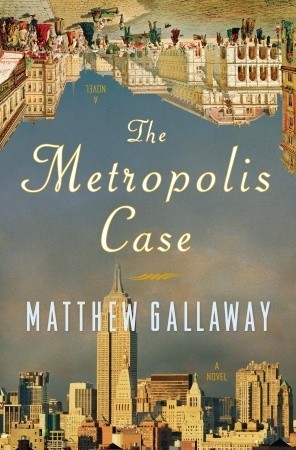
I love the cover of this book! I can't wait to get it and to read it....
Profile Image for Jeff.
5 reviews1 follower
January 17, 2011
Great debut novel. Looking forward to Gallaway's upcoming event in SoHo.
Profile Image for Diane S ☔.
4,901 reviews14.6k followers
February 7, 2011
What an interesting book and concept. Characters tied together by the opera, Tristan and Isolde.
Profile Image for Clete.
192 reviews3 followers
December 8, 2020
I may have been tipped to five stars, if not for the idea, seemingly implicit in each relationship, that the only way for these gay men to understand themselves or feel alive or leave a legacy was through heterosexual encounters. Indeed, the entire premise of the story rests on this. Lê sigh. Otherwise, a very ambitious, engaging, and immersive story laden with sweeping prose and weighted with universal truths.
Profile Image for Jennifer B.
496 reviews
February 29, 2024
A book featuring both my favourite city and my favourite composer. Potentially 5* but I found both the story and the writing pretty poor.
Profile Image for Zoë Danielle.
693 reviews80 followers
January 21, 2011
The Metropolis Case by Matthew Gallaway is the story of four intertwined lives brought together by Wagner's opera Tristan and Isolde. Their stories connect across time, with the oldest belonging to Lucien, a young man desperate to become an opera singer who falls in love with an architect in 1846 Paris. Over a century later in 1960s New York, Anna's career as an opera singer is just beginning to take off with her role as Isolde. In the 1970s, Maria follows her voice to Juillard as she attempts to break free from her mundane life in Pittsburgh. Finally, Martin is a forty-year-old lawyer, HIV positive and coming to grips with his life after the September 11th attacks on New York.

Gallaway easily intertwines a supernatural element inspired by the original opera after which his book is named, The Makropulos Affair, as Lucien's father works towards creating an elixir for immortal life. Although I tend to avoid books with a supernatural twist, I was so enraptured with Gallaway's writing and storytelling that I was willing to suspend belief when necessary. Admittedly the novel was unexpectedly graphic at times but only once was I made uncomfortable by a liaison between two individuals who are actually related to each other and which felt unnecessary to the actual development of the story. The novel itself is reminiscent of the storytelling of Michael Cunningham, who wrote The Hours and most recently By Nightfall not only because of the fact that they both deal with sexuality but also because like, By Nightfall, The Metropolis Case is a novel focused mainly around New York and what Nightfall did for the art world, Gallaway does for opera, allowing the reader a glimpse into what happens behind the scenes.

An aspect of The Metropolis Case which I found particularly interesting was the very original chapter headings, however I was less impressed by the fact the novel began with a chapter written in e-mail format a technique which was not repeated in the remaining pages. I found it a little odd to begin a book in one way and then to abandon the method in the rest of it. Ultimately though, this is a very minor complaint for a novel that I overall enjoyed. I really loved Gallaway's writing, as he seemed capable of sharing just the right amount of detail to intrigue but not overwhelm the reader. Gallaway is able to interweave an incredible number of themes into the compact chapters, touching on sexuality, love, friendship, passion and family. This is also the first book I have ever read involving opera, and for a form of music which has been so important over time it was really wonderful to finally get a glimpse into the power and the people behind it. The Metropolis Case is a book that can most easily be described as both literary and intellectual, nothing in the novel is straightforward but the reader is rewarded for their investment with a story that is both interesting and original.
Profile Image for Rebecca Johnson.
144 reviews
April 8, 2011
Matthew Gallaway has potential as a novelist, but he has not realized it with Metropolis Case.

Implausible plot aside, much of the book is downright cheesy and not particularly well-written. Many of the characters were fairly 2D. Maria, at best, was a knock-off of Middlesex's Cal, The Early Years; at worst, she was cartoony and trite (how many angsty teenagers do we have to suffer through as new novels are written??) I couldn't get the image of Violet from The Incredibles out of my head as I was reading about Maria in high school. Also, I don't feel that Gallaway ever quite succeeded in portraying Maria's consuming love of music...he said it often enough, but Maria could have been obsessed with pretty much anything; there was nothing special about opera in this case. And while I recognize the difficulty of demonstrating a sensual effect with words, I feel "Show, not tell" should be employed here. I felt that Lucien's love of opera was only slightly more believable; more on that below.

The only character that I thought was worth delving into was Martin; perhaps he is the most realistic character because he is the most autobiographical. This may also be why Lucien is better-written than Maria. In that case, Mr. Gallaway, please stick with what you know. I would gladly read a novel only about Martin. Everyone else was two-dimensional, whiny, cliche, and uninteresting.

I must touch on the overlong section at the end about Martin's cat, Beatrice, and her illness. As a veterinarian, I found the accuracy distracting; only a veterinarian or a cat-owner who had gone through that exact experience could possibly write about it with such detail. This, again, supports my suggestion to the author that he write about what he knows, because he's very good at it.

My feelings about this book are conflicted, though, because it generated so much discussion amongst the group with which I was reading it. It also prompted me to borrow a recording of Tristan und Isolde from the library and listen to it twice all the way through...no small feat, I promise!

And finally, HELLO?? Did nobody notice that there are siblings having sex in here shortly before they know they are siblings? I feel that it warrants some attention when the secret is revealed, otherwise just get rid of that plot element altogether. You can't just introduce something juicy like that only to drop it completely. This was obviously a conscious choice by the author, and one I do not agree with or understand.

On a completely separate note, the author's blog is hilarious. Especially the adorable short stories, mostly about his cats.
This entire review has been hidden because of spoilers.
Profile Image for Gail Cooke.
334 reviews20 followers
January 18, 2011

In a stunning, vividly imagined debut former musician Matthew Gallaway merges literature and music to take us on a journey between Parisian music halls of the1860's and contemporary New York City. A literate, scrupulously detailed author he relates his story through four people whose lives are bound together by Richard Wagner’s Tristan and Isolde. How could this be considering the disparity not only in time but personalities? The artistry of this amazing new author has made it so.

One needn’t be an opera lover to be enchanted by Gallaway’s precise, color-filled prose as we are introduced first to Martin a highly successful Manhattan attorney. He is 41-years-old, a former star hockey play at Cornell who now carries a “not insubstantial paunch, ” is HIV positive, and suffers a “vague if incessant dissatisfaction.”

It is NYC in 1960 that Anna awakens to remember her stellar Isolde performance last evening. She’s the toast of the town, besieged with congratulations and offers, yet she worries “about loneliness; it was such a common lament among top singers.” After a divorce from her older husband she has dated frequently; the men had been pleasant but that was it. However, at the opera’s after party she had met an intriguing man, an antiques dealer.

For this reader an incredibly fascinating member of this quartet is Maria, an adopted child who as a baby was given to screaming fits that were only quieted by the playing of a Callas record. She grows into a tall, ungainly teenager, the object of ridicule by her classmates. Maria loves to sing and longs to escape Pittsburgh, to learn how to use her remarkable voice.

The fourth character is Lucien Marchand whom we meet as a nine-year-old boy living with his widowed father. It is Paris and the year is 1846. The elder Marchand is a scientist, while Lucien is a musician, a dreamer who spends hours at the piano. The teacher and headmaster at his school are dismayed with the boy because none of the other students “shared such a distracting desire for the stage.”

The stories of this foursome are related in brief alternating chapters as each one struggles with what life has given them and how to take their places in the world. THE METROPOLIS CASE is set as opulently as grand opera and composed of the same elements - love, hate, betrayal, death, joy, forgiveness and, of course, music.

Matthew Gallaway has given us a brilliant, magical novel, broad in scope, and elegantly rendered.

- Gail Cooke
Profile Image for Michael.
22 reviews4 followers
November 30, 2011
i apologize in advance, because i use these reviews as a free-write, and thus have a habit of rambling...perhaps my opinions won't be too unintelligible...

It's very difficult for me to describe my feelings both during and after reading this book...i did not dislike it, but for some reason i am just unable to call it a favorite. honestly, i found the whole thing a bit pretentious, something that anyone who knows me would understand is sort of a turn off. there's this sort of snobbery about opera without any real substance. the character development was kind of there, although i didn't necessarily feel like i knew who they were as people by the end...other than their physical attributes and sexual orientations. i don't consider myself closed-minded, and i don't mind the homosexual element to the novel...but i was a bit turned off by the way it was presented: not only is Martin gay...but he's a particular kind of gay...but he married a woman....wait, now he slept with another woman...but still gay, and (SPOILER) HIV positive. although a straight male, i don't find it particularly necessary to keep dwelling on one's orientation, whatever their preference. please state it once and move on! i'm honestly not sure i explained this right without potentially offending someone, but read the book and you'll hopefully understand what i am trying to say.
however, i did enjoy the constant point of view shift, as it required me to take conscious note of where in time i was, and who was the focus. My favorite parts involved Lucien, and i kept trying to predict how he was somehow connected to the other characters. although i stated earlier how i felt the book took on a snobbish air about opera, i was intrigued by the allure of tristan and isolde, a story i am not too familiar with. i rooted for maria throughout the book as well, as i wanted her to succeed. when the twist at the end is finally revealed, i was confused by a specific element of martin and maria's relationship, which i will not divulge at this time, but which you will also probably understand upon your own reading. my absolute favorite scenes, though, involved martin's interactions with his cats. (WARNING: MINOR SPOILER AHEAD)

I found the scene where martin sits with the female cat (her name escapes me at the moment)while she is euthanized to be one of the most beautifully intense and emotional death scenes i have ever read, and i found Martin's heartbreak truly moving.
Profile Image for Vince.
41 reviews3 followers
March 18, 2011

Sorry to take so long getting back to this. I let it sink in, but then procrastinated. I'd also like to disclose that this was a prize in a goodreads giveaway.

I think the universe is trying to tell me something, because a lot of the books and films I've gotten lately have had a similar theme, that there are no coincidences. To paraphrase a character from this book, we shouldn't ask how something could possibly happen, but rather how could it not.

Another thing I found especially poignant was when a character spoke of the threads of love and beauty that intertwine in our lives. These threads prove to be incredibly strong, as the book's events play out.

Don't be put off by the Wagner opera which holds the story together. I'm more into rock and jazz, but we've all been moved by particular works of art. (I dig opera too; more moved by Mozart though. Don Giovanni & Magic Flute would be on my desert island.)

This was a bit of a change of pace for me, as I read alot of mystery & crime. I really enjoyed this though, and as the connections between characters manifest themselves, I think you will as well.

(Some folks have complained about some editorial and typographical problems. I think the "official" release corrects these.)

Profile Image for Jennifer.
39 reviews1 follower
January 7, 2011
I was happy to receive this book as part of a first-reads giveaway.

The Metropolis Case by Matthew Gallaway is an intelligent, thought-provoking, philosophical novel. At the same time it is very emotionally moving and also accessible to readers.
One of my favorite types of novels are ones that weave together the lives of seemingly seperate characters from different time periods into one cohesive story that comes together in the end in surprising ways.
The Metropolis Case does this very well.
This novel focuses on Richard Wagner's opera Tristan and Isolde from its very beginnings and first performances through to the present. The characters in the novel have a deep connection to the music, and the theme of music throughout the novel reflects what is happening in their lives.
Love, loss, confusion, new direction, hope, the author tells the story of the characters emotional lives and skillfully makes it all come alive for the reader.
This is Matthew Gallaway's first novel. I hope that there will be more novels from this talented new author in the future.
I would highly recommend the Metropolis Case to others. I would especially recommend it those who appreciate the emotional power of music and to those who love historical fiction.

Profile Image for Melanie Coombes.
573 reviews10 followers
January 26, 2011
The story focuses on four characters and each chapter gives us a look into their life. The book revolves around the opera of Tristan and Isolde. I am not an opera fan and worried I may not enjoy this book, but that was far from the case. As the storyline moves along, we slowly learn how these characters are connected. When I first started reading this book, it took me about 20 pages or so before I was hooked. The writing style felt a little awkward to me. But then the story took off and I didn't want to put it down. We are introduced to Martin, a 41 year old lawyer who feels disconnected from his life. Then we meet Anna, who used to be a big opera star. Their is also Maria, a lonely teenager who has nothing in common with her classmates, but instead learns to embrace her singing and finally, Lucien, a young singer who lives in the late 1800s. These characters stories weave together throughout the book. I loved it and want to thank the goodreads giveaway program for this book that I won. For some reason I received 2 copies of the book, but shared one with a friend and can't recommend it enough!
Profile Image for Robert Patrick.
15 reviews1 follower
January 1, 2011
Matthew Gallaway should be taking a bow in the golden glow of his much-deserved accolades for "The Metropolis Case" with roses tossed in bucketfuls landing at his feet. This engrossing tale of love, loss and redemption intertwines the lives of four unique and remarkably sympathetic humans as they make their way through life. Completely contemporary in tone and yet reminiscent in structure to the great novels of the late 19th and early 20th century, "The Metropolis Case" succeeds on many different levels. Yes, it's about opera; yes, it's about punk and alternative rock; yes it's about New York after 9/11 and the AIDS crisis, but these are the hooks on which Gallaway has deftly hung his wonderful prose; it is inventive and magical, rich in symbolism and deftly rendered, all of which propel the narrative and draw the reader close. Hard to put down, it leaves you wanting much, much more from this first-time novelist. Kudos!
Displaying 1 - 30 of 194 reviews

Can't find what you're looking for?

Get help and learn more about the design.