Gemma is the bored, pretty second wife of Charlie Bovery, the reluctant stepmother of his children and the béte-noire of his ex-wife. Gemma's sudden windfall and distaste for London take them across the Channel to Normandy, where the charms of French country living soon wear off. Is it a coincidence that Gemma Bovery has a name rather like Flaubert's notorious heroine? Is it by chance that, like Madame Bovary, Gemma is bored, adulterous and a bad credit risk?
Rosemary Elizabeth "Posy" Simmonds MBE is a British newspaper cartoonist and writer and illustrator of both children's books and graphic novels. She is best known for her long association with The Guardian, for which she has drawn the series Gemma Bovery (2000) and Tamara Drewe (2005–06), both later published as books. Her style gently satirises the English middle classes and in particular those of a literary bent. Both of the published books feature a "doomed heroine", much in the style of the 18th- and 19th-century gothic romantic novel, to which they often allude, but with an ironic, modernist slant.
Posy Simmonds dinamita las fronteras tradicionales existentes entre la novela y el cómic para contar una historia de celos, obsesión, infidelidades y voyeurismo que funciona como un reloj, que es absolutamente redonda y que es capaz de cerrar los flecos de todos los personajes perfectamente retratados que intervienen en esta tragicomedia social y amorosa.
La historia de Gemma Bovery nos la cuenta un personaje con el que la joven protagonista apenas interactúa y que no tiene la menor trascendencia en su turbulenta vida: el panadero del pueblecito francés al que se muda desde Londres con su esposo para vivir una existencia tranquila y bucólica restaurando muebles antiguos. Ante los ojos de este entrometido desconocido, Gemma se enamora, se reinventa, cae en desgracia, se endeuda y se desenamora en una sucesión de acontecimientos que el cotilla de su vecino considera que, indudablemente, está conectados con la suerte de la mítica «Madame Bovary».
De este libro me ha gustado absolutamente todo. Desde el uso estructural del espacio y de los elementos narrativos habituales en la autora (sus cartas, notas, recortes de periódico…) hasta la ambientación en una Francia idílica que solo existe en la mente del extranjero que romantiza el país que desconoce. Desde el retrato de los personajes hasta lo consecuente que son todas sus acciones con sus personalidades. Desde los característicos dibujos de la autora hasta un guión brillante y absolutamente redondo. Pero, especialmente, por su punto de vista: por recordarnos el conocimiento, la influencia y la opinión basada en meras sospechas que puede tener sobre nosotros cualquier persona sin ningún peso en nuestra vida que decida que su interés o su obsesión es excusa suficiente para idealizar, opinar o intervenir en nuestras cotidianidades -un pensamiento especialmente inquietante en la era de las redes sociales-.
En conclusión, «Gemma Bovary» es un librazo. Probablemente incluso el que más me ha gustado de los tres que he leído de la autora. Y creo, también, que por su particular estructura puede ser un buen puente entre las personas que solo lean novelas y que tengan interés en iniciarse en el mundo del cómic.
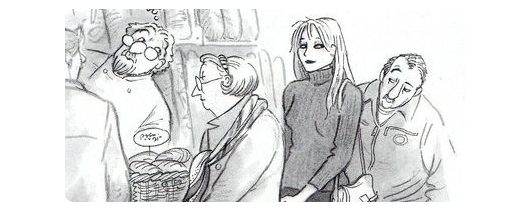
Posy Simmonds' version of Madame Bovary – the precursor to her magnum opus Tamara Drewe, a reimagining of Hardy's Far from the Madding Crowd – loosely applies the framework of Flaubert's tragedy to the tale of Charlie and Gemma Bovery, a dissatisfied upper-middle-class 90s Brit couple who do that very upper-middle-class 90s Brit couple thing of relocating to a rustic farmhouse in rural France. There's a framing device in which their neighbour in the sleepy town of Bailleville, the hapless (and incurably nosy) baker/frustrated author Joubert, frets over his burgeoning obsession with Gemma and his twin concerns that a) she is doomed to suffer the same fate as her near-namesake and b) he is, by sheer force of will, leading her to follow that very path. This is a hybrid of novel and comic book: much of the story is told through chunks of text, representing Joubert's narration, with accompanying illustrations showing what really happened. Initially I actually found Gemma Bovery more difficult to get along with than the original novel, but once I settled into its rhythm, I loved it. Despite the downbeat ending, quite delightful stuff.
How could one forget the tragic fate of Madame Bovary! And how could one not think of that fate when someone of a name so terribly similar moves into your town!
In Posy Simmonds's version of the story, Gemma Bovery hasn't finished the book yet, so she herself is unaware of the similarities that are so obvious to the narrator of our story, French baker Joubert. He watches a stylish British couple move into the neighbourhood, where the charm of the countryside quickly wears off and Gemma soon becomes terribly bored.
"To my eyes, of course, Gemma had adultery written all over her. It wasn't just the extra care she took with her appearance. To be eben slightly in range was to find her irresistible. One couldn't help it."
Gemma Bovery is a clever and surprisingly humorous graphic novel that uses the framework of the classic novel to create a charming version of it that I personally enjoyed a whole lot more than its actual source material.
The art is beautiful and its brilliantly paced. It's a mix of a novel and a graphic novel, really, combining chunks of text with drawn illustrative passages. We follow Joubert as he tries to overcome the language barrier and puzzles Gemma's narrative together. What really sold this to me was the warmth that Simmonds tells stories with - you can tell she cares about her characters, all of them a little quirky, a little selfish, but you (sort of) always get where they are coming from.
It's a quick read if you want it to be, and one that you can take away from whatever you like - if you're just here for some chuckles and a bit of drama, that's what you get. If you care about the depth, Simmonds examines class divisions, cultural identities and the potential turmoil of marriage with a lot of precision.
Chronologisch gezien is 'Gemma Bovery' het eerste literaire stripverhaal van Posy Simmonds. Ik vond het mogelijk nog beter dan 'Tamara Drewe'. Het verhaal heeft meer diepgang en is niet alleen maar grappig, maar is soms ook droevig. En dat hoort ook zo! Gemma Bovery is uiteraard een moderne variant op Emma Bovary van Flaubert en volgt het verhaal vrij nauwkeurig met hier en daar hele amusante afwijkingen. Gemma is even irritant en egocentrisch als de 19-eeuwse Emma. Gemma en haar man Charles zijn Engelse ex-pats in Normandië en dat maakt de locatie van het verhaal zo bijzonder. Het koeterwaals Frans en Engels in de conversaties over en weer met de plaatselijke bevolking is ontzettend geestig vertaald in het Nederlands. Het verhaal wordt verteld door de jaloerse plaatselijke bakker Joubert, voormalig journalist te Parijs, die Gemma bespioneert vanuit bosschages en stiekem door haar ramen loert. Dit stripverhaal heb ik met reuze veel plezier gelezen en bekeken! Ik hoop dat Posy Simmonds niet gestopt is met haar literaire strips. Een moderne Jane Eyre zou bijvoorbeeld niet te versmaden zijn!
Englantilaisen sarjakuvan suurnimien joukkoon kuuluvan Posy Simmondsin "Gemma Boveryn" (WSOY, 2026) julkaiseminen suomeksi on kyllä jonkinlainen kulttuuriteko, vaikka se tapahtuikin suunnilleen neljännesvuosisata alkuperäisteoksen ilmestymisen jälkeen!
"Gemma Bovery" julkaistiin alun perin sanomalehti Guardianin sivuilla jatkokertomuksena. Tekstin osuus on niin merkittävä, että melkein voisi puhua sarjakuvitetusta pienoisromaanista. Niin tai näin, normandialaiseen pikkukylään sijoittuva ihmissuhdedraama tempaisee mukaansa, vaikka Rouva Bovary ei olisikaan tuttu. Luultavasti Flaubertinsa lukenut saa teoksesta vielä enemmän irti!
Simmondsin kynänjälki on erittäin viehättävää ja hahmot ilmeikkäitä, haluaisin itse seinälleni kuvan patonkia pitelevästä pikkupojasta, joka matkustaa isänsä pyörän tarakalla!
I read this for a light Sunday evening pleasure. In the UK we have dramas about country doctors or midwives on Sunday TV, followed by two-hour detective shows with cuddly folk like Steven Fry, to reassure us the world is a kind and fuzzy place and set us up for the Monday hell. This is my non-televisual equivalent—light-hearted comedy, with a fleck of extremely tame drama, among the unrepentant middle-classes, with bags of Frenchisms and Madame Bovary references. It is a fine alternative to drowning in self-loathing and beer, which so many books make me want to do of late. And hey, did you know Stephen M wrote a brilliant review of my book? Like that instead!
I finished reading Madame Bovary, have read a couple of articles about it and was still thinking about its world, so I grabbed 'Gemma Bovery' to kind of continue thinking about Emma. But this didn't quite work out: although obviously referencing Flaubert's characters and plot, this is quite a separate work.
Looked upon in this light... although one cannot look at it just in this light, because, of course, I wouldn't have bought a graphic novel called 'Jane Smith', for instance... I must say that it was an exciting and interesting experience, but somehow closer to watching a film than to reading a book. I guess I liked the artwork and the overall design (though some bits of text are way too small) better than the text. Most of the characters are basically stereotypes, but the play between text and images is very funny at times.
Of course, one wants to know what happens next and keeps turning the pages, so - a quick and enjoyable read; maybe nothing much more, but then not everything has to be.
Mi è proprio piaciuto, tanto quanto Tamara Drewe. Non avevo dato sufficientemente credito a questa autrice e ai suoi graphic novel ma ne ho aggiunto subito un altro in lista. Mi piace il tratto, mi piace il racconto, mi piacciono le idee. In questo, sulla scia di Mme Bovary, racconta la storia della povera e incauta Gemma, inglese trentenne insoddisfatta e capricciosa, che si trasferisce in Normandia con il suo Charlie. Ma poteva mancare il giovane amante?
L'ho letto in un paio di pomeriggi staccando per un'oretta dal lavoro e facendo una pausa con un tea e con il profumo dell'inghilterra.
Just finished the second read of this. Loved it, though it does have its flaws... the breathless attempt at a humorous and happy (?) ending falls a little flat, especially as when taken as a whole the story is not only tragic but also a bitter indictment of both British and French upper middle classes. And yet there isn't a character in it who is not, at some base level, sympathetic. The narrator's lengthy text drags on a bit.
This modern retelling of Madame Bovary is quite entertaining. Its a quick read and I must admit I really enjoyed the format. The story lent itself fairly well to it.
I do have a couple of squabbles. Not all of the french that is spoken by the characters is translated. It seemed as if the key phrases were but the conversational stuff was completely lost. I really wish that wasn't the case because the atmosphere of the small country town would've come across more starkly.
The characters are also less developed than they probably should be. But I think a part of that was simply the way the story was told. It was a spectator's point of view. However, Gemma's development over the course of the story was well executed I thought.
The ending was also pretty abrupt.
Overall I really enjoyed it. I'm not really into graphic novels but this one is very literary so you don't notice the change in format. Definitely worth the read.
Gemma and Charlie Bovery, moved to Bailleville in France from England in the hope of a more beautiful and artistic life, but as things disintegrate and her actions mirror those of the tragic Madame Bovery (from Guatave Falubert’s classic), she stumbles towards an inevitable death.
Full disclosure, I don’t know my classics and have never read Madame Bovery so this story was new to me, but with so much reference to the original text
Posy Simmonds is the middle class graphic novelist. Her topics are middle class people in the countryside, middle class people in the city, middle class people being literary, and her work (collected in Literary Life) appears in The Guardian - how middle class can you get? That said, I've really enjoyed her books "Literary Life" and "Tamara Drewe". The pacing of Tamara Drewe was right, the story captivating, the tension built effectively - it was a great book.
My gripe with "Gemma Bovery" is the oh so middle class story. Gemma falls for a recently divorced wealthy father whom she cheats on with a flashy writer only to be dumped by the flashy writer. She convinces the wealthy divorcee to buy a house in France and the two move over there. She decorates and mixes with the locals and, sigh, has another affair with a local wealthy Frenchie. She has another affair when the flashy writer shows up and then dumps her again. She doesn't like France (boo hoo she misses London's shopping) and wants to move back. Then inexplicably she dies.
I didn't care for the pathetic so called worries of Gemma's life (the expensive decorations, the weakness of her character, her infidelities, and the dinner parties), I didn't care for Gemma who didn't deserve a book but rather to be ignored as the flaky dummy she so clearly is, and I didn't understand what the others saw in her. And then she died. Who cares?
What a rubbish book. I really had to push myself to finish this. The drawings and layout are great but the story was so weak as to be like a used up sub plot from Emmerdale. And is it me or does Gemma Bovery look exactly like Tamara Drewe? Posy should really branch out a bit with her character designs.
Overall, a complete miss. For a better Posy Simmonds book try "Tamara Drewe".
Contemporary re-telling of Flaubert's Madame Bovary in a graphical form. British cartoonist/illustrator Posy Simmonds creates a beautiful scene: she breaks out of box of framed comics and uses the whole book page - formatting the graphic amidst walls of text. It really works and the eyes know where to go next. Her books seem to contain more text than other graphic pieces I have seen - but maybe it was particular to the style of this book, since it was primarily told in an epistolary style with a few narrative interludes.
If you are familiar with Flaubert's work, you are aware of the story (although there are a few "updates") and it's twists and turns through the characters lives.
De «Gemma Bovery» lo he disfrutado todo. Su originalidad, no solo en la historia, sino en su formato a caballo entre la novela y el cómic. Su dibujo, exquisito y de pequeños detalles. Sus personajes, carismáticos y redondos. Su ritmo, trepidante y adictivo.
Ha sido una grata sorpresa, una lectura fresca, emocionante y divertida. La recomendaría a todo el mundo con los ojos cerrados.
Picked this up on impulse in the graphic novel section and found it really interesting. A very different approach to the graphic novel, one all tied up in Madame Bovary without actually BEING Madame Bovary (which is the trick). Loved the simple pencil drawings, loved the varying uses of frame and storytelling.
Risoroman Posy Simmonds je pravi presežek tako s striparskega kot vsebinskega vidika. Spada med moje top tri bralske užitke tega leta. Gre na častno pozicijo na polici s stripi in risoromani!
Tudi prevod Maje Novak je (znabiti) ojačal bralsko izkušnjo. (Čisto malo me je zmotilo, da določenih delov v resnici ni bilo prevedenih, a morda je tako že v originalnem stripu.)
Pod črto: če imate radi stripe in risoromane in ste (tako kot jaz) spregledali ta biser, ki ga je Stripburger izdal leta 2009, toplo priporočam v ogled in branje!
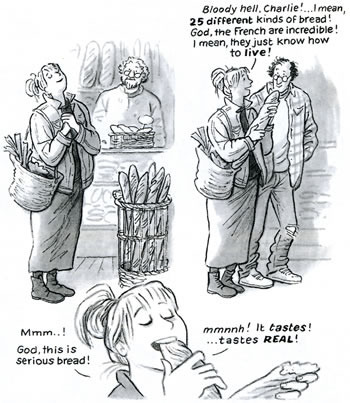
Inderdaad, ik deel onderstaand enthousiasme. Een geweldige graphic novel. Heb ervan genoten. Om te laten zien hoe prachtig het getekend is, een voorbeeldje: Hier vindt Gemma alles in Normandië nog geweldig maar wanneer de zomer voorbij is, bekoelt haar liefde voor haar nieuwe omgeving. Voor een graphic novel is er behoorlijk veel tekst. Ik las de Engelse versie maar er komt ook aardig wat Frans in voor. Dit wordt op een niet-hinderlijke manier vertaald. Nu toch ook maar eens Madame Bovary echt gaan lezen...
I really enjoy Posy Simmonds' graphic novels. They seem to have more text than most graphic novels (although I'm no expert) and the drawings enhance and give detail to the rich storyline. This is obviously an updated to the classic Emma Bovary but you do not need to have read the original to appreciate and follow the parallels in th plot. This is a very accessible both as a graphic novel and as a retelling of a classic.
Tercera historia de Posy Simmonds que leo y primera que no me gusta. El comienzo es interesante, y la resolución entretenida, pero la parte central se me ha hecho larguísima, con un ritmo demasiado lento y un narrador que se me ha hecho cargante. De haber sido el primero probablemente no hubiera leído más de Simmonds, pero vistos los precedentes alguno suyo volverá a caer.
Posy Simmonds is seriously underrated. I may be wrong on this but I rarely ever see her graphic novels in those lists of the ones you 'must read', and if they are included they are never near the top. But she is brilliant and unique and 'Gemma Bovery' was like a breath of fresh air among all the dark lines and capital letters of the more renowned (usually male written) graphic novels. Instead, we get beautiful, sumptuous pencil drawings that, at times, make Gemma look a little like the Corpse Bride; all huge eyes and tons of expression. I loved that. I just felt there was so much depth to the drawings and they are really wonderful pieces of art.
Another thing to love about this graphic novel is the mixture of lettering and fonts throughout. It's not confusing or illegible and it is clear that real time and thought has gone into the layout; not just your boring panel to panel layout. It really makes reading interesting when it is inter-cut with the diary entries and newspaper cut outs and little bits like that. Also, the book itself is tall and long which really works well with the layout as sections can fit onto one page. I like details like that; it shows care and a dedication by the author to make the reading experience as good as possible.
I also really liked Gemma's character. Her diary entries are funny and honest and her behaviour, although quite selfish, doesn't make you hate her. She just seems like a bored, middle-class woman who is stuck between a rock and a hard place. Boring husband, boring house, boring life, boring neighbours. The desperation and panic of feeling as though you can't escape. Everyone can relate. She gets an idealistic idea into her head, goes crazy for it for a little while, and then drops it and despises it. I like that about her; it is very human.
Charlie is pathetic and the dynamic between him and his ex wife is almost painful because it is so relateable. The bored, lonely, exhausted divorced mother of two dissatisfied by her stagnant and mediocre ex so makes him pay through endless nagging and is never, ever satisfied even though he seems to be doing better than your average dad abroad. Ugh it must happen so often and that is so depressing.
I hate the character narrating the tale though- Raymond Joubert. He is sinister and, I found, quite sexually threatening. He's always staring at Gemma and making her life uncomfortable even though it is really none of his business. He annoyed me.
I also found myself wondering at the end...is this a feminist story of the destruction of a woman by men? I don't want to say too much or give it away but Gemma is constantly under the control of men and their passions and it seems she can never be happy alone. I will give that some thought I think.
This is a parallel and modernised version of the classic Madame Bovery, which I hadn't heard of, personally. This is not to my usual tastes (especially in book form), but it was only £4 and one of those moments where I wanted to buy something to solidify a memory, so I'm surprised that I enjoyed it as much as I did. I really loved how the narration didn't take anything away from the story, and it actually made it feel like I was watching a film. I was wondering what the connection was with the narrator (Joubert) and Gemma as it seemed such a simple thing to create such an obsession and although the conclusion wasn't as dramatic as I expected, it was still interesting. It was actually odd how... Not odd I found his literal stalking to be... Perhaps he was convincing and too likeable for me early on! I thought the flow of French dialogue would throw me off, but there were a lot of subtle translations and I felt like I understood more of it than I expected, because of the well written context of the plot. At the end I was like oh no! Not another person to relate to a book! I wonder if there is a sequel...
Overall, I really enjoyed this one. It was a quicker read than I expected (after looking at the text layout) but put me closer to my reading goal! I would totally recommend it, even if you, like me, aren't aware or knowledgeable of the novel it is based on.
I fell in love with Tamara Drew, which I feel the movie ruined with comedic coverage on dark and touching scenes, but I digress..That book is one of my pride and joys of the bookshelf, gorgeous to behold and keep dipping into as it is such a quality book. Yes, so my next Posy book and I must say I am confused that she mainly does strips-she is wasted I tell you...This book is beautiful...the artwork...the detail...the content and the mix between book and graphic novel. Stunning. I loved the story immensly, and inhaled the book from start to finish. Yes she does middle class white an awful lot, because, I am guessing that is what she is and knows..and she does it well. I have seen many a critic comment on it, but really, we are all a product of our upbringing to some extent and telling the story of our landscape is important and needed in any culture to add richness and content to art of all forms. Understanding human relationships is something posy does so well, turmoil and motivations included. A glorious book which poses the question of blame and guilt in relation to chance. Given that Tamara drew is a favourite on my shelf, I have to give this 4.5 but really it is a cut above the rest altogether.
This is a graphic novel, I suppose, although it mixes text and (b/w) pictures freely rather than in a frame-by-frame layout. Our eponymous heroine is a mildly screwed-up young woman bouncing between relationships. Most of the story takes place in a small French town where she lives with her unexciting husband. Her neighbour, Joubert the baker, becomes obsessed with her and with the parallels between her life and that of Madame Bovary, and we see most of the action through his snooping eyes.
It's smart and funny, cunningly plotted, acutely nailing human behaviour but responding with warm generosity. The artwork is unfussy but confident and expressive (Gemma's eyes are startlingly informative!) and the relaxed intermingling of text, diaries, comic format and visual devices is pleasing throughout. Posy Simmonds is an author I'll be happy to revisit.
This is only the second graphic novel I've read - the other was Maus, which is a classic of the genre. Gemma Bovery is an interesting mix of comic style drawings and text. Some text is part of the drawing and some in separate panels. The book was the inspiration for the film starting Gemma Arterton but has layers of relationships that were stripped out for the film. Because it is mainly set in Normandy there is plenty of French mixed in the text, but translated for the most part. The teller of the story is M. Joubert, the owner of a boulangerie who is obsessed with Flaubert's famous novel, Madam Bovary. He begins to see parallels between Gemma's life and Flaubert's tragic heroine which begin to play out in the story.
A very interesting, enjoyable and different read. The only downside is the small size of text and drawings so a bit of squinting required at times.
This entire review has been hidden because of spoilers.
Dans Gemma Bovery, la référence au roman de Flaubert est plus qu'explicite : les personnages vivent dans un monde où le roman existe, et sont donc capables de faire le rapprochement avec le nom de notre héroïne. Ce petit twist, qui pourrait être naïf, virant à l'hommage béat ou au truc scénaristique bateau, est très bien utilisé, et offre plusieurs dimensions au roman graphique : un brin de romantisme, une touche de polar, et une peinture en filigrane de l'exilé de campagne d'aujourd'hui, avec quelques réflexions bien senties (sur l'amitié franco-britannique, la famille, l'ennui, l'amour...). Le tout servi par l'humour, le mordant, la plume et le trait de Posy Simmonds, qui m'a bien plus convaincue qu'avec Tamara Drewe. Un petit plaisir bien ficelé.
My reading brain needed a refresh, a cleanse like, from a heavy, unrewarding book. A cheeky reworking of Madame Bovary in #GraphicNovel form did the job. What a pleasure it was to be engaged with a story, to smile as I was enchanted by the cleverness of the language and the brilliant illustrations, to not want to put it down.