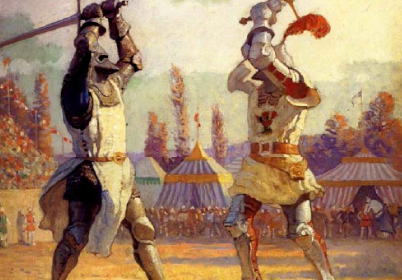
Sir Nigel is a historical novel set during the Hundred Years' War, by the British author Sir Arthur Conan Doyle. Written in 1906, it is a fore-runner to Doyle's earlier novel The White Company, and describes the early life of that book's hero Sir Nigel Loring in the service of King Edward III at the start of the Hundred Years' War.
Dame History is so austere a lady that if one has been so ill-advised as to take a liberty with her one should hasten to make amends by repentance and confession. Events have been transposed to the extent of some few months in this narrative in order to preserve the continuity and evenness of the story. . . . -- Arthur Conan Doyle
Sir Arthur Ignatius Conan Doyle was a Scottish writer and physician. He created the character Sherlock Holmes in 1887 for A Study in Scarlet, the first of four novels and fifty-six short stories about Holmes and Dr. Watson. The Sherlock Holmes stories are milestones in the field of crime fiction.
Doyle was a prolific writer. In addition to the Holmes stories, his works include fantasy and science fiction stories about Professor Challenger, and humorous stories about the Napoleonic soldier Brigadier Gerard, as well as plays, romances, poetry, non-fiction, and historical novels. One of Doyle's early short stories, "J. Habakuk Jephson's Statement" (1884), helped to popularise the mystery of the brigantine Mary Celeste, found drifting at sea with no crew member aboard.
Chivalric deeds, bloody battles, bouts with ships, deeds of arms, chevauchées, robber barons and clever archers (Samkin Aylward!!) abound in this nice prequel to The White Company which follows the younger years of Sir Nigel, a minor noble of a house of great renown for the bravery of his knights, now down on its fortune after the premature death of its Lord (whose memory of heroic deeds is humorously capped by a I-slipped-on-a-bar-of soap kind of demise) and plagued by greedy men of the cloth brandishing injunctions like swords.
“Well, well, the law is the law, and if you can use it to hurt, it is still lawful to do so”
The young and stalwart (and broke) squire Nigel dreams to live the life of the true knight, full of justice, honor, loyalty, courtesy and bravery. “Young and hot-headed with wild visions of dashing deeds and knight errantry”, as skilled as candid, Nigel embarks in the adventure of his life and the reader follows him as he encounters his chivalrous warhorse, faces bureaucrat clergy, obstructs petty nobles and promises the love of his life to return after “worshipfully winning worship” following his King and Prince in France, “that land of chivalry and glory, the stage where name and fame were to be”.
From the English countryside to Poitiers, Doyle depicts the society of the time, its customs and particularly the flaws and virtues of its human types, the social inequality, with many parallels to the contemporary world. Although somewhat patronizing, he describes the bickering between “great England and gallant France” with subtle humor and piquant satire and he doesn’t spare the church nor the “men of blood and coat-armor” nor the commoners nor the extreme notions of war as a romantic affair, as the ideals of chivalry celebrated it. He also shows the facet of war as mindless butchery waged by people without honor.
“War was a rude game with death for the stake, and the forfeit was always claimed on the one side and paid on the other without doubt or hesitation. Only the knight might be spared, since his ransom made him worth more alive than dead.”
Highly documented, masterfully detailed with a rich prose, the historical research feels accurate and vivid: battles, implements, strategies, tactics, horses, ships, tourneys, arms and armors, furniture, heraldry, venery, finery, but also themes like the decline of the heavy chivalry with the introduction of gunpowder and the first signs of erosion of the superiority of English bowmen, the generational contrasts between knights of the old model and their less-scrupulous pupils or the pragmatic thinking of the lower classes, to whom the nobles and the church with all their pretty speeches and veneer of superiority owe, in the end, their status and means for their sport (at home with levies and taxes, on the field with plunder, violence and levies and taxes).
“Oh, these sordid material things, which come between our dreams and their fulfillment!”
Doyle uses the narrative technique of the omniscient narrator, who recounts the tale from the viewpoint of his contemporary society’s moral achievements, smiling kindly upon the deeds of his ancestors -“the rumor of noble lives, the record of valor and truth, can never die, but lives on in the soul of the people”-, at the bravery and idealism of some as opposed to the ravenous appetites of others, “hares to the strong and wolves to the weak”.
I particularly delighted in the moral conundrum of fighting for honor or fighting for money and the consequences of putting plunder before food, not to mention the humorous happy-go-lucky killing sprees, the pageant-style catwalk show of coats-of-arms, the practice of hurrying ransom prizes to the rear during a battle (or driving a dagger home when the means of a would-be prisoner proved unsatisfactory) and with all of this, the valor of many knights following royalty on the battlefield and Nigel’s restless pursuit of a “chance of knightly venture and honorable advancement”.
"A truce!" Here was an end to all their fine dreams.”
I would advise starting with The White Company nonetheless, foreknowledge of the events doesn't hinder the fun and the epilogue of Sir Nigel assumes having read the other book. In a way, Sir Nigel spoils the ending of the White Company and not the other way around. Also, while this one is pleasant and interesting for the reader who likes a solid historical background on the wars and society of that time, the smaller cast of characters and relatively shorter tale are less engaging than The White Company’s. I struggled a little to keep the rhythm, even if I was more familiar with the writing style and Doyle’s characters, which represent keen caricatures, fitting to the tale and its spirit, but not meant to offer an immersive experience to the reader. At any rate, the shining contrast between Nigel and Aylward (or nobles and commoners) is source of a constant delight, as are the witty remarks of the worldwise Saxon and the (hack and slash) romantic notions of the Norman squire. Definitely recommended to all who liked the White Company.
“And lastly there is a journey that you shall make.”
The man’s face lengthened. “Where you order I must go,” said he; “but I pray you that it is not the Holy Land.”
"Nay," said Nigel; "but it is to a land which is holy to me. You will make your way back to Southampton."
"I know it well. I helped to burn it down some years ago."
Many years ago, a dear bookish friend gave me a very beautiful old book, tied with a brown velvet ribbon as a Christmas present. The cover the book was dull orange, the Gothic letters of the title, the same brown as the ribbon. She had found it and thought it was just a neat looking old book. I happily agreed, and placed it lovingly on the bookcase in my bedroom, where it went very well with the heavy brown brocade reading chair. A couple of years ago, for whatever reason, I realized that the author of the book (whose name does not appear on the cover) was SIR ARTHUR CONAN DOYLE. But . . . but . . . this was not a Sherlock Holmes story! Nor was it a treatise on how to care for your garden fairies or contact spirits! What the what? So, at last, when I was offered a free audiobook (from audiobooks.com) of Sir Nigel, I decided to listen/read to it, and see what it was about.
If I had managed to read this without ever knowing the author, and then you had tried to tell me that it was written by Conan Doyle, I would have laughed in your face. The writing style is so completely different! I kept saying to my husband, THIS BOOK WAS WRITTEN BY THE GUY WHO WROTE SHERLOCK HOLMES! just to make sure I had a witness. If you had had me guess the author, I would have said that maybe, MAYBE it was Dumas. It's so perfectly a portrait of a young squire, on his journey to knighthood, through a bleak, plague-ravaged England. The language is formal and romantic, the events of the story remind me of stories about Robin Hood or King Arthur. I shouldn't be surprised, because anyone who could write all those vivid stories, and even more vivid characters in his later stories has to be incredibly clever, but I didn't know that Conan Doyle could really alter his style in this way. Now I have to go read The White Company . . .
Разкошен рицарски роман, засягащ събития от Стогодишната война (кулминацията е битката при Поатие, 1356 г.), в който вероятно щях да се влюбя до уши като юноша, но и като дърто магаре го намерих за доволно симпатичен. Е, имаше я леката наивност и на моменти чак комично звучащата патетика, ала сър Артър е отявлен сладкодумец и категорично не успя да ме отегчи. Четивото се явява предистория на Белият отряд, та ще трябва да си преговоря новото издание на Изток-Запад - разлиствал съм деветдесетарското и по спомени бледи не останах впечатлен... Крайна оценка 4,5.
"It is in the heart of the great Cistercian monastery that this chronicle of old days must take its start, as we trace the feud betwixt the monks and the house of Loring, with those events to which it gave birth, ending with the coming of Chandos, the strange spear-running of Tilford Bridge and the deeds with which Nigel won fame in the wars. Elsewhere, in the chronicle of the White Company, it has been set forth what manner of man was Nigel Loring. Those who love him may read herein those things which went to his making. Let us go back together and gaze upon this green stage of England, the scenery, hill, plain and river even as now, the actors in much our very selves, in much also so changed in thought and act that they might be dwellers in another world to ours."
This was the final paragraph of the first chapter of Sir Nigel. Written in 1905 as a prequel to 1891's The White Company, this book follows Nigel Loring as he meets his destiny. He really should have been born in olden days because by 1350 or so when our story begins, the era of knights-errant was coming slowly to a close. Nigel's grandmother told him all the grand tales of heroes from her times, so by the age of 22, he was burning to prove himself worthy of the old traditions as well as the still romantic ones of his day.
This book was good, but did not have as much impact on me as The White Company. It was fun to see Nigel in his youth, to witness the taming of his great war-horse Pommers, to learn which of two sisters he would pledge vows to before he leaves for war, to watch him become who he was meant to be. But even though there were incredibly exciting moments throughout the story, at the end I did not say WOW the way I did with the earlier book, where the characters seemed more alive than they were here. Nigel was the main focus but in many battles he was injured early and lay unconscious while the melee went on around him. This tends to lessen a reader's involvement with him, and was sometimes frustrating. But imagine how Nigel himself must have felt about it!
I learned more history (there really was a Battle Of Thirty!) and have more titles on my to-read list now because of becoming curious about the meanings of heraldic symbols and the history of knighthood itself. The battle scenes were the most vivid, even though they could be gruesome and brutal. Doyle apologized for that in his introduction: " I am aware that there are incidents which may strike the modern reader as brutal and repellent. It is useless, however, to draw the Twentieth Century and label it the Fourteenth. It was a sterner age, and men’s code of morality, especially in matters of cruelty, was very different. There is no incident in the text for which very good warrant may not be given. The fantastic graces of Chivalry lay upon the surface of life, but beneath it was a half-savage population, fierce and animal, with little ruth or mercy. It was a raw, rude England, full of elemental passions, and redeemed only by elemental virtues. Such I have tried to draw it."
In a way, those sentences could be applied to any age, couldn't they.
Sir Nigel is a historical novel set during the early phase of the Hundred Years' War, spanning the years 1350 to 1356, which is about as historic as you can get. It was written by British author Sir Arthur Conan Doyle, first published in serial form during 1905–06. It is the background story to Doyle's earlier novel The White Company (1891), and describes the early life of that book's hero, Nigel Loring, a knight in the service of King Edward III in the first phase of the Hundred Years' War. The character is loosely based on the historical knight Neil Loring. So now I have to go look him up. The author called the book "the most complete, satisfying, and ambitious thing I have ever done". In an 1889 lecture on medieval times, Doyle was inspired to read over one hundred volumes about Edward III and the early Hundred Years War. I wonder how long that took. To present this subject in novel form, Doyle wrote "The White Company" and "Sir Nigel". In his own opinion he knew as much about the reign of Edward III as any specialist historian, but Sir Nigel makes quite a few errors in some historical respects, but we'll overlook all that.
Arthur Conan Doyle consistently maintained that The White Company (1891) and its prequel Sir Nigel (1906) were his most important works of fiction. The two novels—both featuring Sir Nigel Loring—were particularly dear to his heart because in them he hoped to emulate and surpass Sir Walter Scott’s Ivanhoe and Charles Reade’s The Cloister and the Hearth, both of which he fervently admired. It wouldn't take much to surpass Ivanhoe, I don't think so anyway.
To write The White Company and Sir Nigel, Conan Doyle immersed himself for months in study, absorbing memoirs and chronicles, as well as entire shelves of the latest medieval and military histories. Today we sometimes label the period he was researching “the calamitous 14th century,” when the Black Death ravaged Europe, conflict between France and England would be designated The Hundred Years War, and the feudal order, the Catholic Church, and knightly ideals began to be questioned and renounced.
When The White Company and Sir Nigel first appeared, they were favorably reviewed, to their author’s irritation, as boys’ adventure stories. They have never quite shaken that association. But Conan Doyle takes pains to present the full range of medieval types: Kings, princes, nobles, peasants, monks, brigands, con artists, innkeepers, huntsmen, nuns, wenches, sailors, poets, and pilgrims. I think that covers them all. Some are good, many are rascals or worse, much worse. In both novels aristocratic landowners and the Catholic clergy are shown to be corrupt. The poor are driven to robbery and murder through hunger and abuse by their overlords.
In the novel the author introduces us to young squire Nigel Loring as he leaves home to serve King Edward at the start of the Hundred Years' War. I wonder if the Hundred Years' War lasted One hundred years. Though small of stature, Nigel possesses a "lion heart and the blood of a hundred soldiers thrilling in his veins" that propel him to accomplish heroic acts in his quest for knighthood. I guess somebody has to do it. And of course there is his beloved Lady Mary, who waits for him to complete three courageous acts so he can win her hand in marriage. I hate when that happens. The lady just sits back waiting for the hero to do heroic deeds before she will marry him. It's dumb. Doyle decided to relate what we would now call his hero’s origin story, tracking how an impoverished, almost landless son of an ancient family earned his knighthood. Our hero and his family is described this way:
Of this famous but impoverished family, doubly impoverished by law and by pestilence, two members were living in the year of grace 1349—Lady Ermyntrude Loring and her grandson Nigel. Lady Ermyntrude’s husband had fallen before the Scottish spearsmen at Stirling, and her son Eustace, Nigel’s father, had found a glorious death nine years before this chronicle opens upon the poop of a Norman galley at the sea-fight of Sluys. The lonely old woman, fierce and brooding like the falcon mewed in her chamber, was soft only toward the lad whom she had brought up. All the tenderness and love of her nature, so hidden from others that they could not imagine their existence, were lavished upon him. She could not bear him away from her, and he, with that respect for authority which the age demanded, would not go without her blessing and consent.
So it came about that Nigel, with his lion heart and with the blood of a hundred soldiers thrilling in his veins, still at the age of two and twenty, wasted the weary days reclaiming his hawks with leash and lure or training the alans and spaniels who shared with the family the big earthen-floored hall of the manor-house.
I like the spending days with the spaniels part of all this. Cocker spaniels that is. Yes, Nigel is bored, but his grandmother won't let him go:
Day by day the aged Lady Ermyntrude had seen him wax in strength and in manhood, small of stature, it is true, but with muscles of steel—and a soul of fire. From all parts, from the warden of Guildford Castle, from the tilt-yard of Farnham, tales of his prowess were brought back to her, of his daring as a rider, of his debonair courage, of his skill with all weapons; but still she, who had both husband and son torn from her by a bloody death, could not bear that this, the last of the Lorings, the final bud of so famous an old tree, should share the same fate. With a weary heart, but with a smiling face, he bore with his uneventful days, while she would ever put off the evil time until the harvest was better, until the monks of Waverley should give up what they had taken, until his uncle should die and leave money for his outfit, or any other excuse with which she could hold him to her side.
Don't worry though, he will get away from her eventually, remember the hundred years war thing, and maybe winning the hand of Lady Mary? That's all to come, as soon as he leaves home. But I'm not telling if he did enough brave things to win the hand of Lady Mary. I hope he didn't.
Δεν ξέρω για εσάς αλλά θεωρώ τον Άρθρουρ Κόναν Ντόϋλ ως τον "quintessential" Βρετανό συγγραφέα. Όχι μόνο κατάφερε να δημιουργήσει έναν από τους πιο αναγνωρίσιμους και σημαντικούς ήρωες της παγκόσμιας λογοτεχνίας αλλά η γενικότερη επιρροή του στην λογοτεχνία είναι αναμφισβήτητη. Δυστυχώς μερίδα του αναγνωστικού κοινού ενδεχομένως να θεωρεί το έργο του (ή το πιο γνωστό μέρος από αυτό) ως απλοϊκό αγνοώντας ότι το έργο του Ντόϋλ καλύπτει ένα ευρύ φάσμα αναγνώσεων: ιστορίες τρόμου, μυστηρίου, ρομάτζα, ιστορικά διηγήματα, ταξιδιωτικά διηγήματα, ιστορικά βιβλία, βιβλία για το μεταφυσικό, ποίηση κ.α. Ως εκ τούτου όσο το έργο του μεταφράζεται στα Ελληνικά, αποτελεί ευκαιρία για το Ελληνικό αναγνωστικό κοινό να ανακαλύψει κάθε φορά και κάτι νέο. Ο "Σέρ Νάιτζελ" αποτελεί ένα εκ των δύο βιβλίων που έγραψε ο Ντόϋλ (το άλλο είναι "Ο Λευκός Λόχος") τα οποία εξελίσσονται στην περίοδο του εκατονταετούς πόλεμου της Αγγλίας με την Γαλλία και λίγο πριν την πτώση της ιπποσύνης, για χάρη των μικρομεσαίων στρωμάτων που πλέον θα κυριαρχούσαν στο πεδίο της μάχης ('Αγγλος τοξότης κ.α.). Ο Νάιτζελ Λόρινγκ, ένας φτωχός ιπποκόμος, ο οποίος ζει και αναπνέει σύμφωνα με τον κώδικα της Ιπποσύνης, θα ξεκινήσει μια περιπέτεια ακολουθώντας τον τότε βασιλιά της Αγγλίας (Εδουάρδος ο τρίτος) και τον περιβόητο «Μαύρο Πρίγκηπά» σε μια εκστρατεία στην Γαλλία προκειμένου να κερδίσει τον τίτλο του Ιππότη και φυσικά να παντρευτεί την καλή της καρδιάς του. Στην πορεία θα συμμετάσχει σε ένα σωρό ιστορικά γεγονότα (πχ η «Μάχη των τριάντα» κ.α.) και φυσικά θα δείξει με την ανδρεία και το ήθος του ότι είναι άξιος για αυτό τον τίτλο. Το βιβλίο, παρόλο που είναι πυκνογραμμένο με ξένισε σε ένα και μόνο σημείο: θα μπορούσε να γίνει μια εξαίσια παρωδία των τάξεων του μεσαίωνα (κάτι ανάλογο με το «Ένας Γιάνκης του Κονέκτικατ στην αυλή του βασιλιά Αρθούρου») καθώς οι χαρακτήρες ελάχιστα διαφέρουν από καρικατούρες: οι ευγενείς και οι Ιππότες παρουσιάζονται ως πολεμοχαρείς και αδιάφοροι για τον απλό λαό, ενώ ο ίδιος ο Νάιτζελ είναι αφελής στα όρια της βλακείας. Όμως ο Ντόϋλ παραμένει πιστός στο σχέδιο του, δημιουργώντας μια ιστορία εφάμιλλή του «Ιβανόη» και αυτό είναι η μαγεία του βιβλίου του: μέσα από την απλοϊκότητα του αναδεικνύονται προτερήματα όπως η τιμιότητα, η γενναιότητα, το ήθος, η αυτοθυσία, η πίστη κ.α. στοιχεία που καλό είναι, μέσα στην μιζέρια που κυριαρχεί στην λογοτεχνική θεματολογία, καμιά φορά να θυμόμαστε ότι υπάρχουν. Εν ολίγοις ο «Σερ Νάιτζελ» είναι μια παιδική ιστορία για ενήλικες που αξίζει να διαβαστεί από τους φίλους της (απλοϊκής) καλής περιπέτειας!
A book of the rarest quality. Everything about Sir Nigel is incredible, from prose to characterization and setting and visualization and imagery, to timing and rhythm, to the story itself. It's an epic of high adventure, violent chivalry, purely satisfying medieval aestheticism, and not once hits a lull or lackluster moment, but without heavy handedness or too-densely packed excitement. The pacing is perfect, the show of a master.
The book is colorful and endlessly quotable, driven forward by amusing and fascinating characters, a fully developed and historically accurate world, and gives an authentic sense of being thrown into a period steeped in romanticism and honor and the stuff of legends. Both beautiful and brutal, captivating to an outrageous degree. As soon as I finished it I wanted to restart it. I won't, not yet, but now I'm fully set in high romance, chivalry, medieval mode, a mode I'm always rather prone to anyway, and ready to rip into three or four books of similar themes.
Until now I'd never read Arthur Conan Doyle, but his Sherlock Holmes work has always intrigued me since I'm a sucker for crime fiction and clever mystery writing. But now my interest in Doyle's other, not so well know works, has also been activated. His reputation is deserved, even if only for this single novel.
A nicely entertaining little novel for a weekend, but rather stereotypically told and with the usual honourable knight that's good at everything and gets the lady, a plot full of chivalry topics and quite unsubstantial. Just like cotton candy.
A delightful tale giving the back story to "The White Company" and Sir Nigel Loring. Arthur Conan Doyle pens a historical fiction that covers the years between 1350-1357, an early period in the Hundred Years War. The page-turning, captivating narrative follows the way in which Nigel Loring went from near poverty to Knighthood. It is a tale filled with adventure and daring, overcoming obstacles and impossibilities, and maintaining chivalry and honor. This is a read fit for the young and young-at-heart. I highly recommend "Sir Nigel".
Sir Nigel is everything my 10 year old self wanted to be.
Adventurous, virtuous, kind, cunning, determined and lucky, Nigel travels to the wars (France) seeking to accomplish three feats and so win honor and the love of his promised.
It's all very quaint and collected, with death treated as nonchalantly as I've come across in period pieces.
I was recommended this by the 100 years war series of podcasts by The Rest is History. Hearing the story of the 100 years war via podcast, I knew I needed to delve deeper into a fantasied but entertaining narrative.
Originally published on my blog here in March 1998.
Of all Arthur Conan Doyle's works, this one has perhaps aged least well. It's set in the Middle Ages, or, rather, it's set in a world imitating that of Scott's Ivanhoe. It seems today very in-authentic, particularly in the speech and descriptions.
Sir Nigel is the story of a young man, Nigel Loring, of noble birth but reduced circumstances, who sets out to win renown equal to his ancestors' and to do three deeds worthy of his lady love. He travels to France as squire to Sir John Chandos, and takes part in Edward III's French wars, where he wins renown and does brave deeds.
Nigel is a most annoying young man. He is not terribly intelligent; indeed, his choice of fiancée is probably the only remotely intelligent act he performs throughout the book. Even then, it is only by chance that this happens, for he prefers the sister, who is dishonoured through her own flirtatiousness at the crucial moment.
Nigel's big problem is his excessive devotion to the epics of chivalry. Even though the virtues of chivalry were still admired in principle by the fourteenth century, they were rarely used in practice in the warfare of the time, which was as savage as any before or since. Indeed, following medieval accounts of the battles of the French wars, which Doyle at least does, means that actions of extreme barbarism are excused by warping the chivalric ideals. In fact, there are occasions in this novel where a practice is condemned on one page when practiced by brigands, but this condemnation is ignored and the results of it praised when perpetrated by the English soldiers only a few pages later.
I remember quite enjoying this book when I first read it at the age of thirteen or so; now that I have read more widely (particularly Chaucer and Malory) and grown up a bit, I found it difficult to take to. My feeling now is that there are Conan Doyle novels better forgotten, and this is one of them. Stick to the Sherlock Holmes series, or Lost World, or the Firm of Girdlestone.
At the end of it, I still couldn't determine whether this book was "Hurrah, chivalry!" or "Ha ha, chivalry!" On the one hand, I felt that the reader was meant to root for Nigel and his knight-errant dreams, and that the storyline followed the romantic pattern pretty closely; on the other, Nigel's dreams frequently go awry or are criticized by more knowledgeable characters, and "chivalry" doesn't emerge as a highly attractive code. In fact, it was this latter (and, I felt, more realistic) trend that made me enjoy the novel more than I likely would have otherwise. Unlike some other classic adventure-novelists I've read, Conan Doyle is willing to portray the brutality of medieval warfare - and the snobbery of the culture, too, although I couldn't quite tell whether he was portraying it as snobbery or high-mindedness.
Another reviewer called the book schizophrenic; if that is accurate, I suppose I enjoyed the realist personality more than the romantic personality. Had the novel followed Nigel more closely, I think I would have become annoyed with him and the book. As the narration is more omniscient, however, I was better able to enjoy the writing - both description and dialogue - and Conan Doyle's portrayal of the period.
An entertaining romp rendered in slightly schizophrenic fashion by Conan Doyle, who at times strikes the pose of a contemporary bard and devotee of chivalry, at times an arch modern commentator. The book always seems to be on the point of denouncing the farce of knight errantry and the hero's boyish enthusiasm to "worshipfully advance his worship" through quixotically endangering himself and all around him- but never quite comes clean and does it. At the same time there are some interesting reflections on the plight of the civilian population in a (theoretically) chivalrous war, which seem to take on board the lessons of the (much later) Thirty Years War. Ultimately though, the wretched civilians here seem to be regarded as legitimate grist to the knights' courtly mill. The central love story is a non-event, straight out of courtly cliche and far from qualifying for the Canterbury Tales, and Nigel himself is over-shadowed by grim realist Sir Robert Knolles- who wouldn't be out of place in Blackhawk Down or Saving Private Ryan!
A different book of Sir Arthur Conan Doyle, totally different from Sherlock Holmes that everybody knows about. This book is about Nigel the last of a noble family of England around the 14th century. His family is not so rich anymore and his property is mostly taken by the adjusting church. But the king happens to pass from the area and Nigel's fate is totally changed.
An old story of a knight-to-be and a different atmosphere compared to the contemporary historical and other novels. No striking love story (yes it is not historical romance) or extremely heroic behaviour. Nigel is young, enthusiastic and ready to win fame, but he is also clumsy because of his lack of experience and the first one to get injured in one of the attacks. He follows to the heart the noble ethical rules he is taught and it doesn't always end up to what we would consider lucky today.
The language of the book is a bit difficult and the book can become a bit heavy. But I enjoyed really a lot trying something different from Doyle and the writing of his period.
"The White Company" impressed me so much that I was sure I would like "Sir Nigel" too. But it was an entirely different experience. White-washed and squeaky clean. It was all the nobility of fighting a good fight against famous and honourable knights -? I must be terribly jaded, because that doesn't sound quite right to me. This felt more like a boy's fantasy of knights and battles than anything. I know A.C.D. loved all that, and it comes across clear as day, but he left anything that felt real out of the story entirely.
On a more positive note - the Librivox reader of this book was great.
This is really a book for kids. It reminded me a bit of "The Power of One" by Bryce Courtenay. A young lad sets out to gain fame and honor.
I bought it at a second hand bookstore on account of the good looking cover, one the inside was a note, it was awarded to a kid in Grade 3... in 1932!!!
That should have been the hint to me that it was targeted at a younger audience, but the vintage cover, prestigious author name hooked me.
DNF I quit reading this for a few reasons. * I was really tired of the seemingly constant mentions of St. This, St. That, and St. The-Other. Yes, I know it was the time period, but it did feel a little much. * I don't enjoy scenes of people getting killed or tortured. This has both. Battles scenes aren't as bad since it's usually just mentioned and not described. * The beginning issue with Abbot John (there's a lot of Johns in this book!) is never resolved and it was a big thing at the beginning. It even has a chapter from Abbot John's POV, but then he just drops off the pages. I even read the last chapter where Nigel comes home from the wars and there was nothing.
Sir Nigel is a prequel to Conan Doyle's once celebrated The White Company. Comparrison is unavoidableI. I first read The White Company years ago and found it marvelous; an historical fiction with the action, pageantry, and romance that we don't see any more. So how does Sir Nigel stack up? It is the inferior novel, but well worth reading. It may not have as good a characters as its predecessor or as astonishing a finale, but it hits all the same notes, if with less panache. A good read if you liked The White Company and want another trip into the age of chivalry and dames. 3.5 stars.
Apparently Doyle was incredibly proud of this historical novel. A century (plus) later, it's pretty dated. It's a late victorian take on 14th-century Britain, full of chivalry, forsooths, mete judgments, hearty yeomen, squires pining for noble needs, and so forth. It cannot fail to be what it is, and that is a heavily romanticized view of the 'gentle class'. If that's your thing, great. But historical scholarship has come a long way, and this sort of depiction is as dead as the dodo. So it reads much like fantasy in 2021, not historical fiction (despite some impressive work in locating Nigel's adventures in Surrey, Brittany, and Poitiers). If I am chary of criticizing a 1906 novel for what it is, I will say that I was surprised at how little action there was in the novel. Doyle spends so much time describing scenery and heraldic blazons, and recreating 'fair' conversation, that the moments of action, such as one might suspect would dominate this sort of novel, are actually relatively few and far between.
I'm not unhappy I read it, but I don't need to rush out and (re)read The White Company.
Hello, welcome back to the Arthur Conan Doyle Focus Group. We agreed last time that the writer should make his next book a prequel, but we now need to decide which of his most loved characters should return for the prequel. What about Sherlock Holmes? Hm, seems a popular choice. Professor Challenger? A few votes there. Sir Nigel. I think that is an overwhelming number of votes in his favour.
While I don’t suppose Sir Nigel was written after a focus group discussion, it is certainly mystifying why Conan Doyle chose this character for a prequel, rather than someone more interesting. However Conan Doyle did wish to be remembered for his historical characters, and Sir Nigel may have been closer to his ideal of manhood.
For most of the book, he is plain Nigel Loring, a member of a once-respected family now down on their luck, and facing possible confiscation of their lands by the monks of Waverley Abbey. Onto the scene comes the king’s favoured knight, Sir John Chandos, an actual figure from history.
Chandos takes Nigel under his wing, and a number of adventures follow. He defeats a notorious robber, but the robber and his wife elude capture. Conan Doyle is strangely sympathetic to minor rogues. He meets the daughters of Sir John Buttesthorn. While his head is turned by the flighty daughter Edith, he soon settles for the sensible Mary, and is able to help wrest Edith from the clutches of a corrupt seducer.
To honour Mary, Nigel agrees to perform three acts of unusual bravery, and send her messages with the details of each. This sits oddly with his usual modesty in relation to his acts of prowess, but we accept it as a romantic gesture.
As in The White Company there is time for a battle with the Spaniards. Did Conan Doyle have a dislike of Spain, or was there really this much conflict with Spain at the time? However most of the remaining action takes place in France. Nigel plays a part in capturing a French spy, in rescuing men from a robber baron nicknamed ‘The Butcher’, and in the Battle of Poitiers, one of the most famous English victories of the Hundred Years’ War.
I identified the problems of the historical adventure story in my review of The White Company. Here we must add the problems of the prequel. I don’t think I am including too many spoilers, as the outcome is fairly obvious to a new reader who did not read the earlier book, but be warned.
We know that Nigel and Sam Aylward will not die gloriously at the end, as they appeared in The White Company. We know that Nigel will overcome his misfortunes and become a wealthy and renowned figure. We can even guess he will be knighted. The title clues us in as much as the first book.
The attitudes in the book have also dated somewhat. Written before World War One, the book honours violence and war as the highest ideals in hour and chivalry. The various jousts and combats seem a little like overgrown boys waving their penises around, and boasts about previous battles where the floor ran with blood do not seem as admirable to a generation brought up on images of the trenches in twentieth-century wars.
Nigel Loring therefore seems like an honourable fool to us now. He can think of no other way to woo his lady than to show her the fruits of his valour, i.e. killing and wounding others. He leads a few men on a suicidal attempt to enter The Butcher’s castle, an attempt that would, even if successful, have led to the slaughter of the very prisoners he was trying to rescue. However he dismisses any guilt about this, and sees it as an honourable act.
At the root of it all is a war in France in which England lays claim to a country it had no right to rule, and the defeat of the French is seen as the height of glory and bravery. Conan Doyle lived in a colonial age, where Britain controlled large areas of the world, and he does not have the imagination to question the ethics of invading and colonising someone else’s land.
In that respect, he is of his time. War is honourable, and Sir Nigel is his ideal of how we should behave – courageous and noble, and always living according to his particular set of ethics.
While Conan Doyle includes much meticulous historical detail in the book, his focus is on history as a romantic and wonderful thing. Do not expect gangrene or hewed limbs or dysentery or anything too horrifying.
To be fair, Conan Doyle is not indifferent to the bad side of medieval society. Nigel disapproves of the slaughter of captured men. The brutality of powerful figures is shown, and some of The Butcher’s torture methods are nasty. In some areas the poorer members of society are reduced to lawless activities.
Conan Doyle also has a few digs at the corruption in the church – the Catholic church of course, not the church he belongs to. At the opening, Nigel risks having his property removed from him over a petty disagreement resulting from a prank of his. He adds a pike to the Abbot’s fish pond.
Overall though the bad men are dastards, and either foreign or un-English. There is no suggestion that this is how Englishmen generally behave in a time of war. I’m sure Conan Doyle would have dismissed atrocities in his contemporary India or Africa with a similar argument that these were committed through necessity or by men who were just ‘bad apples’.
Still the book is certainly readable as a historical document of the time, and there are some exciting moments in it. I cannot ever see a time when Conan Doyle’s historical novels will ever be honoured more than the Sherlock Holmes stories however.
I love the book for the way Arthur told the story and how he built the medieval world through the dialog and actions that took place. The only reason I don't give the book a 5 star rating is because Nigel is always taken out of a fight by being knocked unconscious and really the fight scenes are a little confusing. I do have to say that my favorite scene has to either be when he jousts with the knights in the beginning or when he literally tackles a knight in full armor when he has none.
This was an interesting book in that it was a historical fiction book, that's also written over a 100 years ago. Which reads very different from a modern day historical fiction, of course. Doyle wrote in the introduction that he had done a lot of research on the period he wrote about, but of course our knowledge of history evolves through the time. One could claim that because Doyle was living closer to when it happened his view of it is closer to the truth, one could also claim that we currently have more/ better sources our modern view is closer to the truth. Honestly, I feel like it's somewhere in between. I am nowhere near well-versed in history. I like historical fiction, and I don't like it when it's too unbelievable, but minor incosistencies will probably go unnoticed by me.
This book reads like a childrens' book, and not one that's personally up my alley. It's about knights and chievalry and at times very over the top. It's a story that many young boys would dream of, and as such it works decently enough. Though the language needs to be modernized a bit for it to get picked up by young readers. The problem with this book is that not much happens and that all characters feel like caricatures. No one has any depth. The best scene imo happens at the beginning of the book, when young Nigel tames a horse. That scene was described in a way that was intense and thrilling and I absolutely loved it. I was sure I was going to love this book, but unfortunately, that was the only scene I really liked. There is some classism and racism in this book, though it's minor enough that you might miss it. (Though naming the one black character Black Simon is pretty obvious...) I thought it was interesting that the consensus was that the rich Englishmen spoke French and the poor spoke English, yet when they came to France they stated that the peasants couldn't speak French or English. Wouldn't the French peasants speak... French? and these peasants can speak neither French nor English. Just because in England the aristocracy used French doesn't mean that it's only spoken by the aristocracy, everywhere... We see Nigel get complimented excessively for a plan thought out by, planned by and mostly executed by Simon. If we stand here now within this castle, it is to you that I owe it. The King shall know of it, and Chandos also. Can I do aught else, Nigel, to prove to you the high esteem in which I hold you? Nigel was only invited to join in. He played but a small part yet somehow he gets all the praise. I don't know if this is Main Character syndrome, classism (because Simon used to be a slave and Nigel is a Knight's son) or racism, because Simon is the only black character. There were some witty comments here and there, though sprinkled in. For example: for some folk have no grace or honesty in their souls, and cannot keep their hands from that which belongs to another. I thought it was really funny that this man is worried about someone stealing the goods he... stole/ looted after the battle. There were also some comments trying to explain to (at that time) modern audiences how things were different in the time this book takes place.
Otra de las novelas históricas ambientadas en la Edad Media es "Sir Nigel", escrita con bastante posterioridad a "La Compañía Blanca" pero ambas están conectadas con algunos personajes que aparecen en ambas, aunque no sean continuaciones ni secuelas directas.
La sensación que me deja esta novela es que es más de iniciación de un joven que quiere progresar como caballero, y que Doyle la enfoca más como novela juvenil y cercana al estilo "Robin Hood". Personalmente me deja bastante fría, y me parece peor que la anterior del mismo autor que citaba. Tiene bastantes capítulos que son entretenidos y trepidantes, pero en general se nota cierto letargo y cansancio en Doyle, se percibe que está a punto de abandonar un género que no termina de explotar en sus manos, y este es casi el último intento.
Aunque uno de los puntos fuertes de las novelas históricas de Doyle suelen ser la documentación que ofrece sobre la época, en esta se nota que es más ligera, posiblemente por lo que apuntaba antes de que posiblemente esté pensada para un publico más joven que busca más rapidez, aventuras y acción.
No es que sea mala novela ni mucho menos, pero si no la lees con 16 años, luego es complicado que te quede en el alma. Discreta en cualquier caso.
You can't blame Nigel Loring for hating Waverly Abbey. Its smug and rapacious monks have snatched most of his ancestral land, leaving his grandmother and him with but a handful of acres and aging servitors and without enough money to equip the 22-year-old would-be knight with armor with which to adventure for fame and honor. But perhaps Nigel has gone too far when, in the first chapter of Sir Arthur Conan Doyle's episodic historical novel Sir Nigel (1905/06), he has put pike in the carp ponds of Abbot John, which "scathe" leads the fleshy and florid man of spiritual and temporal power to try to evict the Lorings once and for all from their manor house. Thus begins Nigel's knightly career, which stars in 1349 and occurs mostly in France during the 100 Years War.
The novel is full of details of mid-14th century life in England and Europe: falconry, venery, fletchery, armor, weapons, war, food, clothes, etc. Conan Doyle occasionally indulges in info-dumping as to things like the appearance of a typical manor, the dishes of a typical feast, or the superstitious and religious beliefs of the typical Christian, but he's a good enough writer and a big enough fan of the 14th century that such passages are usually interesting.
Conan Doyle writes exciting action, like this: "With his arms round the robber's burly body and his face buried in his bushy beard, Aylward gasped and strained and heaved. Back and forward in the dusty road the two men stamped and staggered, a grim wrestling-match, with life for the prize." And various violent scenes occur, like a fight between Nigel and a twisted nobleman, a sea battle between the English and the Spanish, a siege of a butcher baron's castle, and a famous historical battle (Poitiers) between an English army of 8,000 and a French army of 30,000.
Although Conan Doyle's heart is with the English, he does depict along with his knightly Norman and Saxon heroes some chivalrous French and dastardly British (usually ugly of face or deformed of body). However, although Conan Doyle pays lip service to the chaos and ravages that the 100 Years War inflicted upon France, pointing out that Brittany was "the saddest, blackest land," rife with atrocities and brigands, he does rather treat it as his hero Nigel sees it, as a delightful country in which to achieve honorable advancement through knightly adventure, or, as he tiresomely repeats, to "win worship worshipfully," without ever sympathizing with how hellish it must be for the locals to have so many armies pillaging and killing back and forth across their countryside. For such men as Nigel, a truce between England and France is the worst news--which they deal with by indulging in a brutal 30 on 30 "joust" (combat on foot).
Indeed, the Black Prince, one of the paragons of chivalry according to Conan Doyle, has been leading an army of 8,000 English burning villages and ravaging land through the south of France, and when finally brought to bay by a larger French army, he utilizes his common British bowman to devastate the chivalry of France. In the context of the 100 Years War, Conan Doyle's admiration of Nigel's chivalry finally doesn't ring true or meet, and though aware that he's depicting the waning years of chivalry, he likes knight errantry and England too much to recognize how much damage the former caused and how great a role the latter played in ending chivalry.
I do like that Conan Doyle has Nigel fail nearly as often as he succeeds in his adventures, revealing that during his hero's thirty-some years of warring and adventuring, he spent at least seven years recovering from injury and illness. And the novel is often quite funny, as when Nigel's side-kick Samkin Aylward (who also appears in The White Company) whispers numbers in his naive master's ear during some bargaining with a greedy goldsmith, or as when young Nigel bars passage across a bridge while wearing his father's too large coat of mail in a comical jury-rigged fashion.
I also like Conan Doyle's use of archaic English for dialogue, often so as to reveal character and historical details: "It is in my mind, John of Tuxford, that you have looked in the face more pots of mead than Frenchmen," said the old bowyer. "I am swinking from dawn to night, while you are guzzling in an alestake. How now, youngster? Overbowed? Put your bow in the tiller. It draws at sixty pounds--not a pennyweight too much for a man of your inches. Lay more body to it, lad, and it will come to you. If your bow be not stiff, how can you hope for a twenty-score flight. Feathers? Aye, plenty and of the best. Here, peacock at a groat each. Surely a dandy archer like you, Tom Beverley, with gold earrings in your ears, would have no feathering but peacocks?"
Conan Doyle writes modern English for his base narration, which includes many vivid and interesting scenes, like one where a man at arms is found dead in his armor "spread out in his shattered case like a crab beneath a stone," and like this one: "Besides all these a constant stream of strange vagabonds drifted along the road: minstrels who wandered from fair to fair, a foul and pestilent crew; jugglers and acrobats, quack doctors and tooth-drawers, students and beggars, free workmen in search of better wages, and escaped bondsmen who would welcome any wages at all. Such was the throng which set the old road smoking in a haze of white dust from Winchester to the narrow sea."
Stephen Thorn engagingly and professionally reads the audiobook.
Conan Doyle's earlier The White Company (1891) relates the maturing of Alleyne Edricson under the influence of the now middle-aged and still recklessly chivalrous Sir Nigel. Both well-written books have moments of humor and suspense and are full of interesting 100 Years War era details, but I would only recommend Sir Nigel to Conan Doyle completists or fans of medieval chivalry fiction--though it is interesting to spend time with a Conan Doyle hero so different from the cerebral and calculating Sherlock Holmes.
Arthur Conan Doyle clearly had a good time researching and writing his two ‘Sir Nigel’ books working hard at evoking the 14th century as an age of High Romance and Chivalry. The style clearly calls back to the work of Walter Scott and the hyperbolic, quasi-breathless recounting of tales from an earlier age.
Occasional asides help to reassure the reader that this bone crunching time of high adventure was just the way life was back then and that they shouldn’t judge the people too harshly if their behaviour seems less than palatable to the modern judgement.
Despite the intentionally archaic delivery Conan Doyle serves up a pretty entertaining romp through the high middle ages with honour and chivalry and blood splattering violence all on full display. Our hero does his duty, wins honour and gets the girl.
All the while I certainly get the sense that George RR Martin must have included the White Company books in his own research and development of Westeros seeing the particular focus Conan Doyle has on the Heraldry and symbology of the Knights and their squires and the royal houses and pretty much anyone with a ‘name’.
I must say I enjoyed it! I don’t normally read historical fiction but it’s well written and he drew me in. He’s clearly researched his subject matter well: he really gets under the skin of chivalry in the 1300s and gives you a real feel for those times. He accidentally draws some parallels to our modern times (a world dealing with the fallout of a pandemic (the Black Death; workers in revolt as a result of new found perspectives and refusing to work for little pay; the ‘status quo’ unbalanced as a new world order is fumbled into existence) which adds something, too. His story bowls along well and something I especially like (which some modern authors could learnt from!) is that he doesn’t dwell on unnecessary detail: he doesn’t feel the need to flesh a scene out beyond the impact on the protagonist (Nigel) so is unafraid to deal with, for example, a battle scene or a journey in the few words necessary to make sense of it and no more.
Sir Nigel is a historical novel based on real characters who followed King Edward III into war against France to support his claim to the French throne at the start of the 100 Years War. But really, they're less interested in Edward's claim to the French throne and more interested in winning honor, a name and a knighthood for themselves. It really highlights the change in the times: people today just want to live ,but these guys just WANTED to fight. When a truce was called between the English and the French armies, a group of disappointed combatants stages a mock quarrel and organizes a passage of arms, which is historically known as the Combat of the Thirty, just so they could kill each other. It's an interesting read but bogs down a bit as Doyle tries to list the names of every knight, squire and archer involved in every battle.