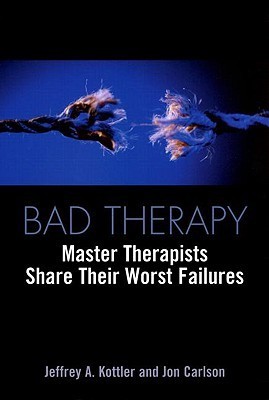
Bad Therapy offers a rare glimpse into the hearts and mind's of the profession's most famous authors, thinkers, and leaders when things aren't going so well. Jeffrey Kottler and Jon Carlson, who include their own therapy mishaps, interview twenty of the world's most famous practitioners who discuss their mistakes, misjudgements, and miscalculations on working with clients. Told through narratives, the failures are related with candor to expose the human side of leading therapists. Each therapist shares with regrets, what they learned from the experience, what others can learn from their mistakes, and the benefits of speaking openly about bad therapy.
Jeffrey A. Kottler is a professor, psychologist, author, consultant, workshop leader, keynote speaker, and social justice advocate who has spent the past 40 years working throughout the world to promote personal and professional development among professionals and marginalized groups. Jeffrey has worked as a teacher, counselor, therapist, and consultant in a variety of settings including a preschool, primary and secondary school, university, mental health center, crisis center, and corporate settings.
I absolutely love the premise of this book and the time that the authors invested in this project. I also appreciate the willingness of some of the experts interviewed to share deeply personal information.. I was disappointed by the fact that what many people chose to share was not anything that I think most of us would consider a failure, so they were preserving the idea that as experts they don't make mistakes. Only a few of the people interviewed were brave enough to share truly large errors, but I deeply benefited from those who did. I believe that as therapists we do not talk nearly enough about these cases, and the "dwellers" among us therefore carry around a great deal of Shame about how we have failed. This book was an effort to help with that shame. it is worth reading if you are someone who tends to be self-critical and wants a new perspective on that and who wants to realize that you are not alone in screwing up from time to time.
I was going to only give this book 3 stars, up until I read the very last chapter. It was in reading the last chapter that I realized that most of the frustrations I was experiencing with this book were the same ones the authors felt in trying to tackle this project. I wanted more from the contributors. I wanted more contributors. I wanted more in-depth discussion and case examples. I wanted to hear more mistakes and failures. I wanted more transparency. I wanted it to be longer. And then I didn't want it to end.
That being said, knowing that the authors struggled with the same issues, I was able to see things from both sides of this project. There were times when I marveled at how closely these therapists held many of my own ideas about the therapy process and how well the authors did at drawing more out of the contributors. Sometimes I was annoyed at the therapists that seemed so tight-lipped, preachy, or acted as if they could do no wrong. Then I saw how frustrating and challenging it might be for the authors, and how scary of an experience it would be as a therapist, especially one that is still practicing. This wasn't just a series of case studies. It was a humanizing experience. It allowed me to understand more about the personalities and backgrounds of different master therapists, to really see them as people, both in what and how much they disclosed and in how much we can gauge that they are withholding.
I think this would be a great book for anyone in the counseling and therapy field, no matter where they are in their practice. I could see this being a useful tool for beginning therapists that need to bolster their confidence level. I could see a long-time therapist finding this as a refreshing course to reflect upon and continue growing, maybe in new directions. And I could see myself coming back to this text over the years as a reminder and to help me gauge how well I am understanding my own experiences and growth as a therapist.
This kind of book is rare in the professional field and that's unfortunate because there should be much more frank discussion of the issues raised here.
Even though most of the failures and mistakes described here are not the dramatic type of situation or criminal type of situation that might be the first thing people think of, e.g. deaths, sexual abuse, abandoning the patient etc. there are many situations just as important where the patients obviously felt misunderstood or let down or angry or confused about what was happening. These are the kind of situations where the patient stops coming to sessions so there is no opportunity to attempt to correct the errors made. These are the kind of situations which haunt therapists for the rest of their lives.
Therapists need to learn from their errors and this book is a good effort in helping people face the shame so they can figure out how to avoid repeating the mistakes they will inevitably make because we are all human too.
I can certainly say that reading this book helped me review my own mistakes and failures and learn as much from them as I could without the benefit of being able to get clarification from the patients. I probably have thought more about those patients since I stopped seeing them than they will ever know.
good, not excellent. the case studies were brief, and while i liked the format of the book (brief discussion, presention of the case, discussion on what can learn from it), it was hard to get that involved in. which suprised me because i think this is fascinating topic - therapists DO fail sometimes, and remembering that is important.
i also had the feeling most of the therapists were not telling the full truth about their most horrible mistakes. or, hell, if those are it, i want their career! not one person discussed a suicidal patient either, which i found really lacking. then again, the suicidal patient is pretty damn lacking in the literature in general, so it makes a sort of sense. but i kind f felt like one "story" with one person with at least suicidal ideation would a) show the pressure therapists are under, b) show that this really is often a matter of life and death, and c) underscore the fact that at it's very least, therapy seeks to improve lives, and fails when it maintains the status quo, or makes it worse.
Omg finally finished. Read for Basic Skills in Counseling. This was kind of an unpleasant read tbh, it's a pretty old book and ethical things have changed and some of the therapists seemed hmm.. misogynistic.
Despite being a bit dated (i.e., over 20 years old), I am amazed how relevant the book still is (saying it from a therapist's perspective). What is even more amazing is the openness and vulnerability of the story tellers at a time when being open and vulnerable was not even a thing, especially among therapists. It should be a recommended read for any wanna-be therapist or in any therapy ethics class.
A series of short chapters where master therapists share their goofs, this book can offer some relief to "real life" therapists. Predictably, a main theme of the book was it's not about the mistakes, but about what you can learn from them.
I felt that this book did not match up to the captivating and enthralling content and style of other three similar books by Kottler and Carlson. Perhaps the reason for the dryer nature of this book was (as Kottler and Carlson also pointed out) that it was difficult for the therapists interviewed to speak candidly about their perceived therapeutic failures. As a result, the therapists in these stories seemed to be much more detached and expert-like than in the other books where they seemed human, genuine, and real. But, I suppose this shows that even therapists struggle with self-acceptance when confronting personal issues. (Perhaps that's the real message of this book!) :)
I would give this 3,5 stars if it were possible. I think the other reviews and the last chapter of the book summarized my opinion pretty accurately. I expected more depth, honesty and case studies. Instead I got plenty of 40 years old stories (!) that were mostly not even the therapist's fault, and showed no real mistakes per se. A few really good insights and case studies, plenty of mediocre ones and a few literally useless ones. At least I know which therapists to look up and read on, and which I better forget I got to know. Also, one minor issue I had with this book - there was not a single psychoanalytic case, even though according to statistics, it's among the 3 most frequently used therapeutic approaches.
Interesting, quick little read from 2003. Somewhat dated: many of the people interviewed were in their 70s or 80s at the time. Supposedly this is a collection of interviews with "master therapists," but in reality it turns out there is not one class of master therapist included here, but three: 1. really strong therapists whose worst "failure" is something subtle and probably more caused by the client*; 2. therapists of questionable judgment and character; 3. therapists who do less traditional forms of therapy. In the first category I would put Kottler and a few others; in the second category I would put Glasser, who seems proud of falling asleep in session, and Pittman, who comes off as a gigantic asshole. But perhaps the therapist who comes off the worst is the co-author Jon Carlson, who tells a story about advising an alcoholic that he can probably learn to drink socially again. Carlson then expresses surprise that this patient starts drinking again, with predictably catastrophic results. Talk about an error of judgment! To top it all off Carlson insists that he was correct - ie, that alcoholics can learn to be social drinkers, an assertion I am deeply skeptical of. (Also Carlson says that he sometimes sees 75 clients a week. How is that advisable, or even possible?)
So the two co-authors themselves embody the two essential types of therapists. Overall, I recommend this book, but take some of these therapists with a large grain of salt.
(*or at least the worst failure these therapists were willing to admit to.)
An intriguing and fascinating premise that would’ve proven a great source of learning and encouragement… if only the therapists has been more upfront about their “failures” and “gone deeper”, as Kottler and Carlson have astutely pointed out time and time again. I feel like the authors did as well as they could with what they were given - the list of therapists who agreed to do the interviews was certainly impressive, and compiling, editing and presenting the 22 interviews in a digestible and meaningful way (while pleasing the therapists too) must’ve been no mean feat. There were definitely some nuggets of wisdom in there too, but what most impressed me was actually Kottler’s high level of vulnerability and openness about his own insecurities and mistakes. I think if the other therapists had met him at this level of reflection and openness, the book would’ve been a lot more meaningful and achieved what it purported to do.
I read this from the point of view of a patient who has been involved with different types of therapy over the past 35 years. This book gave me a lot of insight into why some of my interactions with therapists went badly while others, the majority, have gone very well. Primarily, this book is written by therapists, for therapists to talk about mistakes made because psychiatry and psychology are fields where it’s difficult to admit mistakes. I think this is an important discussion because there is much to learn here, and it can make therapy work better for people in the future. If I see a therapist in the future where things are not working well, I have some ideas of how to talk to the person and advocate for myself. Maybe it will make a difference.
Good book .. I get back to it every couple of years, a good reminder that we are all human and therapists make mistakes, it is how we deal with them what makes a good therapists, even if it resulted in bad therapy, it is also how it is contained and regulated for resolution and closure, transference and reflection. A lot to learn from our clients about the profession essence and its purpose.
Great book but the literature on therapeutic failure has progressed greatly. Mainly in empirical directions. Still this has so many interesting ideas by many authors that it's worth reading for the polyphonic quality itself. Leads one to ponder on making oneself vulnerable by admitting failure, among other things.
It's interesting to read therapists' own words as they grapple with the concept of telling accounts about their failures. The overall message is that each one of them learned something, which in most cases is a success.
Overall I thought the book was preachy and superficial, but I think it was a good reminder of how we can get overcome with the pathology of our clients.