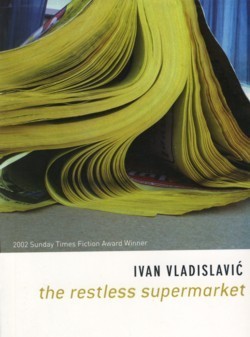
Ivan Vladislavić is a novelist, essayist and editor. He lives in Johannesburg where he is a Distinguished Professor in Creative Writing at the University of the Witwatersrand. His books include The Folly, The Restless Supermarket, Portrait with Keys and Double Negative. Among his recent publications are Flashback Hotel, a compendium of early stories; The Loss Library, a reflection on writing; and 101 Detectives, a collection of new short stories. He has edited volumes on architecture and art. His work has won several prizes, including the University of Johannesburg Prize, the Sunday Times Fiction Prize and the Alan Paton Award for non-fiction. In 2015, he was awarded the Windham-Campbell Prize for fiction by Yale University.
I have a bit of a fascination for ‘transition’ SA at the moment and have had a voyeuristic interest in Hillbrow for ages (it can often sound to the outsider like a ‘real life’ SF dystopia). It took me bloody ages to get a copy of this book, which is generally cited as one of the definitive novels of South African transition. Happily, it’s now back in print.
It’s entertaining and more thoughtful than comedy might suggest.
Firstly, Aubrey Tearle. He’s a memorable portrait of a linguistically-fixated, pedantic old Boomer who’s sorely lacking perspective. Yes, a highly recognisable archetype (just witness a cluster of the recently retired talking crosswords / ubiquity of labels on teeshirts / loud music / baseball caps in any boozer in the English-speaking world). Yet he’s brittle and human too, and often rather unintentionally moving: his loneliness, his brutal honesty about his own appearance and his disappointment at the successive withering of promising friendships.
He’s also dryly funny (and very realistically, his best gags fall on the deaf ears of peers), putting out a stream of strong wisecracks (this being first person) – e.g. describing Bogey’s leather jacket as ‘from the sweepings of an abattoir’ and numerous damning dismissals of the world around. That first line is characteristically snappy and brutal too ‘A salesman buggering a pink elephant.’
He's joined by a coterie of rounded supporting characters. Spilkin: new best friend, then Judas. M.T. Wessels: the kind of man you get stuck with when you are forced to socialise at conferences.
Though comic, the novel does also reflect more deeply on transition. Aubrey sees the detail, but is wilfully blind to the wider picture. He hasn’t really thought about what change will mean (he’s too busy reading phonebooks and tut-tutting at decor), and doesn’t ‘get’ why it’s due. I think the character is stronger for the relatively subtle way in which Vladislavic handles Aubrey’s racism (it’s pretty passive and not especially loud or caricatured). I started wondering if we were to be served a Rainbow epiphany at dawn with the young lady, Shirlaine – but that’s not him. All told: you’re not really thinking it through, are you, Aubs. Shirlaine’s line towards the end is a subtle little cut and summary of his crisis “It’s not the end of civilisation, you know. There are new places for whites opening up in Rosebank.”
And for all of the presence of Aubrey's voice, we aren't spared style and experiment. The ‘story within the story’ chapter breaks for some flashes of rather delicate writing [‘…lovers were leaning on the parapets to watch the moon dissolve like a paper doily in the Indian ink of the water’]. The acting out Aubrey’s fantasy about Alibia (a sort of ‘If Proofreaders Were Superheroes’) is also engagingly disruptive (there’s a touch of SF there, actually). And of course, the very idea of a fantasy about a place, in a mural, in a bar is totally to character (the lonely man playing God like a child poking an ant’s nest in a sandbox). He’s very good at rendering accent too (from the slovenly peer to the Portuguese Mozambiquan shop assistants).
A book that stars a retired proof reader for the Johannesburg telephone directory is unusual. The style is also unusual, almost experimental and at times it works (but not always). Aubrey Teale sees the symptoms of the change in South Africa in the rise of misprints and typos in the local newspapers, ads and notices. In addition to his pedantic compulsion, his racism and sexism is cleverly shown through his various diatribes at his usual table at the Cafe Europa. For Mr T. the world is going down the tube when the Cafe owner's decide too close. An interesting look at modern SA but one that could have risen higher.
This is a difficult book to review. It’s very odd, mostly delightfully so. Vladislavić has a lot of fun with English, and clever wordplay, and I found the narrator, Aubrey Tearle, very amusing. It was a bit unpleasant to enjoy his company so much, and then realize, slowly, that he’s not a very nice person. I can be a grammar Nazi and a pedant myself, and I enjoyed Tearle’s wit in the beginning, but he reveals himself to be less of a sympathetic character than, say, Frasier Crane, which was how I was reading him in the beginning. (Snobbish but ultimately warm-hearted).
Aubrey is a retired proofreader who spends every afternoon in the Cafe Europa in Hillbrow during the period of South Africa’s transition to democracy. Almost the whole book takes place in this cafe, around the comings and goings of other characters, and Aubrey’s almost-friendships with them. It’s an interesting way to tell the story of the transition, as a kind of gathering chaos outside, and I both loved it for its slice-of-life closeness and found myself feeling a bit short-changed that the politics and social upheaval are so indirectly referenced.
But it’s a fascinating portrait of a particular kind of white, subtly-not-overtly racist Boomer in Hillbrow in the late eighties and early nineties, a joy to experience Hillbrow during the transition (I’ve only known it’s democratic-era incarnation) and very, very well written. Funny and clever and experimental (there’s a whole story within a story in it, which is almost science fiction).
- Alcohol spoke in the archaic, extravagant language it uses during our arguments. It said: This is your lucky day, spindleshanks. Nature has done you a favour by dimming your sight. -
- Personally, I prefer reading silently, to myself. Reading belongs in the head, behind the eyes, not just under the breath, but inside the folds of the brain. I can tolerate reading out loud on occasion, if the words are enunciated clearly and the circumstances are fit. But this soundless movement of the lips is uncouth, like a cat twitching trough a rutting dream. -
- Nine out of ten people died peacefully. Did no one die kicking and screaming any more, cursing God and the sawbones? They all seemed to struggle with such good grace against cruel misfortune. One miserable death acknowledged, on long season of pointless suffering faced with bitterness and resentment, would have been a breath of fresh air. -
- Dotting on i might be regarded as a mere punctilio, and failing to do so dismissed as a trifle. But all the dots left off all the i's accumulate, they build up, they pack together like a cloud over a field of stubbly iotas. Soon there is a haze of them in every hollow, and the finer distinctions begin to evade us. In the end, the veil of uncertainty grows so thick that everything is obscured'.
I'm not entirely sure what I think about this book. Possibly I need to wait a week or two and let it settle in my head.
Definitely the sort of book a grammar nazi would love, lots of proofreader references and clever ways with English. And very evocative of Hillbrow of the 1990s. But somehow it lacked pace. I kept expecting something momentous to happen, seeing all this as background to the story. While there is a little bit of "action" in the final pages, it feels inadequate somehow, by then.
I'm giving it 4 stars because it was very, very well written - and holding back one star for plot :)
A really awesome story of a retired proofreader who critiques the changing apartheid society in Johannesburg, South Africa in the 1970s using his editing vocabulary, extensive knowledge of etymology, and other proofreading skills. It is challenging, a dictionary is often needed, but also a very different kind of apartheid book because events are only learned as they are perceived by the narrator who doesn't pay attention to actual events as much as he does to the errors they are presented with.
It's a work of verbal pyrotechnics - sometimes to a fault - slowing down the momentum but always amazing. I picked it up on a visit to South Africa, and it introduced me to a new sub genre of writing - novels about the bridging period between apartheid and a freer society. We view am earthshaking transformation via the mentality of a fussy retired proof reader, confident in his absolute certainties.
Whilst I wouldn't normally venture to write a review, it seems a shame that a book this accomplished doesn't have one. So here are my thoughts. (Please bear in mind it's been a couple of months since I finished the book.)
The protagonist, Aubrey Tearle, is a retired (yet accomplished) proofreader, fighting a familiar battle against redundancy; not only of his profession - which is increasingly irrelevant to the society he sees himself as serving, but of the society in which he has found a comfortable niche. Bit by bit, he sees the things that he holds dear slowly crumbling around him, usurped by meaningless consumerism and coarse behaviour. Apartheid is seldom explicitly mentioned, but the context of the novel is dependent upon it's slow and continual unravelling.
We're given a compelling insight into Tearle's world. He's fusty, anal, and consider's himself a defender of the moral good. There are frequent exercises in wordplay, as one might expect from a proofreader, and whole paragraphs devoted to the intricacies of grammar and vocabulary. In short, it's a pedant's treasure, and I was quite frequently lulled into thinking that I had a trait or two in common with Tearle, which certainly took me aback.
The story does not have a frenetic pace - the action taking place over a couple of weeks - but there aren't any significant dormant periods and I finished the book quickly. As part of Tearle's crusade, a chapter is devoted to his own short story, which is a good work of surreal fiction in it's own right, and a welcome reprieve from the banality of Tearle's story.
Readers familiar with other South African writers such as Andre Brink and J.M. Coetzee will notice the similarity of style, clear, concise prose and neatly constructed fiction. In many ways, this is it's biggest pitfall; the academic style doesn't really distinguish it from those others. I can't help but feel that the plot is also not particularly orignal, notwithstanding the 'futile resistance' theme playing out effectively and compellingly through a different, yet recognisable set of characters.
Of course, there is some liberation towards the end of the novel, and for all those pitfalls (which wouldn't necessarily bother those who hadn't read Brink or Coetzee) it was a rewarding read, made better - surprisingly so, in retrospect - by allusions to other works by Vladislavic, notably The Loss Library.
Is this worth reading? Whenever I reccommend a book to someone, I always ask myself the question: Is it worth reading again? Yes it is.
I think it was a little too experimental for my taste. I figured since it was set in Hillbrow, Johannesburg, South Africa, during the time that the neighborhood was waning, that it would reveal more about the PLACE. But it was kind of a weird book.
The hero is tragi-comic Aubrey Tearle and the setting Hillbrow, Johannesburg in the 80s as the country changes politically and demographically. Ivan V is a master of metaphor and wry, even black humour. It is written with depth and is cerebrally quite challenging: Tearle's observations are rich with etymological word-play that is completely lost on his companions. I loved the book not only for the familiar landmarks (and Braamfontein streets) of my younger days, but also for the caricature-like characters. Yet they too are also believable in the grubbiness of Jo-burg's inner suburbs. Aubrey Tearle, the elderly grumpy nerd who proofreads phone books and is in a state of permanent outrage about the changes around him, will stay in my mind for a long time. (Some reviewer described him as a 'Prufrock' figure.)
Although there were many times when I laughed out loud, this is a portrait of a society undergoing an uncomfortable transition.
A very clever plot, although the dystopian middle section - Fluxman in Albilia - had me puzzled at first.
Indescribable. There's a warning about the foolishness of withdrawing too completely into the abstract inner world here somewhere. And a grim reminder that age is guaranteed to come with neither wisdom nor experience - our protagonist (?), Tearle, is a cautionary figure at best. Somewhere between an absent-minded professor and a perpetually outraged old kook. The parallel between Tearle's disordered thoughts and the human, political turmoil in his neighborhood as it transitions from Apartheid to modern Johannesburg is skillfully done.
I don't think I would know how to recommend this novel, but I'm very glad I read it.
“Then it bore in upon me, unavoidable and crushing, like some juggernaut with 'How am I driving?' carved into its treads. Death itself was the greatest decline in standards of all. That was the certainty I had always been trying to evade. And expiring was just the beginning: unpleasant as it was, it was infinitely more palatable than the decomposition to which it led”.
A really interesting angle on 'transition' Joburg. The protagonist Tearle manages to be simultaneously deeply unpleasant and bigoted, and also rather sweet; charmingly anachronistic. The relationship between the characters in Cafe Europa is complex, though. There aren't 'good guys' and 'bad guys', but rather a mis-matched melting pot of individuals making sense of the new society they are finding themselves in. Vladislavic is rather skilled in building our sympathy, and despite his shortcomings, I found myself becoming rather defensive of Tearle when his old friends start to turn against him.
I found the first half of the book quite hard going in parts. The pace is sometimes a little slow, and though an important part of Tearle's character, the grammar and language jokes become a little self-indulgant and tiresome in parts. My reading pace picked up considerably for the 'Proofreaders Derby' itself and it gave me the momentum to get to the end rather quickly. I'm very pleased that I did.
I forget how I heard about this book, but it represents another paving stone in my path to better understanding South Africa.
Essentially it's the story of Aubrey Tearle, a curmudgeonly, fussbudgety, persnickety, nitpicky, negative Nelly of a man, a retired proofreader confronting life at the crossroads of late Apartheid-era South Africa. The story is told from his perspective and while clever is also very dense.
It helps to have some sense of South African history and pop culture, although there were a number of references that flew past me. It is very funny in places, especially when Aubrey thinks he knows more than he does and yet is completely clueless about popular culture and current events.
It is also touching in places. "We forgive you." That's all I'll say.
And yet it was a challenge of a book to read, not always in a good way. I am curious enough to want to check out some other works by the author, but not right away, especially when there are so many other books to read.
A dense and demanding book, The Restless Supermarket is a comedy and national allegory that painfully criticizes it's narrator with the best possible intentions. Through Tearle, Vladislavic at once captures the voice of the complicit apartheid racist and undermines it through humor, wit and a comedy of errors.
Though often a struggle to read, the novel argues with the notion of a prescriptivist world and questions the authenticity of history in the face of change. The Proofreader's Cup, Tearle's self-proclaimed life's work, sits boldly in the middle as a fanatic's fantasy that runs against the grain of reality. In many ways, The Restless Supermarket is a wonderful reflection of what what it means to be in between, a liminal work that reflects the postmodern relationship between the present and the nostalgic past that never was.
The writing is inspiringly funny, intensely rich, and full of gems from the very first quotation: Q: where do you find happiness . . . A: in the dictionary. The story takes place in Johannesburg at the end of apartheid, and recounts the demise of the Café Europa as well as one of its clients, a retired proof-reader of telephone directories intent on expounding his art of corrigenda in his opus “The Proof-reader’s Derby”. Perfection in his art is when no trace is left. The scene painted on the café wall even becomes a story in itself. Terrific fun.
Interesting book, set in Johannesburg in 1993, the changes happening in South African society are seen through the eyes of the rather unlikeable central character. The retired proofreader Aubrey Tearle spends his days at the Europa Cafe, bemoaning all the standards that are slipping away into the past in his view. Funny in places and riddled with clever wordplay it wouldn't exactly have you rushing out to book tickets to go visit Johannesburg.
Fascinating to read a book with such a clear voice from another country. A cerebral read, concentration needed, but more than rewards the effort, giving an interesting insight into South Africa in transition, and a strongly drawn central character. Involving.