

What do you think?

A House in Sicily
The captivating memoir of a resourceful woman who started life anew in the "most beautiful house in Sicily"
For fifty years, at Casa Cuseni in the small Sicilian town of Taormina, Daphne Phelps has extended her English charm and warm hospitality to seasoned travelers and professional escapists as well as to writers and artists like Tennessee Williams, Bertrand Russell, Henry Faulkner, and Roald Dahl. This memoir tells their story, and hers.
It begins in 1947 when, thirty-four years old and war-weary, a modest Englishwoman arrived in Taormina with little Italian, less money, and a plan to sell the property she had unexpectedly inherited. Instead, she fell in love, not just with the airy quarters of the golden stone house on a hillside but also with a community and its way of life. To save Casa Cuseni from certain demolition, Daphne converted her enchanting inheritance into the wondrous pensione that for nearly half a century she has run with the blessing of every Taorminan from the local silk-shirted godfather, Don Ciccio, to Concetta Genio, her steadfast cook, housekeeper, and friend.
For fifty years, at Casa Cuseni in the small Sicilian town of Taormina, Daphne Phelps has extended her English charm and warm hospitality to seasoned travelers and professional escapists as well as to writers and artists like Tennessee Williams, Bertrand Russell, Henry Faulkner, and Roald Dahl. This memoir tells their story, and hers.
It begins in 1947 when, thirty-four years old and war-weary, a modest Englishwoman arrived in Taormina with little Italian, less money, and a plan to sell the property she had unexpectedly inherited. Instead, she fell in love, not just with the airy quarters of the golden stone house on a hillside but also with a community and its way of life. To save Casa Cuseni from certain demolition, Daphne converted her enchanting inheritance into the wondrous pensione that for nearly half a century she has run with the blessing of every Taorminan from the local silk-shirted godfather, Don Ciccio, to Concetta Genio, her steadfast cook, housekeeper, and friend.
288 pages, Paperback
First published January 1, 1999
Ratings & Reviews
Friends & Following
Create a free account to discover what your friends think of this book!
Community Reviews
Displaying 1 - 30 of 111 reviews

November 26, 2013
In general people know two things about Sicily - both of them alarming: Etna and the Mafia.
Ahh, yes, but thankfully this book taught me so much more about the island few know. It is in Sicily where Zeus trapped Typhon the monster, and they say you can still hear his rage whenever Mount Etna lets loose. Conquered by every Tom, Dick, and Harry through the ages, Sicily has maintained its own identity, albeit one heavily influenced by Mafioso lore.
But when Daphne Phelps had to take over the gorgeous villa her uncle had built, she found a dry, poverty-stricken place filled with myths and superstition. It is her remembrances of her famous house and equally famous guests that make this book a winner. Each chapter focuses on a specific person or event and they really seemed to build to the best passages as the end came near. Caitlin Thomas and Bertrand Russell roll through, but the best is saved for Henry Faulkner and his menagerie of cats, dogs, goats, and ducks.
Wherever had these three (Tennessee Williams-Ezra Pound-Henry Faulkner) met? Could it have been in a mental hospital? It seemed likely.
Phelps writes in a dry style and her adventures with the local authorities are enlightening. When she travels to Kentucky to visit Faulkner, for instance, she discovers the mountain dialect and states that Shakespeare would have felt at home, given the language had not been altered in centuries. The chapter on a poor local Sicilian widow brought tears to my eyes, just as the chapter on a theatrical butler made me laugh.
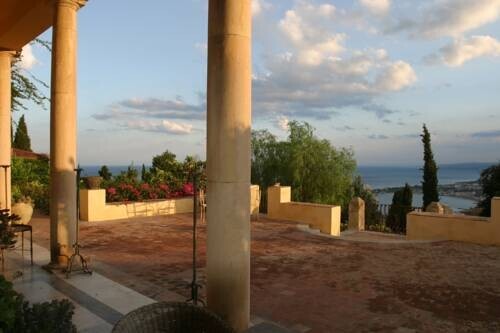
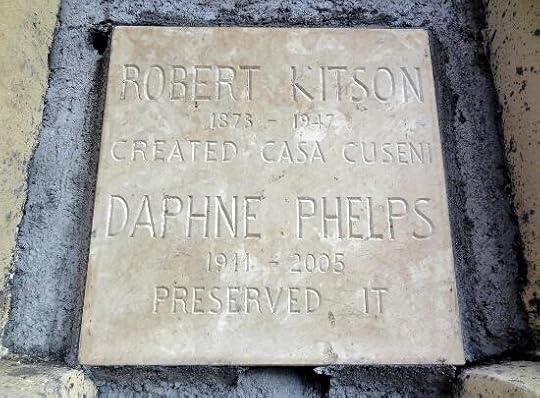
I didn't want to finish the book, because I was enjoying it so much. As Sicily gets dragged into shopping malls and fast trains, much of what Phelps loved has disappeared, so the pages provide images of past simpler days. This isn't a travelogue or one of those snappy selfies about look-where-I-am-now. It's a story of a house, an uncle, and a loyal niece who stayed. Casa Cuseni is now a B&B, with that stunning view of Mount Etna.
As a child, when I hated the world and felt that the world hated me, it was my dog in whom I confided - and he told me I was unique and wonderful.
Book Season = Summer (reds and yellows and oranges)
Ahh, yes, but thankfully this book taught me so much more about the island few know. It is in Sicily where Zeus trapped Typhon the monster, and they say you can still hear his rage whenever Mount Etna lets loose. Conquered by every Tom, Dick, and Harry through the ages, Sicily has maintained its own identity, albeit one heavily influenced by Mafioso lore.
But when Daphne Phelps had to take over the gorgeous villa her uncle had built, she found a dry, poverty-stricken place filled with myths and superstition. It is her remembrances of her famous house and equally famous guests that make this book a winner. Each chapter focuses on a specific person or event and they really seemed to build to the best passages as the end came near. Caitlin Thomas and Bertrand Russell roll through, but the best is saved for Henry Faulkner and his menagerie of cats, dogs, goats, and ducks.
Wherever had these three (Tennessee Williams-Ezra Pound-Henry Faulkner) met? Could it have been in a mental hospital? It seemed likely.
Phelps writes in a dry style and her adventures with the local authorities are enlightening. When she travels to Kentucky to visit Faulkner, for instance, she discovers the mountain dialect and states that Shakespeare would have felt at home, given the language had not been altered in centuries. The chapter on a poor local Sicilian widow brought tears to my eyes, just as the chapter on a theatrical butler made me laugh.
I didn't want to finish the book, because I was enjoying it so much. As Sicily gets dragged into shopping malls and fast trains, much of what Phelps loved has disappeared, so the pages provide images of past simpler days. This isn't a travelogue or one of those snappy selfies about look-where-I-am-now. It's a story of a house, an uncle, and a loyal niece who stayed. Casa Cuseni is now a B&B, with that stunning view of Mount Etna.
As a child, when I hated the world and felt that the world hated me, it was my dog in whom I confided - and he told me I was unique and wonderful.
Book Season = Summer (reds and yellows and oranges)
November 20, 2024
A most enjoyable read full of colourful characters and vivid descriptions of the surrounding landscape.
August 5, 2009
I have to say that I picked up this book after visiting Taormina, Sicily.I loved the book-especially her insight on the people of Sicily. She could not have given a better discription of this fabulous Island and just how wonderful and kind the Sicilians truly are. I sent a copy of the book to my best girlfriend, who traveled with me on all my trips to Italy; and she loved the book, also. In 2005 we decided to take another trip to Sicily and see if we could actually find Casa Cusini in Taormina. We found it and rang the doorbell hoping that Daphne Phelps was still alive and could sign our books. To our amazement the housekeeper, a kind, very old man, came walking down the stairs and in our limited Italian told us that Daphne was sleeping; but if we left our books, he would have her sign them, and we could pick them up the next morning. We left our books and returned the next day; the books were signed by Daphne Phelps who was 94 years old at the time. It was a wonderful time, except we really did want to actually see Casa Cusini- but we couldn't. She passed away in November of 2005- so, we felt so blessed that we took the trip in early 2005. She was an amazing woman...and wrote a fabulous book. Taormina is heaven on earth...that is why she never left.

February 14, 2011
"A House in Sicily" by Daphne Phelps was not exactly what I was expecting. It's the story of Casa Cuseni near Mt. Etna in Sicily which Daphne Phelps unexpectedly inherits when her uncle dies. She is 34 years old and speaks no Italian, yet she goes to Sicily to settle her uncle's estate and sell the house. Instead, she falls in love with the house, the town, and the people and ends up staying there. The book is written more like a series of short stories than a continuous story, so part of my not enjoying this book so much is that I don't particularly like reading short stories. I generally don't enjoy them. Each chapter was about a different person who stayed at the Casa ( Tennessee Williams, Bertrand Russell, Roald Dahl and Henry Faulkner), Don Ciccio, the local mafioso who takes a interest in Daphne, local festivals, places she went within Sicily, animals she and/or her guests adopted, etc. However, there was no real time line. In one chapter the housekeeper had died, in the next chapter she was still alive. It just didn't flow for me. It was easy to put down and pick up something else, but I did keep going back to it and eventually finished it. I actually started it as my February pick for Italy in Books, but didn't finish it until March.

October 7, 2019
Phelps, post World War II, learns her uncle has died — leaving her to manage the house he built in the outskirts of Taormina nearly 50 years prior. This memoir captures well a sense of post-war anxiety, the complexities of Italian bureaucracies and law, the complexities of inheritance, the weight of poverty and absence of opportunity for so many people after the war, and reams of people, famous and no much so, who formed the network of this place.
September 14, 2013
Read this in preparation for a trip to Sicily. Highly recommend it for this purpose as the author married a Sicilian and the story of her life and adaptation to this country was educational as well as a good read.
She currently lives and gives cooking lesson near Palermo. She has written several cookbooks on Sicilian food and its history.
She currently lives and gives cooking lesson near Palermo. She has written several cookbooks on Sicilian food and its history.
August 26, 2022
I give this British gal a lot of credit for being gutsy and adventurous, as well as a good writer. The book details numerous experiences, along with a few set-backs, when she, a single woman, inherits a historic home on the Sicilian coast. Reading it takes you there to lounge among the famous guests and attend island celebrations along with the locals. Nice little getaway.

November 3, 2017
A wonderful, entertaining book of an English woman in Sicily. Having been to her house, Casa Cuseni in Taormina, I simply had to read the book she wrote about her life there. Anyone who lives in a country different to their home country can relate.

July 22, 2017
Mostly anecdotal account of the author's 50+ years in Sicily. This book definitely made we want to travel there.
September 14, 2018
An enjoyable read, I would have liked to hear more about her house as a writers retreat.

July 13, 2023
This is a non fiction memoir of Daphne’s time as the owner/inhabitant of a house at Taormina in Sicily, built by her uncle and subsequently cared for by Daphne for most of her life after his death. Daphne had an incredible life. Through her experiences and memories we meet many guests who came to stay with her, not least Roald Dahl, Tennessee Williams, the philosopher Lord Bertrand Russell, and artist and eccentric Henry Faulkner. Although Daphne had not originally intended to move permanently to Italy, you get a real sense through her own words of how she fell in love with Casa Cuseni and with the local people and environment, and had a deep appreciation for Sicily, as well as a realistic head on her shoulders for dealing with the many new problems and experiences she found herself in. This is an easy and enjoyable read.
April 18, 2023
I just read this book a second time in preparation for my upcoming visit to Taormina, Sicily. It is the heartwarming memoir of a British woman who came to Sicily to sell a house she inherited…and ended up staying for the rest of her life. There is such a strong sense of place and a charming portrayal of the local citizens of Taormina.

August 18, 2026
I'm going to count this as my foray into autobiographies. I guess I didn't realize what this book was going to be, but I really enjoyed it. The chapters were separated by people instead of the book being organized chronologically. I loved all the people and the way that Daphne wrote. Overall, it was really cool to read about someone's life who experienced so much.
November 13, 2019
I picked this book up at a library book sale as I enjoy reading about Sicily, had visited that island in 1986 and stayed at a family run pensione in the beautiful and enchanting Taormina. What I like about this book is author Daphne Phelps' descriptions of the Sicilians and their life, which helped me learn more about these fascinating people and their island. Most of the book is full of interesting people and my favorite is Don Ciccio, the Mafia boss. Phelps' love and respect for Sicilians is evident throughout the book. She also writes very honestly about Sicilians and their hard life both before and after World War II so the reader really gets a sense of what life was like in Sicily at that time. It amazed me to learn that there was a time when Sicilian women did not drive cars and that the islanders couldn't believe that Daphne really knew how.
It is also interesting to read how Ms. Phelps, a single Englishwoman, copes with financing and running the place and adapts to her new country. I found the Sicilians more interesting than the artists and writers who stayed at Casa Cuseni and thus towards the end of the book I became disinterested, whereas in the beginning I hung onto every word. The Sicilians are the stars in this book.
After reading the book, I checked out Casa Cuseni's website out of curiosity. It is truly magnificent. I admire Ms. Phelps for taking on her uncle's villa after his death, which was not an easy task. She made the right choice. I'm glad she wrote the book. If I had known about Casa Cuseni when I visited Taormina all those years ago, I would have visited.
It is also interesting to read how Ms. Phelps, a single Englishwoman, copes with financing and running the place and adapts to her new country. I found the Sicilians more interesting than the artists and writers who stayed at Casa Cuseni and thus towards the end of the book I became disinterested, whereas in the beginning I hung onto every word. The Sicilians are the stars in this book.
After reading the book, I checked out Casa Cuseni's website out of curiosity. It is truly magnificent. I admire Ms. Phelps for taking on her uncle's villa after his death, which was not an easy task. She made the right choice. I'm glad she wrote the book. If I had known about Casa Cuseni when I visited Taormina all those years ago, I would have visited.
December 18, 2021
I really didn't like this book, but then I wasn't interested in the twee memoirs of an English lady amongst 'the natives' of Sicily and how 'well' she managed them and 'how loved' she was by them nor the trifling and banal mentions of various 20th century literati who spent time at the Villa she inherited from her uncle Robert Hawthorn Kitson in Taormina. What I was interested in was an insight into what Taormina was like in the late 19th and early 20th century, why? Because at that time Taormina it was one of the most famous, if not infamous, places for gay men, I suppose one should say rich, foreign, gay men but it really goes without saying, to gather and enjoy sex with the plentifully available local youth (the local boys either spent most of time in complete déshabillé or had simply to be asked to to achieve this desired state) and then talk about art, life and everything else that a literate and educated man might do when he wasn't distracted by or deeply involved in (and I do mean in in the most physical way) with some adolescent boy.
Of course there is nothing of that, sex tourism, in this book but there is another variation, the Peter Mayle school of bad writing about living the good life in Italy, which means living the good life as if you were in Surrey but with easier access to olive oil. If you are interested in some real insight into the author's uncle and the artists who gathered around him and others then you will be sorely disappointed.
Of course there is nothing of that, sex tourism, in this book but there is another variation, the Peter Mayle school of bad writing about living the good life in Italy, which means living the good life as if you were in Surrey but with easier access to olive oil. If you are interested in some real insight into the author's uncle and the artists who gathered around him and others then you will be sorely disappointed.

January 9, 2021
A BRIEF TRIP TO THE MOTHERLAND
My father migrated to Seattle from Barrow-in-Furness in the Lakes District in Northern England. My maternal Grandfather, along with a brother and sister migrated to Seattle from Sicily.
Growing up I heard a lot of family talk about being "Italian" and about "Italy", but rarely did I hear the word "Sicily". I am projecting that the silence was because of the East Coast and Chicago Italian-American Mafia activities in the 1920s and 1930s made Sicily seem like a sketchy place for law-abiding folk to be from.
Last year we joined other descendants of our Grand Father for a visit to Sicily. We toured the peninsula and sat outside our Villa in the evenings drinking local vino and enjoying of view of Mt. Etna blasting red hot magma into the night sky.
We all loved what we saw and reading this book rang very true for me about the heritage of hard work over centuries in a rough land along with prevalent, but not altogether oppressive, underworld influences still in residence.
Daphney Phelds captures the spirit and culture of this beautiful land as an American ex-pat settling into a guest house she inherits.
She charmingly captures both the culture and the terroir in a warm story made rich by both family and neighbors.
I feel good about recommending this read fans of Sicily and fans of family and friendship.
My father migrated to Seattle from Barrow-in-Furness in the Lakes District in Northern England. My maternal Grandfather, along with a brother and sister migrated to Seattle from Sicily.
Growing up I heard a lot of family talk about being "Italian" and about "Italy", but rarely did I hear the word "Sicily". I am projecting that the silence was because of the East Coast and Chicago Italian-American Mafia activities in the 1920s and 1930s made Sicily seem like a sketchy place for law-abiding folk to be from.
Last year we joined other descendants of our Grand Father for a visit to Sicily. We toured the peninsula and sat outside our Villa in the evenings drinking local vino and enjoying of view of Mt. Etna blasting red hot magma into the night sky.
We all loved what we saw and reading this book rang very true for me about the heritage of hard work over centuries in a rough land along with prevalent, but not altogether oppressive, underworld influences still in residence.
Daphney Phelds captures the spirit and culture of this beautiful land as an American ex-pat settling into a guest house she inherits.
She charmingly captures both the culture and the terroir in a warm story made rich by both family and neighbors.
I feel good about recommending this read fans of Sicily and fans of family and friendship.
September 1, 2017
With less than 100 pages till the end, I moved this book to the recyle pile. It all sounded so self-serving, and there wasn't anything worthwhile the author shared with any depth.
The chapter that promised a botanical hunt, had nothing of the local flora in it. The chapter titled "Archaeology" had nothing to say about the subject, other than so-and-so say this terracotta head of horse in such-and-such museum, so the author concludes it must have the object found in the well on the premises (before her occupation of it), then she goes on to accuse two locals.
I persisted in reading because a following chapter was titled, "Bertrand Russell" so I thought may have something literary significant to share. It was worthless. In fact, this was the most disappointing chapter, because it was all about the author knowing some privy fact of a liason.
There is nothing between the covers. No local history or economy, outside of platitudes; no insight into the terrain, flora, fauna; nor any portrayals of local life or locals beyond how so-and-so spun in the author's orbit for a time.
Surprised to see its first printing was 1999--I thought it would be 1970s or earlier. Editorial parameters around the author's ethnocentricity is absent.
The chapter that promised a botanical hunt, had nothing of the local flora in it. The chapter titled "Archaeology" had nothing to say about the subject, other than so-and-so say this terracotta head of horse in such-and-such museum, so the author concludes it must have the object found in the well on the premises (before her occupation of it), then she goes on to accuse two locals.
I persisted in reading because a following chapter was titled, "Bertrand Russell" so I thought may have something literary significant to share. It was worthless. In fact, this was the most disappointing chapter, because it was all about the author knowing some privy fact of a liason.
There is nothing between the covers. No local history or economy, outside of platitudes; no insight into the terrain, flora, fauna; nor any portrayals of local life or locals beyond how so-and-so spun in the author's orbit for a time.
Surprised to see its first printing was 1999--I thought it would be 1970s or earlier. Editorial parameters around the author's ethnocentricity is absent.

March 26, 2019
I am about to go to Sicily - my first time in Italy and friends say I shouldn't start from there - and was on the lookout for books that would give me a whiff of the country. This is not the book, so if I liked it less than I should have, it is down to my expectations.
It is essentially the story of a house in Taormina and people who have either served or stayed there or otherwise come into contact with the author. I desperately wanted her to write more about herself and her reactions, even about the house, and she seems to have done the opposite by telling me about all kinds of incidents. Having read it, I feel short of Sicily although the opening chapters were very interesting: how the house came to be built and what post-war difficulties occurred. My overall impression is that I learnt more about post-war Britain than about Sicily.
It is essentially the story of a house in Taormina and people who have either served or stayed there or otherwise come into contact with the author. I desperately wanted her to write more about herself and her reactions, even about the house, and she seems to have done the opposite by telling me about all kinds of incidents. Having read it, I feel short of Sicily although the opening chapters were very interesting: how the house came to be built and what post-war difficulties occurred. My overall impression is that I learnt more about post-war Britain than about Sicily.

June 7, 2020
This book was actually a collection of short stories from the author who inherited a house in Sicily from her uncle. She was English so she had much to learn about the Italian language/dialects, customs, way of doing things and business, running an old house and the expense that went along with it in addition to learning that women in Sicily were not as powerful and in the forefront as in England.
Many of the stories centered on people - local residents, local characters and staff, but there were also some famous visitors during the time after WWII that came to Casa Cuseni in Taormina which had amazing views of Mt. Etna. Several of the visitors were Bertrand Russell, Henry Faulkner and Roald Dahl. One of the vignettes was about the dogs and ducks that lived there and that was very cute.
Light read with no set order of how the stories are outlined.
Many of the stories centered on people - local residents, local characters and staff, but there were also some famous visitors during the time after WWII that came to Casa Cuseni in Taormina which had amazing views of Mt. Etna. Several of the visitors were Bertrand Russell, Henry Faulkner and Roald Dahl. One of the vignettes was about the dogs and ducks that lived there and that was very cute.
Light read with no set order of how the stories are outlined.

Read
June 1, 2021It's a name-dropping, scattered, sometimes-amusing memoir of White-rich people's antics in southern Italy.
I'm torn: published in 1990s, here you have an older English woman who's clearly enjoyed a priviledged life in Anglo aristocracy, with famous people of many nations shacking up at her inherited Sicilian mansion as she claims economic hardship (while living among people who are clearly far worse off than she. She's got "help", top-shelf booze and Medieval artefacts.. and they have nothing.) Historically, it's an interesting book but Phelps didn't write it in any chrological order -- so over the course of nearly 50 years of residency, following the anecdotes of "good" and "bad" guests is fun, but impossible to follow.
Read it for a dated view from a Colonialist perspective, for moments of wit and reams of priviledge.
I'm torn: published in 1990s, here you have an older English woman who's clearly enjoyed a priviledged life in Anglo aristocracy, with famous people of many nations shacking up at her inherited Sicilian mansion as she claims economic hardship (while living among people who are clearly far worse off than she. She's got "help", top-shelf booze and Medieval artefacts.. and they have nothing.) Historically, it's an interesting book but Phelps didn't write it in any chrological order -- so over the course of nearly 50 years of residency, following the anecdotes of "good" and "bad" guests is fun, but impossible to follow.
Read it for a dated view from a Colonialist perspective, for moments of wit and reams of priviledge.

July 27, 2022
There are some good bits that pop up amidst the longer boring parts. I'm an expat myself and I am always interested in the experiences of others who have, for one reason or another, left their homeland to live somewhere else. Many of them (hopefully I am not among these but it's possible that I am) while having a love for their adopted land, also have a patronizing attitude to the people. They may like the people, but they seem to feel somehow superior to them and/or their culture. Daphne Phelps is one of those expats. I sensed that attitude and it spoiled some of the book for me. But having said all that, the good bits were very good.

November 19, 2019
I visited Sicily for the first time this year. Taormina was a city I loved and reading up on it after our visit, I discovered this book by Daphne Phelps about moving here after the war and her life in Taormina. She was quite a redoubtable woman, taking on prejudices about her sex and dealing with all the complexities of the post war landscape to make her home there. I particularly loved the chapter about Henry Faulkner, an artist and poet who I had known nothing about but went on to research after reading about him here.

May 27, 2020
I loved this book so much. It gave a perspective on Sicily that you sometimes never see. There is always so much focus on other parts of Italy. I feel Daphne gave us such a good view of all the different aspects of life in Sicily that we wouldn’t think about and what she found important to her life there. I enjoyed how it described the aftermath in Sicily after WWII and it’s effect on it entirely. I loved the last chapter: “In Somma”. This chapter gave such a beautiful ending to a life well lived in Sicily, a once unfamiliar place but now a place Daphne could call home.
January 16, 2021
Interesting read. Not at all the book I was thinking it would be. Not a novel at all. Vignettes of the author's 50ish years living in Italy. Fun, but often very disjointed, stories of her life and those around her. Clearly, though she dined and housed artists and writers, their writing abilities did not rub off on her. Many of her stories had little sides that meant nothing to the rest and were fragments of another story the reader did not have knowledge of. Be that as it may, it is a nice book with interesting, and real, characters.
February 27, 2022
This is a warm tribute to the people of Sicily with all their flaws and warmth. I only visited once and never got to Taormina but I bought this book and hoped to return one day. Daphne Phelps was able to live there for fifty years making deep friendships among her neighbors. Hers was a rewarding experience and the book is a delight to read as I recall a few weeks there enjoying the food, the sun and the people who endeavored to communicate with me.

June 29, 2022
Zzzzz. I have been to Taormina - such a lovely little town. I was so looking forward to this book about a Brit who inherits a house there after WWII. I am sad to say that the writing is dry, emotionless, humorless. I just couldn't connect with the author at all.
October 17, 2024
This delightful series of small adventures of a British woman who took over care of a house her uncle had built in Taormina. It begins shortly after World War II and is full of wild characters, Sicilian and otherwise.
“ I carefully considered the pros and cons: I should miss London, life, museums, theaters, concerts, the relative sanity of British Democratic, and legal systems. I might cut myself off for my large and growing family, my friends, and my profession. But I would have all of the varied richness of Sicily: history, archaeology, volcanology, folklore, botany, and so on And, above all, that superb climate and that magical house.
1. Never in debt 2. Never loan to anyone 3. Never marry an Italian.
Giuliano, the Brigand, Palermo
“ it seemed to me that there were two Sicilians, who knew how to behave in a sick room – Vito and my dog Mischineddu.. They came and sat, until turned out, one on each side of my bed, silent, sad, motionless for hours on end – and striking contrast to their elders, who were capable of making it up or out of nothing…”
…” and a huge nail, which, witch-like, she hammered into my favorite tangerine tree. She knew, as I did not, that were not discovered in time, it would have led to the trees, slow but certain death. Citrus trees cannot stand nails.”
“ Concerto is with me still. She is a superb Cook willing to try – and succeeded at – all the mini local foreign recipes. I give her. She collects herbs in the countryside and makes delicious dishes with them. She is an expert gardener with ‘green thumbs’, as they say. She deals with babies, children – even problem ones – with sure, intuitive handling. She knows all about the wild birds and flowers. She was a wonderful nurse. … after more than 30 years I am still amazed at her reasoning powers, her innate taste, her wisdom and her strength, both physical and moral.”
Don Ciccio…” later the Colonel was heard to say that he he had never met anyone so conscious of his own superiority and whatsoever company he might find himself.”
The Robin Hood side of him, but persuasion?”
“ we reached the medieval Village clinging to the steep escarpment of Ice Age rocks…”
“ Adesso che mi sono profumato i capelli può darsi che andrà meglio”
Greatest hero of all time…Martino Lutero “ o Roma città perduta”
Motta home of Don Ciccio
“All lambs are called Martino”
Danilo Dolci, the so-called ‘Gandhi of Sicily’, who was an architect, poet, social reformer, and a courageous fighter against injustice…”
Noto -modern hotel run by Scandinavians - the circus must be coming to town with 2 women driving in an open car with no man.
Archeology in Gela
The tradition of the pupari and the artistry of Emanuele Macri of Acireale. Emanuele had been adopted by the famous puparo and champion cyclist, Mariano Pennisi. Pennisi was his godfather andrescued from the rubble of the Messina earthquake, which left him an orphan.
Cock-sparrowing
Una femina che guida!
Miss Carlyle was writing a book on the resurgence of southern Italy…My companion was a Scot and determined. Tour of Sicily included Piani dei Greci (Albanian)the mayor of which had insulted Mussolini to begin his failed war on the Mafia.
“”We have a saying: if you see a Greek and a wolf, kill the Greek and leave the wolf.”
An Isis Idol - Bertrand Russell’s third wife, Peter
Barne’s Foundation, Merion, Malvern
“Angelo, improvident and doubtful of tomorrow as our so many Sicilians – perhaps, owing to centuries of being conquered and exploited, and with the fear of earthquakes and eruptions – had lived for the day, dressing and entertaining well and putting nothing on the side for any uncertain future.”
“ Not for the first time, I asked myself what kind of a God was this.”
Henry Faulkner - paintings in exchange for meals
“ With shrewd Kentucky-peasant determination, he bargained and beat down prices, obviously loving the battles, which amuse the vendors as much as Henry himself. I think that it would have bought him to buy without a ‘beating of the beaks’ as it’s called. And Henry was generally the winner. Sometimes his opponent would yield simply to get rid of the persistent magpie .”
Mischineddu growling at the begging lay brother in a restaurant in Catania, ending with an invitation to watch the England-Italy football game.
I needed a dog as an essential guard, and I had always been used to their uncritical companionship. As a child, when I hated the world and felt that the world hated me, it was my dog and whom I confided – and he told me I was wonderful and unique. “
Pharaoh hound - the runaway, Cernecco dell’Etna
Pappagallo
Procuratrice
Schittichiata-festive country picnic with friends
Book the Dog at Clambercrown
“ I carefully considered the pros and cons: I should miss London, life, museums, theaters, concerts, the relative sanity of British Democratic, and legal systems. I might cut myself off for my large and growing family, my friends, and my profession. But I would have all of the varied richness of Sicily: history, archaeology, volcanology, folklore, botany, and so on And, above all, that superb climate and that magical house.
1. Never in debt 2. Never loan to anyone 3. Never marry an Italian.
Giuliano, the Brigand, Palermo
“ it seemed to me that there were two Sicilians, who knew how to behave in a sick room – Vito and my dog Mischineddu.. They came and sat, until turned out, one on each side of my bed, silent, sad, motionless for hours on end – and striking contrast to their elders, who were capable of making it up or out of nothing…”
…” and a huge nail, which, witch-like, she hammered into my favorite tangerine tree. She knew, as I did not, that were not discovered in time, it would have led to the trees, slow but certain death. Citrus trees cannot stand nails.”
“ Concerto is with me still. She is a superb Cook willing to try – and succeeded at – all the mini local foreign recipes. I give her. She collects herbs in the countryside and makes delicious dishes with them. She is an expert gardener with ‘green thumbs’, as they say. She deals with babies, children – even problem ones – with sure, intuitive handling. She knows all about the wild birds and flowers. She was a wonderful nurse. … after more than 30 years I am still amazed at her reasoning powers, her innate taste, her wisdom and her strength, both physical and moral.”
Don Ciccio…” later the Colonel was heard to say that he he had never met anyone so conscious of his own superiority and whatsoever company he might find himself.”
The Robin Hood side of him, but persuasion?”
“ we reached the medieval Village clinging to the steep escarpment of Ice Age rocks…”
“ Adesso che mi sono profumato i capelli può darsi che andrà meglio”
Greatest hero of all time…Martino Lutero “ o Roma città perduta”
Motta home of Don Ciccio
“All lambs are called Martino”
Danilo Dolci, the so-called ‘Gandhi of Sicily’, who was an architect, poet, social reformer, and a courageous fighter against injustice…”
Noto -modern hotel run by Scandinavians - the circus must be coming to town with 2 women driving in an open car with no man.
Archeology in Gela
The tradition of the pupari and the artistry of Emanuele Macri of Acireale. Emanuele had been adopted by the famous puparo and champion cyclist, Mariano Pennisi. Pennisi was his godfather andrescued from the rubble of the Messina earthquake, which left him an orphan.
Cock-sparrowing
Una femina che guida!
Miss Carlyle was writing a book on the resurgence of southern Italy…My companion was a Scot and determined. Tour of Sicily included Piani dei Greci (Albanian)the mayor of which had insulted Mussolini to begin his failed war on the Mafia.
“”We have a saying: if you see a Greek and a wolf, kill the Greek and leave the wolf.”
An Isis Idol - Bertrand Russell’s third wife, Peter
Barne’s Foundation, Merion, Malvern
“Angelo, improvident and doubtful of tomorrow as our so many Sicilians – perhaps, owing to centuries of being conquered and exploited, and with the fear of earthquakes and eruptions – had lived for the day, dressing and entertaining well and putting nothing on the side for any uncertain future.”
“ Not for the first time, I asked myself what kind of a God was this.”
Henry Faulkner - paintings in exchange for meals
“ With shrewd Kentucky-peasant determination, he bargained and beat down prices, obviously loving the battles, which amuse the vendors as much as Henry himself. I think that it would have bought him to buy without a ‘beating of the beaks’ as it’s called. And Henry was generally the winner. Sometimes his opponent would yield simply to get rid of the persistent magpie .”
Mischineddu growling at the begging lay brother in a restaurant in Catania, ending with an invitation to watch the England-Italy football game.
I needed a dog as an essential guard, and I had always been used to their uncritical companionship. As a child, when I hated the world and felt that the world hated me, it was my dog and whom I confided – and he told me I was wonderful and unique. “
Pharaoh hound - the runaway, Cernecco dell’Etna
Pappagallo
Procuratrice
Schittichiata-festive country picnic with friends
Book the Dog at Clambercrown

March 26, 2025
The house beautiful
I was directed to this book by Sicily: A Literary Guide for Travellers and bought it for my wife and I to read prior to a trip to Sicily we took last week. The author tells the story of how she came to be left a beautiful house on a hillside overlooking the pretty town of Taormina on the east coast of Sicily. Originally intending to immediately sell it, she soon fell under its spell, became fascinated by post-war Sicilian society, and ended up running it as a guest house whose visitors included Tennessee Williams, Bertrand Russell, Roald Dahl and Henry Faulkner. The account of Russell's visit is one I remembered from reading Ronald Clark's biography long ago; it contains the memorable scene of the aged and distinguished philosopher sitting on a rock during a riotous midnight fishing expedition off the coast of Taormina and declaring "I'm as drunk as a Lord - but then, I *am* a Lord, so it doesn't matter". Phelps tells a good tale, and the insights into the behaviour of her famous guests are interspersed with more homely accounts of her interactions with members of the local community that highlight her kindness and generosity to the poor and disadvantaged.
Phelps died in 2005, but her house is still open to visitors; we enjoyed the book so much that we sought it out when we were in Taormina, and found it just as delightful as her story about it. Recommended.
Originally reviewed 26 May 2015
I was directed to this book by Sicily: A Literary Guide for Travellers and bought it for my wife and I to read prior to a trip to Sicily we took last week. The author tells the story of how she came to be left a beautiful house on a hillside overlooking the pretty town of Taormina on the east coast of Sicily. Originally intending to immediately sell it, she soon fell under its spell, became fascinated by post-war Sicilian society, and ended up running it as a guest house whose visitors included Tennessee Williams, Bertrand Russell, Roald Dahl and Henry Faulkner. The account of Russell's visit is one I remembered from reading Ronald Clark's biography long ago; it contains the memorable scene of the aged and distinguished philosopher sitting on a rock during a riotous midnight fishing expedition off the coast of Taormina and declaring "I'm as drunk as a Lord - but then, I *am* a Lord, so it doesn't matter". Phelps tells a good tale, and the insights into the behaviour of her famous guests are interspersed with more homely accounts of her interactions with members of the local community that highlight her kindness and generosity to the poor and disadvantaged.
Phelps died in 2005, but her house is still open to visitors; we enjoyed the book so much that we sought it out when we were in Taormina, and found it just as delightful as her story about it. Recommended.
Originally reviewed 26 May 2015
July 22, 2023
A thoughtful coworker gave this book to me as a gift on return from her honeymoon in Italy a few years ago, telling me she visited the house and its architecture and gardens reminded her of me. I just picked up this book to read this summer and I'm sure what is a fascinating and gorgeous estate just did not translate in the writing. It was very poorly written, scattered with lots of unnecessary digressions and lacked color and description of what surely must be a wonderful place. It took me a long time to finish it as most of it was so dull and rambling I could only read a handful of pages a day, and I am someone who is seldom ever bored while reading. And, though photo credits are given in the opening pages, there are no photos at all in this paperback edition. The highlight of the book for me was toward the end when the mention of Henry Faulkner's painting for Hemingway came up. I have seen this painting visiting the Hemingway Home & Museum in Key West and just found a photo album of it in my scrapbook, hung over Ernest and Pauline's bed, but never knew its provenance.
May 31, 2021
This memoir was okay. I would definitely rather go to Sicily than read about it, though. I liked the information about Casa Cuseni and how it passed into the hands of the writer, an independent single gal from Britain. Evidently, the house is a three-star hotel and museum now. Some of the stories about the locals went on too long. I did enjoy the introduction to the American painter Henry Faulkner, someone I'd never heard of, and the opportunity to look at some of his work online. Okay read for me.
Displaying 1 - 30 of 111 reviews