

What do you think?

The Elephant Keeper: A Novel
“Enchanting . . . a strange tour of late eighteenth-century England, a natural history of elephants and the story of a most unusual friendship.” —The Washington PostA poignant and magical story set in eighteenth-century England, The Elephant Keeper by Christopher Nicholson is the tale of two baby elephants and the young man who accidentally finds himself their guardian. Every reader who was enchanted by Sara Gruen’s Water for Elephants or enthralled by When Elephants Weep will adore Nicholson’s The Elephant Keeper—a masterful blending of historical novel, coming-of-age tale, animal adventure, and love story.“Intensely moving . . . an exceptional novel.” —The Boston Globe“Endearing . . . Like the elephant at its centre, Nicholson’s book is gentle, profound and sweet-natured.” —The Guardian“Bighearted and warm, with a slow-moving kind of grace, the book is very much like the two elephants that inhabit the world of the novel. Elegant and beautiful, the writing is precise and well-paced. The Elephant Keeper is a book that will stay with you long after you have read the last page.” —Raleigh News & Observer“An extended meditation on human needs and how our choices shape a better or lesser existence . . . [A] poignant, heartfelt novel.” —St. Louis Post Dispatch“Christopher Nicholson traces the arc of Tom and Jenny’s surprising journey with delicate empathy. He confronts sex, violence and power, but he does not shy away from less dramatic themes, such as gentleness and companionship, which help to make The Elephant Keeper such a rewarding book.” —Times Literary Supplement“The Elephant Keeper is the best book I’ve read in the past twenty years or so.” —Nikki Giovanni, poet
308 pages, Kindle Edition
First published September 1, 2008
About the author
Christopher Nicholson
4 books26 followersChristopher Nicholson was born in London in 1956. He read English at Gonville and Caius College, Cambridge, and lives in south-west England.
His first novel, THE FATTEST MAN IN AMERICA, was published in 2005. THE ELEPHANT KEEPER, which followed in 2009, was shortlisted for the Costa Best Novel award and for the Encore Award. His third novel, WINTER, about the life of the elderly Thomas Hardy, was published in January 2014.
His first non-fiction book, AMONG THE SUMMER SNOWS, a meditation on the great, enigmatic snow-beds that survive each summer in the Scottish mountains, was published in June 2017.
He was married to the artist Catharine Nicholson, who died in 2011, and has two children, a son and a daughter.
His first novel, THE FATTEST MAN IN AMERICA, was published in 2005. THE ELEPHANT KEEPER, which followed in 2009, was shortlisted for the Costa Best Novel award and for the Encore Award. His third novel, WINTER, about the life of the elderly Thomas Hardy, was published in January 2014.
His first non-fiction book, AMONG THE SUMMER SNOWS, a meditation on the great, enigmatic snow-beds that survive each summer in the Scottish mountains, was published in June 2017.
He was married to the artist Catharine Nicholson, who died in 2011, and has two children, a son and a daughter.
Ratings & Reviews
Friends & Following
Create a free account to discover what your friends think of this book!
Community Reviews
Displaying 1 - 30 of 563 reviews

June 8, 2011
Book about a rather nice lady elephant and her pervie keeper. Its one thing to want to love and protect your pet, whatever its size, rarity value and potential murderous temperament, it's another to leave your human beloved for it.
Daft story beautifully told, very enjoyable to read, but daft all the same. Imagine if it had been about a man leaving his girlfriend to live with his unstable pitbull? And then, after the pitbull had lost it and killed someone who wasn't very nice, run away with it!
Nice period piece to wile away a day stuck in bed with a cold.
Daft story beautifully told, very enjoyable to read, but daft all the same. Imagine if it had been about a man leaving his girlfriend to live with his unstable pitbull? And then, after the pitbull had lost it and killed someone who wasn't very nice, run away with it!
Nice period piece to wile away a day stuck in bed with a cold.

March 5, 2016
The Elephant Keeper is an engaging novel and an interesting meditation on the relationship between human beings and animals, and on power and class divisions within human society. I liked an assessment in a Guardian review I found online, which captures the novel’s themes well: “a rich meditation on the Enlightenment: its rationality and superstition, silly games and serious concerns.”
The title character of The Elephant Keeper, Tom Page, is a trainee groom tasked by an eighteenth-century English nobleman to take charge of his expensive new toys, a pair of elephants. The novel’s female protagonist is the she-elephant Jenny, whose downwardly-mobile odyssey Tom faithfully follows, from cosseted aristocratic pet and natural-philosophical “curiosity” to public spectacle in a tawdry London menagerie. The tale is quite unashamedly a love story, with Tom increasingly alienated from his own species and drawn emotionally and even erotically to the gentle, dignified Jenny. This is all highly romanticized; but since the novel is narrated in the first person by Tom, we are free to read his bond with the elephant (or “the Elephant”) either as the lonely fantasizing of a young social misfit, or as a true cross-species mingling of kindred souls. I migrated between the two as I was reading the novel, depending on my mood of the day.
By chance, I read The Elephant Keeper not long after a rereading of Gulliver's Travels, whose fourth book, set in the land of the super-horse Houyhnhms, is one of Nicholson’s key subtexts. I also read it not long after Wells’s The Island of Dr. Moreau, again centered on the relationship of man and beast. The juxtaposition was interesting. Nicholson’s novel is far less savage than Swift or Wells, and more interested in animals per se, and not merely as a stick with which to beat humanity. Here is the novel's most explicit philosophical statement, a textbook "animal rights" plea to extend the Enlightenment notion of human equality and fraternity beyond the bounds of our species.
It is a vision almost too much to bear, my eyes prickle with shame: for even as I write “among their own kind,” I feel a kind of kinship with these creatures. We inhabit the same world; we breathe the same air, beneath the same sky … We are born into a state of helplessness; we grow, and learn to fend for ourselves; we feel pleasure and pain; we grow old and die. Why do philosophers always look for differences instead of likenesses?
The title character of The Elephant Keeper, Tom Page, is a trainee groom tasked by an eighteenth-century English nobleman to take charge of his expensive new toys, a pair of elephants. The novel’s female protagonist is the she-elephant Jenny, whose downwardly-mobile odyssey Tom faithfully follows, from cosseted aristocratic pet and natural-philosophical “curiosity” to public spectacle in a tawdry London menagerie. The tale is quite unashamedly a love story, with Tom increasingly alienated from his own species and drawn emotionally and even erotically to the gentle, dignified Jenny. This is all highly romanticized; but since the novel is narrated in the first person by Tom, we are free to read his bond with the elephant (or “the Elephant”) either as the lonely fantasizing of a young social misfit, or as a true cross-species mingling of kindred souls. I migrated between the two as I was reading the novel, depending on my mood of the day.
By chance, I read The Elephant Keeper not long after a rereading of Gulliver's Travels, whose fourth book, set in the land of the super-horse Houyhnhms, is one of Nicholson’s key subtexts. I also read it not long after Wells’s The Island of Dr. Moreau, again centered on the relationship of man and beast. The juxtaposition was interesting. Nicholson’s novel is far less savage than Swift or Wells, and more interested in animals per se, and not merely as a stick with which to beat humanity. Here is the novel's most explicit philosophical statement, a textbook "animal rights" plea to extend the Enlightenment notion of human equality and fraternity beyond the bounds of our species.
It is a vision almost too much to bear, my eyes prickle with shame: for even as I write “among their own kind,” I feel a kind of kinship with these creatures. We inhabit the same world; we breathe the same air, beneath the same sky … We are born into a state of helplessness; we grow, and learn to fend for ourselves; we feel pleasure and pain; we grow old and die. Why do philosophers always look for differences instead of likenesses?

April 30, 2010
This is a wonderful book. It's an account by Tom Page, the elephant keeper of the title, of his relationship with two elephants in 18th century England, and it manages, with no apparent effort, to talk about the nature of love, power structures and their effect on human relationships, notions of the afterlife, landscape gardening and a host of other things. It does so with grace, humour, depth and, above all - perhaps unexpectedly, given that the core of the book describes the love and respect a man can have for an animal - humanity. In an age of taxonomists and dictionary-makers, of professional hermits and travelling menageries, the book gives value to similarity above difference, to care above indifference. Tom Page is a wonderfully conceived character: courageous, touching, stubborn, but with a streak of anti-heroic realism that keeps the reader on tenterhooks. He can also be very funny. I don't think I've used the word unputdownable before. I must have been saving it for this novel. I recommend it to everyone.

February 24, 2011
I'm actually in two minds about this book.
I adored the first part (the actual "History of The Elephant") and was a bit bored by the second, although I enjoyed the descriptions and the conversations between the noblemen. The third was a bit more interesting, although not much about the Elephant (although she was mentioned quite a lot, I didn't feel her presence as much as during the first two parts of the book), and I was was utterly confused by part 4. My rational mind couldn't follow this part at all, and overall I think it would have been better if there had been some kind of frame around the entire book (which in the beginning I thought the telling or writing of the History might be - and I believe that could have been really interesting).
As it was, I loved the first part, but from then on wondered what the goal of this book might be. I didn't reach any conclusion after finishing it, and as such I'd say, for first-time reading it makes for more or less three stars. I'd read it again, and am sure I'd enjoy it a bit more, if I forget about searching for a goal and skip the fourth part, but it won't get past 3.5 stars and I'm not impressed enough to round up.
---
EDIT two years later:
Well, I was impressed enough to round up :). I think about this book a lot. And while I still don't get where this book is going, it didn't bother me as much during re-reads. The guy is a bit forgettable, but I love the Elephant and I love spending time with her.
I adored the first part (the actual "History of The Elephant") and was a bit bored by the second, although I enjoyed the descriptions and the conversations between the noblemen. The third was a bit more interesting, although not much about the Elephant (although she was mentioned quite a lot, I didn't feel her presence as much as during the first two parts of the book), and I was was utterly confused by part 4. My rational mind couldn't follow this part at all, and overall I think it would have been better if there had been some kind of frame around the entire book (which in the beginning I thought the telling or writing of the History might be - and I believe that could have been really interesting).
As it was, I loved the first part, but from then on wondered what the goal of this book might be. I didn't reach any conclusion after finishing it, and as such I'd say, for first-time reading it makes for more or less three stars. I'd read it again, and am sure I'd enjoy it a bit more, if I forget about searching for a goal and skip the fourth part, but it won't get past 3.5 stars and I'm not impressed enough to round up.
---
EDIT two years later:
Well, I was impressed enough to round up :). I think about this book a lot. And while I still don't get where this book is going, it didn't bother me as much during re-reads. The guy is a bit forgettable, but I love the Elephant and I love spending time with her.

April 26, 2010
This was a lovely surprise of a read, a beautiful story of a boy's love and care for Jenny the elephant through all the twists and turns of their lives in 18th century England. It's not faultless - I was more taken by the first half of the book when the young Tom starts to write his history of the elephant than the second which gets a little dark and tackles wider social issues. And there are slower sections that don't grip the attention as effectively. And much is made in other reviews of the speculative and inconclusive ending. But this was overall a really engrossing read (Jenny is a joy...) and I can fully understand what caught the eye of the judges of the Costa prize when they added it to their list.

October 7, 2011
This book started out to be very promising. I was really caught up in a lot of what was happening for about the first third. The second third, I felt like it was starting to get weird, and I was also wondering where the author was going with this. The last third, I nearly threw the book out the window as I got to the end and discovered that the author really wasn't going anywhere with this. It just sort of peters out. There is no point to this book. At all. It ends with some guy in the present looking at elephant bones and wondering what might have happened way back in the day. The actual storyline ends with them running off, or wishing they could or something, and wondering what they're going to do.
So I don't recommend this book to anyone. It's a waste of time you could spend reading other books, that have actual plots with actual climaxes. Also, those other books probably don't have pervy bits in them, like the part where the titular keeper dreams about being an elephant and having sex with his elephant charge. Yeah. That was scary. *shudders*
So I don't recommend this book to anyone. It's a waste of time you could spend reading other books, that have actual plots with actual climaxes. Also, those other books probably don't have pervy bits in them, like the part where the titular keeper dreams about being an elephant and having sex with his elephant charge. Yeah. That was scary. *shudders*
This entire review has been hidden because of spoilers.

May 4, 2014
It's about an elephant--how can you go wrong? I thought it was a very touching story about the bond that developed between a man and an elephant in 18th C. England. The big problem with the story is that it turns grim and the ending is ambiguous. But I would definitely recommend the story to any animal lover.

October 2, 2009
Christopher Nicholson had not registered on my radar before this latest gentle, lumbering, big and somehow soft narrative about two elephants who land at the docks in Bristol, England in the 1700's. The novel is not written like anything that came out of that era, thank goodness, but one gets a feeling of life stripped of its furious pace and all the unnecessary essentials we all find so time consuming now. I laugh quietly to learn on the HarperCollins website that Nicholson is a Thomas Hardy fan because there are echoes. I expect the author also researched source materials to imagine what could have happened to the animals brought to England from Africa at the time, and the story lets us live closely with the animals for the first third of the book.
The book elicits a sad knowingness regarding the tragedy of ignorance about wild animals while celebrating the close bonds that can be formed by the animals with humans. We know so much more about wild animals now, it pains us to see the cruel mistreatments that were common fare then. This absolutely is a book valuable for all of us and teenagers, too, for it gently instructs in an interesting way. There is sex, but it is animal sex, for the most part, or is introduced that way. And anyway, I don't think we are trying to prevent teens from knowing about sex, are we? This book suggests when sex can be wrong and when it can be right, which is actually very helpful. Would be a good class reading selection, especially grades 9-12.
The book elicits a sad knowingness regarding the tragedy of ignorance about wild animals while celebrating the close bonds that can be formed by the animals with humans. We know so much more about wild animals now, it pains us to see the cruel mistreatments that were common fare then. This absolutely is a book valuable for all of us and teenagers, too, for it gently instructs in an interesting way. There is sex, but it is animal sex, for the most part, or is introduced that way. And anyway, I don't think we are trying to prevent teens from knowing about sex, are we? This book suggests when sex can be wrong and when it can be right, which is actually very helpful. Would be a good class reading selection, especially grades 9-12.

April 9, 2012
I cannot remember where I picked up this book, but someone somewhere mentioned to me that it was a good read. It's set in 18th century England and is clearly about an elephant keeper. It's separated into several books. The first few books were interesting enough, but then things got weird in the 4th or 5th book. I wish I would have stopped before reading on. The first few books are all about this boy turning into a man, and how he takes care of two elephants bought by his "master" when he was young. There are some very cute and endearing stories, and some really interesting information about elephants. Then it goes to this boy being in London and turning into a total creeper. Visiting prostitutes, fantasizing about elephants and other weird plot lines. I thought this book was going to be a upper after reading the Hunger Games books. I was looking for a lighter read. I finished it fairly disappointed and confused. It was a very easy read and I finished it in a few days while I was traveling over Spring Break, but I wouldn't recommend it unless you're really into elephants.

September 29, 2013
De cover oogt heel aantrekkelijk, een olijke olifantenslurf en een jongetje, in sepia tinten die je meteen twee eeuwen terug de tijd door katapulteren. Je wordt van in het begin ondergedompeld in een andere tijd, een andere maatschappij, een ander soort leven. Een manier van leven die wij ons niet meer kunnen voorstellen.
Tom Page, een staljongen die zichzelf leerde lezen "door naar letters te turen" en die leerde schrijven in een dorpschooltje, wordt door zijn meester gevraagd om de wedervaren op te schrijven van de twee olifanten die hij onder zijn hoede heeft. Vol twijfel en onzekerheid begint hij aan zijn opdracht. Maar al gauw verandert de stijl van onbeholpen en formeel taalgebruik, vol met doorhalingen, in zeer vlot. Het boek leest in sneltreinvaart.
Al lezend werd ik jaloers op de hechte band die de jongen met zijn olifanten had, ook al gaat dit ten koste van zijn relatie met anderen.
Of alle feiten over olifanten effectief kloppen, weet ik niet, maar zelfs al klopt maar de helft, dan nog zijn het bijzondere beesten. Vanaf nu denk ik nooit meer aan olifanten, maar aan Olifanten.
Jammer genoeg verliest het boek zijn elan wat vanaf deel drie. De jongen verhuist samen met de Olifant naar een "menagerie", een voorloper op onze huidige dierentuinen. Het boek verliest zijn vaart, en wordt bij tijd en wijle zelfs ongeloofwaardig. Een hechte band, absoluut. Maar diepzinnige gesprekken tussen mens en Olifant? Dat gaat mij toch wat te ver.
In onze huidige tijden en termen zou deze Olifant een groot aanhanger van mindfulness zijn. Destijds was het gewoon aanvaarden van je lot, waar de Olifant stukken beter in bleek te zijn dan Tom:
"Iemand bezit mij. Ik ben het eigendom van meneer Cross. Ik ben tevreden, Tom."
"Ik geloof niet dat je tevreden bent. Hoe kun je tevreden zijn?"
"Er zijn ergere plekken op de wereld."
"Maar dit is een gevangenis!"
"Het mag dan een gevangenis lijken, maar in mijn hoofd is het geen gevangenis. In mijn hoofd ben ik heel vrij."
Op het einde wordt er een link gelegd met het heden, wat mijns inziens absoluut niets toevoegt aan het verhaal, er integendeel zelfs wat afbreuk aan doet.
Tip: stop met lezen na hoofdstuk V van deel 3, en sla de Afsluiting over.
Maar laat het mindere einde je niet weerhouden om dit boek te lezen. Het geeft een bijzonder beeld van een andere tijd, en een fascinerend inkijkje in de mogelijke relatie tussen mens en dier.
Tom Page, een staljongen die zichzelf leerde lezen "door naar letters te turen" en die leerde schrijven in een dorpschooltje, wordt door zijn meester gevraagd om de wedervaren op te schrijven van de twee olifanten die hij onder zijn hoede heeft. Vol twijfel en onzekerheid begint hij aan zijn opdracht. Maar al gauw verandert de stijl van onbeholpen en formeel taalgebruik, vol met doorhalingen, in zeer vlot. Het boek leest in sneltreinvaart.
Al lezend werd ik jaloers op de hechte band die de jongen met zijn olifanten had, ook al gaat dit ten koste van zijn relatie met anderen.
Of alle feiten over olifanten effectief kloppen, weet ik niet, maar zelfs al klopt maar de helft, dan nog zijn het bijzondere beesten. Vanaf nu denk ik nooit meer aan olifanten, maar aan Olifanten.
Jammer genoeg verliest het boek zijn elan wat vanaf deel drie. De jongen verhuist samen met de Olifant naar een "menagerie", een voorloper op onze huidige dierentuinen. Het boek verliest zijn vaart, en wordt bij tijd en wijle zelfs ongeloofwaardig. Een hechte band, absoluut. Maar diepzinnige gesprekken tussen mens en Olifant? Dat gaat mij toch wat te ver.
In onze huidige tijden en termen zou deze Olifant een groot aanhanger van mindfulness zijn. Destijds was het gewoon aanvaarden van je lot, waar de Olifant stukken beter in bleek te zijn dan Tom:
"Iemand bezit mij. Ik ben het eigendom van meneer Cross. Ik ben tevreden, Tom."
"Ik geloof niet dat je tevreden bent. Hoe kun je tevreden zijn?"
"Er zijn ergere plekken op de wereld."
"Maar dit is een gevangenis!"
"Het mag dan een gevangenis lijken, maar in mijn hoofd is het geen gevangenis. In mijn hoofd ben ik heel vrij."
Op het einde wordt er een link gelegd met het heden, wat mijns inziens absoluut niets toevoegt aan het verhaal, er integendeel zelfs wat afbreuk aan doet.
Tip: stop met lezen na hoofdstuk V van deel 3, en sla de Afsluiting over.
Maar laat het mindere einde je niet weerhouden om dit boek te lezen. Het geeft een bijzonder beeld van een andere tijd, en een fascinerend inkijkje in de mogelijke relatie tussen mens en dier.

September 29, 2014
Why? Is it so wrong to name an animal? And to love them? Granted that the love you feel towards them is not the perverse kind of love. Then there is nothing wrong in loving them.
Oh well, the book's setting is in the 18th century.
Oh, Tom, I adore you so much.
On page 101, "The reader may judge me harshly, if he chooses, and yet, was I not in the right? Is is not evident, that an elephant is of more value than many human beings?"
I will not judge you harshly Tom, in fact applaud your decision! And I quite agree with what you said.
" Surely the problem- the entire problem of our relations with the rest of the animal kingdom comes down to language!...
They are as full of thoughts as we, but are unable to express them in a form that we human beings can easily comprehend. They cannot speak our language, but then, nor can we speak their language. Is not this the true gulf that lies between us?"
" If animals do not have immortal souls, it must follow that there is no place for them in heaven, and I would be very sorry indeed if heaven were to contain no birds or animals. Or dogs. I cannot believe it."
Ahh, such wonderful words to read. Such beauty to my eyes.
I really really enjoyed this book I am so glad I found this at BookSale.
If you are an animal lover, you will thoroughly enjoy this, you will devour this book.
The love between a man and an elephant, arguments saying that brutes can't think, because we are the superior beings, but with them comes such wonderful rebuttals.
An open ended ending. I can't argue with that, since I don't think I can handle it, if the novel explicitly said that the two main characters died. But of course I knew that would happen, but I am content with the ending.
I was just confused at the last chapter. Who was narrating? Hmmm....

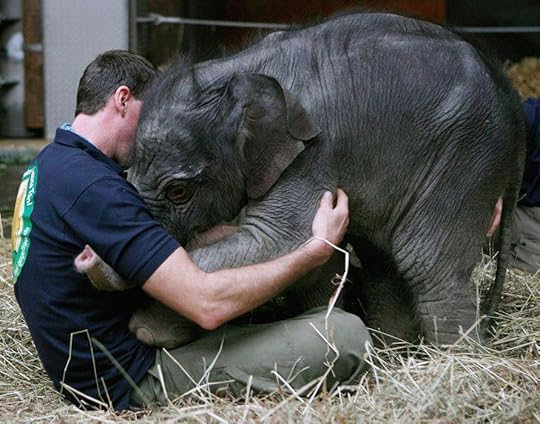
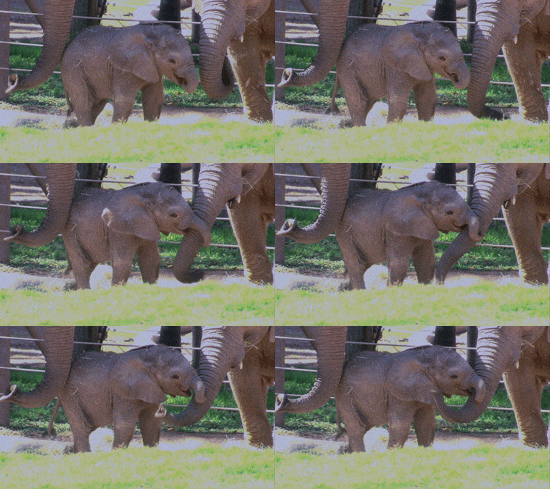
Such magnificent creatures. And to think they are endangered.
Oh well, the book's setting is in the 18th century.
Oh, Tom, I adore you so much.
On page 101, "The reader may judge me harshly, if he chooses, and yet, was I not in the right? Is is not evident, that an elephant is of more value than many human beings?"
I will not judge you harshly Tom, in fact applaud your decision! And I quite agree with what you said.
" Surely the problem- the entire problem of our relations with the rest of the animal kingdom comes down to language!...
They are as full of thoughts as we, but are unable to express them in a form that we human beings can easily comprehend. They cannot speak our language, but then, nor can we speak their language. Is not this the true gulf that lies between us?"
" If animals do not have immortal souls, it must follow that there is no place for them in heaven, and I would be very sorry indeed if heaven were to contain no birds or animals. Or dogs. I cannot believe it."
Ahh, such wonderful words to read. Such beauty to my eyes.
I really really enjoyed this book I am so glad I found this at BookSale.
If you are an animal lover, you will thoroughly enjoy this, you will devour this book.
The love between a man and an elephant, arguments saying that brutes can't think, because we are the superior beings, but with them comes such wonderful rebuttals.
An open ended ending. I can't argue with that, since I don't think I can handle it, if the novel explicitly said that the two main characters died. But of course I knew that would happen, but I am content with the ending.
I was just confused at the last chapter. Who was narrating? Hmmm....
Such magnificent creatures. And to think they are endangered.

June 7, 2011
I think we can all agree that elephants are charming creatures and should be featured in books more. And the first half of this book WAS charming. A young man in 18th century England, taking care of two elephants, on a manor. Then you start to realize, Wow, Tom (the main character) has really given up a lot for these elephants (which becomes just one elephant about a third of the way through). But you feel okay about it--it's a valid life and career choice. But then, you know, Tom doesn't stop a girl from being raped (after the manor owner's son takes the girl for a ride on the elephant), briefly considers taking advantage of this girl too (after they all ride back on the elephant), has a sexual dream about the elephant, and takes up with a whore (not so much related to the elephant, but still, disturbing), and becomes a little to possessive of the elephant and you start to feel like, Ahhhhhhhhh, wtf, this is out of character, and you just generally wonder if the author got bored with the charming elephant story. Yes, I do understand that this was all a result of our main character losing himself and losing touch with the world and what's right and wrong because of his life role as the elephant keeper. But it still felt like, Ahhhhhhhhh, wtf, this is out of character, etc.
I did like the ending (it's not a story about the elephant written by Tom, but a story written about Tom by the elephant!...kind of, as Tom perceives the elephant to perceive him), but not what followed, which was to throw in some possibilities of what might have happened with Tom and the elephant. For example, maybe Jenny (that's the elephant) died of pneumonia in London. Or maybe Tom and Jenny ran away together, delighting children across the land. Or maybe, heck, they even got away to India to live happily ever after together. Christopher Nicholson, I can imagine these scenarios on my own and don't need you to feed them to me, thank you. So, overall, 2 out of 5 stars.
I did like the ending (it's not a story about the elephant written by Tom, but a story written about Tom by the elephant!...kind of, as Tom perceives the elephant to perceive him), but not what followed, which was to throw in some possibilities of what might have happened with Tom and the elephant. For example, maybe Jenny (that's the elephant) died of pneumonia in London. Or maybe Tom and Jenny ran away together, delighting children across the land. Or maybe, heck, they even got away to India to live happily ever after together. Christopher Nicholson, I can imagine these scenarios on my own and don't need you to feed them to me, thank you. So, overall, 2 out of 5 stars.
This entire review has been hidden because of spoilers.

August 21, 2019
story 2/5 So promising...
characters 3/5 The elephants were the most interesting...
writing 2/5 Pfff...
audio/paper Paper. Found in a thriftshop.
reread? ? No?
characters 3/5 The elephants were the most interesting...
writing 2/5 Pfff...
audio/paper Paper. Found in a thriftshop.
reread? ? No?

November 1, 2010
I started it last night. It is wonderful! Hard to put down. Finished early this morning, really hard to put down. A delight for animal lovers and social history buffs. The first Elephant in England and her keeper - about A Life Together.


December 29, 2010
A lovely slow paced book; easy to read and a refreshing change from the fast paced thrillers which I also enjoy

June 24, 2024
Given my love for the amazing traits and intelligence of elephants I know I had high expectations for this story. This is a slow read, 100 pages too long in my opinion. The book is divided into four parts; I enjoyed the first two yet found the last two odd and disjointed.
The setting of eighteenth-century England, with its charming diction and formality of social classes, added character to the journey-over-time between young Tom Page who comes of age while learning first-hand how to be caretaker to two sibling elephants whom he names Jenny and Timothy. I was definitely more interested in the trials and victories of training and caring for the elephants than I was in Tom's struggle to be an author or inability to have healthy adult relationships.
"You inow, Tom, so long as what you write is accurate and free from Invention--so long as it is faithful to the Truth--you cannot go far wrong."
"I remember the great excitement they both shewed when I first placed a heap of carrots in their feeding troughs. This relish of carrots being so marked, made me speculate that the Elephants must know what carrots were; in short, that the taste of the carrots must stimulate memories of their lives in the natural state."
"...and from this point on I rode the Elephants every day, and what was marvellous and almost incredible, found that I could control them well enough without use of bits or bridles, whips or spurs, or of the ankus, merely by the power of speech."
"What angered me most was the charge that they were evil-minded; for, although they occasionally misbehaved, they were never malicious and I think had no conception of evil. Their faces shone with love and innocence."
The setting of eighteenth-century England, with its charming diction and formality of social classes, added character to the journey-over-time between young Tom Page who comes of age while learning first-hand how to be caretaker to two sibling elephants whom he names Jenny and Timothy. I was definitely more interested in the trials and victories of training and caring for the elephants than I was in Tom's struggle to be an author or inability to have healthy adult relationships.
"You inow, Tom, so long as what you write is accurate and free from Invention--so long as it is faithful to the Truth--you cannot go far wrong."
"I remember the great excitement they both shewed when I first placed a heap of carrots in their feeding troughs. This relish of carrots being so marked, made me speculate that the Elephants must know what carrots were; in short, that the taste of the carrots must stimulate memories of their lives in the natural state."
"...and from this point on I rode the Elephants every day, and what was marvellous and almost incredible, found that I could control them well enough without use of bits or bridles, whips or spurs, or of the ankus, merely by the power of speech."
"What angered me most was the charge that they were evil-minded; for, although they occasionally misbehaved, they were never malicious and I think had no conception of evil. Their faces shone with love and innocence."

October 1, 2009
"I asked the sailor what an Elephant looked like; he replied that it was like nothing on earth."
The Elephant Keeper, a wonderful and heartbreaking book, is the story of Tom and two young elephants who, in 1776, arrive at the docks in Bristol, England. They are purchased by a wealthy sugar merchant for his estate, and he hires a young stable boy, Tom Page, to care for them. The story, told by Tom, follows the lives of boy and elephants as they learn to understand each other, and develop a remarkable bond of affection and loyalty. Touching and engaging, the story contains wonderful characters, including the elephants themselves. The writing captures the nuances of character, and paints a compelling portrait of the time as it moves from the green fields and woods of the English countryside to the dark streets and alleys of late-eighteenth-century London, reflecting both the beauty and the violence of the age. Nicholson's lush writing and deft storytelling complement a captivating tale of love and loyalty between one man and the two elephants that change the lives of all who meet them.
I was very impressed with this book. It is a beautiful love story. It is believable because of the innocence and compassion of Tom Page. You learn early on that Tom is following in his footsteps of his deceased father, who was also as an animal caretaker, unlike his brother, who goes on to become a wealthy sailor. Tom, however, prefers a simpler life and the company of animals over humans. It soon comes to be Tom’s destiny to manage and care for two elephants that are brother and sister that Tom names Timothy and Jenny. He immediately devotes his life to them, even putting their well-being ahead of his own. There are many heart-warming scenes in which you can feel the connection Tom has with the elephants. They come to almost speak the same language and the lines get blurred between humans and animals. Tom even engages in conversations with Jenny and they almost seem like lovers in Tom’s mind. Tom does have a human love interest as well but his loyalty to the elephants prevents him from further pursuing it. This would seem like a sacrifice but it is actually what Tom wants. It is an easy read that ends too quickly but leaves your heart feeling full and maybe even restores faith in the ability of humans to communicate with animals.
The Elephant Keeper, a wonderful and heartbreaking book, is the story of Tom and two young elephants who, in 1776, arrive at the docks in Bristol, England. They are purchased by a wealthy sugar merchant for his estate, and he hires a young stable boy, Tom Page, to care for them. The story, told by Tom, follows the lives of boy and elephants as they learn to understand each other, and develop a remarkable bond of affection and loyalty. Touching and engaging, the story contains wonderful characters, including the elephants themselves. The writing captures the nuances of character, and paints a compelling portrait of the time as it moves from the green fields and woods of the English countryside to the dark streets and alleys of late-eighteenth-century London, reflecting both the beauty and the violence of the age. Nicholson's lush writing and deft storytelling complement a captivating tale of love and loyalty between one man and the two elephants that change the lives of all who meet them.
I was very impressed with this book. It is a beautiful love story. It is believable because of the innocence and compassion of Tom Page. You learn early on that Tom is following in his footsteps of his deceased father, who was also as an animal caretaker, unlike his brother, who goes on to become a wealthy sailor. Tom, however, prefers a simpler life and the company of animals over humans. It soon comes to be Tom’s destiny to manage and care for two elephants that are brother and sister that Tom names Timothy and Jenny. He immediately devotes his life to them, even putting their well-being ahead of his own. There are many heart-warming scenes in which you can feel the connection Tom has with the elephants. They come to almost speak the same language and the lines get blurred between humans and animals. Tom even engages in conversations with Jenny and they almost seem like lovers in Tom’s mind. Tom does have a human love interest as well but his loyalty to the elephants prevents him from further pursuing it. This would seem like a sacrifice but it is actually what Tom wants. It is an easy read that ends too quickly but leaves your heart feeling full and maybe even restores faith in the ability of humans to communicate with animals.

August 27, 2009
I had to wait a couple of days after reading this book to post the review. It has now been three. And I still don’t know how I feel about the story. Which doesn’t leave a good taste in my mouth.
The story itself flows well. You get emotional about the elephants and how they live their daily lives. But for the main character, Tom, I could take him or leave him. There isn’t much depth into what he is about, and as the story unravels, even less so.
I am at a loss as to what to say about this book. It wasn’t horrible and it wasn’t great. It was just there. The writing was good (it follows how things were written in the 18th century which is when the story takes place). The story was pretty good, for the most part.
This is a book to get if you are into a slow, sad story dealing with the treatment of elephants. It’s good. I just wouldn’t run out to get it. In the end, it doesn’t stand out for me.

October 3, 2009
Had Christopher Nicholson simply tried to write a historical novel of the 18th century, critics probably would not have liked his book quite so much. Most of them found at least one aspect of the book that bothered them -- from the occasional flat character to inconsistent pacing to episodes they felt didn't make sense. But all were so charmed by the writing and by the way the author develops the characters of the pachyderms Timothy and Jenny, as well as their relationship to Tom, that they were happy to recommend the book even to those readers who aren't animal people. This is an excerpt of a review published in Bookmarks magazine.

January 14, 2026
If Dickens and Gerald Durrel had had a baby… that’s the thought I had when I began reading this book. And the feeling only got stronger as I read on. The biological impossibility of such a situation is not only not a hindrance to the gestalt of the novel, it is the essential ‘suspension of disbelief’ that makes it such an enjoyable reading experience. It contains the social concern, the moral critique of the class divide, the pathos of deprivation, and storgic love for storytelling of Dickens and the irony and humour of animal shenanigans of Durrel. The story of an elephant in England in the late 18th C as told by her barely literate keeper (whose insights and articulation seem like an anomaly, but who is nitpicking!) is one of a deep interspecies friendship. Set in a time when human rights, let alone animal rights, weren’t so much as a glint in the activist’s eye, this narrative highlights the basic instinct for compassion to bridge the gap between the human and the exotic/alternatively reviled. When contrasted with the other primordial human qualities of bigotry and cruelty, the beauty of fellow-feeling shines despite the hopelessness of the characters’ situation. In the farfetched dialogues between the man and beast, and the elephant’s humanlike sense of justice, the author must have broken several rules of writing. But it is this defiance that takes it beyond the realms of the straightjacketed ‘literary fiction’ as good old-fashioned storytelling. This sense is driven home with the open-ended, metanarrative conclusion where the author enters the story and brings with him the contemporariness of underground railways, museums and the benefit of hindsight: where you are left alone with thoughts of love, loss, belonging, questions about loneliness and death, acceptance – and eagerness for a happy ending. Animals have, throughout history, suffered and continue to suffer at the hands of humans. The Elephant Keeper is this fact expressed in story form. And it is beautiful.
June 25, 2021
Interesting and narrated in the voices of the late eighteenth century, although there's no particular attempt to represent regional or class dialects. The story is rather farfetched in that Tom believes that he can talk to Jenny (the elephant), and that she talks back. In other ways he doesn't seem delusional, but (having been affected by the past few years) I can't help but think that anything Jenny "says" is entirely Tom's projection. I entirely believe that an elephant can express affection and a range of emotions, but telepathic speech, taken literally, is a bit too far for me. However, I still really enjoyed the book.

August 4, 2024
2.5 stars

May 16, 2026
The first half of this book really gripped me, and I loved reading about the elephants and Tom. But the second half of the book kinda lost me and I felt like it was a bit of a slog at some points.

May 5, 2025
First, I fell in love with Jenny, the elephant to the extent that when anything negative was about to happen to her, I'd have to stop reading. The story does have a happy ending and indeed oozes with the love that Tom, the elepant keeper, has for his charge.
This entire review has been hidden because of spoilers.

July 10, 2024
A melancholy but beautiful story about the lifelong relationship between an elephant and its keeper. The story of Tom and Jenny is a love story.

May 15, 2011
Christopher Nicholson combines a mischievous sensibility with a creative imagination in this delicate and satisfying story. Working with a subject that could easily degenerate into either sentimentality or bathos, he tells a nuanced story of devotion, empathy, humanity, bittersweet memories, and conscience.
The voice he adopts in THE ELEPHANT KEEPER is entirely his own. He playfully hints at this in a meditation on the differences between speech and writing. His character, a stable boy, is asked to write a memoir of the elephant he tends. The stable boy's struggle to articulate this story is playfully used by Nicholson to reflect on the struggles of the writer. “In speech they use...words...whereas when they write, they employ a different vocabulary....[One] does not meet an Elephant, but encounters it....There is an entirely different language for writing....” It is a succinct reminder that a story is an intimate link between reader and author's minds.
It is a literary conceit that this story is told by Tom, son of Timothy, head groom to Mr. John Harrington of Somerset, a well-to-do Bristol merchant. Yet, because of Tom's modern sensibility regarding animals, the reader is quickly drawn into this beautifully told tale. We want to believe, and so we do. In a voice that only gradually comes to speak as a bond of trust is slowly forged, Jenny the Elephant speaks in Tom's mind. These consist of non-judgmental observations and commonsense (for an Elephant) questions. As Tom teaches Jenny to count, Tom muses that this will demonstrate to his master that animals and humans are not so different after all. As Jenny accepts a carrot as a reward, he imagines her thinking: “Is it so important? May I have another carrot, please, Tom?” The content is so “elephantine,” but the polite diction so human. This is the gift of Nicholson's storytelling.
The bond between Tom and Jenny is tested as voices around Tom, his mother, and more importantly, his friend Lizzy, argue that the Elephant, being not human, is somehow subordinate to the dominion (and selfish desires) of humans. The characters that people this story are all too human. The ignorant village gossip; the pretensions of the pseudo educated; the boorish attitude of entitlement by the younger generation of gentry; and the occasional goodness of the few who retain both a sense of humility and a connecttion to the land.
There is a nostalgic or perhaps romantic element to this tale. Look at the English landscape paintings of Richard Wilson or George Stubbs. There is a monumental quality bestowed on nature, and a connection to domestic animals that ended when urban life came to overshadow the rural. It is no accident that this is also the period of the Enclosures, when the Commons were being fenced off causing a cataclismic change in English social relations.
It is fitting that Nicholson chooses to tell the bulk of his tale in the present tense. There is a timelessness element to this story which leaves us with the consolation: “Not to take what Life offers would be a great mistake, and taking what Life offers must be one of the secrets of happiness....Is that not what, in her own way, Jenny has taught me? If I remain uneasy, I think, it is perhaps merely because Life seems to offer different people such different things.”
The voice he adopts in THE ELEPHANT KEEPER is entirely his own. He playfully hints at this in a meditation on the differences between speech and writing. His character, a stable boy, is asked to write a memoir of the elephant he tends. The stable boy's struggle to articulate this story is playfully used by Nicholson to reflect on the struggles of the writer. “In speech they use...words...whereas when they write, they employ a different vocabulary....[One] does not meet an Elephant, but encounters it....There is an entirely different language for writing....” It is a succinct reminder that a story is an intimate link between reader and author's minds.
It is a literary conceit that this story is told by Tom, son of Timothy, head groom to Mr. John Harrington of Somerset, a well-to-do Bristol merchant. Yet, because of Tom's modern sensibility regarding animals, the reader is quickly drawn into this beautifully told tale. We want to believe, and so we do. In a voice that only gradually comes to speak as a bond of trust is slowly forged, Jenny the Elephant speaks in Tom's mind. These consist of non-judgmental observations and commonsense (for an Elephant) questions. As Tom teaches Jenny to count, Tom muses that this will demonstrate to his master that animals and humans are not so different after all. As Jenny accepts a carrot as a reward, he imagines her thinking: “Is it so important? May I have another carrot, please, Tom?” The content is so “elephantine,” but the polite diction so human. This is the gift of Nicholson's storytelling.
The bond between Tom and Jenny is tested as voices around Tom, his mother, and more importantly, his friend Lizzy, argue that the Elephant, being not human, is somehow subordinate to the dominion (and selfish desires) of humans. The characters that people this story are all too human. The ignorant village gossip; the pretensions of the pseudo educated; the boorish attitude of entitlement by the younger generation of gentry; and the occasional goodness of the few who retain both a sense of humility and a connecttion to the land.
There is a nostalgic or perhaps romantic element to this tale. Look at the English landscape paintings of Richard Wilson or George Stubbs. There is a monumental quality bestowed on nature, and a connection to domestic animals that ended when urban life came to overshadow the rural. It is no accident that this is also the period of the Enclosures, when the Commons were being fenced off causing a cataclismic change in English social relations.
It is fitting that Nicholson chooses to tell the bulk of his tale in the present tense. There is a timelessness element to this story which leaves us with the consolation: “Not to take what Life offers would be a great mistake, and taking what Life offers must be one of the secrets of happiness....Is that not what, in her own way, Jenny has taught me? If I remain uneasy, I think, it is perhaps merely because Life seems to offer different people such different things.”

June 9, 2018
I didn't purchase this book because of Giovanni's blurb or the pretty colors of the cover (okay, maybe the colors did factor in) - it was an impulse buy in a very sad Borders that had been stripped done to barely nothing. And I'm a sucker for books about animals. I should have spent my money on something else.
The author, Christopher Nicholson is a radio documentary producer who worked for BBC and many of the shows he produced dealt with the connections/bonds between animals and humans so it is not surprising that his novel focuses around such a bond. How he develops the bond between human and animal is fantastically done and the writing is quite beautiful, but the novel reaches a point where I was left going "oh no, honey," which tends to my response when a book takes a turn or jumps the track and the editor didn't put things back on track before print. Sigh.
Set in England in the 1770s, The Elephant Keeper is about Tom Page, a man who followed his father's footsteps into a stable as a groomsman and later as the elephant keeper. When his employer decided to acquire two young elephants, Tom could barely contain his excitement. As the male and female elephants grew, Tom created a bond with the two of them that went beyond any connection he'd had with horses, family, or other people. This "feeling each other out" period of the bonding process is the best of the book.
Due to expenses, Tom's employer has to get rid of one of the elephants and Tom suggests he keep the more docile female and sell the less predictable male. Tom's relationship with the elephant he calls Jenny takes a weird turn as he begins to have conversations with her, forsakes his family and his "true" love for her, and begins to have sexual fantasies about her. This single obsession ruins what had been a very interesting book about developing bonds between animal and keeper set against a backdrop of the social hierarchy of England. (There are some fantastic parallels between Tom and Jenny - isn't Tom but a "pet" of his employer's son?)
I think Nicholson is channeling a bit of Martel in this work, but he fails horribly.
(Originally published on the now defunct book review blog 7/11/2011)
The author, Christopher Nicholson is a radio documentary producer who worked for BBC and many of the shows he produced dealt with the connections/bonds between animals and humans so it is not surprising that his novel focuses around such a bond. How he develops the bond between human and animal is fantastically done and the writing is quite beautiful, but the novel reaches a point where I was left going "oh no, honey," which tends to my response when a book takes a turn or jumps the track and the editor didn't put things back on track before print. Sigh.
Set in England in the 1770s, The Elephant Keeper is about Tom Page, a man who followed his father's footsteps into a stable as a groomsman and later as the elephant keeper. When his employer decided to acquire two young elephants, Tom could barely contain his excitement. As the male and female elephants grew, Tom created a bond with the two of them that went beyond any connection he'd had with horses, family, or other people. This "feeling each other out" period of the bonding process is the best of the book.
Due to expenses, Tom's employer has to get rid of one of the elephants and Tom suggests he keep the more docile female and sell the less predictable male. Tom's relationship with the elephant he calls Jenny takes a weird turn as he begins to have conversations with her, forsakes his family and his "true" love for her, and begins to have sexual fantasies about her. This single obsession ruins what had been a very interesting book about developing bonds between animal and keeper set against a backdrop of the social hierarchy of England. (There are some fantastic parallels between Tom and Jenny - isn't Tom but a "pet" of his employer's son?)
I think Nicholson is channeling a bit of Martel in this work, but he fails horribly.
(Originally published on the now defunct book review blog 7/11/2011)
This entire review has been hidden because of spoilers.

October 11, 2020
A gentle jauntily written novel told from the perspective of Tom Page, Somersetshire native, an elephant caretaker, who travels around England with two elephants, Timothy and Jenny. At Harrington Hall, he takes care of both elephants, while under the benevolent lordship of Mr. Harrington, and develops a fondness for both of them. Timothy is sold to another owner, and Jenny and Tom moves to the estate of Lord Bidborough. There he witnesses more injustices, particularly doled out by the Bidborough sons. Finally, he moves to London, where he cares for Jenny who has been sold to a menagerie, something akin to a circus act.
The writing is sometimes overly simplistic and trite, but the language is rather touching and sincere. Without much effort, Nicholson lets you in on the subtle (and overt) classism at display between servant and lord in 18th-century England. Nicholson's seems to aim for writing that resembles the type of coming-of-age memoirs that one might read from the 18th century.
I think it's also cool that the elephants speak English! This writing device adds some sense of supernatural to the work. I also appreciate the use of the 'book within a book' - as some of the novel is narrated from the perspective of Tom writing a History of the elephants, which is to be preserved as a historical record for posterity. At at the final few pages, Touching stuff indeed!
The writing is sometimes overly simplistic and trite, but the language is rather touching and sincere. Without much effort, Nicholson lets you in on the subtle (and overt) classism at display between servant and lord in 18th-century England. Nicholson's seems to aim for writing that resembles the type of coming-of-age memoirs that one might read from the 18th century.
I think it's also cool that the elephants speak English! This writing device adds some sense of supernatural to the work. I also appreciate the use of the 'book within a book' - as some of the novel is narrated from the perspective of Tom writing a History of the elephants, which is to be preserved as a historical record for posterity. At at the final few pages, Touching stuff indeed!
May 10, 2022
Meh. I wanted to love this story, but it was much more about an ordinary man than about elephants. Of course the author anthropomorphized the elephants, but he did not give them the noble characteristics that I expected. Overall, this book did not have the same charm as Water for Eiephants, to which it was compared.
Displaying 1 - 30 of 563 reviews