Jump to ratings and reviews
Rate this book

A Dark-Adapted Eye

Rate this book

A Dark-Adapted Eye - a prize-winning crime classic by bestselling author Barbara Vine

Winner of the Crime Writers' Association Gold Dagger Award

Like most families they had their secrets . . .

And they hid them under a genteelly respectable veneer. No onlooker would guess that prim Vera Hillyard and her beautiful, adored younger sister, Eden, were locked in a dark and bitter combat over one of those secrets. England in the fifties was not kind to women who erred, so they had to use every means necessary to keep the truth hidden behind closed doors - even murder.

A Dark-Adapted Eye is modern classic. If you enjoy the crime novels of P.D. James, Ian Rankin and Scott Turow, you will love this book.

Barbara Vine is the pen-name of Ruth Rendell.

278 pages, Mass Market Paperback

First published January 1, 1986

705 people are currently reading
7780 people want to read

About the author

Barbara Vine

29 books463 followers
Pseudonym of Ruth Rendell.

Rendell created a third strand of writing with the publication of A Dark Adapted Eye under her pseudonym Barbara Vine in 1986. Books such as King Solomon's Carpet, A Fatal Inversion and Anna's Book (original UK title Asta's Book) inhabit the same territory as her psychological crime novels while they further develop themes of family misunderstandings and the side effects of secrets kept and crimes done. Rendell is famous for her elegant prose and sharp insights into the human mind, as well as her ability to create cogent plots and characters. Rendell has also injected the social changes of the last 40 years into her work, bringing awareness to such issues as domestic violence and the change in the status of women.

Ratings & Reviews

What do you think?
Rate this book

Friends & Following

Create a free account to discover what your friends think of this book!

Community Reviews

5 stars
3,300 (32%)
4 stars
3,800 (37%)
3 stars
2,067 (20%)
2 stars
572 (5%)
1 star
268 (2%)
Displaying 1 - 30 of 646 reviews
Profile Image for Bionic Jean.
1,384 reviews1,567 followers
June 21, 2025
“The hands of the watch stood at five past eight.
The only kind of death that can be accurately predicted to the minute had taken place, the death that takes its victim,

’… feet foremost through the floor,
Into an empty space.’”


This is from the first chapter of Barbara Vine’s book A Dark-Adapted Eye, which was first published in 1986. It was the first novel by this particular name, but not by this author. The reason? Barbara Vine is a pseudonym for Ruth Rendell.

Ruth Rendell had already established her credentials as potentially the new Queen of Crime novels after the golden age of Agatha Christie, perhaps sharing her crown with P.D. James. She had written many crime novels, often showing an acute sense of psychology and sexual psycho-pathology. Just as good, but appealing to a wider audience as more conventional fare, was her “Inspector Wexford” series of popular police procedurals. However, despite all the accolades and awards, Ruth Rendell did not feel that her imagination was being given full rein. She felt the need to set herself a new challenge, and to explore another side of her writing personality. Yes, she may have written many accomplished police procedurals and twisted psychological novels, but she felt the need to explore a third, slightly different slant for her psychological thrillers. A Dark-Adapted Eye shows a significant shift in the direction, emphasis and style of Ruth Rendell’s novels.

For these novels, published between 1986 and 2012, she used the nom-de-plume “Barbara Vine”. She set the bar even higher, perhaps because the critics had never really rated her work as literary fiction, although she had an immense readership. She was urged to go beyond the whodunit and even the psychological questions she dealt with, of how and why a criminal was made. Now she needed to address how ordinary people dealt with the skeletons in their cupboard, and what might happen when secrets, which had been buried in their past, came out into the light.

And the public loved the emergence of “Barbara Vine”. A Dark-Adapted Eye won the Mystery Writers of America Edgar award for best novel of the year. These were to be a different kind of novel to the ones Ruth Rendell had given us previously, but they quickly began to rival the sales and public acclaim of her earlier work, and were also adapted for television. Barbara Vine was here to stay.

Ruth Rendell favoured using twisting plots to expose twisted minds. Except for the Inspector Wexford novels, she usually offered close-ups of psychopaths in the making. We are privy to a lot of terrible and often ironic plot elements, as we see the horrible deeds come closer and closer to actuality. But with a Barbara Vine novel, there is a much more leisurely approach. It will still be a tale of obsession, madness and chaos, but it will follow a far more and intricate and circuitous exposition. Sometimes the reader feels the tale is deliberately delayed, teasing them with a build-up which may never be quite explained. For in Barbara Vine novels, Ruth Rendell feels free to break a sacrosanct rule of crime novels, the assumption that there will be a clear solution to a crime affording a final satisfaction to the reader. Barbara Vine, daringly, may leave part of the denouement deliberately ambiguous.

Interestingly, “Barbara Vine” is in a way an expression of Ruth Rendell’s dual nature. She explained:

“Ruth was my father’s choice of name for me, Barbara my mother’s. Her side of the family called me Barbara and my father finally started calling me Barbara too.

Both names are equally familiar to me, equally “my” names. If either were called out in the street, I would turn around. Ruth and Barbara are two aspects of me. Ruth is tougher, colder, more analytical, possibly more aggressive. Ruth is the professional writer. Barbara is more feminine. It is Barbara who sews. If Barbara writes, it is letters that she writes.

For a long time I have wanted Barbara to have a voice as well as Ruth. It would be a softer voice speaking at a slower pace, more sensitive perhaps, and more intuitive. In A Dark-Adapted Eye she has found that voice. There would be nothing surprising to a psychologist in Barbara’s choosing, as she asserts herself, to address readers in the first person.“


More than thirty years later, it is difficult to remember how ground-breaking A Dark-Adapted Eye must have been. No other crime writer seemed to be producing anything so emotionally and psychologically complex, although there are many more now. The novel demands close attention, and the reader becomes compelled to be absorbed, because there is no way of telling which detail will be key to revealing secrets further along the twisting path of the story. And there will be secrets, and secrets in plenty. Nobody knew better than Ruth Rendell how to hold readers in the tight grip of suspense.

We are aware of the narrator immediately, and also that this novel will be a leisurely one to savour, rather than one which will hit the reader in the eye with its explicit and gory descriptions. The opening sentence: “On the morning Vera died I woke up very early”, and the start of the second paragraph: “In these circumstances alone one knows when someone is going to die” immediately feel very different from her other novels. They intrigue us, but in a rather oblique way. And then shortly after, we get the quotation I put at the start of this review. That confirms to us that this will be a carefully crafted piece, by an author who had a keen appreciation of language. Her titles often came unusual parts of English, such as “Kissing the Gunner’s Daughter”, which was an obscure naval punishment, or “An Unkindness of Ravens”, which is one of the very odd collective nouns for groups of bird species.

“ …feet foremost through the floor,
Into an empty space.”


is of course a quotation from Oscar Wilde’s masterpiece, “The Ballad of Reading Gaol”, which was published in 1904. And thus we learn, in a very elegant way, that this novel is going to be concerned with someone who was executed. And that the narrator, Faith, was a very close relation: her niece. In fact Faith has spent most of her life avoiding talking or even thinking about the events which led up to her aunt’s being hanged for murder. She eschewed reading about the crime, and attempted to distance herself as far as possible from the events. Faith had built a little cocoon of emotional safety for herself, and this account we are to read, is partly for the benefit of the true-crime author, who asked for her memories, and perhaps a little for herself, to develop the “dark-adapted eye” of the title. In medical terms, a dark-adapted eye is one which has adjusted to darkness, so that it is able to discern objects. So here, it is symbolic of Faith’s growing ability, after many years of hiding her head in the sand, to begin to examine and analyse her family’s history, and its ultimate tragedy.

We know right from the beginning, if we are to believe Faith’s account, who the murderer is, but not why or how the murder was committed. Nor do we know who the victim is. We have suspicions, but it is not made clear until the final few pages. And there is a twist, although it may not be one the reader guesses. (I didn’t.) This is psychological crime fiction, rather than a murder mystery per se.

The story is largely set during World War II, which ironically is perhaps why this novel is easily read now, without feeling dated. It was already “history” in 1986, although as the events proceed, the distance from when the novel was written becomes less than the distancing, or reach of the past, which is described. Faith Severn, now middle aged, is recounting her memories of her aunt, the prim and fastidious Vera Hillyard, whom we know was hanged for murder back in the late 1940s. But whom did Vera kill, and why? We know that Francis, Vera’s elder son changed his name as soon as she was arrested. We also know that the younger son, Jamie is presently living in Italy at the start of the book. He was only 6 when his mother was hanged so remembers very little, and what he does remember may be unreliable. Many characters such as he are extremely reluctant to discuss anything about the affair.

We learn that Vera was socially conscious to the point of snobbishness, and that her husband, Gerald, was hardly ever around. We learn about Faith’s uneasy relationship with her aunts: the nervy, obsessional Vera, and the lovely, selfish, much younger sister Edith, called “Eden”, who had virtually been raised and instructed in the traditional values of housecraft by her adoring older sister. In fact Vera’s life centres on her beautiful sister, and as a young girl Faith feels judged and excluded from the exceptionally close bond these two have. She notes that even Vera’s own son, Francis, is not close to his mother but is an adolescent with a vicious streak, who delights in being cruel to her.

We learn of Faith’s own family and contingent unhappinesses, and also that of various other friends and relations. Vera’s brother, Faith’s father, had viewed his sisters as near saints, and held them up as examples to his own family, tainting all their relationships by so doing. When Vera was convicted as a murderer, he was so shocked that he removed all photos of her, refusing to read any newspaper reports or go to her trial. We see evidence of many family secrets involved in the case, and can only guess at first, as more details emerge through Faith’s childhood reminiscences, and we read excerpts from the author’s notes from his book in progress, old letters and other documents. There is a wealth of detail about the settings and locations, and all the characters and events come to life very clearly through their thoughts and emotions, and through their actions viewed through Faith’s viewpoint, but their secrets remain well concealed.

It appears that Vera has killed but how or why is not clear until near the end of the book. The plot develops very slowly, and the reader is given many hints, questioning along with the narrator, how things could have turned out differently, without being privy to what actually happened. Barbara Vine rations out the threads of the story very gradually, carefully measuring each point at which more information can be told about the family relationships and events which ultimately led up to the tragedy are revealed.

Eden and Vera have an intense love/hate relationship, which worsens as the years go by. Then Eden begins to be supplanted by the extremely close relationship Vera has with her second son, Jamie. She is intensely devoted to him, as Eden drifts away into the Wrens, and after World War II making other career moves, eventually Family and friends are variously disbelieving, bewildered and shocked, reluctantly taking sides in as it escalates out of all proportion into savage violence, leading to tragedy, and a subsequent series of disturbing revelations, which are never wholly resolved to Faith’s, or the readers’, satisfaction.

As the first novel using this persona, A Dark-Adapted Eye is a startlingly good read. There are a couple of things which prevent it from gaining a fourth star in my estimation. One is that the reader can see the workings a little too easily. Each chapter ends with an overt cliff-hanger, and this feels a little clunky and unnecessary in such an otherwise subtle novel. Another aspect which affect my rating, is the slowness of the first chapters. After the teasingly intriguing start, chapters three or four have far too much family history, before we know any of the descendants who are to play major roles in the story. Barbara Vine gets away with it by introducing a character who wishes to write a book about Vera Hillyard. But we do not! There are too many generations; too many interleaved connections.

We now know from the later novels, that we are never presented with flat characters in a Barbara Vine novel. There is always a background: a series of reasons and motivations the reader is given for their behaviour. A Dark-Adapted Eye is full to the brim with warped and unexpected histories. But this part reads rather like an historical biography. In a factual book of that type, one might be willing to give a little more leeway for dry family histories. However, in a novel, we do not yet have a “pull”: a reason to be interested in these people. When finishing the book, I then wished I had the detailed family history to read, and perhaps thus gain a little further insight. Best of all, of course, would be if the author had casually inserted it into the text at various points. This is precisely what Ruth Rendell did, in the later Barbara Vine novels, which to my mind are more skilled examples of her craft.

Nevertheless it is a good read. Because Ruth Rendell was already a much-loved writer, she had developed enviable experience and writing skills. Her books show a consumate ease with complicated narrative structures. Time lines and viewpoints constantly doubles back on themselves, whilst moving the plot forward inch by inch, keeping us constantly wrong-footed. We see that although it was Vera Hillyard who was hanged, Faith Severn’s entire family have been damaged and affected by the crime. Ruth Rendell’s stories draw you in, tightening the tension as they move inexorably towards the terrifying end.

As Barbara Vine she has an added dimension. The convolutions of plot are still as present, allied with a precise delineation of character, and the stultifying traps they ensnare each other in. As the psychologically astute Barbara Vine, the author has the ability to throw us into seething masses of dread and doubt, making us part of her characters’ chaos and mind-games. No writer is better suited to going through the minutiae of her characters’ lives for hidden shame. She even builds this into her narrator, making Faith Severn conversant with (and somewhat dismissive of) various terms to do with mental disorders.

There are similarities between the two authorial voices, that of Ruth Rendell and that of Barbara Vine, of course. Just as in the best classic fiction, both go beyond the narrow conventional confines of a novel, to explore themes and issues in the wider society beyond. A Dark-Adapted Eye examines the way women were expected to fulfil their roles as wives and mothers, during and after World War II - and the price they paid when they looked beyond and broke those rules, for various reasons. Both are concerned with looking at the way people use their sexuality for their own ends, and the resulting damage when the truth has been hidden away. A Dark-Adapted Eye is a novel about both love and fear, and about alienation. It brings home the horror of what may happen, when using children as pawns in an adult game. And it is about the fallibility of memory: about the tricks our minds play on us, as well as the tricks we deliberately use, those episodes we forget in order to protect ourselves and the ones we love, and how perspective can distort, or reveal, by turn. Do we only understand from a distance, or do we confabulate?

All the way through, the reader is never quite sure what to believe. We trust the narrator Faith Severn, to be reliable, producing a truthful account when she is forced to confront her own memories, attempting to help the author who wants to write a book about Vera Hillyard. This is a neat and persuasive device, to push the story forward and broaden it out, so that we gradually gain convincing portraits of all the key characters. And nearing the end, when the pieces all seem to be fixed in place, Barbara Vine throws everything into question yet again, leaving the reader to decide what did really happen, and what was the truth of it all. As with the best thrillers, we are shocked and may be tempted to flick back through the pages in an attempt to work out the answer, even though there patently will not be enough information.

Today Barbara Vine’s “first” book, A Dark-Adapted Eye is considered by many a modern classic: a novel which changed the format, and questioned the very foundations of the crime and thriller genre. She was set to become what she now is, the Queen of Psychological Suspense novels.
Profile Image for Bill.
1,054 reviews421 followers
February 6, 2008
There's a running joke between me and a friend of mine about jazz music. We'd be out at a club or jazz festival, and once the music moves into an obscure fusion phase, he'd lean over to me and say, "See, here's where the music gets too smart for me".

I had a similar feeling after finishing this novel. There were far too many characters to keep track of and I actually had to write down on a piece of paper the family tree to have any hope of continuing to read forward.
While I admire her for coming up with such a convoluted web, ultimately I found the novel a chore, with zero payoff.
Thank goodness this is not the first novel I had read by Ruth/Barbara because this one would have surely turned me off her. Amazon reviewers love this one, which is why I read it, but maybe this one was just too smart for me.
Profile Image for Dennis Henn.
663 reviews1 follower
June 26, 2014
Imagine driving down a country highway. The posted speed limit is 55 and you are stuck following a vehicle traveling at 40. You pull off on an alternate route hoping to speed the drive up. Unfortunately you find yourself now traveling behind a combine going 30. You can't deny the landscape is beautiful and that your car runs well is a bonus. That, however, does nothing to alleviate the frustration of such a slow ride. Distracted, you get lost, and finally forget where you were heading.
That was my experience reading A Dark-Adapted Eye. It was not very suspenseful. There were too many characters to remember. There was a murder and a murderer announced at the novel's opening. That the book was well written did nothing to enthrall me, it only made the passing of miles more tolerable.
Profile Image for Marwan.
47 reviews43 followers
December 27, 2016
A crime has been committed by Vera Hillyard and she was charged, convicted and executed (with few hints about the victim and motive). 30 years later, A reporter who wants to write a biography of Vera approaches a woman called Faith (who is Vera's niece) and ask for her help. So Faith accepts the task and while she at it, recalls the events of the past, where Vera's story is slowly revealed from the distant past until the moment of the murder.

I would have give it 5 stars if the beginning wasn't a bit confusing (my opinion). Everything started to make sense in chapter 3 and I had to draw the family tree so I won't forget it. Other than that, it was an amazing psychological mystery and I loved it.
Profile Image for Bill Kerwin.
Author 2 books84.3k followers
December 2, 2023

In A Dark Adapted Eye, Ruth Rendell (writing as Barbara Vine) has created a domestic thriller worthy of her earlier masterpiece, A Judgment in Stone. This time, however, the murder does not arise from a servant problem: the Longley sisters—Vera and Eden—though of genteel stock, with familial connections to wealthy families, could never afford servants themselves. And it is precisely these tenuous connections to wealth and privilege that are the problem here.

The primary narrator of the book is Faith Longley, the niece of Vera and Eden, who—a generation later—pieces together the scattered memories of her girlhood in order to explain the murder that blotted the family name. As she relates her tale, her eye becomes “dark-adapted”—a scientific term for an eye accustomed to viewing objects in a dim light—and begins to discern the various motivations and responsibilities that led up to the murder itself.

I loved the book, but it wasn’t always smooth sailing; it took me awhile to get on board. The complications of the Longley family genealogy—with its half-sisters, half-cousins, and half-aunts—was confusing, and—I’ll be candid—boring. Also, the proliferation of details underlining the various distinctions in social class occasionally seemed excessive. But I came to realize that the heart of the Longley mystery was rooted in family and social class, and it is precisely these details that allow the reader’s eye to become “dark adapted” too.

The book is extraordinary well-written and subtle. I may—if I am permitted to live long enough—read A Dark Adapted Eye again.
Profile Image for Barb H.
709 reviews
January 22, 2019
This book was apparently Ruth Rendell's introduction as Barbara Vine. One could not, by any means, classify this as a typical suspense mystery. It is clearly,as we have become better acquainted with Vine, one of sophisticated, intricate and complex plotting. To rehash the details of this tale is unnecessary here, for many others have done so.It is not a fast moving novel, but one of subtlety and careful, deliberate attention to details.

This is the story of an English family, traced through the 20th century and their attitudes toward class and status. Their rituals, manners and secrets all lend import to the narrative. Typically, Vine deftly interwove their psychological flaws, creating a sense of tension for the reader. Her character development was vivid and compelling, although it was often confusing to keep track of individuals.

Life during WW II was so well depicted, one could sense the suffering and privation that people in England were experiencing. Vine describes in vivid detail the efforts that women made to recreate worn clothing into fashionable, acceptable attire. One could also easily sense the fear and frustration the people felt during the bombings in London.

The narrative makes it clear in the introduction that a murder has been committed, but it is not until the riveting, stunning conclusion that all becomes clear. Vine has expertly described throughout the book what may drive humans to madness and murder.
Profile Image for Nancy Oakes.
2,019 reviews919 followers
May 20, 2015
More later, but in my opinion, this is Rendell/Vine at her very best. It's also one of the most powerful stories she's ever written, and I've read most of them so I feel okay about making that statement.
Profile Image for Heather.
105 reviews19 followers
January 16, 2009
When a journalist contacts Faith Severn in the interest of writing a book about the execution of her aunt Vera Hillyard, Faith slowly reveals and unravels the story of the Hillyard family complete in it's complicities and claustrophobias. After her parents' death, Vera leaves her young son and military husband in the care of others and undertakes the role of mother to her younger sister, Eden. Vera and Eden's relationship is extremely close and secretive, often excluding all other parties. Living in virtual isolation during World War II, Vera makes Eden her top priority and constant concern, and becomes a profoundly obsessive and controlling woman. It's here that Faith spends many vacations and holidays, enduring Vera's casual cruelty and myriad insecurities while secretly idolizing the young and beautiful Eden. As time moves on and Faith grows older, she witnesses multiple changes in Vera and Eden's relationship, the return of Vera's son, Francis (a merciless young man), and Eden's eventual flight from the nest. Even so, things are not what they seem in the Hillyard house, and the family secrets will eventually spark an explosive, painful conclusion that leaves the reader sorting through the myriad clues to find a definitive answer to this intensely satisfying psychological thriller. Is Vera's madness really self-induced, or does it come from a more sinister direction? What are the circumstances behind her execution, and what part does her family truly play?

This was a fascinating and, eventually, quite devastating book. The author has a way of laying out the story and prose in a quietly thorough way, keeping the more disquieting elements couched within the normal everyday attributes of a wartime family. Knowing that a murder had occurred but not knowing the circumstances surrounding it, nor even who the victim was, was a particularly interesting way to tell this story. The technique had me reading with trepidation to discover where the cracks would appear, and how the murder would eventually take place. The story has an aura of foreboding attached to it, it was ominous from it's skeleton to it's details, haunting in a wonderful way. Because Vera was not a particularly pshycopathic person, the murder behind her execution seemed all the more interesting. Yes, she was restrictive and cold, and it was very clear that she was also repressed and secretive, at times she could be embarrassingly hysterical, but her character also seemed to be very controlled and conscious of propriety and modulated. Reading along I became convinced that this murder was an act of desperation and madness, instead of an act of calculated cruelty.

In fact, all the characters in this book were exquisitely portrayed. From the obnoxious and perverse Francis to the furtive and beautiful Eden and the reluctant and inquisitive Faith, each character was finely detailed and and exceptionally rendered. It felt like I knew these people, knew how they would react, where their buttons were and could see what would push them. There was a tremendous amount of exposition given over to these characters, a lot of time spent on the mundane and everyday, but it was far from boring. In fact it was a very illuminating and clever way to get the reader invested in the drama of the storyline, and the eventual destruction of a family.

The story dealt with many sensitive issues, and without giving away the mysteries of the story, it would be hard to touch on and identify them all, but the one that stuck out was the repression and emotional constraint of those in England during that time. It was evident in Vera's entire character, in her sister Eden's choice of lifestyle, and eventually in Faith's reticence to tell the story of her aunt. Repression ran like a thick vein down this haunting and dark story.

Another thing that I liked about this story were the atmospheric touches. There was much discussion of war time rationing and the procurement of luxurys items, such as food and cosmetics, during the lean times of war. I thought this was an interesting touch that gave the story believability and flavor. It seemed that the author accounted for all the variables in this time period and those minute touches really amplified the credibility of the story.

The conclusion of the story was also handled brilliantly. It skipped the exposition and definition and instead recounted and laid bare all the facts for the reader to deduce the motives and culpability of this murder. By doing this, it refrained from passing judgment on the killer and let the reader see that there was more to the story than just the black and white of the slaying. As in some real-life murders, the details were murky, the facts sometimes cloudy. One could almost discount Vera's madness and responsibility, could see from the facts alone that she was vindicated. Almost. And in the end, that is what this story came down to. The confusion and reaction of a somewhat normal woman, spurred into to a hideous act that forever changed the landscape of her family's life.

If you can't tell by now, I thought this book was superb. It had an intensity and control that I truly appreciated. I loved the meandering way that the story was fleshed out, and felt that in this way the suspense was built into an almost unbearable measure. I had heard so many good things about this book, and was so excited to read it. In no way did it disappoint. Though it is written by a mystery writer, this book is more of a psychological suspense story. A very intelligent and thought provoking read. Strongly recommended.
Profile Image for Claire Fuller.
Author 14 books2,502 followers
March 19, 2024
The ultimate literary mystery writer. Faith's Severn tells the story of her aunt Vera, hanged for murder, the recounting prompted by a true-crime writer who is researching what happened. The family is so ashamed of what Vera did that they have never talked about it openly until now. During the war, Vera shares her home with her much younger sister Eden, whom she adores, and her son Francis. But while Vera's husband is away she becomes pregnant and gives birth to another boy, Jamie who usurps Eden in her affections. It's twisty, elegantly written, and the characterisation is wonderful. And not an ending I was expecting.
Profile Image for Elizabeth (Alaska).
1,572 reviews554 followers
January 21, 2019
Most mysteries begin with a dead body. This one begins with a hanging of the murderer. Who was murdered is not immediately apparent. In fact, not only is the victim unknown, the usual facts about a murder are entirely unknown to the reader: when, where, how, why. While the reader with only a minimal imagination can determine the probable victim, the remainder of the facts are left unknown until the last 25-30 pages.

The story is told in the first person, but the narrator knows a lot of information. Barbara Vine manages to create tension in the way she tells her story. Although at first I wasn't even certain of the narrator's gender, that she is the niece of the murderer is soon clear. In this position, she knows all of the players, as this is most certainly a family story. There is memory. There are old letters and photographs. The time line switches from before the murder to the present, which is some 35 years after the murder, and also to a few incidences between times. This reader was never allowed to feel secure in knowing or understanding the family dynamics.

I knew I had read Barbara Vine before, but see that it is only her The Chimney Sweeper's Boy that is on my read list. I see by my review the Why is also the big mystery in that one also. I like this psychological delving. Though I thought this one started a bit slowly, I became immersed in the story. My top rating for this genre is 4-stars and this just crosses that barrier.
Profile Image for Sue.
1,439 reviews652 followers
March 2, 2012
Wow what an introduction to Ruth Rendell/Barbara Vine. I suppose this would be considered a psychological suspense mystery, where the suspense is maintained throughout the novel even though the reader knows very early that a murder has occurred and a murderer has hanged. So many have reviewed this book that I don't feel the need to say much but, if you haven't yet read any of this series (as I hadn't), run to your library or bookstore and begin. Since this is the first of Rendell's books writing as Vine, it seems a good place to start. (Now I have to read more and then some of her Rendell books.)

I have to thank those who suggested and seconded I read Barbara Vine books.
Profile Image for Alan (the Lone Librarian rides again) Teder.
2,709 reviews251 followers
March 18, 2023
Through a Glass, Darkly*
Review of the Penguin Books paperback edition (2016), with an Introduction by Val McDermid, of the original Viking UK hardcover (1986)

A dark-adapted eye is one that has adjusted to darkness so that it is able to discern objects. In the context of the novel, the title refers to Faith's ability, after many years, to examine and analyse her family's history and its tragedy. - an excerpt quoted from the book's Wikipedia page (see link below).
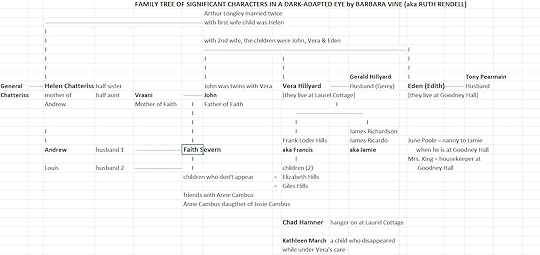

This became a 5 rating after a rough start which was making me angry (usually the harbinger of a 1 star rating). I went back and restarted the book and drew a character tree of family and significant associates to help orient myself which was of enormous help. In case it is of help to others, I've copied it below.


A rough family tree for "A Dark-Adapted Eye". Image from my own screenshot.

This is by no means an easy book to follow and I can understand Ruth Rendell deciding to publish it using an alternate penname. It is far more complex than the lighter Inspector Wexford mysteries or the noirish non-Wexford books which were issued under Rendell's own name.

Vine starts the book on the morning of the execution of Vera Hillyard in the late 1940s. We open on a family breakfast with Faith (nee Longley, later Severn) and her father John and mother Vraani. We don't yet know why Vera has been condemned and will only learn about it gradually. A great number of characters are mentioned by name without any introductions, such as Helen, Chad, Francis, Jamie etc. and the confusion starts. Who are these people? And why aren't they being introduced properly? An element of frustration sets in for the reader, so you need to have patience.

Gradually the book takes shape as Faith (in later life) is enlisted as a source by a journalist who is writing a book about the Vera Hillyard case. Periodically we can read chapter excerpts of the planned book as they are passed on to Faith. These are written in a more factual manner which helps fill in the backstory. What seemed at first a case of one murder becomes a complex examination of other possible murders, child abductions, poisonings, abuse and sisterly rivalry within the extended Longley family, mostly taking place during the World War II years when Faith at a young age was sent to spend time with her aunts Vera and Eden in the countryside and away from London which was regularly under bombing attack by Nazi Germany. There are revelations from both those years and from Faith's discoveries in later life.

This was the most complex book yet in my current Ruth Rendell/Barbara Vine binge read/re-read and my first of the Barbara Vine series. It is also my first 5 star for its masterful tension and suspense and complexity. There is a tiny element calling for an Ambiguous Ending Alert™, although I think most readers will have no trouble deciding on a parentage which is left somewhat open to doubt due to contradictory evidence in the book.


Cover image for the original Viking UK hardcover edition from 1986. Image sourced from Wikipedia.

Trivia and Links
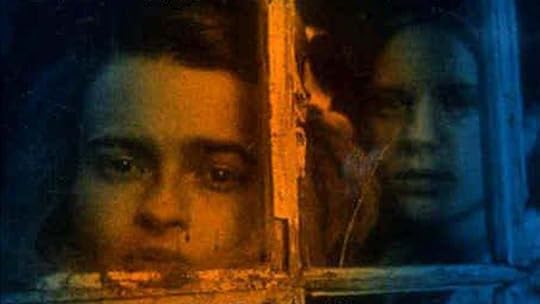
A Dark-Adapted Eye was adapted for television in a 2-part TV miniseries as A Dark Adapted Eye in 1994 with Helena Bonham Carter in the role of the older Faith Severn. You can watch the entire 2 episodes on YouTube starting with Part One here.

* I used an excerpt from Corinthians 13:12 for my lede.
Profile Image for Bruce Beckham.
Author 85 books460 followers
October 17, 2018
Daft as it may seem, I make a point of avoiding reviews before I read a book. However, I had a notion that A Dark Adapted Eye was a bit different. Indeed, something of a groundbreaker, back in the day.

But having DNF’d for the second time, I perhaps ought to have broken my rule.

As a big fan of Ruth Rendell, I have grown to appreciate her pared ascetic prose. Goodreads tells me I have read 3 other of her ‘Barbara Vines’, but I don’t recall such a dense literary style as employed in this novel. Now, I’m not saying this was bad (quite the opposite in many respects; it’s beautifully worded) – but it rather compounded the main barrier to progress.

At an early stage, the reader learns this is a book about the female narrator’s aunt (Vera), who was the last woman to be hanged in England. It is written in the first person, and the story seems to be leading up to revealing what Vera did to deserve the drop.

Then comes the difficulty. The narrator appears to expect the reader to know everyone of whom she speaks (we’re talking family, and circle of acquaintances). I just counted: by 4% into the book, 14 people have been mentioned; by 10% it’s 37 of them!

I struggle with our five kids’ names, and they keep phoning to demand I transfer money. But to remember 37 strangers – largely without introduction – I found impossible. Thus overwhelmed, I didn’t enjoy the state of discombobulation that ensued. It was a relief once again to throw in the towel.

And at least now I can read some reviews and find out what I’m missing.
333 reviews
January 28, 2014
This was hard work. It has the flavour of a police report or schoolboy essay - it's very important to get all the information in & detail exactly who all the characters are & what they ate but style or interest are alien concepts to the author. It's very dry & it took me a long time to get into it. The novel seems to be building to some climactic revelation but there is none. There is a sort of a secret but this is telegraphed from the start so hardly any kind of surprise when the narrator finally wakes up to it.
Profile Image for Algernon.
1,844 reviews1,166 followers
November 6, 2024
The only kind of death that can be accurately predicted to the minute had taken place ...

A very chilling prologue, one that kept me turning the pages eager to find out not whodunit, but whydunit? After my first book from her catalogue, I can now say that if this is the sort of psychological murder mystery that Ruth Rendell / Barbara Vine writes, I want more of the same : in-depth character study, sharp psychological observations anchored in the social tapestry in which these crimes are committed. And what about this multi-purpose title that can be interpreted in so many ways?

Dark adaptation : a condition of vision brought about progressively by remaining in complete darkness for a considerable period, and characterized by progressive increase in retinal sensitivity. A dark-adapted-eye is an eye in which dark adaptation has taken place.
James Drever, A Dictionary of Psychology


The reader starts the journey in the darkness of family secrets, carefully kept by Faith Severn and her relatives for decades, a sort of silenzio stampa regarding their aunt/sister/mother Vera Hillyard, convicted for murder and hanged at the end of a controversial trial. As we follow Faith Severn confessions about her childhood and visits to Laurel Cottage where her aunt Vera lived, stories told decades later to an investigative journalist who wants to write a book about the life of the criminal woman, our eyes become adapted to the darkness of the things that happen behind closed doors and in the minds of people tormented by their own repressed passions.

I have read enough to tell – to hope – he will be sensitive, he will not be too harsh, he will understand the terrible pressures of love.

Faith invites us here to contemplate these ‘terrible pressures of loves’ as the main reason Vera Hillyard decided one day to walk into a child’s bedroom carrying a knife. She also talks about the changes that happened in the English society, in the world in general, in the first half of the twentieth century: a radical transition from one generation to the next, from the rigid and puritan Victorian morals of her parents, with their uncompromising caste system, to the children who grew with war and rations and a seize-the-moment approach to life.

In the nineteen-twenties, English people, notably English country people, still retained a deep distrust of foreigners.

My father really did go on about this sort of thing, behaving as if human beings were biologically monogamous, imprinted with the image of a single partner as the grey goose is or the gibbon. In his view, changing the mate you had first selected was tantamount to a defiance of nature.

You could say that, because she was with them in that way, she partook of their social position, but really this would be a false impression. Of course, it’s all nonsense now but it wasn’t then.

... to put forward a curious postulation. This is that in the early part of the twentieth century, more specifically from 1910 till about 1940, there was a definite cult of aligning blondeness with beauty, so that a dark-haired woman was considered less well-favored than a fair one, often irrespective of other claims to beauty such as feature, figure or eye colour.

Living in a small village where everybody knows your business plays an important part in a drama that, Faith observes, could not have happened a couple of decades later. People of her parents and grandparents generation lived in that spotlight of local gossip and were desperate to maintain the facade of their allocated spot on the social ladder.
Both Vera and her beautiful younger sister Eden were considered to have married above their stations: Vera to an older officer in the Indian Army and, years later, Eden to a rich landowner, after a tumultuous and more than a little racy career as a Wren during the war.
Once the best of friends living together in their small cottage, Vera and Eden will come to blows over custody of Jamie, the child Vera gives birth to while her husband is on the front lines in the war.

The dark-adapted eye by now becomes my 2024 reader eye, one that has spent so many times in the darkness of crime stories and family thrillers and secret liaisons that the motive of the dispute between Vera and Eden is obvious, making me wonder both how people can get so desperate to hide their feelings and to keep appearances in the eyes of the neighbours.

‘It makes you see what bringing people up by these rigid rules can lead to,’ Francis said, and he was right there, in more ways than one.

Francis is Vera Hillyard’s older son, a man who kept his own secrets and who now lives in self-imposed exile in Italy, where he became a famous chef.

The investigation is complicated by several red herrings, possibly unrelated kidnappings of little children, suspected poisonings with ‘Cortinarius purpurascens’, direct emotional involvement of Faith, the refusal of both Vera and Eden to confess their true hearts even to family members. Could the tragedy have been avoided if these English country folk were less prone to keep a stiff-upper-lip and arranged an intervention when emotions started to run amok? Faith has lived her whole life burdened by these ‘whatif’ scenarios, one of the reasons she has finally decided to share the letters and the memories with the investigative journalist.

I think now that what we both felt, what we onlookers all felt, was that there was so much more to this than met the eye, so many submerged secrets contributing to it, things deliberately kept from us, that we should be making fools of ourselves if we expressed opinions and advised courses.

What a question! Had I ever known her happy? What form would Vera happiness take? I had seen her busy, bustling, hysterical, panic-stricken, jubilant, triumphant, frustrated, petulant, angry, but I had never seen her happy.

>>><<<>>><<<<

There is in this novel a second argument to be weaved into the story of Vera Hillyard, one that sees her as a victim of that dying Victorian male dominated society, one where women had clearly defined roles and one where tresspassers must be exemplary punished in order to keep their sisterhood in its place. Vera and Eden were born into this social milieu, and their freedom of choice was severely curtailed by education, by economics, by the morality police.

Having elicited from me that I could neither knit nor sew, crochet or embroider, Vera sighed as heavily and looked as despondent as if I had said I could not master the alphabet or control my bodily functions. She said, incredibly:
‘Well, I’m sure I don’t know what kind of a wife you’ll make.’


and,
She had no money and no means of earning any and nothing to sell.

Even the administration of justice is shown to be biased against women, with Rendell mentioning here two infamous instances of the death penalty for the terrible pressures of love in the judgements of Edith Thompson and Ruth Ellis. This study of the case of Vera Hillyard becomes thus an argument for the abolition of the death penalty, accomplished in Great Britain decades ago, but still abused in other parts of the world.
As I tried to read more about these women who paid with their lives for crimes of passion, I came across a statement from the novelist Raymond Chandler, then living in Britain, wrote a scathing letter to the Evening Standard referring to what he described as "the medieval savagery of the law" [wiki]
Profile Image for Jenny.
64 reviews5 followers
July 22, 2014
If you are looking for a light, easy to read book where the ending ties everything up in a neat bow, then this is not the book for you.

This is a complex read where the narrator slowly unfolds events of the past. We are introduced to a vast array of family and friends, some important, some mere names, but we don't know who is important and who is not. The time frame shifts and changes as the narrator, Faith, recalls almost at random, events from the past.

For the first few chapters I was left adrift, confused by the passing parade of characters and hints of events that are not fully explained. But slowly this jigsaw began to take shape and I was pulled into the narrative, unable to put the book down. I read long into the night, before finally falling asleep, only to wake a few hours later at 2.00am and get up and start reading again. That's how powerful a mystery this was.

The ending wasn't totally unexpected and yet there were still doubts, with the reader left to make up his or her own mind as to what really was the truth. I wanted to rush back and start reading the book all over again, hoping for greater insight or maybe finding an overlooked clue. I longed to find others with whom to discuss the book, to sit down over a cup of tea and find out what they thought really happened. And now, days later, I am still pondering the ending like a dog at a bone, wondering if the author herself ever gave an interview where she set the record straight. Thank heavens for Google!

I know this is a book that will take it's place as one of the best I have read, a book that I will recommend to family and friends when they ask me about my favourite mysteries. It will stay with me for a very long time to come.

Profile Image for M.J. Johnson.
Author 4 books228 followers
August 26, 2016
I have just read my very first Barbara Vine novel, A Dark Adapted Eye. Once I'd finished it, I took a quick peek at some of the reader reviews that have been posted for the book on Goodreads. They are fascinating and insightful, again driving it home to me that a reader's experience with a novel, though in some part down to mood and situation, is often a matter of whether or not the book (assuming the work itself is basically sound!) finds the audience the author hoped to reach.

I understand A Dark Adapted Eye was Barbara Vine's (who of course wrote the Inspector Wexford series as Ruth Rendell) first outing. This is a hauntingly dark, psychological crime novel, a story about the repercussions of a murder upon a family, and its secrets. It is extremely well plotted and the writing itself is unquestionably very skilful. At times I felt that Vine's habit of providing the reader with minute detail about a room's wallpaper, a hat that is worn, or the description of the cover of a book once spotted lying on a shelf, can get a little tedious - but this is probably just me! The book is well worth reading and the family history and roll-call of names the reader has to become acquainted with is worth the effort.
Profile Image for Ahtims.
1,673 reviews124 followers
January 1, 2016
My first book of 2016. One of my favourite authors, as well as favourite genre.
Ruth Rendell/Barbara Vine always delivers what she promises to -i.e., toothy, dark, psychological mysteries, with lots of troubled minds and secrets, with a murder or two thrown in, which can be either immediate, or long forgotten.
This is the first book written by Ruth Rendell as Barbara Vine, and towards the end, she gives an explanation about both her names, which is as interesting as the story she has written.
In a Dark Adapted Eye, a woman murders, and is hung to death by law. It falls to her half niece to piece together the facts before and after the murder, to find out why she did what she did. Most of the book is from the view point of the niece, Faith, who comes across as a keen observer and an intuitive thinker.
Thoroughly enjoyed this one, though I had to re read the first 10% as the initial events were difficult to assimilate, being jumbled in time and place. Once I got the hang of the story, there was no looking back.

Profile Image for John.
1,686 reviews130 followers
October 25, 2023
Right from the beginning we know Vera has murdered someone and is hanged. We then are introduced to a range of characters including the beautiful, vain Eden. She is Vera’s sister and they have a love hate relationship. Who did Vera kill and why?

This psychological story is one with many layers and has a good twist at the end which twists again and may have the reader flicking back. The many characters all interweave well with them all playing a role that adds to the story.

Not a bad winner of the Gold Dagger.
Profile Image for Teresa.
1,492 reviews
March 29, 2016
Nos romances policiais de Ruth Rendell (Barbara Vine) não são os corpos assassinados que são dissecados, sangrados; são as mentes dos que morrem, dos que matam, dos que sobrevivem...

"O amor de mãe por seu filho é diferente de qualquer outra coisa no mundo. Ele não obedece à lei ou piedade, ele ousa todas as coisas e extermina sem remorso tudo o que ficar em seu caminho."
(Agatha Christie)
Profile Image for Franky.
615 reviews62 followers
October 13, 2024
Barbara Vine has quite a following, and given the reviews, whether A Dark-Adapted Eye is one of her better works seems to be a point of contention. This was my first read by this author, and for my money, I felt that the novel had quite a few problems that kept it more in the mediocre range.

Our narrator is Faith Severn, niece to Vera Hillyard, who was sentenced and executed for the murder of her sister, Eden. As she learns that Daniel Stevens, a journalist, is to embark on a project to tell Vera’s story, Faith’s narrative sheds light on the timeline of the family history and those closely associated with Vera. As it is 35 years since the murder and Vera’s trial and subsequent hanging, Faith hopes to form a picture of how and why events transpired.

In the present, even though many of the family have tried to separate themselves from Vera and sweep this under the rug, Faith feels as though tracing Vera and the family is unavoidable:

“She has come back into my life after an absence that extends over more than a third of a century. Helen and Daniel Stewart have brought her to me and she is here in the house…”

While the premise of this novel sounds intriguing and gripping, the process for the reader to sort through this book is not.

For one, this book introduces far too many characters in both the family and those associated with the family—some integral to the plot, some not—and it becomes a chore to figure out said person’s context or relation to other characters around them. A few reviewers had suggested that a family tree be inserted in the preface somewhere to give some clarity; I agree wholeheartedly.

Secondly, there are shifts in time back and forth with moments of supposed import, but Faith has a voice that speaks of these events in a same consistent, off-handed, unassuming manner that gives no particular moment a stronger level of significance over another. Because of this, the time delineations are quite confusing because there is little to suggest a shift is coming or that anything in the way of a vital juncture has arrived.

The novel redeems itself somewhat in the final thirty pages or so, which are easily the most impactful and gripping, but it feels like we have to wade through so much to get here. It’s here where the pieces come together and give us a better picture.

At the end of the day, I can only say that the novel was so so, but like I said, some have indicated that this is not one of her better works, so maybe I will look into others.

Profile Image for Chaitra.
4,493 reviews
February 8, 2017
I hadn't read any books of Barbara Vine or of her other name Ruth Rendell. I went in to this with no expectations whatsoever. What I found was a tightly plotted yarn, but at the same time, it moved at a glacial pace. There's a subversion almost, of the whodunnit mystery genre. Vine tells us immediately who the killer was, and who got killed. It's the whys and wherefores that we are concerned with in the rest of the novel.

Faith Severn, the niece of the hanged murderess Vera Hillyard, is approached by a biographer who wants to write about Vera and the murder. This is years after the fact, and Faith re-examines everything relevant about the life of Vera, and of the woman she murdered, Eden - her sister. We know this: Vera killed Eden. Vera was hanged for the murder. Several witnesses saw the murder. Jamie, Vera's baby, was seemingly the motive. What made Vera, who was almost obsessively fond of her sister, kill her? What was Vera's life like? Would she have done it if the society were a bit more open? If she had some money of her own?

It was a refreshing change, for me at least, that this was more a character study than a murder mystery. Vera is a beastly person, but, no one can argue that she loved her baby. She's almost sympathetic towards the end, even when we know why she did what she did. The novel is also peopled with other rich characters, for example, Francis - Vera's other son, considerably older than Jamie and much neglected, Eden - a snob and a person who knows what she wants and how to get it, Chad - was he the father of baby Jamie? Or was he someone going out with Eden? It is cleverly plotted, the atmosphere is eerie and ripe for murder.

My quibble with the novel is not plot or characterization or the setting. It's that it is too wordy. This novel is a slog. It's strange, in the sense that I didn't think I was being told anything that didn't need to be told or something uninteresting was happening. I liked the information on the page, I only dispute the way it was presented. There's something old-fashioned about the construct and the language, and I had to struggle to engage with what I was reading. I was reading a 500+ page novel at the same time as this book which is 250 odd pages, and Eye felt twice as long. I wasn't exactly bored, but I was glad to see it finish.

All in all, this is a richly detailed mystery and I enjoyed the plot. I will read more of Vine/Rendell, it could be that I was just not in the mood for a wordy book.
Profile Image for Sara.
502 reviews
October 11, 2011
I read this because of the note I found at the end of Rendell's Shake Hands Forever, describing why she began the Barbara Vine series. Evidently she was always called by two names, since her mother's Scandinavian family had trouble pronouncing Ruth. And they came to symbolize two different personalities for her.

She describes them this way:
"Ruth and Barbara are two aspects of me. Ruth is tougher, colder, more analytical, possibly more aggressive. Ruth has written all the novels, created Chief Inspector Wexford. Ruth is the professional writer. Barbara is more feminine. It is Barbara who sews. If Barbara writes it is letters that she writes. For a long time I have wanted Barbara to have a voice as well as Ruth. It would be a softer voice speaking at a slower pace, more sensitive perhaps, and more intuitive."

Hm, I guess I like Ruth better. This book certainly had a slower pace and it also reminded me of my mother's family stories, with lots of names of people that I had never met and knew very little about, and yet I needed to remember them. Oof. I like the voice of Faith Severn. She did have a lot of family history to get through to make this whole tragic story comprehensible. But if Vine had not taken most of the book to reveal the secret of what really happened, I might not have made it through. Simple curiosity kept me slogging.

The reason I upped my rating from 2 to 3 stars is because it did get better at the end and the characters did turn out to be interesting. But gee, Barbara, can't you cut to the chase a bit faster?
Profile Image for Kay C.
335 reviews3 followers
March 31, 2014
I enjoy most of the books by Barbara Vine/Ruth Rendell; this was not one of them. I was very focused while reading this story but I still had a difficult time following all the different characters that appeared periodically throughout the book. I found myself going back through the text multiple times to figure out what the character's role was. This happened throughout the read. Maybe it is my failing. It is not a very suspenseful book; the story builds the end toward what is revealed in the beginning. One of the things I like about this author is her intelligent writing. I am constantly looking up and learning new words. This is not your 16-year old's easy reading mystery. I also didn't find the story to be particularly compelling, and the ending felt like it dribbled toward a sigh of relief. Nevertheless, I greatly admire the writing and crafting of the novel. It wasn't my cup of tea.
Profile Image for Heather.
276 reviews3 followers
April 25, 2008
Wonderful, tragic, amazingly ambiguous book that demands to be read more than once. I love Vine/Rendell's courage in leaving the central enigma unsolved. I love the way she gradually creates sympathy for Vera, who in the beginning of the book seems absolutely unsalvageable... not because she's a convicted murderess, but because she was so unkind, exacting, hysterical, narrow-minded, and cold when her niece was young. It doesn't seem possible that this horrible woman could end as a figure of such pathos and tragedy. The book also explores several of Rendell/Vine's favorite themes -- the cruelty, spite, and selfishness that can hide in a beautiful young woman; the hypocrisy demanded of "good" women; a woman's pathological love/desire for a child; kidnapping; disputed parentage. And it's a great "period piece," evoking the styles and manners of pre- and post-WWII England.

I highly recommend the BBC miniseries adaptation with Helena Bonham Carter as Faith (the narrator)! Excellent casting, and very faithful to the twisty structure and moral complexity of the book.
Profile Image for Christine.
7,224 reviews571 followers
May 29, 2012
A great human desire driven gothic novel about a family. Vine (Rendell) has the ability to make the reader even feel sorry for the murderer. This is an incredibly well done book.
Profile Image for Virginia.
1,288 reviews167 followers
May 24, 2021
Ahhh. Finishing this book is like completing a very involved, cerebral university-level course involving genealogy, history, psychology, class struggles, fashion, the history of childbirth, sexual politics and the entire British justice system, and then scraping through the 12-page exam book at the end of the course. I was forced to take copious, meticulous notes on the mind-blowingly expansive Longley family tree that included original names, aliases and new names, and the various marriages, connections and relationships, along with a long and careful timeline of events. My point is that every single detail is relevant (the previous reader of my ancient copy had written in the margin of the May Durham detour "WHO CARES?) - but it's all relevant and each detail is a fascinating part of the pattern. The entire book is a blockbuster of sounds, textures, tastes and scents.
The scent that emanated from those drawers as I opened them and peered in and sniffed was a mingling of talc, rosewater, lemons and acetone. There were dozens of lipsticks, literally dozens, for I counted one evening and made it a hundred and twenty-one. There were of all possible reds and there was one that was orange and only went red when you put it on your mouth. I knew that because I tried it out.
Eventually we ate the roast rabbit. It was dried up and flaky by then and the carrots tasted as if arrested in a phase of wine-making.
I'm glad I stuck with this book to the end. Some of its mysteries are solved, some are not, but it's been a master class in writing that I'd recommend to anyone with time and patience and an ear for the occasional delicious phrase ("I saw all that in their forked radish nakedness"): perfect pandemic reading. 5 stars.
Profile Image for Lobstergirl.
1,922 reviews1,436 followers
October 21, 2014

From the very first chapter of A Dark-Adapted Eye we know that a woman has been hanged for the crime of murdering her sister. What we don't know is why. Ruth Rendell, writing as Barbara Vine, takes us back and forth (and back and forth, and back and forth) from the 1950s to the present (the 70s or 80s), to the 1890s, the 1930s, the 40s, the present again, etc. Our first-person narrator, Faith Severn (the hanged woman's niece), introduces characters without telling us right away how they fit into the story. For example, it's not until close to the end of the novel that we find out who Faith's husband is. And then we find out that he's not currently her husband, they got divorced, so she's on her second husband. It can get confusing, and you wish she had provided a family tree. The novel is like a skein of wool, and the act of reading is pulling the thread until you get to the center of the skein and all most is revealed. In spite of giving us large chunks of the facts upfront, nonetheless much is revealed over the novel's course, drip by drip. The last 40 pages or so are as tense as any thriller I've read - even though we know the outcome. It's suspensefully and brilliantly done.
Profile Image for Michael.
598 reviews124 followers
December 21, 2015
Two sisters, devoted to each other over many years, one carrying for the other like a mother. How could the older ever have been convicted of killing the younger?

This is the question that the novel attempts to answer. Well written, it is a story of a British family over a twenty year period from the 1930s up to 1950. On the surface, a perfectly proper (if snobby) family situation. But peel the facade away to reveal a properly dysfunctional scene of obsession taken to the breaking point.

This book was a bit of a chore to read, but worth finishing. However, I didn't appreciate the many unanswered questions raised at the end of the book. Call me old fashioned, but I prefer a story that wraps up its plot lines neatly in a bow. This book does not do that and ultimately left me profoundly disappointed.
Displaying 1 - 30 of 646 reviews

Can't find what you're looking for?

Get help and learn more about the design.