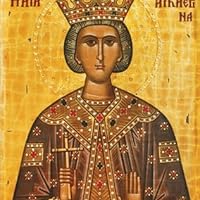
"Perhaps those eyes capable of seeing love will be able to see how Christ himself comes out, quietly and invisibly from the sanctuary of the altar, protected by a splendid iconostasis. The
singing continues to resound, clouds of incense still rise, the faithful are overcome by their ecstatic contemplation of beauty. But Christ goes out to the church porch, and mingles with the
crowd of the poor, the maimed, the cast-off, the embittered, the holy fools. Christ goes to the streets, to prisons, to hospitals and into the shacks. Christ again and again gives his life
for his friends." (Mother Maria Skobtsova, p. 71)
How often the biographies and writings of the church fathers of the first Christian centuries are recommended to us and rightly so! Standing on the foundation of Christ, Peter and the apostles, and the martyrs, they discerned the will of the Holy Spirit, determining the legitimate canon of
Holy Scripture and the rightful elements of Holy Tradition. But the Spirit-filled lives of holy men and women within Orthodoxy has never slowed, never dimmed, even when the times they lived in seemed darkest.
The late 19th and 20th centuries, given the string of global holocausts coupled with Communist attempts to crush the Church, feels like one of those somber times. Michael Plekon, however, examines the lives of ten “living icons” who fully cooperated with Grace in this period and manifested in themselves the finest fruits of theosis in spite of dislocation, persecution, and death.
The lives of St. Seraphim of Sarov, Mother Maria and Fr. Lev Gillet (perhaps you already know Gillet by his pen name: “a Monk of the Eastern Church”) show the heights of spirituality combined with the depth of Christian charity. Frs. Schmemann, Meyendorff, Bulgakov, and Afanasiev embody the regenerative power of the Church’s intellectual and theological life. They pushed against the layers
of platitudes that, over time, had dulled the brilliance of the Orthodox liturgy and sought to reclaim the full spirituality within the highest and best liturgical practices. Plekon doesn’t shy away from the controversies they all caused, including those from the life of Fr. Alexander Men, who was murdered in 1990 by unknown assailants in Moscow.
Why read a book about these modern men and women of faith? Plekon quotes theologian Paul Evdokimov:
"By their active presence, lay people continue the liturgy of the Church. By their active presence, they introduce into society and all human relationships the truth of the dogmas they live, thus dislodging the evil and profane elements of the world … Here is a magnificent definition,…by one’s whole being, by one’s whole existence, to become a living theology…the luminous place of the presence of the Parousia, God’s coming again." (p. 280)