

What do you think?
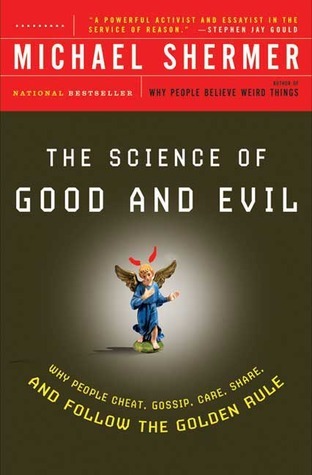
The Science of Good and Evil: Why People Cheat, Gossip, Care, Share, and Follow the Golden Rule
From bestselling author Michael Shermer, an investigation of the evolution of morality that is "a paragon of popularized science and philosophy" The Sun (Baltimore)
A century and a half after Darwin first proposed an "evolutionary ethics," science has begun to tackle the roots of morality. Just as evolutionary biologists study why we are hungry (to motivate us to eat) or why sex is enjoyable (to motivate us to procreate), they are now searching for the very nature of humanity.
In The Science of Good and Evil, science historian Michael Shermer explores how humans evolved from social primates to moral primates; how and why morality motivates the human animal; and how the foundation of moral principles can be built upon empirical evidence.
Along the way he explains the implications of scientific findings for fate and free will, the existence of pure good and pure evil, and the development of early moral sentiments among the first humans. As he closes the divide between science and morality, Shermer draws on stories from the Yanamamö, infamously known as the "fierce people" of the tropical rain forest, to the Stanford studies on jailers' behavior in prisons. The Science of Good and Evil is ultimately a profound look at the moral animal, belief, and the scientific pursuit of truth.
A century and a half after Darwin first proposed an "evolutionary ethics," science has begun to tackle the roots of morality. Just as evolutionary biologists study why we are hungry (to motivate us to eat) or why sex is enjoyable (to motivate us to procreate), they are now searching for the very nature of humanity.
In The Science of Good and Evil, science historian Michael Shermer explores how humans evolved from social primates to moral primates; how and why morality motivates the human animal; and how the foundation of moral principles can be built upon empirical evidence.
Along the way he explains the implications of scientific findings for fate and free will, the existence of pure good and pure evil, and the development of early moral sentiments among the first humans. As he closes the divide between science and morality, Shermer draws on stories from the Yanamamö, infamously known as the "fierce people" of the tropical rain forest, to the Stanford studies on jailers' behavior in prisons. The Science of Good and Evil is ultimately a profound look at the moral animal, belief, and the scientific pursuit of truth.
368 pages, Paperback
First published January 1, 2004
About the author
Michael Shermer
99 books1,183 followersMichael Brant Shermer (born September 8, 1954 in Glendale, California) is an American science writer, historian of science, founder of The Skeptics Society, and Editor in Chief of its magazine Skeptic, which is largely devoted to investigating and debunking pseudoscientific and supernatural claims. The Skeptics Society currently has over 55,000 members.
Shermer is also the producer and co-host of the 13-hour Fox Family television series Exploring the Unknown. Since April 2004, he has been a monthly columnist for Scientific American magazine with his Skeptic column. Once a fundamentalist Christian, Shermer now describes himself as an agnostic nontheist and an advocate for humanist philosophy.
more info:
http://us.macmillan.com/author/michae...
http://en.wikipedia.org/wiki/Michael_...
Shermer is also the producer and co-host of the 13-hour Fox Family television series Exploring the Unknown. Since April 2004, he has been a monthly columnist for Scientific American magazine with his Skeptic column. Once a fundamentalist Christian, Shermer now describes himself as an agnostic nontheist and an advocate for humanist philosophy.
more info:
http://us.macmillan.com/author/michae...
http://en.wikipedia.org/wiki/Michael_...
Ratings & Reviews
Friends & Following
Create a free account to discover what your friends think of this book!
Community Reviews
Displaying 1 - 30 of 94 reviews

May 27, 2014
Traditional view of social scientists has been that over time culture dabs a natural human behavior as moral and another immoral. So morality is an arbitrary notion that can be created and built upon a specific behavior and nature of humanity. In other words, morality is a social construct, thus it is culturally relative. But evolutionary psychologists such as Michael Shermer and sociobiologists like E. O. Wilson argue that there is a “science of morality”, that is, morality, like any other features of humanity, is emerged over the course of human evolution and it existed before civilization and religion. Shermer argues that humans are not the only ones in possession of morality. “premoral sentiments,” as Shermer calls them, are the behaviors that humans share with other social animals, particularly with other great apes:
These premoral sentiments, according to Shermer, are evolved as restraints. They are evolved in societies in order to restrain individual selfishness and encourage cooperation and altruism. To restrain belligerence, evilness, immorality, non-virtuousness, and encourage peace, goodness, morality, and virtuousness.
Traditional opinions on human nature are divided into two classes: pessimists and optimists. Pessimists share Machiavelli’s version of human nature in which he believes that people never do good unless they are forced to. Optimists agree with the intellectuals of the eighteenth century enlightenment called philosophes, who believed human nature to be benevolent. Or even Marxists can be called optimists, for they believe(d) that if humans get the economic conditions right, class will disappear and people will live naturally in egalitarian harmony.
Neither pessimists nor optimists, evolutionary psychologists like Shermer believe that humans are, by nature and intrinsically, good and evil, moral and immoral, altruistic and selfish, cooperative and competitive, peaceful and bellicose, benevolent and brutal, virtuous and non-virtuous.
Shermer argues that moral sense is “evolved out of behaviors that were selected for because they were good either for the individual or for the group.” And immoral sense is the opposite of it, that it is evolved out of behaviors that were selected for because they were bad either for the individual or for the group. In terms of “feeling,” moral sense is the “the psychological feeling of doing ‘good’ in the form of positive emotions such as righteousness and pride,” as Shermer says. Immoral sense, on the other hand, is the psychological feeling of doing “bad” in the form of negative emotions such as “guilt and shame.”
But it is wrong to say that the definition of morality and immorality in every culture and society throughout the history is fundamentally the same. In other words, cultures may differ in tagging a particular behavior as good or bad, as moral or immoral. Although there will always be conflicts between distinct sides of human evolved nature, with some societies and cultures favoring and moralizing one side and some another side, but there is an evolved universality in humans, in all cultures through history that has a tendency toward the moral sense of feeling good or feeling bad about a particular behavior. That is, a sense of right and wrong is a shared characteristic of all human societies, both civilized and pre-civilized.
Summing up of the main points of the book:
* Culture is in close relation with nature and is channeled and limited by it.
* Morality is intrinsic.
* Morality is evolved through history and selected by natural selection and forces of culture in order to adapt humans with nature; it is the result of gene-culture coevolution.
* Morality is continuous with animal social instincts.
* Humans are both moral and immoral, good and evil.
* Some individuals and people some of the time in some circumstances are more or less immoral and moral than other individuals and people.
attachment and bonding, cooperation and mutual aid, sympathy and empathy, direct and indirect reciprocity, altruism and reciprocal altruism, conflict resolution and peacemaking, deception and deception detection, community concern and caring about what others think about you, and awareness of and response to the social rules of the group.
These premoral sentiments, according to Shermer, are evolved as restraints. They are evolved in societies in order to restrain individual selfishness and encourage cooperation and altruism. To restrain belligerence, evilness, immorality, non-virtuousness, and encourage peace, goodness, morality, and virtuousness.
Traditional opinions on human nature are divided into two classes: pessimists and optimists. Pessimists share Machiavelli’s version of human nature in which he believes that people never do good unless they are forced to. Optimists agree with the intellectuals of the eighteenth century enlightenment called philosophes, who believed human nature to be benevolent. Or even Marxists can be called optimists, for they believe(d) that if humans get the economic conditions right, class will disappear and people will live naturally in egalitarian harmony.
Neither pessimists nor optimists, evolutionary psychologists like Shermer believe that humans are, by nature and intrinsically, good and evil, moral and immoral, altruistic and selfish, cooperative and competitive, peaceful and bellicose, benevolent and brutal, virtuous and non-virtuous.
Shermer argues that moral sense is “evolved out of behaviors that were selected for because they were good either for the individual or for the group.” And immoral sense is the opposite of it, that it is evolved out of behaviors that were selected for because they were bad either for the individual or for the group. In terms of “feeling,” moral sense is the “the psychological feeling of doing ‘good’ in the form of positive emotions such as righteousness and pride,” as Shermer says. Immoral sense, on the other hand, is the psychological feeling of doing “bad” in the form of negative emotions such as “guilt and shame.”
But it is wrong to say that the definition of morality and immorality in every culture and society throughout the history is fundamentally the same. In other words, cultures may differ in tagging a particular behavior as good or bad, as moral or immoral. Although there will always be conflicts between distinct sides of human evolved nature, with some societies and cultures favoring and moralizing one side and some another side, but there is an evolved universality in humans, in all cultures through history that has a tendency toward the moral sense of feeling good or feeling bad about a particular behavior. That is, a sense of right and wrong is a shared characteristic of all human societies, both civilized and pre-civilized.
Summing up of the main points of the book:
* Culture is in close relation with nature and is channeled and limited by it.
* Morality is intrinsic.
* Morality is evolved through history and selected by natural selection and forces of culture in order to adapt humans with nature; it is the result of gene-culture coevolution.
* Morality is continuous with animal social instincts.
* Humans are both moral and immoral, good and evil.
* Some individuals and people some of the time in some circumstances are more or less immoral and moral than other individuals and people.

February 9, 2007
This book was a great attempt at explaining the origins of morality and ethics through evolutionary processes. After reading this book I can proudly say I an atheist (or non-theist) with morals that aren’t arbitrary or selfish. Evolution can explain altruistic behaviors. Many religious people believe the fallacy that it is impossible to be moral without God. This is simply not true and Michael Shermer does a great job at explaining why. However, he is careful to point out that evolutionary ethics isn’t necessarily prescriptive. Humans need to consciously devise their own provisional ethics that aren’t completely relative but are still flexible to accommodate most people and cultures. I’m convinced naturalism needs to replace religion at some point in the future for humans to progress but before that we must have a solid moral and ethical framework based on science and this book is a great start.

September 29, 2009
Ever since the kids were old enough to focus on the refrigerator we’ve had the Falk Household rules there, sort of a cross between Asimov’s laws of robotics and basic kindergarten. These are, in order of importance:
1. Don’t hurt anybody.
2. Don’t break anything.
3. Do what your parents and teachers tell you.
(In kindergarten, rule #3 would probably have been “share” or something like it, and I admit it was a somewhat controversial later addition, but we ended up putting it in to assure that 2-year olds would accept third-party foresight to avoid the inevitable, “Ouch!” “Be careful.” “Now you tell me.”) I’m incredibly proud of my daughter that she herself, at age 5, added a zeroth rule: “No whining.”
Well, how would you codify morality? That is precisely the problem that Michael Shermer takes on in this book, after dismissing religion as a viable model (too intolerant of outgroups, see e.g., at p. 233, et seq.) and god(s) as nonplayer(s)/nonactor(s) (a la Dostoyevsky's Brother's Karamazov, discussed GoodReads style on pp. 148-149). In the process, Shermer attempts to reassure us religion and its god(s) are bathwater, not baby, and that for good evolutionary reasons that build basic morality into our species' hardware, ethics will not simply devolve into an anything goes/might-makes-right ethos. The author's reasoning is fairly compelling when he doesn’t ramble (his persuasive discussion of the pre-religious role of trade in promoting positive interrelations is thrown in as an apparent afterthought at page 255 instead of inserted its logical place in the "Why We are Moral" section at the beginning of the book), repeat himself (pages 10-12 and 19-21 are each summaries of the book's entire thesis), or use fuzzy logic in the employment of fuzzy logic (as he does to cast his proposed ethical philosophy as rooted in science, when it appears to be rooted in arbitrarily-defined statistical manipulation -- more on this below). That said, I found Shermer's selected lit-review of state-of-the-art peer-reviewed, published studies in anthropology, cognitive neuroscience, and evolutionary biology itself worth the price of admission.
Shermer defines ethics as the principles, codified or not, that form the basis for cooperative social norms (when trust works to mutual benefit and under what conditions it is likely to be undermined by competition). He defines morality as the way we act on those principles, and philosophically proposes a generic system we might use in order to form a more perfect species. He even goes so far as to play out how his system might be used to address issues ranging from lying and adultery to the contemporary hot-button ethical conundra abortion, cloning, and animal rights. In a nutshell, Shermer suggests that we should view the world as a complex continuum of qualities. Rather than promoting the binary attributes of good-evil and guilty-not guilty he proposes a sliding scale of desirability, the way we read a range of temperatures in terms of personal comfort. This sounds great in theory in the face of nuanced choices (at what stage of development should the rights of a fetus triumph those of the mother/parent/society; under what circumstances is deception more harmful than helpful; etc.), but in practice, it yields some hinky calculus.
Consider, for example, the sanity-qua-culpability of John Hinckley, Jr. at the time of his assassination attempt on Ronald Reagan (ostensibly on behalf of Jodi Foster). Shermer suggests, "We can see in Hinckley's background that the shift from insanity to sanity was a fuzzy one, say, .9 sane and .1 insane in his youth, to .8 sane and .2 insane in his teens, to .7 sane and .3 insane during his two years of college, to .6 sane and .4 insane during his year in Hollywood, to .5 sane and .5 insane during the following year of aimless drifting, to .4 sane and .6 insane as he pursued Foster at Yale, to .3 sane and .7 insane as he contemplated assassinating Carter or killing himself, to .2 sane and .8 insane when he hatched the idea to assassinate Reagan, to .1 sane and .9 insane when he penned his final letter to Foster and headed for the Hilton Hotel with his gun in hand and his moral sense fully disengaged." (pp. 123-124; Shermer supports this unscientific allotment of ratios with three photographs which "show the slow and gradual (and fuzzy) deterioration of [Hinckley's:] mind over time.") At p. 126, Shermer concludes (emphasis mine), "Between .1 and .9 is still not 0 or 1, and so a scientific approach upholds moral culpability."
Scientific, huh? Good luck with that line of argument before opposing counsel, Mr. Shermer. Allow me to cross-examine the witness, Your Honor. Mr. Shermer, would you please read the underlined passage from pages 164-165 of this same book? "[I:]t is clear that you can cook the numbers to make it come out almost any way you like. Doing this on a societal level is simply impossible." I see. Would you please proceed by substituting the words 'fuzzy logic' for 'utilitarianism' in the following passage? "Fuzzy logic [the process of assigning fractional values to incremental aspects of a continuum of qualities to promote statistical analysis:] is very much grounded in pre-twentieth century psychological, social, and economic theory that presumed humans (at least Western industrial peoples) to be rational beings who make choice calculations along the lines of a double-entry bookkeeper…. Moral choices, then, were simply a matter of looking at the bottom line." Mr. Shermer, would you care to distinguish your application of fuzzy logic to morality from Jeremy Bentham's 7-tiered hedonic scale of utility which you so tellingly dismiss? What's that? Crickets, and unfortunately I don't mean Jiminy.
There's a bit more Victorian-era pseudoscience on page 48, where Shermer presents his Bio-Cultural Evolutionary Pyramid. This is a vision of moral “progress,” the broad base level of which is a selfish struggle for survival and reproduction which proceeds gradually by way of care for immediate and extended family, community, society, preservation of the species as a whole, to the currently crunchy pinnacle of serving as Lord High Protectors of the biosphere. Curiously, this is as far as Shermer goes, apparently being unwilling or incapable of envisioning personal identification with still broader nets of creatures and things in the space-time continuum. This is probably just as well, given that even Shermer will admit that acknowledgement of the preeminence of the biosphere in even a plurality of the world's individual human moral decision-making is yet some ways away. Leaving aside questions of the shape or extent of this theoretical scale for measuring human evolutionary moral development (where the greater the scope of the group with whom a person identifies, the greater the sphere of enlightenment/righteousness one can claim), I think Shermer faces a huge problem operationalizing it.
Why propose a hierarchy for ethical motivation at all? Shermer does not argue his pyramid should form a basis for the moral principles he espouses, nor is it apparent that it serves to structure a reading of human history (and the author is vague or at least too long-view when it comes to parsing whose history we are here considering, over what period of time, and how motivational benchmarks are determined). In fact, defining the sheer quantity of variables over any proposed measurement scale seems impossible to me. How should a person (or a group or a state or a scientist) determine what actions are good for humanity as a whole? For the biosphere? Over what period of time? In a reasoned dispute between even two bona fide, intelligent, well-informed people over what course of action to pursue how are we to judge rightness or success? Using this hierarchy as a guiding philosophy seems like crewing a circular trireme -- with everyone pulling on the oars that ring the boat, you expend a lot of energy and still get nowhere.
Shermer more or less begins and ends this book by considering the pre-biblical, anthropologically and historically universal, (and arguably therefore logically endemic) behavioral success strategy known affectionately to game theorists as "Tit-for-Tat" in its simplest form, "Firm-but-Fair" in a slightly more sophisticated version, and as the Golden Rule as codified variously in Western philosophy/theology. This is the old saw, "Do unto others as you would have them do unto you/do not unto others that which is hateful to you." The questions then become who decides and what, if any other limits to behavior are there? Shermer is a self-described "provisional libertarian." That is, he'd prefer "a stateless society governed entirely by free markets and private contracts" but has "decided that such a society probably would not work," pending 100 years or so of definitive social experiment demonstrating otherwise (p. 252). His "provisional ethics" are equally personal (pp. 187-190):
1. Seek your own happiness in ways that best avoid stomping on the happiness of others.
2. Seek greater freedom and autonomy in ways that best avoid stomping on the liberty of others.
3. When in doubt, ask those others.
4. No matter what, killing people is unacceptable. (Admittedly, Shermer waffles here between killing as an absolute wrong and the killing of "innocents" though he would surely fall back on personal calculus to determine the extent to which them innocents needed killing.)
Now before digressing into his fascinating, if belated treatise on the evolutionary value, history, and anthropology of trade, Shermer offers this truism at p. 253: "population abundance plus resource scarcity equals war." I tend to think that all morality comes down to how you define solutions to this problem, depending on the circumstances in which you find yourself. We adults at the Falk household aspire to at least the first two of our three rules and (I hope) treat our third rule more critically.
The thing of it is (and a point that Shermer sort of makes throughout this book), morality and ethics are highly personal, changeable things. It's extremely difficult to articulate clear, consistent principles without coming across as overly simplistic or worse, draconian. Along these lines, I've heard much moral philosophy boiled down to respect for oneself, for others, for property. In fact, I work for an organization that actively promotes greater tolerance throughout the world, and therefore would like to believe myself occasionally capable of understanding that our world is not so simple a place as it might be reflected in kindergarten or our kitchen. But however we each choose to formulate and operationalize our own refrigerator rules, I wonder if we will never escape Rodney King's oversimplification (as popularly corrupted): can't we all just get along?
1. Don’t hurt anybody.
2. Don’t break anything.
3. Do what your parents and teachers tell you.
(In kindergarten, rule #3 would probably have been “share” or something like it, and I admit it was a somewhat controversial later addition, but we ended up putting it in to assure that 2-year olds would accept third-party foresight to avoid the inevitable, “Ouch!” “Be careful.” “Now you tell me.”) I’m incredibly proud of my daughter that she herself, at age 5, added a zeroth rule: “No whining.”
Well, how would you codify morality? That is precisely the problem that Michael Shermer takes on in this book, after dismissing religion as a viable model (too intolerant of outgroups, see e.g., at p. 233, et seq.) and god(s) as nonplayer(s)/nonactor(s) (a la Dostoyevsky's Brother's Karamazov, discussed GoodReads style on pp. 148-149). In the process, Shermer attempts to reassure us religion and its god(s) are bathwater, not baby, and that for good evolutionary reasons that build basic morality into our species' hardware, ethics will not simply devolve into an anything goes/might-makes-right ethos. The author's reasoning is fairly compelling when he doesn’t ramble (his persuasive discussion of the pre-religious role of trade in promoting positive interrelations is thrown in as an apparent afterthought at page 255 instead of inserted its logical place in the "Why We are Moral" section at the beginning of the book), repeat himself (pages 10-12 and 19-21 are each summaries of the book's entire thesis), or use fuzzy logic in the employment of fuzzy logic (as he does to cast his proposed ethical philosophy as rooted in science, when it appears to be rooted in arbitrarily-defined statistical manipulation -- more on this below). That said, I found Shermer's selected lit-review of state-of-the-art peer-reviewed, published studies in anthropology, cognitive neuroscience, and evolutionary biology itself worth the price of admission.
Shermer defines ethics as the principles, codified or not, that form the basis for cooperative social norms (when trust works to mutual benefit and under what conditions it is likely to be undermined by competition). He defines morality as the way we act on those principles, and philosophically proposes a generic system we might use in order to form a more perfect species. He even goes so far as to play out how his system might be used to address issues ranging from lying and adultery to the contemporary hot-button ethical conundra abortion, cloning, and animal rights. In a nutshell, Shermer suggests that we should view the world as a complex continuum of qualities. Rather than promoting the binary attributes of good-evil and guilty-not guilty he proposes a sliding scale of desirability, the way we read a range of temperatures in terms of personal comfort. This sounds great in theory in the face of nuanced choices (at what stage of development should the rights of a fetus triumph those of the mother/parent/society; under what circumstances is deception more harmful than helpful; etc.), but in practice, it yields some hinky calculus.
Consider, for example, the sanity-qua-culpability of John Hinckley, Jr. at the time of his assassination attempt on Ronald Reagan (ostensibly on behalf of Jodi Foster). Shermer suggests, "We can see in Hinckley's background that the shift from insanity to sanity was a fuzzy one, say, .9 sane and .1 insane in his youth, to .8 sane and .2 insane in his teens, to .7 sane and .3 insane during his two years of college, to .6 sane and .4 insane during his year in Hollywood, to .5 sane and .5 insane during the following year of aimless drifting, to .4 sane and .6 insane as he pursued Foster at Yale, to .3 sane and .7 insane as he contemplated assassinating Carter or killing himself, to .2 sane and .8 insane when he hatched the idea to assassinate Reagan, to .1 sane and .9 insane when he penned his final letter to Foster and headed for the Hilton Hotel with his gun in hand and his moral sense fully disengaged." (pp. 123-124; Shermer supports this unscientific allotment of ratios with three photographs which "show the slow and gradual (and fuzzy) deterioration of [Hinckley's:] mind over time.") At p. 126, Shermer concludes (emphasis mine), "Between .1 and .9 is still not 0 or 1, and so a scientific approach upholds moral culpability."
Scientific, huh? Good luck with that line of argument before opposing counsel, Mr. Shermer. Allow me to cross-examine the witness, Your Honor. Mr. Shermer, would you please read the underlined passage from pages 164-165 of this same book? "[I:]t is clear that you can cook the numbers to make it come out almost any way you like. Doing this on a societal level is simply impossible." I see. Would you please proceed by substituting the words 'fuzzy logic' for 'utilitarianism' in the following passage? "Fuzzy logic [the process of assigning fractional values to incremental aspects of a continuum of qualities to promote statistical analysis:] is very much grounded in pre-twentieth century psychological, social, and economic theory that presumed humans (at least Western industrial peoples) to be rational beings who make choice calculations along the lines of a double-entry bookkeeper…. Moral choices, then, were simply a matter of looking at the bottom line." Mr. Shermer, would you care to distinguish your application of fuzzy logic to morality from Jeremy Bentham's 7-tiered hedonic scale of utility which you so tellingly dismiss? What's that? Crickets, and unfortunately I don't mean Jiminy.
There's a bit more Victorian-era pseudoscience on page 48, where Shermer presents his Bio-Cultural Evolutionary Pyramid. This is a vision of moral “progress,” the broad base level of which is a selfish struggle for survival and reproduction which proceeds gradually by way of care for immediate and extended family, community, society, preservation of the species as a whole, to the currently crunchy pinnacle of serving as Lord High Protectors of the biosphere. Curiously, this is as far as Shermer goes, apparently being unwilling or incapable of envisioning personal identification with still broader nets of creatures and things in the space-time continuum. This is probably just as well, given that even Shermer will admit that acknowledgement of the preeminence of the biosphere in even a plurality of the world's individual human moral decision-making is yet some ways away. Leaving aside questions of the shape or extent of this theoretical scale for measuring human evolutionary moral development (where the greater the scope of the group with whom a person identifies, the greater the sphere of enlightenment/righteousness one can claim), I think Shermer faces a huge problem operationalizing it.
Why propose a hierarchy for ethical motivation at all? Shermer does not argue his pyramid should form a basis for the moral principles he espouses, nor is it apparent that it serves to structure a reading of human history (and the author is vague or at least too long-view when it comes to parsing whose history we are here considering, over what period of time, and how motivational benchmarks are determined). In fact, defining the sheer quantity of variables over any proposed measurement scale seems impossible to me. How should a person (or a group or a state or a scientist) determine what actions are good for humanity as a whole? For the biosphere? Over what period of time? In a reasoned dispute between even two bona fide, intelligent, well-informed people over what course of action to pursue how are we to judge rightness or success? Using this hierarchy as a guiding philosophy seems like crewing a circular trireme -- with everyone pulling on the oars that ring the boat, you expend a lot of energy and still get nowhere.
Shermer more or less begins and ends this book by considering the pre-biblical, anthropologically and historically universal, (and arguably therefore logically endemic) behavioral success strategy known affectionately to game theorists as "Tit-for-Tat" in its simplest form, "Firm-but-Fair" in a slightly more sophisticated version, and as the Golden Rule as codified variously in Western philosophy/theology. This is the old saw, "Do unto others as you would have them do unto you/do not unto others that which is hateful to you." The questions then become who decides and what, if any other limits to behavior are there? Shermer is a self-described "provisional libertarian." That is, he'd prefer "a stateless society governed entirely by free markets and private contracts" but has "decided that such a society probably would not work," pending 100 years or so of definitive social experiment demonstrating otherwise (p. 252). His "provisional ethics" are equally personal (pp. 187-190):
1. Seek your own happiness in ways that best avoid stomping on the happiness of others.
2. Seek greater freedom and autonomy in ways that best avoid stomping on the liberty of others.
3. When in doubt, ask those others.
4. No matter what, killing people is unacceptable. (Admittedly, Shermer waffles here between killing as an absolute wrong and the killing of "innocents" though he would surely fall back on personal calculus to determine the extent to which them innocents needed killing.)
Now before digressing into his fascinating, if belated treatise on the evolutionary value, history, and anthropology of trade, Shermer offers this truism at p. 253: "population abundance plus resource scarcity equals war." I tend to think that all morality comes down to how you define solutions to this problem, depending on the circumstances in which you find yourself. We adults at the Falk household aspire to at least the first two of our three rules and (I hope) treat our third rule more critically.
The thing of it is (and a point that Shermer sort of makes throughout this book), morality and ethics are highly personal, changeable things. It's extremely difficult to articulate clear, consistent principles without coming across as overly simplistic or worse, draconian. Along these lines, I've heard much moral philosophy boiled down to respect for oneself, for others, for property. In fact, I work for an organization that actively promotes greater tolerance throughout the world, and therefore would like to believe myself occasionally capable of understanding that our world is not so simple a place as it might be reflected in kindergarten or our kitchen. But however we each choose to formulate and operationalize our own refrigerator rules, I wonder if we will never escape Rodney King's oversimplification (as popularly corrupted): can't we all just get along?

April 27, 2013
The Science of Good and Evil: Why People Cheat, Gossip, Care, Share, and Follow the Golden Rule by Michael Shermer
"The Science of Good and Evil" is an interesting book on the study of morality. It's the study of why humans do what they do, particularly on the social level. Best-selling author and self-proclaimed skeptic Michael Shermer takes a scientific approach to the question of morality. The book specifically deals with the origins of morality and the foundations of ethics. A very sound book published in 2004 that holds up quite well. This solid 368 page-book is broken out into the following two parts: Part I. The Origins of Morality, and Part II. A Science of Provisional Ethics.
Positives:
1. A fascinating topic in the hands of a master of his craft.
2. A well-written, well-researched, engaging and accessible book. Excellent!
3. Great use of charts and scientific research throughout the book.
4. Shermer is a great communicator. He is a deep thinker with a knack of conveying profound ideas to laypersons. He is not afraid to share his experiences in order to give life to his theories.
5. Thought-provoking look at morality from many angles, particularly scientific ones. "This is why a scientific analysis of morality can be more fruitful than a philosophical one."
6. Shermer has earned my trust over the years. He is genuine, he takes a scientific approach but he is not afraid to tell you how he feels. "Here we cut to the heart of what is, in my opinion the single biggest obstacle to a complete acceptance of the theory of evolution, especially its application to human thought and behavior, particularly in the realm of morality and ethics: the equating of evolution with ethical nihilism and moral degeneration."
7. Shermer lays down his thesis and goes to work, "My thesis is that morality exists outside the human mind in the sense of being not just a trait of individual humans, but a human trait; that is, a human universal."
8. The why and how of morality. Shermer covers eight main ideas that encapsulates his interesting theory: moral naturalism, evolved moral sense, evolved moral society, the nature of moral nature, provisional morality, provisional right and wrong, provisional justice, and ennobling evolutionary ethics.
9. The history of the golden rule.
10. The evolution of morality. "In the last 10,000 years, these moral thoughts and behaviors were codified into moral rules and principles by religions that arose as a direct function of the shift from tribes to chiefdoms to states."
11. An interesting look at war and violence. Many great examples. "In this latter sense I claim that there is no such thing as evil. There is no supernatural force operating outside the realm of the known laws of nature and human behavior that we can call evil."
12. Free will and the problem of determinism. The fascinating history. How it relates to the law.
13. Science and theories that pertain to violence. "One of the fundamental tenets of science is that a theory should be able to explain the exceptions to its generalizations. This is a problem for the computer-game theory of violence, as it is for the other theories."
14. Absolute morality, relative morality and provisional morality. Always an interesting discussion. "There is a middle way between absolute morality and relative morality that I call provisional morality."
15. Religion and how it relates to morality. "The belief that one's faith is the only true religion too often leads to a disturbing level of intolerance, and this intolerance includes the assumption that nonbelievers cannot be as moral as believers."
16. The happiness, liberty, and moderation principles. Many case studies: adultery, pornography, abortion, cloning, and animal rights. Interesting stuff.
17. Shermer's interesting conversion to Christianity and deconversion. "...there was a slow but systematic displacement of one worldview and way of thinking by another: genesis and exodus myths by cosmology and evolution theories; faith by reason; final truths by provisional probabilities; trust by verification; authority by empiricism; and religious supernaturalism by scientific naturalism."
18. A quote fest, "Absolute morality leads logically to absolute intolerance."
19. An interesting look at Ayn Rand's philosophy of objectivism, a form of fixed Aristotelian philosophy.
20. The four tenets of scientific provisionalism: 1. Metaphysics: Provisional Reality. 2. Epistemology: Provisional Naturalism. 3. Ethics: Provisional Morality. 4. Politics: Provisional Libertarianism.
21. Two great appendices.
22. Notes and bibliography.
Negatives:
1. So much has happened since 2004, particularly in the field of neuroscience. The book is dated in those areas but still holds up well.
2. The scientific study of morality is in reality in its infancy, this book is a great start but there is still ways to go. In other words, it's not as science heavy as Shermer may make it out to be.
In summary, I really enjoyed this book. It holds up fairly way for a book that was published in 2004. The scientific study of morality is in its infancy and the book suffers a bit due to the limited scientific knowledge in the field of neuroscience. In other words, the book is not as strong scientifically as one would like but Shermer makes a very strong case nonetheless. Shermer is an excellent author and though this is not his best work, it's a good read and comes highly recommended!
Further suggestions: "The Believing Brain" by the same author, "SuperSense: Why We Believe in the Unbelievable" by Bruce M. Hood, "Human: The Science Behind What Makes Us Unique, "Hardwired Behavior: What Neuroscience Reveals about Morality" by Laurence Tancredi, "Braintrust: What Neuroscience Tells Us about Morality" by Patricia S. Churchland, "The Blank Slate: The Modern Denial of Human Nature" by Steven Pinker and "The Brain and the Meaning of Life" by Paul Thagard.
"The Science of Good and Evil" is an interesting book on the study of morality. It's the study of why humans do what they do, particularly on the social level. Best-selling author and self-proclaimed skeptic Michael Shermer takes a scientific approach to the question of morality. The book specifically deals with the origins of morality and the foundations of ethics. A very sound book published in 2004 that holds up quite well. This solid 368 page-book is broken out into the following two parts: Part I. The Origins of Morality, and Part II. A Science of Provisional Ethics.
Positives:
1. A fascinating topic in the hands of a master of his craft.
2. A well-written, well-researched, engaging and accessible book. Excellent!
3. Great use of charts and scientific research throughout the book.
4. Shermer is a great communicator. He is a deep thinker with a knack of conveying profound ideas to laypersons. He is not afraid to share his experiences in order to give life to his theories.
5. Thought-provoking look at morality from many angles, particularly scientific ones. "This is why a scientific analysis of morality can be more fruitful than a philosophical one."
6. Shermer has earned my trust over the years. He is genuine, he takes a scientific approach but he is not afraid to tell you how he feels. "Here we cut to the heart of what is, in my opinion the single biggest obstacle to a complete acceptance of the theory of evolution, especially its application to human thought and behavior, particularly in the realm of morality and ethics: the equating of evolution with ethical nihilism and moral degeneration."
7. Shermer lays down his thesis and goes to work, "My thesis is that morality exists outside the human mind in the sense of being not just a trait of individual humans, but a human trait; that is, a human universal."
8. The why and how of morality. Shermer covers eight main ideas that encapsulates his interesting theory: moral naturalism, evolved moral sense, evolved moral society, the nature of moral nature, provisional morality, provisional right and wrong, provisional justice, and ennobling evolutionary ethics.
9. The history of the golden rule.
10. The evolution of morality. "In the last 10,000 years, these moral thoughts and behaviors were codified into moral rules and principles by religions that arose as a direct function of the shift from tribes to chiefdoms to states."
11. An interesting look at war and violence. Many great examples. "In this latter sense I claim that there is no such thing as evil. There is no supernatural force operating outside the realm of the known laws of nature and human behavior that we can call evil."
12. Free will and the problem of determinism. The fascinating history. How it relates to the law.
13. Science and theories that pertain to violence. "One of the fundamental tenets of science is that a theory should be able to explain the exceptions to its generalizations. This is a problem for the computer-game theory of violence, as it is for the other theories."
14. Absolute morality, relative morality and provisional morality. Always an interesting discussion. "There is a middle way between absolute morality and relative morality that I call provisional morality."
15. Religion and how it relates to morality. "The belief that one's faith is the only true religion too often leads to a disturbing level of intolerance, and this intolerance includes the assumption that nonbelievers cannot be as moral as believers."
16. The happiness, liberty, and moderation principles. Many case studies: adultery, pornography, abortion, cloning, and animal rights. Interesting stuff.
17. Shermer's interesting conversion to Christianity and deconversion. "...there was a slow but systematic displacement of one worldview and way of thinking by another: genesis and exodus myths by cosmology and evolution theories; faith by reason; final truths by provisional probabilities; trust by verification; authority by empiricism; and religious supernaturalism by scientific naturalism."
18. A quote fest, "Absolute morality leads logically to absolute intolerance."
19. An interesting look at Ayn Rand's philosophy of objectivism, a form of fixed Aristotelian philosophy.
20. The four tenets of scientific provisionalism: 1. Metaphysics: Provisional Reality. 2. Epistemology: Provisional Naturalism. 3. Ethics: Provisional Morality. 4. Politics: Provisional Libertarianism.
21. Two great appendices.
22. Notes and bibliography.
Negatives:
1. So much has happened since 2004, particularly in the field of neuroscience. The book is dated in those areas but still holds up well.
2. The scientific study of morality is in reality in its infancy, this book is a great start but there is still ways to go. In other words, it's not as science heavy as Shermer may make it out to be.
In summary, I really enjoyed this book. It holds up fairly way for a book that was published in 2004. The scientific study of morality is in its infancy and the book suffers a bit due to the limited scientific knowledge in the field of neuroscience. In other words, the book is not as strong scientifically as one would like but Shermer makes a very strong case nonetheless. Shermer is an excellent author and though this is not his best work, it's a good read and comes highly recommended!
Further suggestions: "The Believing Brain" by the same author, "SuperSense: Why We Believe in the Unbelievable" by Bruce M. Hood, "Human: The Science Behind What Makes Us Unique, "Hardwired Behavior: What Neuroscience Reveals about Morality" by Laurence Tancredi, "Braintrust: What Neuroscience Tells Us about Morality" by Patricia S. Churchland, "The Blank Slate: The Modern Denial of Human Nature" by Steven Pinker and "The Brain and the Meaning of Life" by Paul Thagard.

August 4, 2020
I did not like this book. Not at all. There are simple reasons that made me hate every page of it and I shall explain it here, briefly:
In my humble opinion, you cannot explain ONLY from a scientific point of view the traits of morality in human beings. How many scientific arguments you may bring, it cannot be explained ONLY this way, in my opinion. Yes, he brought up religious arguments, but not as a religious person would do (or, however, as a person who read something more than The Holy Bible), but as a scientist who sees everything from the outside. Something like "yea, well humans in history believed in Gods because...". No, you cannot say that about the human soul and you cannot bring up Darwin's book and arguments when he himself told everyone on his deathbed that almost everything he worked on was a lie.
He analyzed the evolution of morality strictly from a scientific point of view and that's where he lost me. It's interesting that he quoted atheistic/nihilistic thinkers, but not religious persons whatsoever. Yes, he quoted from each holy book of major religions, but that's not enough. He didn't bring up morality as a trait given us by God, he just brought up the evolution and that was it. A restricted spectrum, not a large one, as I expected.
I could not finish this book. I'm so sorry. I am religious person and I still read what atheists/nihilists say and sometimes I even quote them. Why don't they look into our point of view as well? This life is not only science and that's it. And this author made me feel off and angry, because that's how he treats life and what makes us human. He made me believe that he sees the human soul as an experiment, a thing which I totally hate. The soul is not scientific at all, the soul is so much more than this. That makes morality not scientific as well.
In my humble opinion, you cannot explain ONLY from a scientific point of view the traits of morality in human beings. How many scientific arguments you may bring, it cannot be explained ONLY this way, in my opinion. Yes, he brought up religious arguments, but not as a religious person would do (or, however, as a person who read something more than The Holy Bible), but as a scientist who sees everything from the outside. Something like "yea, well humans in history believed in Gods because...". No, you cannot say that about the human soul and you cannot bring up Darwin's book and arguments when he himself told everyone on his deathbed that almost everything he worked on was a lie.
He analyzed the evolution of morality strictly from a scientific point of view and that's where he lost me. It's interesting that he quoted atheistic/nihilistic thinkers, but not religious persons whatsoever. Yes, he quoted from each holy book of major religions, but that's not enough. He didn't bring up morality as a trait given us by God, he just brought up the evolution and that was it. A restricted spectrum, not a large one, as I expected.
I could not finish this book. I'm so sorry. I am religious person and I still read what atheists/nihilists say and sometimes I even quote them. Why don't they look into our point of view as well? This life is not only science and that's it. And this author made me feel off and angry, because that's how he treats life and what makes us human. He made me believe that he sees the human soul as an experiment, a thing which I totally hate. The soul is not scientific at all, the soul is so much more than this. That makes morality not scientific as well.

December 31, 2015
The true nature of morality is one of the most-pondered concepts in human history, so it's pretty hard to say anything about it in the 21st century that isn't trite, repetitive, or wrong. Shedding the religious baggage from morality is all well and good, the difficulty is then having something interesting to say about where moral concepts come from, what they mean in daily life, how they inform what actions people should take, or how they should be judged against each other. Shermer provides a capable overview of non-religious theories of morality and free will, with a basis in recent research into evolutionary psychology, social dynamics, and neuroscience. The title inevitably promises too much, but he actually succeeds at adding to an already crowded conversation.

April 27, 2025
The book is a summary of research findings and such on the evolutionary basis for moral behavior. (1)
The book’s best part is its argument that there’s an evolutionary basis for ethics, as opposed to theistic (God dictates) or nihilistic (no objective basis for ethics) foundations.
The downside to the book is its title and what that implies. Shermer weaves most of the writing and findings on this topic into a narrative and calls it “science.” Darwinian evolution - natural selection, mutation, adaptation, and survival - is fairly well established as science, though there is quibbling on the details. Shermer refers to this and that study to pull together his storyline, but it’s opinion (albeit, informed) stuff that can be questioned. In other words, there is plenty of room for debate, making the science claim dubious. (2)
Shermer’s overall theme is that we have been bred by evolution to be social (other-regarding) beings. Moral sentiments - sympathy, compassion, empathy; love-attachment; reciprocity-cooperation - developed to make the group cohere. Shame and guilt kept us from deviating too much from group norms, as did, especially, small group dynamics with its here-now enforcement pressures because everyone knew each other and what they were up to.
Once groups became bigger, more formalized rules were necessary to keep deviating behavior in check, and authority was necessary for enforcement. Now humans abstracted the underlying principle for moral behavior at the sentiment level. That principle, in its various iterations, was the golden rule. This in turn became the ethical universal for respecting one’s neighbor - within one’s group certainly, but Shermer extends it as a moral ought to one’s non-group, to other species, and to the earth itself.
It’s a great campfire story about who we have been and who we should become, but it's not real. What’s missing in Sherman’s account is the raw logic that flows from our evolutionary heritage. We are bred to survive. That motive force is clear enough, but, given Darwinian variation, there are two ways to do that, along with a vast continuum in between, which account for great variation about how we behave, morally, depending on the situation. (3) On one pole is other-regarding behavior where group- and self-interest are the same. This is the part that Shermer covers well. The other pole is self-interest without regard for others, which applies to intra-group as well as non-group dynamics. Both poles of behavior work for natural selection. Other-regarding motivations work because, with the group, the individual survives; without it, the individual dies. But self-only behavior within a group also survives natural selection pressures because of inherent inequalities that create dominance hierarchies and benefit differentials. In addition, there’s masking and deceit that allows individuals to free-load, cheat and pretend to be good group members when they are anything but. While, as Shermer notes, this can be detected within the small group, that dynamic breaks down in larger group settings.
This explains why we’ve had such evils (in Sherman’s sense) throughout history and across all cultures. History speaks clearly, and makes Shermer’s claim for our evolutionary future - the Golden Rule as applied to non-group, non-human species, and to the earth itself - a problematic presumption at best.
A good part of humankind is driven by motivations that are at odds with the other-regarding ethical behavior that Shermer sees. How can there be other-regarding behavior when there’s no motivation to do so? With that dynamic ever-present, it sets up a great unraveling where those individuals and groups and nations that are other-regarding must engage in defensive protection, conflict and war. (4) In other words, the golden rule works when both sides adhere, but doesn’t work at all when one side wants it all.
(1) His appendix 1 provides an excellent overview of its history.
(2) For example, Shermer repeats the claim that kin selection explains altruism (by mathematical degrees, we support our extended kin at our own expense) and then just jumps to a non-kin explanation with reciprocal altruism. Since kin altruism doesn’t work for the non-kin, Shermer and others have to import a non-mathematical, non-kin, explanation in the form of reciprocal altruism. Could it be that kin selection applies only to direct parent-child relationships in which the child is an extension of the parent’s reproductive self, and that reciprocal altruism is explained by an imperative to integrate the self with the group, which by the way, initially included largely kin and extended kin? Shermer also endorses group selection (groups compete with each other - a perspective that Darwin himself had, which supported his white-man supremacy perspective - with the stronger groups surviving, and the weaker groups dying off), despite most biologists today believing that selection at the individual level is sufficient to explain human traits. While dangerous because of the racist implications (white is superior; non-white is inferior), an argument can be made that those groups that are stronger benefit the genetic traits of individuals within those groups. But Shermer and other theorists tend to emphasize the good “cooperation” side, whereas it could be that such cooperation applies to one’s own group, not outsider groups, and that Darwin saw such cooperation as linked to “the arts of war” vis-a-vis outsiders. Shermer favorably quotes others to view religion as a form of social control, whereas viewed evolutionarily, it could be all about the need to have a comprehensive worldview that explains how the self is to survive beyond its obvious physical death, and behavioral dos and don’ts are set up conformance with doctrine. In the moral sentiments stage, Shermer says we are nature-driven, but at the larger group stage we’re driven by nurture dictates, including the golden rule. While Shermer equates nature and nurture - both have an equal effect he says - the counter argument is that cultural practices on what we do, how and why we do it reflect our biological nature? Sherman also echoes a common theme, based on scanty evidence, that small groups were egalitarian because group members could keep each other in check. It’s a claim based on the logic he uses here, but the counter logic is that it's just as likely that there was some hierarchy even abusively so, because of the inherent inequalities among individuals who exert authority, like alpha chimps, because they could get away with it. Rather than assert willy-nilly that our basic human nature is egalitarian, Sherman and others might characterize that assertion as (aspirationally?) provisional. Sherman says that science tells us facts and philosophy tells us how to act, and that there’s no linkage between fact (is) and value (ought). But doesn’t biology tell us, as science, that survival and self-interest is a fact, and doesn’t philosophy tell us how we ought to survive? (And, after all, the title of Shermer’s book implies a connection: The Science of Good, which is an ought, and Evil, which is an ought not.) Against the deterministic worldview, Shermer says we have free will because there are too many causal variables to explain why we do what we do. This is like the famous Bohr-Einstein argument, with the former saying that, because we can’t really know the behavior of quanta phenomena, free will (indeterminism) must be true. And on it goes throughout the book.
(3) Sherman writes of human nature as being one thing and he says that it is basically a good and that there’s no evil. While he acknowledges extensive variation, he smoothes over that part when it comes to moral behavior. The problem becomes apparent the way he treats good and evil. Good for him means fitting in with the group. Bad is being at odds with the group. Yet from an evolutionary point of view, good is what serves the self’s interest with or without regard for the other so that good for the self is bad for the group, or what is good for the group is bad for the self. And, Shermer passes off evil as a consequence of our situation (we all could have been Nazis he states), as if Stalin and Hitler were not, inherently, evil (bad for everyone but themselves). The fuzziness of Sherman’s unitary human nature also is clear when he refers to Brown’s laundry list of human universals that include affection, attachment, cooperation, empathy and fear - as if all humans have these in the same degree.
(4) Peace, love and harmony are all good, but shouldn't we resist self-only aggression in order to defend our self interest (i.e. the flip side of Shermer’s liberty principle, which is good)?
The book’s best part is its argument that there’s an evolutionary basis for ethics, as opposed to theistic (God dictates) or nihilistic (no objective basis for ethics) foundations.
The downside to the book is its title and what that implies. Shermer weaves most of the writing and findings on this topic into a narrative and calls it “science.” Darwinian evolution - natural selection, mutation, adaptation, and survival - is fairly well established as science, though there is quibbling on the details. Shermer refers to this and that study to pull together his storyline, but it’s opinion (albeit, informed) stuff that can be questioned. In other words, there is plenty of room for debate, making the science claim dubious. (2)
Shermer’s overall theme is that we have been bred by evolution to be social (other-regarding) beings. Moral sentiments - sympathy, compassion, empathy; love-attachment; reciprocity-cooperation - developed to make the group cohere. Shame and guilt kept us from deviating too much from group norms, as did, especially, small group dynamics with its here-now enforcement pressures because everyone knew each other and what they were up to.
Once groups became bigger, more formalized rules were necessary to keep deviating behavior in check, and authority was necessary for enforcement. Now humans abstracted the underlying principle for moral behavior at the sentiment level. That principle, in its various iterations, was the golden rule. This in turn became the ethical universal for respecting one’s neighbor - within one’s group certainly, but Shermer extends it as a moral ought to one’s non-group, to other species, and to the earth itself.
It’s a great campfire story about who we have been and who we should become, but it's not real. What’s missing in Sherman’s account is the raw logic that flows from our evolutionary heritage. We are bred to survive. That motive force is clear enough, but, given Darwinian variation, there are two ways to do that, along with a vast continuum in between, which account for great variation about how we behave, morally, depending on the situation. (3) On one pole is other-regarding behavior where group- and self-interest are the same. This is the part that Shermer covers well. The other pole is self-interest without regard for others, which applies to intra-group as well as non-group dynamics. Both poles of behavior work for natural selection. Other-regarding motivations work because, with the group, the individual survives; without it, the individual dies. But self-only behavior within a group also survives natural selection pressures because of inherent inequalities that create dominance hierarchies and benefit differentials. In addition, there’s masking and deceit that allows individuals to free-load, cheat and pretend to be good group members when they are anything but. While, as Shermer notes, this can be detected within the small group, that dynamic breaks down in larger group settings.
This explains why we’ve had such evils (in Sherman’s sense) throughout history and across all cultures. History speaks clearly, and makes Shermer’s claim for our evolutionary future - the Golden Rule as applied to non-group, non-human species, and to the earth itself - a problematic presumption at best.
A good part of humankind is driven by motivations that are at odds with the other-regarding ethical behavior that Shermer sees. How can there be other-regarding behavior when there’s no motivation to do so? With that dynamic ever-present, it sets up a great unraveling where those individuals and groups and nations that are other-regarding must engage in defensive protection, conflict and war. (4) In other words, the golden rule works when both sides adhere, but doesn’t work at all when one side wants it all.
(1) His appendix 1 provides an excellent overview of its history.
(2) For example, Shermer repeats the claim that kin selection explains altruism (by mathematical degrees, we support our extended kin at our own expense) and then just jumps to a non-kin explanation with reciprocal altruism. Since kin altruism doesn’t work for the non-kin, Shermer and others have to import a non-mathematical, non-kin, explanation in the form of reciprocal altruism. Could it be that kin selection applies only to direct parent-child relationships in which the child is an extension of the parent’s reproductive self, and that reciprocal altruism is explained by an imperative to integrate the self with the group, which by the way, initially included largely kin and extended kin? Shermer also endorses group selection (groups compete with each other - a perspective that Darwin himself had, which supported his white-man supremacy perspective - with the stronger groups surviving, and the weaker groups dying off), despite most biologists today believing that selection at the individual level is sufficient to explain human traits. While dangerous because of the racist implications (white is superior; non-white is inferior), an argument can be made that those groups that are stronger benefit the genetic traits of individuals within those groups. But Shermer and other theorists tend to emphasize the good “cooperation” side, whereas it could be that such cooperation applies to one’s own group, not outsider groups, and that Darwin saw such cooperation as linked to “the arts of war” vis-a-vis outsiders. Shermer favorably quotes others to view religion as a form of social control, whereas viewed evolutionarily, it could be all about the need to have a comprehensive worldview that explains how the self is to survive beyond its obvious physical death, and behavioral dos and don’ts are set up conformance with doctrine. In the moral sentiments stage, Shermer says we are nature-driven, but at the larger group stage we’re driven by nurture dictates, including the golden rule. While Shermer equates nature and nurture - both have an equal effect he says - the counter argument is that cultural practices on what we do, how and why we do it reflect our biological nature? Sherman also echoes a common theme, based on scanty evidence, that small groups were egalitarian because group members could keep each other in check. It’s a claim based on the logic he uses here, but the counter logic is that it's just as likely that there was some hierarchy even abusively so, because of the inherent inequalities among individuals who exert authority, like alpha chimps, because they could get away with it. Rather than assert willy-nilly that our basic human nature is egalitarian, Sherman and others might characterize that assertion as (aspirationally?) provisional. Sherman says that science tells us facts and philosophy tells us how to act, and that there’s no linkage between fact (is) and value (ought). But doesn’t biology tell us, as science, that survival and self-interest is a fact, and doesn’t philosophy tell us how we ought to survive? (And, after all, the title of Shermer’s book implies a connection: The Science of Good, which is an ought, and Evil, which is an ought not.) Against the deterministic worldview, Shermer says we have free will because there are too many causal variables to explain why we do what we do. This is like the famous Bohr-Einstein argument, with the former saying that, because we can’t really know the behavior of quanta phenomena, free will (indeterminism) must be true. And on it goes throughout the book.
(3) Sherman writes of human nature as being one thing and he says that it is basically a good and that there’s no evil. While he acknowledges extensive variation, he smoothes over that part when it comes to moral behavior. The problem becomes apparent the way he treats good and evil. Good for him means fitting in with the group. Bad is being at odds with the group. Yet from an evolutionary point of view, good is what serves the self’s interest with or without regard for the other so that good for the self is bad for the group, or what is good for the group is bad for the self. And, Shermer passes off evil as a consequence of our situation (we all could have been Nazis he states), as if Stalin and Hitler were not, inherently, evil (bad for everyone but themselves). The fuzziness of Sherman’s unitary human nature also is clear when he refers to Brown’s laundry list of human universals that include affection, attachment, cooperation, empathy and fear - as if all humans have these in the same degree.
(4) Peace, love and harmony are all good, but shouldn't we resist self-only aggression in order to defend our self interest (i.e. the flip side of Shermer’s liberty principle, which is good)?

September 26, 2008
I enjoy Michael Shermer and have read a number of his books, but I felt that "The Science of Good and Evil" was one of his weakest.
The book essentially attempts to answer the question of "why are people moral", but the introduction to the book implied, at least to me, that the book would be a bit deeper.
The early portion of the book seemed to say that Shermer would provide some kind of a moral framework for objective morality - a morality that could be used by secularists (such as myself) to definitively say that an action is right or wrong at an objective level, rather than simply being according to my personal code of ethics. I was very excited to see what Shermer had to offer in this regard, because I consider it one of the few chinks in the armor of a secular worldview.
Ultimately, I think the book is a failure because it fails to provide such a thing. The book, after framing its contents in this way, seems to simply argue that we have developed a naturalistic sense of right and wrong through evolution, and that this system of morality is good enough for those purposes. This is nothing I haven't heard before, and it was extremely disappointing to me.
The book is extremely short, only taking me two sessions to get through, and I think it simply scratches the surface of a complex issue. It argues for naturalistic morality as scientific morality, but simply doesn't provide much in the way of deep analysis of a complex topic. Other Shermer books are better, and the material contained in this book is probably nothing new to someone with a secular worldview who has read these kinds of books before.
The book essentially attempts to answer the question of "why are people moral", but the introduction to the book implied, at least to me, that the book would be a bit deeper.
The early portion of the book seemed to say that Shermer would provide some kind of a moral framework for objective morality - a morality that could be used by secularists (such as myself) to definitively say that an action is right or wrong at an objective level, rather than simply being according to my personal code of ethics. I was very excited to see what Shermer had to offer in this regard, because I consider it one of the few chinks in the armor of a secular worldview.
Ultimately, I think the book is a failure because it fails to provide such a thing. The book, after framing its contents in this way, seems to simply argue that we have developed a naturalistic sense of right and wrong through evolution, and that this system of morality is good enough for those purposes. This is nothing I haven't heard before, and it was extremely disappointing to me.
The book is extremely short, only taking me two sessions to get through, and I think it simply scratches the surface of a complex issue. It argues for naturalistic morality as scientific morality, but simply doesn't provide much in the way of deep analysis of a complex topic. Other Shermer books are better, and the material contained in this book is probably nothing new to someone with a secular worldview who has read these kinds of books before.

November 20, 2017
I read 3 Shermer books tonight and which one said what get's a bit jumbled because they retread themselves so much so let me give my response to the thinker himself, because what's in these three books doesn't bother me so much as what isn't: Shermer is an intellectual coward.
It's damn easy to say "We're way more advanced than Neanderthals, and the Nazis were evil. I don't believe in God because you can't prove it exists, and alien abduction stories are interesting examples of something like anti-scientific thinking." And he does, three times at least, and in one he throws out the real brain-stretch "Rand had a point, but was too culty, and we should really be asking what's wrong with liberals, not conservatives!"
Look mate, you can't offer what Dawkins does to defend evolution, and evolution doesn't need defending anyway, you can't offer what Pinker and Harris can on morality, and nobody should bloody well try to follow in their chauvinistic shoes anyhow, they're assholes. And fuck me but Hitchens needs to be forgotten.
These books are fine for 12 year olds who have never been asked to think critically -- which is far too many of them, so these books have a place -- but bravery is standing against the evil of today, and recognizing that is exactly what it is, evil. What America does for the sake of empire and industry is evil -- the fact no individual person makes a decision to be evil does not negate or even mitigate this, the phrase "banality of evil" exists for a reason, and you didn't bloody invent it (one of these three books he says "what I call"). Chomsky and Hedges write books for adults, Shermer writes books for children.
It's damn easy to say "We're way more advanced than Neanderthals, and the Nazis were evil. I don't believe in God because you can't prove it exists, and alien abduction stories are interesting examples of something like anti-scientific thinking." And he does, three times at least, and in one he throws out the real brain-stretch "Rand had a point, but was too culty, and we should really be asking what's wrong with liberals, not conservatives!"
Look mate, you can't offer what Dawkins does to defend evolution, and evolution doesn't need defending anyway, you can't offer what Pinker and Harris can on morality, and nobody should bloody well try to follow in their chauvinistic shoes anyhow, they're assholes. And fuck me but Hitchens needs to be forgotten.
These books are fine for 12 year olds who have never been asked to think critically -- which is far too many of them, so these books have a place -- but bravery is standing against the evil of today, and recognizing that is exactly what it is, evil. What America does for the sake of empire and industry is evil -- the fact no individual person makes a decision to be evil does not negate or even mitigate this, the phrase "banality of evil" exists for a reason, and you didn't bloody invent it (one of these three books he says "what I call"). Chomsky and Hedges write books for adults, Shermer writes books for children.

February 10, 2016
Ever be in the middle of reading a book and then suddenly realize that you read the damn thing already about 10 years ago? I'm not sure if that shows more about the value of the book or the crappiness of the reader's memory, but anyway ...
Yeah, I was about page 175 before I realized I had read this before about 2006. I just took the book out from different libraries which was what I guess screwed up my memory. I'm weird like that. Just one little deviation and

I love Michael Shermer. I highly recommend most of his books. Not this one. Not only can I not remember most of it ten years later but it's poorly organized. Shermer's books are usually well-focused so you can see where he's going. Not this time.

Perhaps the book needs a new title. Science and Morality or Wouldn't It Be Great If We Were Bonobos Instead of People? or something just a bit more focused. Shermer bounces from personal viewpoints to viewpoints in science literature and books to some crap about philosophy (reminding me why about 99% of the population HATES philosophy) to crushing on Ernst Mayr.
It's quite possible that I'm just too dumb to understand this book.
Yeah, I was about page 175 before I realized I had read this before about 2006. I just took the book out from different libraries which was what I guess screwed up my memory. I'm weird like that. Just one little deviation and
I love Michael Shermer. I highly recommend most of his books. Not this one. Not only can I not remember most of it ten years later but it's poorly organized. Shermer's books are usually well-focused so you can see where he's going. Not this time.
Perhaps the book needs a new title. Science and Morality or Wouldn't It Be Great If We Were Bonobos Instead of People? or something just a bit more focused. Shermer bounces from personal viewpoints to viewpoints in science literature and books to some crap about philosophy (reminding me why about 99% of the population HATES philosophy) to crushing on Ernst Mayr.
It's quite possible that I'm just too dumb to understand this book.

December 26, 2014
The book attempts to offer a middle way between absolutism and relativism in morality by arguing that morality is a universal human trait that evolved under the pressures for within group cooperation and between group competition.
The attempt is generally successful yet seems more of a just-so story because at every fork in the road there does not seem to be much explanation of the path taken.
The second point of the book is that you do not need a transcendental source for morality. This point is argued well yet the simplest reason gets no mention. I think that in most cases the problem is not what is the moral action to do, it is whether we will actually do it. This means that the real problem is not to find a rule (or to bridge the is-ought gab) which makes the source irrelevant in mosy cases.
The attempt is generally successful yet seems more of a just-so story because at every fork in the road there does not seem to be much explanation of the path taken.
The second point of the book is that you do not need a transcendental source for morality. This point is argued well yet the simplest reason gets no mention. I think that in most cases the problem is not what is the moral action to do, it is whether we will actually do it. This means that the real problem is not to find a rule (or to bridge the is-ought gab) which makes the source irrelevant in mosy cases.

August 23, 2008
Shermer is a reformed theist (by that, I mean, he wasn't always an atheist). He's attempting to answer that age-old, annoying question, "If there is no God, why not be as bad as you want?" He presents a pretty good treatment of the issue of morality without religion, and the evolutionary origins of morals and the behavior enforcing morals. Shermer also lays out a moral system based on what he believes to be the fundamental morals of being human, that is, the morals our evolutionary heritage have programmed into us. Does he make convincing arguments? I think the first part of the book, about the origin of morality, is the better half, and the moral system he lays out in the second part is nice but didn't wow me.

May 9, 2008
Shermer was a born-again Christian, now lapsed. He is editor of Skeptic magazine. Te goal of this book is to show that morality can be based on scientific understanding of our evolution as social animals, and need not be based on the dubious authority of religion. Overall, I thought this was an interesting and even important book. Of course to me it was "preaching to the choir" and it is unclear how a wide an audience it will reach. I really applauded his update of the Golden Rule: if you want to know if an act is moral, ask the opinion of the recipient of your action.

August 21, 2008
I think this book is a must-read for just about everyone.
Two good excerpts from the book:
"Prologue — One Long Argument: An apologia pro vita sua"
And more importantly, I think:
The Myth of Pure Good: Noble Savages and Beautiful People
(read pages 92-104 which is the whole of this section)
Two good excerpts from the book:
"Prologue — One Long Argument: An apologia pro vita sua"
And more importantly, I think:
The Myth of Pure Good: Noble Savages and Beautiful People
(read pages 92-104 which is the whole of this section)
April 4, 2009
Sounded very promising. I was hoping for something that explores both the biochemical/physiological causes of "evil" actions, as well as maybe some sociological perspectives based on interviews with adulterers, petty thieves, etc. Not so much. Basically the author just rambles on about his belief that morality isn't absolute, but that the provisional theory of morality holds that most things that are moral are moral in most situations. A few tidbits here and there were kind of interesting, but overall not really what I was looking for.

July 6, 2014
This is an interesting idea. The author attempts to apply science to morals. He makes a lot of interesting observations, and his theories are well thought out. I admit, I found it a bit dry. The man does liks his lists, for example.
He does some very creative analysis, and brings in laws, religion, and even quotes Star Trek along the way.
Recommended for philosophers and those who just plain like learning new things.
He does some very creative analysis, and brings in laws, religion, and even quotes Star Trek along the way.
Recommended for philosophers and those who just plain like learning new things.

June 24, 2015
This is a thought provoking book that actually manages to explain a lot about morality from the scientific view point. However there are some views that I completely disagree with (e.g. the author argues that free trade is good; in some cases it is, but there are many scenarios where it actually does more harm than good) and some facts are either wrong or outdated (e.g. the author states that second hand smoking doesn't cause cancer; it does).

February 26, 2010
This was a pretty good read, although the ideas didn't seem to novel. But, it was good.

April 19, 2014
A good evolutionary psychology investigation of morality.

January 24, 2017
A look at human evolution of emotions and belief system. Compelling to make you think about how you think and believe. Careful, it could enlighten you to your belief systems.
Want to Read
September 9, 2009from the library 2004
Table of Contents
Prologue: One Long Argument 1 (15)
I. The Origins of Morality
Transcendent Morality: How Evolution Ennobles Ethics
15 (9)
Why We Are Moral: The Evolutionary Origins of Morality
24 (41)
Why We Are Immoral: War, Violence, and the Ignoble Savage Within
65 (40)
Master of My Fate: Making Moral Choices in a Determined Universe
105 (36)
II. A Science of Provisional Ethics
Can We Be Good Without God?: Science, Religion, and Morality
141 (16)
How We Are Moral: Absolute, Relative, and Provisional Ethics
157 (24)
How We Are Immoral: Right and Wrong and How to Tell the Difference
181 (42)
Rise Above: Tolerance, Freedom, and the Prospects for Humanity
223 (42)
Appendix I: The Devil Under Form of Baboon: The Evolution of Evolutionary Ethics 265 (20)
Appendix II: Moral and Religious Universals as a Subset of Human Universals 285 (8)
Notes 293 (24)
Bibliography 317 (14)
Illustration Credits 331 (2)
Acknowledgments 333 (4)
Index 337
from the library computer:Booklist Reviews
The source of morality is the topic under discussion in Shermer's latest book to champion rationalism. Religion received a critique in How We Believe: The Search for God in an Age of Science (1999) and does so again as Shermer offers propositions on the origin of our ordinary, innate sense of right and wrong. Disposing of religion's rival, moral relativism, Shermer dedicates his effort to convincing readers that his thesis, labeled "provisional morality," makes more sense. What that means is that ethical rules are accepted conditionally and are as falsifiable as any scientific theory. Shermer takes this precept into the realm of evolutionary psychology, drawing applied ethics from such drastically different sources as anthropological field studies in Amazonia and the TV show The Honeymooners. Contending that the source of ethics is solely evolutionary, Sherman conducts his argument in an assertive but not gratuitously aggressive fashion. This stance as well as his populistic bent should earn him the hearing that he clearly hopes believers in God will give him. ((Reviewed December 1, 2003)) Copyright 2003 Booklist Reviews
Kirkus Reviews
Imagine there's no Heaven (as John Lennon suggested): what, then, is the foundation for morality?Skeptic magazine editor Shermer (In Darwin's Shadow, 2002, etc.) seeks to answer that question and to discover a scientific explanation for our notions of good and evil. He quotes Darwin to the effect that all scientific observation must be either for or against some point of view and avers his own viewpoint to be "non-theistic agnosticism": the decision that, since God's existence is unprovable, he will live and act as if there is no God. The origins of morality and ethics, common to every society on Earth, must then lie in human institutions, Shermer concludes. Over hundreds of thousands of years, our ancestors arrived at moral principles designed to maintain peace and order in communities of ever-increasing size and complexity. The earliest "moral" principles are those that many animals recognize, such as protecting one's mate or young. As human society grew, the needs of larger and larger groups became the basis of morality; at the center of many of them lies something like the Golden Rule, treating others as we would wish to be treated. At the same time, early superstitions coalesced into religions, each of which took on the role of sanctioning the moral principles of its parent society. Shermer goes on to argue that evil has no independent existence but is inherent in human nature. Yet no outside authority is needed to make us moral, he argues; atheists (or temporary doubters) seem no more inclined to kill and steal than the religious. The true dignity of our morality arises from its basis in our common humanity. Shermer draws effectively on familiar instances, from the Columbine killings to the Holocaust, to illustrate and support his thesis. Thought-provoking and well-honed examination of deep questions.Agents: Katinka Matson, John Brockman Copyright Kirkus 2003 Kirkus/BPI Communications.All rights reserved.
Library Journal Reviews
In this concluding volume of his trilogy on the science of belief (following Why People Believe Weird Things and How We Believe), Shermer applies evolutionary psychology and fuzzy logic to moral questions. Moral behavior, he argues, evolved among the earliest humans as a form of social control, which eventually expanded into an ethical code that allowed greater freedom and more humane treatment for more human beings. People, then, are not simply "good or bad," which calls for a "provisional" morality and ethics, as opposed to a binary (yes/no; good/evil) or absolute ethical system. The author has extensively researched his topic, citing in particular current literature in anthropology (for example, controversies surrounding studies of the Yanomami tribe in Venezuela) and cognitive science (neuroimaging experiments that explore regions of the brain affected by moral challenges); he synthesizes results from disciplines with which he has considerable familiarity. This reach extends across cultures and history to support his argument that while not all moral systems apply to all cultures, this doesn't open the way to moral relativism. Instead, Shermer proposes several principles to test the morality of a particular action. Does it restrict the rights, happiness, and liberty of the other? And since it is so often an individual issue, can one "ask first"? At the same time, the author relies on a rigorous application of statistics and evolutionary logic; there's no place here for a Kierkegaardian "leap of faith." Challenging but engaging reading; recommended for most academic and larger public libraries.-Garrett Eastman, Rowland Inst., Harvard Univ. Copyright 2004 Reed Business Information.
Publishers Weekly Reviews
Drawing on evolutionary psychology, Skeptic publisher and Scientific American contributor Shermer (Why People Believe Weird Things) argues that the sources of moral behavior can be traced scientifically to humanity's evolutionary origins. He contends that human morality evolved as first an individual and then a species-wide mechanism for survival. As society evolved, humans needed rules governing behavior-e.g., altruism, sympathy, reciprocity and community concern-in order to ensure survival. Shermer says that some form of the Golden Rule-"Do unto others as you would have others do unto you"-provides the foundation of morality in human societies. Out of this, he develops the principles of what he calls a "provisional ethics" that "is neither absolute nor relative," that applies to most people most of the time, while allowing for "tolerance and diversity." According to the "ask-first" principle, for instance, the performer of an act simply asks its intended receiver whether the act is right or wrong. Other principles include the "happiness" principle ("always seek happiness with someone else's happiness in mind"), the liberty principle ("always seek liberty with someone else's liberty in mind") and the moderation principle ("when innocent people die, extremism in the defense of anything is no virtue, and moderation in the protection of everything is no vice"). Shermer's provisional ethics might reflect the messy ways that human moral behavior developed, but his simplistic principles establish a utilitarian calculus that not everyone will find acceptable. 35 b&w illus. Agents, Katinka Matson and John Brockman. (Feb. 2) Copyright 2003 Reed Business Information.
Table of Contents
Prologue: One Long Argument 1 (15)
I. The Origins of Morality
Transcendent Morality: How Evolution Ennobles Ethics
15 (9)
Why We Are Moral: The Evolutionary Origins of Morality
24 (41)
Why We Are Immoral: War, Violence, and the Ignoble Savage Within
65 (40)
Master of My Fate: Making Moral Choices in a Determined Universe
105 (36)
II. A Science of Provisional Ethics
Can We Be Good Without God?: Science, Religion, and Morality
141 (16)
How We Are Moral: Absolute, Relative, and Provisional Ethics
157 (24)
How We Are Immoral: Right and Wrong and How to Tell the Difference
181 (42)
Rise Above: Tolerance, Freedom, and the Prospects for Humanity
223 (42)
Appendix I: The Devil Under Form of Baboon: The Evolution of Evolutionary Ethics 265 (20)
Appendix II: Moral and Religious Universals as a Subset of Human Universals 285 (8)
Notes 293 (24)
Bibliography 317 (14)
Illustration Credits 331 (2)
Acknowledgments 333 (4)
Index 337
from the library computer:Booklist Reviews
The source of morality is the topic under discussion in Shermer's latest book to champion rationalism. Religion received a critique in How We Believe: The Search for God in an Age of Science (1999) and does so again as Shermer offers propositions on the origin of our ordinary, innate sense of right and wrong. Disposing of religion's rival, moral relativism, Shermer dedicates his effort to convincing readers that his thesis, labeled "provisional morality," makes more sense. What that means is that ethical rules are accepted conditionally and are as falsifiable as any scientific theory. Shermer takes this precept into the realm of evolutionary psychology, drawing applied ethics from such drastically different sources as anthropological field studies in Amazonia and the TV show The Honeymooners. Contending that the source of ethics is solely evolutionary, Sherman conducts his argument in an assertive but not gratuitously aggressive fashion. This stance as well as his populistic bent should earn him the hearing that he clearly hopes believers in God will give him. ((Reviewed December 1, 2003)) Copyright 2003 Booklist Reviews
Kirkus Reviews
Imagine there's no Heaven (as John Lennon suggested): what, then, is the foundation for morality?Skeptic magazine editor Shermer (In Darwin's Shadow, 2002, etc.) seeks to answer that question and to discover a scientific explanation for our notions of good and evil. He quotes Darwin to the effect that all scientific observation must be either for or against some point of view and avers his own viewpoint to be "non-theistic agnosticism": the decision that, since God's existence is unprovable, he will live and act as if there is no God. The origins of morality and ethics, common to every society on Earth, must then lie in human institutions, Shermer concludes. Over hundreds of thousands of years, our ancestors arrived at moral principles designed to maintain peace and order in communities of ever-increasing size and complexity. The earliest "moral" principles are those that many animals recognize, such as protecting one's mate or young. As human society grew, the needs of larger and larger groups became the basis of morality; at the center of many of them lies something like the Golden Rule, treating others as we would wish to be treated. At the same time, early superstitions coalesced into religions, each of which took on the role of sanctioning the moral principles of its parent society. Shermer goes on to argue that evil has no independent existence but is inherent in human nature. Yet no outside authority is needed to make us moral, he argues; atheists (or temporary doubters) seem no more inclined to kill and steal than the religious. The true dignity of our morality arises from its basis in our common humanity. Shermer draws effectively on familiar instances, from the Columbine killings to the Holocaust, to illustrate and support his thesis. Thought-provoking and well-honed examination of deep questions.Agents: Katinka Matson, John Brockman Copyright Kirkus 2003 Kirkus/BPI Communications.All rights reserved.
Library Journal Reviews
In this concluding volume of his trilogy on the science of belief (following Why People Believe Weird Things and How We Believe), Shermer applies evolutionary psychology and fuzzy logic to moral questions. Moral behavior, he argues, evolved among the earliest humans as a form of social control, which eventually expanded into an ethical code that allowed greater freedom and more humane treatment for more human beings. People, then, are not simply "good or bad," which calls for a "provisional" morality and ethics, as opposed to a binary (yes/no; good/evil) or absolute ethical system. The author has extensively researched his topic, citing in particular current literature in anthropology (for example, controversies surrounding studies of the Yanomami tribe in Venezuela) and cognitive science (neuroimaging experiments that explore regions of the brain affected by moral challenges); he synthesizes results from disciplines with which he has considerable familiarity. This reach extends across cultures and history to support his argument that while not all moral systems apply to all cultures, this doesn't open the way to moral relativism. Instead, Shermer proposes several principles to test the morality of a particular action. Does it restrict the rights, happiness, and liberty of the other? And since it is so often an individual issue, can one "ask first"? At the same time, the author relies on a rigorous application of statistics and evolutionary logic; there's no place here for a Kierkegaardian "leap of faith." Challenging but engaging reading; recommended for most academic and larger public libraries.-Garrett Eastman, Rowland Inst., Harvard Univ. Copyright 2004 Reed Business Information.
Publishers Weekly Reviews
Drawing on evolutionary psychology, Skeptic publisher and Scientific American contributor Shermer (Why People Believe Weird Things) argues that the sources of moral behavior can be traced scientifically to humanity's evolutionary origins. He contends that human morality evolved as first an individual and then a species-wide mechanism for survival. As society evolved, humans needed rules governing behavior-e.g., altruism, sympathy, reciprocity and community concern-in order to ensure survival. Shermer says that some form of the Golden Rule-"Do unto others as you would have others do unto you"-provides the foundation of morality in human societies. Out of this, he develops the principles of what he calls a "provisional ethics" that "is neither absolute nor relative," that applies to most people most of the time, while allowing for "tolerance and diversity." According to the "ask-first" principle, for instance, the performer of an act simply asks its intended receiver whether the act is right or wrong. Other principles include the "happiness" principle ("always seek happiness with someone else's happiness in mind"), the liberty principle ("always seek liberty with someone else's liberty in mind") and the moderation principle ("when innocent people die, extremism in the defense of anything is no virtue, and moderation in the protection of everything is no vice"). Shermer's provisional ethics might reflect the messy ways that human moral behavior developed, but his simplistic principles establish a utilitarian calculus that not everyone will find acceptable. 35 b&w illus. Agents, Katinka Matson and John Brockman. (Feb. 2) Copyright 2003 Reed Business Information.

June 26, 2025
This was my first Michael Shermer book, and I’ve already got a small stack queued up. After reading Sapiens last year, I found myself hungry for more books that peel back the layers of what it means to be human—where we come from, why we behave the way we do, and how we’ve convinced ourselves of certain stories along the way. That curiosity led me to The Science of Good and Evil, and Shermer didn’t disappoint.
In a deeply analytical (and yes, heady) way, Shermer dives into a question that’s nagged me for as long as I can remember: Why do some people seem naturally inclined toward kindness, fairness, and empathy, while others choose cruelty, violence, and selfishness? Since childhood, I’ve (perhaps arrogantly) trusted my own moral compass—I’ve never liked bullies, I offer kindness first, and I’ve instinctively sided with the underdog. That’s not a badge I wear—it’s just felt… natural.
What’s always puzzled me is why that isn’t universal. Why do we seem to need divine permission—or threat—to treat each other decently? Is there something broken in our species that needs commandments, kings, or gods to tell us how to live? Shermer gets right into this territory and, using the tools of science and psychology, explores the gray area between what we label “good” and “evil.” His case is compelling: not only are good and evil more fluid than religious dogma suggests, but the gods themselves—across cultures—have often inspired or justified violence rather than compassion.
Two concepts Shermer introduces—fuzzy logic and provisional ethics—really stuck with me. These ideas accept that moral decisions are rarely black and white. They suggest that ethics should shift with context, experience, and understanding. To me, this dovetails beautifully with the secular Buddhist perspective I often lean on. While Shermer pulls no punches about religion, Buddhism is mostly spared his criticism—and I found many of his arguments aligning surprisingly well with teachings like those found in the Heart Sutra.
Did I find the answer to why people do good or evil? Not exactly. But I found something better: a framework for understanding how our moral instincts evolved, how they succeed (and fail) in a complex world, and how civilization itself might be part of the problem. Shermer suggests that while cooperation and kindness make sense at a small scale—in families, tribes, or villages—our modern systems have grown too large, too fast. We’ve built structures that prioritize acquisition over empathy, and that rapid expansion has outpaced our evolutionary wiring.
If you’re interested in ethics, morality, or the science of why we are the way we are—this is a thoughtful, thought-provoking read that might leave you asking even bigger questions. For me, it confirmed what I’ve long felt: kindness may be natural, but sustaining it at scale is one of humanity’s greatest challenges.
In a deeply analytical (and yes, heady) way, Shermer dives into a question that’s nagged me for as long as I can remember: Why do some people seem naturally inclined toward kindness, fairness, and empathy, while others choose cruelty, violence, and selfishness? Since childhood, I’ve (perhaps arrogantly) trusted my own moral compass—I’ve never liked bullies, I offer kindness first, and I’ve instinctively sided with the underdog. That’s not a badge I wear—it’s just felt… natural.
What’s always puzzled me is why that isn’t universal. Why do we seem to need divine permission—or threat—to treat each other decently? Is there something broken in our species that needs commandments, kings, or gods to tell us how to live? Shermer gets right into this territory and, using the tools of science and psychology, explores the gray area between what we label “good” and “evil.” His case is compelling: not only are good and evil more fluid than religious dogma suggests, but the gods themselves—across cultures—have often inspired or justified violence rather than compassion.
Two concepts Shermer introduces—fuzzy logic and provisional ethics—really stuck with me. These ideas accept that moral decisions are rarely black and white. They suggest that ethics should shift with context, experience, and understanding. To me, this dovetails beautifully with the secular Buddhist perspective I often lean on. While Shermer pulls no punches about religion, Buddhism is mostly spared his criticism—and I found many of his arguments aligning surprisingly well with teachings like those found in the Heart Sutra.
Did I find the answer to why people do good or evil? Not exactly. But I found something better: a framework for understanding how our moral instincts evolved, how they succeed (and fail) in a complex world, and how civilization itself might be part of the problem. Shermer suggests that while cooperation and kindness make sense at a small scale—in families, tribes, or villages—our modern systems have grown too large, too fast. We’ve built structures that prioritize acquisition over empathy, and that rapid expansion has outpaced our evolutionary wiring.
If you’re interested in ethics, morality, or the science of why we are the way we are—this is a thoughtful, thought-provoking read that might leave you asking even bigger questions. For me, it confirmed what I’ve long felt: kindness may be natural, but sustaining it at scale is one of humanity’s greatest challenges.

March 14, 2023
I read this book in high school and wow, it really helped me develop a profound understanding of human nature. I definitely want to re-read this one, because the ideas in it are still relevant to this day. I would love if Shermer would update this book with the newest scientific discoveries available as well as with his more evolved understanding of the nuances of each aspect of human nature he explores. I don't agree with Shermer on every issue, but he is most certainly an erudite polymath that has contributed greatly to humanity. Every psychology major, Neuroscience major, Philosophy major, and criminal justice major should read this book.
I wish college's would replace one class each semester with an independent study and research section, where they would be encouraged to read a wide variety of non-fiction books across a wide variety of subjects and then deliver speeches summarizing the books they read and their personal opinions about the book and the author's conclusions. We live in a world where continuous self-education is required in every field. Why institutions of education still fail to promote self-education baffles me. How can they all be so dysfunctional and ineffective at inspiring a love of learning in their students?
I wish college's would replace one class each semester with an independent study and research section, where they would be encouraged to read a wide variety of non-fiction books across a wide variety of subjects and then deliver speeches summarizing the books they read and their personal opinions about the book and the author's conclusions. We live in a world where continuous self-education is required in every field. Why institutions of education still fail to promote self-education baffles me. How can they all be so dysfunctional and ineffective at inspiring a love of learning in their students?

December 4, 2022
I still don't know what this book was about. It was over before it got interesting, unfortunately. I don't like when people moralize so it was clearly not for me. As for the actual science of cheating, I've learnt more in the book The Red Queen: Sex and the Evolution of Human Nature or could infer more from neuroscience books that don't even have these buzzwords in the title. Well, at least this was over quickly and I can add 1 more to this year's list on my way to the 100. I simply don't care about the topic contained in this book (not sure why I even picked it) and even by reading other reviews I can't put it together that this book is the once they describe. It was simply boring for me but mind you I listened to it while walking with corona so might not have the best judgmental abilities at the moment, but whatever. All in all, entirely skippable. Pick a topic and get a longer book on that single thing and you'll be better off. This couldn't dig deep into anything to make me fascinated about any of it.

October 6, 2023
Amazone
Lousy, pop, reductionistic scientism
I've been reading a lot of books and articles about evil lately, and this is about the worst. Shallow, reductionistic, pop publishing. Mostly a stringing together of various and sundry studies related to morality, with semi-coherent and semi-informed interpretations of them.
In the end, it's a lot of evolutionary psychology. In parts it is simply an argument against religion. If this is the kind of crap that most people are reading, no wonder our culture is in the sorry state it is in.
I instead higyly recommend Vetlesen's Evil and Human Agency (Cambridge) and Claudia Card's The Atrocity Paradigm: A Theory of Evil, for readers who really want to understand evil.
Christian Smith
Lousy, pop, reductionistic scientism
I've been reading a lot of books and articles about evil lately, and this is about the worst. Shallow, reductionistic, pop publishing. Mostly a stringing together of various and sundry studies related to morality, with semi-coherent and semi-informed interpretations of them.
In the end, it's a lot of evolutionary psychology. In parts it is simply an argument against religion. If this is the kind of crap that most people are reading, no wonder our culture is in the sorry state it is in.
I instead higyly recommend Vetlesen's Evil and Human Agency (Cambridge) and Claudia Card's The Atrocity Paradigm: A Theory of Evil, for readers who really want to understand evil.
Christian Smith

March 6, 2021
Michael Shermer develops an argument that human morality in his current state is the product of a revolution as a social species. He examines the current state of human morality across many cultures and concludes that human development across time led to empathy and altruism. He then evaluates the different moral frameworks supporting ethical systems including absolute morality and conditional of situational morality. He then argues for a system he calls provisional morality to guide human conduct. A thought-provoking book about what explains human behavior and what is optimal human conduct.

May 21, 2025
An intelligent, well thought out book that covers all of its bases. More focused on why we as a species do the things we do, as opposed to why different individuals act differently, which is important to know before reading. Additionally, a spectacular argument for secularism, which will always score major points with me.
““Philosophy [religion included] often only tells us the way the world should be. Science tells us how it really is, and science reveals a very fuzzy world with multiple shades of gray.”
““Philosophy [religion included] often only tells us the way the world should be. Science tells us how it really is, and science reveals a very fuzzy world with multiple shades of gray.”
May 12, 2019
Importance of subject matter: 4
Importance of thesis: 4
Presented arguments in favor of thesis: 4
Clarity of disposition: 2
Author credibility: 3
Prose: 4
Page turner factor: 3
Mind blown factor: 2
Final score: 3
Importance of thesis: 4
Presented arguments in favor of thesis: 4
Clarity of disposition: 2
Author credibility: 3
Prose: 4
Page turner factor: 3
Mind blown factor: 2
Final score: 3

March 21, 2023
A great a book to give a perspective to why and how we consider an action or behavior evil or not. I would read this with Sam Harris The Moral Landscape book. They can create a more clear picture of how morality is felt and thought.

May 29, 2018
Second reading review below:
My perspective on this book has changed, so my rating and review will change (and it is unfortunate that goodreads does not let you rate multiple times upon multiple readings). My original rating of this book was a solid 2 stars. I'm not sure what was up with me, but I was very much fire and brimstone against this person for belittling the structural role of religion in early society. I think I'm seeing it from a much more clearheaded place, which is why my current rating is 4 stars.
I still think the author was right about Dunbar's number, neonotinization, the banality of evil (and Milgram's work and Zimbardo's), the inability to have an absolute sense of 'evil', the circumstantial nature of our values and personalities, the bounded nature of morality.
What I think he got wrong: That moral relativism shouldn't be a consideration. His conclusions may be scientifically sound there but they are profoundly philosophically flawed. I think he got the role and genesis of religion backwards. He says that religion latched on to burgeoning systems that humans put in place to manage large group sizes in peaceful coexistence. It's probably more accurate to say that religion was amplified when it was found that it had greater potential utility if deployed in a large social environment. I also think there's probably some mild ethnographic problems with the assertions made regarding questioning aboriginals (or their artifacts) on the subject of god or gods. The only time we state the obvious is when we're teaching children, so they may not have found any overt references to a god or gods but that doesn't preclude there being a god or gods in the understanding of the people those communications were originally intended for.
An interesting point made was that while very few people would argue that Hitler was sane, it is equally true that very few people (who aren't ethnonationalists) would allow him to go on trial and be found not guilty by reason of insanity.
Only just now did I realize that I read this book earlier this year. That's wild as hell. Not only did I not remember it until one of the very specific stories told in the book. I wonder how many other books I should be rereading. The quote, which i find captures the quintessential essence of the things I like about this book is this:
"You do not have to give people reasons to be violent, because they already have plenty of reasons. All you have to do is take away their reasons to restrain themselves."
This also resonates strongly with Pinker's telling of the history of violence in The Better Angels of our Nature. That violence is a function of system performance. In looking back, this is a good small-take on the larger concepts posed in that book, explaining interactions with a more fine-grained approach. Good book. Recommend.. but I don't know to who.
First reading review below:
Profoundly disappointing. I won't go into depth, as I don't believe in spending too much time or energy on things that are low quality, but I will cover the broad points.
Here's what I think the author got right, based on my other reading and own anecdotes. Dunbar's number, the flexible and social nature of reality, the need to assess things probabilistically, the need to use fuzzy logic/ assign fractional values, context-driven assessment.
Here's what I think the author got wrong, based on my other reading and own anecdotes. Literally everything else. I don't know when this was written and I don't particularly care. There is a laundry list of books that would patch the holes in Shermer's thesis, including How to Think, Thinking Fast & Slow, Antifragile, When They Severed Earth From Sky, How to Change Your Mind, and The Social Animal. Viewing religion as just a vehicle that coopted nascent morality is not only short sighted, it is blatantly wrong. If you're going to reduce things to data terms, then religion has served not only to document and uphold existing morals but to establish new ones for more complex systems of human interaction that necessarily arose from having more people crammed in together. Shermer paints religion merely as a repeater. Nope. Religion serves the function of repeater, parser, translator, curator, creator and storyteller and, in raw data terms, all of those roles are not only relevant but are indicative of an entirely different model than what Shermer is suggesting. Furthermore, if morality is a thing that manifests out of nothing on the basis of reoccurring universal traits in our species, religion is also. Saying that we can have a society without it that functions is a bit like saying that we can have a society without sex or intoxicants or aggression. Yeah, it's great in theory but god bless you if you're intending on bringing it to fruition in practice.
And here's what's new from this book. Pleiotropic. Just the word, not the concept of neotenization of ourselves or other species.
100% skippable. The extra star over the baseline rating is literally for making the attempt. All the missing stars are for failing so egregiously in that attempt.
My perspective on this book has changed, so my rating and review will change (and it is unfortunate that goodreads does not let you rate multiple times upon multiple readings). My original rating of this book was a solid 2 stars. I'm not sure what was up with me, but I was very much fire and brimstone against this person for belittling the structural role of religion in early society. I think I'm seeing it from a much more clearheaded place, which is why my current rating is 4 stars.
I still think the author was right about Dunbar's number, neonotinization, the banality of evil (and Milgram's work and Zimbardo's), the inability to have an absolute sense of 'evil', the circumstantial nature of our values and personalities, the bounded nature of morality.
What I think he got wrong: That moral relativism shouldn't be a consideration. His conclusions may be scientifically sound there but they are profoundly philosophically flawed. I think he got the role and genesis of religion backwards. He says that religion latched on to burgeoning systems that humans put in place to manage large group sizes in peaceful coexistence. It's probably more accurate to say that religion was amplified when it was found that it had greater potential utility if deployed in a large social environment. I also think there's probably some mild ethnographic problems with the assertions made regarding questioning aboriginals (or their artifacts) on the subject of god or gods. The only time we state the obvious is when we're teaching children, so they may not have found any overt references to a god or gods but that doesn't preclude there being a god or gods in the understanding of the people those communications were originally intended for.
An interesting point made was that while very few people would argue that Hitler was sane, it is equally true that very few people (who aren't ethnonationalists) would allow him to go on trial and be found not guilty by reason of insanity.
Only just now did I realize that I read this book earlier this year. That's wild as hell. Not only did I not remember it until one of the very specific stories told in the book. I wonder how many other books I should be rereading. The quote, which i find captures the quintessential essence of the things I like about this book is this:
"You do not have to give people reasons to be violent, because they already have plenty of reasons. All you have to do is take away their reasons to restrain themselves."
This also resonates strongly with Pinker's telling of the history of violence in The Better Angels of our Nature. That violence is a function of system performance. In looking back, this is a good small-take on the larger concepts posed in that book, explaining interactions with a more fine-grained approach. Good book. Recommend.. but I don't know to who.
First reading review below:
Profoundly disappointing. I won't go into depth, as I don't believe in spending too much time or energy on things that are low quality, but I will cover the broad points.
Here's what I think the author got right, based on my other reading and own anecdotes. Dunbar's number, the flexible and social nature of reality, the need to assess things probabilistically, the need to use fuzzy logic/ assign fractional values, context-driven assessment.
Here's what I think the author got wrong, based on my other reading and own anecdotes. Literally everything else. I don't know when this was written and I don't particularly care. There is a laundry list of books that would patch the holes in Shermer's thesis, including How to Think, Thinking Fast & Slow, Antifragile, When They Severed Earth From Sky, How to Change Your Mind, and The Social Animal. Viewing religion as just a vehicle that coopted nascent morality is not only short sighted, it is blatantly wrong. If you're going to reduce things to data terms, then religion has served not only to document and uphold existing morals but to establish new ones for more complex systems of human interaction that necessarily arose from having more people crammed in together. Shermer paints religion merely as a repeater. Nope. Religion serves the function of repeater, parser, translator, curator, creator and storyteller and, in raw data terms, all of those roles are not only relevant but are indicative of an entirely different model than what Shermer is suggesting. Furthermore, if morality is a thing that manifests out of nothing on the basis of reoccurring universal traits in our species, religion is also. Saying that we can have a society without it that functions is a bit like saying that we can have a society without sex or intoxicants or aggression. Yeah, it's great in theory but god bless you if you're intending on bringing it to fruition in practice.
And here's what's new from this book. Pleiotropic. Just the word, not the concept of neotenization of ourselves or other species.
100% skippable. The extra star over the baseline rating is literally for making the attempt. All the missing stars are for failing so egregiously in that attempt.
Displaying 1 - 30 of 94 reviews