

What do you think?
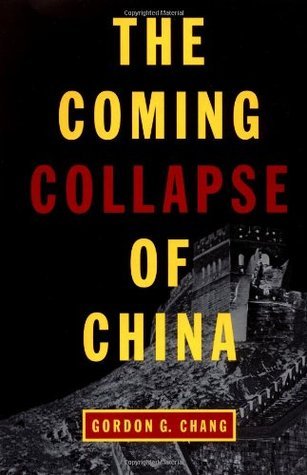
The Coming Collapse of China
China is hot. The world sees a glorious future for this sleeping giant, three times larger than the United States, predicting it will blossom into the world's biggest economy by 2010. According to Chang, however, a Chinese-American lawyer and China specialist, the People's Republic is a paper dragon. Peer beneath the veneer of modernization since Mao's death, and the symptoms of decay are Deflation grips the economy, state-owned enterprises are failing, banks are hopelessly insolvent, foreign investment continues to decline, and Communist party corruption eats away at the fabric of society.
Beijing's cautious reforms have left the country stuck midway between communism and capitalism, Chang writes. With its impending World Trade Organization membership, for the first time China will be forced to open itself to foreign competition, which will shake the country to its foundations. Economic failure will be followed by government collapse. Covering subjects from party politics to the Falun Gong to the government's insupportable position on Taiwan, Chang presents a thorough and very chilling overview of China's present and not-so-distant future.
Beijing's cautious reforms have left the country stuck midway between communism and capitalism, Chang writes. With its impending World Trade Organization membership, for the first time China will be forced to open itself to foreign competition, which will shake the country to its foundations. Economic failure will be followed by government collapse. Covering subjects from party politics to the Falun Gong to the government's insupportable position on Taiwan, Chang presents a thorough and very chilling overview of China's present and not-so-distant future.
368 pages, Hardcover
First published September 15, 2001
About the author
Gordon G. Chang
12 books55 followersGordon Guthrie Chang is an American journalist, lawyer, political commentator, and writer. He is the author of The Coming Collapse of China in which he attempted to predict the collapse of China and claimed that it would collapse by 2011. In December 2011, he changed the timing of the year of the predicted collapse to 2012.
In 1976, Chang graduated from the Cornell Law School. He then lived in mainland China and in Hong Kong for close to two decades, where he worked as Partner and Counsel at the US international law firms Baker & McKenzie and Paul, Weiss, Rifkind, Wharton & Garrison LLP.
Chang has given briefings at the National Intelligence Council, the Central Intelligence Agency, the US State Department, and the US Department of Defense, and he has testified before the US House Committee on Foreign Affairs. The New Yorker has characterized him as a "longtime überhawk on China".
In 1976, Chang graduated from the Cornell Law School. He then lived in mainland China and in Hong Kong for close to two decades, where he worked as Partner and Counsel at the US international law firms Baker & McKenzie and Paul, Weiss, Rifkind, Wharton & Garrison LLP.
Chang has given briefings at the National Intelligence Council, the Central Intelligence Agency, the US State Department, and the US Department of Defense, and he has testified before the US House Committee on Foreign Affairs. The New Yorker has characterized him as a "longtime überhawk on China".
Ratings & Reviews
Friends & Following
Create a free account to discover what your friends think of this book!
Community Reviews
Displaying 1 - 30 of 46 reviews

June 15, 2020
It's out of date drivel although Gordon Chang is still pedaling his theories whenever he can get a TV interview. Sometimes as I read it, I wondered whether Chang had spent much time in China. What he doesn't seem to understand is the Chinese people rather like their government and sufficiently so that independent polls by western companies are encouraged. Sure, there is no democracy, but there has been an explicit understanding between government and people that they will become better off, and that has happened. A middle class of 450 million and poverty almost wiped out are remarkable achievements, whatever your economic definition of either. Yes, there will be ups and downs, as COVID-19 has demonstrated but collapse?
January 23, 2016
Lots of facts. Lots of opinion. I happen to agree with the author. Anyone who as been to China, will recognize many of the problems addressed in this book.

Want to Read
December 17, 2016China seizes US Navy underwater drone in international waters of South China Sea
in: http://www.independent.co.uk/news/wor...

“This is an act of war against the United States”
[A propos trade war and China's stealing] "We [USA] are bleeding"
Gordon Chang
UPDATE
CHINESE DRONE SHOT DOWN OVER TAIWAN STRAIT
https://news.yahoo.com/chang-issues-w...
in: http://www.independent.co.uk/news/wor...
“This is an act of war against the United States”
[A propos trade war and China's stealing] "We [USA] are bleeding"
Gordon Chang
UPDATE
CHINESE DRONE SHOT DOWN OVER TAIWAN STRAIT
https://news.yahoo.com/chang-issues-w...
November 16, 2012
I did not finish this book. It got to technical for me. ALsoit predicted the collapse of China in 10 years and was written in 2001 so guess it was wrong.
February 10, 2021
ZERO STARS option should be available for this piece of sickening primitive propaganda.
Pure lies, dumb clichés, inversion of reality...
Accusations not backed by hard evidence, apology of a US-sponsored criminal organization named Falung Gong...
Dishonest misinterpretation of Mao's words, Deng's words and others' words...
Sinophobic caricatures, petty paternalism, absurd predictions...
In resume a horrible simplistic piece of Western sinophobic propaganda based on intellectual dishonesty and dumbness!
The simplistic primitive descriptions of the Chinese and their thinking, in this "book", perfectly exemplify the supremacist arrogance that blinds Westerners and prevent them from understanding alternative human reasoning.
This book is like a manual on how to look down on Chinese, and feel oneself superior as an utterly racist, fundamentalist, ignorant Nazi-like Westerner.
This despicable racist author goes as far as blaming communist government for having destroyed the market of female prostitution
Oh, how dare the CPC to create conditions for Chinese women to study, have a job and career, thus have human dignity! Oh bad CPC, how dare you! According to Gordon, plunder-capitalism that flooded Shanghai with starving orphans and hopeless prostitutes, that was preferable, I see. Utterly disgusting and abhorrent apology of Western barbarism!
Shame on you Gordon G. Chang, shame on you for daring to caricature the Chinese people as "dumb brainwashed beings" for daring to attack the evil crimes committed by Westerners (burning of Summer Palace, Opium Wars, enslaving of Chinese "colies", the bombing of Belgrade Embassy, etc) and, at the same, insisting on blaming the Chinese for plenty of crimes they did not commit.
This book is the ultimate definition of WESTERN SICKENING SUPREMACIST ARROGANCE.
(read in Thailand)
Pure lies, dumb clichés, inversion of reality...
Accusations not backed by hard evidence, apology of a US-sponsored criminal organization named Falung Gong...
Dishonest misinterpretation of Mao's words, Deng's words and others' words...
Sinophobic caricatures, petty paternalism, absurd predictions...
In resume a horrible simplistic piece of Western sinophobic propaganda based on intellectual dishonesty and dumbness!
The simplistic primitive descriptions of the Chinese and their thinking, in this "book", perfectly exemplify the supremacist arrogance that blinds Westerners and prevent them from understanding alternative human reasoning.
This book is like a manual on how to look down on Chinese, and feel oneself superior as an utterly racist, fundamentalist, ignorant Nazi-like Westerner.
This despicable racist author goes as far as blaming communist government for having destroyed the market of female prostitution
Oh, how dare the CPC to create conditions for Chinese women to study, have a job and career, thus have human dignity! Oh bad CPC, how dare you! According to Gordon, plunder-capitalism that flooded Shanghai with starving orphans and hopeless prostitutes, that was preferable, I see. Utterly disgusting and abhorrent apology of Western barbarism!
Shame on you Gordon G. Chang, shame on you for daring to caricature the Chinese people as "dumb brainwashed beings" for daring to attack the evil crimes committed by Westerners (burning of Summer Palace, Opium Wars, enslaving of Chinese "colies", the bombing of Belgrade Embassy, etc) and, at the same, insisting on blaming the Chinese for plenty of crimes they did not commit.
This book is the ultimate definition of WESTERN SICKENING SUPREMACIST ARROGANCE.
(read in Thailand)
January 17, 2008
I hated this book. Unless you like arguments like "a Muslim in Xinjiang doesn't like all the pork in Chinese food, therefore China is bound to collapse," you're not gonna get anything out of this book.

June 29, 2014
Ten years have passed since I first read this book and none of it has come true. I bought it in a foreign bookstore in Hong Kong expecting to read something insightful about the economic and political condition in China but sadly that was not the case. I remember there's lots of Falun Gong propaganda and a chapter about prostitutes.
The author's arguments about the collapse of China didn't sound convincing back then but he still holds on strongly to his opinions (you can check his videos on youtube).
Sure, there is always the possibility the China Bubble may burst one day but that doesn't make this more accurate. It's all hokey pokey, muck like the Book of Revelations, and it should be banned in China, not because it's dangerous for the regime, but because it's boring!
The author's arguments about the collapse of China didn't sound convincing back then but he still holds on strongly to his opinions (you can check his videos on youtube).
Sure, there is always the possibility the China Bubble may burst one day but that doesn't make this more accurate. It's all hokey pokey, muck like the Book of Revelations, and it should be banned in China, not because it's dangerous for the regime, but because it's boring!

July 8, 2008
I'm only at about page 100 of this book. There's some good information in here, but it's bit too dry for me. It's also highly biased. I was hoping for more objective writing, but it's just dripping with the author's feelings of China's 'impending doom'.
I may get back to this book later just to finish it, but not because I'm that interested. It's time for me to move on to my next book club selection and other books that I'll enjoy more...
I may get back to this book later just to finish it, but not because I'm that interested. It's time for me to move on to my next book club selection and other books that I'll enjoy more...

July 25, 2019
Anybody who would like to know about the real China as it is should avoid this book. This book reads almost like a propaganda piece, with its conclusion clearly wrong.

August 19, 2018
The back cover asserts that "the end of the modern Chinese state is near. The People's Republic has five years, perhaps ten, before it falls."
That was in 2002.
It is now more than fifteen years later, and the PRC under Xi Jinping looks as economically robust and as politically stable as it has since the early '80s - Gordon G. Chang's prophecy has singularly failed to happen.
Some of the elements of Chang's analysis still ring true in 2018, but most others seem to be shrill and superficial - more a reflection of the author's hopes and paranoias than any sober reflection.
This book stands as an example of why you should not give a specific date to your prognostications if you want your work to stand the test of time - but is a testament that an attention-grabbing title will aid in shifting units in the short term.
That was in 2002.
It is now more than fifteen years later, and the PRC under Xi Jinping looks as economically robust and as politically stable as it has since the early '80s - Gordon G. Chang's prophecy has singularly failed to happen.
Some of the elements of Chang's analysis still ring true in 2018, but most others seem to be shrill and superficial - more a reflection of the author's hopes and paranoias than any sober reflection.
This book stands as an example of why you should not give a specific date to your prognostications if you want your work to stand the test of time - but is a testament that an attention-grabbing title will aid in shifting units in the short term.

April 11, 2020
Yet another shrewd bureaucrat: something is going to collapse. If it does, he'll be in the history book as a visionary. If it doesn't he'll be long dead and the money would have been long wasted. So he has nothing to lose with his fairy tale, but a lot to win.

June 28, 2019
time tells the truth

January 23, 2021
The book was written in 2001 so in the 20 years that have passed since the author wrote it, China's movement towards collapse has not yet occurred. Will it occur ? Well you have a one party country with 1.3 billion people. Corruption is a thread that runs painfully through the landscape. The book leaves you with a blurry head trying to compare your own world with what goes on over there. I suppose when you live under autocratic rule where your freedoms are defined by the government you are trapped and controlled. By in large for a Westerner, China is not a pretty place, so their future is probably bleak as insurrection constantly has to be suppressed. It is just a matter of time before implosion takes place. Chinese authoritative leaders maintain order by denial on almost every matter of relevance, so basically nothing can be believed from what is said. My hope from ending the book is that Chang provides a follow-up. Giving it a three is easy as one has to be in the mental frame of dealing with the din of fact after fact after fact. Repetition on any front can be exasperating ! and stifling

August 22, 2020
I bought this book because of its intriguing title and my presumption of its relevance to a Great Courses series I recently completed covering Ancient Eastern Civilization. Unfortunately, as reported by others, the content is at least a decade old and it is exceedingly dry. With my interest level being modestly piqued, I only read a chapter or two, unhurriedly, in between other books. As a consequence, it took me nearly four months to finish it.
Although clearly well researched and exhaustively annotated, I did not learn much... Chang offers various theories as to how and why China is likely to collapse; however, none of those stimulants have occurred since the book was published. Given China's long history of internal and external conflict over millennia, I would not be surprised if communism is overthrown in time. Perhaps its recent responsibility for the COVID-19 outbreak and the world's condemnation for its behavior will be instrumental in exacerbating public disfavor with the ruling party whose acts of commission and omission have embarrassed the country and its leadership.
Although clearly well researched and exhaustively annotated, I did not learn much... Chang offers various theories as to how and why China is likely to collapse; however, none of those stimulants have occurred since the book was published. Given China's long history of internal and external conflict over millennia, I would not be surprised if communism is overthrown in time. Perhaps its recent responsibility for the COVID-19 outbreak and the world's condemnation for its behavior will be instrumental in exacerbating public disfavor with the ruling party whose acts of commission and omission have embarrassed the country and its leadership.
May 24, 2020
Coming collapse of China somewhat delayed
Chang is actually very familiar with the deep workings of the Chinese Party. He is able to explain the deep rooted corruption of a failed political system, i.e. Communism quite well so the average person can see why the United States should not even entertain the thought of adopting socialism or its twin brother communism. The book starts fast enough but then begins to drag but becomes interesting again by chapter 12. If you know a lot about the world financial system it’s an easy read but for the average guy just trying to understand why China might collapse its kind of slow.
Chang is actually very familiar with the deep workings of the Chinese Party. He is able to explain the deep rooted corruption of a failed political system, i.e. Communism quite well so the average person can see why the United States should not even entertain the thought of adopting socialism or its twin brother communism. The book starts fast enough but then begins to drag but becomes interesting again by chapter 12. If you know a lot about the world financial system it’s an easy read but for the average guy just trying to understand why China might collapse its kind of slow.

April 25, 2022
This book has the problem of being around long enough for events to dispute the predictions.
There are some elements here which a worth considering. Chang argued that the government would fail in China as a result of its accession to the World Trade Organization. (2001)
His argument parallels analysis of other arguments against authoritarian systems - for example he suggests that the State Owned Enterprises and State Owned Banks are ultimately Ponzi schemes - they live off the cadres not market indicators. He also suggests that China’s political leaders are ultimately corrupt. Those suggestions have some relevancy even two decades after the book was published.
So why has the revolution not happened. There are a couple of reasons why Chang’s arguments did not come true. First, the Chinese have been adept at controlling information in their society - they have proven pretty adept at manipulating the technology which was supposed to be liberating. Second, totalitarians, including China, have been successful in locking down their systems. No one believes, except for perhaps Putin, that Russia is a major power. About the time that Chang was writing their book the Russians were being routed in Afghanistan - but Putin through bravado has been able to continue to tell the big lie. Finally, the leaders of China, pre-COVID had the skill of distributing some of the surplus from China's growth.
But as Chang was closing his book he quoted Leon Trotsky - "Revolution is impossible until it becomes inevitable." As Frederich Hayek argued in the Fatal Conceit the error of socialism is that it violates the fundamental discipline of market based systems. Chang was obviously overly optimistic but that does not mean that he was wrong.
There are some elements here which a worth considering. Chang argued that the government would fail in China as a result of its accession to the World Trade Organization. (2001)
His argument parallels analysis of other arguments against authoritarian systems - for example he suggests that the State Owned Enterprises and State Owned Banks are ultimately Ponzi schemes - they live off the cadres not market indicators. He also suggests that China’s political leaders are ultimately corrupt. Those suggestions have some relevancy even two decades after the book was published.
So why has the revolution not happened. There are a couple of reasons why Chang’s arguments did not come true. First, the Chinese have been adept at controlling information in their society - they have proven pretty adept at manipulating the technology which was supposed to be liberating. Second, totalitarians, including China, have been successful in locking down their systems. No one believes, except for perhaps Putin, that Russia is a major power. About the time that Chang was writing their book the Russians were being routed in Afghanistan - but Putin through bravado has been able to continue to tell the big lie. Finally, the leaders of China, pre-COVID had the skill of distributing some of the surplus from China's growth.
But as Chang was closing his book he quoted Leon Trotsky - "Revolution is impossible until it becomes inevitable." As Frederich Hayek argued in the Fatal Conceit the error of socialism is that it violates the fundamental discipline of market based systems. Chang was obviously overly optimistic but that does not mean that he was wrong.

September 17, 2021
I have listened to many things Mr. Chang has said, regarding China, while a guest on Fox News. He is quite the interesting man with a wealth of information about China. Many see China as a up and coming power, or super power. However, as a communistic nation, all businesses are essentially owned by the Chinese government. And looking at their financial loaning policies, they have a tendency to have the government run banks to loan to SOEs (or State Owned Enterprises.) This becomes problematic, in that, this is much like the German government in the 1920s & 1930s, or Argentina in the 1930s, or even the country of Zimbabwe. When this is done it is much like what America does with the Fed by "monetizing debt" by printing up new money out of thin air. But the Chinese tend to just forgive the debt of the borrowing entity, which has a very similar affect...making the money in your bank accounts and the cash in your pocket worth less. This was but one example. He spoke on, in great detail, on the uprising of the workers based upon the Maoist belief...but the workers are now being downtrodden while the world is being told that the people of China are happy...hmmmmmmm...It is a worthwhile book to read, if you are interested in China.
March 13, 2020
Somewhat dated but good foundation on big picture Chinese economy and government
January 25, 2019
"The Coming Collapse of China" was referenced in a newspaper article not too long ago and piqued my interest. China's robust growth has slowed, but is this a sign of collapse? It wasn't until I had dug a little bit into the forward that I discovered this isn't a current assessment, but a forecast of downfall copyright 2001. "The end of the modern Chinese state is near" author Chang asserts. "The People's Republic has five years, perhaps ten, before it falls." Today, we are well beyond that 5-10 year window. Even though the outcome Chang predicted didn't come into fruition, his observations are thought provoking. He lays most of the blame at the foot of the Communist party and the inefficiency of SOEs, state-owned-enterprises. Rampant corruption and an over-leveraged banking system would in short order cause public unrest and bring down both the financial system and the Communist government. Private ownership, capitalism, and foreign investment were beginning to show some signs of life at the dawn of the 21st century, but were subject to the whims of the government authorities. When the book was being written, China has just been accepted into the World Trade Organization. Chang viewed WTO acceptance as an accelerant to collapse, but it appears that it has been fuel to growth and increased prosperity instead. I found it interesting that not one of China's richest citizens in 2018 was even mentioned in Chang's version of the future. When the doors to the vast Chinese market were opened to foreign investors, they rushed in with ready money to spend and technology to share. China's laws limited foreign ownership rights and insured the flow of knowledge was a one-way street. New leadership under Xi Jinping has strengthened the Communist party's control of the country and the economy. While China is experiencing a slowdown in growth, the likelihood of a collapse seems highly remote.

April 12, 2018
The real lesson in this book is an insight into why there hasn't been a revolution the USA. It's the same logic to why there wasn't one in China either.
I read this knowing it was dated, mostly just fishing for innovative insights. It's not bad. The main problem is that it is full of statements saying that the Chinese people are fed up with the Chinese government and will therefore topple the system. They may be fed up, but national governments keep becoming more and more totalitarian and the people have so far simply put up with it. There is a lot of apathy, and very little revolution.
I read this knowing it was dated, mostly just fishing for innovative insights. It's not bad. The main problem is that it is full of statements saying that the Chinese people are fed up with the Chinese government and will therefore topple the system. They may be fed up, but national governments keep becoming more and more totalitarian and the people have so far simply put up with it. There is a lot of apathy, and very little revolution.

April 14, 2022
Outstanding read by a political movement rallier from Twitter, Gordon Chang.
I found this book, as it was recommended by Gordon himself on his Twitter cover banner.
I found this a very good book on China's future.
Although this book is a pretty old book, I found it still mostly accurate.
4.2/5
I found this book, as it was recommended by Gordon himself on his Twitter cover banner.
I found this a very good book on China's future.
Although this book is a pretty old book, I found it still mostly accurate.
4.2/5

March 29, 2009
"Another nearly ten-year old book that attempted to prognosticate China's future at the turn of the new millenium. Looking at China today in 2009 it seems this author might be a bit off. But what kind of cracks in the façade lurk beneath the surface?"
January 3, 2012
280 pages that can be summed up as centralized gov't planning is not efficient, corrupt, and stifles innovation. Presently, the gov't can control the people but eventually too many people will challenge it and there will be too many for the gov't to prevent it.

May 12, 2015
Mr. Gordon, we're still waiting for the coming collapse of China...
June 28, 2019
Good insights on PRC China, govt, corruption
Read
August 17, 2019very interesting book on the state of things in China. For most of us China is an enigma. Is it the roaring dragon coming after our economy and our jobs? Is it the military competitor of the next 10 years and will it end in war or another cold war?
Chang points out the huge cracks in China and its culture. Shows that major corruption threatens to destroy China from within.
Talks of coming conflict with Taiwan. Which could be catastrophic for many people.
The funny thing is that this book is now over a decade old so we get a glimpse of how much Chang is correct or wrong in what has taken place. Now with the unrest in Hong Kong we may be seeing the things he predicted coming true. His main point is that personal unrest is what will bring down this communist central control government down. It is a reminder how flawed these type of systems are all over the world they have been tried and failed.
We also see how entrance into the WTO may be the downfall of the Chinese system as it has required them to try to conform to normal market rules which they have never done before and is causing great pain between China and USA. They seem powerless to stop stealing Intellectual property and not manipulate their currency as millions go hungry are out of work.
Only time will tell how this all ends.
Chang points out the huge cracks in China and its culture. Shows that major corruption threatens to destroy China from within.
Talks of coming conflict with Taiwan. Which could be catastrophic for many people.
The funny thing is that this book is now over a decade old so we get a glimpse of how much Chang is correct or wrong in what has taken place. Now with the unrest in Hong Kong we may be seeing the things he predicted coming true. His main point is that personal unrest is what will bring down this communist central control government down. It is a reminder how flawed these type of systems are all over the world they have been tried and failed.
We also see how entrance into the WTO may be the downfall of the Chinese system as it has required them to try to conform to normal market rules which they have never done before and is causing great pain between China and USA. They seem powerless to stop stealing Intellectual property and not manipulate their currency as millions go hungry are out of work.
Only time will tell how this all ends.
February 13, 2024
I heard an interview with Gordon Chaing where this book was touted. I decided to read it. As I began reading it seemed not to be correct, I then looked at the copyright and it was published in 2000 and he predicts that China will fall by 2010. While I learn much from the book, clearly the authors understanding of the significance of the events that he described were inaccurate. I’m surprise that he still touts this book. As yogi Bear stated making predictions is hard, especially about the future.
Usually when an author gets it so wrong he would try to have the world forget about it. He has written several other books, which I don’t intend to read. If in the interview he had said something like in totally missed the boat in 2000 and I have re-annualized the situation. I might consider a future book
Usually when an author gets it so wrong he would try to have the world forget about it. He has written several other books, which I don’t intend to read. If in the interview he had said something like in totally missed the boat in 2000 and I have re-annualized the situation. I might consider a future book

March 20, 2024
Chang should have added 30 years to his prediction. With the gift of hindsight, of course, one can see how naïve it was for Chang to think China joining the World Trade Organization would bring down the CCP. The WTO isn't stacked in America's favor. If things get as desperate as he's portrayed, and the Great Firewall can be cracked, and an invasion of Taiwan would be a failure, then the CCP could go to the dustbin of history, but it's not coming soon.

December 29, 2024
Bored. Whole book could have been written in one paragraph — China continually fails bc state owned enterprises act as both provider of goods and social services to its ppl. Hence, why big gov waste/power does not work without free private sector (gov can’t be sugar daddy), both end up in debt. Even with “high tech” universities based in China, many come from outside and return home, meaning innovation continually stunted in China.
Displaying 1 - 30 of 46 reviews