

What do you think?

It's Such a Beautiful Day
"It's Such A Beautiful Day" is a science fiction short story by Isaac Asimov. It was first published in 1954 in Star Science Fiction Stories No.3, an anthology of original stories edited by Frederik Pohl, and later reprinted in the 1969 collection Nightfall and Other Stories.
Set in the year 2117, the story presents District A-3, a newly built suburb of San Francisco, and the world's first community to be built entirely using Doors, a method of travel via teleportation.
Set in the year 2117, the story presents District A-3, a newly built suburb of San Francisco, and the world's first community to be built entirely using Doors, a method of travel via teleportation.
64 pages, Library Binding
First published January 1, 1954
About the author
Isaac Asimov
4,424 books28.7k followersWorks of prolific Russian-American writer Isaac Asimov include popular explanations of scientific principles,
The Foundation Trilogy
(1951-1953), and other volumes of fiction.
Isaac Asimov, a professor of biochemistry, wrote as a highly successful author, best known for his books.
Asimov, professor, generally considered of all time, edited more than five hundred books and ninety thousand letters and postcards. He published in nine of the ten major categories of the Dewey decimal classification but lacked only an entry in the category of philosophy (100).
People widely considered Asimov, a master of the genre alongside Robert Anson Heinlein and Arthur Charles Clarke as the "big three" during his lifetime. He later tied Galactic Empire and the Robot into the same universe as his most famous series to create a unified "future history" for his stories much like those that Heinlein pioneered and Cordwainer Smith and Poul Anderson previously produced. He penned "Nightfall," voted in 1964 as the best short story of all time; many persons still honor this title. He also produced well mysteries, fantasy, and a great quantity of nonfiction. Asimov used Paul French, the pen name, for the Lucky Starr, series of juvenile novels.
Most books of Asimov in a historical way go as far back to a time with possible question or concept at its simplest stage. He often provides and mentions well nationalities, birth, and death dates for persons and etymologies and pronunciation guides for technical terms. Guide to Science, the tripartite set Understanding Physics, and Chronology of Science and Discovery exemplify these books.
Asimov, a long-time member, reluctantly served as vice president of Mensa international and described some members of that organization as "brain-proud and aggressive about their IQs." He took more pleasure as president of the humanist association. The asteroid 5020 Asimov, the magazine Asimov's Science Fiction, an elementary school in Brooklyn in New York, and two different awards honor his name.
http://en.wikipedia.org/wiki/Isaac_As...
Isaac Asimov, a professor of biochemistry, wrote as a highly successful author, best known for his books.
Asimov, professor, generally considered of all time, edited more than five hundred books and ninety thousand letters and postcards. He published in nine of the ten major categories of the Dewey decimal classification but lacked only an entry in the category of philosophy (100).
People widely considered Asimov, a master of the genre alongside Robert Anson Heinlein and Arthur Charles Clarke as the "big three" during his lifetime. He later tied Galactic Empire and the Robot into the same universe as his most famous series to create a unified "future history" for his stories much like those that Heinlein pioneered and Cordwainer Smith and Poul Anderson previously produced. He penned "Nightfall," voted in 1964 as the best short story of all time; many persons still honor this title. He also produced well mysteries, fantasy, and a great quantity of nonfiction. Asimov used Paul French, the pen name, for the Lucky Starr, series of juvenile novels.
Most books of Asimov in a historical way go as far back to a time with possible question or concept at its simplest stage. He often provides and mentions well nationalities, birth, and death dates for persons and etymologies and pronunciation guides for technical terms. Guide to Science, the tripartite set Understanding Physics, and Chronology of Science and Discovery exemplify these books.
Asimov, a long-time member, reluctantly served as vice president of Mensa international and described some members of that organization as "brain-proud and aggressive about their IQs." He took more pleasure as president of the humanist association. The asteroid 5020 Asimov, the magazine Asimov's Science Fiction, an elementary school in Brooklyn in New York, and two different awards honor his name.
http://en.wikipedia.org/wiki/Isaac_As...
Ratings & Reviews
Friends & Following
Create a free account to discover what your friends think of this book!
Community Reviews
Displaying 1 - 30 of 40 reviews

November 6, 2022
A short story about the rise of car-dependent suburbs and white flight, but "science fictionalized" so high school students think it's about human connection with nature.
Full review on my podcast, SFBRP episode #500:
The First Science Fiction Story Luke Read
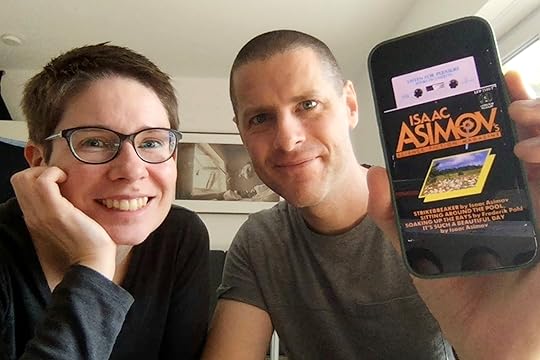
https://www.sfbrp.com/archives/2036
Full review on my podcast, SFBRP episode #500:
The First Science Fiction Story Luke Read
https://www.sfbrp.com/archives/2036
May 15, 2017
Isaac Asimov writes this story with the purpose to give the audience a perception of life in a future. The reason of this story being science fiction, I knew that it was going to be interesting; However that is not why I decided to place a 5 star rating. Basically, the reason is that Asimov wanted to transmit a strong message to the readers and he did it in the best way as possible.
This story is set in the year 2117 in San Francisco “District A-3”. Humans depend on special doors in order to be able to transport from one place to the other. Yes, they do have robots that can do their own beds. There is a boy horrified because his door does not work and he will have to confront an unpleasant situation. As dramatic as it may sound, this poor boy suffered because he had to walk outside and most probably his shoes would get dirty.
You may well think, what a spoiled child. But basically the author is providing us a sneak peak with what will happen to future generations if we continue to depend on technology. It is impressing how the boy completely changes when he has direct contact with nature. This is what reminds us that we are surrounded by such beautiful things but unfortunately we are taking them all for granted.
Towards the end of the story the boy says: “You know, it’s such a beautiful day I think I will take a walk.” I believe this is the most powerful part because it was interesting to see how the boy's life has turned around completely by doing such a simple thing. We should not let technology dominate us.
This story is set in the year 2117 in San Francisco “District A-3”. Humans depend on special doors in order to be able to transport from one place to the other. Yes, they do have robots that can do their own beds. There is a boy horrified because his door does not work and he will have to confront an unpleasant situation. As dramatic as it may sound, this poor boy suffered because he had to walk outside and most probably his shoes would get dirty.
You may well think, what a spoiled child. But basically the author is providing us a sneak peak with what will happen to future generations if we continue to depend on technology. It is impressing how the boy completely changes when he has direct contact with nature. This is what reminds us that we are surrounded by such beautiful things but unfortunately we are taking them all for granted.
Towards the end of the story the boy says: “You know, it’s such a beautiful day I think I will take a walk.” I believe this is the most powerful part because it was interesting to see how the boy's life has turned around completely by doing such a simple thing. We should not let technology dominate us.

August 10, 2018
Even excellent sci-fi wants to remind the reader that the most advanced technology is never going to be able to compete with the majesty of mother nature. With this sweet tale Asimov celebrates nature, the outdoors and youth's curiosity.
4.5
4.5
May 22, 2017
Isaac Asimov’s It’s Such a Beautiful Day gives a very good example of what a future with evolved technology might look like and how the human race can be affected by it. This story about the lives that people live in the future and their unique beliefs about interacting with the outside and nature may give us a hint on what we will be like a few decades from now, even if this story was written far before our time.
The protagonist’s, Richard Hanshaw, has an unlikely “adventure” after an unknown cause causes his Door to malfunction. In this story, set in the year 2117 in District A-3, a suburb in San Francisco, young Richard does something that is considered abnormal in society. Soon after, he is in love with the outside world and can’t get enough of it. He realizes that nature is beautiful, which I believe is something everyone should believe because, in fact, it is.
I gave this short story four stars out of five because it gives an excellent and meaningful message about technology. We should not be completely dependent on it, or let it take over our lives. Even today, when out technology is not as advanced as the one in the story, kids tend to spend hours indoors playing video games and this should be changed since technology should not be our whole lives. A quote from the story that perfectly portrays what our interaction with nature should be like is “You know, it’s such a beautiful day that I think I’ll walk”, and it should be like this, always.
The protagonist’s, Richard Hanshaw, has an unlikely “adventure” after an unknown cause causes his Door to malfunction. In this story, set in the year 2117 in District A-3, a suburb in San Francisco, young Richard does something that is considered abnormal in society. Soon after, he is in love with the outside world and can’t get enough of it. He realizes that nature is beautiful, which I believe is something everyone should believe because, in fact, it is.
I gave this short story four stars out of five because it gives an excellent and meaningful message about technology. We should not be completely dependent on it, or let it take over our lives. Even today, when out technology is not as advanced as the one in the story, kids tend to spend hours indoors playing video games and this should be changed since technology should not be our whole lives. A quote from the story that perfectly portrays what our interaction with nature should be like is “You know, it’s such a beautiful day that I think I’ll walk”, and it should be like this, always.

July 24, 2017
This book is called It’s Such a Beautiful Day by Isaac Asimov. Isaac Asimov was born in Russia, worked as a professor of biochemistry at Boston University as well as being an American writer of science fiction and popular science. The book’s genre is Science Fiction, focused on the balance of technology and nature. This book was assigned as summer reading in our school for the rising 8th graders (Me and my fellow classmates). Every now and then, I come across a book which will involve the future science and technologies of our world and use dates as predictions to when it will actually be developed. If I came across this book myself, I probably wouldn’t read it. Unless there's a strong relationship which ties the whole story together to show the normal life of people in an environment that is described in the book and the difference it makes when something goes wrong.
The book is about a twelve-year-old boy named Dick Richard Hanshaw and about his sudden interest in what is on the outside of this whole life that the society doesn’t want people to discover entirely. It all took place in a District A-3, a newly built suburb of San Francisco where the Doors (with the capital d) is the scientifically developed door (and a method of transportation) that allows the people to transport from coordinates to coordinates. Whilst the doors (lower case d) are used for fire emergencies and other consequences. In the book, the other major character is his mother, Mrs Richard Hanshaw that shows the worries and negative opinions about the whole situation with his son and how he goes through the door path, rather than the Door path in his everyday life. The more time passes, the more frequently he does it as a consequence of his mother starting to worry more with each day that passes by.
This story made me wonder, about how this all comes to reality. How the technology is taking over our world and that people start to forget that it is still there and enjoy the moment while it lasts. The whole plot idea was too short for me because I am not used to reading short books like these, which is why I think this is a good introduction for a long story book and how the boy keeps exploring the nature. The story made me believe that it can be true, maybe in 100 years based on the date predictions this book gives you. From this book I learned the opinions of the author, and how he might think of the future the way he describes it in the book since he also placed it in a real location - San Francisco. One of my favourite parts of the story was probably the ending conversation between Mrs Hanshaw Dr.Sloane the psychiatrist how he explains to her that Dick is normal and he doesn’t need any probes because of a sudden interest in something not very common. Overall, the book is interesting and definitely sends a message and a thought to wonder, especially the ending line which is referred to the title of the book which made it a good wrap up. I enjoyed reading the short story and wished it was longer. I will recommend this book to a friend since it's short and easy to read for a teen age like me since it puts a thought in their mind. I would give this book a 8 out of 10.
The book is about a twelve-year-old boy named Dick Richard Hanshaw and about his sudden interest in what is on the outside of this whole life that the society doesn’t want people to discover entirely. It all took place in a District A-3, a newly built suburb of San Francisco where the Doors (with the capital d) is the scientifically developed door (and a method of transportation) that allows the people to transport from coordinates to coordinates. Whilst the doors (lower case d) are used for fire emergencies and other consequences. In the book, the other major character is his mother, Mrs Richard Hanshaw that shows the worries and negative opinions about the whole situation with his son and how he goes through the door path, rather than the Door path in his everyday life. The more time passes, the more frequently he does it as a consequence of his mother starting to worry more with each day that passes by.
This story made me wonder, about how this all comes to reality. How the technology is taking over our world and that people start to forget that it is still there and enjoy the moment while it lasts. The whole plot idea was too short for me because I am not used to reading short books like these, which is why I think this is a good introduction for a long story book and how the boy keeps exploring the nature. The story made me believe that it can be true, maybe in 100 years based on the date predictions this book gives you. From this book I learned the opinions of the author, and how he might think of the future the way he describes it in the book since he also placed it in a real location - San Francisco. One of my favourite parts of the story was probably the ending conversation between Mrs Hanshaw Dr.Sloane the psychiatrist how he explains to her that Dick is normal and he doesn’t need any probes because of a sudden interest in something not very common. Overall, the book is interesting and definitely sends a message and a thought to wonder, especially the ending line which is referred to the title of the book which made it a good wrap up. I enjoyed reading the short story and wished it was longer. I will recommend this book to a friend since it's short and easy to read for a teen age like me since it puts a thought in their mind. I would give this book a 8 out of 10.
May 16, 2017
It's Such a Beautiful Day, by Isaac Asimov, is a great example of the dangers mankind faces by biting off more than we can chew with technology. I have to say, the concept of spending your entire life indoors, and being considered a "weirdo" if you want to step outside. In this story, humans are led to believe that the outside world is a dangerous place, and to travel you need to use "Doors", or teleportation devices. Richard Hanshaw, a young boy, starts to get curious, after having to walk to school one day. He starts going out more and more often, to the point where his overbearing mother determines that he see a shrink.
What scares me most about this story, is how close we are in real life to getting to the point where you are ostracized for wanting to go outside. Today, I'm the son of two people born in the 1960s, where you would still play outside on the streets with your neighborhood buddies, so I was influenced by them to prefer the outside rather than the inside. But I ask myself, what is going to happen with my children, or my grandchildren, when they no longer have that voice telling them to go outside, then they have everything indoor, at their fingertips.
I have faith, that if there ever comes a day where the real world is like "It's Such a Beautiful Day," there will be someone like Richard, or Dr. Sloane there to reverse the tide. As the doctor said, "There's a little rebel in all of us..." I can only imagine the pressure there will be in the future by all the new kinds of technologies; everyone will be so comfortable, there will be no reason to go outside. Even today, kids are tempted to spend hours on end playing on their iPads, or having a Netflix and Chill session. Having someone with a rebellious streak will save us, but that's why humans are built this way, to go against the current. You know what? It's such a beautiful day, I think I'll stop writing this review and go outside.
What scares me most about this story, is how close we are in real life to getting to the point where you are ostracized for wanting to go outside. Today, I'm the son of two people born in the 1960s, where you would still play outside on the streets with your neighborhood buddies, so I was influenced by them to prefer the outside rather than the inside. But I ask myself, what is going to happen with my children, or my grandchildren, when they no longer have that voice telling them to go outside, then they have everything indoor, at their fingertips.
I have faith, that if there ever comes a day where the real world is like "It's Such a Beautiful Day," there will be someone like Richard, or Dr. Sloane there to reverse the tide. As the doctor said, "There's a little rebel in all of us..." I can only imagine the pressure there will be in the future by all the new kinds of technologies; everyone will be so comfortable, there will be no reason to go outside. Even today, kids are tempted to spend hours on end playing on their iPads, or having a Netflix and Chill session. Having someone with a rebellious streak will save us, but that's why humans are built this way, to go against the current. You know what? It's such a beautiful day, I think I'll stop writing this review and go outside.

May 16, 2017

It’s Such a Beautiful Day is a science fiction short story by Isaac Asimov portraying what life in the future will be like life with an abundance of innovations and technological advances. The uses of technology in the story may seem drastic; however, years ago, the way we use technology today may have seemed like something extreme, too.
The story takes place in the year 2117 in District A-3 where humans teleport from one place to another through special doors. It is considered out of the ordinary to go outside; therefore, the moment that Richard Jr decides to walk to school, his mother is sure he has a strange neurosis. Richard is not used to the outside world. However, once he experiences it, he can't get enough. He realizes that there is more to technology, there is a whole world outside that is worth seeing.
By writing this short story, I think Asimov is trying to show the reader what the future will look life if technology keeps rapidly advancing and innovating as it is today. There are so many benefits that the outside world has that we need to take advantage of them while we can. .
Like Richard says, “You know, it’s such a beautiful day that I think I’ll walk”, we should walk more often and be thankful for the amazing beauty of nature. Asimov was clear to give the message that we shouldn’t depend on technology so much; we shouldn’t let it dominate us.

May 18, 2017
“It´s Such a Beautiful Day” is a science fiction short story written by Isaac Asimov. It was a book that I read at the beginning of my 9th-grade class that was introduced by my English teacher. Isaac Asimov has other books such as Nightfall and they usually talk about popular science or science fiction.
This short story is about a young kid named Richard Henshaw that lived in the year 2117 which takes place in San Francisco District A-3; where people to travel don´t use normal doors instead they use a teleport. one day this teleport did not use and instead of Richard using the neighbor one as he was told by his mother, he decided to take a walk. Walking was something considered as different or as a concern for society so his mother decided to take him to a doctor.
What I liked about the story is Asimov represented how society is today when someone that does not follow the trends or what others do as a treat or as something that needs to be fixed.
The theme of the story is about how people can get really affected or influenced by the new technology that exists, that sometimes they forgot their roots or where do they come from.
The story after being read can leave you with a lesson in life that can be very important. The story is always giving what you want to see and makes you get interested in it.
This short story is about a young kid named Richard Henshaw that lived in the year 2117 which takes place in San Francisco District A-3; where people to travel don´t use normal doors instead they use a teleport. one day this teleport did not use and instead of Richard using the neighbor one as he was told by his mother, he decided to take a walk. Walking was something considered as different or as a concern for society so his mother decided to take him to a doctor.
What I liked about the story is Asimov represented how society is today when someone that does not follow the trends or what others do as a treat or as something that needs to be fixed.
The theme of the story is about how people can get really affected or influenced by the new technology that exists, that sometimes they forgot their roots or where do they come from.
The story after being read can leave you with a lesson in life that can be very important. The story is always giving what you want to see and makes you get interested in it.

November 8, 2021
Collected in Through A Glass, Clearly and Nightfall and Other Stories. In 2117, San Francisco suburb District A-3 is the world's first community to be built entirely using Doors, which enable instant teleportation to other doors. When the home Door fails, Richard "Dickie" Hanshaw starts walking. His mother, worried that he is mentally abnormal, sends him to a psychiatrist.
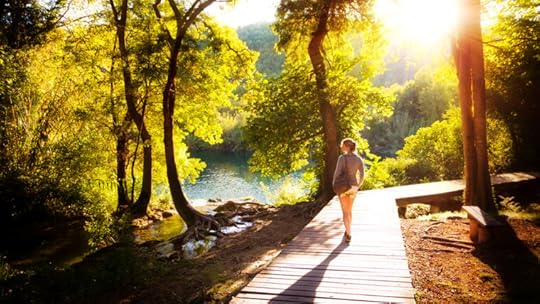
What a great story, to make the reader really think about what future awaits humanity. It presents an interesting question of whether anyone would want to walk out in the elements if instant teleportation (which is faster and more convenient) is available? And if so why should that be abnormal? How would the joggers get their daily exercise? Via treadmill? Will there be no more beautiful hills, lakes, or mountain nature paths to to hike in? So many things to consider! Now that I think about it, perhaps I should take a walk outside.
What a great story, to make the reader really think about what future awaits humanity. It presents an interesting question of whether anyone would want to walk out in the elements if instant teleportation (which is faster and more convenient) is available? And if so why should that be abnormal? How would the joggers get their daily exercise? Via treadmill? Will there be no more beautiful hills, lakes, or mountain nature paths to to hike in? So many things to consider! Now that I think about it, perhaps I should take a walk outside.
August 29, 2017
It’s such a beautiful day
by Isaac Asimov
This is a short story that is Sci-fi. It takes place in the future, the year 2117. I think that in addition to Sci-fi that it is also realistic fiction because it is a prediction of the future and how our lives may become. This book was assigned to me for summer reading but I think that if I found this book I would’ve read it anyways because I like science fiction.
This book is about a family that is used to using a Door for transportation that teleports them anywhere they want to go. This is what they are used to and use everyday but one day it breaks down when the son tries to go to school and he is forced to go into the open and walk to a neighbor's house. This is not what he is used to and he doesn’t want to. The story is about how they handle this problem.
The story made me feel intrigued and also sad because I was interested to see a new perspective on the future but sad because I think that it is true that we will get spoiled and when something doesn’t go our way no matter how hard it is to recover we sometimes won’t. I would recommend this book to anyone who likes to read science fiction. I think that the concept is a little hard to grasp if you are under the age of 13 but I think once you understand it then any age can love this book. I would give this book a 7/10.
December 31, 2017
I am not a big lover of sci-fi and never read anything by Arthur Clarke or Jules Verne or Isaac Asimov, in fact. I don't remember how and why I came across this story, but I really loved it. The story was written in the 1950s, way before the computers, cell phones, GPS's and other smart devices, which only underscores Mr Asimov's gift of prediction. He sets the action in 2117 in a very high tech community in California. The central element of the technology is the Doors that teleport people from their homes to just about every place in the world where receiving Doors are available in a matter of seconds and return them home in the same manner. But herein lies the danger. The way the Doors work is, they take people apart while they're passing through them and then re-assemble them on the other end. And if a Door breaks down, as we saw in the beginning of the story, the person passing through it will never come out. I consider this idea in the story the writer's protest against the overwhelming power of technology, "the rising, choking tide of machinery". The story is nicely written, in a clear, expressive language; the characters are well-drawn. I am not a big lover of science fiction, but this work gets my vote.
May 22, 2017
"It's Such a Beautiful Day" is set in a distant future, where people literally don't go outside and use machines that work like portals to transportate from one place to another. However, one day a boy named Richard could not go to school because his teleporting machine, or portal, was malfunctioning. He had to walk to his neighbor's house and go to school from their portal. In this moment, Richard realised that the outdoors were better than using the portals.
After that, Richard only walked to go to any place, and refused to enter the portals when his mother told him to. Richard's mother was scared of his son's attitude, so she decided to take him to with a doctor. However, Richard convinced the doctor to go outside with him and walk, which he had never done before. After walking some tine, the doctor realised that it was better to walk and thought that it was such a beautiful day.
In my opinion, this story pictures the probable future we are heading to because of the use and discoveries of new technologies. As time passes, more people rely more in technology to perform daily tasks, and we will reach a point when we rely on it on a 100% percent if society does not changes.
After that, Richard only walked to go to any place, and refused to enter the portals when his mother told him to. Richard's mother was scared of his son's attitude, so she decided to take him to with a doctor. However, Richard convinced the doctor to go outside with him and walk, which he had never done before. After walking some tine, the doctor realised that it was better to walk and thought that it was such a beautiful day.
In my opinion, this story pictures the probable future we are heading to because of the use and discoveries of new technologies. As time passes, more people rely more in technology to perform daily tasks, and we will reach a point when we rely on it on a 100% percent if society does not changes.

June 28, 2022
3.5 stars -- Originally published in 1955, this science fiction short story has a great theme. That is the philosophy that "Anything men can do, machines can do better." Indeed, from smart phones, to smart watches, to Ring, to health rings, to virtual reality games, to roombas, we allow ourselves to be plugged in all the time and be more & more reliant on technology and devices every year. And it does not have a positive effect always. Poor mental health and adult-onset ADD can both be traced back to device use. Regardless, in this imagined future of 2117, wealthy people have their own Doors. These teleport them from place to place without ever having to go outside. The problem begins when the Hanshaw's Door malfunctions, and young Dickie Hanshaw has to go outside to get to school. Amazingly, he likes it! But his mother believes he is not normal - indecent - because of it, and sadly, that is the one time the story shows its age.

December 28, 2019
The day that the Hanshaw Door failed to operate was the day that 12 year old Richard Hanshaw Jr. began to avoid using it to go to school and back home again. Nothing his mother tried could deter him other than on rare unexplained occasions. Yet Dick didn't seem to mind using the Door to visit New York or Canton, China. His mother reluctantly agrees with his teacher to take him to a psychiatrist for probing.
Asimov has provided a most prophetic story about how technology can cause people to withdraw from experiencing the outdoors. The reasons and type of technology might be different, but the results wind up the same. Video games, the internet, television, and other media all do the same. Thought-provoking. 4.5 out of 5.
Asimov has provided a most prophetic story about how technology can cause people to withdraw from experiencing the outdoors. The reasons and type of technology might be different, but the results wind up the same. Video games, the internet, television, and other media all do the same. Thought-provoking. 4.5 out of 5.

August 13, 2022
Muy biena historia como siempre asimov estuvo adelantadísimo para su tiempo, con esto de que ya nadie sale a la calle sino que como sabrina a bruja adolescente viajan a otras casas por las puertas, me gustó mucho esta historia que nos hace valorar lo que tenemos, el medio ambiente, la naturaleza.

March 3, 2022
Loved Asimov’s introduction to this story. How he prefers bad weather and hates “nice” days. He loves writing so much that bad weather allows him to stay inside and write rather than be forced to “enjoy” the outdoors.

April 24, 2022
Scientists say teleporting would be impossible, but what a lovely concept. I loved reading this story with students and discussing the pros and cons of teleporting vs. traveling through the real world outside our doors and Doors.
April 30, 2024
Asimov gets really hung up on this concept of human society moving exclusively in doors, forgetting the outside entirely. Prusumably due yo his own severe agoriphobia. This story may be the least inspired version of this Ive read. Presenting telportation as the only relevant method of travel but also as being quite expensive doesn't add up.

September 3, 2020
Humanity needs nature? Not really enough here.

July 16, 2023
Now instead of dehumanizing Doors with a capital “D” we have dehumanizing Windows with a capital “W”.

August 25, 2023
Es el primer cuento que leo de Isaac y me gustó mucho, sobre todo el final.
March 10, 2025
read this for school
July 12, 2025
Elementary school computer lab
December 18, 2025
la historia me pareció la mas floja desde que empecé a leer los cuentos

March 31, 2026
This story shows its innocence and shows its age, and still tells a charming, thought-provoking story. Well worth the read. Thank you Dr. Asimov.

March 22, 2020
An insightful short story about technology and its ability to remove us from nature. I read this many years ago and suddenly recalled the story after "sheltering in place" for days during the world pandemic.
Staying in side is safe and currently the right thing to do, but at some point, we'll need to once again get past our fear of nature and go outside.
Found online at https://novels77.com/the-complete-sto...
Staying in side is safe and currently the right thing to do, but at some point, we'll need to once again get past our fear of nature and go outside.
Found online at https://novels77.com/the-complete-sto...

May 20, 2023
"Go touch grass" the story.
In all seriousness: Asimov stated that he likes to stay inside and write even when it's nice outside, and that he's peeved by how people think he's weird for it. And so he wrote a story where the norm is reversed and it's weird to want to go outside. The adults begin thinking that there is something mentally wrong with a young boy wants to go outside and doesn't want to use the teleportation doors.
It's a nice story that illustrates how "normal" is very much determined by society. It can be further applied to how societal norms determine what we consider to be neurodivergent.
In all seriousness: Asimov stated that he likes to stay inside and write even when it's nice outside, and that he's peeved by how people think he's weird for it. And so he wrote a story where the norm is reversed and it's weird to want to go outside. The adults begin thinking that there is something mentally wrong with a young boy wants to go outside and doesn't want to use the teleportation doors.
It's a nice story that illustrates how "normal" is very much determined by society. It can be further applied to how societal norms determine what we consider to be neurodivergent.

August 30, 2015
Initial publication date was noted.
It was then re- printed in Beyond
Belief which was printed in 1966.
I won't talk about the plot because I don't want to ruin the story for people who have not read it.
I first read this story when I was about 15.
To me this story is almost the essence of what great science fiction is.
I have read many of Isaac Asimov's short stories and IMO most of them are just OK. Maybe 3 out of 10 with a very few being 10 out of 10.
I think ISABD is one of the 3 best SF short stories that I have ever read.
For anyone who is interested in good vintage science fiction, they should definitely check this one out.
It was then re- printed in Beyond
Belief which was printed in 1966.
I won't talk about the plot because I don't want to ruin the story for people who have not read it.
I first read this story when I was about 15.
To me this story is almost the essence of what great science fiction is.
I have read many of Isaac Asimov's short stories and IMO most of them are just OK. Maybe 3 out of 10 with a very few being 10 out of 10.
I think ISABD is one of the 3 best SF short stories that I have ever read.
For anyone who is interested in good vintage science fiction, they should definitely check this one out.

February 4, 2014
What a great futuristic tale that plays on the notion of forgetting to enjoy the reality of life. Set in the future where people no longer leave their homes and remain in the sterile environment of their interconnected buildings and schools, the lead character breaks away to experience real world. Excellent ending. A Feel good book.
Theres a very good reading of it on Librivox too.
Theres a very good reading of it on Librivox too.

April 2, 2010
I listened to an audio version of this short story. The story was alright. The voice of the narrator was annoying and distracting.
Displaying 1 - 30 of 40 reviews