
What do you think?
Rate this book


Jane Austen es heredera de los logros de la novela inglesa del siglo XVIII, pero al mismo tiempo crea un estilo nuevo de novela más breve, concentrada e intensa, y exhibe en sus dos últimas obras un dominio de recursos narrativos en la expresión de la interioridad que se adelanta a su época. El realismo económico de Jane Austen, la implicación de sus primeras obras en los debates de la última década del siglo XVIII sobre la naturaleza humana, la familia, las instituciones sociales o la educación de las mujeres, y el reflejo en sus novelas de madurez de las innovaciones y escándalos de la Inglaterra de la Regencia, demuestran que la inteligencia creadora, alimentada por las lecturas y la observación, es capaz de interpretar el mundo desde la mesa de un cuarto de estar.
Persuasión es la única novela de Jane Austen de la que se puede decir que es básicamente una historia de amor. Todas sus obras cuentan siempre el enamoramiento de una o dos parejas y acaban con la boda de los protagonistas, pero Persuasión es la única en la que el interés narrativo se centra en los sentimientos y en la interioridad de la protagonista. Publicada póstumamente, Persuasión es la última crónica austeniana del triunfo del amor, la bondad y la inteligencia en un entorno social dominado por la vanidad, la estupidez y el egoísmo.
330 pages, Paperback
First published December 20, 1817


 -Captain Wentworth
 -William Elliot (The young shadow of Sir Walter)


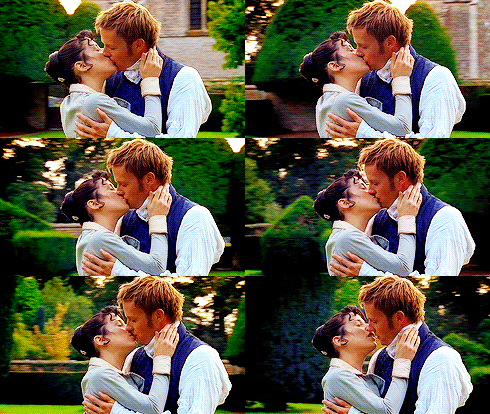
"To be claimed as a good, though in an improper style, is at least better than being rejected as no good at all."And all of Anne's family members seem to compete with each other in how to best put down Anne - the treatment that she easily sees but tolerates without complaining and in good spirits. Oh, and they have to downsize because all the vain and shallow family members are quite rotten at preserving the family fortune.
 .
."But I hate to hear you talking so like a fine gentleman, and as if women were all fine ladies, instead of rational creatures. We none of us expect to be in smooth water all our days."And another thing that I came to appreciate is the attempt to decry the classism of English society. The most admirable people in this book are not the gentlemen by birth, unlike the proverbial Mr. Darcy (ughh) but the naval officers and their circles - Wentworth and the Crofts especially. It's like Austen was finally acknowledging that it's not only the birth into the gentry class that makes you a decent person. Way to go, Miss Austen! Congratulations on succeeding in making all your hypocritical gentlemen with overblown feeling of self-importance appear to be total idiots like they should be:
"A man is in greater danger in the navy of being insulted by the rise of one whose father, his father might have disdained to speak to, and of becoming prematurely an object of disgust himself, than in any other line."A lovely 3.5-star book. It does not quite reach the 4-star enjoyment of Jane Eyre, but it is a delightful book with which to spend an overcast day filled with bronchitis cough.
"Anne wondered whether it ever occurred to him now, to question the justness of his own previous opinion as to the universal felicity and advantage of firmness of character; and whether it might not strike him that, like all other qualities of the mind, it should have its proportions and limits. She thought it could scarcely escape him to feel that a persuadable temper might sometimes be as much in favour of happiness as a very resolute character."
Single women have a dreadful propensity for being poor-which is one very strong argument in favour of Matrimony.
Men have had every advantage of us in telling their own story. Education has been theirs in so much higher a degree; the pen has been in their hands. I will not allow books to prove any thing.
It is a difference of opinion which does not admit of proof. We each begin probably with a little bias towards our own sex, and upon that bias build every circumstance in favour of it which has ocurred within our circle; many of which circumstances (perhaps those very cases which strike us the most) may be precisely such as cannot be brought forward without betraying a confidence, or in some respect saying what should not be said.


