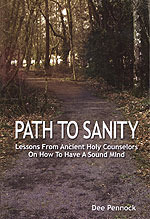
The author's main point: Using variations of the Jesus Prayer, believers can ask God to manifest their sins, so they can repent.
These Jesus Prayer variations are based on the teachings of a wide variety of Church Fathers on overcoming sin.
The result is regaining the sanity God originally gave humanity.
It's a practical book on overcoming sin, but the road laid out by the author is a long one. There are no quick fixes, but there are practical steps that readers can begin right away.
A great read, I highly recommend it. I kind of already want to reread it. It will certainly be a book I reread regularly for spiritual benefit and practice.
IN my life, this book has been a very powerful and practical guidebook on how to apply ancient truths to address illnesses of soul that can impact our neurochemistry.
There is great healing that can occur when the wisdom of this book is prayerfully applied in our fight with our vices and passions.
If you have been diagnosed with depression, anxiety, bipolar etc., this book is incredibly helpful. I would encourage you not to struggle alone with just this book - plug into a community that will help you apply the wisdom in this book. Also, find a practitioner who can help you navigate the path to wholeness. This is a very helpful resource: https://www.assemblyofbishops.org/dir...
Great book to help people understand more about what Christian healing truly looks like. The author largely prescribes repentance and prayer as the driving force in which we are healed from our mental afflictions.
The book is almost entirely written without the authors opinion, with almost all of the points being backed by either Scripture or a Church Father. The book also comes with a very useful glossary at the back which the reader can turn to for more information on whichever Saint or Father the author is citing.
Overall, this book is great at explaining why we must deny ourselves and take up our cross as Christians, while explaining what this truly looks like. It’s offered me some great perspectives and advice as I move forward in my journey to Christ.
I tend to veer away from anything that sounds like a self-help title, merely because there are so many, in Christian libraries, no less. This was highly recommended by Fr. Thomas Hopko on Ancient Faith Radio. I am exchanging a library copy for a personal one. Common sense, theologically sound insights into the human condition. I would also recommend Fr. Thom's podcast, "Our Thoughts & Feelings". This is a wonderful book for any Christian, especially anyone who disciples, counsels, or is a spiritual director.
Describes the ancient Orthodox Christian understanding of the person and how that understanding can be used to facilitate coherent change consistent our true inner selves.
Wow! I am thoroughly impressed by this book. It is rich with patristic wisdom and guidance while at the same time very approachable and easy to understand. Every Christian should read this book, and keep it to refer to again and again. It would make an excellent book to study in a group - there's so much good food for thought and great questions at the end of each chapter.
I found this to be an interesting text, though for me some sections were more tedious as they went on longer than was helpful to me. An interesting synthesis of the Fathers of the church and modern psychology. For me a few flashes of brilliance, but then longer sections which were OK but not as inspiring.
This is a great read on the Orthodox church and psychology. An easy read, Pennock speaks of the passions we are all faced with and how the Church fathers teach us to pray and recognize and overcome them. This is a great read for Lent, or whenever.
Explains a non-archaic take on concepts such as idolatry and vainglory. Puts the passions that lead to sin into a modern context - better understand what one strives to achieve in their relationship with God and the obstacles that prevent one from doing so.
I read this in a group from church; opinions were mixed, which generated a lot of thought and discussion. Personally, it resonated with me. Others, who were less emotionally intuitive, found it difficult because their personalities were so cerebral. Ultimately, the author challenges and encourages in equal measure. Despite the cumbersome topics I would recommend it as a tool for personal growth, especially as an alternative to pop-psychology that offers open-mindedness and self-discovery though abundant validation and self-indulgence.