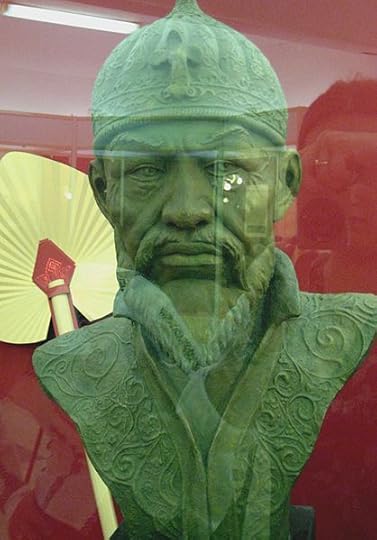
I just love this play. Like 'Doctor Faustus', Tamburlaine is essentially a 'one-man play'. However, while it lacks the subtle characterization that made Shakespeare so great, Tamb. is an exceptional 'de Casibus' Tragedy that will delight all those who give 'Marlowe's Mighty Line' the attention it deserves.
Let there be no mistake about it, Tamb. is pride personified. The scourge of the gods and the terror of the world, as he terms himself, abides by a strict code of war ethics and lets nothing stand in his way of his conquests. Part One concerns both his martial conquests and his 'conquest' of Zenocrate. Although in the beginning the reader is not sure whether Tamb. sees Zen. as just another prize or as his eternal love, their mutual feelings for each other are made obvious (even though their physical beauty did them a lot of merit). Tamb.'s looks make a city surrender, while Zen.'s makes the heavens envy her. Part One is also concerned with the weak monarchy of Mycetes. Cosroe betrayed his brother Mycetes but Tamb. betrayed Cosroe. All is fair in love and war, after all. No brief summary can do this play any justice though, and I'll leave it at that.
What is important to note is that in the tradition of any 'de Casibus tragedy', Marlowe explores not just the historical figure and his exploits (that is Tamir, Tamburlaine in this play, who was responsible for the death of 5% of the whole world) but also his moral virtues. It is true that Tamb. did win a "fatal victory" (as Zen. terms the triumphs of war) over "the High and Highest Monarch of the World" that is Bajazeth and his obese empress wife, Zabina. However, his cruel and perverse treatment of them was a fate worse than death. It was such a humiliating experience for them that they committed a most bloody suicide. Zen. curses her "wretched eyes" when she sees them dead. Even though Bajazeth was not particularly amiable, nonetheless his love for his wife, and equally his wife's love for him, did humanize their characters. It makes the reader notice that Bajazeth's love for his wife, and both their desire to remain together even after death parts them, was much more real and much more gratifying than the love one 'experiences' with a random Turkish concubine.
The same goes for Tamb.'s unmerciful and symbolical killings of the Damascus virgins. The fifth act is in fact termed as one of the most complex in Elizabethan drama, and I agree wholeheartedly. Even in such a case, where one is predisposed to loathe Tamb., Marlowe give Tamb.'s pride some tragic structure. The attentive reader will notice that it was the Governor of Damascus who really was responsible. He (the governor) knew all too well Tamb. strict adherence to the code of war (being unmerciful especially to the besieged) but he still sent them anyway. By technicality, Tamb. was faultless, he did what any respectful conqueror had to do. However, that is not what the reader thinks and this is what is important. The reader condemns Tamb., and Marlowe is aware of this this. What Marlowe does, most brilliantly in my opinion, is to make Tamb. unaware of his 'immorality' (if we disregard the war code), Tamb. is happy that he had won, and thinks that only Jove's throne remains for him to conquer. Tamb. is oblivious to the grief that Zen., and the reader, felt for the besieged, the virgins of Damascus and Bajazeth and Zabina's suicide. All of these presented to Zen. 'A thousand sorrows to her martyred soul'. Tamb. thinks of Zen. as his muse who 'adds more courage to his conquering mind'.
In my opinion, Part 2 is equally as sublime as Part One. Many dimensions to Tamb.'s character are explored, including his treatment of his three sons. The death of "That effeminate brat" (Tamb.'s words not mine) Calyphas by his own father is a reminder that Tamb. abides by his war code no matter what. I do not wish to explain Part Two more than I have to, but the burning of the Alcoran by Tamb., and the illnes that quickly plagued him, is Marlowe's own way of bringing justice to the unmerciful tyrant. Even in death, Tamb. was still obsessed over what he might conquer; "And shall I die and this unconquered?". The question remains whether or not, despite his immorality, Tamb. was a bad person as he was only doing his duty as conqueror. My Opinion? Well, I think that ,like Doctor Faustus, Tamb. was overwhelmed by ambition and he tested fortune too much for comfort. He once wisely advised his son Amyras not to test fortune, but that is what exactly what Tamb. did when he burned the alcoran. Tamb. went one step too far, though it was not the burning of the alcoran that really matters (as I think Marlowe would have said).
'Tamburlaine' is a unique play that managed to entertain its sixteenth century audience without a heavy reliance on theatrical effects (indeed, even the admiring Marlowe critic Swinburne said that it is 'monotonous', saved only by its sublime poetical verse). I can proudly and admiringly say that it is still engaging more than 400 years afterwards. It is not only a scholarly delight ,for it is a very 'structured' play, but also an entertaining piece of poetry in its own right.