Jump to ratings and reviews
Rate this book

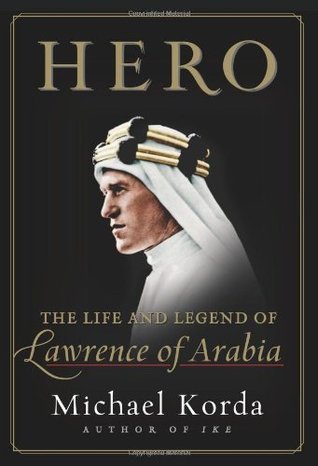
Hero: The Life and Legend of Lawrence of Arabia

Rate this book

T.E. Lawrence (1888-1935) first won fame for his writings and his participation in the British-sponsored Arab Revolt of WWI, but the adventurer known even in his day as "Lawrence of Arabia" is remembered today mostly as the subject of the 1962 film masterpiece based on his life. This splendid page-turner revitalizes this protean, enigmatic adventurer. That this colorful British scholar/Middle East warrior deserves a better fate is demonstrated amply in Michael Kordas' authoritative 784-page biography. Exciting, well-written, and relevant.

699 pages of text, 762 with notes

699 pages, Hardcover

First published November 16, 2010

517 people are currently reading
4308 people want to read

About the author

Michael Korda

75 books186 followers
is an English-born writer and novelist who was editor-in-Chief of Simon & Schuster in New York City.

Ratings & Reviews

What do you think?
Rate this book

Friends & Following

Create a free account to discover what your friends think of this book!

Community Reviews

5 stars
1,671 (36%)
4 stars
1,619 (34%)
3 stars
724 (15%)
2 stars
353 (7%)
1 star
260 (5%)
Displaying 1 - 30 of 367 reviews
Profile Image for Lorna.
1,058 reviews740 followers
October 11, 2023
Hero: The Life and Legend of Lawrence of Arabia was a well-researched and heavily sourced biography of Sir Lawrence but told in such an easy and forthright way by Michael Korda, ultimately letting the reader decide where the truth may lie. I was enthralled with the book and how this magnificent life and legend was portrayed, not only through his words but in those of his friends and family as well as colleagues. What interested me in pursuing this particular biography was a previous book that I read by Mary Doria Russell entitled Dreamers of the Day, in which Lawrence of Arabia is one of the dreamers of the day when the 1921 Cairo Peace Conference was about to convene and he was there with Winston Churchill and Lady Gertrude Bell, meeting to decide the fate of the Arab world and that of our own.

I don't think that I can add anything better than the thoughts of the author Michael Korda at the conclusion of the book where he again mentions the many books, at one time thought to be over one-hundred books, about Lawrence. But in the words of Michael Korda:

". . . his is still a story worth telling, a life that needs to be described without prejudice and without a fixed agenda: a military 'triumph,' as he himself called it with a combination of pride, bitterness and irony; an extraordinary and heroic epic; and a political failure whose importance we can only begin to reckon today as we pick among the ruins of Lawrence's hopes for the Middle East in search of a way forward."


And Lawrence's words may have described his genius best:

"All men dream: but not equally.
Those who dream by night in the dusty recesses of their
Minds wake in the day to find that it was
vanity; but the dreamers of the day are
dangerous men, for they may act their dream
with open eyes, to make it possible. This I did."

Profile Image for Jill H..
1,638 reviews100 followers
June 30, 2023
The life of this brilliant but troubled and complex man is so full of myth that it is always difficult to know who he really was. The author, Michael Korda, may come as close as most in capturing the "real" Lawrence........an extremely talented man who was a linguist, military leader, writer, and brave almost beyond belief (some called it foolish).

He was born to unmarried parents, a "guilt" he carried throughout his life and stated, as a child, that he wanted to become a hero. He was a small man who never weighed more than 120 pounds and stood 5'5" tall but his determination was gigantic.

While traveling in the Middle East, he fell in love with the Arabic people - their culture, lifestyle, and their efforts to defeat the Turks. It was in the beginning of WWI and as a low-ranking member of the British military, he caught the ear of the leadership due to his depth of knowledge and was transferred to Cairo as an intelligence officer. He disappeared into the desert and reappeared as "Lawrence of Arabia".

I will not go into the military battles in which Lawrence led his Arabic followers and how he united the tribes to fight for their freedom. Needless to say, it was amazing the he, an Englishman, could command such loyalty from the sometimes undependable Arabs. Speaking Arabic, wearing the dress of the people, and his familiarity with their social customs were certainly helpful

The film Lawrence of Arabia (1962) brought his name back to modern audiences, although it was not completely factual and people began reading again his masterpiece Seven Pillars of Wisdom, one of the finest book ever written about war.

I gave the book four stars only because some of the battle narrative dragged a bit but it is a "must read" about a truly amazing man. Highly recommended.
Profile Image for Michael.
1,094 reviews1,964 followers
July 22, 2014
Very enjoyable read on T.E. Lawrence, with an emphasis on why he was a true hero in the classical sense. In his thoughtful, even handed approach, Korda demystifies his role in facilitating the Arab revolt of diverse tribes against the Turkish during World War 1 and the establishment of Iraq, Jordan, and Israel in the post-war division of the Ottoman Empire.

Korda addresses some of the negative viewpoints on Lawrence taken by other biographers and historians and does well to try to deflate the psychoanalytic approach used by others to "explain" Lawrence. Korda does validate that Lawrence's stoicism, aversion to sexuality, and tendencies toward masochism have deep roots, but effectively advances the overall view of his wholesomeness and decency. The damages of the war to his spirit included his rape by Turkish police, the loss of men due to mistakes, and a case of supporting slaughter of prisoners.

Lawrence's failure to secure an independent Syria after the war, as he promised to Feisal (who was annointed to govern Iraq instead), also contributed to his personal need for expiation. These factors account for his abdication of leadership in favor of service as an enlisted man in the RAF and army for nearly a decade before his death in 1935 in a low-speed motorcycle.

This biography renders a more realistic, in-depth portrait of Lawrence than the movie, "Lawrence of Arabia", which although superb as a film was produced for entertainment value, not historical accuracy.
Profile Image for Mike.
1,235 reviews175 followers
January 14, 2012
Masterpiece, magnum opus, tour de force, throw in every superlative you can find to describe an incredible story about an inspiring hero and tragic man! Of all the millions who fought in all the theaters of WWI, this man is probably the first and only one who comes to mind if asked to name someone from that conflict. This 5 Star biography of T.E. Lawrence, or Lawrence of Arabia will introduce you to someone you would want to meet, given the chance. If all you know about Lawrence is the David Lean movie, then you will see that story here but so much more. If you do not know about Lawrence, then this book will be wonderment. His personality was remarkable consistent. His whole life had been, in a sense, a training program for heroism on a grand scale; the war had merely provided an opportunity for Lawrence to fulfill his destiny. His intense will and his determination to have things his own way were always remarkable. He had methodically pushed himself beyond his physical limits, as a child and as a youth long before the war. He had carefully honed his strength and his courage, forced himself to a lifelong repression of his own sexuality, and punished himself for every temptation toward what other men would have regarded as normal impulses, a deliberate calculated assault of his own senses. He would always remain, however reluctantly a combination of genius and hero…

Korda’s book begins where Lawrence is most familiar to us, in the desert during the 3rd summer of WWI. The first 2 chapters take us up to the capture of Aqaba and the start of his remarkable military exploits. We then go back in time to see his childhood and how he trained himself to be ready for his destiny, whatever it would be. Lawrence did not just fall into fame. He prepared himself over years. That story itself is fascinating and key to understanding the man. We come back to Lawrence in the war and follow him to Damascus and then postwar.

What was most fascinating, other than his wartime experiences, was how influential Lawrence was after the war in so many different venues. He was Feisal’s escort at the Paris Peace Conference and made many recommendations on how to reward the Arabs for their support in the war. Lawrence’s influence and his contacts with political leaders, kings, diplomats, etc there are simply an amazing story you probably have never heard about. Disappointed in the outcome (he would say betrayal) of the Arabs in Paris, he escapes on a trip to Egypt in the new RAF Handley-Page bomber. Leaving the Paris Peace conference, the bomber crashed on landing at Rome when the pilot tried to land downwind. The pilot and copilot were killed and Lawrence suffered a broken collarbone or shoulder. Shortly after this crash, he resumes his trip on another bomber, making emergency landings in Taranto, Albania, Athens, Crete and Libya. Lawrence then becomes an advisor to Churchill’s Middle East Department. He has a central role in creating Iraq and Transjordan for Feisal and Abdulla. This was a core issue for Lawrence as he was guilty over his leadership in the war in which the Arabs were promised (and then betrayed) a nation and so many died at his command or due to his forces.

After his efforts to gain the Arabs a nation, he seeks to avoid his fame by enlisting in the RAF under an assumed name. He is discovered and forced to leave, then enlists in the Royal Tank Corps and finally is allowed back into the RAF under another name as an enlisted airman. As AC2 (Aircraftman) Shaw, he spends his time until 1935 in the RAF, stationed in Britain and in India. These years are a revelation and immensely fun to read about. He had an impact on sea rescue boat technology that would be used to rescue downed pilots in WWII. He fought against ridiculous and arcane regulations, using his contacts and fame to pressure military leaders to better treat the enlisted force.

Lawrence is simply an amazing man and you should treat yourself to this story. Yes it is 700 pages long but the pages will fly by so quickly. Mr Korda has a wonderful narrative and keeps the action going.
Profile Image for Christopher Saunders.
1,051 reviews961 followers
March 17, 2023
Michael Korda's Hero: The Life and Legend of Lawrence of Arabia is the last major biography of T.E. Lawrence, published in 2010 (Scott Anderson's Lawrence in Arabia isn't really a biography as such). Korda's approach is spelled out in the title: he portrays Lawrence, one of the most enigmatic and frustrating figures from recent history, as very much the "hero" of the subtitle's Legend. Korda starts in media res with a long account of the raid on Aqaba before backpedaling to Lawrence's early life, a curious structural choice that disoriented the present reviewer. Korda is undoubtedly an engaging writer and it's hard not to be swept up in his colorful accounts of Lawrence's archaeological adventures, espionage missions, military operations, political struggles and his last decades wrangling with his guilt and unwanted fame. But this account of Lawrence is a mixed bag, alternately insightful and shallow. Korda seems tempted to take Lawrence's writing at face value, with long passages cribbed directly from Seven Pillars of Wisdom, while passing on stereotypes about the lovably roguish Bedouin and monstrous Turks without critical comment. Korda acknowledges Lawrence's dicey relationship with truth but invariably puts it down to "leg-pulling," which seems convincing at first but less so the dozenth time. Several strained, not always appropriate pop culture references from Tolstoy to Casablanca and even Princess Diana are perhaps explained by Korda's descent from the famous British filmmaking family. Korda's analysis fares best, for this reader at least, when diving into the controversial aspects of Lawrence's life: his prewar proposal to Janet Laurie, which Korda accepts but doesn't attach overmuch significance to; his assault by Turkish soldiers at Deraa, with Korda concluding that the incident happened but Lawrence misidentified the officer responsible; his perceptive critiques of Lawrence's writing style, particularly his RAF memoir The Mint, which Korda finds overwritten and not always convincing in its details; his defense of Lawrence's motives towards the Arabs as basically honest, but compromised from the beginning by his role as a servant of British imperialism. It's an engaging portrait, if overlong in places, but mostly for general readers who haven't yet been introduced to Lawrence's life and times.
Profile Image for 'Aussie Rick'.
434 reviews250 followers
January 10, 2012
This is one of the best books that I have read covering the life & times of T.E. Lawrence - 'Lawrence of Arabia'. The author covers in great detail his activities in the Middle East during WW1 but also provides lots of interesting information about Lawrence before the War and what happened to him post WW1. In fact, the accounts of his pre and post war experiences are just as interesting as his activities during the War, maybe even more so.

I found the author was a joy to read and presented Lawrence without the entire psychoanalyst that some authors feel they need to throw into some books. This author tells us the story, provides the facts and background information, provides you with some possibilities and you decide which is most likely.

This is a great book and although it is 700 pages of narrative it flows easily and quickly and is a joy to read. Well researched and well written I think anyone who has an interest in the subject with love this book and also possibly learn a few new things along the way, I did!
Profile Image for Sweetwilliam.
175 reviews63 followers
July 1, 2023
Another must read. I was a fan of the movie Lawrence of Arabia so I had to read this book. This was for the most part an outstanding read with the exception of a few chapters that were used to explain Lawrence's early childhood and the end of his life - these chapters could have been condensed. The book explains the Balfour decleration and how France, Russia and England met in 1916 to decide how the rapidly declining Ottoman Empire would be divided up amongst the modern powers (Sykes-Picot). The English looked down thier noses at the Turks. However, on the battlefield the English met disaster at every turn against them until Lawrence came along. With the help of his Bedouin irregulars, Lawrence was able to have success cutting the Turkish supply line by dash and daring. Lawrence was a true hero. The trench warfare, frontal assault, meat grinder that was Europes Western Front produced no heros...only mud and mangled corpses. Lawrence gained notoriety and fame for organizing the Arab revoult and making dashing cavelry raids and blowing up tracks in the Turkish rear. Lawrence on the other hand, hated himself for what he felt was a fraud that he perpetrated on the Arabs and wanted no money, notoriety, or accolades for it after the war. All he wanted was to serve out his days in the Air Corps as a private under an assumed name. This is a curious story.
Profile Image for Jenny Brown.
Author 7 books57 followers
January 17, 2011
The second half of this book is far more interesting than the first, which is a shame because I came close to giving up through the first few chapters which told me far more about Lawrence's military action in taking Aqaba than I wanted to know. By the end of the book it became clearer why I might want to know those details, but Korda just dumps them on us without giving us the orientation that would put what he's telling us in perspective.

My other cavil with this book is that Korda is mostly rehashing the findings of earlier biographers and scholars, and not making it clear in the text (though he does in the footnotes) how dependent he is on their work for all of what he's recounting. I have read other books by Korda and been turned off by his overweening egotism, so it annoyed me that he was presenting himself as a biographer when it seemed more honest to call himself a compiler.

That said, the story he tells is fascinating because Lawrence was such a complex and unusual character. So the book is worth reading, though you might want to skim the military history part unless that's something you really enjoy reading.
Profile Image for Larry.
1,507 reviews95 followers
December 17, 2016
Korda's life of Lawrence fits on the same shelf with those by Robert Graves, B. H. Liddell Hart, and (best of all) Jeremy Wilson. It's interesting to have read it while rereading Lawrence's own account, "Seven Pillars of Wisdom," and Hart's. F. Scott Fitzgerald once wrote, "Show me a hero and I'll show you a tragedy." It's more interesting to wonder what else Lawrence would have written about his efforts and disillusionment had he not had his famous fatal motorcycle accident. In any case, Korda's book is well worth reading.
Profile Image for Ron.
Author 2 books169 followers
January 20, 2015
Upwards of fifty biographies have been written about T. E. Lawrence (“of Arabia”). This is one of them. Why the author would undertake such an effort almost a century after the events which catapulted Lawrence to fame only he can tell. It’s not a bad biography, though its efforts to “balance” the record is unbalanced by the author’s many self- and family-referential comments.

Lawrence seems to have spent the first half of his life preparing to become a hero, was one for a couple years, then spent the rest of his life stepping in and out of the limelight of his notoriety.

Numerous references to Princess Diana and current culture (“media feeding frenzy” and “drones”) distracts rather than adds. The text is also marred by numerous untranslated French phrases. Surely Korda understands that Americans are uni-lingual. (One phrase, which partly compensates, is l'esprit de l'escalier, referring to the inspiration for the perfect retort too late.)

That said, Lawrence’s story is one worth preserving and retelling. He pioneered modern guerrilla warfare and successful tactics against it, which neither his country nor the United States have followed. He opposed the mess the 1919 Paris Peace Conference made of the Middle East, which planted the seeds of much of the strife and turmoil which now covers the globe. Prior to World War One, “It was a strict rule of desert warfare that women and children of your enemy were spared.” Blowing up Turkish trains signaled the death knell of that distinction. He was an archeologist, a genius of boat design, and a author of distinction.

(Korda also inserts the provocative note that Woodrow Wilson had the opportunity to partly redress the Turkish genocide of the Armenians but passed.)

A tale worth telling … and reading.
Profile Image for Jason.
18 reviews1 follower
December 31, 2010
Having read most books on TEL (including Seven Pillars of Wisdom), I would have to say this is shaping up to be the best biography on TEL. Granted it starts off in a unique way, and is 700+ pages, but at page 220 I'm finding it hard to put down and one I don't want to end. Korda has uncovered information about TEL I didn't know before - why this has been missed in other biographies is beyond me. It adds to the TEL enigma. Korda's writing style is generally easy to read, however some sentences can carry on, with an overuse of commas - so many in fact, the nature of the sentence changes from start to finish. Other than that it's a monumental piece of writing and research and certain to raise the bar on TEL works.

Now that I've finished the book I can safely say my initial impressions were well foundered. Excellent book and I might be so bold to say, in time, it will probably be recognised as one of the leading studies on TEL.
Profile Image for Michael Flanagan.
495 reviews27 followers
December 13, 2013
If you only read one book on the life of Lawrence of Arabia then this book should be the one. The author delivers a well-researched book that peels back the myths surrounding the man. It also gives us a great insight into the time and the world in which he lived.

Lawrence is one of those rare people that have played a big part of the world we live in. Korda covers a lot of issues that are still relevant today, especially concerning the Middle East. This book goes beyond the Lawrence of Arabia and shines a light on some of the other impressive contributions that he made throughout his life. What stopped this book being a 5 star rating for me was the authors need to constantly compare what Lawrence went through to that of Princess Diana. We got this comparison from his relationship to the media right through to the motorcycle accident that claimed his life. Yes I know I am fussy at times. Hero is one of those books that will stay with you long after you finish it.

458 reviews159 followers
April 5, 2017
Was amazed at how different the real Lawrence of Arabia was than portrayed by Peter O'Toole in the movie- real Lawrence was very short(while O'Toole is very tall) and made fun of anyone taller than him. Was a true hero and survived many grim brushes with death.
Profile Image for Michael.
1,094 reviews1,964 followers
July 22, 2014
Very enjoyable read on T.E. Lawrence, with an emphasis on why he was a true hero in the classical sense.

In his thoughtful, even handed approach, Korda demystifies his role in facilitating the Arab revolt of diverse tribes against the Turkish during World War 1 and the establishment of Iraq, Jordan, and Israel in the post-war division of the Ottoman Empire. Korda addresses some of the negative viewpoints on Lawrence taken by other biographers and historians and does well to try to deflate the psychoanalytic approach used by others to "explain" Lawrence.

Korda does validate that Lawrence's stoicism, aversion to sexuality, and tendencies toward masochism have deep roots, but effectively advances the overall view of his wholesomeness and decency. The damages of the war to his spirit included his rape by Turkish police, the loss of men due to mistakes, and a case of supporting slaughter of prisoners. His failure to secure an independent Syria after the war, as he promised to Feisal (who was annoited to govern Iraq instead), also contributed to his personal need for expiation. These factors account for his abdication of leadership in favor of service as an enlisted man in the RAF and army for nearly a decade before his death in 1935 in a low-speed motorcycle.

This biography renders a more realistic, in-depth portrait of Lawrence than the movie, "Lawrence of Arabia", which although superb as a film was produced for entertainment value, not historical accuracy.
Profile Image for Sharon Barrow Wilfong.
1,135 reviews3,968 followers
January 1, 2021
I do not know if this is the best biography of Lawrence of Arabia, but I certainly felt I learned a lot about the Middle East during WWI and Lawrence's role in helping the Arabs and consequently the British gain control of several of the Arab countries and bring about the fall of the Ottoman Empire.

This book does not glamorize, nor romanticize Lawrence's life, nor T.H. Lawrence as a person, but neither did it seem slanted the other way. Lawrence is enigmatic as a person, but also quite fierce as a warrior.

War is brutal and Lawrence had to act brutally as well as being brutalized. We gain a lot of insight in just how inhumane soldiers can be to each other. Think of the most inhumane practices you can imagine and then double it and you have how the Arabs treated their enemies. Double it again and you gain an idea of how vilely the Turks treated their enemies.

And then there were the western countries who fought through the Arabs (the British, the French) and those that fought through the Turks (the Germans, and the Russians) in order to gain access to valuable oil land and sea ports. It allows one to gain insight as to how leadership in various countries, Iraq, Jordan, Saudi Arabia and Turkey was appointed and why the Middle East has leaders that it has today.

Considering the profoundly significant role these countries play today in world events, it behooves all of us to learn the history of the Middle East.
Profile Image for Chris.
2,094 reviews29 followers
December 15, 2010
An epic biography to complement the epic movie. Don't be intimidated by the page count. It's hard not to engage in hagiography when the life of Lawrence is told. What a complex and fascinating man!! Korda's book is truly fair and balanced and seems to be a homage to a childhood hero. He was both a Nelson and a Lady Diana of his time. I'd always been curious about what he did with his life after WWI and the accident that took him from the world so early. Korda delves into this chapter of Lawrence's life with just as much relish as the war time exploits which begin the book. Lawrence obviously had PTSD. He lived life on his own terms. He died a hero too as he was only going less than 40 mph on his motorcycle when he came upon two boys on bicycles in a dip in the road. He braked and tried to avoid them and ended up going over his bike and hit his head on a tree. One wonders what the world and the Middle East would be like if he had lived longer. When Lawrence spoke, people listened.
Profile Image for Arun Divakar.
830 reviews422 followers
June 16, 2016
Allow me to enumerate here the characteristic traits of a certain British gentleman :

•A crack shot with a rifle or a pistol
•A dedicated reader with a prodigious memory
•Has a brilliant command over multiple languages
•A gifted writer in English who has churned out multiple books, one of which was a best seller
•Competent at archaeology, architecture and structural drawings and
•Rides a motorcycle !

The last one was considered more of a superpower during the early 1900’s when this gentleman was alive.

And thus we are introduced to the polymath named Colonel T.E. Lawrence who has been immortalized as Lawrence of Arabia in our minds. He also holds the credit of being one of the most popular figures on the side of the allies during the WWI and had a significant role in the subsequent powering down of the Ottoman empire. Lawrence achieved a mythic status and a cult following as he did something which was and still remains an impossibility : unifying the Arabs to fight against a common enemy. The Bedouins (as they were called by the British) were a rag tag bunch. Clan rivalries ran deep within their ranks and being rough survivalists, they cared not for orders or the discipline of an army. Into this melee entered Lawrence and fighting against odds that would surely have crumpled a lesser man, he rallied together the Arabs to victory against the Ottoman Turks. His victory at Aqaba and his involvement in the fall of Damascus are stuff of lore from WWI.

A hero was in the classical sense a person who had a great destiny, knew that he/she had it and then set out to accomplish it. According to Korda, Lawrence practiced from a very young age to be a hero later in life. He always competed primarily with himself to become better at everything he did. Lawrence was man who made kings, a man who was involved in carving up the map of the World into a format recognizable to most of us today and in accomplishing things that no man can hope to achieve in a lifetime. For a man at such heights of his powers, he also tried fading away to relative obscurity only to be dragged into a media circus. He was perhaps the first ‘media celebrity’ to be hounded ruthlessly by a still nascent press corps. David Lean’s magnum opus on Lawrence’s life also stops at this point where his slide into oblivion begins. Michael Korda comes up with an exhaustive biography of a man whose efforts and actions still find repercussions in the middle east of today.

The exploits of Lawrence are overshadowed by the exploits of Britain itself. The whole aspect of British foreign affairs at this time seems to have been to grab as many colonies as possible in the middle east even at the extent of contradictions on how to get this done. Consider this : Lawrence as the emissary of the British and taking orders from London supported Emir Faisal to be the leader of the Arabs post their revolt while Britain’s most powerful colony – India and it’s government supported ibn Saud (who would later become the King of Saudi Arabia) to be the leader. One single country – two different proposals and in the midst of it all, no one bothered to ask the Arabs what they wanted. The entire lifetime of Lawrence was also the time when most the hotspots of today – Syria, Lebanon, Iraq, the Arab Emirates attained a specific shape, form and found their feet. It might be unfair to say that Lawrence had a responsibility for all this but he certainly was involved in the flow of events. Korda covers these events with an even-handed approach in his book.

The latter half of the book is Lawrence’s withdrawal from the world stage and trying to live out in obscurity which is practically laughable. Ridiculous while it might appear, Lawrence sticks to it and this is also the time when there is a lot of name-dropping in the book : The King of England, Winston Chruchill, G.B. Shaw, Defence Chiefs and many a familiar face all appear and disappear in Lawrence’s life. From his adventures in the desert, Lawrence retires to a life which was almost domestic in comparison. Korda also touches upon his dalliances in masochism and immense feelings of guilt and self-doubt. Lawrence is a complicated and compelling character who more or less demands such a detailed biography.

Recommended but come armed with a lot of patience !
Profile Image for Denise.
7,504 reviews136 followers
June 26, 2018
Excellent biography of an immensely fascinating figure. Korda succeeds admirably in the tightrope walk of objectivity, highlighting his subject's incredible achievements without succumbing to blind hero worship that would lead him to omit controversies and flaws.
Profile Image for Booknblues.
1,534 reviews8 followers
January 19, 2016
I really had no idea how riveting the story of T.E Lawrence’s life would be, when I picked up Michael Korda’s Hero; The Life and Legend of Lawrence of Arabia. Lawrence, was a complex man of extraordinary talents and Korda does well in presenting him as such.

T.E. Lawrence was an expert of medieval castles, and ancient pottery, an archaeologist, a military strategist, the leader of a force of Arabs who helped to turn the tide in World War I, a force and political strategist who helped to define the borders of the modern Middle East, a gifted author, a translator of the Odyssey, a designer of marine craft and boats and disappeared into the RAF as a simple private.

Lawrence, always a complex man who often tormented those with too proper an attitude about class and stations of life, had a somewhat elfin personality but like many of the Lost Generation suffered from bouts of depression brought on by what we would term today as PTSD. Like many before and since he was ill-equipped to deal with fame and found a unique way to retreat from the world.

Korda does an excellent job of presenting the true and complex Lawrence. While reading the book, I found myself thinking of an actor who could possibly fill the role in a true manner. Such a great hero but also such a torn and tragic figure.

Korda actually had me interested in military strategy and his chapters about the war in the Middle East was compelling and interesting and I couldn’t get enough of that. The picture of Lawrence under a railway bridge setting explosive before the arrival of an oncoming train, or him riding on a camel with the Bedouins through the endless desert, or tearing through the desert in his Silver Cloud is astonishing. Here is a brief passage about travels in the Middle East:

"Lawrence and his two Arab escorts rode on through the moonlit night and into the glare of day, crossing a valley so wide that it seemed like a plain, down which the Turks, had they chosen to , could have descended to the southwest from Medina in strength to take Rabegh, and past a village where they were joined by a"a garrulous old man" on a camel, who plied them with questions and offered them "the unleavened dough cake of yesterday, crumpled while still warm between the fingers, and moistened with liquid butter till its particles would only fall apart reluctantly." Sprinkled with sugar, this was a delicacy of the Hejaz, which Obeid and his son ate greedily, but which Lawrence compared to eating "damp sawdust."

What I didn’t love was the heft and sheer volume of the book. I sincerely believe that a hundred pages could easily have been edited from the book. I could have done without at least one or two of the discussions about his sexuality or lack thereof. I really could have gone without reading a half dozen pages about his relationship with his mother.

I highly recommend this book for any history fan.
Profile Image for N.
302 reviews23 followers
July 21, 2018
Dear Michael Korda,
is it common practice among biographers to cite other biographers as primary evidence rather than, say, the "ample evidence" there is in historical letters and documents?

As others have pointed out, this feels like an admittedly well-written and very readablee reworking of the more accepted TEL biographies rather than an independent research to show something new. The 'Hero' angle was interesting and when Joseph Campbell was mentioned (on p141 for the first time...) I thought, aha, so this is Korda's angle/thesis. But no. Campbell is mentioned a grand total of 3 times and the 'Hero' angle isn't touched upon again in the second half of the book - a missed opportunity, I feel.

Anyway I mean I still loved reading this because it's an easily readable trove of info on Lawrence and also the pictures are great but Academic Me feels that the approach isn't wholly justifiable but then again I'm not a biographer.
Profile Image for Nooilforpacifists.
990 reviews64 followers
July 9, 2014
Lawrence of Arabia was Horatio Nelson on a camel--and this book tells the story simply and powerfully.
Profile Image for Nicki Markus.
Author 55 books297 followers
December 21, 2022
Hero was a engaging and detailed biography of T. E. Lawrence. Between watching the movie and reading Lawrence's Seven Pillars of Wisdom much of the war-time action was familiar to me; although, it was still useful to see the author's interpretation of those events in context of different elements. More interesting for me were the sections on Lawrence's early life and the post-war years, about which I knew a lot less. Colour plates would have been nice, but the black and white photos included were still a good addition to the text. Although it comes in at over 700 pages, the book didn't feel long and kept my attention throughout. Recommended to readers of biographies and those interested in WWI and/or T. E. Lawrence. It gets 5 stars from me.
Profile Image for Jerome Otte.
1,916 reviews
October 29, 2012
We live in an age of celebrity as created by an immense media industry. Lawrence of Arabia embodied the word celebrity; in fact he may have been the 20th century's first real celebrity as Lindberg came after him. This book cries out to be read by a readership that understands that heroes do in fact exist. This word hero has been much misused in modern day America to apply to people that the word was never intended for.

Lawrence was very much a hero, as well as many other things. He was a military genius on a level with Napoleon. He also possessed a genius for guerilla warfare and his techniques are taught at West Point as we speak. Possessing a talent for writing, his Seven Pillars of Wisdom is considered a literary masterpiece. His direct actions changed the entire map of the Middle East, and the inability of politicians to adjust to the realities of this region that Lawrence saw so vividly have led to the chaos that we see in the Middle East today.

Sheikh Hamoud had it right when he wrote so many years ago of Lawrence:

"My heart was iron, but his was steel."

If you love great, gifted, writing on an immense topic describing a man that truly impacted and changed the world that he saw, than Michael Korda's biography of Lawrence of Arabia is for you. This is a 700 page narrative before footnotes and biography. The quality of the paper used in the book is fabulous, and this is due to Korda's lifetime in the publishing industry. The selection of the font and the feel of the book left nothing to chance. Korda thought through every aspect of this project and brought it off with flair, and panache.

He is a master storyteller and he has demonstrated considerable scholarship in creating this page turner which is so sweeping in scope covering one of the giants of the 20th century. Here are just a few of the things you will learn about Lawrence of Arabia:

* In his early 30's he translated Homer's The Odyssey which then became accepted as the classic account of Homer's work.

* Why King George on Lawrence's untimely death in 1935 said his name will live in history?

* He possessed a dazzling display of knowledge, almost Einstein like in the topics he could converse in. Lawrence never did anything halfway. If he was in, he was in all the way.

* As a young man, an illegitimate son, along with 4 other brothers, he managed to do amazing things at Oxford. He studied and more importantly absorbed the works of every great military tactician including Admiral Mahan, and Creasy's 15 Decisive Battles of the World. Lawrence's own thesis, The Influence of the Crusades on European Military Architecture was recognized as an act of genius when he presented it.

* Liddell Hart considered to be one of the truly eminent military writers of the 20th century compared Lawrence to Napoleon, and used the term Napoleon coined "le coup doeil de genie" which means quick glance of genius. What this describes is that Lawrence had the scarce ability to look at a map (remember he was also a master mapmaker) and immediately know where to attack based on a unique ability in a glance to know intuitively how to attack. This is still studied at West Point, and is very rare in generals throughout history.

* If you want to know the depth of his influence on all who came after him, than consider this. Mao Zedong led a revolution in China based on his writings and theories. Ho Chi Minh forced the United States out of Viet Nam based on Lawrence's theories of guerilla war. I haven't even mentioned Castro and Che in Cuba using Lawrence as a blueprint for winning in Cuba. Lawrence is the original creator of the road side bomb we now see in Iraq and Afghanistan. He knew how to strike light, and disappear into the night. The term turn weakness into strength is his.

* The story of the making of the David Lean movie, Lawrence of Arabia which was nominated for 10 Academy Awards, and won 7 is told here in a beautiful fashion. Only Sam Spiegel, the producer at Columbia Pictures could have gotten this movie done. You will learn how the part was first offered to Leslie Howard, Lawrence Olivier, and then Albert Finney, until settling on newcomer Peter O'Toole.

In conclusion, if you love history and the grand expanse of extraordinary people doing extraordinary things then you are going to love this book. Lawrence was Hollywood handsome with a magnetic personality and charisma to match. His influence directly led to the creation of the modern Jordan, and the UAR (United Arab Republic). Iraq and Syria now owe their modern boundaries to Lawrence. Since the 1960's England has opened up its secret historical files on Lawrence. We now know that all the wild stories about Lawrence are true. It actually comes down to this. Lawrence did what he said he did, and even downplayed his own role in the affairs of which we know about.

I promise you that if you begin reading this book, you will not put it down, and you will be transfixed by what a gifted writer like Korda can do with a legendary impactful figure like Lawrence of Arabia.

The irritating problem is that in several places, quotations are presented in French and not translated - such as on page 270 and 273. Does the author think that everyone speaks French?
Profile Image for Taveri.
649 reviews83 followers
August 8, 2020
There are hundreds of books written about T.E. Lawrence and I've read a couple so I don't know why I felt compelled to read this one.

For an interesting topic the author provided a drawn out portrayal.  It started with Lawrence's exploits in the Arabian penisula then went back to his childhood and early years which were presented in drab fashion.  Then back to exploits after Aqaba.

The author jumped around, often repeating bits of information and meandering to other topics.  For instance there was mention of naming Elkader, Iowa after an Algerian who fought the French and took refuge in the Ottoman Empire, honoured by Abraham Lincoln, in the 1800s.   There was an interview with Lord Robert Cecil, a descendent of William Cecil, Lord Treasurer to Queen Elizabeth I (appointed in 1571), who went on to win the Nobel Peace Prize.  

Another mention was of Richard Meinhertzhagen, who was involved with the Post War Peace Conference with Lawrence, had at one time shot and killed a leader of the Kenyan tribal uprising while shaking his hand at a meeting to negotiate a truce.  Meinhertzhagen also claimed to being the inventor of the "haversack ruse", pretending to be wounded dropping his pack with £20, a fake love letters, fake map and war diaries to make the Turks think an attack was planned against Gaza.

Although interesting sidebits, and all had ties to the story, but they distracted from the overall telling.

The part about Lawrence trying to get independence for various Arab states was fascinating as was if his proposals had been accepted, there would have been less strife in the Middle East in the years after and even now.  However honouring the secret agreement with France, to divide up the area stymied chances of indepenendence.  Lawrence was appalled to have been part of the deception and turned down many honours/medals.

There were intriguing glimpses into Lawrence's character such as the incident where he woke a sleeping Turkish soldier and instead of shooting him said "Allah is merciful" and rode away on his camel, to see if the soldier would shoot him in the back (which would have been appropriate) or grant the same reciprocity (which would have been moral).

It seems most of the incidents shown in the movie occurred but not necessarily in the order given.  There seemed to be more outrage of the portrayal of Lawrence and claims that actor Peter O'Toole did not look like Lawrence, yet the images of Lawrence in the book looked like O'Toole.

After the Peace Conference Lawrence sought to join the RAF as an ordinary recruit, under a false name, that led to some humourous incidents.  I laughed outloud a number of times at Lawrence's subtle insolences.  Just as I was beginning to enjoy the chapter on Lawrence's life in the RAF, the author spoiled it and began his meandering from George Bernard Shaw's thoughts on the draft of "Seven Pillars of Wisdom" to sadomasochism.

In his "anonymous" time as a 'regular' in the military Lawrence made improvements on rescue water craft, wrote the defintive user's manual for their operation and provided another intepretation of "the Odessey".

The few pages on Lawrence's death from a motorcycle accident were handled with sensitivity in an almost reverent fashion.  Then the author offered a final chapter on Lawrence's "Life After Death", that covered publications, articles and films regarding the enchantment the public has had with his story.

"Seven Pillars of Wisdom" his perspective of the Arab revolt was published in 1927 in a limited edition and copies today sell for $200,000.  Thirty-five years later, in 1962 the movie "Lawrence of Arabia" was released - nearly six decades ago.  Korda's "Hero" was published in 2010.  Interest is still strong about the exploits and adventures from a hundred years ago.

Profile Image for Martha.
21 reviews27 followers
August 23, 2013
Hero was satisfying, but not great. Through it I learned a great deal about and gained a greater appreciation for the man behind the legend of Lawrence of Arabia. Korda has done exhaustive research, and you certainly feel that it would be hard to find holes in his scholarship or arguments. This biography also benefits from having been written after so many documents both by and about Lawrence, both personal and political, had been released to the public.

Unsurprisingly, the book shines when Lawrence is in the Middle East, both before and during the war. How could it not? This is a man and a story that have fascinated generations for nearly a century. That Korda falters somewhat in Lawrence's early and later life is hardly his fault; I'd be surprised if anyone could make Lawrence's years of bouncing around between Royal Air Force and British army posts anywhere near as engrossing as his years in the Middle East, or the years after the war, when his fight turned from military to political. (That said, an editor could have trimmed about a hundred pages that no one would have missed.)

The biggest problem with the book in my mind is that Korda quotes extensively from Lawrence's writings, including letters as well as The Seven Pillars of Wisdom. This is only a problem because Lawrence quite simply writes circles around Korda. Korda's prose is clear and businesslike, but never elegant, and rarely emotional. Lawrence's writing, on the other hand, is crisp, self-deprecating, wise, often funny in his letters, and utterly stunning in every way in Seven Pillars. Once you have read Lawrence's account of the slaughter at Tafas, you'll find the return to Korda's utilitarian prose a rather awkward transition.

So while I would certainly recommend Hero as a biography, I plan to follow it up with Lawrence's own writing (particularly his correspondence, which has been collected in several books).

(Side note: Gertrude Bell is cool! Why haven't I heard of her before? Where's the movie???)
Profile Image for Brian Bess.
423 reviews12 followers
November 23, 2019
The dreamer of the day

When I asked my brother, who is a connoisseur of T.E. Lawrence biographies, which one would be a good one to start with he suggested Michael Korda’s ‘Hero’. For one thing, it’s the most recent full-scale biography. Yes, it’s long but there are much longer tomes out there. He told me don’t start with Lawrence’s dense thicket of prose, ‘Seven Pillars of Wisdom’. Get the basic facts down first, then dive into Lawrence’s own assessment of what he did.

‘Hero’ begins in the middle of the action, as Lawrence leads a coalition of Arab forces upon an assault on the valuable port city of Aqaba after having crossed several hundred miles of treacherous desert. For those familiar with the classic film ‘Lawrence of Arabia’, this is the center of the film, the major victory that not only spurred the Arab tribes into active rebellion against Turkish domination but got the attention of Lawrence’s superior British officers. This sprang from a strategy that Lawrence devised, unauthorized by British command headquarters, who had to acknowledge the successful the results that this lower ranking officer, in their eyes merely a Middle East authority and advisor, could get from unlikely soldiers. The desert crossing itself was a major accomplishment, where Lawrence proved his mettle to the Arabs by enduring every hardship that they were capable of dealing with. At one point, a man turned up lost. Lawrence went back alone for several miles to locate the man, who had drifted off and fallen from his camel, carrying him back on his own camel, and catching up with the rest of the Arabs. Later during the same journey, arising from a dispute between a man from one tribe and a man from another, one man killed the other man. As a neutral arbiter and to prevent a blood feud, Lawrence carried out the justice that would not offend either tribe by executing the perpetrator himself. This was one of the first of many difficult decisions to kill that weighed on Lawrence’s conscience. Lawrence taught guerilla warfare to the Arabs as well as the use of explosives, which he employed toward blowing up railroads upon which the Turks transported supplies. He didn’t want to completely destroy the railroads but to keep blowing up portions to keep the Turks in a constant state of needing to repair them while debilitating their strength.

After the extremely readable, action-packed first two chapters, Korda goes back in time to chronicle the backgrounds of each of Lawrence’s parents. Lawrence’s father, an Irishman named Thomas Chapman, who had four daughters from a still-extant but unhappy marriage and fell in love with his daughters’ governess, Sarah Lawrence. His wife refused to give him a divorce and so he left with Sarah and moved to Wales, where they presented themselves as Mr. and Mrs. Lawrence and later moved to Oxford. They had five sons, of which Thomas Edward was the second. Ned was always a rebellious son and he repeatedly clashed with his pious mother. Even before he confirmed it, he knew he was illegitimate but did not at first realize that he and his brothers were all born out of wedlock. From an early age, he was a loner and a scholar who developed interests with archaeology, languages, and mapmaking. He also envisioned a heroic destiny:
“[He] aspired to be both a leader of men and a hero. He claimed that when he was a boy his ambition had been “to be a general and knighted by the time he was thirty,” and both goals would come close to being within his grasp at that age, had he still wanted them.”

After embarking on archaeological digs for ancient artifacts in Carchemish in the years before World War I broke out, he enlisted in the army and, based on his knowledge of the area, was assigned to the Arab Bureau in Cairo. He had prepared himself well for the role he eventually played, learning about the history as well as studying military tactics. When he embedded himself in the Arab forces, he quickly adopted to their customs and grew sympathetic to their desire for independence and to form their own nation state. This put him in an awkward position for someone who was supposed to represent British interests. He later wrote:
“A man who gives himself to the possessions of aliens leads a Yahoo life…He is not one of them…In my case my effort for these years to live in the dress of Arabs, and to imitate their mental foundation, quitted me of my English self, and let me look at the West and its conventions with new eyes, and destroyed it all for me. At the same time I could not sincerely take on the Arab skin: it was an affectation only.”

Lawrence presented the British cause to the Arabs as a gift of independence for them to rule themselves. However, he was fully aware of the Sikes-Picot agreement between Britain and France, which arbitrarily divided the borders of the Arab territory between British and French rule, without respect to tribal differences or long-held hostilities between the Arabs and the Jews. All the careful tactics he planned to help them win the war against the Turks would be in vain. After a reconnaissance mission into the Turkish stronghold in Daraa led to his capture, torture, and rape Lawrence was a broken man. According to Korda, Lawrence’s reaction to his mother’s religious upbringing led him to an aversion to all sexuality or touching of any sort which the Turkish assault on his body confirmed. The total breaking of his will by the Turks increased his post-traumatic stress combined with his intense guilt. At this point, he simply wanted to get out of this untenable position with respect to Arab independence. At one point, he told Gilbert Clayton, the Arab Bureau chief:
“I've decided to go off alone to Damascus, hoping to get killed on the way: for all sakes try and clear this show up before it goes further. We are calling them to fight for us on a lie, and I can't stand it.”

He begged Allenby, the commander of the British campaign, to relieve him of his command and reassign him to the Royal Air Force as a low-ranking soldier under a new name. He wanted to get away from the legend of his fame that had been spread largely by American correspondent Lowell Thomas. He wanted anonymity. Based on his reputation and Allenby’s respect and understanding of Lawrence’s temperament, he was able to get a command in which he could serve for as long as he pleased and opt to get out of the service when he wished. He resisted following orders and his identity and fame blew his cover. He served both in the Royal Tank Corps as well as returning to the Royal Air Force before retiring in March of 1935. Two months later, he was killed in a motorcycle crash.

‘Hero’ is the first biography that I have read of Lawrence so I can’t really judge it in relation to others that have been written. What I gather is that Korda assimilates information that has already been presented in previous biographies, evaluating other analyses of Lawrence’s motivation and character and presenting the story in a very well-written, evenhanded account. The most engaging portion is the story of the Arab Revolt of 1917-18. After the Paris peace treaties that concluded World War I, Lawrence’s life perhaps became less overtly dramatic. While this portion of the book is interesting and filled in several blanks, such as how Lawrence became friendly with a wide range of prominent figures including Winston Churchill, Thomas Hardy, George Bernard Shaw, and Noel Coward, it is not quite as engaging as the most dramatic years of his life.

Korda also delineates the posthumous fame that has been rekindled regularly over the decades since his death, including the account of attempts by his uncle, famed director Alexander Korda, to make a film of Lawrence’s life, originally proposed while Lawrence was still living. First because of a pledge not to make a film until after Lawrence’s death, then through geopolitical tensions that could still be stirred by such a cinematic account, the rights were sold and the film wasn’t released until 1962.

Korda expresses unabashed admiration for what Lawrence achieved. He says that it is very difficult to understate the significance of his accomplishments and points out that Lawrence underplayed his own role in major events such as the Arab campaign against the Turks. Lawrence is the most famous hero from World War I that is still known by almost everyone, even those without detailed understanding of what he did. He was one of the first media celebrities. Korda compares Lawrence’s fame to what Princess Diana later experienced. He also played a pivotal role in the diplomatic establishment of Middle Eastern borders that perpetuated the border disputes that continue into the present day. Korda repeatedly illustrates Lowell Thomas’s famous quotation that he “had a genius for backing into the limelight.” It is largely due to Thomas’s efforts that over eighty years after his death, Lawrence still resides there.
289 reviews1 follower
August 1, 2014
Unexpectedly compelling read. My family pointed out that while I was reading this, I mentioned Lawrence at least once a day. Korda does an excellent job of unpacking Lawrence's complexities, his excellent military strategy but also his anguish over the horrors of war; his extensive writing but also his desire to stay out of the limelight; his profound leadership capabilities and his choice to live the second half of his life as an Aircraftsman in the British RAF, in which he was in charge of nobody.

I have only two complaints. First, some of the military maneuvers described are a little hard for those of us who are not strategists to follow. That's okay, though; the book can be enjoyed without understanding every detail of the military campaigns. Second, Korda leans rather hard on Freudian psychoanalysis at times, excusing or explaining parts of Lawrence's character with reference to his mother. What this amounts to is unsupported assertions, based on shaky psychology. Korda occasionally needs to "fall back" on clearer reasoning, and on something more substantial and verifiable than an oedipal complex.
Profile Image for Chip Walter.
Author 13 books82 followers
February 12, 2013
Wonderful book! Thoroughly researched life of an absolutely fascinating character. He was so extraordinarily different and strange that it's difficult to believe he wasn't invented. The parts of the book that deal with Lawrence's mideast campaign and heroics were fascinating, but Korda does an equally great job with the telling of his youth and post war life.

My only small issue is that the whole book is VERY pro Lawrence (as you might imagine from the title) and I sometimes worried that Korda wasn't always as objective as I would like. Nevertheless, he does mostly point out even the darker and more troubled sides of this man, but he sometimes skates by them.

Still, highly recommended.

Read it while also keeping a copy of Lawrence's autobiographical "SEven Pillars of Wisdom," nearby. They work well in tandem.
Profile Image for Nick McRae.
Author 4 books27 followers
July 21, 2015
This book offers a great overview of T.E. Lawrence's life before, during, and most notably after his famous WWI exploits in Arabia. The book is a good complement to Lawrence's own masterwork SEVEN PILLARS OF WISDOM that both helps us interpret Lawrence's text and lets us see what happened in Lawrence's life after that book comes to a close. An excellent read for those interested in the beginnings of the modern Middle East and in Lawrence particularly.
Profile Image for Jennifer.
69 reviews
December 7, 2016
For those of you who don't know, Indiana Jones is based on this amazing real life bad-ass. This book is fascinating and pretty heavy. Loved it!
Displaying 1 - 30 of 367 reviews

Can't find what you're looking for?

Get help and learn more about the design.