

What do you think?
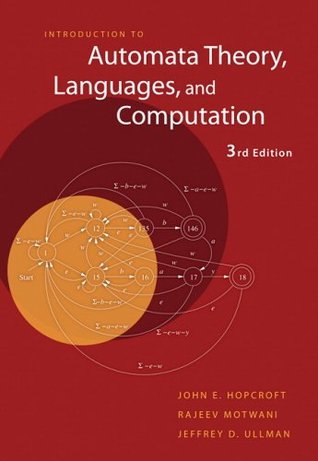
Introduction to Automata Theory, Languages, and Computation
This classic book on formal languages, automata theory, and computational complexity has been updated to present theoretical concepts in a concise and straightforward manner with the increase of hands-on, practical applications. This new edition comes with Gradiance, an online assessment tool developed for computer science. Please note, Gradiance is no longer available with this book, as we no longer support this product.
560 pages, Hardcover
First published January 1, 1979
Ratings & Reviews
Friends & Following
Create a free account to discover what your friends think of this book!
Community Reviews
Displaying 1 - 30 of 30 reviews

April 26, 2014
Read in tandem with the definitive Sipser text on the topic. I would recommend Sipser, as it is much better at simply communicating the raw concepts, but is weak in application to keep you engaged. And that is where this text delivers. It kept me interested in the topics so that I would dig deeper in to Sipser. The two are parallel from start to finish, so it made an excellent companion.
August 4, 2014
This is the original edition which has a nice description of CSGs and LBA. These two topics are omitted in later editions. I lost my personal copy of the original edition and ordered the later edition only to find that several important topics including the above two which are of particular interest to me to be missing. While the missing topics are not very practical they have certain theoretical beauty. The two author edition is highly recommended.
PS: Original review which had been written on an iPad is revised to be lot more coherent with proper grammar and spelling corrections. Smartphone/Handheld/Tablet/Phablet predictive spelling/grammar correction, to put it mildly, is a shame to the model based predictive NLP research community.
PS: Original review which had been written on an iPad is revised to be lot more coherent with proper grammar and spelling corrections. Smartphone/Handheld/Tablet/Phablet predictive spelling/grammar correction, to put it mildly, is a shame to the model based predictive NLP research community.

Read
August 31, 2023in terms of style, this book favors laborious construction and unyieldingly rigorous precision over conceptual understanding. It demands careful understanding of every word in a sentence and if I skip a few sentences, I'm in the swamp of befuddlement.

December 28, 2007
SO HARD TO UNDERSTAND!!!
May 1, 2013
I haven't read the original version of this book, which some computer scientists told me that they prefer. But for my own sake, as an engineering who just want to get a grasp of some basic ideas about automata, Turing machine, decidability and NP vs. P, I would say this book is the perfect match.

August 18, 2012
Not a great book to learn about Automata. Good as a reference.

March 22, 2019
Worst One......

November 22, 2023
tearjerker

September 17, 2013
After picking at this for goodies here and there, I finally read it more or less start to finish while taking the Automata course from one of the authors on Coursera. Wasn't able to give this learning experience quite the commitment I had in mind, but I still got a lot out of it.
As for the book, I like this first edition I have better than its successors. The proofs are the kind that you can get your hands dirty with and in so doing you really come to grips with them. Coming from a maths background they're not Rudin-esque, but not inelegant either. Probably best to work through the book in the order the material is presented, but once you have it will do for a reference as well.
The popular alternative is Sipser, which I agree might be more intuitive and easier going on the face of it, but you can get a deeper understanding here if you work for it- I guess working for it just feels less optional than with Sipser.
As for the book, I like this first edition I have better than its successors. The proofs are the kind that you can get your hands dirty with and in so doing you really come to grips with them. Coming from a maths background they're not Rudin-esque, but not inelegant either. Probably best to work through the book in the order the material is presented, but once you have it will do for a reference as well.
The popular alternative is Sipser, which I agree might be more intuitive and easier going on the face of it, but you can get a deeper understanding here if you work for it- I guess working for it just feels less optional than with Sipser.

Currently Reading
January 30, 2012Picked up from Saida Akhter in exchange for
ECE 372 Project Report on January, 30th 2012.
Order #: 002-3203239-5060233
Leave seller feedback
Seller: Ammad (contact this seller)
Items:
1 of: Introduction to Automata Theory, Languages, and Computation (3rd Edition) by John E. Hopcroft [Hardcover]
ECE 372 Project Report on January, 30th 2012.
Order #: 002-3203239-5060233
Leave seller feedback
Seller: Ammad (contact this seller)
Items:
1 of: Introduction to Automata Theory, Languages, and Computation (3rd Edition) by John E. Hopcroft [Hardcover]

Read
August 30, 2016Extremely dense. This was the text for an Automata Coursera class I did. I think this is a good reference book, but I found it difficult to get through independently. That is, without accompanying lectures, this book would be challenging to digest.
The exercises in the book are helpful.
The exercises in the book are helpful.

February 22, 2007
Translated to farsi with Ahmad Reza Jalili.
It's my reference on this term teaching.
It had good slides in it's site, translated to farsi by Dr Minaei.
It's my reference on this term teaching.
It had good slides in it's site, translated to farsi by Dr Minaei.
September 13, 2010
best text book for an introduction on this subject
August 5, 2011
A classic, so there's not much to say. I did find the notation somewhat cumbersome.
October 24, 2014
Since I am a beginner it's a bit tough for me to grasp the subject.
Want to Read
December 2, 2014dddaa aaa
December 10, 2014
This is really a good book. I want to learn more from this book.

July 17, 2019
All the subjects are well-explained, yet it's a little too lengthy for some parts.
Currently Reading
February 8, 2011hgkjdsg

December 10, 2023
This was not written very accessibly. I wish there was more guidance on the exercises, since I am more of a concrete learner. I found this textbook too abstract. Another section at my school used Dr. Michael Sipser's book, I found that one had more online support (he has an MIT OCW course free online): https://ocw.mit.edu/courses/18-404j-t... - not light reading or a light course for sure.

December 21, 2023
I've always stumbled with automata theory in general, but Dr. Hopcroft really comes through with his very straightforward and concise approach along with a sizable coverage of practical applications. I would recommend it to anyone wanting to improve their grip on formal languages and theoretical computation.

January 28, 2018
The original text is easy to understand.

December 9, 2018
Can be a little dense at times, Sipser's book on the other hand is a lot easier to digest.
May 16, 2025
To my secret admirers - I will make a comeback (in a big way), I just have a lot on my plate right now
January 22, 2026
Very thorough yet easy to read! perfect for anyone who's tired of their professor skimping over proofs:D

December 29, 2024
ottimo libro sul piano teorico.
esplicita teoremi e dimostrazioni in modo chiaro ed efficace.
peccato per la parte di esercizi che è molto misera e non presenta soluzioni, se non molto stringate, su pochissimi esercizi
esplicita teoremi e dimostrazioni in modo chiaro ed efficace.
peccato per la parte di esercizi che è molto misera e non presenta soluzioni, se non molto stringate, su pochissimi esercizi
Read
March 7, 2016good job
Read
September 6, 2018Location: ND6 IRC
Accession No: DL030136
Accession No: DL030136

Read
January 29, 2019I have the slovenian translation.
Displaying 1 - 30 of 30 reviews