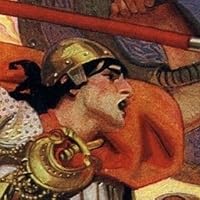
Xenophon (Ancient Greek Ξενοφῶν, Modern Greek Ξενοφώντας; ca. 431 – 355 BC), son of Gryllus, of the deme Erchia of Athens, was a soldier, mercenary and a contemporary and admirer of Socrates. He is known for his writings on the history of his own times, preserving the sayings of Socrates, and the life of ancient Greece.
Historical and biographical works: Anabasis (or The Persian Expedition) Cyropaedia Hellenica Agesilaus
Socratic works and dialogues: Memorabilia Oeconomicus Symposium Apology Hiero
Short treatises: On Horsemanship The Cavalry General Hunting with Dogs Ways and Means Constitution of Sparta
I have loved horses and books about them all of my life.Years and years ago I would see Xenophon's name mentioned in magazine articles and non-fiction books, always referring to this book, The Art Of Horsemanship. I wanted to read it, but never did see a copy until about 10 or 12 years ago in a specialized horse book catalog that I happened upon. I ordered it and when it came I had that wonderful 'Oh, finally!' feeling....but then I never read it! I don't know why. I picked it up many times, looked at the illustrations, marveled that I would be able to read a book that is considered almost as fresh and logical as it was back in 350BC when it was written. Then I would put it back on the shelf.
But lately I have been reading other works from Ancient Greece, and Xenophon began to call me. I picked it up the other day and could barely put it back down. My edition has the original treatise by Xenophon, which was translated by M. H. Morgan in 1894. There is also an essay by the translator titled The Greek Riding-Horse, where he discusses what is known of the history of the horse in Greece. Then there is a nifty section called Points Of The Horse, where Morgan gives us his translations of ten Greek and Roman authors describing the perfect horse. This was a treat because Xenophon himself mentioned a man named Simon, supposed to be a superb horseman, and one of the first to write what you could call a guide to the horse. If you know me, you will know that at this point I was wishing I could read Simon, so when I got to this section and found that it included all that remains of Simon's book on the horse, I was enchanted!
There is also a large and invaluable grouping of footnotes; and one last section that explains the illustrations the translator chose to use throughout the book. I liked Morgan's style, it complemented Xenophon to the point where I felt as though I were sitting in the barn having a good long horse chat with them both.
But about the actual treatise by Xenophon. It was written (according to one of those wonderful footnotes) as a guide for younger men, perhaps even intended for Xenophon's two sons. He covers such information as how to judge the horse you are looking at (always begin with the feet!), how to keep him healthy and happy in the stable, how to teach your groom to care for him properly, how to train and exercise the horse. Of course in those days most riding horses were meant for war, not just to go tootling around the park bridle path on a pretty afternoon, so most of the training was meant to create a supple and willing battle mount.
There were no saddles or stirrups at that time, so there are comments about how to mount using your spear as a vault, and the idea of training your horse to 'settle down' so you can hop on easily. There were two ways to do this: you could teach your horse to kneel down in front (Bucephalus the famous warhorse belonging to Alexander The Great was trained this way, according to Morgan). Or you could have the horse stretch his fore and hind feet apart, which lowers the body. My horse Patton was trained to do this, and I later taught another horse I had to do the same thing. It is really quite simple to do and easy for the horse to learn. Since Patton was already trained for it, all I had to do to get him to stretch was give a little nudge on his withers in front of the saddle. He knew to settle himself and stay stretched until I was sitting in the saddle ready to go. Every so often he would be extra excited and raring to get going on our daily desert rides, and he would step forward with his hind feet as soon as I got myself off the ground but before I was in the saddle. Felt sort of like having a non-moving escalator suddenly come to life. Of course, he was not supposed to do such a thing, even though it was just from high spirits. I always got back down and started over when that happened, because a horse needs to know that when they are expected to do something, they must do it properly, high spirits or not. But also on such days, after the first mile out (always walk that one, as well as the last mile back) we would head for a particular dry creekbed we liked, and have a glorious gallop. Maybe that is the reason Patton would stand up in the first place....to get to have a full-blast run. And I thought I was the boss!
Anyway, getting back to the book, it tickled me no end to see that I was doing the same training that the Ancient Greeks did. And I loved how Xenophon says to take your horse all over and show him everything you can think of that he will have to face. Also that you should never punish your horse for simply being a horse: if he spooks at something you must not lose your temper or else he will never get over thinking that he has truly seen a Monster. Xenophon's exact words here are Consequently, when your horse shies at an object and is unwilling to go up to it, he should be shown that there is nothing fearful in it, least of all to a courageous horse like him; but if this fails, touch the object yourself that seems so dreadful to him, and lead him up to it with gentleness. I love that mindset. It shows he truly knew and understood the way a horse thinks, and the way to help them be the wonderful partners they have the potential to be.
I'm really glad I finally read this classic. I think anyone who has horses in their life should read it, preferably in the barn with your horse looking over your shoulder. Those of us who love horses know the magic created when horses and humans work well together, whether on the battle field or in the riding ring. To me this book proves that the magic is timeless.
The trouble with these public domain books is that people tend to review the text not the actual edition. Here I am reviewing the edition. This book here is a public domain translation, and has been around for over a century. The knowledge of classical Greek language has changed considerably in this time. If you want Xenophon's Art of Horsemanship, I suggest getting Nyland's modern translation or the Loeb translation, rather than one of the dozens of public domain translations - they are everywhere - same 100 plus year old translation - different cover. It is Morris Morgan's 1893 translation that is mostly rehashed by the public domain editions, such as this book.
This short book was fascinating to me, because of the topic of horsemanship, but more so because this was written in 350BC by a Greek man.
Many parts of this book were interesting to me. Xenophon describes some things that still apply today: "Just as a house would be of little use, however beautiful its upper stories, if the underlying foundations were not what they ought to be, so there is little use to be extracted from a horse, and particular a war-horse, if unsound in his feet, however excellent his other points"
He also describes things that made me laugh, that we would not necessarily consider today, "A horse ought not to have large testicles, though that is not a point to be determined in the colt." or this comment of "Mane, forelock, and tail are triple gifts bestowed by the gods upon the horse for the sake of pride and ornament, and here is proof: a brood mare, so long as her mane is long and flowing, will not readily suffer herself to be covered by an ass; hence breeders of mules take care to clip the mane of the mare with a view to covering.". Hmm, really? I never knew mares were so vain!
Some things were complete common sense, today and then, such as "The one best precept - the golden rule - in dealing with a horse is never to approach him angrily. Anger is so devoid of forethought that it will often drive a man to do things which in a calmer mood he will regret."
And some parts immediately took me back to ancient Greece, and put me in the moment of Xenophon writing this: As to the apprehension, which some people entertain, that a horse may dislocate the shoulder galloping down an incline, it should encourage them to learn that the Persians and Odrysians all run races down precipitous slopes, and their horses are every bit as sound as our own." I had actually never heard of the Odrysians, but after looking it up I now know that the Odrysian kingdom endured between the 5th and 3rd centuries BC in what is now present day Bulgaria. History lesson for me.
On a horse, a cavalryman of ancient Athens must have felt on top of the world. No slogging along in the dust and heat of the road; instead, on horseback, one could gallop away from the main body of the army, and could engage in slashing, lightning-quick attacks against the Spartan or Corinthian enemy. Words like the English cavalier and the Spanish caballero speak to the idea that ownership of a horse made a man a gentleman, conveyed higher social status, in many societies; now, as it was then, it is a costly thing to own a horse. Accordingly, good care for one’s horse has always been at the heart of equestrian culture. And the Athenian writer Xenophon provides much more than an equestrian’s treatise in his On Horsemanship.
Xenophon is best known for his Anabasis (also known as The March Up Country or The Persian Expedition). That classic work recounts how Xenophon successfully led a stranded army of Athenian mercenaries in a “march to the sea,” across hundreds of miles of hostile territory in what is now Turkey. Accordingly, he was a man who knew a great deal about war and how to fight it; and as a practical military man, he knew the critical role that cavalry could play in warfare.
Any devoted equestrian would appreciate the practicality of the advice that Xenophon gives regarding ways to make the young warhorse ready for battle: “The groom should have standing orders to take his charge [the colt] through crowds, and to make him familiar with all sorts of sights and noises; and if the colt shows sign of apprehension at them, he must teach him – not by cruel, but by gentle handling – that they are not really formidable.”
And anyone who owns a horse and has mucked out a stall would appreciate these words of Xenophon: “A stable with a damp and smooth floor will spoil the best hoof which nature can give. To prevent the floor being damp, it should be sloped with channels; and to avoid smoothness, paved with cobblestones sunk side by side in the ground and similar in size to the horse’s hoofs. A stable floor of this sort is calculated to strengthen the horse’s feet by the mere pressure on the part in standing.” Very sensible – as your warhorse cannot sustain you in war if you don’t take care of said warhorse before the war begins.
Xenophon’s overall rule for effective horse training seems to be that “If you would have a horse learn to perform his duty, your best plan will be, whenever he does as you wish, to show him some kindness in return, and, when he is disobedient, to chastise him.” Please note that Xenophon writes “chastise,” not “punish.” A horse is a spirited animal, and Xenophon does not want to see that spirit broken.
Contemporary equestrians will likewise appreciate Xenophon’s advice that “The one best precept – the golden rule – in dealing with a horse is never to approach him angrily.” When a horse is fearful of something, Xenophon recommends that the rider gradually, gently make clear to the horse that there is nothing to fear. “The opposite plan of forcing the frightened creature by blows only intensifies its fear, the horse mentally associating the pain he suffers at such a moment with the object of suspicion, which he naturally regards as its cause.” If only we lived in a world in which no rider would even consider beating a horse.
Xenophon shows comparable concern for the horse’s sensibilities when he writes that “When the moment to dismount has come, you should never do so among other horses, nor near a group of people, nor outside the exercising-ground; but on the precise spot which is the scene of his compulsory exertion, there let the horse find also relaxation.” Steadiness in one’s treatment of the animal seems to be Xenophon’s watchword – as when he states that “far the best method of instruction, as we keep repeating, is to let the horse feel that whatever he does in obedience to the rider’s wishes will be followed by some rest and relaxation….[W]hat a horse does under compulsion he does blindly, and his performance is no more beautiful than would be that of a ballet-dancer taught by whip and goad.”
I thought of Xenophon’s words when I saw footage of Roy Moore, then a Republican candidate for a United States Senate seat in the state of Alabama, making a great show of dressing as a cowboy and riding a horse to his polling place. Perhaps Moore thought that his doing so would give him a “manly man” image that would help him win the election – it did not; he lost to Democratic candidate Doug Jones – but what struck me was how many knowledgeable equestrians criticized Moore for his poor handling of the horse. The criticism I kept hearing was that Moore’s clumsy handling of the reins posed the danger of cutting or tearing the horse’s mouth.
Moore would have done well to heed the words of Xenophon: “The horse’s mouth is not to be pulled back too harshly, so as to make him toss his head aside, nor yet so gently that he will not feel the pressure. But the instant he raises his neck in answer to the pull, give him the bit at once; and so throughout, as we never cease repeating, at every response to your wishes, whenever and wherever the animal performs his services well, reward and humour him.” Even now, 2400 years after the time of Xenophon, his advice on how to take care of a horse still applies.
For Xenophon, horsemanship is not simply a matter of good form, or of holding on to one’s membership in the upper class; rather, it is key to survival and success in a Greek world where warfare is a constant reality of life. Suggesting for a rider, “a good seat is not that of a man seated on a chair, but rather the pose of a man standing upright with his legs apart”, Xenophon is quick to give a practical reason why: “In this way he will be able to hold on to the horse more firmly by his thighs; and this erect attitude will enable him to hurl a javelin or to strike a blow from horseback, if occasion calls, with more vigorous effect.” Not the sort of thing that equestrians of the present day have to worry about, generally, but certainly advice that Greek readers of Xenophon’s time would have appreciated.
Sometimes, it is the shorter and more commonly overlooked works of the classical Greek writers that provide the greatest insights into life in the ancient Greek world. Xenophon’s On Horsemanship does that for us, even as it is likely to provide a particularly enjoyable reading experience for anyone who still rides a horse and understands that extraordinary experience of the bond between horse and rider.
I am the translator of this book. Please do not confuse this book with the many public domain versions on the market, and please note that Goodreads links this book to those versions. Reviews of those versions show up linked to this book due to the Goodreads system, and ratings of other versions are merged with this book. This book contains content additional to editions of Art of Horsemanship. I hope this helps!
Interesting to read such a gentle approach to horsemanship from so long ago. It surprised me to note the desire to train a horse without breaking him was lauded by the ancients, and I'm curious at what point in history we lost that.
I grew up in the saddle in Colorado, but I’ve not kept up with my riding roots. However, this book was delightful and an informative view on ancient horse care practices. It is amazing the universal things that haven’t changed and the things that have (especially beauty standards for horses 😜).
If you like horses or ancient history this is a must read, if you like both it is better than ice cream. (And I love ice cream.)
This is Xenophon's treatise on training a warhorse. The ancient Greeks really knew their horses, and it was refreshing to see that they treated them with a great deal of respect and compassion. Xenophon had some great advice on how to purchase a horse without getting cheated by the horse trader or the trainer. He begins by advising that you look for a horse that has good feet. (I'm looking forward to telling this to my farrier when I see him next.) I enjoyed the section on grooming. "And no matter what pains one has spent on it, the horse is no sooner led out than it gets exactly dirty as before." (Obviously, Xenophon has given his horse a bath only to watch him roll as soon as he gets turned back outside.) There's also some handy advice on how to mount using your spear, how to tack your horse up with a set of armor, and how to use your javelin when you go into battle. This edition also includes an interesting discussion about the horse in Greek art and literature and how the ancient Greek horse would compare to modern horses. It was well worth reading.
Well, if not for my authors alphabet challenge I might have never read this, but I'm glad I did, I learned quite a bit. Where would I need it? Well, at least while watching historical and fantasy movies 😃
A fascinating insight into a bygone era of equestrianism.
Xenophon was primarily concerned with raising and training the horse for war, yet his approach espouses a kindness very sadly lacking in many 'horsemanship' experts of today.
He offers an excellent guide to desirable conformation with emphasis on a good hoof, although modern ideals of hoof structure differ from ancient Greek ideals the principle of a quality foundation for your horses body is a sound one (excuse the pun). The commentary on stone sizes brings an element of comedy to an otherwise serious text and is bound to raise a few giggles.
You can read about the bits used in ancient times, Xenophon recommends two types and they were both rather barbaric, the descriptions will make you feel sorry for any horse that had to have one in his mouth, thankfully most of the equine world has advanced on that front (though sadly not all of it). There are also some rather unusual aspects of horsemanship mentioned in the book that I didn't know existed, the use of horse muzzles being an obvious example.
An interesting read for anyone fascinated by horses and history.
Interesting and a fun little read. This copy is by Dover, with the translation by Morris H. Morgan in 1893. Morgan used several references and translations to verify the agreement in terminology between other books and authors.
Basically Xenophon was one of the original, and best writers of the ideals of a horse, and basic horsemanship. Understand that the ideal for the Greeks was a light horse, fast cavalry sort, and the heavy drafts were frowned upon, unlike later, the English with their heavy draft war-horses, the Shires. The Greeks were fairly unorganized with regards to a cavalry, and lighlty armored as well, unlike in later times with full armor, so their horses didn't need to be able to carry that kind of weight. They also had no stirrups at that time, and essentially rode bareback or with a pad and girth.
Xenophon’s The Art of Horsemanship is an often referenced but much less read book amongst horse-people. In this work Dr A Nyland has included selections from many other classical writers along with some observations drawn from her own considerable knowledge to help clarify what Xenophon is saying. The Art of Horsemanship Xenophon and Other Classical Writers is drawn from people whose very lives depended on the quality, soundness and training of their horses. Making it a fine book for horse-people, horse lovers and anyone with an interest in history. Horsepeople may also find this book enlightening as to how old some of our current ‘new ideas’ in horsemanship actually are.
Great if you like a mix of ancient history and horses. I'm surprised I hadn't read this sooner. The amount of text that comes from Xenophon is only a small portion of this book. Most of it contains explanatory notes and further discussions on the horse in antiquity. The translating scholarly author has done much research on the subject and shares both opinion and information in a balanced way. It was very interesting to hear Xenophon's opinion on how the horse should be selected, treated and so on. I recommend it to anyone with a love of history and horses.
Xenophon's Art of Horsemanship is cited so often in training and equine psychology texts and, having now read it, it's easy to see why. This is a very quick read and I would recomend anyone with an interest in horses take a few moments and give it a read. Xenophon's love for the horse clearly shows in his writing and it's truely amazing to see how the core values of horsemanship can bridge the gap of centuries.
Some good wisdom here, although preparing a horse for battle (or myself for that matter) is not my prime concern, I was pleased to note that several times within the text, Xenophon encouraged trainers and riders to approach horses calmly and with thought for the horse's well being rather than using anger and force. It makes me wonder what happened in the intervening years and why "natural horsemanship" is a relatively modern concept.
Dover republication of M. H. Morgan's 1893 Little, Brown edition, based on Dindorf's Oxford Greek text.
Illustrated. Nine full page illustrations, and many in the text. Thirty seven pages of notes, including an excellent six page discussion of the lack of evidence for curb-chains on Greek bits.
We often think that animal rights is a most recent issue and with a shiver think back to how animals were treated by humans for centuries. And then here is Xenophon, who wrote about horsemanship thousands of years ago. And guess what- treating horses with respect is the basis of the whole book. An amazing read, both within and outside its historic context.
A perfect resource for anyone researching the minutia of ancient life for historical fiction or fantasy writing. This treatise is methodically detailed without being impenetrable and provides plenty of trivia that a writer could use to give their story more realism. I plan to read "Hipparch" next, a guide for Greek cavalry commanders.
When I was little I read The White Horses of Lipizza by Marguerite Henry over and over again. This book is mentioned in that one, so the title has been floating in my head since I was a kid. It's historically interesting, though not life-changing.
I feel qualified to buy and train a Greek warhorse now; that's a plus.
I found this book to be boring. It would probably be of a lot more interest to someone who is interested in horsemanship or military history as it is a combination of the two.
Absolutely fascinating how much of it is similar to present-day horsemanship. Just a few things sounded outdated - and that after 2300 years. I am impressed.