

What do you think?

The Guild of Specialists #1
Operation Red Jericho
A sister and brother's search for their missing parents uncovers a mysterious secret society in an action-filled sea-and-land saga centered in 1920s Shanghai.
For Joshua Mowll, it was the surprise of a lifetime. There, among the archives inherited from his great-aunt Rebecca MacKenzie, was a 1920s journal recounting the thrilling and dangerous adventures of fifteen-year-old Rebecca and her younger brother, Doug, in the wake of their parents' mysterious disappearance in the deserts of China. Now carefully re-created in a lavish volume — complete with cloth binding and a journal-style elastic clasp — the siblings' tale begins aboard the Expedient, their uncle's enigmatic research ship, and moves at a breathless pace through the streets of Shanghai and on to a terrifying island fortress. Along the way, Doug and Becca encounter an ancient order of Chinese mercenaries, a brutal pirate warlord, a feisty Texan heiress, and a stolen cache of a volatile explosive called zoridium. By their saga's end, the intrepid duo has exposed a murderous plot involving their parents and uncovered a high-minded secret society hidden from the world for hundreds of years. Interspersed are such "archival" elements
— elaborate diagrams and maps
— vintage photos and illustrations
— documents with stamps, seals, and watermarks
— four full-color gatefolds, the largest a six-page foldout
— extensive appendices and notes
Painstakingly researched and packed with authentic detail, OPERATION RED JERICHO is the first of three nonstop-action tales of intrigue by first-time author Joshua Mowll — historical fiction at its finest.
For Joshua Mowll, it was the surprise of a lifetime. There, among the archives inherited from his great-aunt Rebecca MacKenzie, was a 1920s journal recounting the thrilling and dangerous adventures of fifteen-year-old Rebecca and her younger brother, Doug, in the wake of their parents' mysterious disappearance in the deserts of China. Now carefully re-created in a lavish volume — complete with cloth binding and a journal-style elastic clasp — the siblings' tale begins aboard the Expedient, their uncle's enigmatic research ship, and moves at a breathless pace through the streets of Shanghai and on to a terrifying island fortress. Along the way, Doug and Becca encounter an ancient order of Chinese mercenaries, a brutal pirate warlord, a feisty Texan heiress, and a stolen cache of a volatile explosive called zoridium. By their saga's end, the intrepid duo has exposed a murderous plot involving their parents and uncovered a high-minded secret society hidden from the world for hundreds of years. Interspersed are such "archival" elements
— elaborate diagrams and maps
— vintage photos and illustrations
— documents with stamps, seals, and watermarks
— four full-color gatefolds, the largest a six-page foldout
— extensive appendices and notes
Painstakingly researched and packed with authentic detail, OPERATION RED JERICHO is the first of three nonstop-action tales of intrigue by first-time author Joshua Mowll — historical fiction at its finest.
271 pages, Hardcover
First published January 1, 2005
About the author
Joshua Mowll
16 books71 followersAuthor of Operation Red Jericho, Operation Typhoon Shore, Operation Storm City, The Great Space Race and Beautiful Titan
Ratings & Reviews
Friends & Following
Create a free account to discover what your friends think of this book!
Community Reviews
Displaying 1 - 30 of 193 reviews

February 12, 2009
This was a fun as well as amazingly researched book. The details on some of the fold out schematics (where's my spell check?) are incredible (if you're into that sort of thing, which I'm not, but still I was impressed). It was also a refreshing change from fantasy - the mainstay of current YA literature. And, frankly, I wish all authors would include some illustrations. How come only kids get pictures?

Read
February 3, 2026If I had read this when was 11 or 12 I would have been completely enchanted. The story is fast-paced, the kids play major roles, and the addition of colorful maps and newspaper clippings and diagrams and the kids’ own drawings and later correspondence really adds to the experience.
As an adult, it doesn’t do so much for me (is my inner child dead?), hence no rating.
As an adult, it doesn’t do so much for me (is my inner child dead?), hence no rating.

September 13, 2011
Operation Red Jericho
by Joshua Mowll
Before I review the story I must say something about the incredible design of the book. The cover is like a old fashioned notebook or journal, rounded page edges and a elastic band to keep the book shut. Inside the book is richly illustrated. Every few pages there are beautiful illustrations, diagrams, maps, sketches, pictures and a number of larger foldout illustrations. The journal design and quality of the book makes it instantly visually very interesting.
Operation Red Jericho is an adventure novel aimed at young adults, the first in a trilogy. Set in and around Shanghai in 1920 the story follows fifteen year old Becca and her ten year old brother Doug as they search for clues to the whereabouts of their parents who have disappeared in mysterious circumstances while in a remote part of China. While in the care of a mysterious uncle onboard his ‘research’ ship they uncover a secret society. Its aim to protect the world from evil.
The book is interestingly written as a third person novel with extracts from both Becca’s and Doug’s diary including a number of Doug’s illustrations. The story is packed with adventure, mystery, action and uncomplicated good or bad characters I found the book fun, fast paced, and at times totally unbelievable, but still a throughly good read. My only surprise is that it hasn’t yet been adapted for the big screen.
Age range ‘confident KS2 readers’
by Joshua Mowll
Before I review the story I must say something about the incredible design of the book. The cover is like a old fashioned notebook or journal, rounded page edges and a elastic band to keep the book shut. Inside the book is richly illustrated. Every few pages there are beautiful illustrations, diagrams, maps, sketches, pictures and a number of larger foldout illustrations. The journal design and quality of the book makes it instantly visually very interesting.
Operation Red Jericho is an adventure novel aimed at young adults, the first in a trilogy. Set in and around Shanghai in 1920 the story follows fifteen year old Becca and her ten year old brother Doug as they search for clues to the whereabouts of their parents who have disappeared in mysterious circumstances while in a remote part of China. While in the care of a mysterious uncle onboard his ‘research’ ship they uncover a secret society. Its aim to protect the world from evil.
The book is interestingly written as a third person novel with extracts from both Becca’s and Doug’s diary including a number of Doug’s illustrations. The story is packed with adventure, mystery, action and uncomplicated good or bad characters I found the book fun, fast paced, and at times totally unbelievable, but still a throughly good read. My only surprise is that it hasn’t yet been adapted for the big screen.
Age range ‘confident KS2 readers’

March 2, 2015
As promising as the book cover looked, the plot didn't nearly convince me as much of the story. The characters felt archetypal, sometimes unrealistic and not very well-developed. The turning point was especially disappointing, as the author was unable to introduce the battle in any convincing way. The reason for the book to receive three stars by me was its layout, the fantastic cover and the way it was structured with all those additional information on the ship etc. Even though the book looked like a journal, the author soon gave up on the idea to write it as one, in the beginning switching from journal entries to narrative chapters before totally concentrating on the narrative parts.
The beginning was well-executed and would even have convinced me to read the second installment, but the ending egalized that opinion and left me very disappointed. The positive thing about it is that it looks absolutely stunning.
The beginning was well-executed and would even have convinced me to read the second installment, but the ending egalized that opinion and left me very disappointed. The positive thing about it is that it looks absolutely stunning.

August 19, 2008
When I was reading Joshua Mowll's Operation Red Jericho to my son, I kept hearing the foley effects, the radio crackle, and the commercials for the Army that accompanied the great radio tales of Lamont Cranston.
"Who knows what evil lurks in the hearts of men?"
"The Honourable Guild of Specialists knows. Mwaaaahhaaaahhhaaa!"
It may seem strange that a book published in 2005 would conjure such aural memories in a man born well after the Golden Age age of radio, particularly considering so many of the pleasures of Operation Red Jericho are visual, but Mowll's tale contains an innocent simplicity, a nostalgic, war era siss-boom-bah that has intrigued me since I was a boy. I sought out the great radio shows and eventually went on to write a radio drama. So I am a huge fan of the stories Mowll was paying homage to, and it was refreshing to see someone today going to the roots of the serial adventure rather than simply paying homage to Indiana Jones, itself an homage, and thereby serving up a bland copy of what was once at the core of so many boys' imaginations.
Operation Red Jericho gives us something more. Sure it isn't great literature. It's not a mind-blowing experience that shouldn't be missed. It's not even widely accessible to today's boys. But it is a heck of a yarn told with love and care, and for those few boys with imaginations that go beyond the television set, Operation Red Jericho can be a gateway into comic books, Sherlock Holmes, Tarzan, and anything else that turns boys into lifetime readers.
It's not particularly original (though it doesn't need to be since it is an homage) and the characters are mere archetypes (as it should be for the same reason) but Mowll takes all the classic pieces of pulpy adventures -- exotic locales, sadistic madmen, champagne sociopaths, scrappy women, tigers, torture devices and cliffhangers -- and offers them up in a pretty package full of diagrams, maps, photos, and sketches -- enough verisimilitude to convince any 5-10 year old boy that the adventures of Douglas and Becca MacKenzie are, indeed, possible and that, at least for one brother and sister duo, they were very real.
Now I have to go out and find us a few episodes of the Shadow, so Miloš can hear what I hear when we're reading Operation Red Jericho.
"Who knows what evil lurks in the hearts of men?"
"The Honourable Guild of Specialists knows. Mwaaaahhaaaahhhaaa!"
It may seem strange that a book published in 2005 would conjure such aural memories in a man born well after the Golden Age age of radio, particularly considering so many of the pleasures of Operation Red Jericho are visual, but Mowll's tale contains an innocent simplicity, a nostalgic, war era siss-boom-bah that has intrigued me since I was a boy. I sought out the great radio shows and eventually went on to write a radio drama. So I am a huge fan of the stories Mowll was paying homage to, and it was refreshing to see someone today going to the roots of the serial adventure rather than simply paying homage to Indiana Jones, itself an homage, and thereby serving up a bland copy of what was once at the core of so many boys' imaginations.
Operation Red Jericho gives us something more. Sure it isn't great literature. It's not a mind-blowing experience that shouldn't be missed. It's not even widely accessible to today's boys. But it is a heck of a yarn told with love and care, and for those few boys with imaginations that go beyond the television set, Operation Red Jericho can be a gateway into comic books, Sherlock Holmes, Tarzan, and anything else that turns boys into lifetime readers.
It's not particularly original (though it doesn't need to be since it is an homage) and the characters are mere archetypes (as it should be for the same reason) but Mowll takes all the classic pieces of pulpy adventures -- exotic locales, sadistic madmen, champagne sociopaths, scrappy women, tigers, torture devices and cliffhangers -- and offers them up in a pretty package full of diagrams, maps, photos, and sketches -- enough verisimilitude to convince any 5-10 year old boy that the adventures of Douglas and Becca MacKenzie are, indeed, possible and that, at least for one brother and sister duo, they were very real.
Now I have to go out and find us a few episodes of the Shadow, so Miloš can hear what I hear when we're reading Operation Red Jericho.

December 30, 2011
This book was truly formative for me as a kid.
First of all, the included schematics, illustrations, and footnotes are amazingly detailed. I was fascinated and half-convinced the story was really handed down to the author by his great-aunt, as the forewards claim.
This book taught me to finally stop misspelling the word "tongue" with the helpful mnemonic: it's like Sheng-Fat's tong, except add a U-E at the end. Helped me out in seventh grade life science class, too, because who can forget that baby ferns are called "croziers" when you associate them with Julius Pembleton-Crozier? I marinated in these books for so long. I used zoridium-related passwords to my online accounts. I pictured a gyrolabe spinning at my center of gravity to help with balancing exercises. It's no accident that I later went through subsequent obsessive phases regarding both Alexander the Great and also atomic physics.
Now that I'm older, Operation Red Jericho is inevitably thinner than I remember it being. The plot is a little less riveting than I remember, but still full of 1920s conspiracy, dash, and danger. The characters have always been the weakest point. I never cared much for any of them particularly, even as a kid, except for Xu and Xi. (They were my favorites, naturally, just because they were members of a secret martial order.) Everyone is kind of a caricature; the person who comes closest to being real is Doug.
I still enjoyed the experience of re-reading, though, and I still believe these books are honestly pretty unique. If you are a kid or have a kid who is curious, interested in adventure and learning stuff, this is a great series to explore.
First of all, the included schematics, illustrations, and footnotes are amazingly detailed. I was fascinated and half-convinced the story was really handed down to the author by his great-aunt, as the forewards claim.
This book taught me to finally stop misspelling the word "tongue" with the helpful mnemonic: it's like Sheng-Fat's tong, except add a U-E at the end. Helped me out in seventh grade life science class, too, because who can forget that baby ferns are called "croziers" when you associate them with Julius Pembleton-Crozier? I marinated in these books for so long. I used zoridium-related passwords to my online accounts. I pictured a gyrolabe spinning at my center of gravity to help with balancing exercises. It's no accident that I later went through subsequent obsessive phases regarding both Alexander the Great and also atomic physics.
Now that I'm older, Operation Red Jericho is inevitably thinner than I remember it being. The plot is a little less riveting than I remember, but still full of 1920s conspiracy, dash, and danger. The characters have always been the weakest point. I never cared much for any of them particularly, even as a kid, except for Xu and Xi. (They were my favorites, naturally, just because they were members of a secret martial order.) Everyone is kind of a caricature; the person who comes closest to being real is Doug.
I still enjoyed the experience of re-reading, though, and I still believe these books are honestly pretty unique. If you are a kid or have a kid who is curious, interested in adventure and learning stuff, this is a great series to explore.

September 14, 2009
Brontë: I love it. I love it all.
Pa: What did you love the most?
Brontë: Everything. I loved the drawings and the maps. I liked how the maps were drawn. The one that I really loved was the submarine. I love how they were waiting there to attack the fort, to attack the other guys and stuff. I liked it. That's pretty much it.
Pa: That's a short review, Të. You don't have anything else?
Brontë: You should go down to the other level and say, "P.S."
Pa: Okay.
p.s. Love it!
Pa: What did you love the most?
Brontë: Everything. I loved the drawings and the maps. I liked how the maps were drawn. The one that I really loved was the submarine. I love how they were waiting there to attack the fort, to attack the other guys and stuff. I liked it. That's pretty much it.
Pa: That's a short review, Të. You don't have anything else?
Brontë: You should go down to the other level and say, "P.S."
Pa: Okay.
p.s. Love it!
October 4, 2015
When it comes to adventure novels, this one is near the top of my list, despite its occasional problems. Operation Red Jericho is noteworthy because of the inventive mythology that Mowll has created, as well as the action-packed story that he creates with this mythology. Although the story occasionally indulges in unflattering tropes and characters often struggle to rise above archetypes, he manages to create an awesome yet slightly flawed story nevertheless. This would be the type of story that you would definitely have to suspend your disbelief for – except thanks to Mowll’s creativity, the opposite is true.
When Becca and Douglas Mackenzie’s parents disappear, they’re sent to live with their uncle, a mysterious ship captain currently on a research expedition in China. Their uncle is, in fact, no mere researcher, but a member of a secret organization called the Guild of Specialists. What follows is a madcap adventure involving pirates, ninjas, aviators, volatile explosives, awesome submarines, and more technical drawings than you can shake a stick at.
What makes this series so exceptional is the sheer detail that Mowll put into this book. He includes supplementary material such as maps, technical drawings, sketches, and photographs. The story behind this story is that Becca was Mowll’s great-aunt and what we’re reading is her journal, and everything else was found in a hidden archive in her house. And all this is done in such painstaking detail that you will seriously have to reassure yourself that this is a work of fiction. Repeatedly.
Of course, the actual story leaves a little to be desired. But only a little. It’s clear that Mowll was heavily influenced by the serial adventure stories of the 1930s and their later successors, the Indiana Jones movie. So, yes, there are quite a few clichés. I wouldn’t say these clichés are especially offensive, but certain characters could have been handled better. Personally, I find such stories fun, but you may disagree. The Guild of Specialists trilogy is decidedly not for everyone, I suppose.
Mowll’s bizarre choice to combine an excessively realistic background story with a clichéd foreground story definitely produces…interesting results, shall we say. It’s definitely a sign of his talent that he makes this story work as much as it did. He manages to tell a fun, engaging story and keep us enthralled the whole way through. It also features my favorite painting, Holbein’s The Ambassadors prominently, which is a nice touch for me. I also want to give kudos to his undoubtedly talented illustrators, who really make the story work. This is a great book. Not a superlative one. But definitely great.
When Becca and Douglas Mackenzie’s parents disappear, they’re sent to live with their uncle, a mysterious ship captain currently on a research expedition in China. Their uncle is, in fact, no mere researcher, but a member of a secret organization called the Guild of Specialists. What follows is a madcap adventure involving pirates, ninjas, aviators, volatile explosives, awesome submarines, and more technical drawings than you can shake a stick at.
What makes this series so exceptional is the sheer detail that Mowll put into this book. He includes supplementary material such as maps, technical drawings, sketches, and photographs. The story behind this story is that Becca was Mowll’s great-aunt and what we’re reading is her journal, and everything else was found in a hidden archive in her house. And all this is done in such painstaking detail that you will seriously have to reassure yourself that this is a work of fiction. Repeatedly.
Of course, the actual story leaves a little to be desired. But only a little. It’s clear that Mowll was heavily influenced by the serial adventure stories of the 1930s and their later successors, the Indiana Jones movie. So, yes, there are quite a few clichés. I wouldn’t say these clichés are especially offensive, but certain characters could have been handled better. Personally, I find such stories fun, but you may disagree. The Guild of Specialists trilogy is decidedly not for everyone, I suppose.
Mowll’s bizarre choice to combine an excessively realistic background story with a clichéd foreground story definitely produces…interesting results, shall we say. It’s definitely a sign of his talent that he makes this story work as much as it did. He manages to tell a fun, engaging story and keep us enthralled the whole way through. It also features my favorite painting, Holbein’s The Ambassadors prominently, which is a nice touch for me. I also want to give kudos to his undoubtedly talented illustrators, who really make the story work. This is a great book. Not a superlative one. But definitely great.

April 10, 2011
This is a good preteen, early teen book, full of chases, escapes, pirates, gunboats and mystical artifacts. The writing itself isn't terribly special, and it commits the sin of having a folksy talkin' character from (where else) Texas, but at least he doesn't have them utter horrible catchphrases like "Well burn mah' biscuits!" etc. All in all, if I had had this as a 13 year old, I would have stayed up all night reading it, and begged my mom for the next one. Plus it has charts and fold out maps and schematics, which make it even better.

October 23, 2016
This was a good book. There was a great plot and good characters, and some awesome diagrams and maps, but I really didn't like the writing style. It was a style that made you just want to skim the entire book so you could finish it.

Read
February 9, 2017thumbs up :))

November 10, 2015
Wegens omstandigheden ben ik verworden tot een leugenaar, een slotenbreekster, een lezeres van geheime documenten. Mijn situatie bepaalt wie ik ben, alleen en op drift - samen met Doug - op een zee van ellende, geleid door invloeden van buitenaf. Ik probeerde alleen mijn veilige plekje te beschermen.
'Niet zomaar een verhaal. Niet zomaar een boek.' Dat staat er achteraan in de korte inhoud (die ik trouwens bijzonder goed vind, er is net genoeg en net de goede informatie gekozen). En dat klopt natuurlijk ook.
Dit boek is een pareltje, een prachtstuk.
Je zou het zo op het eerste zicht niet zeggen als je de cover ziet - tot je 't oppakt, want dan merk je dat er iets speciaals aan de hand is met dat kaartje rechtsonder... Dat plakt er namelijk echt op!
Bij dit boek vervaagt de grens tussen fictie en realiteit - toen ik Geheime Missie Jericho Rood voor het eerst las, weet ik nog, ben ik nadien een hoop dingen gaan opzoeken omdat ik dacht dat ze écht gebeurd waren. Dat is wat dit boek zo sterk maakt. Alles is fictie, maar het wordt zó geloofwaardig gebracht dat je op den duur denkt dat er dingen inzitten die echt gebeurd zijn. En dat is dus niet.
Dat gevoel van realiteit komt ook zeker door wat dit boek zo speciaal maakt: het is niet enkel tekst, oh nee. Er zitten tekeningen, dagboekfragmenten, kaarten (ja, zelfs uitvouwbare kaarten!!), kanttekeningen, achtergrondinformatie en zo veel meer in.
De twee hoofdpersonages - en alle andere trouwens ook - zijn echt superaangenaam om te lezen, ze komen heel reëel over. Doug en Becca (broer en zus) hebben een goede relatie, en doen niet zo irritant tegen elkaar, zoals in andere boeken wel eens voorkomt. Ze plagen mekaar wel eens, maar wat mij opvalt is dat ze echt altijd voor elkaar klaarstaan en opkomen, dat ze elkaar steunen en helpen, en dat wordt echt prachtig neergezet.
Het boek leest vlot en heeft een goede stijl - die de vertaler, Gerbrand Bakker, goed behouden heeft, zo te merken. Er zit hier en daar een onopvallende grammatica- of typfout in, of soms mist er een aanhalingsteken, maar in een boek van dit kaliber kan zelfs mij dat echt niks schelen.
Het boek ziet er ook gewoon aangenaam uit; het enige nadeel is misschien dat je wat problemen hebt om te beslissen welke dingen je eerst leest, omdat die kaarten en zo allemaal informatie bevatten recht door de tekst, maar na een tijdje geraak je daar wel wijs uit.
Een héél erg grote aanrader!
10/10
PS Opvallend detail: de naam van de auteur staat niet op de kaft. En die van de uitgeverij ook niet (wat ik altijd leuk vind)!
'Niet zomaar een verhaal. Niet zomaar een boek.' Dat staat er achteraan in de korte inhoud (die ik trouwens bijzonder goed vind, er is net genoeg en net de goede informatie gekozen). En dat klopt natuurlijk ook.
Dit boek is een pareltje, een prachtstuk.
Je zou het zo op het eerste zicht niet zeggen als je de cover ziet - tot je 't oppakt, want dan merk je dat er iets speciaals aan de hand is met dat kaartje rechtsonder... Dat plakt er namelijk echt op!
Bij dit boek vervaagt de grens tussen fictie en realiteit - toen ik Geheime Missie Jericho Rood voor het eerst las, weet ik nog, ben ik nadien een hoop dingen gaan opzoeken omdat ik dacht dat ze écht gebeurd waren. Dat is wat dit boek zo sterk maakt. Alles is fictie, maar het wordt zó geloofwaardig gebracht dat je op den duur denkt dat er dingen inzitten die echt gebeurd zijn. En dat is dus niet.
Dat gevoel van realiteit komt ook zeker door wat dit boek zo speciaal maakt: het is niet enkel tekst, oh nee. Er zitten tekeningen, dagboekfragmenten, kaarten (ja, zelfs uitvouwbare kaarten!!), kanttekeningen, achtergrondinformatie en zo veel meer in.
De twee hoofdpersonages - en alle andere trouwens ook - zijn echt superaangenaam om te lezen, ze komen heel reëel over. Doug en Becca (broer en zus) hebben een goede relatie, en doen niet zo irritant tegen elkaar, zoals in andere boeken wel eens voorkomt. Ze plagen mekaar wel eens, maar wat mij opvalt is dat ze echt altijd voor elkaar klaarstaan en opkomen, dat ze elkaar steunen en helpen, en dat wordt echt prachtig neergezet.
Het boek leest vlot en heeft een goede stijl - die de vertaler, Gerbrand Bakker, goed behouden heeft, zo te merken. Er zit hier en daar een onopvallende grammatica- of typfout in, of soms mist er een aanhalingsteken, maar in een boek van dit kaliber kan zelfs mij dat echt niks schelen.
Het boek ziet er ook gewoon aangenaam uit; het enige nadeel is misschien dat je wat problemen hebt om te beslissen welke dingen je eerst leest, omdat die kaarten en zo allemaal informatie bevatten recht door de tekst, maar na een tijdje geraak je daar wel wijs uit.
Een héél erg grote aanrader!
10/10
PS Opvallend detail: de naam van de auteur staat niet op de kaft. En die van de uitgeverij ook niet (wat ik altijd leuk vind)!

January 30, 2017
First of all, about three years ago, I checked this out from the library.... and didn't finish it.
About a year ago, I found this on the shelf at a Goodwill, and because I needed red-themed items for an exhibition at an art museum, I bought it.
I will always cherish the physical object of this book, I will always cherish the rounded corners, the endless charts and images, the fact that this book was used in an exhibition in the summer of 2016.
The pictures, by the way, are lovely. So, so lovely. I loved studying the charts, looking at all these cool diagrams. Like this diagram for instance:
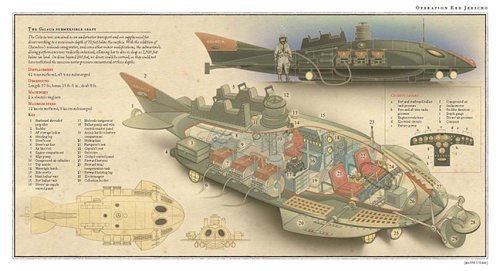
I WAS NOT however, in love with anything else about this book. I didn't even finish it, for the third time I've tried reading. However, I was so close to the end this time, I feel justified in putting it on my read shelf (or should I say red shelf???)
I feel like the fact that I couldn't read it, not even after three attempts is indicative of the lackluster writing. I have, after all, read something like four hundred novels. I like actiony books, I like historical stuff, I like a steam punk vibe. I didn't like this book.
It's so bare-bones that it's boring. I suppose the format was meant to sell the type of visual that the book wants to portray... yet the lovely images and the flat writing style didn't seem to work together at all. Instead, this seemed like a design team's collaborated (and rushed) effort to sell a design concept, and not a story.
About a year ago, I found this on the shelf at a Goodwill, and because I needed red-themed items for an exhibition at an art museum, I bought it.
I will always cherish the physical object of this book, I will always cherish the rounded corners, the endless charts and images, the fact that this book was used in an exhibition in the summer of 2016.
The pictures, by the way, are lovely. So, so lovely. I loved studying the charts, looking at all these cool diagrams. Like this diagram for instance:
I WAS NOT however, in love with anything else about this book. I didn't even finish it, for the third time I've tried reading. However, I was so close to the end this time, I feel justified in putting it on my read shelf (or should I say red shelf???)
I feel like the fact that I couldn't read it, not even after three attempts is indicative of the lackluster writing. I have, after all, read something like four hundred novels. I like actiony books, I like historical stuff, I like a steam punk vibe. I didn't like this book.
It's so bare-bones that it's boring. I suppose the format was meant to sell the type of visual that the book wants to portray... yet the lovely images and the flat writing style didn't seem to work together at all. Instead, this seemed like a design team's collaborated (and rushed) effort to sell a design concept, and not a story.
July 19, 2019
I have a thing for old-timey adventures, filled with old-school science and machinations. This story evokes a sense of H.G. Wells and the like - of the very end of an era in which there were still unexplored places in the world. The author does a fantastic job of telling of ancient guilds, pirates, treasure, and esoteric mysteries and secret histories in an exciting, yet plausible enough way so that suspension of disbelief comes quite easily.
What really ties the book’s world-building together, though, is its aesthetic. The whole thing is a lovingly hand-crafted work of tactile art; presented as a hard-covered notebook/journal belonging to the main characters. It’s filled with sketches, stamps, fold-out maps and diagrams, old newspaper clippings, photographs, etc. It’s charming as hell. Though this is classified as “Young Adult” literature, this fast-paced romp through the South China Sea ought to be appreciated by readers of all ages, and re-ignite their love of adventure.
I’m definitely getting my hands on the sequels ASAP.
What really ties the book’s world-building together, though, is its aesthetic. The whole thing is a lovingly hand-crafted work of tactile art; presented as a hard-covered notebook/journal belonging to the main characters. It’s filled with sketches, stamps, fold-out maps and diagrams, old newspaper clippings, photographs, etc. It’s charming as hell. Though this is classified as “Young Adult” literature, this fast-paced romp through the South China Sea ought to be appreciated by readers of all ages, and re-ignite their love of adventure.
I’m definitely getting my hands on the sequels ASAP.

March 20, 2011
I really liked the concept of this book, but the story fell a little flat. The idea is that in cleaning out an inherited library/mansion of a dead relative, the inheritor finds a vast collection of notes and journals etc. relating a life of adventure.
Interspersed with the story, then, are photographs, maps, boat schematics, and "historical" side notes about the characters. I liked that part, but it bugged me that the story was written like a narrative rather than a journal. I think it was supposed to be a journal, but that idea got lost after the first chapter.
I guess that's more an indication of the intended audience, who might get confused if the story were to change narrators or point of view.
---------------
I picked this up because it was on the shelf next to the "Something Wickedly Weird" books, and it looked interesting. I love libraries.
I'm only one chapter in, but it seems promising.
Interspersed with the story, then, are photographs, maps, boat schematics, and "historical" side notes about the characters. I liked that part, but it bugged me that the story was written like a narrative rather than a journal. I think it was supposed to be a journal, but that idea got lost after the first chapter.
I guess that's more an indication of the intended audience, who might get confused if the story were to change narrators or point of view.
---------------
I picked this up because it was on the shelf next to the "Something Wickedly Weird" books, and it looked interesting. I love libraries.
I'm only one chapter in, but it seems promising.

February 22, 2009
It is not in the usual format and I think because of that it took some getting used to. It is a mystery book and I am extremely picky about that genre... but honestly, if I were to give my heartfelt description... It was pretty awful.

February 9, 2024
Plot 3/5 but the way the book is made like the structure 4.2/5 was so fun it was interactive and had many cool things which made me understand the plot better. I was reading a translation so it was harder to understand some parts but once I translated them back to English it made sense
Read
February 1, 2019Operation Red Jericho is a story about two siblings: Rebecca and Doug McKenzie. They live with their uncle on a ship in the South China Sea. They learn about a secret society that their parents and uncle are a part of called The Guild of Specialists. While exploring on their uncles ship they found that the cargo crates were not real. The crates concealed two large cannons. They later learned that the cannons were used to protect other ships from pirates. I would have a lot of questions for my uncle when I found the cannons. Their uncle had a rivalry with a Chinese pirate warlord, Sheng Fat. Sheng Fat would put his prisoners in cages on the beach. When the tide came in the cages would be almost completely submerged. Sheng Fat had a fortress on an island that had ship traps. Their uncle laid siege on the fortress with the ship's cannons. The ship was caught in the traps and Sheng Fat fired back at the ship with his own cannon. The crew ended up killing Sheng Fat. This book was particularly interesting because it was filled with maps and diagrams that you could unfold from the pages.

April 1, 2010
Talk about a book that misses the mark....
First off, let me say that the presentation for this book is gorgeous, simply fantastic. You won't find many books that look cooler by their overall design.
That being said, I only wish the writing was as strong as the concept and design. I just couldn't get into ANYthing with this book. The mystery aspects felt thrown in, all the INTENSE moments seemed ridiculously forced--or simply there to "add" tension, and the protagonists were not likable in any way, shape, or form.
I wanted to like this book, right from the first time I laid eyes on it, but outside the aesthetics, there really isn't much to like. Sorry, Mr. Mowll.
First off, let me say that the presentation for this book is gorgeous, simply fantastic. You won't find many books that look cooler by their overall design.
That being said, I only wish the writing was as strong as the concept and design. I just couldn't get into ANYthing with this book. The mystery aspects felt thrown in, all the INTENSE moments seemed ridiculously forced--or simply there to "add" tension, and the protagonists were not likable in any way, shape, or form.
I wanted to like this book, right from the first time I laid eyes on it, but outside the aesthetics, there really isn't much to like. Sorry, Mr. Mowll.

March 22, 2020
The world the author brings us into is fantastic- the aesthetic of the book, the illustrations, the foldouts, the exotic lands and the adventure. It's an adventure you can really immerse yourself in. It's very scientific and meticulous in its detail, like a Jules Verne novel, only with graphics and illustrations.
I kept these books around for long after I read them because of the aesthetic and way the book was made, the overall presentation is great. It really resonated with me, I cannot speak for anybody else.
I kept these books around for long after I read them because of the aesthetic and way the book was made, the overall presentation is great. It really resonated with me, I cannot speak for anybody else.
March 5, 2008
This was a neat, neat book in so many ways. But the story itself, though it was very good, wasn't what I liked most about it- the little "extras" were what did it for me. The thing that got me reading it in the first place was the unique style of the book. It was much like a journal, with fold-out notes, pictures, and even blueprints to the ship where a lot of the plot took place. I loved reading it, and was quite sorry when the story had ended.

November 8, 2013
This book was so fun to read once I got into it. At first, it was sort of boring and I almost didn't keep reading it. I'm so happy that I did keep reading. The book was a huge adventure with twists at every turn. I had to keep turning the pages until I finished it. Becca and Doug are really entertaining together, since they are really opposite from each other. I highly recommend this book to pretty much anyone.

November 20, 2008
I enjoyed this book. It is like Indiana Jones, Limenity Snicketts, and Hardy boys/Nancy Drew mixed together. Also like Howerwitz.
Alot of science and mystery within the story.
I want to read the next one.
Alot of science and mystery within the story.
I want to read the next one.

May 6, 2015
Es un libro lleno de mucha aventura, mientras lo leia me imaginaba una pelicula de hollywood, lo disfrute mucho leyendo, ya me hacia falta leer algo asi, quizas no sea un libro con mucha fama, pero la verdad es que me pregunto por que? tengo ganas de leer el segundo sin duda lo hare.
January 28, 2008
just 2 things i have to say WHAT A GREAT BOOK! and you should read the second one operation typhoon shore
February 13, 2009
this book was pretty good for a historical fiction. Though they where always using morsee code in it.

August 16, 2021
Found this in great condition at one of my favorite little thrift stores. It wasn't on my radar but it was so cleverly packaged that I couldn't resist. This novel definitely won me over with it's graphic design and the incredibly detailed illustrations. It wasn't until I was halfway in that I realized I was essentially reading a war novel told as a young adult adventure/mystery book. Another reviewer compared it to the great radio shows of the 1920s and that certainly rings true.
The amount of information and research that went into the world building and the fold out diagrams, maps, and references to real life historical paintings, etc. made it such a unique read. Unfortunately, the characters are rather 2D while the resources are 3D, which was the only thing keeping it from the ranks of one of my all-time favorites. As it stands it's still enough of a page turner and so much fun that I will definitely be reading installments two and three in the series.
Young Becca and Doug have been shepherded around various family members since their parents went missing a year ago. Becca is 15 and Doug is 12. It's Becca's diary that is unearthed upon her death that launches the story. The diary entries are told in first person but then much of the story switches to third person narrative and Doug often takes certain stage, with Becca curiously watching from the sidelines or following his lead, which I found incredibly annoying. She could have been written as a much stronger character.
I also found the relationship with some of the most fascinating characters - their uncle the Captain, Mrs. Ives, the Duchess, Charlie and crew - was sorely underdeveloped given how promising these personalities emerged! We are given strong sketches but there's little to flesh out these characters over the course of the book. It's all action and very little relationship building, which is only saved from being disastrous because the action is told well and at a rapid pace. There's a secret society that Becca and Doug's parents were likely members of, new elements discovered, a mysterious new form of energy creating international intrigue and power struggles akin to a James Bond villain's nefarious plot for world domination. Plot points and characters actions and reactions in certain situations are not always believable. Honestly it does feel like a somewhat cheesy 1920s radio drama with flimsy characters with exaggerated mannerisms to make up for the lack of substance and warp speed drama to keep the plot moving along so quickly that the audience doesn't have time to stop and wonder if the sequence of events makes any sense. Given that I tend to love that genre and if you can go in with those expectations, it's a fun ride.
The amount of information and research that went into the world building and the fold out diagrams, maps, and references to real life historical paintings, etc. made it such a unique read. Unfortunately, the characters are rather 2D while the resources are 3D, which was the only thing keeping it from the ranks of one of my all-time favorites. As it stands it's still enough of a page turner and so much fun that I will definitely be reading installments two and three in the series.
Young Becca and Doug have been shepherded around various family members since their parents went missing a year ago. Becca is 15 and Doug is 12. It's Becca's diary that is unearthed upon her death that launches the story. The diary entries are told in first person but then much of the story switches to third person narrative and Doug often takes certain stage, with Becca curiously watching from the sidelines or following his lead, which I found incredibly annoying. She could have been written as a much stronger character.
I also found the relationship with some of the most fascinating characters - their uncle the Captain, Mrs. Ives, the Duchess, Charlie and crew - was sorely underdeveloped given how promising these personalities emerged! We are given strong sketches but there's little to flesh out these characters over the course of the book. It's all action and very little relationship building, which is only saved from being disastrous because the action is told well and at a rapid pace. There's a secret society that Becca and Doug's parents were likely members of, new elements discovered, a mysterious new form of energy creating international intrigue and power struggles akin to a James Bond villain's nefarious plot for world domination. Plot points and characters actions and reactions in certain situations are not always believable. Honestly it does feel like a somewhat cheesy 1920s radio drama with flimsy characters with exaggerated mannerisms to make up for the lack of substance and warp speed drama to keep the plot moving along so quickly that the audience doesn't have time to stop and wonder if the sequence of events makes any sense. Given that I tend to love that genre and if you can go in with those expectations, it's a fun ride.

April 20, 2024
A cross between Alex Rider, Indiana Jones, and The Da Vinci Code (3.5 stars)
This young adult book by Joshua Mowll is the first of a trilogy, although it can be read as an independent story. You could describe it as a book for teens that is a cross between Alex Rider, Indiana Jones, and The Da Vinci Code.
Set in 1920s, it features two teenage siblings aged 13 and 15, Bec and Doug McKenzie. Their parents have disappeared, and they find themselves under the care of their uncle on his ship The Expedient. But what is the strange resource that the ship is engaged with? They begin uncovering more and more secrets, and soon find themselves in the middle of fast-paced action involving a pirate warlord, powerful weapons, a secret Chinese society, and exciting gun battles.
The story is deliberately over-the-top, which will appeal to teens especially. A unique feature of the book is how it purports to be the result of research discovered by the author, Joshua Mowll, some 80 years later. All kinds of elaborate diagrams, photos, maps, documents, and illustrations are included, to give this a sense of being faux-history, and these visual elements really do add to the appeal.
The story line is quite fast paced and suspenseful, although at times it felt a bit flat, and I was disappointed to come across a few instances of blasphemy and language like "hell". Despite some weaknesses, it's still a decent adventure story, and teens will probably enjoy it quite a bit. I wasn't impressed enough to want to read more entries in the series.
This young adult book by Joshua Mowll is the first of a trilogy, although it can be read as an independent story. You could describe it as a book for teens that is a cross between Alex Rider, Indiana Jones, and The Da Vinci Code.
Set in 1920s, it features two teenage siblings aged 13 and 15, Bec and Doug McKenzie. Their parents have disappeared, and they find themselves under the care of their uncle on his ship The Expedient. But what is the strange resource that the ship is engaged with? They begin uncovering more and more secrets, and soon find themselves in the middle of fast-paced action involving a pirate warlord, powerful weapons, a secret Chinese society, and exciting gun battles.
The story is deliberately over-the-top, which will appeal to teens especially. A unique feature of the book is how it purports to be the result of research discovered by the author, Joshua Mowll, some 80 years later. All kinds of elaborate diagrams, photos, maps, documents, and illustrations are included, to give this a sense of being faux-history, and these visual elements really do add to the appeal.
The story line is quite fast paced and suspenseful, although at times it felt a bit flat, and I was disappointed to come across a few instances of blasphemy and language like "hell". Despite some weaknesses, it's still a decent adventure story, and teens will probably enjoy it quite a bit. I wasn't impressed enough to want to read more entries in the series.
October 5, 2017
I never really liked reading, but this book had something about it that made me like it. I thought this would be another boring book that I was forced to read for school, but I was wrong. This book actually was interesting, and it was really nice that there were pictures and mini maps to make the story less confusing.
I think that the major turning point for the main characters, Becca and Doug, is when they meet their uncle after their parents go missing. “‘A most impressive fireworks display,’ boomed a voice from above, making Becca and Doug spin around and gaze up in unison. ‘I thought the gates of hell had opened. I am your uncle, captain of this ship. Welcome aboard’” (Mowll 9). This was the major turning point in their lives. After meeting their uncle, they would go on many adventures that tested their trust in themselves and each-other and their mental strength.
This book is very action packed and doesn't really have a slow part to the story once they board the ship. I would recommend this book too anyone that doesn't want to read a long book, and that likes having an extra visual aspect to the book.
I think that the major turning point for the main characters, Becca and Doug, is when they meet their uncle after their parents go missing. “‘A most impressive fireworks display,’ boomed a voice from above, making Becca and Doug spin around and gaze up in unison. ‘I thought the gates of hell had opened. I am your uncle, captain of this ship. Welcome aboard’” (Mowll 9). This was the major turning point in their lives. After meeting their uncle, they would go on many adventures that tested their trust in themselves and each-other and their mental strength.
This book is very action packed and doesn't really have a slow part to the story once they board the ship. I would recommend this book too anyone that doesn't want to read a long book, and that likes having an extra visual aspect to the book.
Displaying 1 - 30 of 193 reviews