In 1971 a young French ethnologist named Francois Bizot was taken prisoner by forces of the Khmer Rouge who kept him chained in a jungle camp for months before releasing him. Four years later Bizot became the intermediary between the now victorious Khmer Rouge and the occupants of the besieged French embassy in Phnom Penh, eventually leading a desperate convoy of foreigners to safety across the Thai border. Out of those ordeals comes this transfixing book. At its center lies the relationship between Bizot and his principal captor, a man named Douch, who is today known as the most notorious of the Khmer Rouge’s torturers but who, for a while, was Bizot’s protector and friend. Written with the immediacy of a great novel, unsparing in its understanding of evil, The Gate manages to be at once wrenching and redemptive.
François Bizot is the only Westerner to have survived imprisonment by the Khmer Rouge.
Bizot arrived in Cambodia in 1965 to study Buddhism practiced in the countryside. He traveled extensively around Cambodia, researching the history and customs of its dominant religion. He speaks fluent Khmer, French and English and was married to a Cambodian with whom he had a daughter, Hélène, in 1968. When the Vietnam War spilled into Cambodia, Bizot was employed at the Angkor Conservation Office, restoring ceramics and bronzes.
Bizot, at first, welcomed the American intervention in Cambodia, hoping that they might counter the rising influence of the Communists. "But their irresponsibility, the inexcusable naivete, even their cynicism, frequently aroused more fury and outrage in me than did the lies of the Communists. Throughout those years of war, as I frantically scoured the hinterland for the old manuscripts that the heads of monasteries had secreted in lacquered chests, I witnessed the Americans' imperviousness to the realities of Cambodia," wrote Bizot in his memoirs of the time.
François Bizot è arrivato in Cambogia nel 1965 per studiare il buddismo locale. Ha viaggiato il paese in lungo e largo, ammirandone la bellezza e la storia. Ha sposato una cambogiana e nel 1968 è nata sua figlia Hélène. Parla khmer e inglese, oltre al francese.
Un’immagine presa dal film di Régis Wargnier del 2014 ‘Le temps des aveux’, a volte chiamato anche ‘Le portail’, basato sul romanzo di Bizot.
Quattro anni prima che Pol Pot entrasse a Phnom Penh (1975) e scrivesse una delle pagine più allucinanti della storia dell'umanità (l’obiettivo era ricominciare tutto dall'anno zero attraverso l'annientamento totale di ogni forma di modernità, della società e dell'essere umano stesso), Bizot fu catturato dai khmer rossi con l’accusa di essere una spia della CIA e incarcerato in un campo nella giungla (M 13 ad Anlong Veng) dove rimase incatenato per tre mesi e quotidianamente interrogato (pare che gli fu risparmiata la tortura fisica…).
La persona che lo interrogava tutti i giorni era Duch, che in seguito divenne famoso come capo del famigerato campo Tuol Sleng nella capitale del paese, tristemente noto anche come S-21 – famoso anche per essere stato il primo (e forse unico) khmer rosso giudicato e condannato molto dopo il crollo di Pol Pot e del suo regime.
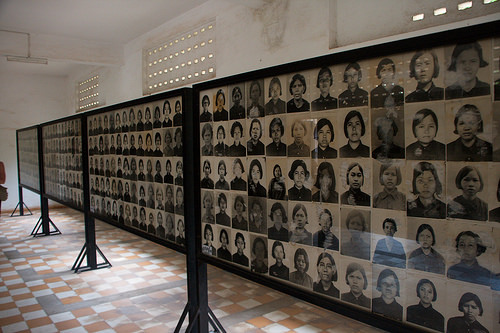
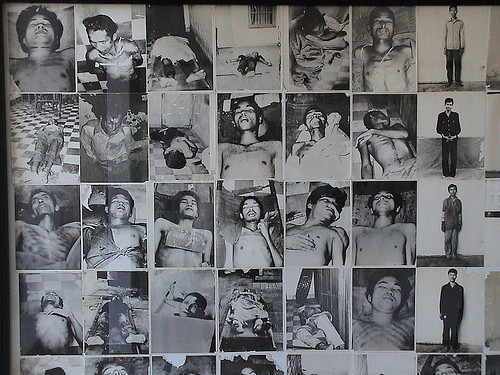
Foto di persone detenute, torturate, uccise, scomparse nell’Ufficio di Sicurezza S21 di Phnom Penh, così tipica di tutti i luoghi macchine della morte col tempo diventati musei del genocidio.
Duch era un khmer idealista, convinto fino al midollo delle sue idee. Duch era un fanatico (adesso sembra che sia pentito). Dopo 90 giorni Duch si convinse dell’innocenza di Bizot e lo liberò, caso unico nella storia, visto che poi a Tuol Sleng sotto i suoi ordini furono uccise decine di migliaia di persone e Duch stesso è stato ritenuto personalmente responsabile della morte di almeno dodicimila. La liberazione di Bizot acquista ancora maggior risalto.
Non si capisce bene quale fosse lo scopo di quegli interrogatori, altro che piegare e distruggere la vittima: erano già tutti colpevoli prima ancora di rispondere. I cosiddetti controrivoluzionari venivano tenuti in gabbie piene di ragni e scorpioni e poi decapitati con fibre di foglie di palma, non si sa se per povertà di altri mezzi o ricchezza di fantasia.
Esposta al Museo del Genocidio di Tuol Sleng di Phnom Penh.
Bizot tornò in Cambogia durante il processo a Duch, i due s’incontrarono di nuovo, vittima e carnefice uno di fronte all'altro (Duch è poi stato condannato per crimini contro l’umanità al carcere a vita, morirà probabilmente in prigione, e potrebbe essere l’unico khmer rosso a farlo, visto che gli altri imputati hanno già più di ottanta anni).
È la storia che questo libro racconta. Io non posso che far mie le parole che John Le Carré ha dedicato a “Il cancello”: Ogni tanto leggiamo un libro che quando è finito ci spinge a invidiare chiunque non l’abbia ancora letto, semplicemente perché, diversamente da noi, ha ancora quell’esperienza da provare.
PS Per chi ha voglia di documentarsi, raccomando caldamente anche il film di Rithy Panh del 2003 S 21, la macchina della morte dei Khmer Rossi. Panh è un regista cambogiano scampato ai campi. In questo lavoro intervista due dei soli sette sopravvissuti a S21, e li mette a confronto con i loro carcerieri.
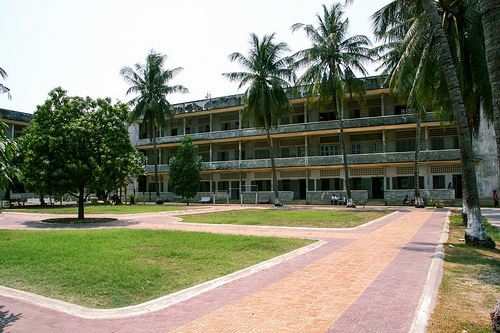
S21, Tuol Sleng a Phnom Penh. Prima una scuola. Poi una prigione e centro di tortura, denominato Ufficio di Sicurezza S21. Oggi un Museo del Genocidio. Un iter che ricorda altri luoghi sinistri in tutt’altra parte del mondo.
I keep picking up books about the Khmer Rouge that narrate fascinating survival stories but are poorly written. I had higher hopes for a book written by a French academic, but I think it's actually worse. He tries too hard to be poetic, sets up a confusing timeline of events, and comes across as an *sshole. (For example his total apathy toward his Khmer wife who gets left behind while he makes it out--spouses of westerners were allowed to leave with them. Having been married to a westerner would have meant torture and execution under the Khmer Rouge).
There were some interesting things though. One was the description of French academics enamored with the people's revolution. Probably most engaging was his imprisonment under a young Comrade Duch before he became the notorious head of S-21. That Bizot formed a strange friendship with Duch and was ultimately released is revealing that the Khmer Rouge's had more complicated feelings about their former colonial masters than their hardline ideology would suggest.
3.5 stars. This is a book with a really fascinating subject that unfortunately isn't written all that well. The author, a French academic studying Buddhism in Cambodia in the 70s, has the distinction of being the only Westerner to be voluntarily released from imprisonment by the Khmer Rouge. Then a few years after his release, he helped negotiate the removal of French citizens from the country after the Khmer Rouge won the civil war. So clearly this guy has had a fascinating life. I hate to be that girl who's all like, "I know you barely escaped execution by a genocidal regime and had to leave your family behind in Cambodia when you were forced to leave the country, but I have to dock you a star or two because your sentences lack logical transitions"... but I guess I am. Oh well.
Bizot's book describes his captivity in Cambodia during the latter months of 1971 and then moves to spring, 1975 when the Khmer Rouge capture Phnom Penh, forcing him to take refuge at the French Embassy with several thousand others (as depicted at the beginning of The Killing Fields). His writing is lucid, elegant and insightful, and his role during this event was crucial: he was one of the few foreigners who spoke Khmer fluently and the only one with any real experience with the Khmer Rouge. The book reads like a great adventure novel and Bizot's love for Cambodia and its people contrasts sharply with the brutality of the communists as they seize control of the nation. Bizot had a unique opportunity to engage them in intelligent debate and expose the contradictions and flawed thinking behind their quest for power.
Oddly enough, Bizot barely mentions the fact that he was forced to abandon his Khmer wife and daughter, who almost certainly died during the Pol Pot regime. In a book so full of pain and sorrow, this seems puzzling, although the author may have been reticent to touch this deepest of all agonies.
As a historical document, this book is a marvel of detail and considered analysis, totally eclipsing Schanberg's (The Death and Life of Dith Pran) crude description of the embassy drama and going far beyond Jon Swain's brief chapter in River of Time. Bizot owes his life to the Khmer Rouge Executioner Douch, who persuaded Pol Pot to release him over the bloodthirsty demands of Ta Mok. These three Khmer Rouge leaders went on to kill hundreds of thousands of Cambodians and at least 30 non-Asian foreigners, of whom Bizot was the only one to be released.
Easily the best work of non-fiction I have ever read.
Mr Bizot is definitely passionate about Cambodia, in fact he seems the epitome of the volatile, emotional Frenchman. His love for the country and its customs that was given so wholeheartedly is corrupted by the destruction of the country he loved by the Khymer Rouge. He writes in a possessed non-linear fashion about his capture and imprisonment, his eventual teneous friendship with a man who became a mass-murderer, who astoundingly gave him a precious gift, that of freedom. That Douch or Duch was undoubtably a torturer is well documented in these pages, but it is the all too human Bizot tormented by his helplessness at how Cambodia is changing for the worse around him that is the soul of the book. The latter half of the book is spent on his final month in Cambodia in a newly-invaded Phnom Penth at the French Embassy, forced to witness no end of indignities and continually forced to accept less and less in the desparate hope he wouldn't have to leave and accept that Cambodia and his work there with Buddist traditions was over. It's true his writing has a bit of an imperialist taint to it. I love it when he says things like "the French knew how to treat Cambodians!" It's kind of hilarious. But I know what he means and I appreciate his kind intentions.
This is one of the best memoirs ever written, and certainly the best book I've ever read about Cambodia. I know that reveals some Euro-centric bias on my part; I agree that some of the memoirs of the Killing Fields written by Cambodians are just as eloquent and perhaps show an even clearer picture of Cambodia during the awful ascendency and throttling years of Pol Pot.
Still. Bizot was the only Westerner taken and released instead of killed by the early Khmer Rouge squads. In his case, his captor was no less a monster than Duch himself, murderer of hundreds of his countrymen and women.
Bizot was heroic during his days in Cambodia. The genocide going on there wasn't really his war; he was just an anthropologist, he could have gone home. Except it was his war - he was human. And he loved the people, the country, and its history. For me, his insights into what happened and his descriptions of how it happened are brilliant - and the book is a page-turner. It's amazing that he survived, and amazing how many people he saved. (Not many, considering the numbers who died, but considering the circumstances, many indeed.) It's as if the Raoul Wallenberg of Cambodia were also a gifted writer.
John Le Carre writes in the foreword, "Now and then you read a book, and, as you put it down, you realize that you envy everybody who has not read it, simply because, unlike you, they will have the experience before them."
It might smack of blasphemy to compare this to "Life and Fate," but this memoir reads like a novel and Bizot covers personal psychology and granular and moving characterization in the midst of enormous historical earthquakes in a way that reminded me of Grossman's magnum opus.
One of the many amazing scenes: while in captivity and mostly manacled by his ankles, Bizot saves a little girl from dying of malnutrition; once healthy, she visits him and rewards him by tightening his manacles... for he is first and forever only an imperialist.
Also I was amazed by his honest view that"... fear of appearing to support the Americans so froze minds that nowhere in Europe were people free enough to voice their indignation and denounce the lies (of the Vietnamese and Cambodian communist revolutions)."
I found myself somewhat disappointed when his imprisonment is over not even halfway through the book, but the consequent scenes in Phenom Phen five years later and the ending at the border are far more chilling, in that his tenuous freedom during the triumph of the Angkar at the dawn of Year Zero is far more dreadful that the brutal binaries of the prison camp.
Also the postscript of his visit to his captor in prison, when he learns the true stakes of a meal long ago, and how one of the most jovial participants at the repast had in fact repeatedly demanded that Bizot be killed, is a reveal worthy of narrative fiction. Bizot learns that only the persistence of the man who became the head of the secret service (who became one of the world's most notorious torturers) and the decision of Brother Number One himself spared Bizot, with him none the wiser! In the aftermath of "Life and Fate", I read a few books on Stalin; I am now doing the same with "The Gate", as a testament to how evocative I found it.
This entire review has been hidden because of spoilers.
Although Francois Bizot’s ordeal as a prisoner of the Khmer Rouge is central to this memoir, I was also interested in his work as a scholar of Buddhism. When he described village Buddhism in the countryside of Cambodia as possibly including aspects of pre-Buddhist shamanism, I was reminded of Tibetan Buddhism which includes aspects of the pre-Buddhist shamanistic religion of Tibet, Bon-po. I also found it highly ironic that the Marxist materialist Khmer Rouge considered the peasants the most ideal citizens apparently without realizing that many of them were practitioners of this very mystical form of Buddhism.
This book shows that the Khmer Rouge had a very contradictory relationship with France. On the one hand, they wanted to court France as an ally because France recognized the Khmer Rouge. On the other hand, they certainly didn’t respect France’s embassy. I suspect that the history of Cambodia having been colonized by France is largely responsible for this ambivalence. They probably didn’t want to be too cozy with their former colonizer.
Unlike other reviewers, I found Bizot very sympathetic. He tried to do the best he could for his Cambodian friends. I would never judge someone in such desperate circumstances. It seems to me that if you haven’t been imprisoned by the Khmer Rouge, you couldn’t possibly know how you yourself would react. Maybe you would have responded in the same way as Bizot.
This is a very difficult book - the descriptions of the horrors inflicted by the Khmer Rouge, and of the surreal, multi-faceted war in which there were so many enemies both internal and external - are painful to read. It is an intensely personal account of Bizot's capture by the KR and his subsequent life until the evacuation of all foreigners from Phnom Penh. It is also a portrait of his captor Douch, who seems thoughtful and approachable and who ultimately releases him (he is the only French prisoner to be so released), but who then goes on to become the head of the brutal torture facility at Tuol Sleng.
A young historian studying Buddhist texts and antiquities, fluent in Khmer and with a Cambodian partner and child, Bizot has a unique viewpoint on the events which overtook him. He has no use for the European intellectuals and leftists who approved and encouraged the KR, which made it safe and easy for the West to ignore the awful realities, nor for the misguided and naïve intervention of the US and it allies who only made things worse before finally leaving.
Other views and biographical information at these links.
It is the history of a crime. How we gave up a people to insane bloodthirsty men. How this young people, who studied in France with gauchists teachers put into practice their absurd theories by assassinating a quarter of the population (intellectual, professors…)A lawsuit against the French intellectuals would be necessary so much their responsibility is committed. Bizot like Cambodia. He was a khmer's specialist. He married a cambodian. He has been arrested by Dutch a first time and he escape to death miraculousely. Dutch was a leader of red khmer. He was the director of Tuol Sleng or S-21 center in Pnom Penh. I advice you to visit it. It's terrifying. No abominable thinks but photos, many photos. The red Khmer photographed pervertedly each prisoner before killing them with blow of stick. I moved by the glance frightened by these people who fix the objective. There is the innocent smile of these young girls. This wall of photographs is one of the worst things that I saw. Bizot understood the criminal nature of red Khmer. He will inform all the embassies of them but people will not listen to him. When the Khmers invade Pnom Penh, occidental people withdraw to embassy of France. will make attack of cowardice and will give up their Kampuchean friends to a certain death. It's really a story of a crime.
The story of the only Westerner to be released from imprisonment by the Khmer Rouge, The Gate manages to fall short. Some of it, I think, is a weak translation from the original French. (And, I'll add, one of the worst printings I've seen in a long while with smudges at the top and bottom edges of many pages and near onion-skin paper). Some it, no doubt, is that the author fell short in his storytelling.
What should be an absolutely riveting story about the author's capture and confinement is quite disappointing. I'll avoid getting into spoilers but some parts don't quite ring true or aren't told well. Some other parts of the narrative - including that of the author's wife - are told in passing or go untold.
It certainly helps to know a little of the situation in Cambodia and the Khmer Rouge because the book fails to provide much context. You won't get much here. Other reviewers here and elsewhere have taken offense at the author's disdain for the media and the American role in Cambodia, but those did not really bother me much. The greatest shortcoming of this book is in how the narrative itself is constructed and executed.
In turns, I admired this book, and yet was frustrated by it. It plays in two halves, starting with Frenchman Francois Bizot's capture by the Khmer Rouge in Cambodia in 1971. Bizot was a foreigner living in the country as an archaeologist, and it turns out he was one of the few people to "escape" (aka be released from) a Khmer Rouge prison camp. This part plays like a POW war movie, as he becomes strangely personable with his captor, Comrade Duch, who later became infamous as the brutal commander of the Tuol Sleng prison (that was the last stop to the Killing Fields). The second half of the book is a fascinating account of the last stand of the French Embassy as the Khmer Rouge took over Phnom Penh in 1975, as all foreigners were commanded to leave the collapsing city. Bizot's role as an interpreter in the chaos is really interesting, but like many others have said, he is not very likable, and many questions remain, like what happened to the Cambodian mother of his child? I found it hard to get through (as in style, not content), but for the most part it was quite interesting.
I visited S21 earlier this year. After an emotional visit of the prisons, I was left tearful of what has happened to the Cambodian people only a few decades ago. I saw the only survivor of S21 there, on its grounds. I can't even describe the feelings of that damn place, even so many years after the dreadful events. I bought the book there, within the gates of the prison. I thought that it would truthfully represent what history is about, but it does not. Some times poorly written, it really strikes as a plot of someone who sacrificed a lot but who also compromised a lot and somehow took very bad decisions in order to save his own life... and his life only. I'm not here to judge, hopefully, most of us will never be in the same excruciating situation. His, was clearly a matter of life and dead, and he came out alive. A truthful account that depicts history in the frontline. For us not to forget!
The Gate is Francois Bizot's account of his experience with the Khmer Rouge: of his own imprisonment (supervised by the now-notorious Duch) and, a few years later, of his struggle to assist those who were caught in the crossfire of the Khmer Rouge's "liberation" of Phnom Penh. Bizot, who at the time of his imprisonment was an academic researching Buddhist traditions in rural Cambodia, uses evocative prose to tell a compelling story. I would recommend this book to anyone looking to gain a more personal perspective into what can otherwise be a simply overwhelming tragedy.
This is one of the painful book but I chose this on purpose. I bought this book when I visited to one of the Killing Fields in Phnom Penh. I have read 3 books about Khmer Rouge but this is the book that gave me different perspectives of Khmer Rouge and Angkor.
When I first read it, I thought it's only about Bizot's arrested in Anlong Veng Camp. But it is more than that. His camp experiences were different. He went through a lot but as he was a foreigner, he obviously got a lot of advantages like allowed to take shower in the stream. Also he made a good friendship with Douch who was the camp leader. I really like their conversation on the last night Bizot was in the camp. Here is a spoiler 'We want peace and prosperity. It's not for the Americans to tell us what to do. Their intervention is hypocritical and calculating. Besides, they know nothing about us or our traditions. They're bullies who have never had the slightest consideration for our customs and have never respected our feelings.' Douch also wanted peace for his country.
The another part of the book was about Bizot days at the French embassy. I feel like that part of the book is more relevant to the title 'The Gate' because the gate of the embassy meant a lot for refugees. Some of them just need to leave because they don't have proper documents. Some of them bring good and bad news through the gate. Whenever the gate was opened, something happened.
The book gave me a lot of flash back as I had been to S-21. The remorse feeling come back to me. Each and every characters in the book were very human. Overall, it is a really good book for me.
This entire review has been hidden because of spoilers.
Although it is futile to fault a book for not doing what you thought it should have done, I couldn't help being frustrated Bizot didn't provide more context for his testimony. Being ignorant about the tragic events unleashed by the Khmers rouges in Cambodia, I would really have appreciated it if Bizot had given us more of a frame. What you find in this book is a detailed account of 2 highly stressful periods of his life: the few months he spent as a prisoner of the Khmers rouges in the jungle in 1971, and the few weeks he spent helping to run a refugee camp on the grounds of the French Embassy in Phnom Penh after the fall of the city to the Khmers rouges in 1975. Here and there he makes scathing comments about the willfully misguided attitude of the French intelligentsia towards the Khmers rouges, but by and large he doesn't provide much background either about his own trajectory or about the reasons why Cambodia plunged into chaos and murderous madness the way it did. Some of the scenes he describes are very vivid, and maybe his accuracy is the great strength of the book, although I find it hard to believe that anyone who lived in fear of his life and half starved in a camp could remember the sort of details he comes up with. Be that as it may, for me this book didn't have the emotional impact of the movie "The Killing Fields", and maybe that's why I was disappointed. It doesn't help that Bizot's old-fashioned idea of poetic style reads ponderously at times.
An excellent book. Bizot, a Frenchman, was taken prisoner by the Khmer Rouge in 1971 and released after three months. That makes him the only westerner to be captured by the Khmer Rouge who was subsequently released.
The first half of the book details this three month ordeal. The camp in which he was held captive was run by the infamous Dutch (or Doutch), well known for being in charge, a few years later, of S-21, the notorious prison in Phnom Penh during the Khmer Rouge's short rule of Cambodia.
After Bizot was released in 1971, he stayed in Cambodia, researching Buddhism, as he did before his capture, and was still in the country when in 1975 the Khmer Rouge rolled into Phnom Penh. Bizot became the negotiator, or middle man, for the French diplomatic mission when dealing with the Khmer Rouge's provisionary government. This is detailed in the second half of the book.
Originally written in French, the text suffers a bit from an odd translation here and there, most notably the use of English words which are not very common, but the highly personal style against the backdrop of the Khmer Rouge's atrocities works extremely well.
One couple, stuck at the French embassy with Bizot in 1975, have a daughter who's name is Vinca.
Mid 3. The memoirs of the only Westerner to fall into the clutches of the murderous Khmer Rouge and live to tell the tale, and of the self-same uinterpreter for the beseiged foreign community in the compound of the French embassy at the fall of Phnom Penh should have become a classic of modern reportage. Instead, Bizot's failings as a writer, as well as the possible shortcomings of the translation, make this a frustrating read. Though many commentators find the author to be a distasteful individual, it is difficult to be judgemental when the reader is not faced with such tortuous circumstances, and a heightened personal instinct for self-preservation, themselves. Bizot was an archaeologist investigating ancient Buddhist traditions when he was captured by the Khmer rebels in 1971. Amazingly his survival was due to the influence of Comrade Duch who would become infamous as the executioner of the regime and would face charges of genocide at the Hague. The book then shifts to the dramatic events in the capital in 75, of which he provides an honest and lucid appraisal. A lost opportunity which an independent writer could have exploited with much more success.
This book follows a non linear narrative of Francois' Bizot's, a French Scholar specializing in Cambodian Buddhism with the temples etc. His capture by 'Duch' who was later to gain notoriety by running S21 in Phnom Penh, the infamous Khmer Rouge torture and confession prison with its associated Killing Fields is Part one of the book. During the ECCC UN trials Bizot was called as a witness and testified that his book should certainly not be used as a historical document for he wrote it thirty years after the events and had to reconstruct the conversations from an emotional perspective rather than what was actually said. The reading of the book was so good , I had no clue that it was not the actual conversations that actually occurred. The second part of the book is when he takes a main position at the French Embassy during the evacuation of Phnom Penh and describes what occurred. This certainly is eye opening and describes such players as Sirik Matak who was taken away for execution. This book provides one of the best, one on one, accounts of Duch and his thinking from an emotional perspective aside from his testimonies at the UN trials.
The first part of this book I thought as a little bit weird. Don't know, it wasn't the story but the style of writing. I had the feeling the riter jumped sometimes from one event to a much further event. I had to torture me through it, but then, when he made a jump in time, it read very fast. Strangely after reading newspaper articles about Duch, I liked the first part more and more! The writer don't focus himself on what Duch did for cruelties, but on the person behind it,....and that is what made this book special to me. There are many books written by witnesses, but here, the autor doesn't focus on his own experience. He put the focus on how the people think, after what he experienced he tries to understand and explained. The best part of the book is for me when he returns to the camps. How he explaines how he met the people, being there, sawing him being captured.
Prisonnier des Khmers rouges en 1971, témoin privilégié de la chute de Phnom Penh en 1975, François Bizot revient, près de trente ans plus tard sur ces événements. Le vrai héros du livre est en fait Douch, son gardien qui s'avèrera être son paradoxal sauveur. De longues discussions nocturnes rapprochent les deux hommes : d'un côté le jeune ethnologue français soucieux de connaître et de défendre l'identité khmère, de l'autre le professeur de mathématique devenu révolutionnaire par idéal marxiste. Mais l'histoire a des détours cruels : Douch deviendra le bourreau sanguinaire de Tuol Sleng, la prison où étaient détenus et torturés les opposants khmers. Il y a beaucoup de Malraux dans Bizot. Du lyrisme, du courage, de la virilité, un fond d'anti-américanisme, beaucoup d'anti-communisme. Ecrit en 2001, le livre n'a pas son âge.
Halfway into this book so far and finding it excellent reading.
I few years back I did a meditation retreat in Australia led by a Cambodian monk, who was the ex Finance Minister, in the period leading up to the Khmer Rouge/Pol Pot takeover. He lost all his family, wife, 10 kids and somehow got out of the country becoming a monk later. It very much brought it home that this was real and in our times. We all wish for peace and an end to senseless genocide ... but will it ever be achieved. I hope and pray so.
Have been watching a Pilger report and other documentaries on this period in parallel with reading the book. How divisive politics can be. While all lament the loss of life, how much blame shifts from one person to another, from one country to another from one ideologue to another in the space of a coupe of YouTube clicks.
John Le Carré , in his introduction, says it all: "Now and then you read a book and, as you put it down, you realise that you envy everybody who hasn't read it, simply because, unlike you, they will have the experience before them."
I read this amazing book on cramped busses and hostel balconies while travelling through Cambodia. Looking up from the pages and seeing the landscape and places where the story took place created a connection that enriched both the book and the country -- The Gate is the ideal Cambodian travel companion.
However, even people who have never been to Cambodia should find this account of French ethnologist, François Bizot's, capture, torture and ultimate release by the Khmer Rouge, an un-put-downable read.
It is at once an an adventure thriller, an uplifting biography, and a wonderfully written history of a shocking period.
An extraordinary true story of a man who was held hostage and interrogated by one of the leaders of the Khmer Rouge. It's thought-provoking and harrowing. He was the only survivor of his camp, and the only Westerner to survive such an ordeal.
Speaking as an anthropologist, he poses some fascinating questions - not just the obvious "Why do humans do this to each other?" One of the most disturbing is when he talks about people being taken away to be executed in the forest. Everyone taken away knows their fate, and yet not one tries to prevent it from happening to them when it's their turn. Any other animal would try to effect an escape.
To me, that poses a wider question: why do we let others have the power over our lives that we let them have? The majority of us are led quietly and willingly to a mind-numbing existence. Stop and think. Save yourself.
This is a memoir of a Frenchman's year of detention by the Khmer Rouge's infamous Brother Number 2 (Duch) prior to the Khmer Rouge taking power in Cambodia, and the chaotic days in the French Embassy prior to the evacuation of Phnom Penh.
Written from the perspective of an expatriate, the book does not elicit the same sadness as memoirs written by other Khmer survivors of the period. However, it does present a unique perspective on France's historical links with the IndoChinese colony, and the colonist's complete loss of power over the region as Embassy staff prepare to flee in the final days.
The author does not talk much of his Cambodian wife and daughter - nor does he dwell on the emotions of his decision to leave them behind. It would have been interesting to find out what happened to them.
It has taken me a while to finally get around to reading this book, which I have long been curious about. I began it with a bit of hesitation as I have read another more recent work by the author that I really did not like it, so I was fully expecting not to like this one. I was glad to find that I didn’t dislike it. What I found most interesting was the accounts of the dealings the author had with the infamous Comrade Duch which he had when he was captured and held prisoner by the Khmer Rouge. What has left me puzzled is what happened to the author’s wife who fled Phnom Penh. Why did she not evacuate with him and did she survive? His lack of mention of what happened to his wife, the mother of his daughter seems callous to say the least. Did he ever try to find her or help her leave after he had safely left Cambodia?
this book really touched me, but it's a bit of an obscure, local read. french ethnologist bizot was living in cambodia in the 1970s studying ancient buddhist traditions when he was taken prisoner by the khmer rouge. he later became the only western prisoner ever to be released by the KR. the prose is extremely 'french': kind of dreamy, veiled, philosophical, metaphorical. i have a soft spot for such charismatic, learned, adventurous raconteurs like bizot (see axel munthe) but the story on its own has a limited scope (there's not a comprehensive discussion of the KR or cambodia) and so doesn't put forth the book as a must read.
This is a powerful book. I read it in only a couple of days, foregoing sleep in order to do so. Even though I read a translated version, Bizot portrays setting and character so vibrantly that it is (sometimes painfully) as if you are in his shoes. There are times when he describes tragic occasions in a matter-of-fact manner, but that almost makes them seem more tragic, as if no one cared. I hadn't realized the political complications in Cambodia in the 1970s, though I knew about the Khmer Rouge. Also, his story illustrates the importance of learning the primary language of your surroundings, since his ability to speak Khmer, Vietnamese, and French all led to his becoming an important intermediary in the rise of the Khmer Rouge.
I found this book while browsing at my library; something about the title drew me in. I don't know a lot about the Khmer Rouge or the killing fields of Cambodia. History classes I took as a kid glossed over that part of history and spent most of the time devoted to the US involvement in the Vietnam War.
I found the author's insight into what occurred in Cambodia from the influx of communists from Vietnam to the fall of Phnom Penh, and the desperate last days at the French Embassy before the expulsion of all foreigners and the closing of the borders compelling.
From what I understand Bizot is the only known westerner to survive a prison camp of the Khmer Rouge during those horrific times.