

What do you think?

The Vision Revolution: How the Latest Research Overturns Everything We Thought We Knew About Human Vision
In The Vision Revolution, Mark Changizi, prominent neuroscientist and vision expert, addresses four areas of human vision and provides explanations for why we have those particular abilities, complete with a number of full-color illustrations to demonstrate his conclusions and to engage the reader. Written for both the casual reader and the science buff hungry for new information, The Vision Revolution is a resource that dispels commonly believed perceptions about sight and offers answers drawn from the field’s most recent research.
Changizi focuses on four “why” questions:
1. Why do we see in color?
2. Why do our eyes face forward?
3. Why do we see illusions?
4. Why does reading come so naturally to us?
The Vision Revolution explores phenomena such as cyclopses, peeking and many more you hadn’t even thought to wonder about. Changizi shows how deeply involved these evolutionary aspects of our vision are in why we see the way we do—and what the future holds for us.
The Vision Revolution is a book that finally gives attention to what before has been largely neglected by other works on human vision—a book that looks at the “why.”
Changizi focuses on four “why” questions:
1. Why do we see in color?
2. Why do our eyes face forward?
3. Why do we see illusions?
4. Why does reading come so naturally to us?
The Vision Revolution explores phenomena such as cyclopses, peeking and many more you hadn’t even thought to wonder about. Changizi shows how deeply involved these evolutionary aspects of our vision are in why we see the way we do—and what the future holds for us.
The Vision Revolution is a book that finally gives attention to what before has been largely neglected by other works on human vision—a book that looks at the “why.”
240 pages, Paperback
First published May 2, 2009
About the author
Mark Changizi
11 books31 followersMark Changizi is a cognitive scientist, and Director of Human Cognition at 2AI Labs. He has written three books about his research:
HARNESSED: How Language and Music Mimicked Nature and Transformed Ape to Man
,
THE VISION REVOLUTION
(Benbella 2009), and
THE BRAIN FROM 25,000 FEET
(Kluwer 2003).
He writes about science at places like... ChangiziBlog (HUB), Forbes , Wired , PsychToday , Atlantic , Seed (a, b), Telegraph , Scientific American , New Scientist .
He writes about science at places like... ChangiziBlog (HUB), Forbes , Wired , PsychToday , Atlantic , Seed (a, b), Telegraph , Scientific American , New Scientist .
Ratings & Reviews
Friends & Following
Create a free account to discover what your friends think of this book!
Community Reviews
Displaying 1 - 24 of 24 reviews

November 16, 2011
"Why do we see in color? Why do our eyes face forward? Why do we see illusions? Why are letters shaped the way they are?
"
Intriguing riddles such as these often necessitate interdisciplinary brilliance to solve. Theoretical biologist and neuroscientist Mark Changizi has been stockpiling research in these areas for much of the last decade, fixated on some of the fascinating but imperfectly understood precincts of human perception. Not content with asking how our central nervous system functions, Changizi is determined to provide explanations of why its architecture and inter-operative functionality exist as they do. The Vision Revolution, should it withstand the scrutiny of peer review, is a groundbreaking work in vision science that brings forward original research into the evolution of the human visual system.
In the book he pivots between four core ideas, each of which are given mystical titles:
(1) Color telepathy: "Color visions was selected for so that we might see emotions and other states on the skin."
(2) X-ray vision: "Forward-facing eyes were selected for so we could use X-ray vision in cluttered environments."
(3) Future-seeing: "Optical illusions are a consequence of the future-seeing power selected for so that we might perceive the present."
(4) Spirit-reading: "Letters culturally evolved into shapes that look like things in nature because nature is what we have evolved to be good at seeing."
Each entrée of this technical collation is truly mind-altering, and it is a joy to tag along as Mark architects the empirical struts of his developmental theses. Let's dive right in.
Color Vision
His first course of business is to provide an alternate explanation of the origin of color vision in primates. While we take it for granted today, color sensing is a relatively recent adaptation in the mammalian order. Until now, the default view among vision scientists is that color was selected for to distinguish between various types of fruit and leaves. The regnant explanation has survival value on its side, but Changizi believes it is not the complete answer. After all, not all mammalian diets are alike, but our color sensors and attendant properties are strikingly continuous with other color-sensitive primates.
Changizi instead makes the case that color acuity evolved to detect changes in skin oxygenation. When blood and oxygen levels fluctuate, we see an instant feedback effect on our skin. These shifts in skin tone and color signal us to changes in mood and emotion states and, more importantly, alert us to physiological dysfunction. A mother who can sense the full range of hue, saturation and brightness deviations in her baby's face and body is in a better position to detect when something is amiss and take proper action.
This hypothesis puzzles out well enough for bare-skinned animals like humans, but what about hairy primates - the ancestors which supposedly evolved these traits long before our debut? It turns out there is a neatly correlated distribution between color vision and bare-faced primates. Changizi surveys the animal kingdom and finds that primates lacking color vision have furry faces, while those with hairless spots on their faces and body tend to have color vision just like us. He notes that this more "fleshed-out" explanation (pun intended) does not swear mutual exclusivity with the dominant explanation; indeed, they could be co-occurring drivers of selection.
X-ray Vision
Have you ever wondered why we have forward-facing eyes, as opposed to sideways-facing eyes like most reptiles, birds and fish? As Changizi demonstrates, this element of our physiology was selected for to better suit the habitat in which our ancestors evolved. This might at first seem like a non-intuitive proposition, as surely our survival would be better served by the ability to see both in front of and behind us (as animals with sideways-facing eyes most certainly can). But there’s a more marvelous, some might say superhuman reason our current orientation was favored.
Close one of your eyes. Notice how your nose is suddenly visible. The result is the same when you close your other eye. With both eyes open, however, the portion of your visual field occupied by your nose is no longer blocked. You are, effectively, able to see through your nose. Remarkably, this trick can be reproduced with any object whose width is narrower than the width of your eyes. Hold up your hand, position it vertically in front of your face, and you can see through it to read the screen behind it.
According to Changizi, this ability was helpful in leafy habitats, enabling our predecessors to see through grass and other foliage to spot predators and food. As life transitioned from water to land, those acclimatizing to heavily verdant environments gradually evolved the optical design shared by humans today. The binocular region for animals with sideways-facing eyes, on the other hand, is far too narrow to be effective, explaining why this arrangement is less commonly found in lush surrounds. While we may be manifestly less dependent on this feature today, it is nonetheless fascinating that evolution has gifted us with a passive form of X-ray vision.
Optical Illusions (and why they trick us)
As we move into the book's third unit, we listen in as Changizi disassembles the aura of visual illusions. It's estimated that eyes first evolved around 500 million years ago. Why then, after all this time, aren't our eyes and brains complex enough to avoid being fooled by simple visual tomfoolery? Shouldn't we process these images correctly by now?
The answer lies in the communication protocols linking our optical and brain arrays. The deep relationships governing the brain and the eye help us function appropriately in a three-dimensional world. The architecture of our central nervous system is such that a gap of 1/10th of a second exists between the moment light first hits our photoreceptors and when that signal is processed by the brain. Our brain then compensates for this delay by projecting images 1/10th of a second into the future.
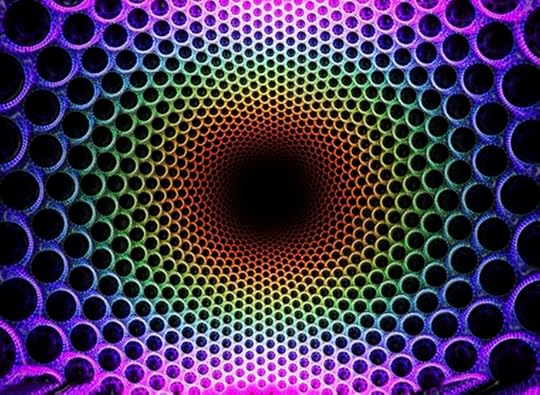
These premonitions aid us in catching a thrown ball, for example, but can trick our senses when viewing static imagery on a two-dimensional plane. In effect, our in-built neural lag causes us to intuit motion-like characteristics to inert images, per the example above. Alas, our future-seeing ability is too favorable to our survival to ever part with, so the minor bug of awkwardly processing 2D geometry will remain an acceptable trade-off.
Spirit-reading
"Spirit-reading" is Changizi's nimble way of referring to all of the knowledge, thoughts and ideas nesting in the world's books, literature and other written material. Thanks to language and writing, we have the ability to peer into the minds of our ancestors. And what an uncanny ability it is! Written language is not a technology we could have guaranteed would mesh well with our biology. So how did it come about? And why was it such a glowing success?
Changizi seeks to explain the contagion of written communication by linking its design to the shapes and contours found in our natural environment. If the basic strokes, junctions, marks and symbols of writing were adapted from familiar objects in nature, then our streamlined visual system would be well-prepared to process this information effectively. In fact, if we rewind the clock to our most ancient writing systems, we find they are unmistakably logographic (object-like), including Sumerian cuneiform (the very first writing system ever developed organically ~3200 BCE), Egyptian hieroglyphs, Chinese characters, and the independently derived writing of the Mexican Indians appearing sometime before 600 BCE.
Through some involved visual linguistic analysis, Changizi submits that the fundamental structures of letters are akin to object parts observed in nature. The more common configurations we find in nature tend to find prevalence in human writing schemes. This relationship was no accident; our ancestors mimicked natural scenery to optimize information retrieval through the instrument of writing. In this sense, the clues to writing's triumph are lurking in the letters themselves.
Closing Thoughts
There should be more books like The Vision Revolution. Changizi presents a highly compelling, evolutionarily grounded case for four intriguing ideas, distills the related focus areas into readable prose, and tailors it to the nonspecialist. The abundance of visual aids is a thrilling, effective way to convey his ideas and goes a long way toward making this more engaging than the average non-fiction work. The Vision Revolution is concise, well-argued, easy to wade through, and comes enthusiastically recommended. These ideas will change the way we think about vision and our perception of the world, and I hope it spawns even more exciting research going forward.
Note: This review is republished from my official website.
Intriguing riddles such as these often necessitate interdisciplinary brilliance to solve. Theoretical biologist and neuroscientist Mark Changizi has been stockpiling research in these areas for much of the last decade, fixated on some of the fascinating but imperfectly understood precincts of human perception. Not content with asking how our central nervous system functions, Changizi is determined to provide explanations of why its architecture and inter-operative functionality exist as they do. The Vision Revolution, should it withstand the scrutiny of peer review, is a groundbreaking work in vision science that brings forward original research into the evolution of the human visual system.
In the book he pivots between four core ideas, each of which are given mystical titles:
(1) Color telepathy: "Color visions was selected for so that we might see emotions and other states on the skin."
(2) X-ray vision: "Forward-facing eyes were selected for so we could use X-ray vision in cluttered environments."
(3) Future-seeing: "Optical illusions are a consequence of the future-seeing power selected for so that we might perceive the present."
(4) Spirit-reading: "Letters culturally evolved into shapes that look like things in nature because nature is what we have evolved to be good at seeing."
Each entrée of this technical collation is truly mind-altering, and it is a joy to tag along as Mark architects the empirical struts of his developmental theses. Let's dive right in.
Color Vision
His first course of business is to provide an alternate explanation of the origin of color vision in primates. While we take it for granted today, color sensing is a relatively recent adaptation in the mammalian order. Until now, the default view among vision scientists is that color was selected for to distinguish between various types of fruit and leaves. The regnant explanation has survival value on its side, but Changizi believes it is not the complete answer. After all, not all mammalian diets are alike, but our color sensors and attendant properties are strikingly continuous with other color-sensitive primates.
Changizi instead makes the case that color acuity evolved to detect changes in skin oxygenation. When blood and oxygen levels fluctuate, we see an instant feedback effect on our skin. These shifts in skin tone and color signal us to changes in mood and emotion states and, more importantly, alert us to physiological dysfunction. A mother who can sense the full range of hue, saturation and brightness deviations in her baby's face and body is in a better position to detect when something is amiss and take proper action.
This hypothesis puzzles out well enough for bare-skinned animals like humans, but what about hairy primates - the ancestors which supposedly evolved these traits long before our debut? It turns out there is a neatly correlated distribution between color vision and bare-faced primates. Changizi surveys the animal kingdom and finds that primates lacking color vision have furry faces, while those with hairless spots on their faces and body tend to have color vision just like us. He notes that this more "fleshed-out" explanation (pun intended) does not swear mutual exclusivity with the dominant explanation; indeed, they could be co-occurring drivers of selection.
X-ray Vision
Have you ever wondered why we have forward-facing eyes, as opposed to sideways-facing eyes like most reptiles, birds and fish? As Changizi demonstrates, this element of our physiology was selected for to better suit the habitat in which our ancestors evolved. This might at first seem like a non-intuitive proposition, as surely our survival would be better served by the ability to see both in front of and behind us (as animals with sideways-facing eyes most certainly can). But there’s a more marvelous, some might say superhuman reason our current orientation was favored.
Close one of your eyes. Notice how your nose is suddenly visible. The result is the same when you close your other eye. With both eyes open, however, the portion of your visual field occupied by your nose is no longer blocked. You are, effectively, able to see through your nose. Remarkably, this trick can be reproduced with any object whose width is narrower than the width of your eyes. Hold up your hand, position it vertically in front of your face, and you can see through it to read the screen behind it.
According to Changizi, this ability was helpful in leafy habitats, enabling our predecessors to see through grass and other foliage to spot predators and food. As life transitioned from water to land, those acclimatizing to heavily verdant environments gradually evolved the optical design shared by humans today. The binocular region for animals with sideways-facing eyes, on the other hand, is far too narrow to be effective, explaining why this arrangement is less commonly found in lush surrounds. While we may be manifestly less dependent on this feature today, it is nonetheless fascinating that evolution has gifted us with a passive form of X-ray vision.
Optical Illusions (and why they trick us)
As we move into the book's third unit, we listen in as Changizi disassembles the aura of visual illusions. It's estimated that eyes first evolved around 500 million years ago. Why then, after all this time, aren't our eyes and brains complex enough to avoid being fooled by simple visual tomfoolery? Shouldn't we process these images correctly by now?
The answer lies in the communication protocols linking our optical and brain arrays. The deep relationships governing the brain and the eye help us function appropriately in a three-dimensional world. The architecture of our central nervous system is such that a gap of 1/10th of a second exists between the moment light first hits our photoreceptors and when that signal is processed by the brain. Our brain then compensates for this delay by projecting images 1/10th of a second into the future.
These premonitions aid us in catching a thrown ball, for example, but can trick our senses when viewing static imagery on a two-dimensional plane. In effect, our in-built neural lag causes us to intuit motion-like characteristics to inert images, per the example above. Alas, our future-seeing ability is too favorable to our survival to ever part with, so the minor bug of awkwardly processing 2D geometry will remain an acceptable trade-off.
Spirit-reading
"Spirit-reading" is Changizi's nimble way of referring to all of the knowledge, thoughts and ideas nesting in the world's books, literature and other written material. Thanks to language and writing, we have the ability to peer into the minds of our ancestors. And what an uncanny ability it is! Written language is not a technology we could have guaranteed would mesh well with our biology. So how did it come about? And why was it such a glowing success?
Changizi seeks to explain the contagion of written communication by linking its design to the shapes and contours found in our natural environment. If the basic strokes, junctions, marks and symbols of writing were adapted from familiar objects in nature, then our streamlined visual system would be well-prepared to process this information effectively. In fact, if we rewind the clock to our most ancient writing systems, we find they are unmistakably logographic (object-like), including Sumerian cuneiform (the very first writing system ever developed organically ~3200 BCE), Egyptian hieroglyphs, Chinese characters, and the independently derived writing of the Mexican Indians appearing sometime before 600 BCE.
Through some involved visual linguistic analysis, Changizi submits that the fundamental structures of letters are akin to object parts observed in nature. The more common configurations we find in nature tend to find prevalence in human writing schemes. This relationship was no accident; our ancestors mimicked natural scenery to optimize information retrieval through the instrument of writing. In this sense, the clues to writing's triumph are lurking in the letters themselves.
Closing Thoughts
There should be more books like The Vision Revolution. Changizi presents a highly compelling, evolutionarily grounded case for four intriguing ideas, distills the related focus areas into readable prose, and tailors it to the nonspecialist. The abundance of visual aids is a thrilling, effective way to convey his ideas and goes a long way toward making this more engaging than the average non-fiction work. The Vision Revolution is concise, well-argued, easy to wade through, and comes enthusiastically recommended. These ideas will change the way we think about vision and our perception of the world, and I hope it spawns even more exciting research going forward.
Note: This review is republished from my official website.

July 9, 2020
Some of the most original thinking I’ve seen in a very long time. Now on the sequel, "Harnessed", also fascinating – I may use parts in my phonetics class next semester.

May 26, 2015
Very appropriate title. This book concentrates on 4 hypotheses that turn conventional notions on their heads. It is cutting edge neuroscience, and as anyone in the "science" fields know, means that it is not yet anything close to fact. Any reader should take this with an unhealthy dose of salt. That isn't to say it might not be true, but the material is just so new, and has not been studied/tested by other sources other than the author and his collaborators (and I am saying this in 2016, several years after the book has been published).
5 stars though for the originality, detail and strength of his arguments, clarity of writing, etc. My personal opinion is that the hypothesis he puts forward are important in the evolutionary history (cultural and biological) of humans, but not nearly as fundamental as the author would like you to believe.
5 stars though for the originality, detail and strength of his arguments, clarity of writing, etc. My personal opinion is that the hypothesis he puts forward are important in the evolutionary history (cultural and biological) of humans, but not nearly as fundamental as the author would like you to believe.

June 11, 2021
3.5 - lots of extremely cool, interesting stuff about vision, but he overstretched it a bit - definitely aimed at a more popular audience than me. But I will never forgive him for saying that 10^300 is "very close to infinity".
April 7, 2014
The Vision Revolution discusses four speculative but research-based ideas in why human vision works the way it does.
Changizi frames his topics as super-powers: Color Telepathy, X-Ray Vision, Future-Seeing and Spirit-Reading. Personally, I didn't need the super-power packaging, but the ideas and how he explains them are extremely thought-provoking. His writing style is accessible and the book is very readable - this is not a dry academic treatise. Better yet, each of the topics involve visual experiences we have every day, so you will have opportunities to test his ideas almost immediately.
Each of his topics are elements of vision that most of us either thought we understood already (two forward-facing eyes? for depth perception of course!), or that we really hadn't thought much about (why do the shapes of our written language fall into a rather narrow set?). With each, Changizi uses the "why" question and experimental evidence to turn our assumptions sideways. Given the topic is vision, you would expect a fair number of diagrams, and he provides them to support his written explanations.
There are couple of reasons to read this book. First and most obviously, if you are curious about how humans think and process visual information, then it's a natural fit into your interests.
The second reason though, is to take a trip with a thinker who asks the "why" questions and tries out answers that are often outside of established consensus. Beyond the topic of visual processing, this inquisitive, scientific and experimental way of approaching the world provides a model for all of us to not just take explanations as they are given to us, but to dig deeper into the stuff that interests us and really question the assumptions behind those ideas. To that end, Changizi's style communicates his curiosity, and he does a great job of bringing us along with him. His ideas may or may not hold up over time, but there is enough evidence to at least consider them seriously.
At just over 200 pages with lots of illustrations, the book is not a long read, and each of the four chapters stands on it's own. Bottom line: recommended.
Changizi frames his topics as super-powers: Color Telepathy, X-Ray Vision, Future-Seeing and Spirit-Reading. Personally, I didn't need the super-power packaging, but the ideas and how he explains them are extremely thought-provoking. His writing style is accessible and the book is very readable - this is not a dry academic treatise. Better yet, each of the topics involve visual experiences we have every day, so you will have opportunities to test his ideas almost immediately.
Each of his topics are elements of vision that most of us either thought we understood already (two forward-facing eyes? for depth perception of course!), or that we really hadn't thought much about (why do the shapes of our written language fall into a rather narrow set?). With each, Changizi uses the "why" question and experimental evidence to turn our assumptions sideways. Given the topic is vision, you would expect a fair number of diagrams, and he provides them to support his written explanations.
There are couple of reasons to read this book. First and most obviously, if you are curious about how humans think and process visual information, then it's a natural fit into your interests.
The second reason though, is to take a trip with a thinker who asks the "why" questions and tries out answers that are often outside of established consensus. Beyond the topic of visual processing, this inquisitive, scientific and experimental way of approaching the world provides a model for all of us to not just take explanations as they are given to us, but to dig deeper into the stuff that interests us and really question the assumptions behind those ideas. To that end, Changizi's style communicates his curiosity, and he does a great job of bringing us along with him. His ideas may or may not hold up over time, but there is enough evidence to at least consider them seriously.
At just over 200 pages with lots of illustrations, the book is not a long read, and each of the four chapters stands on it's own. Bottom line: recommended.

August 10, 2012
The color pigments in the cones of our retinas were selected by evolution to enable us to make fine discriminations in skin color to help us read emotions. Primates have forward-facing eyes to help is see through the clutter of leaves in the forests. The brain receives an image from the retina that is a tenth of a second out of date. The brain compensates for this by extrapolating from this out-of-date information to create a perception of what the three-dimensional situation must actually be at the moment the brain receives the image. Objects that are in the direction we are headed are made to appear larger. This mechanism, when applied to some static, planar drawings, creates optical illusions. In the final chapter, the author shows that letters have shapes that resemble objects in the real world. In particular, there is a high frequency of lines meeting at a corner (L-shape) or in a T-shape. The parts of the brain for recognizing corners and T's were reused when written language was developed.

December 2, 2015
Если книга отвечает на вопросы, про которые ты слышал, но хотелось поподробнее, это хорошо.
А вот если она отвечает на те вопросы, о существовании которых ты и не подозревал, причем в области, где вроде "всё и так понятно", это отлично.
Хотя теории (4 штуки) может и неверные, но всё равно очень интересно.
А вот если она отвечает на те вопросы, о существовании которых ты и не подозревал, причем в области, где вроде "всё и так понятно", это отлично.
Хотя теории (4 штуки) может и неверные, но всё равно очень интересно.

March 20, 2026
Mark Changizi is proposing a new origin of vision and how we see. It moves the emphasis from food to socializing. He proposes that vision provides us with six super powers: telepathy, x-ray vision, future vision, and spirit reading. Cool, huh? Ok, they are really a bit more mundane than that, especially since we use them on a regular basis.
In more ordinary terms, we have telepathy from our ability to read each other. Our color vision has its greatest response range around the areas of our skin involving blood flow. We can tell the oxygenation levels and blood volume by subtle changes in skin color. These changes correspond to health and basic brain activity.
We have x-ray vision by virtue of our binocular vision. When we have a leafy environment close to us, our brain combines two images from our eyes and is able to remove the leaves from our view. He argues that animals from leavy environments are more likely to have forward-facing eyes, and that animals larger than the size of leaves and grasses are also more likely to have forward-facing eyes.
In a similar vein he explains future vision and spirit reading. In all cases, you understand why this ability is special, and why it is also ordinary. He backs his theory up well with data and interesting trivial.
He also uses his theory to explain a variety of visual illusions. These are primarily related to our future vision. He makes very good arguments and demonstrates a number of different classes of illusion.
The book is fascinating and a very good read for anyone interested in vision, physiology, or psychology.
In more ordinary terms, we have telepathy from our ability to read each other. Our color vision has its greatest response range around the areas of our skin involving blood flow. We can tell the oxygenation levels and blood volume by subtle changes in skin color. These changes correspond to health and basic brain activity.
We have x-ray vision by virtue of our binocular vision. When we have a leafy environment close to us, our brain combines two images from our eyes and is able to remove the leaves from our view. He argues that animals from leavy environments are more likely to have forward-facing eyes, and that animals larger than the size of leaves and grasses are also more likely to have forward-facing eyes.
In a similar vein he explains future vision and spirit reading. In all cases, you understand why this ability is special, and why it is also ordinary. He backs his theory up well with data and interesting trivial.
He also uses his theory to explain a variety of visual illusions. These are primarily related to our future vision. He makes very good arguments and demonstrates a number of different classes of illusion.
The book is fascinating and a very good read for anyone interested in vision, physiology, or psychology.

October 21, 2019
"The Vision Revolution" left some unsatisfactory thoughts while I was reading it. First of all, I want to express my great respect for Mark Changizi for his research and explanation.
Conversely, I felt a little bias towards his field of profession, namely, surpassing some unclear ideas and explaining it with his narrow field. In each chapter he states some theories that are not proven, which means he uses senses to identify them; it reminds some classical philosophers who did a lot of errors later. For example, he believes that we change color of our body because we want to show our emotions; then using this predicate he concludes that evolution disposed from abundant hairs in order to show our emotions. Afterwards, he gives some scientific explanations that cannot be proven in real life. Maybe he is right or not. Only time will show us.
All in all, book is heavy to read, organization of images is ordered uncomfortably. In case if you read electronic version, it creates mess.
Conversely, I felt a little bias towards his field of profession, namely, surpassing some unclear ideas and explaining it with his narrow field. In each chapter he states some theories that are not proven, which means he uses senses to identify them; it reminds some classical philosophers who did a lot of errors later. For example, he believes that we change color of our body because we want to show our emotions; then using this predicate he concludes that evolution disposed from abundant hairs in order to show our emotions. Afterwards, he gives some scientific explanations that cannot be proven in real life. Maybe he is right or not. Only time will show us.
All in all, book is heavy to read, organization of images is ordered uncomfortably. In case if you read electronic version, it creates mess.
March 18, 2015
The premise of this book is that we have super powers, visually. Thankfully, Changizi is more tongue-in-cheek than one might think at first. He goes over four ‘powers’ which are more a placing of phenomena we thought we understood into a new context. The first: our three-hue color vision is not for seeing color in our environment (few tasks proto humans or our simian ancestors need three hues, especially two that are as close together as red and green) but for seeing minute variations in blood flow and temperature underneath the skin of our fellow humans. Provocative evidence is our perception of our own skin as not having a sort of color. Second: we have binocular vision not for depth perception, which our one-eyed friends can manage just fine, but for seeing through leaf cover where no leaf can by itself cover both eyes. Third: we interpret lines as motion, and our inevitably falling for all sorts of optical illusions is our brain seeing these lines and using their assumed motion to predict the future. In fact, Changizi gives many ways in which the brain might divine motion from stationary sense data, and shows how that affects our perception. Last, and the biggest stretch to fit the ‘superpowers’ theme: our alphabets have shapes similar to those that appear in nature, so that we can better interpret each word as an object (in fact he gives convincing evidence that the frequency of a letter in an alphabet is correlated to the frequency of the letter’s shape in our environment). The evidence he gives in support of these reinterpretations is convincing, and the writing isn’t too bad. I enjoyed it.

October 6, 2014
An interesting book in principle. He tackles the reason why we have particular visual capabilities and makes some interesting hypotheses. We have colour opponent vision to best read the amount of blood and oxygen level in peoples faces, so as to intuit the mood/emotion etc. Our eyes are placed in the front of our heads, not to maximise binocular stereo but to help us see through leaves. Optical illusions are caused by the way our visual brain attempts to predict the short term future, and the illusions confuse our brain into thinking there is motion when there is not. Finally, the symbols we use in writing mimic stroke patterns found in nature, that's how we harness a visual system evolved in nature to a very recent thing like writing.
The ideas are thought provoking, and there is some limited evidence to support them. However the book is written for a general audience, so he goes slowly with a lot of irrelevant material that gets tedious after a while. The section on illusions was really very interesting but ends quite abruptly, I'd much rather have less fluff and more details on his theory.
The ideas are thought provoking, and there is some limited evidence to support them. However the book is written for a general audience, so he goes slowly with a lot of irrelevant material that gets tedious after a while. The section on illusions was really very interesting but ends quite abruptly, I'd much rather have less fluff and more details on his theory.

October 12, 2010
A short, wonderful new perspective on how our vision actually works. Changizi shows us why we have the superpowers of:
Mind reading via a complex color processing visual system evolved for social interaction.
X-ray vision via binocular clues to object recognition and depth perception.
Future Seeing via inferences our brain makes about how the world works.
And Spirit Reading, or the art of conversing with the dead via written language.
Changizi embarks from an ecological and evolutionary standpoint which should fit well with anyone with a staunch evolutionary perspective. The book allows one to further question just how our other sensory processes have adapted with respect to their social evolutionary advantage.
Best of all, the read is very accessible, jargon free, and full of useful analogies and humor. If you are even remotely interested into how, (and more importantly why), we perceive the way we do, you should read this book.
Mind reading via a complex color processing visual system evolved for social interaction.
X-ray vision via binocular clues to object recognition and depth perception.
Future Seeing via inferences our brain makes about how the world works.
And Spirit Reading, or the art of conversing with the dead via written language.
Changizi embarks from an ecological and evolutionary standpoint which should fit well with anyone with a staunch evolutionary perspective. The book allows one to further question just how our other sensory processes have adapted with respect to their social evolutionary advantage.
Best of all, the read is very accessible, jargon free, and full of useful analogies and humor. If you are even remotely interested into how, (and more importantly why), we perceive the way we do, you should read this book.

June 2, 2015
Is there a scientific method that can create optical illusions?
Why is skin color the most transparent color to the human eye?
What caused Chinese to evolve as a logographic (picture/symbol for a word) writing system?
Our eyes, turns out, aren't there for seeing only, but are a powerful medium translating our personality and choice into this world and vice versa: be it seeing emotions, x- ray vision, creating motion in space, re- programming our perception, and leading evolutionary changes in humanity- our vision actively leads all these harmoniously...
This is a powerful, informative and transforming read, especially for people studying computer vision, user experience, and psyche development.
Why is skin color the most transparent color to the human eye?
What caused Chinese to evolve as a logographic (picture/symbol for a word) writing system?
Our eyes, turns out, aren't there for seeing only, but are a powerful medium translating our personality and choice into this world and vice versa: be it seeing emotions, x- ray vision, creating motion in space, re- programming our perception, and leading evolutionary changes in humanity- our vision actively leads all these harmoniously...
This is a powerful, informative and transforming read, especially for people studying computer vision, user experience, and psyche development.

August 16, 2009
The basic premise of this book is that our vision evolved to give us specific powers for determining things about our environment. For instance, color vision developed so we can determine the color of skin, by which we become emotively empathetic. His argument is such that it would be hard to falsify it--if you are not aware of it then it is operating under the radar. I didn't see a lot of hard data from fMRIs backing the claims. Its a ways out there. I got to the point where he was saying that skin color can take on any hue and I stopped reading. There's more books to catch...
This was a Multnomah County Library book.
This was a Multnomah County Library book.

February 13, 2011
An interesting book; it covers some really interesting research on vision. The problem for me was the tone of the writing; the author tries too hard to be light and amusing at the expense of anything substantial, and it made me feel like I was reading a junior high textbook. Some of the examples in the last section seemed very poorly thought out as well. But the research is very intriguing and well worth reading about.
February 15, 2013
Those who know me won't be surprised to hear that I love to read about vision. What makes this book great is what it's not: It's not just another way of telling how the eye transforms light into neural impulses. Rather, each chapter takes a "superpower" (e.g., X-Ray vision) and explains not only how we have it, but why we evolved to have it. It's a thought-provoking little read that kept me on my metaphorical toes for hours.
June 29, 2013
This book poses four questions about the evolution of vision that I'd never formulated: what is colour vision for? what is binocular vision for? How was human vision preadapted for reading? What is going on with optical illusions of mistaken scaling? I don't have enough knowledge of he research to judge whether the theories presented here are an accurate representation of the current state of knowledge or just ingenious rhetoric, but I was convinced and fascinated.

May 28, 2013
I've tried twice in the last year to read this book. This time I made it to page 100 before realizing life is too short and my "want to read" list too long to keep fighting the fact I'm just not that interested in the material as presented. This one goes in the "donate" pile.
Maybe someone really into physiological evolution or ophthalmology will enjoy it.
Maybe someone really into physiological evolution or ophthalmology will enjoy it.

October 8, 2009
The evolution of the human eye is not something I'd normally read a book on, or be interested in, but Mark Changizi's enthusiasm and skill engaged me throughout the book and left me wanting more.

May 2, 2012
A very good explanation for our awesomeness!!!, answer the Why question about one of our greatest senses, and gives ideas about how we can improve it!!

May 3, 2012
Even though it is full of sinentific fact the book is great fun to read and the author clearly has a quick wit and enjoys the humor spiced throughout.
September 18, 2012
I really liked the first half of the book, the last part was a bit tedious and harder to make sense of. Changizi is an entertaining and engaging writer who makes hard concepts fun to read about.

Read
September 25, 2012Featured on Skeptically Speaking show #151 on February 12, 2012, during an interview with author Mark Changizi. http://skepticallyspeaking.ca/episode...

March 18, 2015
This is a terrible book.
The author tried to be more intererting but in fact he isb't.
The author tried to be more intererting but in fact he isb't.
Displaying 1 - 24 of 24 reviews