Shaun Tan (born 1974) is the illustrator and author of award-winning children's books. After freelancing for some years from a studio at Mt. Lawley, Tan relocated to Melbourne, Victoria, in 2007. Tan was the Illustrator in Residence at the University of Melbourne's Department of Language Literacy and Arts Education for two weeks through an annual Fellowship offered by the May Gibbs Children’s Literature Trust. 2009 World Fantasy Award for Best Artist. In 2011, he won his first Oscar in the category Best Short Animated Film for his work The Lost Thing.
This incredible book was made into an academy award winning short film. The Australian artist and illustrator, Shaun Tan, is the Midas of the visual world. His innovative illustrations speak volumes.
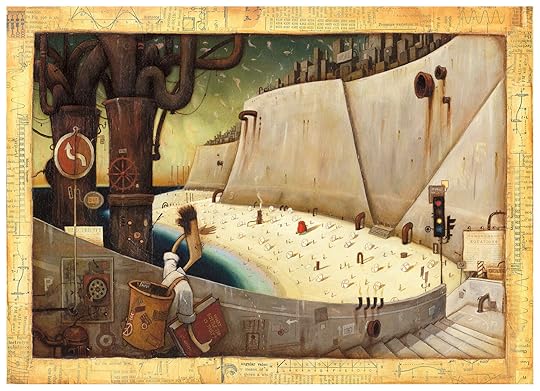
Plot: A boy , still curious due to his youth, discovers an odd creature at the beach, a 'Thing' that appears lost. In this mundane monotonous world of sepia, The Lost Thing, goes by relatively unnoticed. The boy sets out to find the Lost Thing a home.
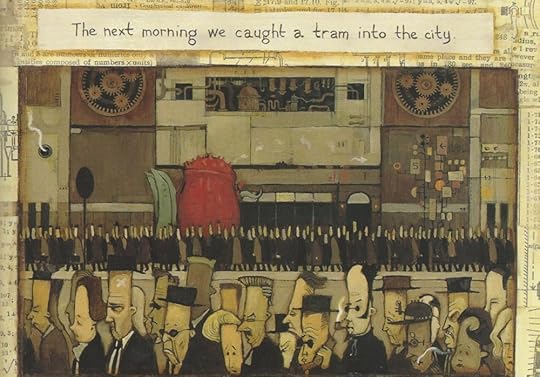
Themes: The Lost Thing explores how curiosity and wonder decay with age, until we, as adults, are simply robotic grey creatures. In a way, we have been conditioned to mirror the colourless world around us. Tan challenges the reader to not follow the many signs and orders that have conditioned us, but rather to witness (and remember) the fantastic that exists. The Lost Thing is highly critical of our need to label and categorise others. Furthermore, it asks us to not accept our adult world, devoid as it is, of individuality. We are becoming an industrialised model, which makes for a dull urbanscape and even duller society.
The Lost Thing also questions the marginalisation of subgroups. The Lost Thing itself, as a creature, could symbolically represent so many things: the poorly labeled and mistreated refugee; the individual who lacks acceptance because he/she doesn't fit into the cultural norm; the child-like zest that's missing in our lives; the wonder we fail to see...
Shaun Tan is an incredible artist whose pictures are able to capture nostalgia, and the bittersweet sadness that exists in the contemporary world. Rather than superficial princesses and shallow fairy tales, Tan asks us to also reflect upon aspects of life through original illustrations that are humorous, sentimental, poignant and satirical.
I'm deeply moved by Tan's work. The Lost Thing is a must read. It's truly marvelous.
كتاب عميق، مؤثر، ويأخذك إلى نقطة بعيدة في داخلك، لكي تفهم نفسك والعالم أكثر. شون تان فيلسوف فذ وكاتب مبدع وفنان عبقري.. كتبه تقرأ أكثر من مرة، خاصة في مواسم الحزن والغربة.
I am having a moment of going through my collected works of Australian illustrator Shaun Tan. So far this year I have worked my way through what I consider his masterpiece The Arrival and his more recent The Singing Bones. While The Lost Thing is probably not my favourite of his works, it is still an outstanding picture book. There is actually very little to read but you can spend ages pouring over the illustrations including the wonderful background collages of industrial drawings, algebraic equations and engineering text. I think I was most taken with the inside cover of bottle caps each with a tiny technical drawing or equation. This could be read as a simple tale of a Lost Thing in a faceless industrial world but as with all Tan's work it invites more complex analysis. I think it evokes so well those melancholy feelings of being "other", of not fitting into a world that appears to be rushing on without you. It is of note that this was adapted into an Academy award winning animated short film which is also worth tracking down if you enjoy animation.
Shaun Tan‘o knygomis susidomėjau išgirdus, kad kažkas jas laiko prie lovos, o skaito, kai pasijunta pavargęs. Prarastas daiktas – nedidelė didelio formato gausiai iliustruota knyga apie Daiktus. Daiktus, kurie tarsi ne vietoje. Radus tokį daiktą galima jį nunešti į tam skirtą vietą, kur yra jiems lentynos – palikti ir užmiršti. Arba – kaip pasielgia šios knygos vaikas, - nunešti ten, kur nežinai ar vieta, bet daiktai ten bent jau laimingi. Jauki knyga. Skaityčiau tokią gulėdama ant pilvo, su vaiku, ant minkšto kilimo. Tikriausiai dar pasiimtume ką nors kramtomo ir kikentume iš piešinių. Arba prisimintume, kad kaip tik turime kišenėje neseniai gatvėje rastą Daiktą. Kuriam reikia vietos būtų laimingam.
O dabar tiesiog pagalvokite, kad ši knygelė apie savo vietos nerandančius žmones....
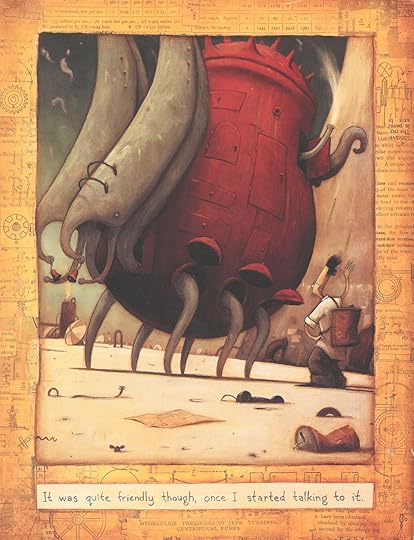
Un ragazzo occhialuto e spettinato nota una strana creatura sulla spiaggia. Una cosa strana, una specie di teiera con i tentacoli. Sembra spaesata, o forse solamente abbandonata. E si lascia avvicinare senza timore dal ragazzo che decide di cercarne il proprietario.
I due iniziano quindi a girare per la città in silenzio alla ricerca del Posto per la Cosa smarrita che, apparentemente, nessuno vuole.
In questo peregrinare notiamo tante cose strane che riusciremmo a vedere tranquillamente se solo non fossimo sempre così impegnati a pensare ai fatti nostri.
Il racconto è molto breve, folgorante. Forse troppo. Disegni meravigliosi (come sempre lo sono quelli di questo autore). E il messaggio è altrettanto chiaro e folgorante. Prendere tempo, vedere dove di solito non guardiamo, rallentare, incuriosirsi per tutto quello che c’è di diverso, sforzarsi di aprire l’angolo di visione, anche se impegni, distrazione e falsi obiettivi ce lo impediranno.
E’ curioso che ho letto il libro in modo abbastanza rapido, curandomi soprattutto della storia senza dare troppa importanza ai dettagli. E alla fine sono sbottato in un: “e allora?”
Ecco; il libro ci spinge a cercare di evitare di fare proprio questo. Correre per arrivare a una fine per poi chiedersi “e allora?”
Grande formato, colori bellissimi, disegni ricchissimi di dettagli, impaginazione accuratissima. Forse però l’efficacia del messaggio è parzialmente compromessa dalla brevità.
Well, I’ve loved the other books I’ve read by this author-illustrator, and he recently won an Oscar for a film adaptation of this book (an Academy Award winning animation short I’ve not seen, yet) so I was sufficiently curious to get and read a copy of the book. And, yes, I want to see the film; I can see it being an excellent short.
It’s probably not fair that I compare all Tan’s books with the brilliant The Arrival or even The Red Tree; those books are so amazing. This one is terrific too. Melancholy. Quirky. Funny. About growing up and changes in perspective, and much more. The simple story is written well but it’s the illustrations that shine, although the story does its job because I wouldn’t like the pictures anywhere near as much as I do without the context of the story. There’s so much to view on every page, some of it nonsense. I think. Which is fine; it works. It’s left me rather pensive, but I’m fine with that. Another winner from Tan, in this case his first book. I have to eventually read them all.
I loved this book. The illustrations are a weird combination of dark/depressing and funny/ironic. It is a dark, mechanical world. Very dystopian, but the characters do normal and very dorky things that make it funny. The text by itself would seem ordinary, which is part of the magic of this book, because it fools the reader into thinking they will see something familiar in the illustration. Of course there is nothing boring or cliche about the illustrations. In fact, it is completely unpredictable: the story, the illustrations, and well...the ending.
Loved it. Very short text. Very interesting, complex illustrations with multiple layers.
I read this straight through in the Oxford Street Bookshop (took less than five minutes), and only did the 'you're not crying in the shop!' thing once, which is good going for a Shaun Tan.
Then I went and bought it, and spent a total of an hour pouring over all the hundreds of tiny details on the train. So beautiful, and utterly wrenching.
He writes of kids' magic: all the things you see before the grown up world trains you out of seeing what's really there.
Is belonging to some home a good thing? Is being lost about being without a place to return to at the end of the day? How many people of us are being lost? Living in a place they do not really belong to! It is a gloomy story in fact.
I still think about that lost thing from time to time. Especially when I see something out of the corner of my eye that doesn’t quite fit. You know, something with a weird, sad, lost sort of look. I see that sort of thing less and less these days though. Maybe there aren’t many lost things around anymore. Or maybe I’ve just stopped noticing them. Too busy doing other stuff, I guess.
*
Some don't need grandiose words to break hearts. Using a most colloquial speech, one is reminded of how often important things are neglected. Forgotten. Left behind. Just plain lost. Surrounded by a growing apathy, one keeps fulfilling tasks conscientiously, exchanging absentminded smiles, squandering time as if it weren't the stuff life is made out of.¹
O tom, že občas nezaškodí pozrieť sa na svet detskými očami...
...ale povedzme si pravdu, kto z nás by radšej na zemi našiel šesťnohý čajníkoid* ako dvacku?
------- *teleso vzniknuvšie ako plod krátkeho ale o to intenzívnejšieho vzťahu Krakena a chladiarenskej veže atómovej elektrárne** **čím viac sa na to pozerám tým viac si myslím, že tam bol aj slon
This picture book has gorgeous art - but then I would expect nothing less from the author. The story however was not as engaging as his other work. Still, I'd get a library copy just so you can ogle the artwork.
The Lost Thing is an illustrated book for young readers by award-winning Australian illustrator and author, Shaun Tan. The story is being told, according to the post card from Suburbia on the back cover, to the reader by Shaun. In it, a younger Shaun, idling around by the beach, spots The Lost Thing. At least, it seems lost to him. It’s quite big, but when he interacts with it, it seems friendly, and he tries to find out to whom it might belong. Unsuccessful, he eventually takes it with him. His friend Pete gives some sage counsel, and Shaun takes this large, red, part-metal, part-creature, home.
When his parents notice it, Shaun’s mother reacts like most do: “Its feet are filthy!” she shrieks. His father is equally negative: it has to go. The Lost Thing is hidden in the shed, but Shaun knows that’s not a permanent solution, so he tries his best to do the right thing. He encounters bureaucratic indifference in the city (Downtown, 6328th Street, Tall Grey Building #357b) but also helpful advice, and hopes he has ultimately helped The Lost Thing to a good destination.
Tan’s exquisitely composed colour illustrations are presented on a background of what appears to be heavily foxed pages of technical notes and drawings from a textbook. In keeping with this, the back cover has a (rather self-deprecating) sticker that includes “INSPECTOR’S COMMENTS: No perceptible threat to the order of day to day existence. Inconsequential. Safe for public consumption”. Damned by faint praise… The departmental stamps with their logos and Latin mottos are smart and funny.
There is so much detail in the illustration that each page, even the endpapers and the front and back cover, bears minute examination. Young eyes will be fine, but older readers supervising (or reading for themselves: Tan’s books should not be reserved for young readers!) may appreciate a little magnification. It’s really worth doing this because the text tells you that the young man has a bottle-top collection, but just how serious he is about that is only revealed when you read the title of the fat red book he is carrying around. Clever and insightful, but also heart-warming: Shaun Tan is so talented!!
فضاهای مالیخولیایی و پرجزئیات شان تن خیرهکنندهان
با ظرافت عجیبی تصویرسازیهاش رو درگیر تنهایی و احساسات عمیق آدمها میکنه. از اینجهت خیلی جذابه؛ اینکه دغدغهش و سروکارش، مواجهه با انسان مدرنه، و این رو به زیباترین شکل در قالب دنیاهای کودکانه تصویر میکنه.
Çok mühim işler yaptığımız hayatlarımızda neleri göz ardı ediyoruz, neleri kaçırıyoruz ya da neleri görmek istemiyoruz bunlara cevap niteliğinde bir çizgi hikaye. Shaun Tan'ın hayal gücü ve eşsiz çizgileri ile birlikte güzel bir kitap.
I can't even express how much I love Shaun Tan's works. Each one is like diving in a vaguely familiar, but strange world, where you have to find your own way to navigate. I love how he changes his style in different books and how he explores different topics, I love the inclusion of article excerpts, word waves, unexplained creatures that somehow feel normal. I always crave for more and if I'm sad or feeling down, I go to a library section with his books and immerse myself in his worlds.
Zoveel laagjes in dit boek over kijken, over tijd maken, over ontdekken, over verliezen en verloren zijn, over ontmoeten en afscheid nemen, over verwondering,...
You'd think this is a book of pretty pictures stuck on top of scraps from a thermodynamics textbook, you'd think this is a book about finding a creature that is really an assemblage of mechanical parts with no rhyme or reason, you'd think this is a book about the misfits, you'd think this is a book about a fictional emotion attached to the words home and belonging, you'd even think this in a book about looking out for lost creatures and extending help and companionship, but what this book really is is a gaping honest statement that is as subjective as it can get with the brutal acknowledgement of cluelessness and pointlessness of the whole exploration of the concept which in itself somehow makes it all the more authentic and as absurd as life itself.
One of Tan's best, with his trademark combination of whimsical storytelling and fantastic (in both senses) artwork. The drawings themselves are minor masterpieces, but the overall layout - and detailed background areas - are also to be slowly savored.
With his unexpected aliens-among-us world-building, Shaun Tan is like the H.R. Giger for the under-12 set.
Instead of this, read The Arrival by Shaun Tan first.
If you want more, this is a nice small addition. This is a very short, nice kids book for all ages. Shaun Tan's books have brilliant imagination and good but subtle moral messages. Collecting these for my future kids!
I'd actually give this 4.5 stars for the graphic element - Shaun Tan's style is really a wonder to behold, it's fresh and unique. But the storyline is - well - somewhat odd and disconcerting (and I like odd, disconcerting stories usually!), so it dropped down in enjoyment rating for me. The only purpose it seemed to have was to support what was drawn as opposed to illustrate the story that was happening and I felt that, in a book form, it would have been a stronger impact if it had been the other way around. Does that make sense? It was a little too meandering - or aimless - at times and it took strength away from the thing as a whole.