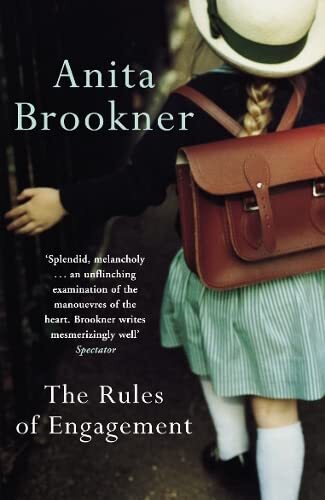
Elizabeth and Betsy had been school friends in 1950s London. Elizabeth, prudent and introspective, values social propriety. Betsy, raised by a spinster aunt, is open, trusting, and desperate for affection. After growing up and going their separate ways, the two women reconnect later in life. Elizabeth has married kind but tedious Digby, while Betsy is still searching for love and belonging. In this deeply perceptive story, Anita Brookner brilliantly charts the resilience of a friendship tested by alienation and by jealousy over a man who seems to offer the promise of escape.
Anita Brookner published her first novel, A Start In Life in 1981. Her most notable novel, her fourth, Hotel du Lac won the Man Booker Prize in 1984. Her novel, The Next Big Thing was longlisted (alongside John Banville's, Shroud) in 2002 for the Man Booker Prize. She published more than 25 works of fiction, notably: Strangers (2009) shortlisted for the James Tait Black Memorial Prize, Fraud (1992) and, The Rules of Engagement (2003). She was also the first female to hold a Slade Professorship of Fine Arts at Cambridge University.
Not just did I DNF but I barely started this book before abandoning it. It's full of elegant, balanced sentences but they seem to go nowhere. The blurb sounds enticing but the grave and discontented 1st person narrator looking back on her life is so listless and lacking in any kind of energy that reading her words is tedious. Even her dislike of the 1960s which betrayed the values and ideas she'd been brought up with lacks punch. What I think was intended as a portrait of isolation and lack of connection ends up feeling hollow. I skipped to the final chapter and the book didn't seem to have moved from the start.
I'd like to give Ms. Brookner, whose rather expansive body of work has heretofore flown under my radar, the benefit of the doubt. I'm hoping that my first encounter with her work ("The Rules of Engagement", her 22nd novel) was a flukey bad choice, and that everything else she's written is deserving of the accolades heaped upon her. From my limited perspective, however, I'm not terribly optimistic that this pseudo-19th century poseur of a novel isn't indeed representative of the whole. After reading this, arguably the dullest novel i've read this year, I'm sure not eager to find out.
Much of my problem with the book is with its style: it tries to convey the gravity and importance of classic literature of the nineteenth century (although set primarily between the late 1960s through the early 1980s) but lacks the substance (e.g. rich plotline, indelible characterizations, subtle wit) of the books it tries so desperately to emulate. It drowns in a sea of monotonous (exact, exactingly syntacted) prose, most of which provided by its main character, an insufferably slight, completely unsympathetic woman named Elizabeth, who lives in London. She is our narrator, and comprises probably 90% of "Rules..." content. She attempts to compare and contrast her life with that of her childhood friend (also named Elizabeth, but calls herself Betsy), particularly after their school days when they embark upon their adult lives. We can infer from the monologues of Elizabeth the narrator that she is unsatisfied with her marriage to a man 27 years her senior and, predictably, skeezes around with another married man. The other Elizabeth, her friend Betsy, ends up skeezing with him, too, after the first Elizabeth ends the affair subsequent to a tragic circumstance. (yawn)
Not only is the plot tawdry and humdrum, but Elizabeth's narration is just runs on, and on, and on, seemingly ad nauseam, with what is intended as emotional handwringing and introspection, but is so frightfully verbose and repetitive, it becomes nearly impossible to stay awake through. Consider our Elizabeth, who gives us really no indication whatsoever in her limited, rather vapid conversations with the other characters in the book, would have the intellectual wherewithal to toss around 50 cent words like "suzerainty", "mephitic", "concatenation", "clandestinity", "anodyne" (too many times to count...must be Ms. Brookner's favorite word), and "animadverting" (just to name six words at random). We're supposed to buy that this woman conveys coherent thoughts using words such as these, when she she can barely elevate a dialogue with her fellow characters beyond two-word call-and-response. Uh-uh; I don't buy it for a second. It only conveys to me that Ms. Brookner wrote this with haughty affectation and aim to emulating other far superior works rather than working on imbuing her characters with some semblance of empathetic, human qualities the reader could relate to. Everything the narrator bothers to convey to us rings either false or irrelevant. Tack on a superfluously maudlin ending, and you've got yourself a 270-page complete waste of the readers' time.
Reviewing this reminds me of the old childhood arithmetic axiom: Anything x Zero = 0.Or to put it into this context: Overly precise and verbose English prose x Zero Meaningful Substance = 1 (Regretfully Proffered) Star.
I've read numerous books by Anita Brookner and eventually want to read them all.
The Rules of Engagement (2003) is one of Anita Brookner's final novels and, sadly, not up the level of the other novels I've read by her. It's the story of a friendship between two women who first meet whilst at school.
Elizabeth Wetherall, the narrator and central character, is so solipsistic and seemingly with such limited appetite for life and experience, that she feels barely credible. Perhaps she's the ultimate Brooknerian character. Many of Brookner's women have somewhat empty lives but this takes it to the nth degree. There's plenty to appreciate but the enervated Elizabeth complete with her obsessive self absorption - and aligned to a slender plot and maudlin vibe - were a constant distraction from the elegant prose and perceptive insights.
One for Brookner completists.
3/5
More info...
The Rules of Engagement is the twenty second novel by Anita Brookner, the Booker Prize winning author of Hotel du Lac.
Elizabeth and Betsy are old school friends. Born in 1948 and unready for the sixties, they had high hopes of the lives they would lead, even though their circumstances were so different.
When they meet again in their thirties, Elizabeth, married to the safe, older Digby is relieving the boredom of a cosy but childless marriage with an affair. Betsy seems to have found real romance in Paris. Are their lives taking off, or are they just making more of the wrong choices without even realising it?
'One of the most observant moralists writing today. A dark, wintry work and there is plenty here to satisfy Brookner's fans' Guardian
'Her technique as a novelist is so sure and so quietly commanding' Hilary Mantel, Guardian
'She is one of the great writers of contemporary fiction' Literary Review
Anita Brookner was born in south London in 1928, the daughter of a Polish immigrant family. She trained as an art historian, and worked at the Courtauld Institute of Art until her retirement in 1988. She published her first novel, A Start in Life, in 1981 and her twenty-fourth, Strangers, in 2009. Hotel du Lac won the 1984 Booker Prize. As well as fiction, Anita Brookner has published a number of volumes of art criticism.
This is a compelling examination of morality and relationships from the perspective of a woman born too early for her time. This is the first book I've read by this author - and it was her 22nd book! I will explore more of her work for sure.
The Rules of Engagement is the story of Elizabeth and Betsy - two women who have known each other since childhood. They lose contact, but then reconnect in their 30s/40s when both have become unexpectedly single. Although, the inside cover presents the book as being about the two women, I think it is really about Elizabeth and how she feels navigating middle-age as a single woman with no children. Everything is told from Elizabeth's point of view and she psychoanalyses Betsy a lot, but who are we to say whether her descriptions are correct or not.
As with many of Brookner's novels, not much happens in The Rules of Engagement...or I suppose things do happen - sickness, adultery, death - but everything is told in Brookner's calm, precise style. I love the way Brookner writes and I like the ruminations of the main character, but this book was a little too amorphous to me. I found the ending to be unsatisfying. It's not that I wanted things wrapped up in a bow, but it all felt a bit rushed and blah. Even so, there are some insightful descriptions.
I found this quite a funny observation since London weather can be pretty crap. Elizabeth is on a walk with a group of college students and their leader, Mr. Ward. She thinks: The weather had deteriorated sharply: there was a scudding wind - our version of the tramontane, the fohn - the wind that sets the teeth on edge and inclines one to murder. By the time I reached Baker Street Station my eyes were watering and my hair unkempt. The students, two Indians, two Japanese, and a Nigerian, seemed disenchanted, as I was, by the peculiar pall that hangs over a London Sunday...Mr. Ward, his evident good intentions surrounding him like the attributes of sainthood, was engaging them politely in the sort of conversation they were in no mood to appreciate. When we set off we must have resembled a couple of dutiful parents with a family of disgruntled teenagers.
and later she escapes, "The whole group watched as the taxi carried me away. I felt ashamed, as if I had let them down, but in fact they were merely envious." I've defintely been in the position of both Elizabeth and the students.
And then this rather sad thought: I also learned that nature, that great benefactor, exacts its punishment for all the bounties hitherto enjoyed, without a thought of worth or entitlement, and that all life ends badly. 'Peacefully, in his sleep,' one reads, but what of the preceding hours or minutes? ...I also learned that it is the gods who are in control, and that their pagan indifference can be visited on any life, no matter how correctly that life has been lived. I have come to believe that there can be no adequate preparation for the sadness that comes at the end, the sheer regret that one's life is finished, that one's failures remain indelible and one's successes illusory. I also believe that there occurs a moment of renunciation, when one is visited by the knowledge that time is up, that there will be no more time, or that if a little time remains it will be lived posthumously, and with a sense of pure loss. This is also, conversely, an invitation to play Russian roulette with one's life and affections while one has the time, to take chances, to defy safety. But of course one no longer has the time to do that. The ability- the capacity - to take chances has been lost. All is subject henceforth to the iron decree of mortality.
This entire review has been hidden because of spoilers.
The book is about the simple but unhappy and lonely life of the main character. Nothing much happens but there are pleny of lengthy musings about what could have gone differently or what could be a productive next step, which will invariably not be taken, even after considerable considerations. Only suitable for fans of the author. It is not her best book, in my opinion.
My second Anita Brookner novel (also read Hotel du Lac several years ago). I don't know if there will be a third.
Maybe Brookner is tapping into a "British" sensibility/sense of decorum, but Elizabeth Wetherall (great stiff-upper-lip sort of name), the narrator of this novel (and, to a lesser extent, the narrator of Hotel du Lac), seems chilly, too abstracted from her own emotions, critical, overly cerebral. (Maybe I consider myself too cerebral, so I want the books I read to be an escape from this quality.) This was very much a novel of thoughts, with little dialogue, scenes, or described actiona quality that, I found, discouraged engagement and identification with the story.
No doubt Brookner is a skilled writer: the caliber of her writing was never in question. Main characters Elizabeth and Betsy were two women born slightly too soon (as Elizabeth notes) to eschew traditional roles and fully engage in the women's movement, and in women's relatively new sense of independence in the 1980s. I appreciated Brookner's exploration of this group of women "caught in between." And the author's long, self-contradictory sentences mimicked well the ruminative nature of the mind.
The final chapters of the novel, dealing with the events around Betsy's death (which comes as no surprise and is not a device of plot, as Brookner references it in the beginning of the book), were difficult to read, in their acute portrayal of loneliness and of considering one's own mortality. These keen and harshly truthful passages were for me the most poignant in the book.
Throughout the novel, however, harsh truths and bleak observations were not tempered with with warmth or affection, ruminations were not counteracted with action or sensory description, and this is what, ultimately, made the novel off-putting for me.
This entire review has been hidden because of spoilers.
Anita Brookner is such an accomplished author; however, her books leave me feeling sad because the subject matter is usually lonely women leading introspective lives. This novel is no exception. Elizabeth is a quiet woman married to a respectable (dull) man when she embarks on an affair with a man who is also married and experienced in clandestine affairs. When Elizabeth's husband dies, she concludes her affair with Edmund, only to see her long-time friend, Betsy, begin her own affair with Edmund. Elizabeth's inner dialogue is fascinating as she watches Betsy give herself wholeheartedly to Edmund and his children. Anita Brookner is a master at evoking characterizations of women who live on the outside while wistfully hoping for fulfillment "on the inside."
Ah, what it is to have been born too soon. You get to witness all the benefits and bonuses you long for being enjoyed by the generation that comes after your own, but you don't get to experience any of them first hand. This is the story of two friends, both born too soon. It is not a happy novel but, as per Anita Brookner, it is beautifully told.
Bad, bad, bad. A book spanning over a few decades and ignoring EVERYTHING happening not in the world, but even in the UK - as if the seventies and thatcherism never happened. Unbelievable. Not to mention Digby's end which was criminally stupid. I regret the time lost with this book and the fact that I remember it after more than five months.
Lovely. I could relate to the main, lonely female character who settled for a comfortable arrangement, got released from it as if from gift of fate (for we all know the Brookner fantasy is fierce independence whilst financially comfortable despite how crass the dismissal of the husband-character's own fate is), and almost sucked into another compromising, because dull but safe, marriage, but not this time to her lack of diversion, a career of some sort, although she did like reading, alone, at coffee shops. The book is also about female friendship, but not really a deep one, and Brookner largely abstracts this relationship and administers the tinge of female betrayal as they end up sharing the same emotionally unavailable affair. Probably not the Brookner book that I cling to fiercely, perhaps like Bay of Angels, more like Hotel du Lac, a light exercise in rumination about self-exile and a natural tendency to be selfish with one's life journey.
Astute, perceptive. I reel in amazement at her ability to recognise and describe the emotions and the motivations of her characters. Particularly when I recognise these in myself. An astonishing appreciation of human nature and behaviour. Read through it pretty rapidly to find out what was going to happen. Now I need to go back and read it slowly and take time to enjoy the beauty of the writing.
Brookner voice and language is articulate as a surgeon's or a concert pianist's hand, and all other bumbling writers have the clumsy soft barely formed fingers of a small child.
Themes of friendship, life choices, women who live essentially solitary lives.
I have a stack of about fifty books that need to be read or leave my shelf, and this was one of them. I told myself every book got 50 pages to hook me enough to finish it, or it would go away.
This passed the fifty page marker, and I finished it. And I debated between two and three stars. It is well-written, the prose is thoughtful, and it has some interesting insights into female friendships, and the bounds of societal expectations for single women and the binds on women in relationships. For that, I'd probably give it a three. But the reality is that I really didn't like any of the characters in this book. Every single one of them felt emotionally stunted, and incapable of emotional vulnerability and making healthy relationship choices.
Yes there's something important to be said about women who settle into a relationship they're not happy in because of stability, and the potential draw of illicit relationships because of that lack of happiness. It holds important social commentary and the decisions the characters make, do make sense, the narrator is not always reliable, but the author seems to recognize that within the writing, and at times the narrator is even self-aware enough to recognize that her assumptions about the motivations of other people are based on absolutely nothing but her own imaginings.
All of this would make for interesting conversation in a classroom setting, or possibly even a book-club, but I still don't like the characters, they still feel emotionally stunted, and unhealthy, and it is a bit frustrating to read.
Looking at the reviews on this page, it feels as if this may be par for course with this author, so while obviously she's written a number of books (this is her 22nd), and the writing feels solid, I probably won't be picking up another book by her. I think it's worth picking up if this type of story appeals to you - the writing is good - but it was not personally for me.
A única razão pela qual não dei 2 ⋆ a este livro é que, apesar dos seus muitos defeitos - entre os quais se contam uma narradora inconcebível do ponto de vista humano de tão cerebral é a sua análise da própria vida -, senti algum tipo de interesse em saber como acabaria a história de Elizabeth. Queria saber se o ritmo desoladamente maçador e o tom insuportavelmente repetitivo da história teriam algum ponto alto, o momento "ah! É agora!", quando sentimos que encontrámos o ponto nevrálgico da história, ou alternativamente uma quebra na monotonia e falta de (re)ação da personagem principal. Esse ponto nunca chega, e para alguém como eu que nunca teve problemas com ritmos lentos ou com pouco diálogo num livro, aqui achei esses aspetos insuportáveis. Não há quase nada na história que nos está a ser contada, ou nalguma das personagens, que redima o facto de eu estar a contar as páginas para que o livro acabasse. Nunca tinha lido uma obra onde sentisse que não havia rigorosamente nada que se estivesse a passar "por detrás das linhas", nada que não nos estivesse a ser comunicado diretamente, ao ponto de se tornar condescendente a repetição consecutiva de frases inteiras, sem tirar nem por, como se a autora duvidasse da capacidade do/a leitor/a em compreender a importância da ideia. Em suma, compreendo o que a autora estava a tentar fazer - um retrato da solidão feminina na geração dos late 1950's -, mas penso que a execução falhou.
This book has been on my shelf for years. Recently I made an intentional TBR stack choosing mostly those that have been on my shelf for three or more years. I seemed to be in the habit of reading my most recent acquisitions. But I digress . . .
The best way to describe this book is that it seemed the epitome of the English in all their demeanor, mannerisms, and utmost restraint. It is the story of two women named Elizabeth one of which narrates to us, while the other she refers to as her friend Betsy. They meet at school when they are young and remain lifelong friends. When in their 30's Betsy has met her love in Paris while Elizabeth meets the older Digby and settles into a mediocre but safe life and must live with the effect of it's outcome.
While there is really no plot to this story it is not a light read by any means. The true gem of this book is the remarkable writing itself and how perfectly the author describes Elizabeth's every reasoning behind her every thought and action as if we are truly in her head. The intimacy we gain with this character is amazing. Ms. Brookner's tone is rather somber yet soothing to read. I will be reading more by this author and I would recommend this only to those who truly appreciate the written word.
How I acquired this book: Barnes & Noble clearance shelf
The Rules of Engagement is Anita Brookner's twenty-second novel, and as usual, her eloquent and intelligent telling of the story has the power to keep the reader focussed, even transfixed, on the central character with her ruminative and sometimes entertaining thoughts on complex issues surrounding love, marriage, infidelity, jealousy and passion.
The story is narrated by Elizabeth, a woman in her fifties who takes an introspective look at her life and that of her friend Betsy whom she's known since childhood. Born in 1948, they belonged to a generation that tended to marry men for protection and respectability rather than exclusively love. Elizabeth conforms by marrying Digby, a much older man: "It was the right thing to do." But Betsy, she tells us rather pithily, "took it upon herself to have a career, out of despair, perhaps, at not being provided for." Betsy does eventually marry for love, albeit briefly.
When Betsy comes back into her life in their twenties, Elizabeth's capacity for loyalty and compassion is put to the test. Betsy makes a decision which the prescient and ironically more worldly Elizabeth sees as having a tragic outcome...
Anita Brookner is a wonderful writer, but her vision is so narrow, almost claustrophobic, and this book so depressing that I dipped to three-stars which I don't like to do. Even if you accept all the melancholy, struggles with loneliness, and death, one of Elizabeth's central dilemmas--desire for passion while preserving freedom--remains unresolved by the end of the book. Is passion not possible if one wants to remain free?
Brookner's books are extended meditations--regardless of protagonists and characters--on women's right to independence, and the trade-offs this insistence entails: loneliness, spinsterhood, childlessness, insecurity, etc. She seems to harbor grave doubts about the women's movement: doubt that passion and human connection are possible without relinquishing personal freedom. Elizabeth ends up volunteering at the hospital and going on platonic walks with Nigel?! That is hardly a satisfying ending. Is that what Brookner believes we should settle for?
This entire review has been hidden because of spoilers.
Another Brookner read for IABD at http://myporchblog.blogspot.com. The story centers on two childhood friends who connect and reconnect through the years, leading sort of parallel lives. The book covered what I am finding are typical Brookner themes: loneliness, adultery, and sad childhoods. Like with Falling Slowly I found reading this book to be tedious; like listening to a friend ruminate about a bad break up over and over again till you just want to slap her and tell her to get a life.
Great read about two women and their friendship from youth to middle age. A must read for women in their 50's and up. It travels through the changes in their friendship caused by choices they made in their life. the aging process plus more but ever so beautifully written establishes the loyalty we have for our true women friends. Highly recommend for women
I received this book as a wedding gift at my sister’s wedding two weeks ago. First of all, let’s revisit this, has there ever been a cooler wedding gift?!? Not that shot glasses and apple butter weren’t also wonderful but come on, what a great touch. But sadly, in direct contrast to a beautiful wedding, T.R.O.E. was about as dark and depressing a look at love, marriage, and aging as it gets.
Anita Brookner’s The Rules of Engagement is a partly absorbing, partly frustrating novel to read. Certainly a world away from my usual fare of historical fact, or biography, as well as contemporary novels. Having ploughed through so many words, I am writing at some length, but nothing is here that hasn’t already been said by many other Good Reader responders, who either loathed the book (less than 3 stars), or saw it as an unusual work which had value for those who were looking for something different. I gave it three, but I have to say the book has got me thinking, and verbalising (like the central character !).
The world depicted kind of works if you are OK with ignoring the many seismic shifts that have occurred in Western societies in the last century (20th). This is in spite of the fact that the book relies on the two central characters being born ‘before’ the feminist breakthroughs that occurred in the latter part of the twentieth century, and so lived limbo lives of frustrated ambition, because of the inappropriate expectations put on them by society generally, and their own families, in particular.
The setting of the two girls’ childhoods in post WW II London does help to build this very well. We are given a suitably bleak account of early childhood experiences in lower middle class (or some intricate variant of English middle class) England, where one’s responses to others had to be carefully calibrated and nuanced to ensure social survival. Not much emotional joy in supply in the childhoods of the two key characters. All good, loved the descriptions, the emotional claustrophia.
The two main characters are well differentiated, I enjoyed the contrast. Betsy is a more joyous character than the over thinking Elizabeth, but she ain’t going to come to a good end in the sexist society she wants to fit into, it is suggested.
J Alfred Prufrock, in one of TS Elliott’s poems refers to
‘Time for you and time for me And time yet for a hundred indecisions’
And this novel, for me, is a whole book given over to telling the story of a female version of J Alfred Prufrock, Elizabeth.
This has a benefit in pushing the reader to consider how it all may have been otherwise, how a profoundly discontented woman who is (or feels) sidelined because…?
Well, a couple of suggested reasons are dangled before us.
She lived at a time when a proportion of females saw that the world for Western women was changing, and were seemingly able to dabble their toes in the new life waters and live lives of some fulfilment, in ways that the central character and her friend were not, because of constraints put on them in their early years by insensitive/ ignorant/ sexist/dysfunctional parent figures.
Women then (1960s and 70s) were shunted into subsidiary roles, and unhappily striving for attainment in ways that were doomed to failure.
The novel certainly lays bare how easy it was to ‘fit in’ by never rocking the boat, and accepting second or third best. Elizabeth’s marriage to a plodding, boring much older male is rendered so bleakly that the point when she has an affair with her husband’s acquaintance comes across as a welcome break!
But Ladies and Gentleman, this is Elizabeth, a personality type whose glass of water will never be half full, will always be somewhere near the red warning light, and we will be hear how this is the case, at great length. It’s scary, but there’s enough of Elizabeth in quite a few of us to make us watch her, in horrified fascination, step sideways, as crab like, throughout little incidents, carefully avoiding ending up in situations where she might get a break, and hope that we are not quite as bad as that.
What the book does do is show, in incredible detail, how a proportion of individuals will weave about themselves a dense thicket of ‘no-go thoughts’, rules, and ‘principles of living’ which can be erected where there is actually a need to think and to ACT (yes to do something) that is slightly non-expected. My personal take is Elizabeth would have been the way she was, in any era, so yes, while the relegation of females to expendable ‘bits on the side’ is well shown, it’s Elizabeth’s own over thinking of what occurs that is the centre of the novel. As with the book, you either appreciate Elizabeth’s complexities, or you want to exit the movie.
One of the exasperating features of the novel was the central character’s apparent complete disinterest in taking on work of any kind that would have challenged her while also hopefully providing some sense of purpose, and identity. She frequently bewails the fact that other females she is aware of draw meaning from their careers, but she herself appears to patronise them for ‘working’. The whole notion of actually earning money, of drawing inspirations from getting your hands dirty, she views with distaste (all the while simultaneously bewailing the fact that she is so lonely.) At a couple of points one of two ‘do-gooder’ acquaintances suggest she get a job (paid or unpaid),but the suggestion is ignored.
Loneliness, alienation and isolation, are Beth’s constant companions. She lives in one of the busier and more cosmopolitan centres of the world (London) in relative freedom from want, but this character is unable to make connections which might give her some meaning. Most exasperating of all, she is supremely articulate in giving voice to her alienation. She imbues any possible ‘way forward’ with countless what if’s and ‘but no’, but, everywhere, BUTs! So frustrating but also, believable as well.
At one point in the novel, the protagonist briefly steps out of her self-imposed ‘anguished peeping’ at the outside world, and cuts to the chase by inviting a potential paramour to bed. Just like that. Without eons of anticipating, agonising, hypothesising, fantasying, she abruptly tires of ‘small talk’ and suggests they hit the sheets.
I cheered. Easily the highlight of a very drawn-out narrative of tortured philosophising and over thinking. Hey, maybe this will be the breakthrough! And this does bookmark another phase, if only one which the character carefully reprocesses and reframes as a kind of example of what she might be missing out on in her life.
A really poignant moment of the novel was a point where the two women, Elizabeth and Betsy, who had been through quite a few travails, and whose relationship as friends was the strongest bond depicted, have an opportunity to be open with one another. I did find it a little unbelievable/ incredibly sad, that fully aware of the suffering which each was undergoing, these two did not once, not even for a single second, speak openly and honestly to one another, free of resentment, guilt, supposition. English stuffiness? Acquaintance rivalry? You are left to wonder.
On one occasion Elizabeth refers somewhat superciliously to evidence that the ‘romantic interest’ she took up with was uttering lines from a therapist’s session (suggesting he’d sought some outside help), and I was wondering (hoping!) that our protagonist might herself have thought to try a similar stratagem (ie seek a good psychologist/ therapist/whatever to do some existential co-lifting).
Nup.
Even when confronted by the faint possibility of being able to live in the here and now, and be more a part of a world that she seemingly longs to accept her, she can’t quite make that jump. I wanted to jump into the book and give her a good shake (of exasperation), and say ‘Luvvie, the gems are there for you, but you keep seeing rocks only.’
It’s a credit to Brookner that she can elicit such a response. This writer can conjure a full-length novel which is largely free of a modern ‘storyline’ and thousands of lines of inner thinking and keep a proportion of her readers interested. A considerable achievement.
Rules of Engagement definitely an acquired taste, but I have to say that I did enjoy the writer’s complete avoidance of the colour and clanking of what passes for modern living. Another responder has suggested that Brookner is trying to write as a nineteenth century writer, and I agree that the book does have this feel to it. But it’s a refreshing alternative (in small doses).
[2003] Writing: love her writing, interesting and rich without being flowery. Characters: well drawn, introspective. I didn't have total clarity around them but loved the depth she provided. Story: a little drawn out, could maybe have been condensed a little, since there was no real plot to support, the intense introspection became a little repetitive. Setting/world: London, atmospheric, melancholy, fit the characters and the story. Feelings of loneliness, of settling, that no one ever really gets what they want. The funny thing about all three of Brookner's books that I have read is that they somehow feel out of time. They are contemporary but there is almost no indication of that and everything about them feels kind of old fashioned. I can see why her books aren't for everyone, but I'll be back for more.
A well written novel about Elizabeth and Betsy who knew each other as school children and who had kept in touch, though infrequently as adults.
Elizabeth is the narrator. She has an affair with Edmund, a married man with a wife and children. Betsy marries and her husband dies.
It’s a story about two fairly dull, mostly independent, slightly unlikeable single women.
I liked the reading experience, but then, I am an Anita Brookner fan. Readers new to Brookner should begin with ‘Hotel du Lac’ (1984 Booker Prize winner), or ‘Latecomers’ (1988).