In an ambitious departure from her usual form, Anita Brookner expands her canvas in FAMILY AND FRIENDS to create a richly textured novel about the life of a wealthy Jewish family in London, centering upon the generation that came to maturity between the two World Wars.
Anita Brookner published her first novel, A Start In Life in 1981. Her most notable novel, her fourth, Hotel du Lac won the Man Booker Prize in 1984. Her novel, The Next Big Thing was longlisted (alongside John Banville's, Shroud) in 2002 for the Man Booker Prize. She published more than 25 works of fiction, notably: Strangers (2009) shortlisted for the James Tait Black Memorial Prize, Fraud (1992) and, The Rules of Engagement (2003). She was also the first female to hold a Slade Professorship of Fine Arts at Cambridge University.
And in the front row, the three children: Laurie, Charlie, and Nellie's c:hild Vicky (Victoria). See that look on Vicky's face, that imperious stare. so unlike a child, so like Sofka. See Alfred's hand proudly clasping her little shoulder. See the resemblance. Wait for the dancing to begin.
Different from Hotel du Lac, Family and friends, the fifth novel that Anita Brookner published and the second one I read by her, made me understand why some readers eventually venture into binge-reading Brookner’s novels.
Brookner plunges the reader into a solid family saga pivoting around the widowed matriarch Sophie (Sofka) Dorn – fortuned, London-based, with Eastern-European, Jewish roots, ‘sent to England from a European debris’, and her four children - Frederick, Mimi, Betty and Alfred. Focussing on the trials and tribulations of the children from their privileged childhood to middle age, the progression of time is visualised by the leitmotif of leafing through a family photo album, commenting on the photographs taken at various weddings, revealing the changes that have taken place over time in the family. All are mostly preoccupied by what happens – or refuses to happen – in their own lives, seemingly ignorant of the outside world – to them the Second World War is background music that is barely audible, apart from some intrusions from the European past of Sofka Dorn, standing on her doorstep as a Jewish refugee (resuscitating her fear for impending terror and death towards her children).
Brookner’s tone is detached but nonetheless slightly more affectionate than in Hotel du Lac. The family members are if maybe not exactly likeable at least less preposterous than the hotel guests.
Brookner meticulously characterizes the mother and the four siblings with their rivalries and personal struggles via their contrasting temperaments, looks and destinies. Two will rebel and break free from the stiffening cosy and orderly bourgeois nest and from mother’s high social expectations (and will be even more loved for it): like their cosmopolitan parents, the egoist charmer Frederick and wild Betty will fan out to Paris, California and the Italian Riviera. Two will stay – Mimi and Frederick for various reasons will continue to take shelter in the protective den of their mother, shaped by hard work, decorum, routine and marzipan cake. Because of their foreign descent, Frederick, all constraint and formality and craving mother’s esteem, aspires to be more English than the English (with some funny scenes on devouring traditional (‘Dickensian’) food even if the actual taste of it turns out disappointing). Freedom, idleness and frivolity are set against wayward sense of duty, self-discipline and self-sacrifice. The different attitudes to life of the siblings roughly reflect the ones of the grasshopper and the ant from the fable of de La Fontaine. The siblings form a quartet of sorts that dances respectively graciously and clumsily through their life on the pages.
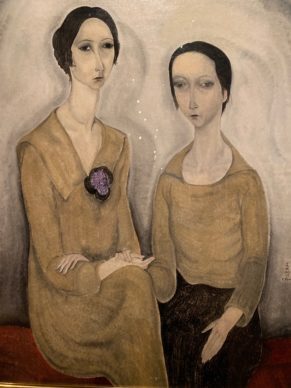
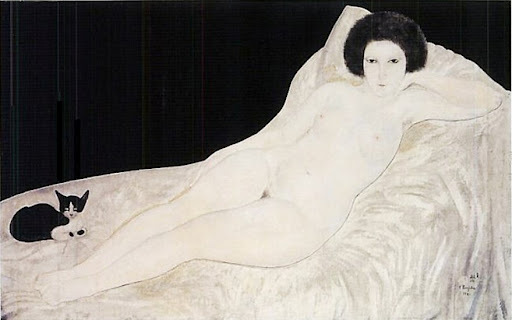
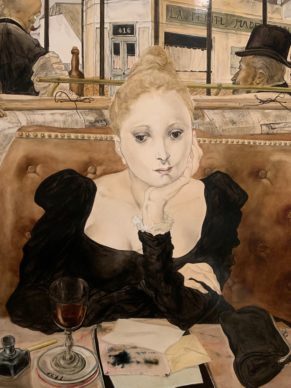
Art references visualise the contrasts in the personalities: while bohemian and flamboyant Betty, having run off to Paris, is compared to the women featuring in the paintings of Tsuguharu-Léonard Foujita, the docile, passive, dreamily romantic and soft-hearted Mimi is likened to Dante Gabriel Rossetti’s Beata Beatrix.
What Anne Stevenson writes about Jane Austen in her poem Re-Reading Jane could as well be said about the intricate panorama Brookner’s observant eyes convey in Family and friends: Yet the needlework from those needle eyes. On top, one might also hear some echoes from Sense and Sensibility in the characterisation of both sisters and their amorous adventures – however radically the tables might have turned since Austen’s time with regard to marriage and family morals. Don’t expect a life of exemplary morality, common sense and obedience to be rewarded by Anita Brookner.
He does not yet know that men who obey their mothers in everything rarely win the admiration of other women.
Brookner’s perceptive and flowing prose is lavishly larded with witty, mockingly stoic asides and observations. She gives the reader a sense of time-travelling to indefinite but unmistakably bygone time – without nostalgic yearning for the past.
Though it is apparently classified as a pretty atypical novel in her oeuvre, with Family and friends, I imagine Brooker might join those authors that I have been lately indulging myself with at least once a year when I am in the mood for a special treat (Patrick Modiano, Javier Marías, Antonio Tabucchi). I deplore the upsurge of bookish miserliness that overtook me the moment my eyes fell on this novel, modestly having only picked this one from a shelf amply provided with second hand copies of her novels. It comes across as a sin righteously punished since her books mostly have disappeared from the shelves of the local library to make room for more fashionable writers – and somehow I imagine her mischievously grinning at my mistake: if anything, one can learn from her books that petty virtues aren’t rewarded.
And there was always this suspicion, born when she sat at the piano in Mr Cariani's academy and heard Betty stamping away at her dancing, that the good live unhappily ever after.
Even if Brookner herself is pouring glasses of Madeira for the Dorn family, the fact that I saw Brookner’s writing compared to a bone-dry sherry makes me consider to give that brew another try, despite not liking it much on previous occasions.
Set from the 1920's through post WWII, the history is the mere whisper of a backdrop in Anita Brookner's novel Family and Friends. Her focus is on the Dorn family, not on external events which seem to have little impact on the Dorns other than through some secondary characters.
Brookner is an artful writer. Her narrator seems dispassionate and disassociated from the characters. Yet with very little dialogue and a lot of narration Brookner creates a vivid portrait of each. How does she do that? Alas, despite the sharpness of their portrayal I never feel connected to any of these characters, which is almost essential for me to love a novel.
These characters seem static; they don't evolve or grow. I am not clear on Brookner's intention here. Ebba, my buddy reader, feels this is like a "Gedankenexperiment" of unbalanced extremes. Two of Sofka's children are polite and restrained and do what is expected of them. Two are spirited and rebellious and do not follow familial expectations.
The themes of Family and Friends include: the idea that romantic love isn't always possible, and that ultimately it may not be what one thinks it will be; the roles of members of a family and their responsibility for and their accountability to each other; and one's role in society. Most of all, this novel seems to express the loss of youthful promise, energy, and innocence--were these lives lived or wasted?
I appreciate Brookner's prose and some of the thoughts she brings forward in this novel. And I left this world not completely satisfied.
One more thought, the epigraph for this novel:
"There is much to be said for the advantage of rules and regulations, much the same thing as can be said in praise of middle-class society--he who sticks to them will never produce anything that is bad or in poor taste, just as he who lets himself be molded by law, order and prosperity will never become an intolerable neighbor or a striking scoundrel. On the other hand . . . rules and regulations ruin our true appreciation of nature and our powers to express it." Goethe, The Sorrows of Young Werther, 1774
This struck me as quite different from the other Brookner novels that I have read (look at me, the latecomers, Providence, Brief Lives, Falling Slowly, a closed eye), a step in a different direction.
1. Instead of keeping close to one central character (two in the latecomers), Brookner has five main characters here, so although this book is on the longer side for a Brookner novel - it breaks the two hundred page barrier - we spend much less time on the page with any one of them
2. It follows then that this novel is far more sketchy than usual
3. The timespan of the novel is far longer, four of the characters beginning the novel as teenagers (the eldest might actually be in his early twenties) and it ends as they are middle aged. Generally a Brookner novel covers a period of less than a year, maybe a few months but with flashbacks or narrated memories
4. The narrator tells us that the main characters are Jewish
4a. My feeling is that this is implicit in her other novels as a factor in their sense of difference
4a1. I have no idea if this is typical for the British-Jewish experience, but my sense is that it was central to Brookner and something that she lovingly shared with the characters that she created
5. The significance of this is the "friends" part of the title, the Matriarch builds up a small community of Jews who are refugees from continental Europe
6. This novel is set much further back in time than other Brookner novels, maybe in the 1930s, even the end 1920s through the Second World War and into the 1950s at least. Normally a Brookner novel is set in a hazy period from the 1970s up to the date of publication, though the lucky reader might be able to tie it down occasionally a bit tighter than that
6a. The characters here could be the parents, grandparents, aunts or uncles of the typical Brookner character. This novel is like a journey up the family tree, and we see if not the origins, thenbearliers versions of the psychological traps, the longings and desires that will torment their more modern relatives
6b. They might also be Brookner's own ancestors or part of her family circle
7. It is much more expansive in space as well as time, in addition to London we see Paris, New York, Hollywood, and the environs of Nice
8. Generally in Brookner, places outside of London and certainly those outside of England, feel to be places of exile, or possibly the underworld (or perhaps the other world as in the Mabinogion). They are not places where 'normal' or 'real' life takes place, they are places apart. However here they are perfectly viable, though with a footnote that says that the two characters who live in foreign parts are in escape
9. The result of these differences was for me to excentuate what I think of as the flatness of Brookner's style, that you can visualise the novel as a series of pictures, an idea that is enhanced by the narrator refering to wedding photos as though the narrator was turning the pages of a photo album telling us about each picture in turn. On the whole this flatness is offset by the intimacy that we build up with the main character, but here we flit from character to character, emotionally I found this far less intense than any other Brookner novel that I have read
10. This visualisation can be misleading, which means that I misled myself through my own narrative expectations. I assumed that Frederick and Betty would settle into a Rake's progress a la Hogarth, but no. Their lives are self- indulgent but moderate. At points I thought they were escaping from family and the roles laid out for them by their mother. Then again they seem on the whole to have conformed to those roles, just not quite as their mother expected. Regression to the mean?
11. He will always think of the essential Evie as bare-legged, her feet in broken savates, her nightgown slightly soiled with milk, yawning and stretching in the early morning, and, half asleep, going to the dressing room to feed the babies. Frederick, with the finely attuned senses of a man who has always loved women, finds this scene ravishing, voluptuous. Evie, who never really worried, knows she will not lose him now. (pp 150-151). Ok, this is Frederick, the eldest son. For me this is an example of Brookner's visual style. He looks at his wife, drinks in the moment as we might look at a painting in a gallery. And I think she looks at him, looking at her, also reads him like a painting. Or maybe just feels his eyes on her and understands the meaning of that image. This for me is the rich flatness of Brookner as a writer, the oily wealth of the surface, the visual intelligence of the eye
11a. We have an image too for the younger sister, Betty, of her six weeks or so of cat mornings in Paris, echoed by her later days by a pool in Beverly Hills, but they are a copy of her Paris mornings
11b. The elder sister, Mimi, and the Matriarch, Sofka, both seem to be less generously treated, maybe the images didn't strike me as hard, maybe it is important that Brookner in an interview said that she had wanted to have four sons - all that masculinity inside her that she wanted to express, if I can indulge myself in a bit of saturday morning Jungianism
11c. Alfred, the younger son, and I think the youngest child struck me as the most richly drawn. By sixteen he is working in the family factory ( in a mangement capacity, it is a Dickensian reference, but not quite so extreme). His desires repressed to allow the self indulgence of the others. We see him carving the Sunday roast, at the head of the table i.e. performing the role of the Paterfamilias, such a graphic role reversal, an inverted lord of misrule, the youngest put in charge as a child obliged to be the diamond hard businessman. Suppressed desires expressed by longing for Dickensian feasts, which never satisfy him, his dream of runing through the woods with a pair of dogs towards home, his growing inner rage at having denied himself the life that two of his siblings lead for the sake of duty towards the family, which translates in to plain text as love and longing for his mother. Some fine and grotesque scenes illustrating this.
12. Character development is not Brookner's "thing", if a kind reader permits an inarticulate expression. For her the child is the father of the man , there is no escape from a quasi-genetic moulding, formation of the character which simply unfolds or blossoms through life so the programmed potential can be revealled. From a literary perspective this means that Brookner characters are like mechanical toys, they are wound up and let go, they march through the pages until the clockwork runs down. If you beed to believe in characters who change over time as in become different then avoid Anita Brookner! Her people instead simply become themselves more strongly over time, there is no escaping the imprint of early years and hereditary.
12a. This is strongly apparent in this book because it runs over such a long time period (by Brookner standards!)
13. Opens with citation from Goethe's Werther, after reading it feels apt, during reading an unclear reference, I thought also of his Wilhelm Meisters Lehrjahr, not that I have read it, but Rebecca West in Black Lamb and Grey Falcon discusses a scene from it - the bourgeois Wilhelm seeing the bedroom of an artistic character - messy, clothes everywhere, bed unmade - the way we see Betty luve in Paris. But also I thought of Goethe and his sister, sibling sacrifice is a theme here too.
This book puts to shame so many "Familienromane" that I've read. It's barely 200 pages long yet it contains worlds upon worlds, never rushed, never cliched, never cynical in its description of multi-generational struggle and trauma. It's so generous, so loving, yet crystal-clear and hard as nails. The best book I've read this year so far.
I loved this. It's only the second Brookner novel I've read, so I'm going to have to get some more. It's about a family: matriarch and four children living in London. In slow, studied language we learn about each character in turn and how they interact. Brookner's close observation of human nature is exemplary, especially the women - the subtle slights and double meanings. None of these characters are particularly nice, and not an awful lot happens. Betty and Frederick emirgrate, Mimi gets sadder, and Alfred angrier; everyone grows old. The stories of the family are interspersed with pauses over photographs at family weddings where we are invited to see how everyone has changed.
Cleverly, Brookner led me one way, and then shocked me with her penultimate line, which I just did not see coming. And then the final line of the book is so perfect: 'Let the dancing begin.'
Another find borrowed from my local library, this was my fifth Anita Brookner novel, and like Latecomers, it is one of her more enjoyable books. It tells the story of Sofka, a Jewish matriarch and widow with German origins, who has been in England since well before the Second World War, and her four very different children, from their childhood up to the immediate aftermath of Sofka's death.
The wilder ones, Frederick and Betty, allow Brookner's powers of comic observation plenty of scope, and as in many family stories the central character of each chapter changes, and to some extent the overall tone changes along with this.
The other two children are Alfred, the youngest, who rather reluctantly takes on running the family farm and remains unmarried, preferring flirtations with his married cousins, and Mimi, who seems to be heading for spinsterhood but eventually marries Alfred's faithful assistant Lautner.
I found this to be a true departure for Ms. Brookner and enjoyed it thoroughly. Each character was followed through his or her life (not only in interior life as is often Brookner's forte,) but with lifelong relationships with family members. It was an absorbing read.
A Compton-Burnett title and indeed style, with touches of Elizabeth Bowen. Following the lives of four very different siblings, using wedding photos as a hook for different times of their lives. Set around the war years (though not really concerned with it).
An engaging shortish character based novel about a well off Jewish family of five living in London before and after World War Two. Sofka, the mother, lives with her grown up children, Fredrick, Alfred, Mimi and Betty. They live comfortably off from the proceeds of their dead father’s manufacturing business.
Fredrick, the eldest, is a kind of lady’s man, with a congenial manner. Most people find Fredrick pleasant to be around. Fredrick is a good communicator, however he is very lazy. Betty, the youngest, is quite vivacious, moving to Paris to live the life of an actress / dancer. Mimi has a staid personality, acting very proper and is quite shy. Alfred is very responsible and hard working. He is rather dull and unexciting.
Sofka prefers Frederick and Betty, but they leave home before they are twenty. Sofka finds she becomes dependent on Alfred and Mimi.
”I find it entirely appropriate and indeed characteristic that Sofia should have named her sons after kings and emperors and her daughters as if they were characters in a musical comedy. Thus were their roles designated for them. The boys were to conquer, and the girls to flirt. If this implies something unfinished, as if the process were omnivorous but static, that too would be characteristic.”
This quiet, stately book opens with the description of a wedding photograph: a moment caught in time. The family matriarch “Sofka” (a nickname, used by everyone) appears to be the centre of the photograph, although the narrator later admits that “the bride and the groom were there all the time, in the centre, as they should be.” Still, Sofka appears to “have given birth to the entire brood.” Mother of four children - two girls and two boys - Sofka is the head of a vaguely European home, set in London. She rules her roost with quiet correctness, a devotion to good housekeeping and the ritual of the silver coffee tray and marzipan cake. Her ambitions as a mother center mostly around keeping her children close within the family circle.
I kept trying to date the book, but Brookner leaves only the tiniest trail of “period” breadcrumbs to follow. The description of a dress, a reference to the worsening situation in Europe or the war (but not which one) a moment of time in Paris, the development of film in Hollywood. I suspect the family are meant to be Jewish, although there are no references to religion or cultural traditions which could absolutely establish this. They are rich middle class - owners of a factory and clearly used to ancestral wealth - but the whole point is that they are meant to embody a way of life that exists slightly outside of time. (I think that the book takes place between the two world wars, because the Second World War surely sees off this way of life.)
Brookner begins and ends her narrative with the description of a wedding photograph, appropriately enough as the book is a family portrait. Nothing much happens, although the four children grow up and two of them leave their mother’s home. That rebellion is their one and only subversive act, but it is ultimately an empty gesture.
I kept wondering what the book was about, and where it would lead, and if the author had buried some surprises (like land mines) in the plot, but in the end it really is nothing but a portrait: beautifully drawn, yes, and atmospheric, but as strangely (and maybe deliberately) static as that photograph.
This is my 10th book of Anita Brookner that I have read now. She remains a favourite and unique even after ten books. Such is her charm and hold over me. In this 1985-novel, we follow a seemingly normal family in England who are coming to terms with life's multiple celebrations and discolour. There is Sofka, the matriarch who has brought up her four children when her husband died all too early. She wants the best for all her children and sees nothing beyond their well-being; the fact that they marry well, and have enough to outlast them. Frederick, the elder son runs the family business but is taken by too many women and hates the work itself. He is looking for the right lady who would appeal his mother and give him a reason to be grateful to life. Mimi, the elder daughter is sentient of life's change. She likes being home, attending to her family, and becoming a display case for the family's honor. Alfred, the younger son is forced into the family business when his brother resigns to love and marriage. Alfred loved to read but now he is made to work while the girl he liked as a c hild is setting home with another man. Betty, the youngest daughter is unlike any one of them. She is aspirational both for beauty and ambitions. She flies far away from the uncomfortable nest to make a home and name for herself. As time passes and the family reconciles with their idea of who they are and who these blood-kins are, a story emerges and roots deep into the reader's mind. This book reminded me a lot of her 1988-novel Latecomers which is one of my favourite books of hers. It has the emotional tenacity to whip you asunder and yet all of it is an exercise in restraint. Brookner's prose is not forceful. It has the unique quality of a movement, a bubble, a tiny pump until it springs forth. But this springing forth only happens in the reader's mind. Her carefully crafted writing makes deep cut without making the reader aware of the wound. The blood simply appears and you wait for it heal. But there is no healing from the grief and heartbreak of what a family causes. I grew in this grief. I felt honoured to read it as I feel with every book of hers that I read. Merry Christmas, my dear Brookner.
In short, it's the portrait of a family. The novel is punctuated by a series of wedding photos, interspersed throughout. (That's an awkward sentence, but I'm a little sleep deprived!)
Above all, this is an introspective novel. There's an airy detachment to the narrative and the breezy pace took some getting used to. Yes, Brookner's writing tells more than it shows. But there's so much insight in the telling, it had my rapt attention. Like leaves on the wind, true poetry emerges.
Anita Brookner is a writer i’ve been dully aware of for some time now, but not from any real reputation. The only sense of her I really have is from seeing her books often in second hand stores, or constantly on offer for kindle. I guess from this I had a maybe slightly lowered opinion of the kind of writer she might be, informed only by this ready access to so many of her novels. An author often discarded doesn’t always inspire confidence in their abilities. But oh, to be wrong, sometimes is such a wonderful feeling, and ‘Family and Friends’ quickly and with relative ease, cemented itself as one of my favourite books I’ve read this year.
Telling the story of matriarch Sofia and her four children, this novel is both as good as and better than so many other generational family stories I’ve read, plenty of those more famous and considerably longer. Not only does ‘Family and Friends’ exceed so many of them, it does it in a fraction of the page count. While the book is certainly this great branching familial tale, it can not only feel as grand as this, but so much smaller too, perfecting both focus and scope. It often comes across as an intensely clever and focussed set of character studies, carefully woven together. All at once unique and individual and yet inextricable from each other. As you read about each, it’s impossible not to become so absorbed that they feel like the only person in the world, then we move to the next and yet the feeling persists. Then Brookner zooms the lens out to catch each and throw them against each other again and again. The result is a wonderfully vivid portrait of a whole family of such distinguishable individuals as ever was. Perfectly in sync, perfectly contradictory.
I also didn’t expect just how beautifully written this would be. Clear and concise and confrontational, with the most devastatingly insightful observations making up both the core of the book and the most throwaway lines that stunned and stopped me over and over again. The writing was equally beautiful and believable, never too much or too little. Hard truths wrapped in stunning prose to make them hurt so good.
Another quality I really loved was the ongoing motif of framing different stages in their lives through these wedding photographs. This was a lovely little thread to tie through the entire novel, one of those small details that is not strictly necessary to the story being told, but suffuses the entire novel with a more cohesive, more measured and more unique quality. So simple, but added so much to make the book feel fuller than its sub-200 page length. I also really liked the ending itself. It’s always hard to end books that span long periods of multiple characters’ lives and ‘Family and Friends’ concluded just enough to feel satisfying, but left the story otherwise largely open and incomplete, as only feels right when it comes to any life not yet done.
So I don’t know why Anita Brookner seems to fill the second hand book shops I seem to go into, but I can assure you that she won’t any longer. I’ll be righting this wrong by buying any and all I see from now on and hoping they’re all as good as ‘Family and Friends’. I’d take even half as good - that would still be beyond exceptional.
Family and Friends opens with a wedding photograph, a group of family and friends in the 1920s, Sophia Dorn – always called by the diminutive Sofka – her eldest son; Frederick, the pride and joy, her daughters; Mimi and Betty all in white, while Alfred the youngest and favourite sat crossed legged at the front with assorted other children. This wedding photo and the ones which follow later in the novel form a frame for telling the stories of these family members and their hangers on. The final photograph coming on the last page – it is the last one in the album we are told by the unnamed narrator.
“At the wedding they will dance, husbands with wives, fathers with daughters. Under watchful gazes the young people will flirt, amazed that no one is stopping them. The music will become slower, sweeter, as the evening wears on. The children will be flushed, glassy-eyed with tiredness, their beauty extraordinary, as if it were painted. On the gilt chairs the elders will sit and talk. Reflecting on the following day, Sofka will judge the event a success.”
The family live in Bryanston Square, London, Frederick at only twenty-one is at the helm of the family business started by Sofka’s late husband. Alfred is just sixteen, but expected upon leaving school to enter into the business, learn it all from Frederick and the faithful Lautner who has been there since the beginning and without whom the firm wouldn’t be as successful. Mireille and Babette (Mimi and Betty) are the pretty daughters, whose job it is to flirt while the boys go out and conquer. However, Frederick already has itchy feet – eager to escape the confines of the business and leave it in the hands of his little brother. Frederick meets Eva, of whom Sofka is immediately suspicious – rightly so as it turns out, for it isn’t long before Evie (as she prefers to be called) has spirited Frederick away to Italy to help run a family hotel. Alfred, much to his frustration is left to run the business, any hope of freedom slipping daily away. His adult life (still only sixteen) starts as it will continue, living with his mother and sisters, spending his days at the family business, which he discusses with Lautner each Sunday evening in Sofka’s drawing room where she serves her famous marzipan cake.
When I started this book, I have to admit that I didn’t like it much; while I didn’t actively dislike any of the characters, I found them somewhat annoying. Then it occurred to me that this is what a family is, a bunch of slightly annoying people related by blood; as much as you may love them and would fight to the death to protect them, they can get on your nerves in a way which would seem petty to mention but exists on a low level, even in later years. Twenty years down the line, are you going to mention that your sibling always borrowed without asking? Or that while one side of a shared bedroom was impeccably neat while the other side looked like a tornado had hit it? Or that one sibling always had to be the center of attention, to the point of openly flirting with the other’s love interest? Probably not but it’s there, deep down, especially because these character traits are so ingrained as to be impossible to overlook.
This is a sort of old-fashioned comedy of manners involving two brothers, two sisters, a mother and the family friend/employee who all but runs the family business for them after the father’s death. There is the older brother who exists on charm (and the mother who would deny that she favored him but who’s an accomplice in his schemes because he reminds her so much of that rascal she married), and the younger brother who’s a bit humorless and takes the reins of the family because someone has to. And there’s the older sister who’s so egocentric that she can’t imagine anyone not being focused on her, to the point of resenting anyone preferring her withdrawn self-sacrificing younger sister who avoids risking herself at all costs. These characters may not exist wholly in your family or mine but the dynamic can be very recognizable as all families generally have some fragile balance that its members understand and maintain over the years.
The family is based in England before, during and after the Second World War but this barely touches the story except when the mother is visited by an acquaintance who’s a war refugee. (It’s also never stated openly that the mother is originally from one of those war-torn countries but it’s implied; the same as it’s never mentioned that the family is Jewish until the ending reveals it indirectly.) As each of the siblings grow older, their lives expand to other countries; in this case, their different personalities lead them down different paths, not always to their own personal satisfaction, but true to who they are.
This book grew on me because it was not only true to what a family is but it was true to its characters. As in many books of this type, you can become attached to the different personalities, in the same way you’re attached to your own family and friends, and feel a part of them, their failures and successes. There is nothing in this book that can possibly offend but a lot to make you smile. I hope to read Anita Brookner’s Booker Prize winner, “Hotel du Lac” soon – it’s been sitting on my shelf and staring at me for a while now – with the expectation that it will be equally charming.
Since I finished reading this book (rereading, on second thoughts), I have started to rack my brains to discover why certain family stories are so memorable and others are swallowed up by the black hole of forgetting more or less immediately. This tale, the chronicle of a Jewish matriarch and her children definitely belongs in the former category and is not easily forgotten - the psyche of the characters is subtly delineated, which draws the readers in and enables them to identify with all the protagonists despite their lack of resemblance to each other. Although this is not the work that won Ms Brookner the Booker Prize, it could well be considered her best.
Central to this novel – Brookner’s fifth – are the Dorns, a wealthy Jewish family living in London during the first half of the 20th century. It’s a quiet, character-driven book, rather European in style – an approach that reflects the family’s origins and mitteleuropean traditions. It also represents something a break from Brookner’s previous novels, each of which featured a lonely unmarried woman at its heart. A widening of scope, so to speak, building on some of the supporting themes from the earlier Providence.
Head of the family is Sofka, a stately matriarch beholden to traditional rituals, a practice typified by her celebrated marzipan cake, usually served with coffee on a Sunday afternoon. Sofka’s husband is no longer alive – a flirtatious man who engaged in various dalliances (and possibly some excessive gambling) prior to his early death several years before.
Frederick is the eldest of Sofka’s children – a natural boulevardier who prefers the captivating company of women to the dull environment of business. It’s a temperament that his mother encourages, reminiscent as it is of her late husband’s salacious charm. At sixteen, young Alfred is already destined to spend the best part of his life managing the family firm; his serious, bookish nature marking him out as the dutiful one, despite any other, more personal aspirations he may be harbouring. Aiding Alfred in this respect is Lautner, the faithful right-hand-man and longstanding employee at the factory; his knowledge and experience prove indispensable at first, although Alfred soon supersedes him in standing.
Completing the family are Sofka’s daughters, Mimi and Betty, who couldn’t be more different from one another if they tried. At seventeen, Mimi is the prettier of the two girls, but she is also the more passive in temperament, favouring the piano over more sociable pursuits. Betty, on the other hand, has her sights set on Paris, preferably as a dancer in the Folies Bergère, a role where she can put her high-spirited, flirtatious nature to evident good use.
I find it entirely appropriate and indeed characteristic that Sofka should have named her sons after kings and emperors and her daughters as if they were characters in a musical comedy. Thus were their roles designated for them. The boys were to conquer, and the girls to flirt. (p. 10)
Brookner says that Family and Friends is “the only one of my books I truly like.”
Beginning with a wedding photograph, this story charts the loves and lives of a rich widow and her four children - the rakish Frederick, the reticent Mimi, the adventuress Betty and the pure and serious Alfred - living in London and their friends, following each of them through their own struggles, triumphs and sorrows. Anita Brookner is a social spectator who watches her characters and tells us nearly every detail of them and yet somehow manages to skirt over major issues, like the fact that the book runs concurrent with the Second World War and that the family are Jews. Despite its period setting a very relevant book.
The lack of action will bother some readers. Although photographs don’t appear as much as I expected it’s almost as if every chapter is a snapshot that is explained to us. Brookner argues that an absence of action can actually lend drama to a text. Delays, especially when repeated, can be the “stuff of nightmare,” that which make a situation Kafkaesque. […] What does not happen underscores what does thereby making momentous even the most seemingly unmomentous scene.
I enjoyed the book and would have no problems reading her again.
I've read that Brookner essentially wrote the same book over and over, and after reading A Start In Life (a.k.a. The Debut) and this one, I see the point. I loved A Start In Life, and was quite taken with the main character, whereas I found this novel a cooler, less captivating read, though I still liked it a great deal. Both books are quite well-written. In both there are similar themes: emotional stuntedness within intense yet neglectful family crucibles; a red-haired spinster daughter's dashed dreams and thwarted growth; grief and loss; psychologically sophisticated thinking about characters full of confusion and ambivalence. The present tense omniscient narration in Family and Friends provides cynical detachment and sharp commentary that only heightens the sense of lost chances and emptiness. Overall an effective, sad book.
Very atmospheric and impressionist. I could feel the materials, smell the scents and taste the food. The characters were all marvellously sketched (it is a short novel) and developed. Told as a series of visions brought on whilst thumbing through an old photograph album it took us through England, Paris, Nice, New York and California. Lovely!
4.5* A wonderful exploration of humans and families and how faulty we are. I have more questions than answers but that’s how life works, don’t you agree?
Before book club I thought of this as a book with little plot but excellent characters, after book club I realize it is a book with little plot, but tons of things happened, and excellent characters. I would definitely like to read more Anita Brookner.
Family and Friends is a study of a family - matriarch Sofka Dorn, and her four children. Unlike many of Brookner's other books, I did not find the character studies here overly convincing. Something about the narrative, and the following of five different characters in quite a brief novel, made the whole feel quite detached, and I was unable to immerse myself within its pages quite as fully as I have with the likes of Look at Me and Leaving Home. Family and Friends is rather a light read, and whilst it is filled with familial dramas, not a great deal happens. The structure, which followed wedding photographs in an album, and then told the stories of individuals involved, was simple and did work well, but I feel that more could have been made of these connections. Family and Friends is probably my least favourite Brookner to date.
This was lovely. I love Anita Brookner's style--it's rather boring, really, and yet the boringness is part of the storytelling method, so it's pleasing. She seems to use her style to say about the story, "Things happen, things change, but it never really feels very big or grand, does it?" I like that she never once uses the word Jewish or Holocaust, because the characters themselves would scarcely allude to their own Judaism.
For such a chilly writer, she manages to make me cry at the end of all of her books. This time, I was moved by the very subtle suggestion that the matriarch had been doing her part here and there to help others escape Germany or Austria or Hungary, or wherever the hell she was supposed to be from.
Un po' sotto tono per gli standard della Brookner, forse perché contrariamente al suo solito questa è una specie di saga familiare (normalmente i romanzi della Brookner si concentrano in modo ossessivo sulla protagonista).
La famiglia Dorn è di origine tedesca ed ebraica (credo, e dico credo perché questo romanzo è davvero sottile, e temo di averlo letto con poca attenzione e di non aver colto tutti i dettagli). La matriarca è Sophia (Sofka), vedova, con quattro figli, due maschi e due femmine, con caratteri molto diversi fra loro le cui vite vengono analizzate in modo puntiglioso ma allo stesso tempo vago.
Compito del lettore leggere fra le righe e scavare le tristezze dei protagonisti.
I really appreciated this book and find it truly surprising. This is the portrait of a family that covers, in a short book, several decades of the characters's life. It could have stay frustratingly on the surface, but on the contrary, it goes really in debt. In fact, the author concentrated on the psychological aspect of the characters and their evolution over time instead of on a classical narrative, wich make for a really original story and style that isn't like anything else I remember reading.