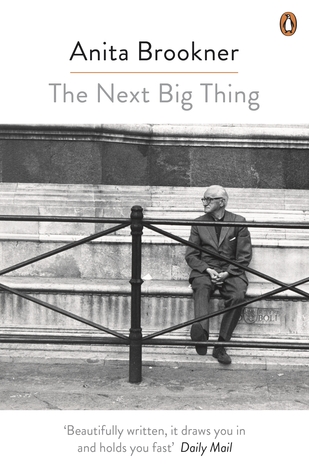
'Herz wondered if the people he passed on the street ruminated on lost causes, as he did. Try as he might to divert himself, he could never escape the suspicion that he should be elsewhere.' Herz is seventy-three and facing the difficult what is he going to do with the rest of his life? How is it all going to end? He could propose marriage to an old friend he hasn't seen for thirty years; he could travel, he could make a trip to Paris to see a favourite painting; he could sell his flat, move, start afresh. He must do something with the time left - but what? Anita Brookner's masterpiece - the ultimate comedy about what it really means to be old.
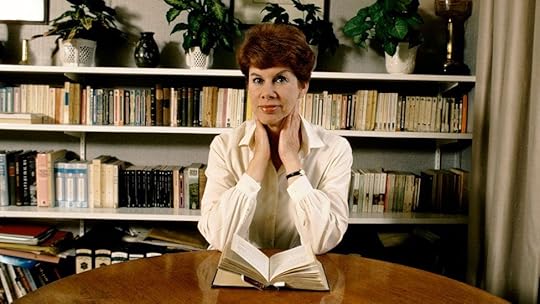
Anita Brookner published her first novel, A Start In Life in 1981. Her most notable novel, her fourth, Hotel du Lac won the Man Booker Prize in 1984. Her novel, The Next Big Thing was longlisted (alongside John Banville's, Shroud) in 2002 for the Man Booker Prize. She published more than 25 works of fiction, notably: Strangers (2009) shortlisted for the James Tait Black Memorial Prize, Fraud (1992) and, The Rules of Engagement (2003). She was also the first female to hold a Slade Professorship of Fine Arts at Cambridge University.
Anita Brookner is one of my favorite authors. This is my seventh book of hers that I have reviewed. New readers though should be aware that in her obituary (1928-2016) the New York Times called her stories “bleak.” But she is a powerful writer with brilliant psychological insight into human nature. Example: “It was their lives rather than their deaths that were regrettable…”
I’ll add this book to a couple of others I have read lately that I could call ‘retirement manuals.’ Not really, but this story gives you a good idea of the dilemma that many people face in retirement: what do I do with the rest of my life? The other two books I think of in this vein are Everyman by Philip Roth and My Father's Tears and Other Stories, a collection of short stories by John Updike.
All of Brookner’s characters are lonely. The main character, Herz, as she calls him by his last name, has no friends or family left, only ‘acquaintances’ like his lawyer, his ex-wife that he has lunch with 2 or 3 times a year, his landlord, a lady who runs a tailor shop below his apartment, a cleaning man, and a distant cousin.
Most of Brookner’s main characters are women, but this one is a man, although by the end of the book we know as much about a female cousin Herz has been in love with all his life as we know about him.
Both Herz and his cousin have spent their entire lives fulfilling ‘family expectations.’ Herz’s parents favored his musically inclined brother and had high hopes for the brother as a performing violinist. The brother’s career never takes off. His parents become ill and Herz spends his working years running his father’s musical instrument shop and caring for all three of his relations – the ‘making things better’ of the title.
Herz’s cousin spent her life serving her domineering mother. Her two husbands she never loved were picked by her mother because they would take the mother in as part of 'the package.' The young woman probably loved Herz too but her mother rejected him. Now her mother is dead – can she and Herz finally get together and find love as they approach their 70’s?
There is humor too in the story – bleak humor of the type that would entertain the Greeks gods who toy with us. (Shades of John Banville’s Infinities.) Like all of Brookner’s aging male characters, he is predestined to attempt one last fling with an attractive young woman. The gods have ordained it and we know this infatuation will lead to ‘an indiscretion’ and humiliation for him. The gods know it, we know it, the author tells us in advance, and Herz knows it too – he just can’t help himself.
Some of the good writing:
[Herz looks at an old photo of himself, a rare one of him smiling:] “Even the smile had become modified with age. The smiling boy had become a polite adult; the smile now had something dutiful about it as if it were expected of him; he would continue to offer it but without conviction. It was a smile that no longer expressed eagerness but was a suitable feature in his dealing with others. Preparing to listen, to sympathize, he would acknowledge the return of his habitual smile, while all the time registering his lack of joy.”
“…his brother, a failure who had found failure to be his proper element.”
“We are now very old and only one thing can happen to people of our age.”
“With only our own welfare to preoccupy us how could we not go wrong?”
“If you want to make God laugh tell Him your plans.”
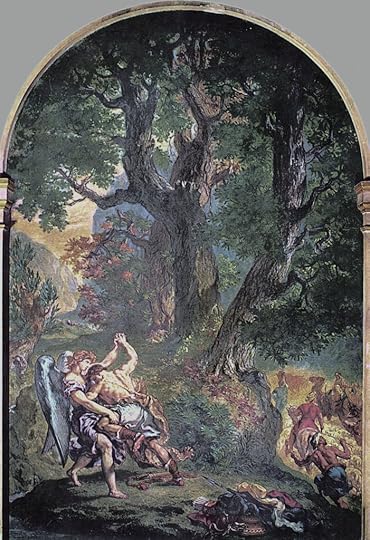
Brookner peppers the story with allusions to classical paintings where Herz, visiting galleries to burn time, puts himself into the mindset of figures in the paintings. (Such as the Delacroix painting shown here.) For her day job, Brookner was a professor of art history. It’s interesting that there are no references to music despite his brother’s role as a musician and Herz's lifelong work in a music shop. That was all ‘duty’ and Herz apparently had no real interest in music.
An excellent story with great writing and psychological depth, worth a ‘5.’
I’ve enjoyed many other novels by Anita Brookner and below are links to my reviews of them. The two I enjoyed most were Hotel du Lac and Making Things Better. (I gave those two novels a rating of 5; all the others, 4.)
Anita Brookner was undoubtedly a talented writer but, like her Booker winner Hotel du Lac, this is not an easy book to love. As part of The Mookse and the Gripes group's project to re-read the 2002 Booker shortlist, I have decided to read a few of the longlisted books too to help put the shortlist into context.
This one could be read as a very bleak character study, but it has moments of humour and eventually a partial redemption so it seems fairer to view it as a tragicomedy, rather like Bernice Rubens' A Five Year Sentence if a little less savage.
The central character Julius Herz is a lonely 73-year old living alone in a London flat. He has spent most of his life serving his parents and his brother, whose early potential as a musician gave way to illness. He is still in the shadow of his parents, with whom he fled Berlin to escape the Nazis, and their mysterious benefactor who housed and employed them in London before retiring to Spain, selling the shop where Herz is employed but giving him enough money to be settled reasonably comfortably. He has a practical ex-wife who he sees for occasional dinners, and he still harks back to a youthful infatuation with his cousin Fanny, who he has not seen for 30 years since a failed marriage proposal. His only other regular meetings are with his solicitor and a rather ineffectual cleaner.
The plot centres on Herz's rather desperate attempts to find meaning in his increasingly limited life, and much of the humour is derived from his misreadings of various social situations. Things get more complicated halfway through the book when Fanny writes to him seeking his help.
Brookner writes lavish and often convoluted sentences, using obscure vocabulary with great precision (for example the word inanition appears three times), but I sensed the sentences became shorter and more focused as the book moved inexorably towards its conclusion.
Who really wants to read Anita Brookner's repellently accurate novels about the intricacies of loneliness? I'm sure this isn't a question that troubles the Booker Prize-winning author, who's managed to publish a book a year since 1981. But a critic confronting her 21st novel has to wonder if readers want to subject themselves to Brookner's searing insight. Indeed, Making Things Better is a sort of literary toothache, an all-absorbing pain that brings thoughts into unwelcome clarity.
At 73, Julius Hertz is a survivor. He escaped the Nazis as a child, but as an adult, he endured rather than fled his claustrophobic family, a decision -- or lack of decision -- that essentially cost him his life. Now he's finally outlived all the needy people who consumed him: His parents, whom he cared for even as they destroyed his marriage, are dead; his mentally ill brother, who stole all the family's attention and enthusiasm, has passed away; and his only employer has left him a comfortable retirement.
These were to be his golden years, but "at heart he was still a young man, a boy, even, to whom adulthood had come as a surprise and had never ceased to be a burden."
Freed from the problems of supporting himself or anyone else, he rises to meet each boring day "of his present existence in which nothing happened nor could be expected to happen." And so he spends his life getting the paper, eating a bowl of soup, and "hoping to catch life on the wing, and to make himself into a semblance of gentlemanly old age which others might find acceptable."
It's not an accident that Random House has released this novel about a nearly dead man in the nearly dead weeks of January. Earlier this year, it appeared in England under a slightly more bitter title -- The Next Big Thing -- where it received tepidly appreciative reviews from apologetic critics. Even assuming that older people read more than younger people, how many of the 65 million Americans over 65 will want to subject themselves to the alarmingly still story of Julius's final years? And how many of the rest of us have the courage to confront Brookner's warnings about the challenges of retirement? Especially in the wake of our relief that the perky models on Friends have agreed to give us one more year.
But the reasons to pay attention to Anita Brookner grow no less compelling. First, she's one of the great English stylists, an artist of such extraordinary precision that her novels serve as an antidote to the overwritten tomes from so many contemporary writers.
Second, in a literary marketplace excited by the bizarre, she remains committed to the mundane. No, she can't tell us about a hermaphrodite whose grandparents were siblings -- for advice in that situation you must go to Jeffrey Eugenides's widely praised Middlesex -- but if you're considering the somewhat more common predicament of getting older, Brookner is as wise a guide as you'll find.
For Julius, the challenge is not so much the burden of age but the burden of believing that he must always make things better for others. A lifetime of self-sacrifice and excessive obedience has yielded him none of the satisfaction promised by religious creeds.
He feels "as if he were one of those victims in the French Revolution who were tied to a dead body and thrown into the river to drown." Trapped between thoughts of grotesque self-pity or embarrassing himself in an adolescent search for new friends, Julius suffers a "delicate sadness," which his distracted young doctor hopes to correct with blood pressure medication.
A chorus of acquaintances offers advice: His cordial ex-wife admonishes him to cheer up, his lawyer suggests travel, his distractingly beautiful neighbor tells him to stop staring. But none of these courses can solve the problem of learning how to live with an abundance of unaccustomed freedom. "Keeping one's dignity," he admits, "is a lonely business. And how one longs to let it go."
Of course, there's something ruefully comic about a man who thinks of himself in a "posthumous condition," but what laughter Brookner inspires sounds like whistling past the graveyard. It's clear she has no intention of soothing our anxieties with some deathbed conversion to happiness.
Indeed, when an old cousin writes to Julius for assistance, presuming on his devotion which she cruelly brushed aside many decades before, he finally earns a degree of self-knowledge that's harrowingly profound: "His will had been at the service of others, to use as they thought fit, and in allowing this, in the fallacious enterprise of making things better, he had surrendered that part of himself that others could not and would not supply, and in so doing had forgone his right to respect."
This is bitter medicine for sure, but Brookner draws a portrait of despair so perfectly that it might serve a homeopathic purpose for anyone in or slipping toward "a pale simulacrum of life." Only a writer of her astonishing wit and insight could get us to swallow it.
The Next Big Thing (2002) is known as Making Things Better in the USA. Both titles are very apt.
At 73 years old, Julius Herz reflects on his unfulfilled life. His situation is mainly a result of having conformed to the expectations of his family and sacrificed his own needs, hence Making Things Better (for others).
In the final years of his life Julius sporadically believes that he may yet enjoy a satisfying finale by finding someone to share his life with and so looks forward to The Next Big Thing.
Julius ponders his personal history and how things have ended up as they have. His life has been spent pleasing others, adhering to the expectations of his family.
A change in circumstance brings his loneliness and lack of fulfilment to the fore as he ponders how to spend the rest of his life.
This is only the second novel I have read by Anita Brookner and both have dwelt upon loneliness, isolation, and alienation. Despite these themes Brookner manages to endow her characters with insight and dignity, and create engrossing and perceptive studies of the human condition.
There’s so much in The Next Big Thing to ponder: art, the holocaust, love, loneliness, expectation, the inner life, perception, and memory.
I'm looking forward to reading more novels by Anita Brookner.
'This would soon be a new day, all too closely resembling the others, the normal days of his present existence, in which nothing happened nor could be expected to happen'
At seventy-three Herz is facing an increasingly bewildering world. He cannot see his place in it or even work out what to do with his final years. Questions and misunderstandings haunt Herz like old ghosts. Should he travel, sell his flat, or propose marriage to an old friend he has not seen in thirty years? Herz believes that he must do something, only he doesn't know what this next big thing in life should be . . . 'Beautifully written, it draws you in and holds you fast' Daily Mail
While conditional clauses present an opportunity to display exquisite mastery of language and can lead to an appreciation of an author's innermost thought processes, interspersed as they are (in this and no doubt her other novels) with parenthetic clauses further separating subject - as it were - from object, the use or in this case, "overuse", of such techniques, coupled with the author's emotional and encyclopaedic attachment to words like "plangent" and "trenchant" that should be used sparingly at best (although to be fair I do not now, at this distance from my initial reading, recall if those words, per se, appeared in this particular novel), can lead to a state not unlike one that this reader in fact experienced - that is to say, weeping with frustration - at Brookner's apparent inability to write a sentence that did not, in its own convoluted way, form an entire paragraph of which it was the only member.
And while it is to be acknowledged that it is rather easy to parody her style by cutting and pasting phrases here and there within applications that permit misuse of such editing techniques, one is nevertheless left wondering whether, in Brookner's entire prolific and undoubtedly respected career, did she ever write - or even utter - a simple declarative grammatical construct such as "Put the kettle on, dear"?
I did not finish this book, although I did give it a good try, and I am not sure if I want to read any more of her work.
Herz is 73 and living a half-life alone in London. He thinks back to his stifled childhood with his formal parents and ill brother, to when he was married for a brief time, and to his German cousin Fanny whom he was once in love with and to whom he once proposed. Now, his days are only enlivened by tiny acts such as taking in some post for his neighbour, Sophie, which make him 'grateful that this event would give the day some shape'. For a time Herz becomes obsessed with Sophie and makes an error of judgement, when this passes he becomes fixated on Fanny after receiving a letter from her. He overthinks and worries without anything to fill his day except occasional lunches with his ex-wife, or solicitor (for which he is charged). He finally makes up his mind to visit Fanny, but then 'the next big thing' happens... It's a very introspect book, but Brookner's prose is wonderful as always. This is the third novel by her that I've read, and I am sure to read some more.
Ms. Brookner's books are endlessly fascinating and addicting. I've read apprx. 16 books by her in the last few months. No one, except perhaps for Charlotte Bronte's, Villette, - which is wickedly depressing and so very dark - does isolation, loneliness, alienation, despair as well as Brookner. However, the catch with Brookner is her psychological insights, her admiration for her characters and the glint of hope and promise beyond the loneliest most isolated one(s). Brookner's enormous vocabulary and insights do not make for a quick read, she makes you work quite a bit and who doesn't enjoy reading a novel or 16 with a dictionary at the ready?
This is typical Brookner--in another one of my reviews (Leaving Home) I wrote: So check, there's a quiet, unassuming girl and her reserved widowed mother. Check, there's a small but steady cash flow so the above don't need to work. Check, the location is in both London and Paris. Check, girl acts like a doormat. Yup, it's Brookner.
So change it to an older man vs. girl and the set-up is the same. An older, lonely man who's facing retirement and has no hobbies, family, friends or even interests. The usual ERE is here (Exercise--long walks, Reading, Eating with of course many cups of tea). The title comes from the man always "making things better" for his parents, brother, etc and being the ultimate doormat. For example, he visits his brother in a home every weekend, saving his parents from having to do it.
One thing I didn't understand was the arrangement between Hertz's family with their benefactor when they left Germany pre-WWII. The benefactor gave them a flat and the husband a job, but was there no other money? That would explain his generosity later as well as why Hertz didn't consider college...but why didn't he get a job elsewhere if he was only working for his lodging?
What's the plot line? Well,
I admit, I enjoy these Brookner novels to get a glimpse of how other older people handle their retirement. My motto when I'm 75 will probably be, "Well, I'm better off than a Brookner character!"
This is not a fly through it and enjoy it book. This is a book of contemplative prose in which a reader wants to haul the characters around by their shirt collars, all the while telling them in no uncertain terms that they are behaving in a way that they will regret deeply, feel great guilt for having done whatever it is they are doing, wish to pull back words, gestures, etc. In other words the reader wants them to listen to all the good advice which the reader has and continues to hear from all sides throughout their lifetimes -- even though the readers are fine, failed examples of humanity right along with these hapless characters. This book is a reminder to all who persrevere to the end -- of the book? Well, not exactly. But yes, that, too. Brookner is quite the writer. I recommend exploring her work.
The next big thing is most probably the loneliest thing—death. 73 year-old Julius Herz is filling his empty life with empty days. Divorced and easily frightened, he would rather read his old-fashioned Thomas Mann than interact socially, yet craves contact. To fill his days, he studies the past hoping to find a clue to his lonely present, he has quick (and regrettably hopeful) lunches with his ex-wife, and writes letters to an unfulfilled love. ▪️"That was why he was half contented, with his present solitude, recognising it as something merited, something that was his due, and moreover something that would not fail him." ▪️Brookner, in her final interview with The Telegraph said that her novels are to a certain extent about betrayal. "By this she meant not only the betrayal of trust and affections within a relationship, but a larger, unavoidable betrayal of life's promise." She continues to say that "the body gives you away. It lets you down. It betrays you...Age is the final betrayal." ▪️The Next Big Thing, Brookner's 21st novel, is loneliness under a microscope, splitting and multiplying. It is bleak, graceful, and strives to hold on to dignity until the next big thing comes around. #bringbackbrookner
Okay, I've read two Anita Brookners now (Undue Influence was the first and it was better subject matter than this one so I decided to give her another chance). I know AB has her devoted fans and there's no doubt she can write, in a very Proustian style in a modern setting, would be my description. HOWEVER, the subject matter of this novel, a man's tiny life at the end of his years, just about had me ready to scrape at my wrists with a blunt key. The sheer timidity to LIVE, nicety of manners and in depth analysis of every thought that passes through his mind: a psychological study and grand achievement, but as entertainment and a page-turner? Not for me. Maybe for you?
Julius Herz is in his 70s and divorced, leading a solitary life in his London flat, contemplating memories of his dead parents and the long-adored cousin who rejected his proposal of marriage many years earlier. He is becoming ever more conscious of the passage of time, and the need to decide what he should do next with his life.
Anita Brookner is an expert at creating a character-driven story, taking the reader ever deeper into the thoughts and emotions of her protagonist, and thereby exploring the loneliness, frustration and self-deception of life. Herz is trapped by the expectations of others, by the past and by his own fear of action, and we share his agonised attempts to move forward and embrace his freedom of choice.
Freedom is a theme which features prominently here, from the constraints of the immigrant experience to the choice of a partner or a way of life. Brookner links this with art, as Julius finds significance in certain paintings which reflect the aspects of life and memory that he is struggling with. This is a thoughtful, poignant, often bleak but always compelling character study.
Another delightful, engaging read about 73 year old Herz. Herz was married for 3 years and continues to communicate with his ex wife on an occasional basis. The story focuses on Herz's loneliness and his current life. He sees very few people, spending a lot of his time walking, sitting in parks, going to galleries. Herz fills in the major events in his life when he reminiscences. Fanny was a childhood sweetheart. Herz's mothers sisters daughter. He had proposed marriage to Fanny after her first husband died, but she declined. A gentle read. In some ways, similar to Brookner's last novel, Strangers.
How I wish Brookner were around to write some more. Her books do have consistent themes as remarked here by many reviewers, but no one else writes about those themes quite as well as she. This is my second reading of Making Things Better. In some ways MTB is my least favorite of Brookner's works, and yet Julius Herz is a favorite character. He is almost too wise and emotionally intelligent (based on his internal narrative) to be in this place of almost no engagement. The writer leaves us an opening in the ending. Ignoring the ghost of a smile and exertion of his last strength, I've decided to see him get on the plane.
In detailed inner dialogues, Julius Herz examines memories of his 73 years and gains insights into how he ended up alone at the end of an unfulfilled life. He has spent his life observing the rules and attempting always to do what was expected of him from the people in his life. His loneliness is palpable as he now attempts to connect with people and somehow alleviate his anxieties about how to spend the rest of his life. The prose is exquisite in this typical Brookner novel.
Do not be disuaded by the rather jaunty title of this novel. When you are 73, alone, suffering from Durkheimian anomie, and plagued by Freudian dreams and ideas, not to mention a "dicky heart," the next best thing limits one's possibilities, whether the narrator is ready to recognize it or not. Brooker, a distinguished art historian, former Cambridge professor, Booker-winning novelist (noted for her refined style and her depiction of women facing issues of isolation, emotional distress, and disappointment) offers a volume that is even more autobiographical than her previous work, despite the fact that the protagonist is a man, Julian Herz. Not only do Herz/Brookner share personality traits, including being aliens within English society, but their ages are also virtually the same (at the time of composition).
For reasons known only to the American publishers of this work, it is titled here as MAKING THINGS BETTER, more ironic, but less appropriate to the novel's intent. Julius, who devoted his life to assisting his parents and his brother while assuming a job as shopkeeper for Ostrovski, his mysterious boss and patron is forced to relocate when his "benefactor" sells the business and flat that has been his world. Relocated in another part of London, with modest funds, Julius attempts to reconsider his life and what his future might be. He remembers his failed marriage to Josie, for whom he still feels affection, but who has become increasing distant despite their carefully-arranged luncheon meetings. He has no friends, only acquaintances to whom he offers a friendly wave or a smile. He does remember (with bittersweet regret) the arrogant Fanny, a cousin, he pursued in his faint-hearted way before she found more prosperous suitors to indulge her selfish whims. He attempts to reconnect with her only to be again rebuffed until her financial circumstances cause her to reconsider. Julius realizes who she is and writes (on two occasion) letters redefining their relationship...only to destroy them and indicate that he will submit to her wishes when they meet again. Like Stevens, in Ishiguro's THE REMAINS OF THE DAY, the reader is quite aware of Julius's position as Brookner vividly portrays the odd mixture of his self-knowledge and self-delusion. Is the prearranged reaquaintance with Fanny to be the next big thing in Julius's life or has time run out?
This is a thoughtful and reflective study of what familial obedience, willingness to assume responsibility, and respectablity (without being respected) can mean in forfeiting a life that might have had grander possibilities. Unlike some of Brookner's other novels, resignation is not Julius's pathetic fate. Has he, however, waited too long to make his life meaningful? This is the ethical question posed and one that the author leaves to the reader to determine in this very subtle and perceptive book.
The only real problem I had with this book is with the ending. In his review Thomas Hogglestock called it, “a little high school” and I have to agree with him. Like him I saw it coming about halfway through the novel but in her defence it was probably the right ending; sometimes things do turn out the way you expect them to. In a review on Amazon Ralph Blumenau happens to mention that the dustjacket of his copy promotes this is her “funniest novel to date”. Like him I think this as a very strange thing for a publisher to do. Yes, the book has its humorous moments but Tom Shape she is not.
You can read an extract from the book here and you can read my full review on my blog.
This seemed to me something of an updated version of Edith Wharton's House of Mirth, but with a male lead character. Herz had devoted his life to carrying out his obligations to his family members, and finds himself alone and lonely. He attempts to reconnect with a female cousin for whom he once had strong romantic feelings. Meanwhile, his carefully constructed life alone is feeling encroachment from all sides--the shop owner who owns the space below his apartment has sold out to another shop. Everything is changing; how will he navigate these changes?
Herz is isolated from society. He is very proper and does not wish to do anything to draw allegations of impropriety. But he is lonely, so lonely.
Brookner's writing is lovely, her sentences and paragraphs beautifully crafted, but the story she tells is very bleak.
well, wasn't sure whether to give it 3 or 4 stars as it is a book I have grown to love more since I've finished it! It is a brilliant evocation of loneliness in an extremely socially isolated man elderly who lived with his dysfunctional family after leaving Germany in the 30's and is then left on his own but is financially secure thanks to his benefactor. the detail of his days, the descriptions of London and his attempts to fill his days are wonderful and the end, in a way, shows how seizing life is so worth it but may come at a huge cost. I think it is possibly too long and it's not exactly a good read in that it's not enjoyable reading but on balance I think it is a remarkable book
This one surprised me. I'm a fair weather fan of books that highlight life regrets so obviously. But Anita Bookner nailed it, and quite poetically, too. Don't we all have regrets in life that we wish we could write about? That we could reflect upon later in life? I enjoyed the analytical rants (and yes, some of them are lengthy) she shares because don't we all over analyze the things we wish we could change? Well done.
2002 Author 1928 – 2016. Born to Polish Jews US title: Making Things Better [as a title, certainly more accessible!] Wiki: 'Brookner (Bruckner) was born in London. She was the only child of Newson Bruckner, a Jewish immigrant from Piotrków Trybunalski in Poland, and Maude Schiska, a singer whose grandfather had emigrated from Warsaw, Poland, and founded a tobacco factory at which her husband worked after arriving in Britain aged 18. Her mother gave up her singing career when she married and, according to her daughter, was unhappy for the rest of her life. Maude changed the family's surname to Brookner because of anti-German sentiment in Britain. Anita Brookner had a lonely childhood, although her grandmother and uncle lived with the family, and her parents, secular Jews, opened their house to Jewish refugees fleeing the Germans during the 1930s and World War II. "I have said that I am one of the loneliest women in London" she said in her Paris Review interview. ...Brookner never married, but took care of her parents as they aged.'
The first time I read the book: After the half-dozen Brookner's books I have read, this one I expected to like more than I did. At many points I wearied of the main character's depressing view of himself and his life. Go out and find some friends!!, I keep wanting to yell at him [he is said to be age 74, about the author's own age on publication]. The second time around, I was yelling at him, Go do volunteer work! Go join a book club! Plenty of ways to be around other people.
Grabbed this off the shelf, not knowing whether I had already read it, thinking probably I had, yet I in fact didn't remember the story at all. It did keep me turning pages, while at some points it feels so heavy and intense and you know/feel it is not going to get any better at all. Brookner does a great job of getting inside Herz's head. There we learn quite a lot about his childhood, all very sad, yet realistic, at least convincing to me.
Copying over these quotations, I find I am surprised to see that the book is written in third person! It 'felt' like it was written in first person, being totally from Herz's perspective.
Herz spends lot of time self-analyzing. Also lots of time analyzing Fanny, and to a lesser extent his solicitor, his parents [who had fled Berlin with him in the 1930s], his building mate.... 'He turned his anger on himself, felt confused, foolish' 79 'He had ended up respectable, but not respected' 187 'All his life he had been, not robust, but resistant to illness, obliged to spare others the knowledge of his own weaknesses...He had built up a certain immunity to physical distress' 77 'HIs parents had had so little idea that pleasure and freedom were due to the young.' 17 'His will had been too effectively suppressed' 187
Also of interest, the author's comments on the state of women: 'He could appreciate that marriage, even a defunct marriage, conferred a certain dignity on a woman...' 24
Herz thinks he has finally come to understand something important, about love [probably meaning passion]: 'Act only on the moment, consult only your own wishes. Don't waste too much time thinking. If you do, you may spend the rest of your life regretting a lost moment.' [i.e. he regrets lost moments in his own life] 216
Brookner has found a good way to avoid the word Jew/Jewish: 'She had separated herself from the terror that had affected their kind...' [during WW II] 167
Quite a long discourse on the women of a younger generation [Sophie is around 30, I think]: 'an attractive girl in the contemporary mould cool, businesslike, independent, indifferent to compliments and favours, making her own choices, clear as to her rights....He simply did not know how her generation operated . He was not a member of the weaker sex, missing the signals wo to which he had previously responded...Now...men had to be on their guard against purely natural impulses, advances, even gestures. Opening a door, giving up a seat were looked on as patronage...' 137. Makes one curious what Brookner's own views are on this.
My friend Ian wrote the following about Brookner's novels in general, and it all applies to this novel if you change the female into a male [as main character]: "Recently I have read a few novels by Anita Brookner. Her novels are mostly set in England of the 1970s-1980s and seem usually to be centred on articulate, socially sensitive, unself-confident and unassertive women in mid-life (broadly defined) who have wistful yearnings in the face of feelings that life is passing them by, but whose impulsive and hesitant lurches toward more meaning/excitement do not succeed. Nothing much happens in the way of plot and most of the (non-) action occurs in domestic interiors, details of which are skillfully used to establish mood and reveal character. Her eye for the social significance of the small gesture and the inflections of socially polite conversation is delicate and delightful. Brookner's way with domestic scenes is reminiscent of Jane Austen, though she perhaps lacks the latter's range and does not have the same capacity for the sardonic."
Strana lettura. “La prossima avventura” può essere catalogato come tragicommedia, uno studio su un personaggio cupo – Julius Herz, 73 anni – con qualche verve umoristica e un po' selvaggia e un excursus sulla redenzione. Mi ha ricordato moltissimo il contesto de “Una vita a parte "della stessa autrice, e questo mi ha fatto storcere un po' il naso durante il percorso.
Anita Brookner ha un’ottima proprietà di linguaggio ma ricorre spesso a frasi sontuose che penalizzano una narrazione che richiederebbe, per gli argomenti trattati, un processo più lineare e semplificato.
Per me, ad oggi, la sua perla rimane “Guardatemi”.
This is the first and last book written by Anita Brookner that I'll read. It's too focused in the mind of the main character for me. A short conversation takes six pages because of the endless flow of thoughts between each sparse line of dialogue. There's very little happening apart from in his imagination. Brookner has a style that is too wordy. What can be said in a short sentence takes several pages. It comes across as old fashioned despite it being published in 2002. I finished the book, through sheer determination rather than pleasure. It was depressing and uninspiring. The ending was typical of a story wanting to be recognised as literature. I can see that it will appeal to some people. For me, the challenge it presented was to keep going under the fire of constant exposition. I prefer a book where I can join up the dots left by the writer.
A challenging book but worthwhile. Brookner writes about the outsider so well. Herz is an exile from Germany living in England. We get his entire life in hindsight as he thinks about his life during his old age. I enjoyed seeing society through his eyes, the way thinking positively can be abused as an armor against any real conversation, the way modern women live and work, the way the elderly have to live, what is expected of them, how treacherous it is to stray outside their acceptable range of behaviors, the smile, the nod, being a listener, not offering advice, certainly not having any desires. A lifetime of dignity can be compromised with a single indiscretion.
This book is a work of art showing old age and displacement with some startling insights about society, families and loneliness.
[rating = B-] Miss Brookner has a very good hand at writing; it is clear from each paragraph that she can apply language in very detailed and orderly ways. This book is much like her others, focusing on loneliness, other's happiness over one's own, trying to move on or somewhere else. She has very mundane actions but to her characters they are momentous. Herz has given up his life, essentially, the making better of others. The next big thing is for him to move on and conquer his own wants. Although it is inconclusive if this is achieved, the reader feels Herz has overcome his sadness and made something happen. Miss Brookner is a fanastsitc write, though at times a bit dull, she hits many serious points on contemplation of one's life and role in it.
The only reason why I rated this a two was because I am fan of this author,otherwise it will get a one. I am very disappointed after reading this book, it lost the charm and tranquility of her other novels that I read. There were some highlights in the novel like the friendship that Hertz had with his social friends, the regrets about what he did not do and the family he loved. On the other hand, what disappointed me about this book greatly was that the author included unnecessary characters. They did not contribute to the story, they were just there to not add anything remotely interesting to the plot.