

What do you think?

For Kids
The American Revolution for Kids: A History with 21 Activities (Volume 11)
Heroes, traitors, and great thinkers come to life in this activity book, and the concepts of freedom and democracy are celebrated in true accounts of the distinguished officers, wise delegates, rugged riflemen, and hardworking farm wives and children who created the new nation. This collection tells the story of the Revolution, from the hated Stamp Act and the Boston Tea Party to the British surrender at Yorktown and the creation of the United States Constitution. All American students are required to study the Revolution and the Constitution, and these 21 activities make it fun and memorable. Kids create a fringed hunting shirt and a tricorn hat and reenact the Battle of Cowpens. They will learn how to make their voices heard in “I Protest” and how Congress works in “There Ought to Be a Law.” A final selection including the Declaration of Independence, a glossary, biographies, and pertinent Web sites makes this book a valuable resource for both students and teachers.
139 pages, Paperback
First published January 1, 2002
Ratings & Reviews
Friends & Following
Create a free account to discover what your friends think of this book!
Community Reviews
Displaying 1 - 14 of 14 reviews

October 1, 2019
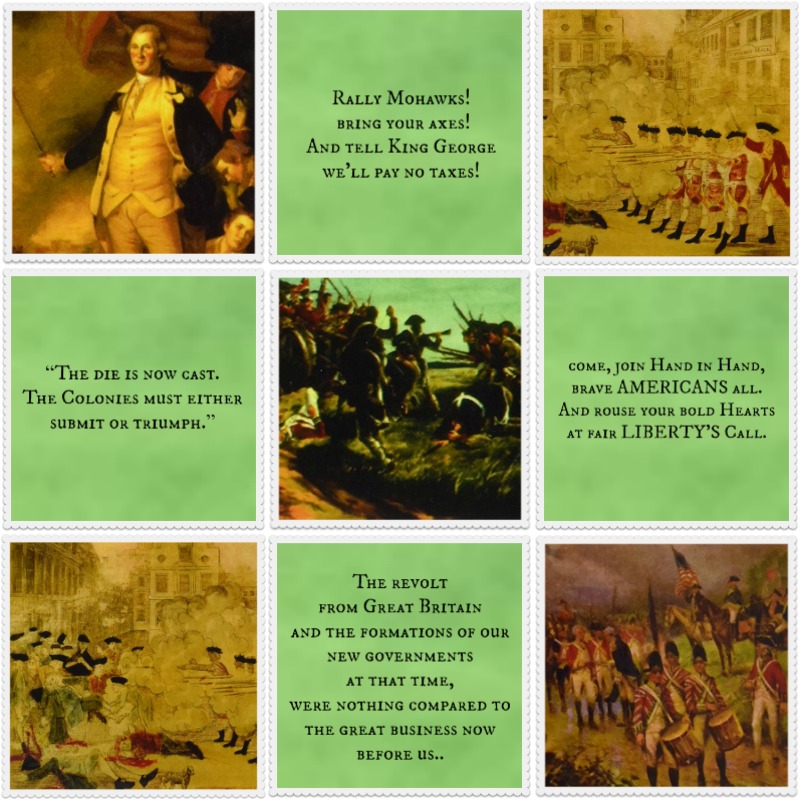
COME, join hand in hand, brave Americans all, And rouse your bold hearts at fair Liberty's call!
“Friends! Brethren! Countrymen! That worst of Plagues, the detested tea shipped for this Port by the East India Company, is now arrived in the Harbour: the hour of destruction, of manly opposition to the machinations of Tyranny, stares you in the face.”
Rally Mohawks, and bring your axes. And tell King George we'll pay no taxes.
"We have an old mother that peevish is grown, She snubs us like children that scarce walk alone; She forgets we're grown-up and have sense of our own."
“The die is now cast. The Colonies must either submit or triumph.”
"They cannot conquer an idea with an army."
“At the battle of Eutaw Springs, hundreds of my men were naked as they were born..."
"The revolt from Great Britain and the formations of our new governments at that time, were nothing compared to the great business now before us."
1760: Be A King!
The Parson's Tobacco
1765: Tyranny!
1765 Rabble Rousing
1767: Champagne Charlie and the Tax on Tea
1773: A Tea Party
1774: "Intolerable Acts"
Tinkers, Tailors, Candlestick Makers
"Ordinary" and Everyday Life
From the Frontier to Philadelphia
Fall 1774: A Meeting in Philadelphia
April 19, 1775 "The Shot Heard 'Round The World"
June 17, 1775: The Battle of Bunker Hill
1775-1776: Boston and Quebec Under Siege
July 4,1776: The First Fourth
August 27,1776: The Battle of Long Island
Christmastime 1776: The Battles of Trenton and Princeton
Summer 1777: The Three-Pronged Plan
August 16,1777: Battle of Bennington
September 11, 1977: Battle of Brandywine
October 6,1777: Battle of Germantown
October 1777: Battles and Surrender at Saratoga
November, 1777: The United States of America
Winter, 1777-1778: Valley Forge
Homespuns, Hessians, and Redcoats
Brown Bess and Battle
Hardship: A "Constant Companion"
June 28, 1778: Battle of Monmouth Courthouse
The War Moves South
August 16,1780: Battle of Camden
September 23,1780: Treason of the Blackest Dye
October 7, 1780: Kings Mountain
January 17, 1781: Battle of Cowpens
March 15,1781: Battle of Guilford Courthouse
October 19,1781: Surrender at Yorktown
September 3,1783: Treaty of Paris
September 1786: The Annapolis Convention
May, 1787: The Constitutional Congress Meets
MORE TO LEARN //
The Navigation Acts
Writs Of Assistance
Parson's Cause
Magna Carta
Sugar Act
Currency Act
Stamp Act
Quartering Act
James Otis
"Taxation without representation is tyranny!"
Samuel Adams
John Hancock
Sons of Liberty
The Liberty Tree
Daughters of Liberty
Issac Barre
Dr. Joseph Warren
Stamp Act Congress - was the first time the colonies had worked together in a common cause
John Dickinson
Benjamin Franklin
Declaratory Act
Charles Townsend
Townsend Acts
Patriots (whigs) vs. Loyalists (tories)
General Thomas Gage
tarring & feathering
Committees of Correspondence
March 1770 - Boston Massacre
John Adams
Thomas Hutchinson
Coercive Acts
Intolerable Acts
Quebec Act
Patrick Henry - give me liberty or give me death
Thomas Jefferson
Abigail Adams
Paul Revere - tea sets & tableware
The fashionable Mrs. Hamilton
Robinson Cruesoe [Chains]
Daniel Boone
Join or Die
Poor Richard's Almanac
Independence Hall
Peyton Randolph
Battle of Lexington & Concord
Capture of Fort Ticonderoga
Midnight Riders
Attack on Bunker Hill and the burning of Charlestown
Suffolk Resolves
Minutemen
The Liberty Bell
Battle of Long Island [Chains]
Nathan Hale - I only regret I that I have but one life to lose for my country [Chains]
Common Sense [Chains]
Thomas Paine [Chains]
John Burgoyne
Battle of Bennington
Betsy Ross
Battle of Brandywine
Battle of Germantown
Battle and Surrender at Saratoga
Yankee Doodle
John Dickinson
Marquis de Lafayette
Baron Von Steuben
General Putnam
Blacks Fight for Freedom
Troubles on the Frontier
Joseph Brant
General Daniel Morgan
Fringed Hunting Shirt
One King Statue = 4,000 pounds
Valley Forge
Battle of Cowpens
Battle of Monmouth Courthouse
General Lee
Nathanael Greene
Deborah Sampson
John Paul Jones
Battle of Camden
Casmir Pulaski
Francis Marion
Benedict Arnold
Banastre Tarleton
Cornwallis
John Pitcairn
William Dawes
Dr. Samuel Prescott
Henry Clinton
Ethan Allen
Green Mountain Boys
Henry Knox
Surrender at Yorktown
Treaty of Paris
Joseph Plumb Martin
James Madison
Alexander Hamilton
Dr. Joseph Warren - Died at The Battle of Bunker Hill

July 10, 2008
I really like this series of books a lot. The information is good and easy to read (for Noble and myself) and is easy to follow understand. The pictures are real looking, not cartoony or cheesey. The activites match what they are learning and are not worksheet kind of activities. (examples: maing Boston Brown Bread and churned butter or Papyrotamia (paper cutouts))

May 21, 2021
I highly recommend this wide, horizontal book. It was dense, coming in at 117 pages plus a historical event timeline and a preface, as well as a glossary in the back matter. It was dense and informative but written with such a style as to teach children and adults alike about colonial times and the American Revolution. There are some tough topics—war is not an easy one—but I feel as though Ms. Herbert did a phenomenal job of writing it in such a way as to keep it from being scary or gory. I also love her writing style and wit. I love that she wove in stories of women, children, and African Americans who were both free and enslaved during this time. I would have loved to have seen this expanded, but one book cannot possibly contain everything. These side snippets were interesting and a welcome addition.
As a lover of science, growing up I was only interested in world history. I had no interest in American history at all since it is only several hundreds of years old. But as I read large chunks of this book to my children and went back and reread the parts that they had read to themselves, I found myself engrossed and even emotional at various points. Ms. Herbert really brought to life the conditions that the colonists and, later, the soldiers experienced and how they went from being almost 13 sovereign colonies to unifying for a common cause. It brought me to an appreciation of all that was overcome and the principles for which the Americans fought.
There are also over 20 activities within its pages, such as making your own butter. My children did not want to do that activity; however, once they started and made their first batch, two of the three went on to make more, and they have it almost every morning with breakfast! Such fun. Shake, shake, shake!
Since this is a story specifically from the American colonists POV, the plight of the Native American wasn't really addressed, though the book does mention that there were Indian raids and hostilities as a result of settlers moving in, the fact that Indians fought on both sides, and that the colonists were set on westward expansion, though King George III had set their boundaries at the Appalachians.
If you need to brush up on your American history or want your children to have an understanding of the colonial times, this is a must read.
As a lover of science, growing up I was only interested in world history. I had no interest in American history at all since it is only several hundreds of years old. But as I read large chunks of this book to my children and went back and reread the parts that they had read to themselves, I found myself engrossed and even emotional at various points. Ms. Herbert really brought to life the conditions that the colonists and, later, the soldiers experienced and how they went from being almost 13 sovereign colonies to unifying for a common cause. It brought me to an appreciation of all that was overcome and the principles for which the Americans fought.
There are also over 20 activities within its pages, such as making your own butter. My children did not want to do that activity; however, once they started and made their first batch, two of the three went on to make more, and they have it almost every morning with breakfast! Such fun. Shake, shake, shake!
Since this is a story specifically from the American colonists POV, the plight of the Native American wasn't really addressed, though the book does mention that there were Indian raids and hostilities as a result of settlers moving in, the fact that Indians fought on both sides, and that the colonists were set on westward expansion, though King George III had set their boundaries at the Appalachians.
If you need to brush up on your American history or want your children to have an understanding of the colonial times, this is a must read.
April 20, 2022
3.9 would refer to in future if the situation called for it

July 22, 2008
Another amazing book from this series...they have books covering a huge range of topics from the different American wars to specific historical events, people, places, etc. I can't say enough about the great experiences we have had reading, discussing and then DOING together. It is a great way to bring history alive for your children and get them engaged in learning without them even realizing it!

April 10, 2014
This is an amazing book for assisting students who are learning about the American Revolution. This book has a section about each battle that took place. It also discusses key people during the time and how they contributed to the revolution. It also gives side notes to help the students fully understand what is being discussed. The front of the book has a timeline, which discusses events that led up to the revolution and everything that occurred during it.

March 23, 2016
A lot of great information for kids interested in learning about the history of our country. Quite a few activities to do in it as well. The reading is a bit heavy- but not too bad (for children). Really good information.

September 28, 2007
Very interesting -- provides a history of the American Revolution and then crafts, recipes, etc. to use along the way.

January 22, 2009
Cit in Nation with 11 year olds!
I just wanted some activities that would make a history lesson less dry and more fun. There are some great simple ones in here.
I just wanted some activities that would make a history lesson less dry and more fun. There are some great simple ones in here.
Want to Read
March 26, 2009This book details the events of the Revolution from the colonists' rebellion with the Stamp Act to the British surrender at Yorktown, and provides activities to make the history come alive.

December 29, 2011
I loved this book. Kid-friendly history of causes of the Revolution, battle overviews, crafts and fun facts - it was a hit with my students!

April 16, 2012
good history book for kids.

April 23, 2012
This book is great to use for social studies lesson on the American Revolution. In easy words the book highlights and explains important events and battles during that time period. Grades 3-5.

Read
September 12, 2017Didn't read. But will be a great resource for when David is older. Copied activities from it to use this year with learning about the Revolution.
Displaying 1 - 14 of 14 reviews