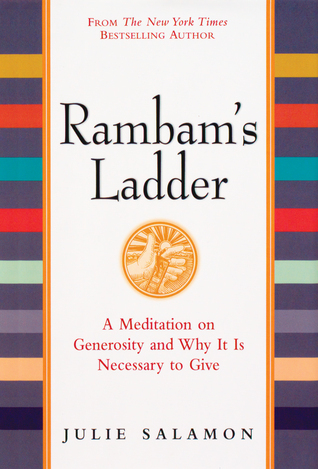
As my religious Jewish friends here know, “Rambam” is an acronym for Rabbi Moshe ben Maimon, also known as Maimonides, one of the most influential Torah scholars of all time. He lived in Spain and the Middle East in the 12th century, yet his works are still read today. One of his most famous teachings is on charity, and that is the focus of this book. The Rambam enumerated eight levels of charity, in which setting someone up for independence is at the top and giving begrudgingly is at the bottom. Author Julie Salamon uses the metaphor of a ladder to describe this list, but instead of going from top to bottom as the Rambam does, she explores each level from the bottom up, as though we readers are on a journey of self-improvement. She doesn't seem to be Orthodox, but she definitely has positive Jewish values. Actually, her secular influences make the book more interesting. She intersperses the traditional teachings with examples of modern-day philanthropy, drawing from a wider variety of sources than you'd encounter in a typical frum book.
Inspiring as I found her examples and stories, I have to say that the book is somewhat dated. It was written in the early 2000’s when the economy was still booming. Without the perspective of the ’08 crash, the author's faith in the positive side of capitalism seemed a bit naïve. She dedicates one chapter to the subject of corruption, but that raised other problems. Its connection back to the Rambam seemed more of a stretch than the other chapters. I appreciate her point that the Rambam's value of anonymity was a prevention against corruption, but since the main focus of the chapter was a particular scandal, it felt like she was trying to force a connection just to be able to tell the story.
These two faults aside, charity is among the most admirable of human traits, and since most people love reading about humans at their best, they're likely to find this book both inspiring and accessible. Recommended.