Primary authority on what was proper, beautiful, efficient in all aspects of mid-19th-century interior design. Originally published in 1868. Over 100 illustrations.
Well that was not what I was expecting. I thought this book was going to be how to decorate a modern room Victorian-style. Nope. It's how to decorate Victorian-style if you are a Victorian. The author lost me when he started discussing the superiority of wrought iron versus cast iron. That's a bit too in depth for a gal that makes her husband pick the color of paint for rooms.
I highly recommend this book though if you're looking to replace your brass doorknocker and want a good discussion of what type of material to go with. As a bonus once you get rid of your brass doorknocker your housemaid will have more time for other household responsibilities.
Another helpful tip is to get a Gothic looking settee for your Billards room. It's all the rage.
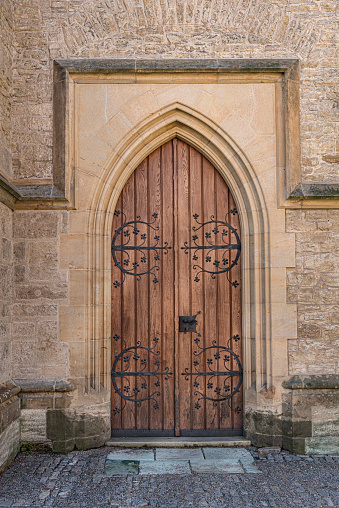
Everyone needs to stop graining their front door. You can tell it's oak. It's just ridiculous to make it look anything other than oak. The author suggests just painting it instead.
Although they are largely forgotten now, in their lifetimes Eastlake and his wife were the premier arbiters of interior decoration. They were probably more widely influential than was the more intellectual Ruskin, as they addressed the needs of those of modest means and education as well as elites. This is a very accessible, easy-to-understand guide that any person could follow to create an attractive and tasteful home. It was novel for the time both in addressing issues of economy and in discouraging faddishness. Eastlake shared William Morris' insistence on sturdy, timeless workmanship and his aversion to the prevailing heavy, cluttered style of Victorian homes. 1st published 1868.
*note: the author is the nephew of the artist Sir Charles Eastlake (1793-1865), who also published his opinions on art. Check pub dates to keep them straight.
Less useful information than I expected from a work I understand to be so historically significant. Much of it is Eastlake sharing extremely specific personal opinions about very specific things, including many topics outside the scope of interior architecture and design.
For Eastlake, every piece of furniture should be a family heirloom.
For the modern reader, this book is half a treatise on furniture design and half a DIY handbook for decorating a home. Since the book was originally published in 1868, it references styles that were contemporary at the time but are many trend-cycles out-of-date for the modern home decorator. Still, he describes basic principles for material, color, construction, and organization of furniture that serve as more perennial hints.
The "Eastlake style" encompasses several principles: 1. Beauty in construction lies in proper form that meets a functional purpose. For instance, a chair should be comfortable, stable, and durable. Its materials should not deteriorate with frequent use or collect dust easily. Any sort of construction that conflicts with these purposes (e.g. eccentrically curved chair legs that wobble, cushions that look "regal" yet feel uncomfortable) is therefore disagreeable. 2. Simplicity in craftsmanship. This does not mean that furniture should not be ornamental or detailed in its decoration, but that decoration should not interfere with simplicity in design. He disagrees with a dissociated concept of beauty in which sentimental, aesthetic value is seen as inconsistent with practical concerns. 3. Function should be highlighted rather than obscured. Think of the hinges on Gothic-style doors. Instead of attempting to hide the hinges and weaken their function, they are exposed frankly and used as a subject of embellishment. 4. Handcrafted over machine-made pieces. A perfectly symmetrical rug constructed in an English factory is less preferable than a handmade, less technically exact rug from the European Middle Ages or 19th century Turkey. However, he recognizes that there can be a trade-off with price. 5. Timeless measures of taste over trends. While furniture design should evolve in accordance with new availability of materials or recently developed methods of construction, he discounts the coming and going of trends merely for the sake of novelty. He sees this as a social problem in England at the time, where the general population lacks taste and thus increases demand for low-quality furniture, and shops supply furniture based on trendiness which is constantly cycled for something different.
The tone is certainly "of its time" with a signature English Victorian pomp which some will find amusing while some will consider it pretentious or overly judgmental. He's proclaiming an objective standard of taste and decrying the masses for their uncouthness, which is not everyone's thing.
The title "Hints on Household Taste" is also very Victorian, with "hints" being a popular way to name manuals of the time, such as "Hints on Etiquette" or "Hints on Child Training." It gives off an accessible connotation of "mere suggestion" yet "helpful guiding knowledge."
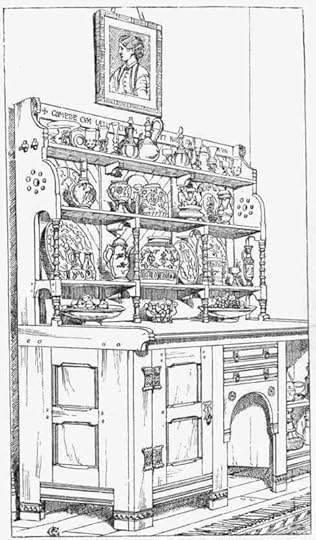
The author has a clear preference for the structural style of the high Middle Ages. The book is full of beautiful woodcut illustrations, many of which are pieces of furniture from the Middle Ages that he uses for examples of good craftsmanship and style. It is in part because these pieces have lasted for so many centuries that he gives them praise. It does raise questions of practicality for the modern person. We're generally not living in the same farmhouse or manor as our parents. Instead, we're moving out at age 18 and filling an apartment with pieces that are hopefully not too heavy to move in a UHaul and will last at least a few years. In that sense, this book is more helpful for someone trying to fill a permanent house rather than a catch-all guide for all types of interior decoration.
I enjoyed this book, in part because I'm aesthetically drawn to the neo-Gothic style, and also because I appreciate his attention to small details of design (he spends a couple pages extolling the brilliant construction of a traditional English bucket).
Although this is THE classic text on Victorian style, the author's arrogance and elitism were just not for me. Perhaps I should have expected it of a Victorian man talking about what taste is "correct"...
the living embodiment of "back in my day" he has little advice for the modern Victorian style decorator. The negative language on display makes the gentleman seem ill in deposition with an upturned nose to anything that wasn't already produced in the medieval period. Oddly enough some of his principles fit right in with the principles of Dieter Rams which has the modern wold in a chokehold to it's detriment. The preface also resonates quite keenly with the modern reader. That of the increasing decline in quality of our manufacture that is, in my opinion, the only chapter worthy of your attention. I'm sure the good gentleman would probably suffer a heart attack at the very thought of an MDF IKEA cupboard.
An interesting look into the Victorian "morality" of art-manufacture and design, containing valuable insights to the Victorian Era's "absurd conventionality" in service to which most citizens "submitted under a vague impression that if we differed from our neighbours we should be violating good taste."
In an effort, then, to explain "taste," Charles Eastlake writes in 1868 of the infinite superiority of the work of the hammer to the work of the mold (wrought iron would be superior to cast iron) and of the myriad "shams" being perpetrated in manufacture (paper stained and varnished in imitation of marble) which ought to be condemned.
That no object which violates "true principles of design" should be called "pretty" is a source of much frustration for the author. Eastlake contends that the honest handicraft of a housemaid's bucket or an Italian oil-flask would serve as a more interesting sketch subject than an English work-table, though the work-table would, despite some flaw which "is sure to belie its purpose in some way," doubtless be the first of the three labeled "pretty" by its owner. For having "doors which look like drawers" or drawers which look like doors, the work-table, in Eastlake's estimation, should rather be labeled dishonest or amoral and undeserving of its owner's praise.
So too is it frustrating to Eastlake that shop-keepers are unable to "educate" their customers by their providing what "should" be purchased instead of what is currently fashionable -- but which will be "frightful" within a year's time. The problem of replacing "last year's goods" with another of the same style or pattern is still surprisingly relevant, even if the modern audience does not as adamantly demand that objects be a completely honest marriage of form, function, and material.
The book does assume some familiarity with household items which would have been commonplace in its time but which are no longer in standard use; as a study of Victorian THOUGHT, however, there is no lost comprehension if one does not know the distinguishing characteristics of (for example) a "Cromwell" chair.
Nothing like decorating in the true style of the era. This books covers everythung from Parquetry to Crockery to Jewellery. Amazing design book for the Victorian era