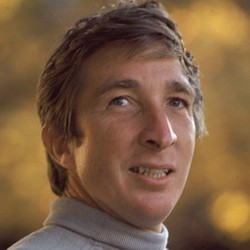
Composed chiefly of Updike's book reviews of the past eight years, this collection includes pieces on Edmund Wilson, Vladimir Nabokov, and Muriel Spark, on actresses Doris Day and Louise Brooks and an appendix of imaginary interviews, humorous pieces, and essays
John Hoyer Updike was an American writer. Updike's most famous work is his Rabbit series (Rabbit, Run; Rabbit Redux; Rabbit Is Rich; Rabbit At Rest; and Rabbit Remembered). Rabbit is Rich and Rabbit at Rest both won Pulitzer Prizes for Updike. Describing his subject as "the American small town, Protestant middle class," Updike is well known for his careful craftsmanship and prolific writing, having published 22 novels and more than a dozen short story collections as well as poetry, literary criticism and children's books. Hundreds of his stories, reviews, and poems have appeared in The New Yorker since the 1950s. His works often explore sex, faith, and death, and their inter-relationships.
“What art offers is space – a certain breathing room for the spirit.” - John Updike
Similar to classical violinists taking a master class with Itzhak Perlman, similar to generations of painters sitting at their easel before a Leonardo da Vinci, those of us reading and writing book reviews can likewise learn a great deal from an accomplished master of the craft.
Hugging the Shore – Essays and Criticism by John Updike contains dozens and dozens of provocative, extraordinarily well-written essays, enough examples to keep any student of book reviewing going for many years. As a way of sampling this book’s rasa, here are three quotes from John Updike’s Forward where he specifically addresses the art of book reviewing. I’ve also included my modest comments on his quotes.
"Writing criticism is to writing fiction and poetry as hugging the shore is to sailing in the open sea." --------- Well, certainly, if you write a novel or a collection of poems, you are opening yourself, your feelings and emotions, your ideas and values, your sense of language and character and relationships to yourself in the process of creation and also to the public via publication. However, I have seen many book reviewers taking strong stands on controversial subjects. Opening oneself to criticism, especially in an on-line format like Goodreads, is very much part of the agenda. Hugging the shore can have some pretty rough, choppy water to navigate.
"My own experience of authorship urges me to heed the author’s exact expressions and to condemn him, if he must be condemned, out of his own mouth." --------- Excellent point. This is why incorporating direct quotes from the book can be so helpful to readers, such quotes can serve as evidence to underscore a reviewer’s judgment. Also, of course, direct quotes provide a sample of the tone and quality of the author’s writing.
"Whereas book reviews perform a clear and desired social service: they excuse us from reading the books themselves. They give us literary sensations in concentrated form. They are gossip of a higher sort. They are as intense as a television commercial and as jolly as candy bars." --------- Ha! Love your language, sir. And as jolly as candy bars, here are a few of my very favorite reviews, each a one sentence review:
Nightmare of an Ether Drinker, by Jean Lorrain “Almost too good to be true.”
The Book of Monelle by Marcel Schwob “What the fuck did I just read?”
The Book of Laughter and Forgetting by Milan Kundera “It was funny, but I can't remember why.”
When it comes to book reviews, the first few lines can serve as a hook to prompt a reader to continue reading. Again, by way of example, here are a few hooks written by Mr. John, ever the virtuoso wordsmith, combining vivid master sentences by artfully orchestrating colorful vocabulary and turn of phrase, telling detail, and an ear for the rhythms of language:
Searching For Caleb by Anne Tyler "Out of her fascination with families – with brotherly men and aunty women, with weak sisters and mama’s boys, with stay-at-homes and runaways – Anne Tyler has fashioned, in Searching for Caleb, a dandy novel, funny and lyric and true-seeming, exquisite in its details and ambitious in its design. She here constructs the family as a vessel of Time."
The Pornographer by John McGahern "Surely one of the novel’s habitual aims is to articulate morality, to sharpen the reader’s sense of vice and virtue. Yet, in a time of triumphant relativism, speckled with surreal outbursts of violence on both the public and private level, light and shadow are so bafflingly intermixed that fiction exerts its own spell best in pockets of underdevelopment where the divisive ghosts of religious orthodoxy still linger. Out of a contemporary Ireland where the production of pornography is still a matter of, if not prosecution, self-reproach, and where a woman can still be concerned for her virginity and a man for his honor, and where the notion can persist in intelligent heads that “things were run on lines of good and bad, according to some vague law or other,” and where erotic adventure is still enough freighted with guilt and pain to seem a mode of inner pilgrimage."
Invisible Cities by Italo Calvino "Like Jorge Luis Borges and Gabriel Garcia Marquez, Italo Calvino dreams perfect dreams for us; the fantasy of these three Latins ranges beyond the egoism that truncates and anguishingly turns inward the fables of Kafka and that limits the kaleidoscopic visions of Nabokov. Of the three, Calvino is the sunniest, the most variously and benignly curious about the human truth as it comes embedded in its animal, vegetable, historical, and cosmic contexts: all his investigations spiral in upon the central question of “How shall we live?” In Invisible Cities he has produced a consummate book, both crystalline and limpid, adamant and airy, playful yet “worked” with a monkish care."
I've been periodically dipping into this book for months now and finally I feel as though I've read, if not every word, at least enough of them to have formed an opinion. Although I must say that writing a review of a book by John Updike in which he reviewed and offered criticism of the work of other writers is a rather daunting prospect.
Updike was, of course, a famous reviewer of books, especially for The New Yorker, in his day. This particular collection was published in 1983 and it won the National Book Critics Circle Award for Criticism that year. Sometime after that - I don't remember when - I purchased it at Barnes and Noble and it has languished on my bookshelf ever since, waiting to be read. Last summer, I decided it was time and so I began and now in the new year I am prepared to mark the book "read."
Updike explains the title of his book as an allusion to the critic who does not venture far from the shore or go into the deep waters. Instead, it is the creator of fiction, the dreamer, who sails far out to sea, where the safe sight of land disappears from view and one is entirely on his/her own. He obviously was an admirer of those who took the risk to expose the worlds of their creation to the critical view of the readers.
Most of the writers whom he reviewed were his contemporaries, but we also get three long essays, appreciations really, of writers he terms "American Masters" - Nathaniel Hawthorne, Herman Melville, and Walt Whitman. As a long-time admirer of Melville, I was particularly interested in what he had to say about him, and I was struck again with the sad fact that so much of Melville's work, including his master work, Moby Dick, was not really appreciated during his lifetime.
Here we have Updike's thoughts on the works of Vladimir Nabokov, Saul Bellow, Kurt Vonnegut, Anne Tyler, Iris Murdoch, Italo Calvino, and many more. It is such a pleasure to read his perspectives on these authors, even when I don't necessarily always agree with him. His reviews are always thought-provoking.
In addition to his reviews of works by professional writers, we also are able to read his criticism of memoirs by people like Doris Day and Louise Brooks. When I was a little girl, I wanted to be Doris Day when I grew up, but had I had any idea of some of the sorrows of her life perhaps I would have looked elsewhere for a role model. On the other hand, she survived and overcame her troubles, so she was not a bad role model after all.
This is a very long book, stretching out to well over 800 pages, and it is not just book reviews and criticism. There are a number of essays included on a variety of subjects which interested Updike, not least of which was golf and golfers like Sam Snead and Arnold Palmer. In fact, there are two essays on golf.
Updike was a master wordsmith. He could string words together with the best of them, and it is a pleasure to read his smooth and flowing sentences, even when those sentences were written on a subject that didn't necessarily interest me, like golf. Just to view his writerly craftsmanship was a pleasure. I expect I will continue to dip into this book for months to come.
For my money the best of Updike’s many volumes of criticism which, like prize pigs, fattened with age.
Classic essays on E.B White’s letters and the fiction of John Cheever, John McGahern and William Trevor should be the first port of call. Unlike many American critics, Updike wrote well about international authors.
so the content here (and my god but there's a lot of it) is of a superior quality. i went into this somewhat suspicious of john updike, Champion Literary Phallocrat, given DFW's enmity in the NYO and especially that abominable cover picture, which quite aside from being a dead ringer for john kerry, is simply the new england faggiest thing upon which my eyes've ever lain (odd for a man whose question for "one neighbor's wife" in interviews with insufficiently famous americans (an otherwise choice essay in the superb first collection of this volume) is, "what does your pussy look like?", and for whom impotence is secondary only to The Ineluctably Calamitous Loss of John Updike in terms of threats to grand Western Civilization)--who sneaks a goddamn boat into the Olan Mills booth? but i digress. then again, I've read one-half of the Rabbit tetralogy (the two on the ends: to answer your inevitable question, because those are the two i had available), and thought them ultramegaok if not ultramegaok-tothemax.
well, this is all of the highest calibre. man updike has a vocabulary to envy (i only learned from this book deliquesce, which i see myself using at least once a day from now on), though i suppose he does have all that time sitting in boats along stormy new england, pondering pussies and looking like an undeservedly wealthy massachusetts stalinist scion who couldn't even beat george w. freakin' pigs-trotters-for-brains bush--sorry! the biggest problem with the book's contents are the sheer catholicism of mr. updike, and his unnerving recall (keep in mind always that these essays were written in the antepedian era, the long long ago of easy reference). it's one thing to read 30 pages of anne tyler reviews, having never read mrs. tyler nor spent more than a week in baltimore; it's quite another to realize that these reviews expect casual conversance with all of mrs. tyler's previous work, the history of baltimore, eudamnsure eudora welty and i mean all the eudora welty, controversies involved in awarding the O'Henry Prize and two baseball players to be named later. i don't care to be reminded that there are people fundamentally better read than i'll ever be, and updike can't really help but do that. the major problem is that this hefty tome, easily had used in a bludgeoning hardback for less than $10 from amazon, will inspire several hundred dollars of further book purchases and back up your queue for god knows how long. not such a problem, i suppose.
sorry kids, there'll be no christmas this year! here's the collected stories of Günter Grass. my advice is that you get a good dictionary and some serious volumes on german aesthetics. Sturm und drang, ahoy!
To truly appreciate the sensitive, playful intelligence that was John Updike, you need to read some of his essays and criticism. You learn far more about whatever Updike is reviewing than you would have imagined possible in just a few pages. His density of information and sharp eye for all details amazes. I think Updike was the best and most intellectually entertaining critics that this country has ever produced.
Witty and perceptive reviews of John McGahern, William Trevor and John Cheever. Updike seems to read more authors in translation than most Americans. He seems softer on them than his contemporaries. Rare exceptions are Anne Tyler and EB White.
Just some quotes from the one essay here called Melville’s Withdrawal, really an incredible portrait of the tortured artist being overtaken by the tortured man, before, as Melville put it, he had at last “pretty much made up his mind to be annihilated."
"Dollars damn me," he wrote Hawthorne. "What I feel most moved to write, that is banned, — it will not pay. Yet, altogether, write the other way I cannot. So the product is a final hash, and all my books are botches."
From Pierre, perhaps a rather scary picture of the author himself at this time:
“He will not be called to; he will not be stirred. Sometimes the intent ear of Isabel in the next room, overhears the alternate silence, and then the long lonely scratch of his pen. It is as if she heard the busy claw of some midnight mole in the ground. Sometimes she hears a low cough, and sometimes the scrape of his crook-handled cane... In the heart of such silence, surely something is at work. Is it creation, or destruction? Builds Pierre the noble world of a new book? or does the Pale Haggardness unbuild the lungs and the life in him?— Unutterable, that a man should be thus!…He cannot eat but by force. He has assassinated the natural day; how then can he eat with an appetite? If he lays him down, he cannot sleep; he has waked the infinite wakefulness in him; then how can he slumber? Still his book, like a vast lumbering planet, revolves in his aching head.”
"’The sooner this author is put in ward the better.’ Though Melville left no record of his reaction, such insults must have pained a man who at the age of twelve had watched his own father die a raving maniac.”
“I must get on some other element than earth. I have sat on earth's saddle till I am weary.” —Pierre
“But more important than all oppressions and deprivations real or imagined was, perhaps, an event within the œuvre: Moby-Dick used up the last major portion of Melville's artistic capital, his years at sea. Henceforth, he must draw upon the accounts of other seafarers or write about land. And little that he saw around him in Pittsfield interested him enough to write about or could be written about with frankness.”
“In the emptiness of the lifeless antiquity of Jerusalem the emigrant Jews are like flies that have taken up their abode in a skull." —from Melville’s journal.
“Melville, by a series of accidents of which not the least remarkable was the luxuriant verbal gift he discovered in himself, brought the news from the South Seas—among the first to bring it, and still among the best.”
“What is this shore I hug so repeatedly, with such a squint of guilt? Were not these exercises in appreciation and exposition composed, like anything else, by taking a deep breath, leaning out over the typewriter, and trying to dive a little deeper than the first words that come to mind? Of some I am proud enough, as work completed and self-education achieved. Of none I am ashamed, else I would not have admitted them to my summer-long clerical labor, my mustering of deteriorating tearsheets into the hefty form of this book.”
So goes one of several revealing sections in the excellent foreword to "Hugging the Shore,” a collection of John Updike’s literary criticism. I'm not intelligent enough to make informed comments about a literary critic this well-read, this thoughtful, this insightful; all I can do is read and wonder at how many lifetimes it would take me to attain the heights he has, within the boundaries of thirty years of adulthood.
The best I can do is say that upon reading his takes on the famous writers of the world, I come away having learned about people and books I’ve never heard of before, and feel like I could have spent much of my previous waking life in better, more productive ways. Then again, reading Updike (not to mention Henry James) does that to me- makes me grateful for the profound examples of prose and analysis that John U was born to share with the world.
A brief sampling of this sizeable tome’s content is in order. Pages 3-69 hold a decent intro to Updike’s essays, character sketches and short stories; the rest of the book covers the work of over sixty authors from across the globe.
There are letter collections from Nabokov, Kafka, Flaubert, Colette, Hemingway, E. B. White, and John O’Hara (pages 118-195); from pages 196-836, we are served a banquet of opinions and observations on not only the works but also the lives of Auden, Beattie, Beckett, Bellow, Borges, Burroughs, Calvino, Cheever, DeLillo, Dinesen, Grass, Hawthorne, Joyce, Melville, Murdoch, Naipaul, Stevens, Tyler, Vonnegut, and Walt Whitman, to name a few.
Rounding out the book is an appendix titled “On One’s Own Oeuvre,” a fascinating sampler of John Updike’s forewords, replies to inquiries, messages to readers, and comments to various people about the author’s writings and thoughts on a variety of subjects and concerns (pages 839-878). Following that is a thirty-eight page index, which gives this book the feel of a textbook- a claim rightly deserved, given the scope of Updike’s work.
Updike figures that the material covered in “Hugging the Shore” represents the 34, 869 pages he read and commented on over an eight-year period. The least we can do is take a look at what he came up with.
I would say more of a 3 1/2. It was long and some of it tedious. I did not like the essays that began the collection; they seemed dated, the arrogant musings of an unconsciously entitled white man. I bought the book in 1983 when I was going through an Updike phase. It sat on my shelf for 40 years before I finally read it. It was worth reading and I certainly got more out of it than I would have at 26. However, I was struck by the whiteness of the selections reviewed. Only one Black American writer, Gayl Jones, was reviewed. A brush stroke of Asian, Indian, and African writers were included, a brief nod to the "Third World," and everything else was European and American. I learned a great deal about writers I did not know, and the immersion in a book of ideas was nourishing. However, this is a White Person's book of a time that one hopes has passed.
Updike was a loathsome creature, witness his support of the Vietnam War, who wrote beautifully and perceptively on just about anything. Highlights in this collection include a defense of the fiction, not the life, of Celine, "The Curious Case of Dr. Mestouches and Celine", that beautiful Brazilian novel, JORGE: UM BRASILEIRO, and a deep appreciation on Julian Jaynes's, THE ORIGIN OF CONSCIOUSNESS IN THE BREAKDOWN OF THE BICAMERAL MIND. Updike the critic is superior to Updike the novelist.
This 800-page volume, covering about eight years of Updike's critical writings, is throughout both insightful and a pleasure to read. On almost every page, Updike has something perceptive to say about the work he's reviewing.
Collection of Updike's essays (a few) and criticism (a lot). The bulk of the book concentrates on Updike's takes on other writers. The intellectual zeal he brings to each assignment is palpable, and the breadth of his contextual knowledge astounds. Predictably, though, the master stylists with wispy themes are exalted while the egotists handling the bigger ideas suffer a mixed reaction. And you can see Updike the consummate craftsman honing his trade as he haughtily dissects each contemporary, setting his mind to appropriate a practice here, duly noting a misstep there. The collection, then, is a palimpsest, as much about its author (a notion endorsed by a hodge-podge of autobiographical bits thrown in at the end) as about others.
I think I picked up this tome in the early 1980s and I was able to glean from it many of the authors I have read since then: Murdoch, Spark, Calvino, Eco et al