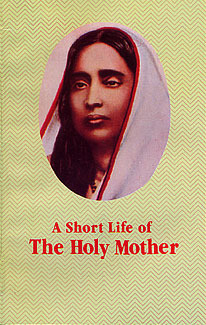
The spiritual consort of Sri Ramakrishna, Sri Sarada Devi, or Holy Mother, lived an unassuming, yet fascinating, life. From a humble background, she is now considered one the the notable woman saints of the nineteenth century. This short biography is a wonderful introduction to the life of this revered woman.
When thousands of persons are literally worshipping her, she is completely unattached to the honours that are being showered on her. This is not possible for any human being. It is enough proof of her divinity.
Sometimes, as a Westerner, we get tempted towards the Eastern religions as holding the secrets of humanity and the universe not available to us through our established orthodoxies. It is widely known that Christianity and Islam are bullshit, so it is ignorance that draws us towards Eastern religions like Hinduism.
So we do yoga, meditate, pass on good Karma, and call Shiva to our aid in Final Fantasy. There must be something to it. It's all so mysterious.
And some of us decide to learn about influential figures like Sarada Devi, also known as The Holy Mother.
It seems that Sarada led a rather unremarkable life, though this book would claim otherwise, "a life which was lived so silently and unostentatious that its very simplicity was bewildering."
She got married at 5 years old, which speaks a little bit for the advanced state of morality of 19th century India, and grew up spending most of her time serving her husband. She transitioned into providing spiritual guidance to people, where most of her holiness is derived. To really understand why so much praise and worship was placed upon her, you would have to believe that all of this spiritual work was actually doing something. Otherwise, you could call it mass delusion.
For the most part, that was her way - a life of mass delusion. The only concrete virtuous work she did to help people was occasionally eating less and doing some laundry.
Reading about the life of someone who did little to nothing might seem like a waste of time, but I would say it's not totally so. At the very least, I was able to get a glimpse of the life and values of another culture in another century, and contrast that with the way we live in the West and how far we have come.