

What do you think?
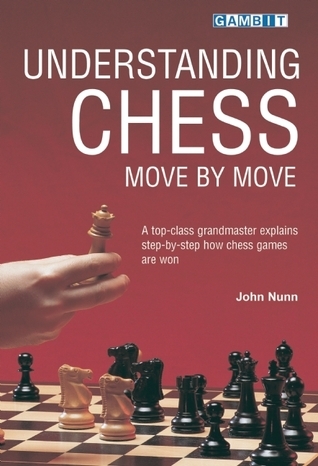
Understanding Chess Move by Move
John Nunn is one of the most highly regarded chess writers in the world. He has carefully selected thirty modern games to help the reader understand the most important aspects of chess and to illustrate modern chess principles in action.
Virtually every move is explained using words that everyone can understand. Jargon is avoided as far as possible. Almost all the examples are taken from recent decades and show how key ideas are handled by modern grandmasters. The emphasis is on general principles that readers will be able to use in their own games, and detailed analysis is only given where it is necessary.
Each game contains many lessons, but to guide the reader through the most important ideas in each phase of the game, the thirty games are grouped thematically into those highlighting opening, middlegame and endgame themes.
John Nunn is a grandmaster from England. He has won four individual gold medals and three team silver medals at Chess Olympiads. In the Chess World Cup of 1988/9, he finished sixth overall, ahead of several former World Champions. He is arguably the most highly acclaimed chess writer in the world, with three of his books receiving the prestigious British Chess Federation Book of the Year Award. He is principal author of the definitive one-volume openings encyclopedia, Nunn’s Chess Openings .
Virtually every move is explained using words that everyone can understand. Jargon is avoided as far as possible. Almost all the examples are taken from recent decades and show how key ideas are handled by modern grandmasters. The emphasis is on general principles that readers will be able to use in their own games, and detailed analysis is only given where it is necessary.
Each game contains many lessons, but to guide the reader through the most important ideas in each phase of the game, the thirty games are grouped thematically into those highlighting opening, middlegame and endgame themes.
John Nunn is a grandmaster from England. He has won four individual gold medals and three team silver medals at Chess Olympiads. In the Chess World Cup of 1988/9, he finished sixth overall, ahead of several former World Champions. He is arguably the most highly acclaimed chess writer in the world, with three of his books receiving the prestigious British Chess Federation Book of the Year Award. He is principal author of the definitive one-volume openings encyclopedia, Nunn’s Chess Openings .
- GenresChessGamesNonfiction
240 pages, Paperback
First published February 14, 2001
About the author
John Nunn
205 books45 followersJohn Denis Martin Nunn is an English chess grandmaster, a three-time world champion in chess problem solving, a chess writer and publisher, and a mathematician. He is one of England's strongest chess players and once was in the world's top ten.
Ratings & Reviews
Friends & Following
Create a free account to discover what your friends think of this book!
Community Reviews
Displaying 1 - 20 of 20 reviews

January 6, 2017
Irving Chernev's classic book "Logical Chess: Move by Move" was a profound book for many beginners in the past, as Chernev was able to breakdown each annotated game into digestible morsels for the aspiring chess player. Now Dr. John Nunn uses the same approach, yet focuses more on the dynamic nature of modern chess and looks at games that are more contemporary in nature.
Nunn's lavishly annotated games are a joy to go over. At points he'll spend several paragraphs of text on explaining the thought process behind the move. Not a stranger to listing trees of variations, Nunn does include several of these lines of analysis, but the main focus is on the text and explaining in "simple" terms the underlying context of the moves.
Each game begins with an overview of the topic on hand and then the game begins and there is an explanation of the opening. To his credit, the reader is exposed to various Sicilians and other common openings, but not a focus on a particular variation. So while the main focus is on the dynamic nature of the middlegame, the reader is also exposed to an overview on opening theory. At the end of each game he gives a summary of the key concepts of the game.
This is a book that I would highly recommend to intermediate players, as Nunn's annotations are brilliant, and advanced players will enjoy Nunn's trees of variations and analysis. Highly Recommended!
Nunn's lavishly annotated games are a joy to go over. At points he'll spend several paragraphs of text on explaining the thought process behind the move. Not a stranger to listing trees of variations, Nunn does include several of these lines of analysis, but the main focus is on the text and explaining in "simple" terms the underlying context of the moves.
Each game begins with an overview of the topic on hand and then the game begins and there is an explanation of the opening. To his credit, the reader is exposed to various Sicilians and other common openings, but not a focus on a particular variation. So while the main focus is on the dynamic nature of the middlegame, the reader is also exposed to an overview on opening theory. At the end of each game he gives a summary of the key concepts of the game.
This is a book that I would highly recommend to intermediate players, as Nunn's annotations are brilliant, and advanced players will enjoy Nunn's trees of variations and analysis. Highly Recommended!

August 8, 2008
Re-reading this book and I appreciate more the second time. Very well written with very good explanations; however, this is not a chess book for beginners. Some of the advice is excelllent for intermediate players like me, but much of the analysis is geared for advanced players.

February 8, 2020
I don't have a FIDE or USCF rating, but I am about an intermediate to light advanced player, maybe Category C/B. This is my second move by move type of book, the first was Seirawan's Winning Brilliancies. I will focus in this review on a specific issue that I think all annotated chess books generally have, but particularly John Nunn's.
Needless to say, all annotated games collections chess books should provide a healthy balance between useful explanatory prose and concrete analysis, with all its variations and sub-variations. A book that heavily emphasizes prose isn't very useful, if the explanations don't hold up under concrete analyses. And vice versa, if the book is nothing but reams of analyses, it's useless to the vast majority of the consuming chess playing public, since 99% of us aren't masters+. And considering that chess engines today are robust and still keep getting better, books with mostly analyses in them are becoming obsolete anyway.
Having said that, this is what I wish all annotated games chess books contained: for the intermediate-advanced players, it would be most helpful, IMO, if the author (and publisher) distinguished between absolutely critical lines and sub-lines and merely alternative/playable lines, preferably by color. In other words, it would provide a helpful way for the student to know which lines/sub-lines he/she ought to absolutely pay attention to and which lines he/she can choose to ignore. Clearly, there are positions in every chess game which are critical, where one path may lead to a win or a considerable advantage and another to a loss or draw. It would be foolish to ignore those lines, even for the beginning students. But there are also many lines authors give that are merely playable - in other words, even the computer evaluates the text line and alternative line as roughly equal. Those alternative lines may perhaps be of use to advanced/master level tournament players, who are looking for some novelties or off the beaten path lines in order to obtain some advantage in their competitions. But unless there is some strategic/tactical/positional lesson in those lines, they are probably useless to the majority of us.
John Nunn is a very meticulous chess researcher (and he himself was a world's top 10 player at some point), but many of the lines he provides in his books are of the "alternative/playable" types, that IMO just distract, rather than teach. It's a problem with the vast majority of annotated chess games books, of course, not just Nunn's.
The other issue with this book, is that the games chosen in this book involve many highly tactical positions, so that concrete analyses becomes practically unavoidable in many positions. And hence, strategic/positional lessons are very few and far in between here.
So, to conclude, I wish Nunn (and other authors) would essentially categorize variations that are absolutely critical for beginners-intermediates (for better understanding); variations that are helpful only to the advanced intermediates and above (critical fork in the road types of positions) and variations that may be of use only to the competing tournament players/masters+ (the merely playable lines).
All in all, this is another solid book from Nunn. But don't expect to suddenly get better as a result of studying it. But it should definitely be part of any staple diet of chess books for the improving and advanced player.
Needless to say, all annotated games collections chess books should provide a healthy balance between useful explanatory prose and concrete analysis, with all its variations and sub-variations. A book that heavily emphasizes prose isn't very useful, if the explanations don't hold up under concrete analyses. And vice versa, if the book is nothing but reams of analyses, it's useless to the vast majority of the consuming chess playing public, since 99% of us aren't masters+. And considering that chess engines today are robust and still keep getting better, books with mostly analyses in them are becoming obsolete anyway.
Having said that, this is what I wish all annotated games chess books contained: for the intermediate-advanced players, it would be most helpful, IMO, if the author (and publisher) distinguished between absolutely critical lines and sub-lines and merely alternative/playable lines, preferably by color. In other words, it would provide a helpful way for the student to know which lines/sub-lines he/she ought to absolutely pay attention to and which lines he/she can choose to ignore. Clearly, there are positions in every chess game which are critical, where one path may lead to a win or a considerable advantage and another to a loss or draw. It would be foolish to ignore those lines, even for the beginning students. But there are also many lines authors give that are merely playable - in other words, even the computer evaluates the text line and alternative line as roughly equal. Those alternative lines may perhaps be of use to advanced/master level tournament players, who are looking for some novelties or off the beaten path lines in order to obtain some advantage in their competitions. But unless there is some strategic/tactical/positional lesson in those lines, they are probably useless to the majority of us.
John Nunn is a very meticulous chess researcher (and he himself was a world's top 10 player at some point), but many of the lines he provides in his books are of the "alternative/playable" types, that IMO just distract, rather than teach. It's a problem with the vast majority of annotated chess games books, of course, not just Nunn's.
The other issue with this book, is that the games chosen in this book involve many highly tactical positions, so that concrete analyses becomes practically unavoidable in many positions. And hence, strategic/positional lessons are very few and far in between here.
So, to conclude, I wish Nunn (and other authors) would essentially categorize variations that are absolutely critical for beginners-intermediates (for better understanding); variations that are helpful only to the advanced intermediates and above (critical fork in the road types of positions) and variations that may be of use only to the competing tournament players/masters+ (the merely playable lines).
All in all, this is another solid book from Nunn. But don't expect to suddenly get better as a result of studying it. But it should definitely be part of any staple diet of chess books for the improving and advanced player.
October 12, 2016
I am crap at chess. I spent a lot of money on books that I thought would at least make me competitive. Nothing worked. I think these chess books will all sit in a box gathering dust and one day I might get the urge to rejoin the local club and get butchered by 12 year olds so then may have a further look. (Generic review for all half finished chess books I will never finish)
August 3, 2019
This is quite possibly the best book ever written on chess. It covers every important middlegame strategy, a wide array of pawn structures, and discusses the reasons behind common opening moves. For any player below master level, this book is an essential read. You will not be disappointed. The concepts are key.

April 1, 2017
This book is very informative, instructive and educational. The author offered an in-depth analysis of 30 games, showing the reader how to think while playing chess, and esp. how to plan the sequence of several moves ahead, taking into account the best moves of the opponent.

October 18, 2021
Excellent. Akin to a modern version of Chernev's classic "Logical Chess"

November 22, 2013
A solid, all-around middlegame strategy book with some basic opening coverage and minimal endgame. Covers a variety of strategic elements of chess at a high level (i.e. attacking play, pawn structure, good bishop vs bad bishop, positional sacrifices, passed pawns, etc.). The author uses grandmaster games to help us understand these strategic elements in action. Most of us can't come close to emulating grandmasters playing chess, but it's great to be inspired by their precise, accurate moves in implementing plans, in hopes that we can imitate (at some level) to improve our own games. Highly recommend.

May 22, 2016
In this book John Nunn has made a good selection of games - the games are high quality games played between the best players after 1990. And John Nunn does a good job in explaining nearly every move using words that everybody can understand. Off course he sometime exaggerate and gives a whole page of analyses, but as a whole he does a fine job explaining the plans. Sometimes the explanation is a little to much: Game 25: 1. e4 "For comments on 1.e4", see game 3. On to game 3: "1.e4 Along with d4, this is one of the two most popular opening moves...."!!
🍁 🍁 🍁 🍁 🍁 🍁 🍁 🍁 🍁 🍁 🍁 🍁 🍁 🍁 🍁 🍁 🍁 🍁 🍁 🍁 🍁 🍁 🍁 🍁 🍁 🍁 🍁 🍁 🍁 🍁
🍁 🍁 🍁 🍁 🍁 🍁 🍁 🍁 🍁 🍁 🍁 🍁 🍁 🍁 🍁 🍁 🍁 🍁 🍁 🍁 🍁 🍁 🍁 🍁 🍁 🍁 🍁 🍁 🍁 🍁

January 2, 2021
El libro merece la pena, aunque se hace repetitivo porque los primeros movimientos casi siempre se justifican del mismo modo: desarrollo de las piezas, control del centro y protección del rey.
Recomendación: leer cada una de las partidas ejemplo desde el enroque.
Bueno para principiantes y jugadores de club.
Recomendación: leer cada una de las partidas ejemplo desde el enroque.
Bueno para principiantes y jugadores de club.

November 22, 2016
A classical masterpiece.
As a trainer I'm happy whenever I need to use the games from this book.
If your level is not not high enough to go through all the annotations, then just enjoy the eloquent comments from a first-class writer. If somebody is looking for a game-collection which he wants to learn by heart - Nunn's book would be my first recommendation.
I'm surprised that this book hasn't been republished with a couple of additional games.
As a trainer I'm happy whenever I need to use the games from this book.
If your level is not not high enough to go through all the annotations, then just enjoy the eloquent comments from a first-class writer. If somebody is looking for a game-collection which he wants to learn by heart - Nunn's book would be my first recommendation.
I'm surprised that this book hasn't been republished with a couple of additional games.
March 8, 2020
These kind of books take a while to get through with an actual chess board and pieces (or two boards, one for the variations), but they are very worthwhile. It’s like having a GM chess coach telling you why every move was made in the 30 games reviewed and about specific chess principles! Very well done and highly recommended!
January 2, 2026
This is a fantastic book. It touches on so many concepts and themes.
But don’t get it confused: the book is promoted like a beginners book but trust me it is relevant even for advanced players, and maybe even more so
But don’t get it confused: the book is promoted like a beginners book but trust me it is relevant even for advanced players, and maybe even more so
April 28, 2026
I finished it this 2026. Some moves and annotations are outdated with computer analysis, but overall the main ideas per game are great for picking up middle game patterns. Would recommend to 1500-1800. (As I am also around this range).
I will work on end game next
I will work on end game next

January 31, 2022
This book is highly recommended in the chess community. I wanted to love it, I really did.
It was ok, but nothing too amazing.
It was ok, but nothing too amazing.
June 22, 2026
Cool right??,
This entire review has been hidden because of spoilers.

November 25, 2014
An update on an old classic (Chernev’s Logical Chess Move by Move) but with more computer-abetted analysis. Whether you like this sort of thing is a matter of taste. The more I experience these sort of books the more it dawns on me that, at a certain level, it’s one grandmaster writing to others like him. For the average player, there are lessons to be learned in this volume, and Nunn does and admirable job in calling them out before, during, and after the game, but in the end he can’t control his compulsion to litter every game with long variations and sub-variations (some 10-15 moves deep) that often shed little light on the theme. One suspects that some games (e.g., number 30) were simply picked so the author could display his empirical virtuosity and that the “lessons learned” were teased out as an afterthought. Certainly, in the case of the aforementioned game, there had to be other games, cleaner and clearer that explored the concept of the rook on the seventh rank. The book is simply impractical; it took me 4-8 hours of attention per game to thoroughly go through each one, and since I have a busy life apart from chess, the constant interruptions made it difficult to maintain the relationships between the main lines, the variations, and the ideas behind each one. So, a qualified recommendation: 1) if you have a lot of undisturbed time, 2) you simply want to read it at a more superficial level, and depart the main lines only to explore critical junctures in each game.
March 28, 2014
For people who really, really, really want to understand chess strategy.

May 20, 2014
Very informative. One of the few chess books I read completely.
Displaying 1 - 20 of 20 reviews