

What do you think?
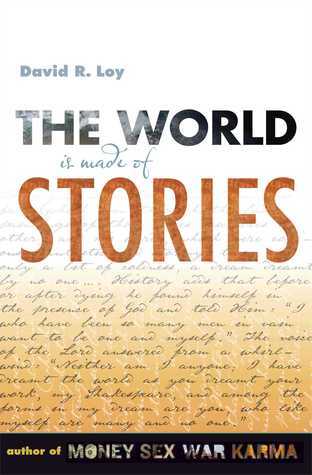
The World Is Made of Stories
In this dynamic and utterly novel presentation, David Loy explores the fascinating proposition that the stories we tell--about what is and is not possible, about ourselves, about right and wrong, life and death, about the world and everything in it--become the very building blocks of our experience and of reality itself. Loy uses an intriguing mixture of quotations from familiar and less-familiar sources and brief stand-alone micro-essays, engaging the reader in challenging and illuminating dialogue. As we come to see that the world is made--in a word--of stories, we come to a richer understanding of that most elusive of Buddhist ideas: shunyata, the "generative emptiness" that is the all-pervading quality inherent to all mental and physical forms in our ever-changing world. Reminiscent of Zen koans and works of sophisticated poetry, this book will reward both a casual read and deep reflection.
128 pages, Paperback
First published May 10, 2010
About the author
David R. Loy
31 books70 followersDavid Robert Loy is an American author and authorized teacher in the Sanbo Kyodan lineage of Japanese Zen Buddhism.
Ratings & Reviews
Friends & Following
Create a free account to discover what your friends think of this book!
Community Reviews
Displaying 1 - 27 of 27 reviews

Currently Reading
December 20, 2011Have to read this three more times when I finish the first time!
November 6, 2013
We tell stories. We live within stories. We understand through stories. We are stories. Can we not story? One story is that we are how the universe makes meaning. What story are you living? What part do you play in others' stories? What story would you like to live? Can you change the story you are telling yourself? What's your story about God? What's God's story? What cannot be storied?
This small volume, about 100 pages, will stop you in your tracks, provoke, inspire, and may help free you from the notion that you are living the "real story."
This small volume, about 100 pages, will stop you in your tracks, provoke, inspire, and may help free you from the notion that you are living the "real story."

April 3, 2011
Engaging, challenging, informative, speculative -- a wonderful read!

March 1, 2011
This is a wonderful book; every page worthy of deeper investigation, and reflection. I read it fairly quickly, all the time knowing I'd be reading it again and again. In fact, I'm already contemplating gathering a group of friends to read and discuss this story about stories and storying.
David Loy has created a new type of book with this study; rich in quotes from a diverse group of writers and thinkers, Loy then dialogues with the quilt of voices.
David Loy has created a new type of book with this study; rich in quotes from a diverse group of writers and thinkers, Loy then dialogues with the quilt of voices.

February 10, 2013
Wonderful little book.

December 26, 2011
David R. Loy is a Buddhist scholar-practitioner who, in addition to more scholarly titles, has also authored books intended for general audiences. This is one of those books, and it's a gem. It's short at only 128 pages, but it's packed with genuinely thought-provoking insights. Loy's text consists of a large number of quotes from a wide variety of sources: contemporary and historical, famous and obscure, scriptural and profane, and a variety of cultural traditions. But this book is not simply a collection of thought-provoking quotes gathered at random from a wide variety of sources. Loy interspaces his quotes with his questions and commentary. Indeed, the quotes serve more to adorn his commentary than vice versa. But the book works so well because of the deft interweaving of Loy's thoughts with those whom he quotes. Loy's text lends itself to brief quotation as well, as I demonstrate below. But taken together, Loy's text provides a compelling argument, a compelling story about stories.
Below I'll share a series of quotes that I've lifted from Loy's text as he lifted from others. As those he's quoted, there's no doubt more said before and after the quotes that round out the thought and may be usefully persued. But brevity provides fertile seed with which one can grow one's own thinking as well. Here's a sample of Loy's text, primarily as it relates to story, although this isn't the sole topic that he touches upon. Enjoy:
If the world is made of stories, stories are not just stories. They teach us what is real, what is valuable, and what is possible. Without stories there is no way to engage with the world because there is no world, and no one to engage with it because there is no self.
This is not to deny (or assert) that there is a world apart from our stories, only that we cannot understand anything without storying it. To understand is to story.
The limits of my stories are the limits of my world.
Science is not primarily about discovering facts. It is about accounting for the relationships that make them meaningful.
Stories do not have sharp edges. They never begin at the beginning.
A story is a point of view is no perspectiveless perspective. There is no way to escape perspectives except by multiplying them.
We transcend this world by being able to story it differently.
The metaphorical nature of religious language makes its truth claims the most difficult to evaluate, because we cannot agree on what criteria to use. Myth avoids this problem by being meaningful in a different way. Religious doctrines, like other ideologies, entail propositional claims to be accepted. Myths provide stories to interact with.
One of the most dangerous myths is the myth of a life without myth, the story of a realist who is freed himself from all that nonsense.
Liberation from myth, is that our myth?
Another way to evaluate a story is by its consequences when we live according to it. The most important criterion for Buddhism is whether a story promotes awakening.
My character is constructed by the roles I play.
If one's personality is composed of sub-personalities, each of us is composed of multiple narratives.
The question is not so much “What do I learn from stories?” as quotes "What stories do I want to live?"
Happens when I realize that my story is a story?
One meaning of freedom is the opportunity to act out of the story I identify with. Another freedom is the ability to change stories and my role within them. I move from scripted character to co-author of my own life. A third type of freedom results from understanding how stories construct and constrict my possibilities.
Whether or not karma is an unfathomable moral law built into the cosmos, living a story has consequences.
Without stories there is no self. And letting go of all stories during samadhi meditation I become no-thing. What can be said about nothing? Neti, neti, “not this, not this.” To say anything about it gives it a role in a story, even if only as a place-marker like a zero.
Am I the storyteller, or the storytold . . . or both? If a sense of self is produced by stories, who is telling them?
Descartes accounts for the continuity of awareness, Hume for its transformations. A narrative self—self as story—bridges the two, providing both sameness and difference. Essential to this narrative is intentionality. It is not enough to have a story about what happens. It is necessary to story why I do what I do.
A narrative understanding of the self implies a distinction between two aspects. One’s character composed of dispositions solidified out of roles that have become habitual. This is my identity, from the Latin identidem, which means “over and over.”
The other aspect of self preserves the possibility of novelty, of doing and become something different. This is my no-thing-ness. Identify is relatively fixed. No-thing-ness is that which cannot be fixed.
Myth as history, history as myth. Premodern people lived in a mythic world, how much of our own history is mythological? Although the past makes us what we are, what we have become determines what we will be able to see in our history.
A profusion of stories is liberating yet uncomfortable, because we want to tuck ourselves securely into the True Story, the one that reveals the way things really are and what’s really important.
The story of history as the history of story.
We are trying to fill up the hole at our core—the sense that something is missing, that I am not real enough—by becoming more wealthy, famous, attractive . . . more powerful. Power—the ability to impose my stories—offers the promise of reality. How could I be unreal, if I'm the one who decides what happens?
The Buddha, like Socrates and Jesus, wrote nothing.
Having learned to find meaning in words, we miss the meaning of everything else.
Our deepest fear is rooted in a compulsion to secure what cannot be secured.
The end of a life organized around fear is to forget your stories about yourself, and thereby your self.
We never achieve a neutral standpoint outside all stories from which to evaluate them objectively.
Those who do not care for such Big Stories [Buddhism, Christianity, etc.] need to consider the alternative. There is no such thing as not storying. Everybody stories. The only choice we get is how to story.
The best stories are paradoxical, one hand offering what the other takes back.
Below I'll share a series of quotes that I've lifted from Loy's text as he lifted from others. As those he's quoted, there's no doubt more said before and after the quotes that round out the thought and may be usefully persued. But brevity provides fertile seed with which one can grow one's own thinking as well. Here's a sample of Loy's text, primarily as it relates to story, although this isn't the sole topic that he touches upon. Enjoy:
If the world is made of stories, stories are not just stories. They teach us what is real, what is valuable, and what is possible. Without stories there is no way to engage with the world because there is no world, and no one to engage with it because there is no self.
This is not to deny (or assert) that there is a world apart from our stories, only that we cannot understand anything without storying it. To understand is to story.
The limits of my stories are the limits of my world.
Science is not primarily about discovering facts. It is about accounting for the relationships that make them meaningful.
Stories do not have sharp edges. They never begin at the beginning.
A story is a point of view is no perspectiveless perspective. There is no way to escape perspectives except by multiplying them.
We transcend this world by being able to story it differently.
The metaphorical nature of religious language makes its truth claims the most difficult to evaluate, because we cannot agree on what criteria to use. Myth avoids this problem by being meaningful in a different way. Religious doctrines, like other ideologies, entail propositional claims to be accepted. Myths provide stories to interact with.
One of the most dangerous myths is the myth of a life without myth, the story of a realist who is freed himself from all that nonsense.
Liberation from myth, is that our myth?
Another way to evaluate a story is by its consequences when we live according to it. The most important criterion for Buddhism is whether a story promotes awakening.
My character is constructed by the roles I play.
If one's personality is composed of sub-personalities, each of us is composed of multiple narratives.
The question is not so much “What do I learn from stories?” as quotes "What stories do I want to live?"
Happens when I realize that my story is a story?
One meaning of freedom is the opportunity to act out of the story I identify with. Another freedom is the ability to change stories and my role within them. I move from scripted character to co-author of my own life. A third type of freedom results from understanding how stories construct and constrict my possibilities.
Whether or not karma is an unfathomable moral law built into the cosmos, living a story has consequences.
Without stories there is no self. And letting go of all stories during samadhi meditation I become no-thing. What can be said about nothing? Neti, neti, “not this, not this.” To say anything about it gives it a role in a story, even if only as a place-marker like a zero.
Am I the storyteller, or the storytold . . . or both? If a sense of self is produced by stories, who is telling them?
Descartes accounts for the continuity of awareness, Hume for its transformations. A narrative self—self as story—bridges the two, providing both sameness and difference. Essential to this narrative is intentionality. It is not enough to have a story about what happens. It is necessary to story why I do what I do.
A narrative understanding of the self implies a distinction between two aspects. One’s character composed of dispositions solidified out of roles that have become habitual. This is my identity, from the Latin identidem, which means “over and over.”
The other aspect of self preserves the possibility of novelty, of doing and become something different. This is my no-thing-ness. Identify is relatively fixed. No-thing-ness is that which cannot be fixed.
Myth as history, history as myth. Premodern people lived in a mythic world, how much of our own history is mythological? Although the past makes us what we are, what we have become determines what we will be able to see in our history.
A profusion of stories is liberating yet uncomfortable, because we want to tuck ourselves securely into the True Story, the one that reveals the way things really are and what’s really important.
The story of history as the history of story.
We are trying to fill up the hole at our core—the sense that something is missing, that I am not real enough—by becoming more wealthy, famous, attractive . . . more powerful. Power—the ability to impose my stories—offers the promise of reality. How could I be unreal, if I'm the one who decides what happens?
The Buddha, like Socrates and Jesus, wrote nothing.
Having learned to find meaning in words, we miss the meaning of everything else.
Our deepest fear is rooted in a compulsion to secure what cannot be secured.
The end of a life organized around fear is to forget your stories about yourself, and thereby your self.
We never achieve a neutral standpoint outside all stories from which to evaluate them objectively.
Those who do not care for such Big Stories [Buddhism, Christianity, etc.] need to consider the alternative. There is no such thing as not storying. Everybody stories. The only choice we get is how to story.
The best stories are paradoxical, one hand offering what the other takes back.

May 7, 2013
I like to drink tea while I read. There is a pause between reading a passage and pouring the hot water into the teapot that David R. Loy's book is perfectly designed for. It is written in a series of provocative short quotes from notable figures and comments by David. He strings each chapter together in a loose flow of meditative thoughts that made me stop and ponder frequently. Each section unravels this great story we call reality and brings the reader/thinker into a mind-state before story. I recommend this book to philosophers, spiritual thinkers, and tea drinkers, too!

September 4, 2011
Mindblowing. I think I need to read this a couple more times for it to all sink in! Luckily it's not a very long book :-)
March 1, 2011
A delightful book mostly of quotations with some explicatory transitions.
Fiction as "laboratories for moral experimentation"p.63
"The earth is not sacred in Abrahamic religions but God's Word is. ... Idolatry was supplanted by bibliolatry" p. 78.
Like Salwak's The Wonders of Solitude, this is one of those little books nice to have close at hand for a quick browse.
Fiction as "laboratories for moral experimentation"p.63
"The earth is not sacred in Abrahamic religions but God's Word is. ... Idolatry was supplanted by bibliolatry" p. 78.
Like Salwak's The Wonders of Solitude, this is one of those little books nice to have close at hand for a quick browse.
July 13, 2020
At its most rewarding when read for 3 pages then pondered over. It's mostly Loy's collection of quotes. The Buddhist writing between them is thought provoking but ultimately superficial. Not enough connective tissue. I recommend instead Harari, 21 lessons for the 21st century, the chapter on stories.
June 28, 2011
A short, pithy, quotation-filled book about the forms, uses, and effect of narrative(s) on human existence. The book is written from a light Buddhist perspective - fans of Wittgenstein will either be confirmed or bored by the middle half of this book. I was confirmed - hence the four stars.

February 11, 2011
a reflection on the way we create and live in and through our narratives, Loy's thoughts certainly had me engaged in some deeper contemplation of meaning, story, and mystery.
September 7, 2012
Brilliant. Thought-provoking. Wordy. Very wordy. Could have given it four stars or even five....but damn those words.
May 10, 2013
Again, a fun read that turns life meaning and purpose on its head. Highly recommend.

August 28, 2015
I've read this about 6 times now and every time I get something new out of it.

Read
July 18, 2026Maailma on ehkä tehty tarinoista, mutta tätä kirjaa ei. Tarinan sijaan kirja oli kokoelma lainauksia ja Loyn muistiinpanomaisia ajatuksia liittyen lainauksiin. Sinänsä mielenkiintoinen kirja, jos sen ajattelee jonkinlaisena aforismikokoelmana, mutta ei vastannut ihan sitä, mitä olin odottanut.
Toki kirja oli organisoitu temaattisesti ja siinä oli selvä punainen lanka, mutta tuntui jotenkin laiskalta, ettei ajatuksia oltu integroitu paremmin yhtenäiseksi kokonaisuudeksi. Seurauksena kirja tuntui keskeneräiseltä.
Toki kirja oli organisoitu temaattisesti ja siinä oli selvä punainen lanka, mutta tuntui jotenkin laiskalta, ettei ajatuksia oltu integroitu paremmin yhtenäiseksi kokonaisuudeksi. Seurauksena kirja tuntui keskeneräiseltä.

April 6, 2019
If you read this book, you will soon find its flaws and supeficiality. If instead you immerse in it, you will appretiate its depth and the great way the author used in weaving its pieces of enlighntment.

March 15, 2021
Although there were some grammatical errors and some parts needed to be more connected with the preceding quotes, I can’t ignore that this book calmed my heart while reading it. This book touched my soul.
December 18, 2017
Very interesting for most of it. Pages from about 70 to somewhere around 80 degenerated into common political shibboleths. Picked up again after.

December 11, 2020
Worth reading and rereading.

March 4, 2017
One of the most intriguing aspects of humanity is the very different way eastern and western cultures look at life. For many of us raised in the western hemisphere there's only one workable paradigm for life and that is rationalism. More precisely, scientific rationalism. When exposed to how eastern thinker envision the world we're left with a bewildered "huh?" Loy helps to make that transition a little easier.
A Buddhist, Loy reflects on stories in this little book. More specifically, he argues that all life is story. Even science, apart from narrative, is nothing. We can't understand without the benefit of story. Contradictions and paradoxes abound. Instead of rushing to resolve them, we ought to be willing to ponder them. Make them part of our story. Appropriate quotations, mostly from western writers, are used to help make the spare, contemplative points he raises. I found this a most liberating book.
Instead of distrusting other cultures, it is worth thinking deeply about them. I tie this to the idea of contemplation on my blog (Sects and Violence in the Ancient World) for those who are more interested in that aspect of telling the story.
A Buddhist, Loy reflects on stories in this little book. More specifically, he argues that all life is story. Even science, apart from narrative, is nothing. We can't understand without the benefit of story. Contradictions and paradoxes abound. Instead of rushing to resolve them, we ought to be willing to ponder them. Make them part of our story. Appropriate quotations, mostly from western writers, are used to help make the spare, contemplative points he raises. I found this a most liberating book.
Instead of distrusting other cultures, it is worth thinking deeply about them. I tie this to the idea of contemplation on my blog (Sects and Violence in the Ancient World) for those who are more interested in that aspect of telling the story.
January 2, 2014
More meditation than narrative, this book muses on the formative role that stories have in our lives: how the stories we tell ourselves about ourselves—personal stories, cultural stories, political stories, religious stories—shape our individual and collective identities. Yes, the world is made of stories. WE are made of stories. The self is a construction, and stories are the raw material from which we build. The author, though, is a Buddhist, so he also wants us to consider that our story-constructed selves are merely artifices, and to realize one’s Buddha nature one must look beyond the self, must look beyond the source of stories to the void that is the generative source of stories, to the emptiness that is form and the form that is emptiness.
February 10, 2015
I picked up a copy of The World is Made of Stories at the Barre Center for Buddhist Studies bookstore. I've been wanting to read this for some time. It is a slim volume (my favorite kind) that is a conversation between Loy and quotes from philosophers and literary greats. It is a meandering, often stream of consciousness contemplation on the storied nature of existence. Despite being a Buddhist teacher, it's not all about Buddhism. Much reflection on politics, imagination, and Christianity too. The book is very academic yet more poetic than scholastic. It's a bit recondite at times. I suspect that will remit on a second reading. Lot's of great quotes that I can use in my teaching.

January 1, 2016
This is an extraordinary book, one which I will almost certainly re-read. It is almost a themed collection of aphorisms or thoughts about how we make up our own little worlds by the stories that we tell ourselves. These short little expositions are easily and quickly read, and can really make you aware of the way that you make your own experience, potentially giving you more freedom to write a different life story.

April 12, 2013
A font of wisdom from many different voices integrated around the meaning of life.

September 28, 2014
The title is the best part of this book.

Read
February 15, 2019Didn’t finish
Displaying 1 - 27 of 27 reviews