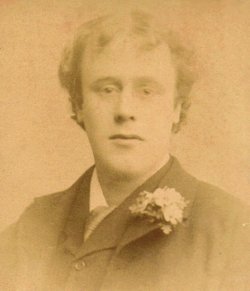
Count Eric Stanislaus (or Stanislaus Eric) Stenbock was a Baltic German poet and writer of macabre fantastic fiction. He was a symbol of his age, poet, decadent, short story writer, a true member of the aristocracy who mixed with the Socialists and radicals of the late Nineteenth Century. In his time he was known as a 'drunkard, poet, pervert, most charming of men' a description which serves to confuse more than illuminate. Stenbock's life in Brighton, London and Estonia gives us a window on to the complicated worlds of literature, art and fashion which characterised the late Nineteenth Century.
Stenbock was the count of Bogesund and the heir to an estate near Kolga in Estonia. He was the son of Lucy Sophia Frerichs, a Manchester cotton heiress, and Count Erich Stenbock, of a distinguished Baltic German noble family with Swedish roots which rose to prominence in the service of Gustav Vasa. Stenbock's great-grandfather was Baron Friedrich von Stuart (1761–1842) from Courland. Immanuel Kant was great-great-granduncle of count Eric Stenbock.
During his lifetime the eccentric Count Eric Stenbock published a single collection of short stories, Studies of Death. These seven tales, at once feverish, morbid, and touching, are a key work of English decadence and the Yellow Nineties.
W.B. Yeats called Stenbock: "Scholar, connoisseur, drunkard, poet, pervert, most charming of men." Arthur Symons saw him as "bizarre, fantastic, feverish, eccentric, extravagant, morbid and perverse."
In a short life - (he died at 36 in 1895) - he so impressed himself upon his contemporaries that the legends they tell of him in memoirs and anecdotes far outstrip the attention given to his writings.
Studies of Death: Romantic Tales appeared in 1894, ornamented with a striking frontispiece by its author. The seven stories reveal an original imagination and a spry, urbane style quite removed from the melancholy murmurings of the Count's verse.
Towards the end, the Count was mentally as well as physically ill. At Withdeane Hall he terrified the domestic staff with his persecution complex and his delirium tremens. On his travels he had been escorted, and with him went a dog, a monkey and a life-size doll. He was convinced that the doll was his son and referred to it as 'le Petit comte'. Every day it had to be brought to him, and when it was not there he would ask for news of its health.
He was buried at the Brighton Catholic Cemetery. Before burial his heart was extracted and sent to Estonia & placed among the Stenbock monuments in the church at Kusal. It was preserved in some fluid in a glass urn in a cupboard built into the wall of the church. At the time of his death, his uncle and heir, far away in Esbia, saw an apparition of his tear-stained face at his study window.
On the day of his death the Count, drunk and furious, had tried to strike someone with a poker and toppled into a grate. -- R. B. Russell
Stenbock creates an incredible and extremely chilling rendition of the Faustian myth. Note: This work is available in The Moons At Your Door, curated, edited and foreworded by David Tibet.
Faust is an epistolary tale told by a high-ranking clergyman about his conversation with a Monk, who got his hands upon a cursed and dangerous manuscript of the experiences of who in this story is 'Faust'; he believes he has reached the peak of human knowledge and is subsequently visited by 'Shaitan'('Lucifer') who deems himself the first and true son of God, he gives Faust instructions to visit a particular house within his city, and he does so, leading to an ensuing madness of cult worship, sacrifice, vampirism and soul-rending dialogues with The Beast. Stenbock portrays Faust through a very decadent era mindset (and being evidently very inspired by the Pre-Raphaelite Brotherhood), the story is a stunning fusion of Catholic thought, blasphemous Miltonian-Luciferian sympathies, the bending of gender and beauty in its divine forms and a refusal to treat the trinity with just beauty and holiness, but also terror and an unfathomable depth of realism and true divine power. For fans of the Faustian myth (Marlowe, Goethe), M.R. James, Sheridan Le Fanu, Pre-Raphaelite art and poetry, and to an extent Milton's Paradise Lost. 9/10
Beautiful decadent depiction of Morning Star, Lucifer as told via a "cursed" manuscript. I found the tale to be visually entrancing, pulling one into the depths of the scenarios as though standing there and witnessing it all from within. The juxtaposition between the beautiful and macabre is well done and the story never veers into kitsch or becomes overdone with morbidity. Short in length, a must read.