Faroe The Bradt Travel Guide is the first country guide dedicated to these unspoilt North Atlantic islands. Known for their towering cliffs and mountainous terrain, these islands offer a unique opportunity to experience nature in the raw. Hike through some of Europe's most unspoilt landscapes, explore traditional villages complete with turf-roofed houses, cycle round fjords and valleys or watch over 300 species of birds attracted by the abundant fish stocks of the North Atlantic. The Faroese capital, Tórshavn, offers a surprising number of lively bars and excellent restaurants where the catch of the day has to be tasted to be believed.
This guide
* Getting to the Faroes, by air and sea, including specialist tour operators * Comprehensive guide to the capital, Tórshavn * Suggested hiking routes across the islands, complete with maps * Natural history and wildlife in depth, with a guide to Faroese birdwatching * Practical information, including transportation around the Faroese archipelago
When I flew into the Faroes the weather was beautiful as we dipped and circled over the islands. I now realise how unusual this was, which explains why all the Faroese, as well as the foreign visitors, were craning over to take pictures of the cliffs and inlets from the windows. Seen from above, the geography of the place is very striking – both familiar and wildly exaggerated, like Scotland as reimagined by Game of Thrones.
I drove excitedly to my hotel to charge my camera batteries. By the time I stepped outside the door again, the whole place was draped in thick sea-mist and drizzle. It's said that Faroese has around forty words for fog, and I'm sure I experienced most of them during my week. Tórshavn, the smallest capital city in the world, with its pretty turf roofs and meandering alleyways, looked like a foggy Hobbiton. In the ‘cathedral’ (just a little church, really) they have model ships hung up from the ceiling between the chandeliers, and even though it was the middle of summer everyone had their woolly jumpers and oilskins on.
Luckily, the weather was different from place to place; driving out to another island, you could soon escape the precipitation and find blue skies again. And driving to other islands is a possibility thanks to the undersea tunnels which the Faroese are very proud of. Living in Switzerland, I though I knew tunnels. But the ones on the Faroes are something else. The one from Vágar to Streymoy had a ceiling all lit with coloured blue lights, so you really feel like you're driving under the sea, while the new one from Streymoy to Eysturoy is so big there's a huge roundabout halfway through.
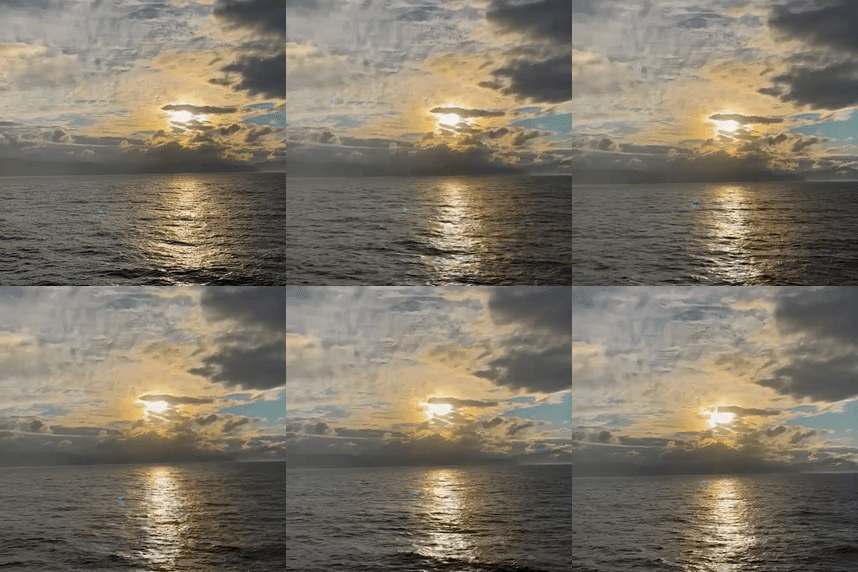
Some islands are still pleasingly disconnected, however. I had to take a boat down to Suðuroy, the most southerly and distant of the Faroes, a three-hour journey across (as they delighted in reminding me) some of the roughest seas in the world. I was lucky: the Atlantic was smooth as a mirror the evening I sailed, and after we exited the fog bank that seems to surround Tórshavn, I stood on the deck watching the sun drift down to a lazy late sunset. My mobile phone didn't work on the local cellular network, so it felt like travelling in the old days – phone booths at hotels, vague arrangements to meet people at certain times and places, and a lot of trusting to luck.
From the ferry to Suðuroy
The scenery is so dramatic that every time I came around a headland I found myself saying ‘Oh fuck off!’ out loud, although there's also something strange about it which I couldn't quite work out for ages. Eventually it occurred to me: there's no trees! The wind is too strong. Europe's strongest ever gusts of wind were recorded here (283 kmh in 2016), but regular winds of 160kmh (100 miles an hour) are common – nothing taller than the grass can really grow, which explains why in, for example, The Old Man and His Sons, the knowledge of how to scavenge driftwood is so valuable.
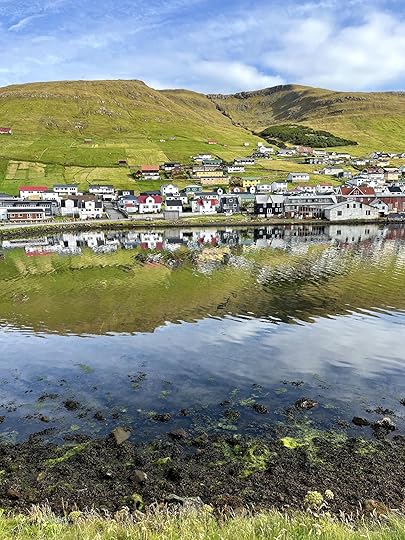
The ‘ð’ in Suðuroy is pronounced like a ‘w’, by the way – it's one of those letters that has more or less disappeared into its surrounding vowels now. Other letters are even less predictable. Vágur, in the picture at the top of the review, is pronounced, appropriately enough, something like ‘wow-er!’ (/ʋɔaːʋʊr/); the letter G can sound like w, k, ch, y, v, or can be silent. Basically when you come across a new Faroese word, you just have to roll a d20, pick some random consonants, and hope for the best. (James Proctor has a decent stab at explaining some of the basics in an appendix to this book.) Google Translate doesn't cope well with Faroese, but endearingly, the locals banded together to create their own version, Faroe Islands Translate, where you can type a phrase or word in and hear a local recite the translation.
I'm a vegetarian, but I knew I'd have to at least eat fish in the Faroes, which I certainly did. At one slap-up dinner I was served crispy cod skin, followed by deep-fried capelins, and then plaice en croûte; even the butter for the bread was mixed (deliciously) with cod roe. Luckily I was never offered whale, since I would probably have eaten it out of social awkwardness. The other main meat source is mutton, from the wispy-fleeced sheep roaming around everywhere. These were apparently brought over by Celts from Scotland more than a thousand years ago – native land mammals are something else the Faroe Islands doesn't have.
It compensates by having a shitload of birds instead. There are about twenty puffins for every man, woman and child here, and that's before you get to the innumerable gulls, fulmars, terns, gannets, and of course skuas (‘skua’ being the only word that English has taken from Faroese, according to the OED). This guidebook offers some useful tips on where to find nesting colonies of them all, which I might have tried if I'd had a bit more free time. Instead I just bought some more liquorice sweets and sat at the harbour, staring into the shifting fog and feeling very happy and far from home.
Fascinating overview of one of the least-known and most enigmatic parts of Europe. It manages to simultaneously make you desperate to visit… and incredibly wary of the treacherous seas, ridiculous gradients and lack of facilities in places. If you’re remotely interested in the Faroes it’s a must read
I found this guide really useful. I arrived in Torshavn from Reykjavik (city airport, not Keflavik) & the guide helped me quickly find the shopping district, the parliament, historic sites & art galleries. There is clear info on transportation links (bus, chopper, ferry, etc.), currency, medical & all hotels/restaurants with price points. There is also a breakdown of all the islands (not all are inhabited), how to get there & local tour operators. Because this book helped me plan ahead, I was able to pack a lot into a few days, truly a spectacular place to visit.
This is my first Bradt guide, and I'm hooked! This beats the pants off the Lonely Planet guide to Denmark and the Faroe Islands, perhaps understandably. I loved that it gave so much history, info on local flora and fauna, societal context, and pronunciation information (gravely needed in the case of Faroese, which is pronounced nothing like it's written). The author has spent a huge amount of time traveling in the Faroes, and it shows. Two-thirds of Bradt guides are about places obscure enough that there is no other guide to that locale, and they specialize in deep-dives into places that other guidebook companies probably wouldn't consider profitable due to the smaller audience. All of this creates a really unique guide, with so much specificity that you almost feel like you've already been there. "Ask in the village for so-and-so, who has the key to the historic church," or "start your hike at the fence on your left; cross the fence and follow the cairns as you begin to climb the steep hillside" are common levels of detail in this book. I checked it out on interlibrary loan but loved it so much that I bought my own copy to take with us in May.
We leave the Faroe Islands after a week today. The Bradt guide was really useful and to be honest doesn't have much competition. It's reasonably accurate with the only differences being new things that have opened.
Faroe Islands are fantastic in that they are not majorly geared up for tourism but at the same time have loads of things to do and hikes to walk. You really need a good guide book as villages often have a free functional WC but no cafe or Tourist Information so you need to know what's there and what you can do.
Alongside this make sure you download the visit Faroes Hiking guide BUT be aware some of there child friendly routes involve walking along the side of a mountain with a 50+ metre drop into sea or onto rocks. Love Faroe Islands but they are definitely people without fear!
The first and only English language guide book to the Faroes. This book was invaluable in my research prior to visiting the Faroes in July 2019. The Faroes are a group of islands in the stormy North Atlantic, located in the triangle formed by Iceland, Norway, and Scotland. These islands were carved out by glaciers during the last ice age, and are separated by long, narrow fjords. These sparsely populated islands are famous for dramatic landscapes and seascapes, as well as abundant bird life. I was fortunate to visit the Faroes on a photo tour in July 2019. Due to their location at 62 deg North, in summer, the sun rises around 3am, and sets about 11pm, there being only about 4 hours of twilight. This can make for beautiful, long lasting sunsets.
The book I read to research this post was The Brandt Guide to The Faroe Islands which is an excellent book which I bought from Amazon. The Faroes have no indigenous mammals although they nowadays have twice as many sheep as people. Torshavn which has a population of 19,000 is the capital and centre of any nightlife. They're roughly 300 miles from the Shetland Islands. The only airport is quite far from Torshavn and you have to go under quite a long tunnel which helps shorten the route. There national languages are faroese & danish. They are a self governing province of Denmark. There is a cathedral in Torshavn which is more like a church elsewhere there is a big cathedral which the church tried to make the locals fund but so strong was the feeling against it, it was never completed & still has no roof. Among the local delicacies are puffin breast & whale blubber. Whale blubber is an acquired taste. There are some of the highest sea cliffs in the world and these islands are something of a mecca for bird spotters. The islands are connected by ferry to Aberdeen although the sea tends to be quite stormy. There are flights from London Standsted & Copenhagen & the national airline operates 2 aircraft & flights are reasonably priced. A good way to visit the various islands is by helicopter.
A really good guide with loads of tips for smaller lesser known places in Faroes, as well as an introduction to the islands' history. Would be helpful if it included more maps.