two of The Justice Society of America travel to the past and rescue the Seven soldiers of Victory. But this rescue lands them on a parallel world where World War II has been raging for more than thirty years. But will the combined might of these awesome super-teams be enough to save this strange world. Age 12
Includes Justice League of America #91-92, 100-102, 107-108 & 113
Crisis on Multiple Earths volume 3 collects Justice League/Justice Society team-ups from issues 91-92, 100-102, 107-108, and 113 of Justice League of America.
Back when super hero comics weren't written for 30 year olds and allowed to be fun, the Justice League of America teamed with the Justice Society of America twice a year. In this volume, the teams battle a alien child and his missing pet, Iron Hand, Nazis, and Sandy, sidekick to the Golden Age Sandman.
Sure, it's a little hokey but it's also a fun read. The assembled teams retrieve the Seven Soldiers of Victory from where they've been scattered throughout the time stream after their final battle with the Nebula Man, liberate Earth-X from Nazis after WWII goes horribly wrong, and learn the dark secret the Golden Age Sandman has been carrying around all these years.
Some second stringers like Metamorpho, Elongated Man, and Red Tornado get a lot of focus. It's interesting that Wonder Woman lost her powers during this era and took to wearing a white jumpsuit. It's also interesting that Zatana and Black Canary were both wearing fishnet stockings with their costumes. Go, Fishnet Force!
While I found the collection a little slow going at times, it was fun to read about moments I'd only experienced in Who's Who as a kid, like the Seven Soldiers of Victory being restored and the Freedom Fighters being introduced. I also really liked the Earth-1 Robin wearing the Earth-2 Neal Adams Robin costume when his was shredded. Alan Scott and Hal Jordan reciting the Green Lantern oath at the same power battery was another high point.
Dick Dillin did the art on all of these and he was a workhorse. His art looks best with Dick Giordano's inks but whose doesn't? Len Wein wrote most of the tales and they have kind of a late 60s Marvel feel to them. However, most of them follow the "let's split up and battle different menaces" template but most team books of the era followed that path.
Crisis on Multiple Earths volume 3 provides a lot of uncomplicated fun from an era when comics weren't so damn serious all the time. Three out of five stars.
Seeing the differences from the first few issues to the last couple of issues was interesting. There was a definite shift from the 60s way of thinking. I enjoyed most of the stories that partnered the Justice League and the Justice Society, they were wacky but had some good team work! Overall, I enjoyed seeing the two teams once again work together to save both of their worlds!
This is a decent collection reprinting some of the old JLA/JSA team-ups. Although Mike Friedrich is credited as the author here, he only wrote one story, the rest are by Len Wein.
The first story by Friedrich, the weakest of the collection, is about an alien boy who is separated from his pet. They have a symbiotic relationship with each other, and as the boy is on one Earth and his pet on another, they are about to die. The League and Society think they're both monsters, however, and battle with them. Solomon Grundy shows up and makes things worse. To top it all off, the Robin of Earth 2, now a member of the JSA, and the Robin of Earth 1, who is attending college near where the alien boy is, are both treated like children by the adult heroes, thus setting off an bit of a generation gap which gets a bit silly by the end of the story. As with most of Friedrich's stories, the dialog and narration are just wacky, flower-child stuff that is hard to read and just dreadful.
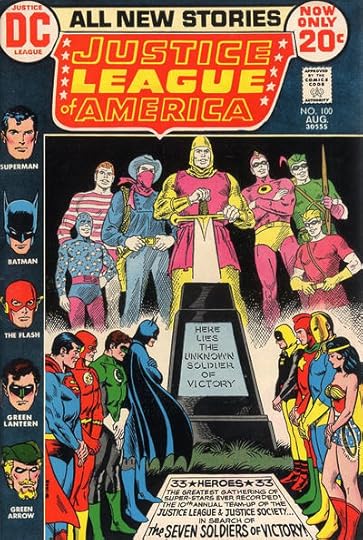
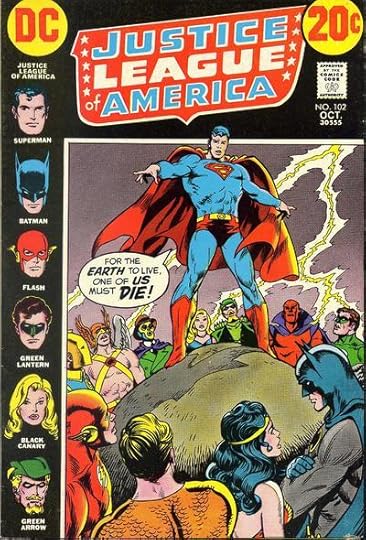
The next team up takes place in issues 100-102, and start a trend that continues for most of the rest of the JLA's existence: the introduction of a third set of heroes that set up the motivation for the adventure. Here, to celebrate the 100th meeting of the JLA, all the members, past and present, and honorary/reservists are featured or at least given a cameo, which is a nice touch. Zatanna and Elongated Man, not yet members, join fellow reservist Metamorpho as the combined forces of the JLA and JSA have to solve the mystery of what happened to the original Seven Soldiers of Victory from the Golden Age of comics. The story spans time and the various breakaway teams travel back to cave man days, the time of the Pharaohs, Robin Hood, and more. A pretty good tale over all and these three issues featured some fantastic Nick Cardy covers that have become classics in their own right.
Next up is the re-introduction of the Quality Comics super-heroes Uncle Sam, Phantom Lady, the Human Bomb, Doll Man, Black Condor, and the Ray. Trapped on a parallel Earth where the Nazis won WW2, members of the JLA and JSA, trying out their new transmatter cube, get shifted there and get caught up in the fight against the Nazi overlords of Earth. Once again, the heroes break up into smaller teams to take out the mind control ray used to subvert Earth's population. It takes the bumbling Red Tornado to save the day, but he gets a chance to knock out Hitler and that was fun to see.
The final tale is a rarity: a one issue JLA/JSA team up, in which the Sandman must confess to what really happened to his sidekick Sandy so many years ago, and why he donned his traditional trench coat and fedora rather than his yellow and purple spandex suit when he came out of retirement. It's a sad story in a way, and won't be truly resolved until thirty years later or so when Geoff Johns wrote the JSA in their own book. Nice compact story.
As always, penciller Dick Dillin does the impossible, drawing all of these characters with relative ease. His style is a bit stiff for today, but I still say he was a great artist and I still love seeing his work after all of these years. Joe Giella wasn't the best inker for him, but Dick Giordano completes the art in the last two set of stories.
Probably not the cup of tea most modern readers would enjoy, but these are solid comics from the early Bronze Era at DC Comics. I enjoyed reading them again after many years.
I've been listening to a podcast all about the Earth-2 stories of the JSA, and on occasion they will cover one of these crossover stories. I had an interest in getting one, and when I saw this one for only five dollars I figured, "What the hell, why not?". If you don't know, the JLA used to have annual team up with their Earth-2 counterparts, the JSA. This must have proved popular because these team ups started not long after the launch of the JLA title and continued until Crisis on Infinite Earth's, which destroyed the multiverse making the team ups no longer possible. The first story in the book is weak. Two aliens form a symbiotic relationship where being in close contact with each other is needed to keep them alive. A mishap sends one to Earth-1 (home of the JLA) and the other to Earth-2 (home of the JSA). Both teams fight the alien's until Robin see's that the alien is acting out of fear, rather than malice, and he figures out that the two aliens are looking for each other. They are able to get the aliens together, which makes their combined life force strong enough to be read by other members of their race, who then come and get them. And because they needed something to make this story a bit grander in scale, Solomon Grundy shows up to. The next story is better. A villain known as the Hand will destroy the earth unless his demands are meet. Both the JSA and the JLA are powerless to stop this. Doctor Fate does some magic mumbo jumbo and they find out that they need the Seven Soldiers of Victory to stop Hand from carrying out his plan. To bad no one knows how they are! After that the story turns into a rescue mission/exposition of what happened to the Seven Soldiers. After that comes the best story of the book where the JLA and the JSA are pulled to Earth-X, a world where the Nazi's won world two, and Uncle Sam and his Freedom Fighters still fight for America! I enjoyed this story the most. There is just something pleasing about seeing superheroes beat up Nazi's. The final story is only one issue. It's about a dark secret that Doctor Midnite was hiding from the group. As we all know though, secrets have a way of coming back to bite you in the ass! This book isn't bad. It's a bit corny at times, and the art isn't that great, but it's enjoyable. There are some great moment's in here (Hitler get's his head punched off!) that I enjoyed. I would say that if your a fan of silver and bronze age DC, this book is for you.
Volume Three reprints the JLA/JSA team-ups from 1971 through 1974, including the three team, three part team up that began in the 100th issue of Justice League of America. When reading these stories, I get a feeling that the writers and editors were saying to themselves, "How can we retell the basic story this year?" In 1971, Mr. Friedrich played with limiting the line up to characters who had counterparts on the other Earth. That particular team up seemed to focus on the theme of relationships. 1972's team up was the aforementioned three-parter sending the JLA and JSA on a quest to find the time lost Seven Soldiers of Victory. A year later, our heroes stumbled upon Earth-X where the Nazis won World War II. They help Earth-X's resident heroes, the Freedom Fighters, in a rematch. (These were comics I had actually owned back in the day. It was a pleasant surprise to turn a page and discover that Dick Dillin's image of Batman climbing the Eiffel Tower had been burned into my brain. Great stuff.) By 1974, the creative teams wisely tried a different tack and told a smaller tale focusing on the Sandman and his erstwhile partner, Sandy.
Another collection, another great cover. This time by Alex Ross. Once Len Wein takes over the writing chores, the stories get a little better. Dick Dillin's pencils continue to underwhelm, but are salvaged on occasion when Dick Giordano imposes somethin beyond a coloring book's flourish to them.
Not Recommended: if you can't some pretty typical early 70s DC stories.
Recommended for: fans of Earth-2 and those with nostalgia for this era in DC history, such as it is.
I've said it before and I'll say it here again: pre-Crisis JLA stories are hit or miss, mostly misses. The value was in the volume of heroes all in one book, instead of having to stretch that hard earned allowance amongst numerous single-hero books.
"The Creature in the Velvet Cage" hints at the potential yet to come, but if you're a latter-day JSA fan, it's worth reading. Not sure why they didn't include the non-crossover stories from #113, but otherwise a nice collection.
Strictly for fans, though. This is not gonna convince anyone what's so great about this book or these characters, let alone a non-comics reader.
If you want some SUPER HERO examples of LEN WEIN's genius you can't do better than this volume of JLA /JSA meet-ups! He gives us SEVEN SOLDIERS OF VICTORY... He gives us FREEDOM FIGHTERS OF EARTH X.. and tons of little character moments, such as after much time jumping the heroes rejoice in returning to the wonderful current 1978! And of course that ending saga in which SANDMAN COMES OUT and admits he's ruined SANDY's life.. Oh those complicated closeted heroes and their young patrons!
As I've discussed in previousreviews for this series, one of the things that attracted me to comics as a child was the sheer insanity of a multiverse. To my perhaps naive young mind, the story-telling options of a multiverse were so varied and diverse that I probably didn't understand why there were people who spent entirely too much effort complaining about continuity and forcing creative teams to attempt to "clean it up." I posited why the continuity police are so adamant that continuity be maintained elsewhere and so won't repeat it here, but eventually those fans had the loudest voices and thus were catered to--but not before readers got over two decades of the annual Justice League/Justice Society "Crisis" crossovers. This is the third volume of these crossovers.
In the last volume I pointed out that the volume was transitional as it began with stories from Gardner Fox, who was there at the dawn of the Golden Age of comics and had actually created the original Flash. It was his story "The Flash of Two Worlds" in The Flash #123 that started this "mess" and he and peer John Broome handled most of the Earth-1/Earth-2 crossovers in the beginning of DC's Silver Age. By the time of this volume Fox and Broome had retired and the "new wave" of comics writers, embodied by Roy Thomas on The Avengers and Denny O' Neil on Justice League of America (among others) were writing more sophisticated comic fare that didn't necessarily appeal to only children. This trend has continued, and ultimately may have encouraged the continuity police, who felt the need to have a chronology of their favorite characters. But that sort of thing was over ten years in the future, and this volume, which mainly features the work of Len Wein (known at that point for creating Swamp Thing with Berni Wrightson) and contains three stories that would have staying power for decades to come, reintroducing the Seven Soldiers of Victory and the Freedom Fighters back into the DC Universe (the Freedom Fighters Earth-X played a big role in the first attempt to clean up the continuity, Marv Wolfman's Crisis on Infinite Earths), as well as introducing the Sandman's side-kick Sandy as a super-powered silicon hero that would eventually be the leader of the modern Justice Society named Sand. Unlike the Seven Soldiers and Freedom Fighters stories, the Sand story is only a single issue--this is because at the time of publication Justice League of America was being published bi-monthly rather than monthly, and Wein and editor Julius Scwartz felt they couldn't justify a multi-part crossover taking over a third of the then scheduled yearly publication. Regardless of this, this volume really spotlights why Wein was really in demand for the 70s and into the 80s. The plot lines are intricate and detailed but not overly complex where readers get lost easily. Wein's work here helps accentuate the rich tableau of the DC multiverse that Wolfman felt he had to disentangle in Crisis on Infinite Earths. In some ways it is a shame that Wolfman's job in Crisis was to destroy places like Earth-X (and history has shown that it was probably a foolish endeavor anyway.)
This is the strongest of these volumes that I have read to date. I think this is partially because for the writers of Fox and Broome's generation, comics were for kids and even the storytellers didn't find the work all that gratifying (the story about Mort Weisinger effectively killing The Legion of Super-Heroes because he was trying to extricate himself from the business, but DC threw too much money at him for him to go is a prime example of this attitude.) The likes of Thomas, O' Neil and Wein had a different approach that were instrumental in helping legitimize the comic form as a storytelling medium. This volume is an excellent example of how the "new wave" of writers that came to the fore in the late sixties and early seventies created an environment where a middle-aged guy like myself can still enjoy what is effectively swashbuckling adventure even in my advanced age.
And so we come to the annual JLA/JSA cross-overs of 1971 through to 1974. The first of these four crossovers is written by Mike Friedrich, while the other three are from the pen of Len Wein. Having read all of these crisis/crossover books, it is a relief and a pleasure to be able to say that the quality established by Denny O'Neil is, if not equalled exactly, then at least not dropped back to Gardner Fox levels of inane.
Are these stories slight and silly? They sure are, but there is finally a differentiation between characters, and a sense that the Justice League exists within a wider DC universe that can be engaged in outside of these particular books.
As background (repeating a paragraph I wrote for Volume 2), the superhero craze of the ‘30s and ‘40s had died out by the onset of the ‘50s except for a few of the big hitters like Superman and Batman. Comics had largely moved on to westerns, romance and other genres. But DC editor Julius “Julie” Schwartz had the idea to revive the old superhero line and in 1956 started to bring them back but in new garb. He kept the name and general idea (Flash is the fastest man alive) but otherwise started anew. Audiences were once again introduced to these powered vigilantes and somehow, it worked a treat and superheroes took off again.
The Justice League was formed and then in 1961 writer Gardner Fox added a brilliant new twist when he had the Flash vibrate through the dimensional barrier to “Earth Two”. There all the original heroes of the '30s and '40s were alive and kicking as the Justice Society of America and readers learned that those old 1930/40s adventures weren’t wiped away - they had happened on another earth which our current heroes could go visit.
These days, multiverse stories are so common (Gardner Fox has a lot to answer for), it may seem hard to understand what the fascination was but there was a big audience for these crossovers; people loved seeing the old iterations team-up with their familiar Justice League heroes as these cross-overs became an annual event between 1963 and 1984. Why did they end? As writers kept adding more and more earths to play in, partly to find new angles and partly as DC bought other publishers like Fawcett and the rights to their characters, the whole edifice became unwieldy and it was resolved to shrink it down to one earth through 1984’s "Crisis on Infinite Earths".
The need for this re-boot is clearly planted here. Mike Friedrich's two-parter from 1971 ("Earth - The Monster Maker" and "Solomon Grundy - The One And Only") is the weakest of the bunch - an alien race which has co-evolved with another species so that they must be in constant contact or they each will die - sort of like a pet you really can't be away from. A child of this species and their pet are each thrown into Earth One and Earth Two and the countdown is on to find them. It's terribly silly but Friedrich just about gets away with it by infusing some rudimentary character beats (LIke the two Robins feeling like they always need to prove themselves) and a weak attempt at profundity in his narration which talks through all of the things which have found a partner or balance in our world. You can see how writers were struggling to come up with new reasons for the League and Society to interact and struggling to develope anything meaningful from interactions which only occurred once per year.
Wein writes the remaining three crossovers ('72 to '74) and his immediate answer to this is to inject more forgotten super-teams. The three part story from 1971 (Which included the 100th issue so had to be big) ("The Unknown Soldier of Victory", "The Hand That Shook The World", and "And One Of Us Must Die!") (re)introduces the Seven Soldiers of Victory who had appeared in DC's "Leading Comics" in 1941 and combined some of DC's lesser known heroes like The Shining Knight and The Vigilante. Wein makes it work because the plot embraces, as a central element, that no one remembers the Seven Soldiers though the summoning of the cosmic being, Oracle, to explain things is an incredibly easy out for a writer who should have worked harder to get the super-teams up and running. The use of the Seven Soldier's original first nemesis is.a nice touch but the eye-rolling I did when I realised that the "hand that shook the world" is not a metaphorical one but an actual hand was hard. (Where the does hand end?)
1973's two parter attempts to repeat the trick by introducing us to The Freedom Fighters - a bunch of heroes from a publisher called Quality Comics who had folded in the early 1950s and which had been bought by DC. The Freedom Fighters were a group dedicated to fighting the nazi menace, even after it had won World War II and taken over the globe. None of the Freedom Fighters gets much to do here. All we really learn is that Uncle Sam speaks like a distinguished Southern gentleman , and Black Condor can be kind of a dick. But that's it. There was a moment where I thought they were going to do something interesting and make the Freedom Fighters the bad guys - or at least heroes who had lost their way after fighting evil for so long - but no, that was just the Hitler android with another trick up it's sleeve. These guys were popular enough to get their own comic series a few years later though, based on the evidence here, it was surely the hook of a world after a victorious Germany had conquered it that got people curious, and not these anonymous empty costumes. Wikipedia tells met that that series had them cross over into Earth One in the first issues and spend the remaining issues on the run. They wasted the hook!
The final crossover, from 1973, is a one issue story ("The Creature in the Velvet Cage") and it actually works pretty well. It's small in scale, delaing with a secret that Earth Two hero The Sandman has been keeping; namely that he has been his former ward and sidekick, Sandy, (I know) imprisoned due to his having been exposed to some crazy substance in an explosion and becoming a monster. Sure, there's some silly fighting with the super team members mixing it up so we can see them interact but it is the guilt that The Sandman feels which is what sticks in the mind after reading. Proof again that the stakes don't always have to be the universe; a man's view of himself is more than enough.
Overall, this was a fun and pleasant read. Reading these old comics is part of my own project to understand more of the history of the characters, the DC universe and how comics evolved and it is certainly good for that. Although the writing and the awareness of the medium's strengths and limitations continues to grow, these stories remain fairly slight and inconsequential - if amusing. It is their historical value that makes them most interesting. Though maybe a four or five year old would find them gripping. Hmmmm.
A great collection of classic stories. Some are pretty silly, and the Earth-2 Robin's Batman derived costume always struck me as incredibly silly. However, I did like then and still do like the Neal Adams designed Robin costume.
These stories were some of the better JLA/JSA yarns and having them collected in one place is qualifies as a Good Thing.
Tomo 3 de 14 del Box Set y tercero de seis de los plateadísimos Crisis on Multiple Earths en una edición hardcover preciosa, aunque los tomos individuales no tengan ISBN propio.
This volume contains four stories from the JLA from the 70's (a two parter, a three parter another two parter and a one parter).
The first is written by Mike Friedrich who was a very poor writer (at least IMO) and his two parter here is a great example of his bad writing. Super heroes that act like bickering teens, that don't use their powers effectively and have a really dumb menace to overcome (an alien boy and his dog). the less said about Mike and his uninventive writing the better. It is shocking for me to read a lot of these old JLA tales and see the lack of effort put in by the writer to use the heroes in their stories effectively and use their powers in a creative way. That's why (for me) the old Fox Gardner tales are still superior. Yes they have zero character development (i.e. every hero has the same personality) but at least there is some cleverness to the tales and how the heroes win in the end. Mike just has them go in fist a punching - fail miserably - and then solve the problem (two issues and 6 fights later) by talking to the alien boy.
The next three are written by Len Wein and you can see immediately how much better a writer he is. The first three parter is a classic tale that combines the JLA/JSA and the long forgotten Seven Soldiers of Victory. I am not saying it is perfect but at least there is some fun in it and we get the heroes splitting into groups (like Fox used to) so it is is easier to follow the action. This is the best tale of the punch and worth the price of admission.
Next we have a two parter with JLA/JSA and the Freedom Fighters (a group Len created from old heroes that DC had acquired). It was so popular, the Freedom Fighters got their own series briefly in the 70's. It's a fun tale but sadly we barely get to know the Freedom Fighters. It would be nice if they got a little time to shine, beyond just fighting. But sadly, this was DC and unlike Marvel they had trouble building personalities in their characters.
Then we have a one part tale that focuses on Sandman. It actually has some good drama in it. But don't think too much about it or you will wonder why Sandman imprisoned his sidekick and kept him unconscious for a decade instead of asking anyone for help to cure him.
And before I go I would be remiss if I didn't say these were all drawn by Dick Dillin and he is still one of my least liked artists in the history of comics. There are ones that are worse but he had a stranglehold on the JLA comic for over a decade and thus deprived my fav comic of getting a good artist. I do like how Len Wein defends Dick in his intro (you see that in the next intro to volume 4 too) and says he was underappreciated. Translated that means "He was a nice guy in person but the fans never got to meet him so all they knew was how bad an artist he was". Why do I hate his art so much? Static poses, poor panel layout, the same poses over and over again. Everything is flat and uncreative.
Overall - this one is for true fans of the JLA only. But if you are a fan, it is some silly 70's fun.
The many adventures between the JLA and the JSA causes the heroes to experiment further, eventually opening a rift into other parallel universes, including Earth X, where the Freedom Fighters try to keep America safe from the Nazi Occupation.
The multiple earth concept allows for a bit of fun, but it begins to become clear here why the 'Crisis on Infinite Earths' was inevitable. As the adventures develop and the writing becomes more experimental, the artwork maintains its high levels making this volume a good showcase of DC talent in the seventies.
The JLA/JSA crossovers were always a ton of fun. In this volume, with stories from the 1970s, one team-up involves an alien kid and his pet getting separated, with one sent to Earth 1 and the other to Earth 2, both in a rampage as they desperately look for one another.
Two others revive Golden Age characters. The Seven Soldiers of Victory are key characters in one team-up, while the Freedom Fighters (a group made up of more obscure Golden Age heroes) get JLA/JSA help in defeating Nazis (who, on their Earth, has won World War 2).
It all really is great fun--fast-paced, wasting no time in diving into the plot, full of unabashedly comic booky plot twists.
I loved reliving these great Justice League of America and Justice Society of America team-ups from the early 1970's. It was terrific to see both teams meet "The Freedom Fighters."
A must read for any fan of any fan of any of the above mentioned teams!
the reason i collect comic books. The Sandman story was one of the the first superhero stories i read, they've age well. only a coincidence i picked the book up on the day Len Wein's death was announced.
Justice League of America #91-92 - There is definitely an attempt here to offer some characterization and some consistency of superpowers in this first story in the volume. This initial super-team mashup also tries to offer some social commentary, much falls flat, but there is still an attempt at some larger themes other than the usual DC message of Super-might makes right.
Justice League of America #100-102 - A 3-issue story, wow! And this is the first one of these super-team mashups that I’ve actually enjoyed. Yes, some of the typical super heroic cliches are a bit thick, but it was fun and it didn’t insult the readers intelligence (at least not as horribly as the previous JLA/JSA mashups have). So these volumes are definitely improving, at least as long as the rest of this volume is at least as enjoyable as this 3-parter was.
Justice League of America #107-108 - After the apparent increase in quality for the last anniversary super-team mash-up, I had high expectations for this one. Also, as I had been interested in the Freedom Fighters characters from having picked up several issues of their title back when it was first published, I thought it would be a fun reintroduction of the characters for me. Should not have gotten my hopes up. This was pretty much just a rehash of the previous anniversary mash-ups with a different mix of characters and a different goal, but the structure of the narrative was exactly the same. And it was just kind of boring. And stupid. Because? Sure, punching a computer is totally the most effective way to end the tyrannical reign of a Nazi regime.
Justice League of America #113 - Oh my. What the hell was that? This anniversary meeting was a mess. Figuratively and literally. I don’t even know where to begin. There are moments when people writing superhero stories really should just recognize that they have nothing left to offer the industry. Clearly, this is one such moment. This is basically the end result of the methodology of virtually all DC stories that I’d read as a little kid: beat up your opponent before they beat up you, super-might makes your bullying right. This is the whole deranged, narrow-minded belief that fuels the white male savior mentality that is so embedded in western civilization. What’s interesting is that it is called out in the story, not by name, but by the actions of the so called heroes. It’s finally even acknowledged that if they’d listened, instead of punching they might have accomplished a whole lot more.
As this third volume comes to close, I’m again reminded why I didn’t read many DC comics as a little kid. They were mind-numbingly dull and fueling the mentality that having a strength or power meant that using it to get your way was your god granted right. It is like the moral embedded in virtually all of the classic stories of the western genre: having a gun was an extension of your righteousness and thus your godliness. Much of the superhero genre, continues these western male power fantasies and unfortunately most of the worlds problems are not going to be solved with a gun, or punching out a computer or ... stitching a magic lasso through a fault line.
Another collection for fans old and new concerning the Justice League and Justice Society as emergencies from these two different Earth's come together. As in the previous collection, DC Comics takes fans back in time to when certain events came to fruition to create the 70+ of enduring comic book heroes.
This collection continues more of these stories but the writing of them is terribly dated. Poorly told, weak art and silly. Some stories are truly forgettable. But there is one nice speck of gold found in this smear of dirt in what's known as the Crisis on Earth-X, a world in which the Nazi's won World War II and how the allies are defeated, but a force of Freedom Fighters come together to defeat the Third Reich with the help of the Justice League and the Justice Society.
CW has recently adapted this story, but to be honest does it poorly. Omitting many of the great characters - how could they not include the Great Spirit of America? One day I want to right a better version of this story. No I didn't spell write wrong, I meant right as in right a wrong.
Other stories in this collection are pretty forgettable. Could do better. D+
This volume of JLA/JSA Team-ups has the heroes of Earth-1 and Earth-2 help a boy and his dog reunite while being snobby to both Robins, then we get the epic 3 part tale of "whatever happened to the Seven Soldiers of Victory," the next adventure reintroduces the Freedom Fighters on their new home of Earth-X where the Nazis won the war and a smaller scale story about Sandman's dark secret.
reprints, among other things, Justice League of America 100-102, the saga of the Seven Soldiers of Victory, which was the kernel in lil'Grant Morrison's mind that would later lead to his modal superhero comics epic masterpiece, Seven Soldiers.
As a kid the annual JLA/JSA team ups were always my favorite issues, so to finally be getting them all collected like this is a dream come true for me. I'm also a huge fan of the Seven Soldiers of Victory and time travel stories, so it doesn't get any better than this!
I was always a big fan of the JLA/JSA crossovers when DC had the multitude of worlds before their revamp in "Crises on Infinite Earths". Great stories and good art and a ton of heroes in each story. Very recommended
Well I'm not a huge fan of these stories. The actual crises are cool, but it just doesn't do it for me. The art isn't bad, but some of it is just straight propaganda.
Libro de historietas con ISBN compartido con el resto de la colección. Edición estadounidense que forma parte del Box set de Crisis. Hubo ediciones similares con contenido muy similar o igual.