

What do you think?
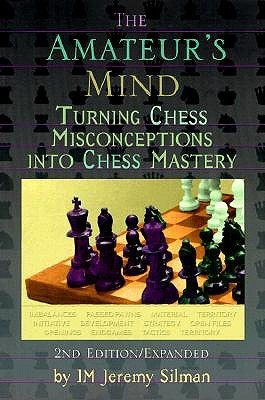
The Amateur's Mind: Turning Chess Misconceptions into Chess Mastery
This book takes the student on a journey through his own mind and returns him to the chess board with a wealth of new-found knowledge and the promise of a significant gain in strength. Most amateurs possess erroneous thinking processes that remain with them throughout their chess lives. These flaws in their mental armour result in stinging defeats and painful reversals. Books can be bought and studied, lessons can be taken -- but in the end, these elusive problems always prove to be extremely difficult to eradicate. Seeking a solution to this dilemma, the author wrote down the thoughts of his students while they played actual games, analysed them, and catalogued the most common misconceptions that arose. This second edition greatly expands on the information contained in the popular first edition.
443 pages, Paperback
First published January 1, 1995
Ratings & Reviews
Friends & Following
Create a free account to discover what your friends think of this book!
Community Reviews
Displaying 1 - 30 of 61 reviews

January 9, 2008
Now you know how to play, you've picked up a few tactical tricks, maybe learned a few openings and common variations... what next? This book can teach anyone how to develop good plans in chess. It outlines a nice system for reading the board to develop strategic insights, so you can move beyond "OK I do this, then he does that, then I do this..." analysis. I think the author is unusually insightful about how the average player approaches the game and thinks about it; if you know you will read a maximum of one chess book in your life, make this the one.

August 21, 2012
For a review of this book I could say, "see my review of How to Reassess Your Chess: The Complete Chess Mastery Course since I talked mostly about this book in that review." But that's ok, I'll say more, because I could go on and on about this book. I never had so much fun reading a chess book in my life.
I read this book many years ago, and I bought thin flat metal chess board the size of a notebook page with flat magnetic pieces and played along with the games in the book, reading Jeremy's witty, insightful, unforgettable comments and analysis of the moves of amateur players. I am an amateur player. If you show me the games of grandmasters I won't understand them. But with this book, I was able to follow along and learn more from the mistakes of beginners and average club players and from Jeremy's criticisms of these moves than I ever could from a book written way over my head about players whose moves I don't understand.
My rating went from 1300 to 1800 from reading this book. I have since studied other good chess books but none were ever as memorable and helpful as this one and How to Reassess your chess. I cannot say enough about what a helpful book this is. Jeremy Silman is a pioneer in chess teaching because he allows his readers to learn from the mistakes of other players. Most of us have to learn from mistakes, that's how we learn, and Sillman recognizes this and that's why he is so helpful.
For example, even while playing game today the curse of the mindless king hunter, and the fear of ghosts (threats that aren't there) will come to mind. I am planning to purchase this book again, since my original has been studied to pieces, and reread it. It's worth it for the entertainment alone. Who knew chess lessons could be this fun.
I read this book many years ago, and I bought thin flat metal chess board the size of a notebook page with flat magnetic pieces and played along with the games in the book, reading Jeremy's witty, insightful, unforgettable comments and analysis of the moves of amateur players. I am an amateur player. If you show me the games of grandmasters I won't understand them. But with this book, I was able to follow along and learn more from the mistakes of beginners and average club players and from Jeremy's criticisms of these moves than I ever could from a book written way over my head about players whose moves I don't understand.
My rating went from 1300 to 1800 from reading this book. I have since studied other good chess books but none were ever as memorable and helpful as this one and How to Reassess your chess. I cannot say enough about what a helpful book this is. Jeremy Silman is a pioneer in chess teaching because he allows his readers to learn from the mistakes of other players. Most of us have to learn from mistakes, that's how we learn, and Sillman recognizes this and that's why he is so helpful.
For example, even while playing game today the curse of the mindless king hunter, and the fear of ghosts (threats that aren't there) will come to mind. I am planning to purchase this book again, since my original has been studied to pieces, and reread it. It's worth it for the entertainment alone. Who knew chess lessons could be this fun.

July 25, 2024
تقریبا همه ما ها نحوه حرکت مهره های مختلف شطرنج و یا چندتا اپنینگ مختلف رو بلدیم. ولی قضیه از اینجا جالب میشه که خب اپنینگ رو اجرا کردیم حالا چکار کنیم. یا بازی بزرگان شطرنج مثل کارلسن و کاسپاروف و تال رو میبینیم و دلیل پشت ۹۰ درصد حرکت هارو نمیفهمیم.
جرمی سیلمان استاد بین المللی شطرنج تو این کتاب میخواد که به آماتور ها یاد بده که شطرنج خیلی عمیق تر از نحوه حرکت رخ و اسبه و تو این کار هم نسبتا موفق هست. کتاب از طریق تجربیات سیلمان با شطرنج آموز! های خودشه و اشتباهاتی که تو ذهن آماتورها هست رو نمایش میده و سعی میکنه که برطرفشون کنه.
کتابش کاملا قابل فهم و ساده با طنز خاص سیلمان و اصطلاحات به خصوص خودش نوشته شده که برای خوندنش به فایل pgn یا یه دست شطرنج معمولی نیاز دارین. البته من کورس چسبلش هم داشتم که مفید بود.
ریتینگ الو من در حین و بعد از خوندن این کتاب کاملا پیشرفت کرد و از حدود ۱۳۰۰ به حدود ۱۶۰۰ رسید. اگر ریتینگ الو ۸۰۰ تا ۱۸۰۰ دارین این کتاب خیلی براتون مفید خواهد بود.
۱۴۰۳/۵/۴
جرمی سیلمان استاد بین المللی شطرنج تو این کتاب میخواد که به آماتور ها یاد بده که شطرنج خیلی عمیق تر از نحوه حرکت رخ و اسبه و تو این کار هم نسبتا موفق هست. کتاب از طریق تجربیات سیلمان با شطرنج آموز! های خودشه و اشتباهاتی که تو ذهن آماتورها هست رو نمایش میده و سعی میکنه که برطرفشون کنه.
کتابش کاملا قابل فهم و ساده با طنز خاص سیلمان و اصطلاحات به خصوص خودش نوشته شده که برای خوندنش به فایل pgn یا یه دست شطرنج معمولی نیاز دارین. البته من کورس چسبلش هم داشتم که مفید بود.
ریتینگ الو من در حین و بعد از خوندن این کتاب کاملا پیشرفت کرد و از حدود ۱۳۰۰ به حدود ۱۶۰۰ رسید. اگر ریتینگ الو ۸۰۰ تا ۱۸۰۰ دارین این کتاب خیلی براتون مفید خواهد بود.
۱۴۰۳/۵/۴
April 28, 2011
I'm a casual player and don't study or practice ever. But I'm just interested enough to consider reading a book on chess from time to time. The Shredder app I have on my phone pegs me at 1450 Elo rating, and I'm probably at the bottom range of what level player might find this book useful.
I enjoyed the format where Silman annotates games against his students, including their thoughts on why moves were made, and his notes on these thoughts. A majority of the content relates to the middle game, and so there isn't too much strict theory on what is the correct move.
One of my weaknesses is having gotten through an opening in fair shape, how to best proceed with figuring out and acting on a plan for what should come next. This book gives a nice framework to use for analyzing the basic aspects of a position which focuses on listing the imbalances (in material, development, space, pawn structure, etc.) which are all simple enough that I can at least grasp the basics. Once you have a handle on where each side stands in relation to these imbalances, you have a fighting chance at figuring out how to capitalize on your strengths and attack the other side's weaknesses. You also come away with a better sense of when/what pieces it makes sense for you to exchange through the middle game.
It's all written in clear English and like most self-study you get more out of it if you put more into it. But I'm proof that even very little effort in the book can be helpful. I particularly appreciated Silman's reminders, amidst all the tactics discussions, that self-confidence and a positive attitude are prerequisites for strong play. If you are afraid to lose, or are certain that your opponent will beat you, you are doomed from the start. That is one simple adjustment that every player can make to help their game.
I enjoyed the format where Silman annotates games against his students, including their thoughts on why moves were made, and his notes on these thoughts. A majority of the content relates to the middle game, and so there isn't too much strict theory on what is the correct move.
One of my weaknesses is having gotten through an opening in fair shape, how to best proceed with figuring out and acting on a plan for what should come next. This book gives a nice framework to use for analyzing the basic aspects of a position which focuses on listing the imbalances (in material, development, space, pawn structure, etc.) which are all simple enough that I can at least grasp the basics. Once you have a handle on where each side stands in relation to these imbalances, you have a fighting chance at figuring out how to capitalize on your strengths and attack the other side's weaknesses. You also come away with a better sense of when/what pieces it makes sense for you to exchange through the middle game.
It's all written in clear English and like most self-study you get more out of it if you put more into it. But I'm proof that even very little effort in the book can be helpful. I particularly appreciated Silman's reminders, amidst all the tactics discussions, that self-confidence and a positive attitude are prerequisites for strong play. If you are afraid to lose, or are certain that your opponent will beat you, you are doomed from the start. That is one simple adjustment that every player can make to help their game.

April 8, 2008
This book is the definitive introduction to strategic chess, where the player goes beyond sheer tactics and calculation to build a more abstract understanding of the wonderful game of chess. Most examples come from games from amateurs, which makes them far more approachable to the average player. Silman's writing is very clear and entertaining, and his selection of material and exercises outstanding.
July 1, 2009
How to control knights - take away their advanced posts.
How to use knights - give them advanced posts.
How to value knights v.s. bishops and use that imbalance to work for you. If you find yourself with a bishop difference, work to open the game and get passed pawns on both sides. If you find yourself with a knight, work to keep it closed, and get passed pawns on only one side, and work to give them an outpost.
How to use knights - give them advanced posts.
How to value knights v.s. bishops and use that imbalance to work for you. If you find yourself with a bishop difference, work to open the game and get passed pawns on both sides. If you find yourself with a knight, work to keep it closed, and get passed pawns on only one side, and work to give them an outpost.

May 4, 2018
The first chess book I've read that did not bore my amateur, casual mind to tears. I really appreciated all the examples, but it is hard to follow if you do not set up a board to follow along, as there are usually only the initial board placements shown in the diagrams. It can make progressing through the book a bit tedious, but it is well worth it. I am able to see what lazy mental chess-playing habits I have picked up over the years, and with my new awareness, try and better my play.
Highly recommend this book!
Highly recommend this book!
April 27, 2008
A modern chess classic, this book is a great primer for folks who want to go from just pushing wood to truly playing the game of chess.

January 27, 2008
This is easily my favorite chess book. It vastly improved my game.

February 11, 2022
At first this seemed to advanced for me — I’ve played chess a lot but never *studied* it. But soon I was learning concepts and storing them away for future games, and I think my game is a lot better for it.
(I published a longer review on my website.)

September 1, 2014
Great book. A new classic.
Jeremy Silman is one of the best chess authors nowadays. In a great writing style and easy to follow, he dissects chess thinking as few. He introduces many chess concepts and, through the reasoning of amateur players ( based on his notes with amateur players thinking out loud), he shows how to avoid amateur thinking. This will improve your game drastically.
This book is all about imbalances. In each of the chapters, he describes an imbalance and, through examples, invites the reader to analyse the position in this framework. It is a great book for everyone, specially beginners, as its imbalances framework is a great guide to analyse positions. The main ideas I captured from it ( and can remember):
*Reasoning at all stages of the game:
1. Before analysing moves, analyse the position first !
2. Break down it into imbalances for both sides
3. MAKE A PLAN based on your imbalances
4. Think about moves to achieve it
* Chess is a psychological game. Don't be sidetracked by your opponent's moves. Carry on with your plan
* Do not react to imaginary ghosts
* Do not simply react to your opponent's moves. Improve your position in each move.
* "What wonderful thing does this move bring to my position"?
Other chess concepts like "trade your opponent's bishop pair" and "make your knight better than your opponent's bishop" can be seen in several books, but probably not the "avoid amateur thinking" way he introduces in this book.
As an aside. Silman suggested reading this book after the first couple of chapters of How to Reassess your Chess. After reading it, you should come back to HTRYC. I couldn't agree more.
Jeremy Silman is one of the best chess authors nowadays. In a great writing style and easy to follow, he dissects chess thinking as few. He introduces many chess concepts and, through the reasoning of amateur players ( based on his notes with amateur players thinking out loud), he shows how to avoid amateur thinking. This will improve your game drastically.
This book is all about imbalances. In each of the chapters, he describes an imbalance and, through examples, invites the reader to analyse the position in this framework. It is a great book for everyone, specially beginners, as its imbalances framework is a great guide to analyse positions. The main ideas I captured from it ( and can remember):
*Reasoning at all stages of the game:
1. Before analysing moves, analyse the position first !
2. Break down it into imbalances for both sides
3. MAKE A PLAN based on your imbalances
4. Think about moves to achieve it
* Chess is a psychological game. Don't be sidetracked by your opponent's moves. Carry on with your plan
* Do not react to imaginary ghosts
* Do not simply react to your opponent's moves. Improve your position in each move.
* "What wonderful thing does this move bring to my position"?
Other chess concepts like "trade your opponent's bishop pair" and "make your knight better than your opponent's bishop" can be seen in several books, but probably not the "avoid amateur thinking" way he introduces in this book.
As an aside. Silman suggested reading this book after the first couple of chapters of How to Reassess your Chess. After reading it, you should come back to HTRYC. I couldn't agree more.
July 13, 2022
Very nice analysis of the thought processes of the amateur player. Common pitfalls are discussed and this helps the reader understand his own thinking and how to improve it. The writing style is informal and funny and makes it a nice experience to work through the book. Not many typos. In the light of many people praising this book so much, a remark is in place. The main problem with this book is a structural one; the author tries to do two things at the same time and doesn't quite succeed in either of them. Firstly, this book is an analysis of the amateur's way of thinking, and secondly, it is a course in positional understanding (with tactics hardly playing a part!). These two goals are not simultaneously reached. The issue is that, on the one hand, most of the text discusses moves that should not be played, it therefore being a poor guide in correct positional chess. And on the other hand, by solely focussing on the positional aspects and leaving out the tactical picture, the analysis of the amateur's mind is rather limited in scope. The best part is perhaps the last section with the test positions, which involves nice feedback on your own thinking. I really enjoyed this bit. This book contains a lot of good stuff and many players can learn a good deal from it, but this is not the best chess book in my opinion. I prefer more structured approaches. One minor point: I hope they change the cover in newer editions, because this one is horrible. Something like the 4th edition of his other book How to Reassess your Chess looks much much better.

January 22, 2012
Great work involved in creating this book, it took me 2 years to finish it but I have to appreciate its consistency. Mr Silman teaches you to play by the imbalances of the board, I think it is a strong and long term approach. We, amateurs, just learn 2-3 openings, basic endgames and we are just searching for tactics, he just take it to a superior level, he is definitely one of the greatest chess writer. I would dream to read a book written by Silman and Zenon!

November 24, 2011
You'll have to spend some time with this one, but it will well be worth it. I've spent months reading it, working fully through each diagram and taking notes, but no other book has helped my game this much. Put in the effort and you will be rewarded.

May 6, 2009
Great Chess Book! Silman is one of the Chess Authors that i can understand.

December 12, 2022
Jeremy Silman’s snappy commentary and prodigious skill and experience shine in “The Amateur’s Mind”. This book is a perfect primer for someone wanting to start really thinking deeply and critically about middlegame strategy and positional play. I would recommend this book for a player around the 1100-1200 range. Readers familiar with Silman’s other works will find a lot of parallel content between “The Amateur’s Mind” and “Reassess Your Chess”, though the latter is probably more suited for players in the 1400-1600 range, making this book an excellent primer for his more difficult content. Several chapters stuck out, including his sections on Knight Vs. Bishop imbalances, ‘The Curse of the Mindless Kinghunter’, and the 28 annotated games that serve as tests for the reader.

November 9, 2021
The amateur's mind was my opportunity to sit across the board of American International Master Jeremy Stillman while he squints, squirms and berated you as you make mistakes.
In each section, different levels of players share their thought process before every move. I'm not sure why more chess books don't employ this method, it's illuminating to hear the rationale.
What I've really taken from these matches is the importance of appraising imbalances. Also that it's all very well learning about imbalances but you have to actually force yourself to use them in your appraisal. Generally, the more experienced the players, the clearer, considered and patient their thinking.
In each section, different levels of players share their thought process before every move. I'm not sure why more chess books don't employ this method, it's illuminating to hear the rationale.
What I've really taken from these matches is the importance of appraising imbalances. Also that it's all very well learning about imbalances but you have to actually force yourself to use them in your appraisal. Generally, the more experienced the players, the clearer, considered and patient their thinking.
Want to Read
July 16, 2024as a lowly 800, I don't think I'm ready for this book yet. most of it is intermediate-level players trying to navigate closed positions from super-GM games and doing a very poor job—I didn't do any better, without the nuanced positional understanding I was hoping this book would teach me!
definitely one to revisit once i'm less terrible at chess
definitely one to revisit once i'm less terrible at chess

February 1, 2017
I enjoy playing Chess, but I am terrible at it. So I decided to read this book and see if it could help me out somewhat. Most of what I gained from this book was the idea of a plan. It doesn't necessarily have to be Checkmate. Silman is a fan of looking at imbalances and seeing what the board has to offer and responding accordingly. So he takes some games from Masters and goes over them, followed by a section where one of his rated students go and try to copy the moves. Silman also does one better by telling the student to say what they are thinking and why they did what they did. So they annotate their moves and then Silman chimes in with his own input. It's pretty well done, but as I am terrible at this game, I don't really have much else to say.

September 10, 2012
While Silman may only be an IM, he writes great chess books for those of us who aren't grandmasters. Reassess you chess, his great learn chess book, is a great book to read first. This book goes into the mind of the armature and shows us what we think and why it's wrong. This book should improve you play!

November 1, 2014
Excellent book for learning how the chess master thinks, against opponents who make the kinds of mistakes normal tournament players are likely to see themselves (as opposed to the mistakes found in typical books about games between grandmasters, in which the errors are so slight its hard to see that one has been made at all until well into the process of exploiting it).
November 10, 2020
A great introduction to chess strategy. Before this book I would feel at a loss in many positions with no idea how to come up with a plan. Silman gives you a framework that helps you break down a position and shows you where to look. Really liked it and felt it had a positive impact on the way I play.
January 29, 2011
I cannot understand this book at all. Will seek a tutor.
March 1, 2012
One of the best chess books, slightly let down by the condescending tone and attitude he has towards the mistakes his students make.

February 15, 2014
One of my all time favorite chess books.

June 11, 2016
One of the best books I've ever read. It gives you an insight into how your mind works, not just with chess, but with life!

November 22, 2022
I used to play chess a long time back and found a long lost interest in it during the covid times. So coming back to the game after 2 decades, i decided to catch up on the reading - and i remember reading this book a long time back - so it was a natural choice to pick up again.
But it also reminded me a lot has changed in the world of chess. Back then we had an expensive chessbase and probably books - but now you have free stockfish, chessable, lichess and chess.com - sothings are different.
In any way - is the book good? Yes and No. It's difficult to stand the test of time, and even more test of stockfish. There are many examples where Silman makes claims about the position only to be proven wrong by Stockfish. Diagram 86 is an example where Silman exclaims white has a great kingside attack and should be winning, but stockfish gives it a -3.1 (which means black is equivalent to a piece up).
However, despite the faults - the book serves it's intended purpose. To enlighten an amateur to the art of planning in chess. Keep in mind the exact nuances of advanced tactical play would well be outside pretty much all intended audience (i am at 1900 in lichess rapid, that icnludes me as well). SO if your rating is around 1500 or lower, you will definitely learn form this book. I would say even people with rating below 2000 will be learning a few things form this book.
But it also reminded me a lot has changed in the world of chess. Back then we had an expensive chessbase and probably books - but now you have free stockfish, chessable, lichess and chess.com - sothings are different.
In any way - is the book good? Yes and No. It's difficult to stand the test of time, and even more test of stockfish. There are many examples where Silman makes claims about the position only to be proven wrong by Stockfish. Diagram 86 is an example where Silman exclaims white has a great kingside attack and should be winning, but stockfish gives it a -3.1 (which means black is equivalent to a piece up).
However, despite the faults - the book serves it's intended purpose. To enlighten an amateur to the art of planning in chess. Keep in mind the exact nuances of advanced tactical play would well be outside pretty much all intended audience (i am at 1900 in lichess rapid, that icnludes me as well). SO if your rating is around 1500 or lower, you will definitely learn form this book. I would say even people with rating below 2000 will be learning a few things form this book.

March 26, 2021
Absolutely brilliant exposition on the concept of imbalances. Master Silman is a fantastic teacher and writer, who not only imparts the wisdom of chess, but also makes it an enjoyable experience.
By showcasing the mindset of amateur players from 800 to 2100 ELO range, he is able to appeal to every level of amateur players and point out the flaws in their thought process by allowing them to relate to his students. I have read a few books on Grandmaster games, and a lot of the ideas simply flew over my head. This was definitely not the case.
His holistic approach of evaluating imbalances first, before looking for candidate moves (instead of looking for candidate moves immediately and calculating every possible variation) leverages the human mind's creativity, reasoning, and critical thinking abilities to maximize chances of victory. After all, we are not engines and should not attempt to mechanically crank out every possible move order.
I will be sure to take these concepts and apply them to my own games, both online and over the board.
By showcasing the mindset of amateur players from 800 to 2100 ELO range, he is able to appeal to every level of amateur players and point out the flaws in their thought process by allowing them to relate to his students. I have read a few books on Grandmaster games, and a lot of the ideas simply flew over my head. This was definitely not the case.
His holistic approach of evaluating imbalances first, before looking for candidate moves (instead of looking for candidate moves immediately and calculating every possible variation) leverages the human mind's creativity, reasoning, and critical thinking abilities to maximize chances of victory. After all, we are not engines and should not attempt to mechanically crank out every possible move order.
I will be sure to take these concepts and apply them to my own games, both online and over the board.

August 12, 2020
This is an excellent, in depth book for the beginning chess player. I followed through carefully with a chess board, and I know that I can still gain much more by re-reading, which I plan to do sometime in the future.
The basis of Silman's chess philosophy is identifying imbalances (both temporary and permanent) and then making plans to take advantage of the imbalances while denying the opponent the use of their imbalances.
The book goes through chapter by chapter over different imbalances, and then discusses some weakness in amateur chess play (such as mindless King hunters and playing on the right side of the board that one's play has led to).
Finally, the book ends with 26 chess problems, with in depth analysis of each problem.
Highly recommended for the amateur player to develop and improve their game.
The basis of Silman's chess philosophy is identifying imbalances (both temporary and permanent) and then making plans to take advantage of the imbalances while denying the opponent the use of their imbalances.
The book goes through chapter by chapter over different imbalances, and then discusses some weakness in amateur chess play (such as mindless King hunters and playing on the right side of the board that one's play has led to).
Finally, the book ends with 26 chess problems, with in depth analysis of each problem.
Highly recommended for the amateur player to develop and improve their game.
November 1, 2025
This was an excellent book if you are a chess fiend. Each chapter dives into a more advanced topic of chess (pawn structure, minor piece strategy, bishops vs. knights, aggressive play vs. defenesive play, etc.). I am rating it four stars instead of 5 because while I enjoyed the content, I am too much of an amateur to get the real meat out of this. Unless you have a working knowledge of chess notation and can keep a game in your head while reading notations, this book is probably going to be a little too advanced for you to get the most out of it. I would love to have this with each move illustrated in the book instead of just notated, maybe something that you could use AI to work through if you have enough time. Great book, but I would say its for an intermediate player more than an amateur.
Displaying 1 - 30 of 61 reviews