Not quite a history of geology, Thinking about the Earth is a history of the geological tradition of Western science. Beginning with a discussion of "organic" views of the earth in ancient cultures, David Oldroyd traverses such topics as "mechanical" and "historicist" views of the earth, map-work, chemical analyses of rocks and minerals, geomorphology, experimental petrology, seismology, theories of mountain building, and geochemistry. He brings us back to the idea that the earth may, in a sense, be regarded as a living entity, or at least that life is an essential feature of its behavior.
Oldroyd offers a broad-brush contribution to the history of ideas and theories about the earth, providing a general synthesis of what science-historians have written about the history of the earth sciences. He shows us that ideas about the earth have been changing constantly since the beginnings of geological science in the seventeenth and eighteenth centuries, and indeed that ideas changed much more rapidly after the establishment of this science than in preceding centuries.
Thinking about the Earth does not assume previous knowledge of earth science. What it does require is an openness to the notion that an understanding of what geologists have to tell us today about the earth can be achieved by examining the evolving history of ideas in geology. This book will be of considerable interest to historians of science, historians of ideas, geologists, students of earth science, and general readers as well.
The book for those who were wondering what a geosyncline is or was, or a miogeosyncline, or eugeosyncline, and for those wondering what the heck a Wernerian was, or what the big deal was between uniformitarianism and catastrophism. Geology, for all that it goes back to mythology, is a surprisingly young science, and not always well-given to empirical research. You collect data and then make a story. So Descartes could send out crazy ideas, and they remained influential for years, while Leibniz could write up some very creative ideas, and see them disappear and never get published until the 20th century. Because who knew what was true, and maybe the earth really had an outer crustal layer lying on a molten ocean of convection. Hooke threw projectiles at plaster balls to try to determine whether the moon's craters were impact craters or volcanoes. Someone else tried to cook limestone to see if he could generate marble. Unknowns make fascinating people.
Of course James Hutton was giving us deep time in 18th century, but Lyell wasn't providing plainly reasonable observations until the the 19th century, and he never bought into ice ages, despite the evidence all around him, covering and confusing all the other geology. Darwin waited till mid century. It's kind of amazing that geologic maps didn't exist until the 19th century, and the real intense mapping didn't get under way until well into that century (many areas weren't mapped at all until the 20th century). That plate tectonics, an earth science fundamental, wasn't worked out in any sensible and defensible way until the 1960's. Ideas that appear crazy to us today aren't very old, leaving one to wonder how fundamentally sound earth and geologic concepts are today.
The writing was maybe rough, the geological terms not exactly user friendly, but Oldroyd has put together quite a story, covering the history of science from the geologic perspective. Lovers of geology and this obscure history of science will really enjoy this.
-----------------------------------------------
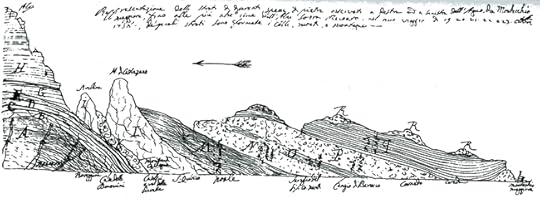
Giovanni Arduino's sketch of the Agno Valley, 1758
A-C - Arduino's Primary, roughly current Paleozoic D-M - Arduino's Secondary, roughly current Mesozoic N-R - Arduino's Tertiary, roughly current Tertiary (his term is still used)
-----------------------------------------------
31. Thinking about the Earth : A History of Ideas in Geology by David R. Oldroyd published: 1996 format: 348 page hardcover (entire book with glossary, bibliography, index, etc is 440 pages) acquired: 1996 read: May 1-28 rating: 4
Very good overview of earth ideas for the science history enthusiast or geologist. May be a bit esoteric for the non-science reader. Enjoyable and readable. Recommended.
Eğer Jeoloji hakkında orta düzeyde bilginiz yoksa bu kitap size ağır gelecektir. Kitapta anlatılan çoğu kavramı anlamakta zorlandım. Kitap bilimin bir dalının (Yerbilimi) tarihi hakkında ama jeoloji bilgisi gerektiriyor. Kendinizi bir anda Sial ile Sima karşılaştırmasını okurken buluyorsunuz . Insanlıgın tarih boyunca Dünya'yı nasıl anlamaya çalıştığını görmek ve zamanla ve yeni bilgilerle bu algının nasıl evrimleştiğini görmek güzeldi. Ama ilk basta dediğim gibi teknik altyapım olmadıgı için çoğu kavramı anlayamadım. Türkçe çeviride sıkıntılar var. Mesela "kararlı" yerine "duraylı" kelimesi kullanılmış. Acaba mühendislik ile hiç ilgisi olmayan biri mi çevirdi diye düşünüyorum.