

What do you think?

The Secret Countess
Anna, a young countess, has lived in the glittering city of St Petersburg all her life in an ice-blue palace overlooking the River Neva. But when revolution tears Russia apart, her now-penniless family is forced to flee to England. Armed with an out-of-date book on housekeeping, Anna determines to become a housemaid and she finds work at the Earl of Westerholme's crumbling but magnificent mansion. The staff and the family are sure there is something not quite right about their new maid - but she soon wins them over with her warmth and dedication.
Then the young Earl returns home from the war - and Anna falls hopelessly in love. But they can never be together: Rupert is engaged to the snobbish and awful Muriel - and anyway, Anna is only a servant. Or so everybody thinks . . .
Then the young Earl returns home from the war - and Anna falls hopelessly in love. But they can never be together: Rupert is engaged to the snobbish and awful Muriel - and anyway, Anna is only a servant. Or so everybody thinks . . .
344 pages, Paperback
First published May 10, 1981
About the author
Eva Ibbotson
87 books2,387 followersEva Ibbotson (Maria Charlotte Michelle Wiesner) was a novelist specializing in romance and children's fantasy.
She was born in Vienna, Austria, in 1925. When Hitler appeared, her family moved to England. She attended Bedford College, graduating in 1945; Cambridge University from 1946-47; and the University of Durham, graduating with a diploma in education in 1965. Eva had intended to be a physiologist but was put off by animal testing. Instead, she married and raised a family, returning to school to become a teacher in the 1960s. They have three sons and a daughter.
Eva began writing with the television drama “Linda Came Today” in 1965. Ten years later, she published her first novel, “The Great Ghost Rescue”. Eva has written numerous books including “The Secret Of Platform 13”, “Journey To The River Sea”, “Which Witch?”, “Island Of The Aunts”, and “Dial-A-Ghost”. She won the Nestlé Smarties Book Prize for “Journey To The River Sea” and has been a runner up for many of major awards for British children's literature.
Her books are imaginative and humorous and most of them feature magical creatures and places, despite that she disliked thinking about them. She created the characters because she wanted to decrease her readers' fear of such things.
Some of the books, particularly “Journey To The River Sea”, reflect Eva's love of nature. Eva wrote this book in honour of her husband (who had died before), a naturalist. The book had been in her head for years.
Eva said she dislikes "financial greed and a lust for power" and often creates antagonists in her books who have these characteristics. Some have been struck by the similarity of “Platform 9 3/4” in J.K. Rowling's books to Eva's “The Secret Of Platform 13”, which came out three years before the first Harry Potter book.
Her love of Austria is evident in works such as “The Star Of Kazan” and “A Song For Summer”. These books, set in the Austrian countryside, display the author's love for all things natural.
She was born in Vienna, Austria, in 1925. When Hitler appeared, her family moved to England. She attended Bedford College, graduating in 1945; Cambridge University from 1946-47; and the University of Durham, graduating with a diploma in education in 1965. Eva had intended to be a physiologist but was put off by animal testing. Instead, she married and raised a family, returning to school to become a teacher in the 1960s. They have three sons and a daughter.
Eva began writing with the television drama “Linda Came Today” in 1965. Ten years later, she published her first novel, “The Great Ghost Rescue”. Eva has written numerous books including “The Secret Of Platform 13”, “Journey To The River Sea”, “Which Witch?”, “Island Of The Aunts”, and “Dial-A-Ghost”. She won the Nestlé Smarties Book Prize for “Journey To The River Sea” and has been a runner up for many of major awards for British children's literature.
Her books are imaginative and humorous and most of them feature magical creatures and places, despite that she disliked thinking about them. She created the characters because she wanted to decrease her readers' fear of such things.
Some of the books, particularly “Journey To The River Sea”, reflect Eva's love of nature. Eva wrote this book in honour of her husband (who had died before), a naturalist. The book had been in her head for years.
Eva said she dislikes "financial greed and a lust for power" and often creates antagonists in her books who have these characteristics. Some have been struck by the similarity of “Platform 9 3/4” in J.K. Rowling's books to Eva's “The Secret Of Platform 13”, which came out three years before the first Harry Potter book.
Her love of Austria is evident in works such as “The Star Of Kazan” and “A Song For Summer”. These books, set in the Austrian countryside, display the author's love for all things natural.
Ratings & Reviews
Friends & Following
Create a free account to discover what your friends think of this book!
Community Reviews
Displaying 1 - 30 of 2,204 reviews

January 19, 2016
Final review, first posted on www.FantasyLiterature.com (not that this is a fantasy novel, but Ibbotson also wrote a lot of fantasy):
As a Jane Austen and Georgette Heyer enthusiast, I’m always on the lookout for historical novels in that mold, with manners, a little romance and lots of deliciously witty dialogue. I previously was familiar with Eva Ibbotson solely from her 1994 children’s fantasy The Secret of Platform 13, in which a magical door at Platform 13 of King’s Cross Station in London opens every nine years for a nine-day period, leading to a delightful kingdom where humans, mermaids, giants, hags, nymphs and other magical creatures live. (The similarities to Platform 9¾ in J.K. Rowling’s Harry Potter and the Sorcerer's Stone, published three years later, did not go unnoticed, but Ibbotson held no grudges.) When I found that Ibbotson also wrote some historical romances, I had to give one of them a try.
A Countess Below Stairs (recently republished and renamed The Secret Countess), is an appealing historical romance. Anna Grazinsky lives a charmed life as a child in Russia in the early 1900s. When her father, Count Grazinsky, dies in World War I and her wealthy family is threatened in the Russian Revolution, Anna, now age eighteen, her mother, and her younger brother escape from Russia and take refuge in England. They give their priceless jewels to the children’s nanny to smuggle out of Russia, but she disappears without a trace, leaving the family destitute. So when they settle in England, Anna insists on taking a job as a housemaid to help make ends meet and enable her brother to get an education. With the help of a massive volume entitled The Domestic Servant’s Compendium, which Anna studies religiously, Anna is certain she can be a model housemaid. She convinces the butler and head housekeeper at Westerholme to give her a chance on a temporary basis.
When Rupert, the Earl of Westerholme since the death of his older brother, returns home from World War I, he is attracted by Anna’s charm and personality ― but he’s also about to be married to an extremely wealthy young lady, Miss Muriel Hardwicke. Muriel is quite beautiful and initially seems quite nice (though how nice can she really be with a name like that, in a romance novel?). It turns out that Muriel, in addition to being completely self-absorbed, has a deep and abiding passion for the philosophy and practice of eugenics. As Muriel’s true colors gradually become apparent both above and below stairs, and Anna and Rupert gradually become aware of their feelings for each other, the plot deftly mixes both comedy and sorrow.
A Countess Below Stairs is a fairly lightweight romance that wears its heart on its sleeve. It suffers from some slow pacing in the middle, and several of the characters (Muriel in particular) are one-dimensional, although some of the servants are quite well-developed characters. Anna herself is a Mary Sue type, not particularly beautiful, but attractive, kind, talented, and beloved by all. She escapes being annoying by dint of an enthusiasm for all aspects of life, a sense of humor, and a charming Russian accent. Rupert, wounded physically and spiritually by the war, is notable primarily for his kindness and his commitment to keeping his word, even at the cost of his own happiness.
A Countess Below Stairs has some extremely funny moments, culminating with a farcical scene where the servants play upon Muriel’s horror of people with mental and physical disabilities. Ibbotson’s unexpectedly literary writing really caught my attention in several places. The plot also explores the eugenics movement that became popular in England in this time period, and the hold it had on some people’s minds, as well as the effect of their intolerance on others. The tragic background of the Russian Revolution and World War I isn’t dwelt on, but we see the secondary effects of these events in their impact on the lives, minds and hearts of the characters.
Although I wouldn’t recommend A Countess Below Stairs to readers who are uninterested in sweet (clean) romances in a historical setting, for those who are, this is an intelligently written, heartwarming tale that’s above the general cut of romance novels.
3.5 stars, rounding up to 4.
As a Jane Austen and Georgette Heyer enthusiast, I’m always on the lookout for historical novels in that mold, with manners, a little romance and lots of deliciously witty dialogue. I previously was familiar with Eva Ibbotson solely from her 1994 children’s fantasy The Secret of Platform 13, in which a magical door at Platform 13 of King’s Cross Station in London opens every nine years for a nine-day period, leading to a delightful kingdom where humans, mermaids, giants, hags, nymphs and other magical creatures live. (The similarities to Platform 9¾ in J.K. Rowling’s Harry Potter and the Sorcerer's Stone, published three years later, did not go unnoticed, but Ibbotson held no grudges.) When I found that Ibbotson also wrote some historical romances, I had to give one of them a try.
A Countess Below Stairs (recently republished and renamed The Secret Countess), is an appealing historical romance. Anna Grazinsky lives a charmed life as a child in Russia in the early 1900s. When her father, Count Grazinsky, dies in World War I and her wealthy family is threatened in the Russian Revolution, Anna, now age eighteen, her mother, and her younger brother escape from Russia and take refuge in England. They give their priceless jewels to the children’s nanny to smuggle out of Russia, but she disappears without a trace, leaving the family destitute. So when they settle in England, Anna insists on taking a job as a housemaid to help make ends meet and enable her brother to get an education. With the help of a massive volume entitled The Domestic Servant’s Compendium, which Anna studies religiously, Anna is certain she can be a model housemaid. She convinces the butler and head housekeeper at Westerholme to give her a chance on a temporary basis.
When Rupert, the Earl of Westerholme since the death of his older brother, returns home from World War I, he is attracted by Anna’s charm and personality ― but he’s also about to be married to an extremely wealthy young lady, Miss Muriel Hardwicke. Muriel is quite beautiful and initially seems quite nice (though how nice can she really be with a name like that, in a romance novel?). It turns out that Muriel, in addition to being completely self-absorbed, has a deep and abiding passion for the philosophy and practice of eugenics. As Muriel’s true colors gradually become apparent both above and below stairs, and Anna and Rupert gradually become aware of their feelings for each other, the plot deftly mixes both comedy and sorrow.
A Countess Below Stairs is a fairly lightweight romance that wears its heart on its sleeve. It suffers from some slow pacing in the middle, and several of the characters (Muriel in particular) are one-dimensional, although some of the servants are quite well-developed characters. Anna herself is a Mary Sue type, not particularly beautiful, but attractive, kind, talented, and beloved by all. She escapes being annoying by dint of an enthusiasm for all aspects of life, a sense of humor, and a charming Russian accent. Rupert, wounded physically and spiritually by the war, is notable primarily for his kindness and his commitment to keeping his word, even at the cost of his own happiness.
A Countess Below Stairs has some extremely funny moments, culminating with a farcical scene where the servants play upon Muriel’s horror of people with mental and physical disabilities. Ibbotson’s unexpectedly literary writing really caught my attention in several places. The plot also explores the eugenics movement that became popular in England in this time period, and the hold it had on some people’s minds, as well as the effect of their intolerance on others. The tragic background of the Russian Revolution and World War I isn’t dwelt on, but we see the secondary effects of these events in their impact on the lives, minds and hearts of the characters.
Although I wouldn’t recommend A Countess Below Stairs to readers who are uninterested in sweet (clean) romances in a historical setting, for those who are, this is an intelligently written, heartwarming tale that’s above the general cut of romance novels.
3.5 stars, rounding up to 4.

July 25, 2008
I love Eva Ibbotson, and I nearly always think her characters are delightful and her stories lovely. That was true for this book as well. I frequently recommend her books to my enthusiastic readers and to parents reading aloud with their elementary-aged children. She's my favorite of all the authors I've discovered in the last few years.
But I couldn't help my stomach churning at the unnecessarily nasty descriptions of the unpleasant family, the Herrings... these descriptions depended almost completely on their fatness as a symbol of their stupidity, squalor, and generally disgusting natures. I mean, jeez, Ms. Ibbotson. Here's an example from the first time we meet them:
Melvyn sighed and looked at his obese and pallid offspring, sitting on either side of the sticky kitchen table reading comics. Donald was methodically sucking a long black stick of licorice into his mouth. Dennis was licking at a dribbling bar of toffee. Like certain caterpillars whose short lives are dedicated to simply achieving the maximum possible increase in size, the twins seem to have done nothing but eat and burst out of their clothes since they were born. Watching them, Melvyn had to abandon another of his half-formed schemes -- that of smuggling them to Mersham in a cello case in the guard's van. Even a doublebass case would not take mor than half of either of his sons..."
That's fully a quarter of their first entrance in the book, as they're minor characters. The next time they intrude on the book, for two pages many chapters later, we get:
Melvyn rose and opened the door of the adjoining room. Owing to an unfortunate spot of bother with the sheriffs, the twins were sleeping in a mattress on the floor. Dennis was lying on his back; his full-lipped mouth hung open and, as he breathed, the mucus in his nose bubbled softly like soup. Beside him lay Donald, apparently overcome by sleep in the act of eating a dripping sandwich, the dismembered remains of which lay smeared across his face.
Melvyn stood looking down at the swollen cheeks, the pendulous chins and bulging arms of his offspring and his fatherhood, never a sturdy plant, withered and died.
"Meat," he said wearily to himself. "That's all they are. Just blobs of meat."
And in fact, that's what the author has made them to be, for these are the only descriptions of their characters that we get. They're thoroughly, effectively, dehumanized; and they're children! We haven't seen them doing anything cruel, even anything stupid, and yet we know that these twins are both revolting and to blame for their miserable state. Their fatness isn't just a trait: it's a moral failing, a character flaw, and symbolic of their general nastiness and lack of worth compared to other children in the book.
I thought these descriptions were simply hateful and cruel. I mean, my goodness, how many fat readers of all ages do you know? I'm one, and so are some of my diverse group of dedicated readers at my school. How much do they deserve to come across this on top of all the other body-hating junk that gets thrown at them, from school "pinch tests" to Seventeen magazine? And how valuable is it for other kids to hear one more throwaway remark that fat kids are lazy, smelly, and eat all the time? In other generations, my students might have had to read the above sort of paragraph with "savage" characters of color whose race stood in for character flaws.
The difference is that those casually racist descriptions are now generally recognized, if not debated and discussed, by teachers, librarians, and readers. Does that mean that we keep copies of those books out of kids' hands? Of course not. But we do give kids the tools to look critically at those descriptions and recognize them as dated and ignorant, and the culture has changed to the extent that they can spot them independently. Unfortunately, the fat-hating powers of our cultures are still going strong on the widely held belief that fat is unpleasant at best and a moral flaw at worst... and I haven't found many texts that counteract this kind of ignorance. I just wish an author I respect hadn't perpetuated it so unnecessarily.
But I couldn't help my stomach churning at the unnecessarily nasty descriptions of the unpleasant family, the Herrings... these descriptions depended almost completely on their fatness as a symbol of their stupidity, squalor, and generally disgusting natures. I mean, jeez, Ms. Ibbotson. Here's an example from the first time we meet them:
Melvyn sighed and looked at his obese and pallid offspring, sitting on either side of the sticky kitchen table reading comics. Donald was methodically sucking a long black stick of licorice into his mouth. Dennis was licking at a dribbling bar of toffee. Like certain caterpillars whose short lives are dedicated to simply achieving the maximum possible increase in size, the twins seem to have done nothing but eat and burst out of their clothes since they were born. Watching them, Melvyn had to abandon another of his half-formed schemes -- that of smuggling them to Mersham in a cello case in the guard's van. Even a doublebass case would not take mor than half of either of his sons..."
That's fully a quarter of their first entrance in the book, as they're minor characters. The next time they intrude on the book, for two pages many chapters later, we get:
Melvyn rose and opened the door of the adjoining room. Owing to an unfortunate spot of bother with the sheriffs, the twins were sleeping in a mattress on the floor. Dennis was lying on his back; his full-lipped mouth hung open and, as he breathed, the mucus in his nose bubbled softly like soup. Beside him lay Donald, apparently overcome by sleep in the act of eating a dripping sandwich, the dismembered remains of which lay smeared across his face.
Melvyn stood looking down at the swollen cheeks, the pendulous chins and bulging arms of his offspring and his fatherhood, never a sturdy plant, withered and died.
"Meat," he said wearily to himself. "That's all they are. Just blobs of meat."
And in fact, that's what the author has made them to be, for these are the only descriptions of their characters that we get. They're thoroughly, effectively, dehumanized; and they're children! We haven't seen them doing anything cruel, even anything stupid, and yet we know that these twins are both revolting and to blame for their miserable state. Their fatness isn't just a trait: it's a moral failing, a character flaw, and symbolic of their general nastiness and lack of worth compared to other children in the book.
I thought these descriptions were simply hateful and cruel. I mean, my goodness, how many fat readers of all ages do you know? I'm one, and so are some of my diverse group of dedicated readers at my school. How much do they deserve to come across this on top of all the other body-hating junk that gets thrown at them, from school "pinch tests" to Seventeen magazine? And how valuable is it for other kids to hear one more throwaway remark that fat kids are lazy, smelly, and eat all the time? In other generations, my students might have had to read the above sort of paragraph with "savage" characters of color whose race stood in for character flaws.
The difference is that those casually racist descriptions are now generally recognized, if not debated and discussed, by teachers, librarians, and readers. Does that mean that we keep copies of those books out of kids' hands? Of course not. But we do give kids the tools to look critically at those descriptions and recognize them as dated and ignorant, and the culture has changed to the extent that they can spot them independently. Unfortunately, the fat-hating powers of our cultures are still going strong on the widely held belief that fat is unpleasant at best and a moral flaw at worst... and I haven't found many texts that counteract this kind of ignorance. I just wish an author I respect hadn't perpetuated it so unnecessarily.

January 2, 2014
This is one of my favorite romances with one of my all-time favorite authors.
No bodice ripping, panting, squirming lady parts, etc, just a sweet, witty, well-written and often humorous romance with a great hero and heroine and a cast of secondary characters that add depth to the story.
Anna
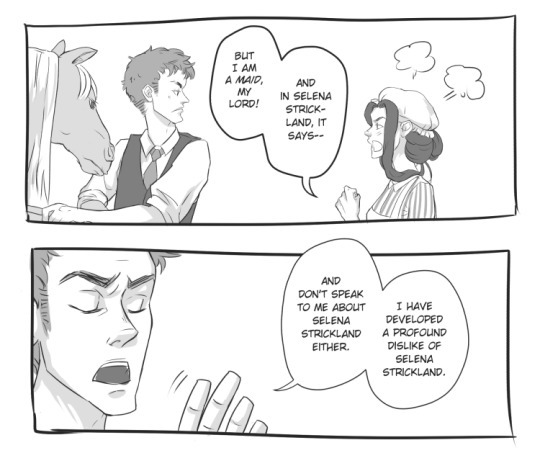
‘You will see, Pinny, it will be all right. Already I have found a most beautiful book in your sister’s room. It is called The Domestic Servant’s Compendium by Selina Strickland, and it has two thousand and three pages and in it I shall find out everything!’
Miss Pinfold tried to smile. Anna had always been in possession of ‘a most beautiful book’: a volume of Lermontov from her father’s library, a Dickens novel read during the white nights of summer when she should have been asleep.
Anna is the daughter of two incredibly wealthy Russians. Her father was killed during WWI and she, her mother, little brother, and British Nanny escaped to England. She's decided she has to go into service to help support her younger brother who knows nothing about her sacrifice. For Downton Abbey fans the look is very similar, but the estate she goes to is in need of refurbishing, and there is an astonishing lack of distance between the upstairs and the downstairs.
The estate is being prepared for the heir's return. Death taxes made it inevitable that the estate would be sold and what's left of the family and the servants are devastated. They are ecstatic to hear that Rupert is engaged to a wealthy heiress so all is saved. Unfortunately, Rupert, a truly nice guy can't recall HOW he came to be engaged to the all too beautiful, all too perfect Muriel. One minute he's an injured soldier, the next he's an engaged man.
Muriel
Only Muriel herself, gravitating naturally to the ornate mirrors in the plush Mayfair mansion where she grew up, was not surprised at the flawlessness of the image which greeted her. It was as though she knew from the start that she was not like other children.
She hated to be dirty, could not bear mess or torn clothes and once, when a stray kitten brought in by the cook scratched her hands, she shut herself in the nursery and refused to come out until it was removed. She had reached a full-breasted and acne-less adolescence when her mother, as though she knew she could do no more for her lovely daughter, contracted pneumonia and died.
As Anna and the rest of the servants get the estate ready, it becomes obvious to everyone that Anna is not as she seems. As Rupert tries to resolve his ever-increasing gloom over his pending marriage with perfect Muriel, he finds out more about Anna.
The cast of characters includes Rupert's doting mother who tries/likes to commune with spirits, the loyal and long-suffering Butler who will do anything to preserve the estate, his foul-tempered, pottery throwing mother, the Kosher Jewish family that still can't understand why these snooty British nobles have embraced them so whole-heartedly, Baskerville the mastiff, sweet young and lame Ollie-daughter of Rupert's closest friend, a bottom-pinching old Uncle, Muriel's snooty and desperate bridesmaids, Sergei their handsome chauffeur, and more.
When she meets Proom the butler,
Proom sighed and glanced at Mrs Bassenthwaite, who lightly shook her head. For the girl’s accent, with its rolling ‘r’s and lilting intensity, quite failed to disguise her educated voice, as did the shabby coat and skirt the grace of her movements. ‘Inexperienced’ was bad; ‘foreign’ was worse . . . but a lady! This time the agency had gone too far.
After NOT getting pinched by Uncle Sebastien.
Anna, coming down half an hour later, fearful of a reprimand, was greeted by an interested cluster of faces. The Russian girl was flushed and she was muttering beneath her breath.
‘He grabbed you, then,’ said Peggy. ‘Well, I warned you.’
‘No, no, he did not touch me,’ said Anna absently. Then the full impact of what she had just said hit her. ‘It is because I am not pretty!’ she said tragically.
And Mrs Park, who had taken less than twenty-four hours to forget that Anna was a foreigner and a lady, said, ‘Now don’t be foolish, dear. Just drink your tea.’
On the downside is Murial and her mentor, a pontificating Eugenics fraud.
A cruel moment for Ollie, a ball with a true Cinderella moment, fraud and deception on the part of Proom, and a little failure to communicate keep the romance moving.
Eva Ibbotson's writing is funny, witty and often ironic.
I know I'm not doing justice to the book. How unfair that I can unleash a rant like there is no tomorrow that says exactly what I want it to say, but when it comes to a real gold star book I am stuck?
It is called both The Secret Countess and Countess Below Stairs.
Time for a re-read.
No bodice ripping, panting, squirming lady parts, etc, just a sweet, witty, well-written and often humorous romance with a great hero and heroine and a cast of secondary characters that add depth to the story.
Anna
‘You will see, Pinny, it will be all right. Already I have found a most beautiful book in your sister’s room. It is called The Domestic Servant’s Compendium by Selina Strickland, and it has two thousand and three pages and in it I shall find out everything!’
Miss Pinfold tried to smile. Anna had always been in possession of ‘a most beautiful book’: a volume of Lermontov from her father’s library, a Dickens novel read during the white nights of summer when she should have been asleep.
Anna is the daughter of two incredibly wealthy Russians. Her father was killed during WWI and she, her mother, little brother, and British Nanny escaped to England. She's decided she has to go into service to help support her younger brother who knows nothing about her sacrifice. For Downton Abbey fans the look is very similar, but the estate she goes to is in need of refurbishing, and there is an astonishing lack of distance between the upstairs and the downstairs.
The estate is being prepared for the heir's return. Death taxes made it inevitable that the estate would be sold and what's left of the family and the servants are devastated. They are ecstatic to hear that Rupert is engaged to a wealthy heiress so all is saved. Unfortunately, Rupert, a truly nice guy can't recall HOW he came to be engaged to the all too beautiful, all too perfect Muriel. One minute he's an injured soldier, the next he's an engaged man.
Muriel
Only Muriel herself, gravitating naturally to the ornate mirrors in the plush Mayfair mansion where she grew up, was not surprised at the flawlessness of the image which greeted her. It was as though she knew from the start that she was not like other children.
She hated to be dirty, could not bear mess or torn clothes and once, when a stray kitten brought in by the cook scratched her hands, she shut herself in the nursery and refused to come out until it was removed. She had reached a full-breasted and acne-less adolescence when her mother, as though she knew she could do no more for her lovely daughter, contracted pneumonia and died.
As Anna and the rest of the servants get the estate ready, it becomes obvious to everyone that Anna is not as she seems. As Rupert tries to resolve his ever-increasing gloom over his pending marriage with perfect Muriel, he finds out more about Anna.
The cast of characters includes Rupert's doting mother who tries/likes to commune with spirits, the loyal and long-suffering Butler who will do anything to preserve the estate, his foul-tempered, pottery throwing mother, the Kosher Jewish family that still can't understand why these snooty British nobles have embraced them so whole-heartedly, Baskerville the mastiff, sweet young and lame Ollie-daughter of Rupert's closest friend, a bottom-pinching old Uncle, Muriel's snooty and desperate bridesmaids, Sergei their handsome chauffeur, and more.
When she meets Proom the butler,
Proom sighed and glanced at Mrs Bassenthwaite, who lightly shook her head. For the girl’s accent, with its rolling ‘r’s and lilting intensity, quite failed to disguise her educated voice, as did the shabby coat and skirt the grace of her movements. ‘Inexperienced’ was bad; ‘foreign’ was worse . . . but a lady! This time the agency had gone too far.
After NOT getting pinched by Uncle Sebastien.
Anna, coming down half an hour later, fearful of a reprimand, was greeted by an interested cluster of faces. The Russian girl was flushed and she was muttering beneath her breath.
‘He grabbed you, then,’ said Peggy. ‘Well, I warned you.’
‘No, no, he did not touch me,’ said Anna absently. Then the full impact of what she had just said hit her. ‘It is because I am not pretty!’ she said tragically.
And Mrs Park, who had taken less than twenty-four hours to forget that Anna was a foreigner and a lady, said, ‘Now don’t be foolish, dear. Just drink your tea.’
On the downside is Murial and her mentor, a pontificating Eugenics fraud.
A cruel moment for Ollie, a ball with a true Cinderella moment, fraud and deception on the part of Proom, and a little failure to communicate keep the romance moving.
Eva Ibbotson's writing is funny, witty and often ironic.
I know I'm not doing justice to the book. How unfair that I can unleash a rant like there is no tomorrow that says exactly what I want it to say, but when it comes to a real gold star book I am stuck?
It is called both The Secret Countess and Countess Below Stairs.
Time for a re-read.

June 30, 2014
Eva Ibbotson wrote five books for adults (or young adults) that clearly fit together -- A Countess Below Stairs, The Reluctant Heiress, A Company of Swans, The Morning Gift, and A Song for Summer. I was strongly considering giving one of them 5 stars in order to make certain that anyone who follows my reviews discovers just how special I think Ms. Ibbotson's writing is, but I couldn't decide which. It wouldn't be right to give all of them 5 stars, because that would double my total count of 5 star books at present, and after a certain point they read as a little bit formulaic, which I would admit diminishes their literary value just slightly. But. A Countess Below Stairs was the first one of the five that she wrote, so I will take it on first and give credit here in particular for the freshness of her ideas. It's not my personal favorite of the five, but still it's a 4.5+ star book and I feel that many people ought to read it.
What's so exceptional about this book? First and foremost, Ibbotson's glorious, sensitive, cultured, loving, wondrous soul shines through in every word. This is a woman for whom Vienna at the peak of its cultural glory is a heaven on earth -- a place where intellectuals and creative spirits gathered and thrived unlike any other time and place in history. She bequeaths her main characters with a love of music that defines them entirely -- she believes that it is impossible to feel so much about music without having a soul to match the beauty of the work, and she depicts how people connect because of their shared love of that kind of beauty. If you haven't realized it yet, that is exactly what I believe and how I experience the world, so I would happily disappear into Ibbotson's creations and live there forever.
Beyond that, Ibbotson is a phenomenal writer. Her use of language is sophisticated, and her subtle sense of humor is a delight. These are incredibly elegant books. To brand them as "romance novels" or "young adult fiction" is dreadfully misleading and fails to capture how utterly unique these books are. While they are undeniably Romantic, that capital R is of the utmost importance -- they are Romantic like Tchaikovsky and Rachmaninov are Romantic, not romantic like Twilight is romantic. The love stories are a joyous part of the novels, but they are not the sole purpose of the novels. The heroines love music and art and their country and the land and LIFE more than many people ever get to love anything. It's miraculous to feel it through them.
I can see how some readers might find the 5 novels I mentioned repetitive after a point, but I love them all and would read another 105 if Ibbotson had written them. If you really love classical music, The Reluctant Heiress has the most powerful music-centered plot of all, with the added bonus of some hilarious descriptions of a fictional Modern opera that the titular heiress ends up supporting. If you are more interested in dance than music, I would recommend A Company of Swans first, and if you're more interested in the intellectual/academic life in Europe in the early 20th century, then The Morning Gift is for you. Both The Morning Gift and A Song for Summer are also particularly resonant if you are of Jewish descent or are sensitive to the historical aspects of what happened to the Jewish people leading up to the Second World War.
I don't think my review has adequately captured the gentle, luminous beauty of these books, but I hope if my review has touched and intrigued you at all, you'll try the book whose short description interests you the most.
What's so exceptional about this book? First and foremost, Ibbotson's glorious, sensitive, cultured, loving, wondrous soul shines through in every word. This is a woman for whom Vienna at the peak of its cultural glory is a heaven on earth -- a place where intellectuals and creative spirits gathered and thrived unlike any other time and place in history. She bequeaths her main characters with a love of music that defines them entirely -- she believes that it is impossible to feel so much about music without having a soul to match the beauty of the work, and she depicts how people connect because of their shared love of that kind of beauty. If you haven't realized it yet, that is exactly what I believe and how I experience the world, so I would happily disappear into Ibbotson's creations and live there forever.
Beyond that, Ibbotson is a phenomenal writer. Her use of language is sophisticated, and her subtle sense of humor is a delight. These are incredibly elegant books. To brand them as "romance novels" or "young adult fiction" is dreadfully misleading and fails to capture how utterly unique these books are. While they are undeniably Romantic, that capital R is of the utmost importance -- they are Romantic like Tchaikovsky and Rachmaninov are Romantic, not romantic like Twilight is romantic. The love stories are a joyous part of the novels, but they are not the sole purpose of the novels. The heroines love music and art and their country and the land and LIFE more than many people ever get to love anything. It's miraculous to feel it through them.
I can see how some readers might find the 5 novels I mentioned repetitive after a point, but I love them all and would read another 105 if Ibbotson had written them. If you really love classical music, The Reluctant Heiress has the most powerful music-centered plot of all, with the added bonus of some hilarious descriptions of a fictional Modern opera that the titular heiress ends up supporting. If you are more interested in dance than music, I would recommend A Company of Swans first, and if you're more interested in the intellectual/academic life in Europe in the early 20th century, then The Morning Gift is for you. Both The Morning Gift and A Song for Summer are also particularly resonant if you are of Jewish descent or are sensitive to the historical aspects of what happened to the Jewish people leading up to the Second World War.
I don't think my review has adequately captured the gentle, luminous beauty of these books, but I hope if my review has touched and intrigued you at all, you'll try the book whose short description interests you the most.

August 20, 2009
I found myself not really giving a shit what happened to Anna. It's frustrating when an author writes a completely perfect character - Anna was an unspoiled, gracious child, and is a captivating, gracious adult. Everyone cannot help but be drawn to her beautiful spirit and beautiful face. Except for the evil, sure-to-become-a-total Nazi fiancee of Anna's love interest. The romance kind of irritated me, too. I understand it is, at its heart, a romance novel, but how much interaction did she really have with Rupert before they totally fell in love? I mean, besides the fact that she's totally flawless and anybody would be an idiot NOT to fall in love with her, right? Oh, and, you know, nobility too. She can't just be any old trash off the street. I'm not a totally cynical person, I like romance and happy endings, but this just felt too forced.

September 25, 2012
I enjoyed this... familiar romance tropes, but intelligently applied, and with a keen sense of time and place and detail from an angle less and less known, I suspect, to many younger 21st C. American readers. The tale does not feel to me to be about events of a whole century ago, but I realize somewhat bemusedly that they now are. The social setting, actually utterly alien-to-me in real life, is, as they say, still strangely familiar from dozens of beloved books, both from the period or attempting to recapture it.
The actual plot was fairly frothy, yet the underlying background was anything but. Horrible things may have happened to the protagonists in their recent pasts, but they are not made horrible by them. (The antagonist characters, who are quite horrible, bring it with them in their own hearts and minds.) The ending was too well set up to be called deus ex machina, but the way the cross-connecting cosmic justice needs of the assorted characters played out was entirely satisfying. The page-turning question in romance is not what will happen (we know that, or else the tale would have to be described by some other term), but how -- and the "how" made me grin.
Granted, the central couple do not solve their own problems, but are rescued by others, and the discursive omniscient style is a little emotionally distancing. This is... not a defect so much as an aspect. By way of trade-off, the reader gets a wider angle of view.
Ta, L.
The actual plot was fairly frothy, yet the underlying background was anything but. Horrible things may have happened to the protagonists in their recent pasts, but they are not made horrible by them. (The antagonist characters, who are quite horrible, bring it with them in their own hearts and minds.) The ending was too well set up to be called deus ex machina, but the way the cross-connecting cosmic justice needs of the assorted characters played out was entirely satisfying. The page-turning question in romance is not what will happen (we know that, or else the tale would have to be described by some other term), but how -- and the "how" made me grin.
Granted, the central couple do not solve their own problems, but are rescued by others, and the discursive omniscient style is a little emotionally distancing. This is... not a defect so much as an aspect. By way of trade-off, the reader gets a wider angle of view.
Ta, L.

February 6, 2008
Okay. This book was kind of a dissapointment to me. I felt really disconeccted from the story and like it was to narrarative. Like the author was telling the story herself, not through her charecters.
I felt like I was getting a lot of uneccissery information about every body. And nothing was really developing in you mind as you read it, but it was all piled on you all at the same time. Like every time some one new came into the story, everything stopped while the author gave a biography on this person's life.
I was warned that it would be a little boring in the begining but that it would get better. So I kept on reading. It really was starting to feel like it wasn't going to turn up. But then, really close to the end, for litterally a split fraction of the book, things seemed to be getting better. Then, it got really corny and melodramatic.
I think it is all personal. I know some people who really like this book and some who don't.
The best way is to decide for your self!!
I felt like I was getting a lot of uneccissery information about every body. And nothing was really developing in you mind as you read it, but it was all piled on you all at the same time. Like every time some one new came into the story, everything stopped while the author gave a biography on this person's life.
I was warned that it would be a little boring in the begining but that it would get better. So I kept on reading. It really was starting to feel like it wasn't going to turn up. But then, really close to the end, for litterally a split fraction of the book, things seemed to be getting better. Then, it got really corny and melodramatic.
I think it is all personal. I know some people who really like this book and some who don't.
The best way is to decide for your self!!

October 9, 2019
A solid 4.25 star book!
Such wonderful writing by this new to me author. I soaked in each and every word, every turn of phrase happily. She ought to be writing 'heavier' stuff. Not have her work placed along with the other contemporarily written anachronistic and modern HRs!
I read it about a month ago so won't delve too deep into the happenings. But let me say that the h, a poor and plain Russian emigre - a 'princess' turned maid - is one of the best and strongest character I've recently read about. She pulls you in, takes you along on her poignant but heartening journey as she makes a place for herself - in a household, in hearts. She wins heart both above and below stairs.
“because her sisters are everywhere in Russian literature: Natasha, who left her ballroom and shining youth to nurse her mortally wounded prince . . . Sonia, the street girl who followed Raskalnikov into exile in Siberia and gave that poor, tormented devil the only peace he ever knew.”
And such an interesting period. Royalty has fallen around Europe and now the nobility is following. It's the time for the Americans, the merchant class and the nouveau riche to call the shots.
The secondary characters are all amazing - a more dramatic and yet simpler Downton Abbey. The servants, the neighbors, the friends, the h's family and the 'Russian club' are all very well fleshed out.
Only the H makes you sigh. And not in a good way!
Wish we could make do without him or change him. Or then, lets just ignore the spineless and clueless sod. (It wouldn't affect the impact of the story much.)
The ow is super ow-y and weird with it. And he's super loyal to her despite knowing her failings. Honour, huh?
My favorite characters after the h - Baskerville, the snobbish but adorable dog; her handsome cousin, Sergei and brave little Ollie.
“He must have swallowed Debrett’s Peerage when he was a pup.”
"Slowly, Anna put up a hand to his muzzle and began to scratch that spot behind the ear where large dogs keep their souls.”
Such wonderful writing by this new to me author. I soaked in each and every word, every turn of phrase happily. She ought to be writing 'heavier' stuff. Not have her work placed along with the other contemporarily written anachronistic and modern HRs!
I read it about a month ago so won't delve too deep into the happenings. But let me say that the h, a poor and plain Russian emigre - a 'princess' turned maid - is one of the best and strongest character I've recently read about. She pulls you in, takes you along on her poignant but heartening journey as she makes a place for herself - in a household, in hearts. She wins heart both above and below stairs.
“because her sisters are everywhere in Russian literature: Natasha, who left her ballroom and shining youth to nurse her mortally wounded prince . . . Sonia, the street girl who followed Raskalnikov into exile in Siberia and gave that poor, tormented devil the only peace he ever knew.”
And such an interesting period. Royalty has fallen around Europe and now the nobility is following. It's the time for the Americans, the merchant class and the nouveau riche to call the shots.
The secondary characters are all amazing - a more dramatic and yet simpler Downton Abbey. The servants, the neighbors, the friends, the h's family and the 'Russian club' are all very well fleshed out.
Only the H makes you sigh. And not in a good way!
Wish we could make do without him or change him. Or then, lets just ignore the spineless and clueless sod. (It wouldn't affect the impact of the story much.)
The ow is super ow-y and weird with it. And he's super loyal to her despite knowing her failings. Honour, huh?
My favorite characters after the h - Baskerville, the snobbish but adorable dog; her handsome cousin, Sergei and brave little Ollie.
“He must have swallowed Debrett’s Peerage when he was a pup.”
"Slowly, Anna put up a hand to his muzzle and began to scratch that spot behind the ear where large dogs keep their souls.”

September 8, 2014

Well, I must say this. I should thank Rane for recommending and giving this book such a nice review. If not for her, this book would still be in my to-read-list.
To be totally honest, I prefer books written in a conversational type (examples are Julia Quinn, Sidney Sheldon and Thea Harrison books) These books uses words that are easy to understand and can be used in everyday life.
On the other hand, this is the type of book where I have to pay attention every freaking word because the wordings are kinda deep and hard. (Example of books like this are Lord of the Rings, The Fault in our stars and The Prince of Thorns which are AMAZING books.) But despite the difficulty, this book still rocked me.
The first thing that caught my attention was the cover of the book. I know-I know. One shouldn’t judge a book by its cover but old habits die hard. My judgement didn’t disappoint me. The book was spectacular and I was hooked from the very beginning until the end.
I love Anna’s kindness and purity and you can’t hate the heck out of her just because she’s nice.
Rupert.Rupert.Rupert. Enough said.
It should also be noted that I’m curious as to what happened to the other characters. Like Sergei or Petya. I want my own Sergei. And Petya is an interesting character.
So if you want to read something light and refreshing, do READ this book.
Two-thumbs up for Miss Eva Ibbotson for a wonderful book.
Speaking of which..


January 29, 2010
I read the blurb and I thought the story was interesting. This was one of the worst books I ever read. First of all, too many unnecessary details about minor characters. I found myself constantly skipping over those parts. The main countess had no character development and it was very narrative. The main character was too perfect, the fiancee was "nasty", the love interest was "prince charming". There was too much description that was not needed. Ending was predictable.

May 4, 2008
Reviewed by Amber Gibson for TeensReadToo.com
Anna Grazinsky is a member of the Russian aristocracy, or White Russians, during the Russian Revolution. Her family is forced to flee from their comfortable life in Russia to England, where they are safe from the revolutionaries. But in England, the Grazinskys are left with nothing. Anna has a very resilient spirit, and instead of moping around and wishing for her old life, she is grateful for the safety of her family and secretly takes a job as a maid so that her little brother can still attend school. With her take-charge attitude, Anna proves that not all rich girls are snobby brats, like modern heiresses lead us to believe.
While many of the servants at the Westerholme residence are skeptical of the new foreign girl, Anna quickly charms her way into their hearts. With her deep curtsies, bright smile, and cheerful demeanor, Anna is beloved by all. She does each task assigned to her as best she can, never slacking on the job.
When the young and handsome Earl of Westerholme returns home from World War I, Anna is immediately drawn to him. And it seems that he feels a similar attraction to her. But Anna's identity as a countess is still a secret, and she does not have the social standing that she once held in Russia. Plus, the Earl is already engaged to the beautiful but vicious Muriel Hardwicke. Muriel nursed Earl Rupert back to health when he was wounded in the war, and he proposed to her. But that was before he met Anna.
In the weeks leading up to the wedding, Muriel begins to take over the Westerholme household, arbitrarily firing servants that do not fit in with her vision for Westerholme. None of the servants or neighbors are fond of Muriel, and as the wedding date approaches, all of Rupert's friends and family are leery of the impending marriage.
At the costume ball thrown prior to the wedding, Anna's true identity as a countess is revealed, and Anna and Rupert dance the night away. Everyone can see that they are a perfect couple, but can Rupert and Anna come to terms with their feelings for each other before his marriage to Muriel?
Although A COUNTESS BELOW STAIRS has a very fairytale-like romantic plot, Anna is far from the typical princess. She has a feisty spirit and genuinely fun personality that immediately draws you in. Eva Ibbotson does a great job in breathing life into the generic fairytale plot. Anna's story is very similar to what much of the Russian aristocracy experienced during the communist revolution, and Ibbotson shows that even though life is unpredictable and rarely kind, if you embrace all opportunities and make the most of your situation, you will find happiness.
Anna Grazinsky is a member of the Russian aristocracy, or White Russians, during the Russian Revolution. Her family is forced to flee from their comfortable life in Russia to England, where they are safe from the revolutionaries. But in England, the Grazinskys are left with nothing. Anna has a very resilient spirit, and instead of moping around and wishing for her old life, she is grateful for the safety of her family and secretly takes a job as a maid so that her little brother can still attend school. With her take-charge attitude, Anna proves that not all rich girls are snobby brats, like modern heiresses lead us to believe.
While many of the servants at the Westerholme residence are skeptical of the new foreign girl, Anna quickly charms her way into their hearts. With her deep curtsies, bright smile, and cheerful demeanor, Anna is beloved by all. She does each task assigned to her as best she can, never slacking on the job.
When the young and handsome Earl of Westerholme returns home from World War I, Anna is immediately drawn to him. And it seems that he feels a similar attraction to her. But Anna's identity as a countess is still a secret, and she does not have the social standing that she once held in Russia. Plus, the Earl is already engaged to the beautiful but vicious Muriel Hardwicke. Muriel nursed Earl Rupert back to health when he was wounded in the war, and he proposed to her. But that was before he met Anna.
In the weeks leading up to the wedding, Muriel begins to take over the Westerholme household, arbitrarily firing servants that do not fit in with her vision for Westerholme. None of the servants or neighbors are fond of Muriel, and as the wedding date approaches, all of Rupert's friends and family are leery of the impending marriage.
At the costume ball thrown prior to the wedding, Anna's true identity as a countess is revealed, and Anna and Rupert dance the night away. Everyone can see that they are a perfect couple, but can Rupert and Anna come to terms with their feelings for each other before his marriage to Muriel?
Although A COUNTESS BELOW STAIRS has a very fairytale-like romantic plot, Anna is far from the typical princess. She has a feisty spirit and genuinely fun personality that immediately draws you in. Eva Ibbotson does a great job in breathing life into the generic fairytale plot. Anna's story is very similar to what much of the Russian aristocracy experienced during the communist revolution, and Ibbotson shows that even though life is unpredictable and rarely kind, if you embrace all opportunities and make the most of your situation, you will find happiness.

February 18, 2016
This was a sweet, feel-good read, which I was in desperate need of. I turn to these sort of books when I'm recovering from illness or surgery. You know, those books that are comfort food? This is one of them.
Anna, along with other Russian nobility, finds herself among the working class of England after the fall of the Tsar. Czar? I always mix those up. Anyhow, she is uncomplaining and determined to be happy in her circumstances. Anna is wise enough to know that the answer to most anything can be found in a book, so she embarks upon her new housekeeping endeavor with The Domestic Servant’s Compendium, by Selena Strickland, tucked into her bag. She references this massive, three volume tome often in regards to her duties as a maid, much to her below stairs companions' amusement and sometimes irritation.
Now, I loved Anna immediately. Her fellow servants quickly grew to love her. Almost everyone came to adore Anna. Normally, this Mary Sue type business is nauseating for me. I can't quite figure out what makes Anna such an appealing heroine. She's alive and full of life, and her attitude is contagious. She brooks zero nonsense and isn't afraid to be frank about it, all the while being kind. Maybe traditional Mary Sue characters tend to lack passion? They also tend to be tragic, and Anna simply is not.
The other displaced Russian characters and their similar perseverance and joy made me want to hang out at their club. I'd specifically like to spend more time with Prince Sergei, Anna's gorgeous cousin and now taxi driver! The downstairs servants were likewise enjoyable, but I have no desire to join their ranks. Proom, the butler, was my favorite! Such a sense of loyalty and family below stairs that extends to those living above. A few beautiful, yet ugly villains to despise. My hate for Murial was honed into something as sharp as I felt for Delores Umbridge!
It's no surprise there's a love story in all this. While it's a central theme, it's danced around in the story very lightly. Things unfold gradually and are barely hinted at, never overtaking the story or becoming boring. My only disappointment was in Rupert. While I would've had him behave in a less noble and martyr-ish manner, my real beef was It all turned out in the end, but I feel an opportunity was missed for him to act the hero.
5 stars. Highly recommended. It made me happy.
Anna, along with other Russian nobility, finds herself among the working class of England after the fall of the Tsar. Czar? I always mix those up. Anyhow, she is uncomplaining and determined to be happy in her circumstances. Anna is wise enough to know that the answer to most anything can be found in a book, so she embarks upon her new housekeeping endeavor with The Domestic Servant’s Compendium, by Selena Strickland, tucked into her bag. She references this massive, three volume tome often in regards to her duties as a maid, much to her below stairs companions' amusement and sometimes irritation.
Now, I loved Anna immediately. Her fellow servants quickly grew to love her. Almost everyone came to adore Anna. Normally, this Mary Sue type business is nauseating for me. I can't quite figure out what makes Anna such an appealing heroine. She's alive and full of life, and her attitude is contagious. She brooks zero nonsense and isn't afraid to be frank about it, all the while being kind. Maybe traditional Mary Sue characters tend to lack passion? They also tend to be tragic, and Anna simply is not.
The other displaced Russian characters and their similar perseverance and joy made me want to hang out at their club. I'd specifically like to spend more time with Prince Sergei, Anna's gorgeous cousin and now taxi driver! The downstairs servants were likewise enjoyable, but I have no desire to join their ranks. Proom, the butler, was my favorite! Such a sense of loyalty and family below stairs that extends to those living above. A few beautiful, yet ugly villains to despise. My hate for Murial was honed into something as sharp as I felt for Delores Umbridge!
It's no surprise there's a love story in all this. While it's a central theme, it's danced around in the story very lightly. Things unfold gradually and are barely hinted at, never overtaking the story or becoming boring. My only disappointment was in Rupert. While I would've had him behave in a less noble and martyr-ish manner, my real beef was It all turned out in the end, but I feel an opportunity was missed for him to act the hero.
5 stars. Highly recommended. It made me happy.

September 2, 2013
Eva Ibbotson has some of the most beautiful prose I've ever read.
This is the most original of her adult books. All the others have the same two main characters.
I'm constantly amazed that she can somehow write accents without changing any of the spelling. That is a real talent.
Reread:01/29/16
The Honorable Olive though. She's seriously the best.
This is the most original of her adult books. All the others have the same two main characters.
I'm constantly amazed that she can somehow write accents without changing any of the spelling. That is a real talent.
Reread:01/29/16
The Honorable Olive though. She's seriously the best.

November 25, 2018
dec 2025: tis the season!!!
dec 2020 reread: perfect book perfect everything
aware that this is the most subjective ever rating but im sick and its cold and i love romance and fun and details and i probably know large chunks of this by heart at this stage
dec 2020 reread: perfect book perfect everything
aware that this is the most subjective ever rating but im sick and its cold and i love romance and fun and details and i probably know large chunks of this by heart at this stage

March 9, 2019
and there was much wailing and gnashing of teeth
EDIT: UNSURPASSABLE, PERFECT, AGONISING
EDIT: UNSURPASSABLE, PERFECT, AGONISING

January 21, 2021
«Las sombras son lugares frescos y tranquilos para quienes tienen la imaginación bien provista de tesoros.»
«—¡Oh! —exclamó—. ¡Qué hermosa! Nunca había visto una rosa como esta.
Los ojos del anciano brillaron con orgullo.
—Es una nueva variedad —dijo—. La he creado yo mismo.
La nueva rosa era blanca. A primera vista parecía un blanco puro y sin mácula, y sin embargo se daba cierta contradicción porque, extraña y maravillosamente, la blancura parecía irradiar de un sonrojo rosado.
—Necesito un nombre para ella —dijo el jardinero—. Es difícil.
—Es como la nieve en Rusia —dijo Anna—. La nieve al atardecer, cuando el sol se pone y parece como el Alpenglühen, ¿sabe? Y si la nieve tuviera aroma, olería así: un aroma puro y sin embargo intenso.
El señor Cameron se rascó la cabeza.
—Podría llamarla así —dijo—. Sí, «Nieve Rusa». Es un buen nombre. »
'El destino de una condesa' ha sido mi segunda incursión en la obra de Eva Ibbotson, tras 'Una canción para el verano'. Una novela que se lee como se degusta un postre favorito. Paladeándola con satisfacción hasta la última página.
Cuenta la historia de una joven condesa que consigue huir de la revolución rusa, y encuentra refugio en Londres junto a algunos miembros de su diezmada familia. El grupo, tras una vida de opulentas comodidades, debe aprender entonces a ganarse el sustento. Anna decide probar suerte como criada en una imponente mansión de la campiña y, muy pronto, no solo se gana el corazón de los otros miembros del servicio, sino del propio heredero; un joven marcado por la recién terminada guerra.
No sé si los creadores de Downton Abbey leyeron esta novela antes de que concebir la serie, pero es fácil pensar que sí tras leerla.
'El destino de una condesa' constituye una deliciosa inmersión en la vida cotidiana de una mansión inglesa; al menos de la cara más amable de la vida de sus habitantes. Y es que las aventuras y desventuras de Anna se leen como un cuento de hadas con final feliz asegurado. El libro puede pecar de previsible, su villana es 'demasiado villana' y algunas de sus frases han envejecido 'mal', pero eso no me ha impedido pasar un delicioso momento de lectura.
No sé si será suficiente garantía para mostraros mi satisfacción, pero ya he comprado dos nuevos títulos de Eva Ibbotson para tenerlos bien a mano en mis estanterías.
Nunca se tienen suficientes novelas amables a las que recurrir en momentos grises.
«—¡Oh! —exclamó—. ¡Qué hermosa! Nunca había visto una rosa como esta.
Los ojos del anciano brillaron con orgullo.
—Es una nueva variedad —dijo—. La he creado yo mismo.
La nueva rosa era blanca. A primera vista parecía un blanco puro y sin mácula, y sin embargo se daba cierta contradicción porque, extraña y maravillosamente, la blancura parecía irradiar de un sonrojo rosado.
—Necesito un nombre para ella —dijo el jardinero—. Es difícil.
—Es como la nieve en Rusia —dijo Anna—. La nieve al atardecer, cuando el sol se pone y parece como el Alpenglühen, ¿sabe? Y si la nieve tuviera aroma, olería así: un aroma puro y sin embargo intenso.
El señor Cameron se rascó la cabeza.
—Podría llamarla así —dijo—. Sí, «Nieve Rusa». Es un buen nombre. »
'El destino de una condesa' ha sido mi segunda incursión en la obra de Eva Ibbotson, tras 'Una canción para el verano'. Una novela que se lee como se degusta un postre favorito. Paladeándola con satisfacción hasta la última página.
Cuenta la historia de una joven condesa que consigue huir de la revolución rusa, y encuentra refugio en Londres junto a algunos miembros de su diezmada familia. El grupo, tras una vida de opulentas comodidades, debe aprender entonces a ganarse el sustento. Anna decide probar suerte como criada en una imponente mansión de la campiña y, muy pronto, no solo se gana el corazón de los otros miembros del servicio, sino del propio heredero; un joven marcado por la recién terminada guerra.
No sé si los creadores de Downton Abbey leyeron esta novela antes de que concebir la serie, pero es fácil pensar que sí tras leerla.
'El destino de una condesa' constituye una deliciosa inmersión en la vida cotidiana de una mansión inglesa; al menos de la cara más amable de la vida de sus habitantes. Y es que las aventuras y desventuras de Anna se leen como un cuento de hadas con final feliz asegurado. El libro puede pecar de previsible, su villana es 'demasiado villana' y algunas de sus frases han envejecido 'mal', pero eso no me ha impedido pasar un delicioso momento de lectura.
No sé si será suficiente garantía para mostraros mi satisfacción, pero ya he comprado dos nuevos títulos de Eva Ibbotson para tenerlos bien a mano en mis estanterías.
Nunca se tienen suficientes novelas amables a las que recurrir en momentos grises.
January 14, 2008
This is a good romance novel without being too mushy, or containing a lot of raunchy scenes. It's about how a young Russian Countess flees to England after the Russian Revolution and earns her keep as a servant for a wealthy family. She tries to keep her past from her employers and their very attractive son, the Earl of Westerholme who is engaged to be married. His future wife believes in the science of Eugenics and only in procreating "the perfect species." Needless to say, there is an attraction between Anna the Countess and the Earl but at a time when men did not break their commitments, and servants could not marry the upper class, it seems like a lost cause. You'll have to read it to find out what happens! This book was intriguing, and described the scenes so well I believed I was in that mansion and era right along with the characters. It will restore your faith (at least for a little while) in true love.

February 7, 2015
This, ladies and gentlemen, is probably my favourite standalone novel of all time. If not favourite, then definitely in my top five. It's adorable and heartbreaking and beautiful and I've loved it ever since I first read it - and I've read it three times since.
It's not without its faults - Anna is a special snowflake, Rupert is controlling at times, and Ibbotson does have a problem with sentences - each one has about nine hundred separate clauses and fifteen adjectives - but to be honest, they're too minor to even scrape away a half star. I love this book, I always have and I always will - and I especially love the ball scene, which has got to be one of the cutest scenes I've ever read.
It's not without its faults - Anna is a special snowflake, Rupert is controlling at times, and Ibbotson does have a problem with sentences - each one has about nine hundred separate clauses and fifteen adjectives - but to be honest, they're too minor to even scrape away a half star. I love this book, I always have and I always will - and I especially love the ball scene, which has got to be one of the cutest scenes I've ever read.

Read
December 20, 2020january, 2026:
happy birthday to ME !
january, 2023:
this has been such a self-indulgent way to start the year, and as of right now i feel v little desire to take myself seriously ever again. luxuriating in being a profoundly frivolous person.
december, 2020:
yes, it's five in the morning & yes, i stayed up all night reading this & yes, i'm in tears ! thanks eva
happy birthday to ME !
january, 2023:
this has been such a self-indulgent way to start the year, and as of right now i feel v little desire to take myself seriously ever again. luxuriating in being a profoundly frivolous person.
december, 2020:
yes, it's five in the morning & yes, i stayed up all night reading this & yes, i'm in tears ! thanks eva

August 19, 2010
This is without doubt one of the best YA novels I’ve read in a long time. Let’s say, ever. If I were to re-do my Top Ten YA Novels list, this would be on it. As soon as I finished it, I wanted to start it all over again (and now, trying to write the review about three weeks after finishing it, I definitely feel the need to re-read it – not because it’s forgettable, but because I’d like to do it justice.) The funny thing is, though, that like other favourite YA novels (such as The Book Thief), I’m not entirely convinced this is a YA novel. I mean, if it was originally written as a YA novel back in the early 80s, wow have the calibre of YA novels gone downhill since! But more on that later.
Anna Grazinsky grew up in a wealthy and luxurious palace in St. Petersburg, well educated, multi-lingual, generous of spirit, joyous of heart. With the First World War came also the Russian Revolution, and families like Anna’s – part of the enormous and ultra-rich royal family – found themselves forced to flee. The young countess is only about eighteen when she finally leaves the city with her mother, her younger brother and her governess, the English Miss Pinfold. Their nanny, Niannka, an ancient crone from the mountain tribes of Georgia, went ahead with all the family’s precious stones – including an emerald that could buy a county – hidden in her luggage; when Niannka doesn’t turn up at the agreed-upon rendezvous, they wearily acknowledge they will never see her or their fortune again, and travel on to England, where Miss Pinfold puts them up in her little spinster house.
A contact of Anna’s father the Count – who died in the war – pays for her brother Peter to go to school, but the family feels their want of money keenly. Through one of many temp agencies set up after the war, Anna finds a job as a house maid at a country estate called Mersham. Her new employers – the butler Proom, the housekeeper Mrs Bassenthwaite, and the lady of the house, the Dowager Countess of Westerholme – can all see that the new maid has been gently bred and well educated, but such is the dearth of help in the country because of those lost in the war, and since Anna works so hard, they can’t afford to lose her.
Anna finds she’s been hired to help get Mersham, once largely shut-up, ready in preparation for the return of the new young Earl of Westerholme, Rupert. A pilot in the war, he’s spent the last several months in hospital with injuries where he faced the fact that his older brother George is dead and he is the new Earl, and where he let a beautiful blonde heiress (of “new money” – her father made a fortune from a chain of groceries) agree to marry him.
Muriel Hardwicke, with her vast wealth, means that Rupert can keep his promise to his brother and not sell Mersham, as many aristocrats are having to do these days. But now that Muriel is installed in Mersham, and the wedding plans are gathering speed, he’s learning more about her attitude, her belief in Eugenics – that people with excellent genes should breed to make perfect children, and hence a race of perfect people – and their complete lack of mutual interests. It’s the little Russian maid with the “devastating curtsey” who he feels more in tune with, but even as learns about who she really is, his sense of honour means he could never jilt a woman.
When I read that the premise was about a Russian countess having to work as a maid in an English manor house, and falling in love with the Earl, I had my doubts. It sounded cheesy and implausible. But it is far from it, and that’s partly why I’ve given such a lengthy and detailed summary instead of saying that it’s about a Russian countess working as a maid and falling in love with the head of the house. Which even now sounds awfully tacky.
I had to double-check the copyright page to see that, yes, this was written decades later – the style of prose matches the period and made me wonder if it weren’t actually older (though if it were it might not have been written the way it was – funny how that works isn’t it?). One of the reasons I doubted whether it was in fact a YA novel is the sophisticated language – which speaks to how unintellectual YA has been lately. Ibbotson doesn’t dumb-down her story but opts for long words and a more old-fashioned sentence structure – I was taken by surprise at how many words there were here that I didn’t know! I didn’t write them down, by the way – I was so caught up in the story that I couldn’t have looked away for a pen and paper, let alone put the book down!
Mrs Park is the cook, and Win is her helper, a possibly mentally retarded girl who can barely speak but who works with Mrs Park like she’s that lady’s third arm.
There’s also a great deal of humour here, even in the simplest descriptions:
(For the record, “obsequiousness” is not one of the words that I didn’t know – but I can’t say I’ve come across “goitrous” before!)
You can also see that Ibbotson used period examples as well – Uriah Heep and Hackenschmidt are clearly not contemporary references (Uriah Heep, a "yes man", is a character from Dickens and Georg Hackenschmidt was a professional wrester from Estonia) but regardless we get the gist from the context.
Another thing to absolutely love is the characters, all of them. You think they’ll be clichés and stereotypes (it’s hard to avoid stereotypes since groups like the British aristocracy are a stereotype without even trying), but the care and understanding Ibbotson writes with – even the despicable characters, the horrible ones like Miriam and Dr Lightbody whom we just love to hate – renders them utterly human. There is a strong sense of the ridiculous about the characters, an irony that’s almost bittersweet, and a great sense of comic timing. A Countess Below Stairs is one of a long tradition of ironic British stories, and reminded me delightfully of Cold Comfort Farm and others.
There is a hint of sadness in the story, or maybe that was just me. It captures very much the end of a golden age, the end of the Russian aristocracy who are reduced to working as chauffers and taxi drivers in London, as well as an end to the lazy British aristocracy, who no longer could afford their enormous homes or lifestyle of doing nothing. It’s fascinating, and rather nostalgic, as the “end” of anything tends to be. It’s wonderful to read a story set in this period of change, to see how profoundly the Great War affected all manner of things, even – especially – after it ended. The book becomes quite educational in that regard. How many of us ever wonder, “I wonder what happened to the Russian princesses when the Revolution came?” or “What was life like in England after the First World War?” – and by default, what is LIFE like after a war? The little details are fascinating to me.
I would have loved this book as a child, without a doubt, but no magic is lost reading it as an adult. It’s the kind of novel that would make me excited about reading all over again, if I had lost interest. As it is, it gives me hope that there can still be room for intelligent, non-dumbed-down YA fiction.
Anna Grazinsky grew up in a wealthy and luxurious palace in St. Petersburg, well educated, multi-lingual, generous of spirit, joyous of heart. With the First World War came also the Russian Revolution, and families like Anna’s – part of the enormous and ultra-rich royal family – found themselves forced to flee. The young countess is only about eighteen when she finally leaves the city with her mother, her younger brother and her governess, the English Miss Pinfold. Their nanny, Niannka, an ancient crone from the mountain tribes of Georgia, went ahead with all the family’s precious stones – including an emerald that could buy a county – hidden in her luggage; when Niannka doesn’t turn up at the agreed-upon rendezvous, they wearily acknowledge they will never see her or their fortune again, and travel on to England, where Miss Pinfold puts them up in her little spinster house.
A contact of Anna’s father the Count – who died in the war – pays for her brother Peter to go to school, but the family feels their want of money keenly. Through one of many temp agencies set up after the war, Anna finds a job as a house maid at a country estate called Mersham. Her new employers – the butler Proom, the housekeeper Mrs Bassenthwaite, and the lady of the house, the Dowager Countess of Westerholme – can all see that the new maid has been gently bred and well educated, but such is the dearth of help in the country because of those lost in the war, and since Anna works so hard, they can’t afford to lose her.
Anna finds she’s been hired to help get Mersham, once largely shut-up, ready in preparation for the return of the new young Earl of Westerholme, Rupert. A pilot in the war, he’s spent the last several months in hospital with injuries where he faced the fact that his older brother George is dead and he is the new Earl, and where he let a beautiful blonde heiress (of “new money” – her father made a fortune from a chain of groceries) agree to marry him.
Muriel Hardwicke, with her vast wealth, means that Rupert can keep his promise to his brother and not sell Mersham, as many aristocrats are having to do these days. But now that Muriel is installed in Mersham, and the wedding plans are gathering speed, he’s learning more about her attitude, her belief in Eugenics – that people with excellent genes should breed to make perfect children, and hence a race of perfect people – and their complete lack of mutual interests. It’s the little Russian maid with the “devastating curtsey” who he feels more in tune with, but even as learns about who she really is, his sense of honour means he could never jilt a woman.
When I read that the premise was about a Russian countess having to work as a maid in an English manor house, and falling in love with the Earl, I had my doubts. It sounded cheesy and implausible. But it is far from it, and that’s partly why I’ve given such a lengthy and detailed summary instead of saying that it’s about a Russian countess working as a maid and falling in love with the head of the house. Which even now sounds awfully tacky.
I had to double-check the copyright page to see that, yes, this was written decades later – the style of prose matches the period and made me wonder if it weren’t actually older (though if it were it might not have been written the way it was – funny how that works isn’t it?). One of the reasons I doubted whether it was in fact a YA novel is the sophisticated language – which speaks to how unintellectual YA has been lately. Ibbotson doesn’t dumb-down her story but opts for long words and a more old-fashioned sentence structure – I was taken by surprise at how many words there were here that I didn’t know! I didn’t write them down, by the way – I was so caught up in the story that I couldn’t have looked away for a pen and paper, let alone put the book down!
When she was compelled to do with lesser ingredients, Mrs Park never sulked, but she nevertheless suffered and her suffering was reflected in Win’s uncomprehending and adenoidal melancholy and a general “atmosphere”, which prevented Sid from whistling and James from giving his biceps their usual evening canter down his forearm. (p.84)
Mrs Park is the cook, and Win is her helper, a possibly mentally retarded girl who can barely speak but who works with Mrs Park like she’s that lady’s third arm.
There’s also a great deal of humour here, even in the simplest descriptions:
Muriel had chosen her bridesmaids with the care and concentration which characterized everything she did. Cynthia Smythe, the only friend Muriel had made at school, had earned the honor [sic] of following Muriel down the aisle by a kind of servility and obsequiousness which made Uriah Heap [sic] look like the all-in wrestler, Hackenschmidt. She was a pale girl, long-necked and goitrous, with crimped, light hair over a low forehead and an insipid mouth. Untroubled by either intelligence or will, Cynthia had though it “spiffing” to be asked to be a bridesmaid, “super” to be invited to lunch with Tom Byrne, and could generally be relied upon not to trouble Muriel with a single original remark or independent action. (pp.145-6)
(For the record, “obsequiousness” is not one of the words that I didn’t know – but I can’t say I’ve come across “goitrous” before!)
You can also see that Ibbotson used period examples as well – Uriah Heep and Hackenschmidt are clearly not contemporary references (Uriah Heep, a "yes man", is a character from Dickens and Georg Hackenschmidt was a professional wrester from Estonia) but regardless we get the gist from the context.
Another thing to absolutely love is the characters, all of them. You think they’ll be clichés and stereotypes (it’s hard to avoid stereotypes since groups like the British aristocracy are a stereotype without even trying), but the care and understanding Ibbotson writes with – even the despicable characters, the horrible ones like Miriam and Dr Lightbody whom we just love to hate – renders them utterly human. There is a strong sense of the ridiculous about the characters, an irony that’s almost bittersweet, and a great sense of comic timing. A Countess Below Stairs is one of a long tradition of ironic British stories, and reminded me delightfully of Cold Comfort Farm and others.
There is a hint of sadness in the story, or maybe that was just me. It captures very much the end of a golden age, the end of the Russian aristocracy who are reduced to working as chauffers and taxi drivers in London, as well as an end to the lazy British aristocracy, who no longer could afford their enormous homes or lifestyle of doing nothing. It’s fascinating, and rather nostalgic, as the “end” of anything tends to be. It’s wonderful to read a story set in this period of change, to see how profoundly the Great War affected all manner of things, even – especially – after it ended. The book becomes quite educational in that regard. How many of us ever wonder, “I wonder what happened to the Russian princesses when the Revolution came?” or “What was life like in England after the First World War?” – and by default, what is LIFE like after a war? The little details are fascinating to me.
I would have loved this book as a child, without a doubt, but no magic is lost reading it as an adult. It’s the kind of novel that would make me excited about reading all over again, if I had lost interest. As it is, it gives me hope that there can still be room for intelligent, non-dumbed-down YA fiction.

May 5, 2008
This book was one of those predictable, fluffy books that is still somehow a charm to read because of the language and characters. The heroine is too good, the rival is too evil and silly, but I found myself enjoying every page anyway. The portrayal of Russian royalty on the run from the Russian Revolution is absolutely believable, and Ibbotson’s descriptions make the world come alive. Russian history and culture are things I never really studied, but have always been interested in, so I found the book fascinating on that factor alone.
A cozy book, A Countess Below Stairs is rather predictable and will appeal to readers of Meg Cabot and Sharon Shinn. Setting and descriptions will draw the reader away for a few hours as they are immersed in post WWI England and the manor house’s society. Plotwise, this book is nothing extraordinary, a fairytale mixed with reality, and it’s not a fantasy book in the most pure sense. It’s more along the lines of Ever After or Just Ella – explaining a classic fairytale with how it could have happened in a world without obvious magic.
Anna is an adorable character, and you could never wish her ill will, but she also strikes me as a little too good. A few of the characters love to talk about her glowing aura, and Anna is set up as the kind of person you only meet once or twice in your life, the kind of girl so utterly nice that you can’t help but dislike her because you look so horrible in comparison. Other reviewers describe her as feisty, but I simply can’t see where they would get that from. She just accepts everything that happens and moves on with her life, whether it’s in a palace or servants’ quarters. A bit too much like Disney’s Cinderella for me to truly care about her.
My biggest problems with this book were its predictable nature (sometimes it was a bit too obvious) and the main villainess, Muriel, the fiancée. Now, I think she could have been a believable character, and the motivation of eugenics and wanting to create a perfect world could have worked, yet there was no reason to empathize with her, and I didn’t feel the reader could find a common ground with her or her beliefs. Petty and jealous, the villainess was set up to be the exact opposite of the heroine, but not in a well developed way. It’s just another love triangle where there is only one obvious choice and the hero/ine spends waay too much time debating over a choice they will obviously make in the end without regret. As much as it can frustrate me, I really love a book that sets up a believable love triangle. Nothing is coming to mind though, except the musical Wicked.
Read the rest of my review at Bookwyrm Chrysalis
A cozy book, A Countess Below Stairs is rather predictable and will appeal to readers of Meg Cabot and Sharon Shinn. Setting and descriptions will draw the reader away for a few hours as they are immersed in post WWI England and the manor house’s society. Plotwise, this book is nothing extraordinary, a fairytale mixed with reality, and it’s not a fantasy book in the most pure sense. It’s more along the lines of Ever After or Just Ella – explaining a classic fairytale with how it could have happened in a world without obvious magic.
Anna is an adorable character, and you could never wish her ill will, but she also strikes me as a little too good. A few of the characters love to talk about her glowing aura, and Anna is set up as the kind of person you only meet once or twice in your life, the kind of girl so utterly nice that you can’t help but dislike her because you look so horrible in comparison. Other reviewers describe her as feisty, but I simply can’t see where they would get that from. She just accepts everything that happens and moves on with her life, whether it’s in a palace or servants’ quarters. A bit too much like Disney’s Cinderella for me to truly care about her.
My biggest problems with this book were its predictable nature (sometimes it was a bit too obvious) and the main villainess, Muriel, the fiancée. Now, I think she could have been a believable character, and the motivation of eugenics and wanting to create a perfect world could have worked, yet there was no reason to empathize with her, and I didn’t feel the reader could find a common ground with her or her beliefs. Petty and jealous, the villainess was set up to be the exact opposite of the heroine, but not in a well developed way. It’s just another love triangle where there is only one obvious choice and the hero/ine spends waay too much time debating over a choice they will obviously make in the end without regret. As much as it can frustrate me, I really love a book that sets up a believable love triangle. Nothing is coming to mind though, except the musical Wicked.
Read the rest of my review at Bookwyrm Chrysalis
March 20, 2008
What wordy, frothy fun Ibbotson's books are. Perfect going on a trip books. In fact, reading them makes me wish I was going somewhere, as her heroines always seem to be off somewhere new and exciting and exotic. But since I am not going anywhere (exotic or otherwise) in the near future, getting lost in them has proved a wonderful balm for my It's mid-March and Still Snowing blues.
Anna is a Russian countess whose family is forced to flee their wealth and their home after her father is killed in the Russian Revolution. Completely displaced, living in a flat in London with her former governess, she determines to support her ailing mother and younger brother by taking a job as a maid at the country estate of the Earl of Westerholme. Rupert, the young Earl, is recently home from the war, wounded and desperately trying to save the destitute estate he didn't want to inherit in the first place. You see, he promised his older brother just before he died that he would do anything in his power to keep the old place afloat. Ah, those pesky deathbed promises. They always come back to haunt you...
To avoid selling, Rupert proposes to a beautiful, very wealthy nurse he meets while recovering in hospital. Muriel is gorgeous, rich, and oh, just by the way, a passionate believer in eugenics--the philosophy of selective breeding in order to achieve a master race. That's right. The woman is Evil Incarnate and Poor Rupert doesn't know! As Muriel sinks her claws deeper and deeper into Westerholme, attempting to dispose of all of its lovely, offbeat, misfit inhabitants, Rupert and Anna strike up a friendship. Not fooled for a second by her maid disguise, Rupert is struck by how much Anna seems to love his home and family, how different it all looks when seen through her eyes. And, indeed, everyone from the other servants to the Earl's giant hound is enamored of Anna. But the path gets thornier and thornier as the wedding draws closer and pride and honor get in the way of everyone's happiness.
Ibbotson's books remind me of a cross between Anne of Green Gables and Jane Eyre, with a dash of Mary Stewart thrown in for good measure. A Countess Below Stairs has a wedding scene that had me laughing out loud. Best of all, though, it contains a truly wonderful rant delivered by the leading lady whilst standing in front of a formal dinner party, clutching a basket of rolls to her chest. Brilliant.
It also contains the best last line of Ibbotson's books yet.
Anna is a Russian countess whose family is forced to flee their wealth and their home after her father is killed in the Russian Revolution. Completely displaced, living in a flat in London with her former governess, she determines to support her ailing mother and younger brother by taking a job as a maid at the country estate of the Earl of Westerholme. Rupert, the young Earl, is recently home from the war, wounded and desperately trying to save the destitute estate he didn't want to inherit in the first place. You see, he promised his older brother just before he died that he would do anything in his power to keep the old place afloat. Ah, those pesky deathbed promises. They always come back to haunt you...
To avoid selling, Rupert proposes to a beautiful, very wealthy nurse he meets while recovering in hospital. Muriel is gorgeous, rich, and oh, just by the way, a passionate believer in eugenics--the philosophy of selective breeding in order to achieve a master race. That's right. The woman is Evil Incarnate and Poor Rupert doesn't know! As Muriel sinks her claws deeper and deeper into Westerholme, attempting to dispose of all of its lovely, offbeat, misfit inhabitants, Rupert and Anna strike up a friendship. Not fooled for a second by her maid disguise, Rupert is struck by how much Anna seems to love his home and family, how different it all looks when seen through her eyes. And, indeed, everyone from the other servants to the Earl's giant hound is enamored of Anna. But the path gets thornier and thornier as the wedding draws closer and pride and honor get in the way of everyone's happiness.
Ibbotson's books remind me of a cross between Anne of Green Gables and Jane Eyre, with a dash of Mary Stewart thrown in for good measure. A Countess Below Stairs has a wedding scene that had me laughing out loud. Best of all, though, it contains a truly wonderful rant delivered by the leading lady whilst standing in front of a formal dinner party, clutching a basket of rolls to her chest. Brilliant.
It also contains the best last line of Ibbotson's books yet.

January 23, 2021
I’m so glad The Morning Gift was just a blip in the oeuvre!
This is Ibbotson at her most joyful and witty. The Secret Countess is more compelling and politically nuanced than Downton, but retains the endearing camaraderie and fierce loyalty that exists below stairs. It is also wickedly funny.
Anna is a wonderful heroine; although her character leans towards the naively optimistic Mary Sue, she is a plucky, hardworking, and genuinely decent person. As always, it’s Ibbotson’s side characters that really steal the show with their idiosyncrasies and angst. This one also stars one of the best antagonists of all time… meet Muriel: she’s a snob, and she’s really into eugenics.
There are one or two incidents that might prove somewhat problematic, namely the condoning of one older man who (as the servants rather delicately put it) is prone to ‘pestering’ the maids. The romance for me was also a little lukewarm - and all the more frustrating when I know Ibbotson can write some electrifying sexual tension. I never had a real sense of Rupert’s character.
Beautiful and uplifting – it gives you a little faith in humanity.
This is Ibbotson at her most joyful and witty. The Secret Countess is more compelling and politically nuanced than Downton, but retains the endearing camaraderie and fierce loyalty that exists below stairs. It is also wickedly funny.
Anna is a wonderful heroine; although her character leans towards the naively optimistic Mary Sue, she is a plucky, hardworking, and genuinely decent person. As always, it’s Ibbotson’s side characters that really steal the show with their idiosyncrasies and angst. This one also stars one of the best antagonists of all time… meet Muriel: she’s a snob, and she’s really into eugenics.
There are one or two incidents that might prove somewhat problematic, namely the condoning of one older man who (as the servants rather delicately put it) is prone to ‘pestering’ the maids. The romance for me was also a little lukewarm - and all the more frustrating when I know Ibbotson can write some electrifying sexual tension. I never had a real sense of Rupert’s character.
Beautiful and uplifting – it gives you a little faith in humanity.
February 23, 2012
The only reason I gave this book a two instead of a one is because despite the horrible writing style, I still managed to want to read it through to the end. The story, although very predictable, was cute and happily ending, as to be expected. Also, the fact that I am currently very into the tv show Downton Abbey kept me reading, as I used a lot of imagery from the show to imagine Westerholme and it's inner workings. However, if grammar and sentence structure matter greatly to you, I would not recommend this book. Ibbotson practically tortured her sentences; dragging them out and stitching them together like a macabre Frankenstein with her dreaded weapon...the comma! I found myself re-reading sentences over and over trying to decipher what was actually being said. Eventually, I came to the conclusion that I could skip over them entirely without any loss to the story line what so ever. I could not in good faith recommend this to any serious reader, but for someone wishing for just a little entertainment, I'll give you the go ahead.

February 2, 2016
This story reads like a 'poor girl who really isn't a poor girl meets the young handsome lord and falls in love and lives happily ever after with the guy' kind of fairy tale. From time to time I have problem suppressing my disbelief but in the end...the good writing (love how the author describes things and her lovely prose) and the reasonable characters and the reasonable romance save this story for me.
I think it is a good story for teenagers, but if you wanted your book to have more to do with Russia and its culture then this book may not suit your taste.
I think it is a good story for teenagers, but if you wanted your book to have more to do with Russia and its culture then this book may not suit your taste.
September 7, 2007
Of the three of her books that I've read, this was by far the best. (The other two were A Song For Summer and The Morning Gift.) For the first time, I actually felt for her main female character, and the entire cast of characters in this book were wonderful and memorable.

January 16, 2010
One of my favorite books of all time! Wonderful! Loved it.

July 13, 2008
.
Eva Ibbotson wrote the most charming romances and this is one of her best, IMO. Put your mind into 'modern fairy tale' mode for best reading results.
The blurb is pretty good, so I won't bother much with a re-cap.
Just a few comments: I always picture a young Audrey Hepburn as Anna. If I ever have a butler, I want him to be just like Proom--so wise! The scheme he comes up with to save the day is great. Muriel, the fiancee from hell, is a wonderful 'other woman'. Her character flaws are revealed bit by poisonous bit, so that it is no great surprise to the reader when her vilest deeds are exposed. [Your choices for vilest deed--her treatment of Win(a young kitchen maid with intellectual disabilities) or her treatment of Olive (a young girl, much loved by all, with a limp and a leg-brace).]
I could have done without the Big Misunderstanding near the end--but it is resolved in a most delightful way.
As with all good fairy tales, there is a well deserved HEA at the end. Happy sighs...
1/20/2017--re-read for the 4th? 5th? time. (I've lost track). I do believe I should recommend this to fellow Betty Neels fans. It's the vibe, especially in the scenes with the old family retainers, as well as the actions/attitudes of Muriel.
22 Jan 2026 Re-read for the Retro Reads book pool. I have read this a number of times and my battered pb copy has a well-deserved spot on my comfort reads shelf. The book never fails to delight me and Ibbotson's skill as a storyteller never fails to suck me right in. Once I start the book I can't help but finish it, relishing every page.
Eva Ibbotson wrote the most charming romances and this is one of her best, IMO. Put your mind into 'modern fairy tale' mode for best reading results.
The blurb is pretty good, so I won't bother much with a re-cap.
Just a few comments: I always picture a young Audrey Hepburn as Anna. If I ever have a butler, I want him to be just like Proom--so wise! The scheme he comes up with to save the day is great. Muriel, the fiancee from hell, is a wonderful 'other woman'. Her character flaws are revealed bit by poisonous bit, so that it is no great surprise to the reader when her vilest deeds are exposed. [Your choices for vilest deed--her treatment of Win(a young kitchen maid with intellectual disabilities) or her treatment of Olive (a young girl, much loved by all, with a limp and a leg-brace).]
I could have done without the Big Misunderstanding near the end--but it is resolved in a most delightful way.
As with all good fairy tales, there is a well deserved HEA at the end. Happy sighs...
1/20/2017--re-read for the 4th? 5th? time. (I've lost track). I do believe I should recommend this to fellow Betty Neels fans. It's the vibe, especially in the scenes with the old family retainers, as well as the actions/attitudes of Muriel.
22 Jan 2026 Re-read for the Retro Reads book pool. I have read this a number of times and my battered pb copy has a well-deserved spot on my comfort reads shelf. The book never fails to delight me and Ibbotson's skill as a storyteller never fails to suck me right in. Once I start the book I can't help but finish it, relishing every page.

October 25, 2009
Oh, I am vastly grateful to Penguin's Speak imprint for reprinting Ibbotson's romances, which are lovely and were previously hard to find.
Anna is a young Russian countess who has fled to England from Russia with her mother and younger brother after the Russian Revolution. Needing to work and wanting to help support her family, Anna takes a position as a housemaid at Mersham, the home of the aristocratic Westerholme family. She conceals her background, of course, but it doesn't take long for the entire household to fall in love with her, especially the young earl, Rupert, who is unfortunately already engaged to the beautiful but horrid heiress Muriel.
Ibbotson's writing is warm and lyrical, evoking beautifully the feeling of the English countryside and of the country house in which Anna works. There's a definite fairy-tale atmosphere to the book, but it's underpinned with reality; Ibbotson doesn't let you forget the effects of the recent war and hints at the upcoming World War II.
The characters are well-drawn and very engaging, especially the honest, direct Anna; though the evil fiancée plot point is a little hackneyed, Muriel's interest in eugenics and uninterest in the feelings of others makes it pretty easy to hate her. I do wish Ibbotson would examine her physical descriptions, some of which take nasty stereotypes too far: the Jewish family are smart and loving, but they're all unattractive, with big noses and frizzy hair, and the fat Herring family are downright unpleasant, which is equated with their size. Still, this aside, this is one of my favorites of Ibbotson's romances.
Anna is a young Russian countess who has fled to England from Russia with her mother and younger brother after the Russian Revolution. Needing to work and wanting to help support her family, Anna takes a position as a housemaid at Mersham, the home of the aristocratic Westerholme family. She conceals her background, of course, but it doesn't take long for the entire household to fall in love with her, especially the young earl, Rupert, who is unfortunately already engaged to the beautiful but horrid heiress Muriel.
Ibbotson's writing is warm and lyrical, evoking beautifully the feeling of the English countryside and of the country house in which Anna works. There's a definite fairy-tale atmosphere to the book, but it's underpinned with reality; Ibbotson doesn't let you forget the effects of the recent war and hints at the upcoming World War II.
The characters are well-drawn and very engaging, especially the honest, direct Anna; though the evil fiancée plot point is a little hackneyed, Muriel's interest in eugenics and uninterest in the feelings of others makes it pretty easy to hate her. I do wish Ibbotson would examine her physical descriptions, some of which take nasty stereotypes too far: the Jewish family are smart and loving, but they're all unattractive, with big noses and frizzy hair, and the fat Herring family are downright unpleasant, which is equated with their size. Still, this aside, this is one of my favorites of Ibbotson's romances.

April 5, 2008
Oh my goodness. Where to start? Such a romantic, wonderfully written, romantic, funny, romantic, historic, romantic book! Did I mention it was Romantic. Rich Anna Grazinky, a 16-year old countess who is VERY VERY rich. Her favorite jewel is a Emerald. Well, her moneys are lost so her family must disperse from Russia. When she finally convinces her mother to let her work as a maid, she becomes the best maid in the entire household, and convinces everyone to be cheery. The head of the house hold, the Earl Rupert, meets her, and they fall in love. But they cannot be together because of the Earl's nasty, twisty fiance, who tries to fire, kill or destroy anyone she dosen't like. When Anna's secret that she is a countess leaks out, she learns that she must flee the Earl's household. This is trully a book worthy of reading. I alone have read it at least 13 times!
This entire review has been hidden because of spoilers.
Displaying 1 - 30 of 2,204 reviews