The chilling story of Stalin's crimes against humanity
Between the early 1930s and his death in 1953, Joseph Stalin had more than a million of his own citizens executed. Millions more fell victim to forced labor, deportation, famine, bloody massacres, and detention and interrogation by Stalin's henchmen. Stalin's Genocides is the chilling story of these crimes. The book puts forward the important argument that brutal mass killings under Stalin in the 1930s were indeed acts of genocide and that the Soviet dictator himself was behind them.
Norman Naimark, one of our most respected authorities on the Soviet era, challenges the widely held notion that Stalin's crimes do not constitute genocide, which the United Nations defines as the premeditated killing of a group of people because of their race, religion, or inherent national qualities. In this gripping book, Naimark explains how Stalin became a pitiless mass killer. He looks at the most consequential and harrowing episodes of Stalin's systematic destruction of his own populace--the liquidation and repression of the so-called kulaks, the Ukrainian famine, the purge of nationalities, and the Great Terror--and examines them in light of other genocides in history. In addition, Naimark compares Stalin's crimes with those of the most notorious genocidal killer of them all, Adolf Hitler.
Norman M. Naimark is Robert and Florence McDonnel Professor of Eastern European Studies at Stanford University, and a senior fellow at the Hoover Institution.
(2011) This is a book not simply about Stalin -- who does not appear in narrative form until ch. 2 (about 20% in), but more generally deals with both the legal and the moral problems connected with the notion of 'genocide' per se. Since the 1948 UN Convention on Genocide, genocide has been defined as mass murder directed against ethnic, national, racial, and religious groups -- and has excluded (though not explicitly) the mass extermination of social and political groups, which were "after all" the chief targets of Stalin -- an exclusion that was (Naimark shows) a direct result of Soviet pressure and intervention in the drafting of the relevant UN committees in the late 1940's.
The general trend of postwar scholarship has been to view the Nazi Holocaust as sui generis, and as being fundamentally distinct from Maoist or Stalinist crimes (since Stalin and Mao, so the theory goes, were motivated by ideological -- that is, by intelligible…, rationally intelligible considerations). Naimark, by contrast, is a political conservative* who wishes to include Stalin under the category of "genocidaire" -- the avowed purpose being to allow for the explanation of Communist genocides (Stalinist Russia, Mao's China, Pol Pot's Cambodia) which do not -- and by design (see above) fit under the classic definition.
* Naimark has connections with Robert Conquest, the American Enterprise Institute, and considers himself to be working in 'Totalitarian' studies. This last is a 'term of art' for those scholars, generally political conservatives, who seek to associate Stalin with Hitlerism, while maintaining the ideological distinction of Left and Right, under the more general rubric of Totalitarianism. There is a discussion of this general approach in Kershaw's fundamental book: http://www.goodreads.com/review/show/... And an example of it in Burleigh's: http://www.amazon.com/Third-Reich-New... The Left, by contrast -- when they have not simply followed Molotov and apologized for Stalinism (see below) -- have dealt with the Hitler/Stalin issue by asserting that "Socialism for One Nation" is essentially fascism (i.e., national socialism). Serge sneers at this Stalinist phrase in just this fashion in the Case of Comrade Tulayev. It is also the view, in part, of Bullock's Hitler and Stalin: (http://www.goodreads.com/book/show/78...), a stunning book. There is also a good discussion (finally) of the difference between Hitlerism and Stalinism, with an emphasis on the organization of power -- a superb discussion, in fact -- in Burrin: http://www.goodreads.com/review/show/... Burrin's point, as I recall -- or one of them -- is that while Hitler (in his capacity as Chancellor) allowed the Party to get swallowed up by the State; Stalin, governing as General Party Secretary -- the spider at the center of the web --, allowed the State to get swallowed whole by the Party. At any rate, though Naimark is a conservative, the book does not reek of that ideological edge as do the books of Conquest, and I found much of his basic argument quite persuasive.
Ch. 1 is dedicated to the methodological issue outlined above. But it is not simply a methodological matter, since these questions form the basis of legal definitions that have now been used in the international courts (at the Hague and elsewhere) with respect to events in Bosnia and Rwanda. The material here is dry and not of great interest for the general reader (i.e., me). (The topic is then taken up again, however, from a more historical angle, in ch. 7.)
The good stuff -- and it's really good - starts with chapter 2.
After a fascinating (brief) chapter on Stalin's psychology and personality -- and seizure of power…, ch 3 takes up dekulakization and shows (while tracing its history) convincingly that it was, indeed, genocidal. First, it was carried out on a broad scale; secondly, Kulaks were persecuted as 'families', not as individuals…, and the taint was hereditary; third, dehumanization and broad stereotyping (collectively characterized as cockeroaches, filth, apes, to be eliminated, etc…; "We will make soap out of the Kulaks!"); fourth, mass executions (again, of entire families); etc.
Ch. 6, on the Great Terror, is also very good - though lamentably brief.
In general, the author seems to have an firm grasp of both the literature and the documentary evidence of the period, and he writes with poignancy. For me -- it was an excellent introduction.
Here is an except from Wikipedia on the Purge of Zinoviev and Kamenev in the Trial of the 16:
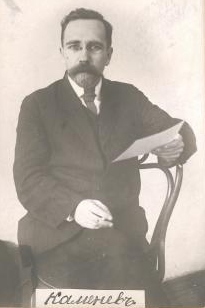
After the murder of Sergei Kirov on December 1, 1934, which started Stalin's Great Purges, Zinoviev, Kamenev, and their closest associates were once again expelled from the Communist Party and arrested in December 1934. They were tried in January 1935 and were forced to admit "moral complicity" in Kirov's assassination. Zinoviev was sentenced to 10 years in prison and his supporters to various prison terms. In August 1936, after months of careful preparations and rehearsals in Soviet secret police prisons, Zinoviev, Kamenev, and 14 others, mostly Old Bolsheviks, were put on trial again. This time, the charges included forming a terrorist organization that supposedly killed Kirov and tried to kill Stalin and other leaders of the Soviet government. This Trial of the Sixteen (or the trial of the "Trotskyite-Zinovievite Terrorist Center") was the first Moscow Show Trial and set the stage for subsequent show trials where Old Bolsheviks confessed to increasingly elaborate and monstrous crimes, including espionage, poisoning, sabotage, and so on. Zinoviev and the other defendants were found guilty on August 24, 1936. Prior to the trial, Zinoviev and Kamenev had agreed to plead guilty to the false charges on the condition that they not be executed, a condition that Stalin accepted, stating "that goes without saying." Nonetheless, a few hours after the conviction, Stalin ordered their execution for that night. Shortly after midnight, on the morning of August 25, Zinoviev and Kamenev were executed by shooting. Accounts of Zinoviev's execution vary, with some having him beg and plead for his life, prompting a more stoic Kamenev to tell Zinoviev to quiet down and die with dignity. Regardless, Zinoviev put up such resistance against the guards that, instead of taking him to the appointed execution room, the guards took him into a nearby cell and shot him there.
After Kamenev's execution, his relatives suffered a similar fate. Kamenev's second son, Yu. L. Kamenev, was executed on 30 January 1938, at the age of 17. His eldest son, air force officer A.L. Kamenev, was executed on 15 July 1939, at the age of 33. His first wife, Olga, was shot on 11 September 1941 on Stalin's orders, in the Medvedev forest outside Oryol, together with Christian Rakovsky, Maria Spiridonova and 160 other prominent political prisoners. Only his youngest son, Vladimir Glebov, survived Stalin's prisons and labor camps.
[image error] Zinoviev
Kamenev
Of course, while one finds these narratives pitiful, one must note that it was precisely Zinoviev and Kamenev who supported Stalin and who help to secure his ascent after the death of Lenin.
Reading the Wiki articles on Molotov and Beria and the events around Stalin's death -- the speculation is that Stalin was actually murdered by Beria --, the last days of Stalin -- the absolute dysfunction of the entire governing apparatus in his wake -- resembles the situation after the deaths of Mao -- and Hitler… much like a political Hiroshima.
At any rate, from 1917-1953, in Russia…, history was certainly playing itself out as tragedy…, and not as farce.
It is an odd thing to read a small set of personal essays about a subject like Stalin's genocides. Indeed, the subject of Stalin's genocides is a contentious one because of the way that it reflects on the Russian nationalist project as a whole as well as the legitimacy of leftist attempts at government. Now, as someone whose politics are resolutely anti-Communist and who has a high degree of compassion for the victims of Stalin's regime, including the poor people he misruled for a period of some three decades between the death of Stalin and his own death, I was clearly on board for what this author had to say. I found it interesting that the author chose to write about this in the form of personal essays, because most writers on Stalin's genocides (and there were more than one of those) have chosen to write about it in rather different ways. Solzhenitsyn wrote novels as well as one of the most epic memoirs of all time, and a great many others have turned the material of Stalin's genocides into heavy and dark historical tomes that delve into the statistics of Stalin's grim harvest, but few have made collections of polemical essays, a format I greatly enjoy writing personally.
This short volume of less than 150 pages contains seven essays along with various other material. The author begins with acknowledgements and an introduction that expresses the scope and perspective of the book as a whole. After that there is an essay that discusses the meaning of genocide and the various activities and levels of genocide that exist and how they would apply to various aspects of Stalin's behavior (1) towards Ukrainians, Poles, and others. The next essay looks at Stalin's life and seeks to remove the sort of excuses that people would make for how Stalin became a genocidal tyrant (2) in looking at his background as a radicalized Georgian. After that the author talks about the political and class violence that was involved in Stalin's dekulakization efforts (3) as well as the horrors of the Holodomor (4), where Stalin's actions killed millions of Ukrainians. After that the author talks about Stalin's record in removing nations for forced exile (with the accompanying massive deaths) that took place for the Tartars and Chechens and others (5). Finally, the author looks at the genocidal hostility of the great purge in the late 1930's (6) as well as the comparison between the crimes of Stalin and Hitler (7) before the author comes to some conclusions about Stalin's many shades of genocide and some notes and an index.
Reading a book like this, even if it is a collection of essays and not based on grim statistics and official writings, helps the reader to frame the moral bankruptcy of Stalin's regime. Unfortunately, Stalin's various genocides are not unique in multiple ways. For example, a writer might compare Stalin's forced transfer of peoples to that which took place in the 1900's America, most notably but not only the Trail of Tears. Stalin's transfer of peoples comes into a context of violence against cultures that includes not only the United States and Hitler's regime but also the Chinese of the Qing dynasty, the Inca, and the Assyrians, as well as others. Likewise, Stalin's own massive amount of killings in imprisonments and internal exile and deliberate hostility towards his own citizens resembles a great many other totalitarian regimes from Hitler's Germany to Communist China to Cambodia under Pol Pot, all of which considerably blackens the historical reputation of the left as well as that of totalitarian governments as a whole. And an essay is a good place to deal with polemical matters such as this, where we must all ponder our own legacies of violence that we have to wrestle with.
I'm the grandchild of kulaks. Both my maternal grandparents died, grave-less, because of Stalin. My grandmother in 1931 in a camp out in Siberia and my grandfather, shot, after a 'troika' found him guilty during the 1937 Great Terror. A couple of pre-schooler uncles died as well. It took some effort for me to explore the fates of this lost family. I'm grateful that scholars like Naimark are highlighting this repressed time under the Soviets—and 'validating' (?) my mother's tortured childhood.
I love reading historical books, from plowing through every U.S. president's bio from Washington through Carter, and awaiting the legitimate historically accurate biography's of the remainder, to exploring the darker episodes of history, books I categorize as chronicling "Man's inhumanity to Man," such as the life & death of Jesus, slavery in America (Ralph Ellison, Baldwin's "Go Tell It on the Mountain," and Stowe's "Uncle Tom's Cabin" which chronicled the underground railroad before the Civil War), Nazism (Shurer's "Rise and Fall of the Third Reich"), and this slim volume from academic Naimark, the result of a meticulous sifting of Russian archive material about Josef Stalin's atrocities.
It is a disgusting foray into mass murder, characterized by the leader as justified for the cause, includes the Russian Civil War (1918-1921), the murderous campaigns in the 1930's which included the dekulakinization (1929-1931), the Ukrainian Famine (1932-1933), the Great Terror (1937-1938), WW2 killings/deportations, the horrors of Order 00447 eliminating 'asocials,' mass execution of Soviet military officers (1938), mass shooting of Polish officers (1940). Naimark also compares the Nazi Holocaust with the pogroms of Hitler. Documented facts, which is much appreciated. Between 15-20 million deaths, Nazi Holocaust totaled @ 6 million. Man's inhumanity to man, indeed!
Certainly not a book for general audiences. It's more of a long essay than a book. He makes a compelling case than many of the actions of Stalin's regime were genocides, but without throwing the word around casually. In fact, he makes a case in the end of the book not to do this.
I agree with the author 100% that social and political groups should be included in the definition of "genocide". The only reason they were not in the original conference in 1948 was pressure from Stalin's Soviet Union. (there's irony for you.)
The Terror Famine against the Ukraine, the war against the "kuklaks", the murder of over 27,000 Polish Army officers in Katyn, the deporting of over 500,000 ethnic groups during WWII as potential "enemies" were all genocides by Stalin's government.
A well-researched, but chilling, account that details how Stalin's horrendous mistreatment of people under his control should be regarded as genocide. Four main topics are covered: the annihilation of the kulaks, the Ukrainian famine, the Great Terror, and the forced migration of ethnic groups within the Soviet Union. Strong arguments are presented for viewing each of these as being a separate case of genocide. The numbers of people killed, and the inhuman attitude of Stalin towards those that he viewed as enemies, is staggering.
a short but none the less worthwhile piece that addresses the topic of Stalin's various campaigns of mass killing and illustrates how these can definitely be considered genocide. Naimark touches on several topics, the Holodomor and the dekulakisation campaign amongst others and demonstrates in each instance how these went beyond simple mass murder and were in my opinion undoubtedly genocidal in nature. Each topic is definitely covered in a greater depth of detail elsewhere but this is a good starting point for those interested in summarising the reign of one of history's worst butchers.
As the library clerk who checked the book out to me said, "Most people would be content with perpetrating one genocide, but not Stalin."
Good primer on the various "terrors" (dekulakization, the Ukranian famine, the purge of nationalities, and the Great Terror) that occurred in the Soviet Union under Stalin with the author arguing that most of them should be considered genocides under the United Nations' definition of the term.
An important short book dealing with the question of genocide under the regime of Stalin. It shortly sums up the political murders, the famine of the kulaks and of Ukraine, the red terror, and more.
According to the u.n treats, none of these are defined as genocide, but this book rightfully raises the important question: what matter does this definition make when it comes to the loss of human lives.
Naimark does a remarkable job of distilling a vast amount of history into an easily digestible text while making the case for viewing the Ukrainian famine and the Stalinist Purges as an extended policy of genocide.
I found Naimark’s thesis comparing Stalin’s Terror to the Holocaust problematic. Although Stalin killed more people during his regime, the Great Terror is over now, while antisemitism still pervades.
As a brief overview of the disgusting crimes committed by and under Stalin, I think this book is very useful. It's presented as basically a "massacre montage", with each crime being followed by another, more horrifying, one. It becomes too difficult to stomach after a few dozen pages.
On the question of genocide, however, and whether the atrocities and mass killings that took place by the NKVD and Soviet authorities during Stalin's reign can be considered "genocide", the author is not convincing. Norman can never fully justify the claim that the killings fall under the Genocide Convention definition, nor can he adequately prove that the plans for collectivization and modernization were done with the EXPLICIT and DELIBERATE intention of eliminating a people as constituted as a group. No genocide is ever committed by accident, or as a consequence of another policy. The author doesn't seem to be aware that large, wholesale mass killings can be described using the adjective "genocidal" without saying that what was committed in toto was, indeed, genocide, per the UN Convention. Ultimately, as you get further into the book, it becomes clear that Norman is only committed to this case, not for any reason of justice-seeking on behalf of the victims or any humanitarian endeavor, but because then it becomes possible to draw direct links between Nazi Germany and the Soviet Union. If I made such a book, and was attempting to do the same for my own side, I would be laying genocide claims at the feet of Winston Churchill, too.
To be clear, I think a really good case can be made that the Soviet Union committed genocide during the period of 1929-1945. On the Kazakhs, during the period of 1930-33 for example, where nearly 40% of the population was completely wiped out; On the Ukrainians, where news of the Holodomor famine and the extent of the death toll was sent to Stalin and the Central Committee and they were deliberately ignored if not outright cheered-on; On the Poles, between 1939-1949, where hundreds of thousands of Poles were deported to Siberia and the Soviet authorities made it a priority to execute large sections of the Polish military and civil service. I Just don't think Norman is the author to do so.
A well researched and written argument for the declaration of specific killings under Stalin’s regime as genocides. While it may seem obvious that anyone who has killed so many people should be classified as a gencidaire, the criteria for genocide is specific and nuanced and Naimark does a pretty good job laying out these nuances and why he believes Stalin’s killings fit the criteria. I also appreciated how he discussed Soviet opposition to the inclusion of political affiliation and social class as these observations were very insightful not only in regards to Stalin but in terms of genocide policy in general. It was at times frustrating for him to throw in a name with no introduction or explanation as to who said individual was while at other times he provides a sizable background for certain individuals such as Yezhov and Beria. There’s no need to go into great detail for every individual discussed, especially since this is more of a long argumentative than a history book, but a simple note of individual X, minister of Y, would have been helpful. Overall, a solidly researched and presented argument for a surprisingly nuanced subject.
An interesting and important read about one of the most powerful people in the 20th century. While a short book, self-described as an “extended essay”, Naimark makes a convincing argument that Stalin was a genocidare and committed genocide in the 1930’s. Looking past the legal arguments and definitions, Stalin definitely killed millions of people in several separate campaigns throughout his rule. For such an important leader in contemporary history, turns out I did not know much about post-revolution pre-war USSR. I learned much about Stalin from this book and would recommend it to others interested in this period of history.
Naimark's short book, "really an extended essay" as he notes, makes the case that the Stalinist repressions could be considered genocide. He reviews the concept of genocide, as first formulated by Raphael Lemkin, and reviews the major features of Stalinism: dekulakization, the Holodomor, the national deportations, and the Great Terror, and makes the case that they all can be considered genocide against their respective victims. It's a short, very readable and accessible book on the subject by a prominent scholar on the topic, and well worth reading.
Interesting deep dive into the definition of genocide and its history, how Stalin became Stalin, and how Stalin committed genocide. Particularly interesting was the part where he discussed how the definition of genocide came to be (some countries got some extra input hint hint)
This short book is part of Princeton University Press’s “Human Rights and Crimes Against Humanity” series, but it’s not clear to me why. Rather, this book makes me wonder what the focus of this awkwardly named series is. The book consists of 137 loosely printed pages that briefly summarize Stalin’s bloodthirstiness, relying primarily, if not entirely, on secondary sources. In fact, only 90 pages actually describe Stalin’s actions. The remaining pages, as well as comments within the 90 pages of Stalin narrative, are devoted to arguing that the definition of “genocide” needs to be expanded to cover Stalin’s actions and much more. I have no idea why words currently used to describe murder, torture, mass murder, and so on aren’t sufficient for the evil of the day, or why Naimark believes that using “genocide” indiscriminately is important. It is clear, however, that Naimark’s proposed expansion of the meaning of “genocide” fits with its current political use. Naimark says that the Soviets, at the Nuremberg trials, refused to allow the accusations to be defined in a way that would include the USSR’s violent and often murderous treatment of individuals, classes, political foes and peoples — all deemed to be politically subversive. (P. 18) Around the same time, Rafael Lemkin, a Polish Jew, invented the word “genocide” and eventually got the U.N. to accept it for its original meaning, viz, as exemplified by the Holocaust. Naimark implies that Jews wanted to appropriate the word for themselves, and therefore, tacitly agreeing with the Russians, lobbied against including political groups in the definition. (P. 23) For Naimark, Jews want to hog the spotlight. So over a third of the book is devoted to arguing that “genocide” should cover all sorts of things — after all, the Holocaust is just one bad thing in a world full of bad things — and, not surprisingly, this is a popular argument. A “landmark” decision held that Serbia’s murder of 8000 Bosnians was a genocide. (P. 26) But that’s just the beginning. “In perhaps the most celebrated case in the Baltic states, Arnold Meri . . . was put on trial in May 2008 for genocide in connection with the forced deportation of some 251 Estonians from the island of Hiiumaa to Siberia in March 1949. Forty-three of the deportees died in exile.” (P. 27) But why limit the word to 43 deportees? For Naimark, “‘Kulaks’ became a ‘people’” as did, in some fashion, ‘asocials and the ‘Bloc of Rights and Trotskyites.’ Their families were drawn into the vortex of execution, exile, and death; their alleged social and historical afflictions were to some extent or another seen as inheritable. They were to be cleansed from society as alien ‘elements’ or ‘contingents.’ Political and social groups became ‘invented nations.’” (Pp. 28-29) Naimark is not using quotation marks around words like “people” and “invented nations” as scare quotes but for typographical emphasis. He suggests quite clearly that turning “genocide” into a general term of opprobrium is a good thing that will prevent Jews from hoarding something valuable in the word. I am all but certain that his book is just a symptom rather than a cause of the fact that “genocide” has become a PR meme, a way of drawing attention to behavior that various political groups want to stigmatize, while necessarily trivializing the Holocaust. So Jews defending themselves against Hamas are commiting genocide; bombing of German cities in WWII no doubt was genocide; indeed, every political action that a radical group opposes becomes genocide, since it is interpreted as an act “committed with the intent to destroy, in whole or in part, a national, ethnical, racial or religious group, as such.” (Pp. 23, 26) “As such” somehow was a key to the landmark Serbian decision that expanded the term, and whatever the international court took it to mean, it obviously has no limiting principle. Naimark is a stupid man.
Stalin murdered more civilians than Hitler, but were they genocides? Politicides? The answer is yes or no by the slimmest of margins—technicalities either way. In this short study Naimark conducts a parade of horribles that display what vicious mass-murder looks like in practice. In the 1930s Stalin uprooted and destroyed “punished peoples” like the Chechens and other Muslims from the Caucuses; peoples with homelands outside of Russia like Germans, Poles and Koreans; Stalin eliminates “Kulaks”—or small landlords, an elastic condition that was “inheritable”; old Bolsheviks accused of treason, destroyed with their families and friends. Stalin unleashes “terror famines” against Ukrainians and Kazakhs —tens of millions die. Millions more were exiled to the wastelands of Siberia. The best of Soviet society was decapitated and its war capabilities compromised. Stalin unleashed series of “political Holocausts” that set a standard in human depravity and cautionary tales about unchecked power.
Josef Stalin killed pretty much anyone and everyone - sometimes one at a time and sometimes by the millions. Then, as beloved Uncle Joe Stalin he defeated the Nazis in WWII. What do you do with a guy like that?