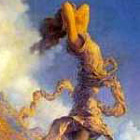
"Trees. Leaves, twigs, branches, bark-covered trunks, roots going down into dark, damp soil. Shields for the earth against the searing sun and drying winds. This is the story of one land and its trees. It begins a long, long, very long time ago..." In Behold the Trees Sue Alexander and Leonid Gore paint a riveting, heartbreaking picture of the long, slow devastation of one piece of Earth--and the hopeful beginnings of its renewal. Alexander, in a mesmerizing litany, recites the names of the trees that once sheltered and protected the land in what is now "Oak and almond, fig and olive, terebinth and palm, acacia and pomegranate, willow and tamarisk." She then describes, in chronologically organized, heartfelt text, the thousands of years of wars, farming, building, burning, and neglect that contributed to the loss of the trees. Ultimately, she writes of present-day efforts by Jewish people of all ages to replant the "one by one--hundreds and thousands and millions of trees." The litany has changed once again, but hope has been rekindled. "Cypress and pine, eucalyptus and acacia, orange and olive, lemon and pecan, oak and palm... They hold back the sea, cool the air, and protect the earth for the people and animals who live there."
Leonid Gore's dramatic illustrations, in acrylic and colored pencil, portray the souls within the trees, and the tragic history they share with humans. (Ages 6 to 12) --Emilie Coulter
At an early age Sue Alexander learned to attract other children’s interest and approval by telling stories. Her passion for storytelling and her understanding of the emotional ups and downs of childhood have led her to write twenty-six books for children to date, notable for their appeal and variety. Alexander is also important for her pivotal role in the growth of an extraordinary international organization, the Society of Children’s Book Writers and Illustrators (SCBWI). At the cost of her own creative writing time, for more than twenty-five years she devoted countless hours to nurturing the group as it grew from three members to over twelve thousand, because, she says, “I was helped... It’s a giving back.”
Born August 20, 1933 in Tucson, Arizona, daughter of Jack M. and Edith Pollock Ratner, she moved to Los Angeles with her family when she was a year old and to Chicago when she was five. Small and uncoordinated for her age, Alexander, influenced by her mother, became a passionate reader. Gradually she used the stories she read, and some she made up, to amuse herself and sometimes others. She says this stage of her life is reflected in her award-winning chapter book, Lila on the Landing (1987) which “was a painful book to write” but let her make peace with the hurt of feeling different and being left out.
Her family life was more satisfying. She, her younger brother and her parents would go flying with her father, an avid pilot. She went with her grandfather to the Jewish markets and neighborhoods. She haunted book stores. Watching a revival of The Desert Song, Alexander was fascinated with the Bedouins on stage. Years later, she used that background in one of her most acclaimed books, Nadia The Willful (1983), a story she wrote to deal with the pain of her brother’s death. Nadia, a young Bedouin girl, disobeys her father’s command not to mention the death of his lost son, her beloved brother. As Nadia finds people with whom to talk about Hamed, she keeps his memory alive and her father ultimately learns that no one is dead if they are not forgotten.
Alexander planned to become a journalist, but while at Northwestern University she changed her major to psychology, which she says helped give her the understanding to make the characters in her stories more real. In her senior year, she left school to marry, and her first child, Glenn David, was born in 1956. When the marriage ended, Alexander moved to Los Angeles, where her parents were then living. She married Joel Alexander on November 29, 1959 and the couple had two children, Marc Jeffry and Stacey Joy.
Alexander had continued to write but it was not until the death of her mother in 1967 that she seriously focused on polishing her craft, determined to “do something with my life that would have pleased my mother...” Her first stories were published in children’s magazines and she reviewed children’s books regularly for the Los Angeles Times. Though Alexander had not yet published a book herself, it was at this time she became a charter member and active board member of the newly formed SCBW (later SCBWI), an involvement that over the years was to help educate and encourage hundreds of aspiring writers like herself.
When her daughter could find no suitable skits to put on with friends, Alexander wrote some, remembering her own imaginative youthful playlets, and Scholastic published Small Plays for You and A Friend in 1973. Alexander’s fourth book, Witch, Goblin and Sometimes Ghost (1976), a book she filled with “tender friendships and lovable foibles,” brought her critical notice and a wider audience of enthusiastic young readers. By popular demand, she revisited these lovable spooky characters several times. She also wrote two more play books, Small Plays for Special Days (1977) and Whatever Happened to Uncle Albert? And Other Puzzling Plays (1980). Other popular Alexander books are the “World Famous Muriel” series about a
Page by beautiful page, the trees of Israel are followed from 5000 BC to the present, including the beginning of a collection of money by Jews in Europe for land and trees in Palestine. Having just come from Israel, I find myself crying for the trees as they reveal the suffering of the land through abuse and war.
Leonid Gore's pictures are strangely and wonderfully stirring.
Merged review:
Behold the Trees is beautifully illustrated by Leonid Gore and tells the story of Israel's trees, through from 5000 BCE, the time of shepherds, through the wanderings of Abraham, Isaac, and Jacob, through the kings, the wars, to the present. Trees are growing there now in large part due to the small blue banks in which the Jewish people put small change to celebrate happy times and to commemorate sad ones.
As the book jacket says, "'Oak and almond, fig and olive, terebinth and palm, acacia and pomegranate, willow and tamarisk. They grew wild when the land was called Canaan...' Some stories happen quickly. Some take thousands of years to unfold. Here is the story of one precious piece of this Earth and how its face was changed again and again by the people who lived, prayed, built, and fought there." The story is told through the trees, the trees that were nearly exterminated. The story is haunting and tender, the illustrations are gorgeous.
I love the artwork and the sentiment of restoring trees to land, but I cannot abide or read again to my child a history of Palestine that so fully erases Palestinians and whitewashes the colonization of Palestinian land.
The sections about how Jewish immigrants moved into abandoned houses when they immigrated, because the land had been abandoned, was particularly odious-if this is a book widely read about young Israelis, they would get the message there was no displacement at all when the state of Israel was founded.
I found the simple timeline of the history of Israel within this book fascinating. However, the presentation was a little too dry for a picture book, in my opinion. More lively or child-friendly images would have made this book so much more enjoyable.
Really really good! This beautifully illustrated picture books tells the history of the Jewish people, the Land of Israel, and the trees of Israel! I love the mention of the work done by the Jewish National Fund! Recommended!
I'm on a quest to find books for Tu B’Shevat! This one nails it. Great front/back page with timeline. Nice repetition of how the trees help and how they disappeared. Beautiful artwork.
I can't even tell if this was supposed to be a kid's book. This was very boring. It tries to claim everyone but Jewish people have been destroying the planet. Completely false and very opinionated. Sounds like the author has some major issues.
I wanted to like this book because of the art but even that wasn't very good.