

What do you think?
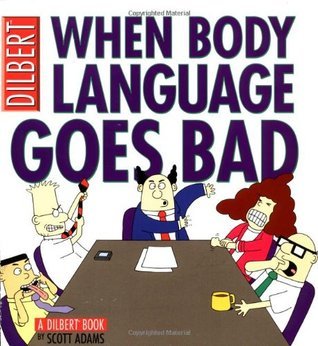
Dilbert #21
When Body Language Goes Bad
Some might think that the corporate scandals of 2002 could make it difficult to find anything funny about today's business world. But When Body Language Goes Bad proves it will take more than that to slow down the inventive wit of Scott Adams, who clearly is never at a loss for finding hysterical things to mock in corporate life.This marks the 21st collection of Adams' wildly popular comic strip, Dilbert, which is featured in more than 2,000 newspapers worldwide. This book updates loyal readers on the so-called careers of Dilbert, Alice, Wally, Asok the intern, and other regulars as they wallow through pointless projects, mismanaged company takeovers, futile team-building exercises, and other inane company initiatives like the "name the rest room" contest.In addition to the strips' familiar characters, this collection showcases Adams' masterful ability to create hilarious "guest stars." There's the network design engineer known as Psycho Hillbilly, who was going for the gentle biker look until he decided it was overdone. Then, there's M. T. Suit, who is merely an empty suit walking the office halls spewing corporatese, such as "promising to enhance core competencies by leveraging platforms." Adams says that about 80 percent of his initial ideas come from his 150 million-plus readers. Those worldwide readers are sure to celebrate the humor found in When Body Language Goes Bad, his latest satirical look at the modern workplace.
128 pages, Paperback
First published March 2, 2003
About the author
Scott Adams
197 books1,319 followersLibrarian Note: There is more than one author in the Goodreads database with this name. See this thread for more information.
Scott Adams was a defining voice of the American white-collar experience who transitioned from a prominent cartoonist into a polarizing political commentator. After earning an MBA from UC Berkeley and spending years in management at Pacific Bell, Adams launched the comic strip Dilbert in 1989. The strip’s sharp satire of corporate bureaucracy and the "Dilbert Principle"—the idea that incompetent employees are promoted to management to minimize their damage—resonated globally, eventually appearing in 2,000 newspapers and winning the prestigious Reuben Award. Beyond the funny pages, Adams explored philosophy and persuasion in works like God's Debris and Win Bigly, the latter of which analyzed Donald Trump’s rhetorical strategies during the 2016 election. His career took a dramatic turn during the mid-2010s as he shifted focus to his daily "Real Coffee" livestream, where he combined his background in hypnosis and corporate strategy to comment on the "culture wars." This period of independent commentary culminated in 2023 when he reacted to a poll regarding racial tensions with a series of inflammatory remarks. Labeling Black Americans a "hate group" and advocating for racial segregation, Adams faced immediate and widespread repercussions; hundreds of newspapers dropped his strip, and his publisher canceled his upcoming projects. Undeterred, he moved his work to the subscription-based platform Locals, rebranding his comic as Dilbert Reborn. In his final years, he faced severe health challenges, including stage IV prostate cancer and vocal cord issues, yet he remained a prolific presence on social media. He eventually announced the end of his hand-drawn work due to focal dystonia but continued to direct the strip's vision. Adams’s legacy remains a complex study in the power of branding, the evolution of digital influence, and the volatile intersection of creative genius and political provocation in the modern era.
Scott Adams was a defining voice of the American white-collar experience who transitioned from a prominent cartoonist into a polarizing political commentator. After earning an MBA from UC Berkeley and spending years in management at Pacific Bell, Adams launched the comic strip Dilbert in 1989. The strip’s sharp satire of corporate bureaucracy and the "Dilbert Principle"—the idea that incompetent employees are promoted to management to minimize their damage—resonated globally, eventually appearing in 2,000 newspapers and winning the prestigious Reuben Award. Beyond the funny pages, Adams explored philosophy and persuasion in works like God's Debris and Win Bigly, the latter of which analyzed Donald Trump’s rhetorical strategies during the 2016 election. His career took a dramatic turn during the mid-2010s as he shifted focus to his daily "Real Coffee" livestream, where he combined his background in hypnosis and corporate strategy to comment on the "culture wars." This period of independent commentary culminated in 2023 when he reacted to a poll regarding racial tensions with a series of inflammatory remarks. Labeling Black Americans a "hate group" and advocating for racial segregation, Adams faced immediate and widespread repercussions; hundreds of newspapers dropped his strip, and his publisher canceled his upcoming projects. Undeterred, he moved his work to the subscription-based platform Locals, rebranding his comic as Dilbert Reborn. In his final years, he faced severe health challenges, including stage IV prostate cancer and vocal cord issues, yet he remained a prolific presence on social media. He eventually announced the end of his hand-drawn work due to focal dystonia but continued to direct the strip's vision. Adams’s legacy remains a complex study in the power of branding, the evolution of digital influence, and the volatile intersection of creative genius and political provocation in the modern era.
Ratings & Reviews
Friends & Following
Create a free account to discover what your friends think of this book!
Community Reviews
Displaying 1 - 17 of 17 reviews

June 6, 2016
I lost my job recently.
My boss called me to his cabin. Being head of the Technical Safety department, I was under the impression that my job was reasonably safe, recession or not. So it was a shock to me when the big guy told that I have been made redundant.
"But... but... why?" I spluttered.
"You're overhead. In the current scenario, company cannot tolerate a single superfluous penny." He said in a sad voice. "You are an old and trusted employee, and I am sorry about this."
"But how can I be overhead? I am the HOD!" I said incredulously.
"That may be true - but can you tell what project you are currently involved in?" The boss asked.
"As Head of Department, in all of them."
"But what do you do, exactly?"
"Well..." I hesitated a moment. "I mentor the guys, advise them in case of knotty problems, decide upon departmental policy, interact with important clients..."
"Ah! But how many deliverables do you produce?" The big guy asked shrewdly.
I was stumped. "Well... none. But that is not expected of a Departmental Head, is it?"
"Exactly!" The boss said. "Which shows that you are a non-producing asset." He pondered for a moment. "Come to think of it, all the Heads are..."
------------------------------
I knew that Dilbert was funny, but never knew that he was so true to life.
My boss called me to his cabin. Being head of the Technical Safety department, I was under the impression that my job was reasonably safe, recession or not. So it was a shock to me when the big guy told that I have been made redundant.
"But... but... why?" I spluttered.
"You're overhead. In the current scenario, company cannot tolerate a single superfluous penny." He said in a sad voice. "You are an old and trusted employee, and I am sorry about this."
"But how can I be overhead? I am the HOD!" I said incredulously.
"That may be true - but can you tell what project you are currently involved in?" The boss asked.
"As Head of Department, in all of them."
"But what do you do, exactly?"
"Well..." I hesitated a moment. "I mentor the guys, advise them in case of knotty problems, decide upon departmental policy, interact with important clients..."
"Ah! But how many deliverables do you produce?" The big guy asked shrewdly.
I was stumped. "Well... none. But that is not expected of a Departmental Head, is it?"
"Exactly!" The boss said. "Which shows that you are a non-producing asset." He pondered for a moment. "Come to think of it, all the Heads are..."
------------------------------
I knew that Dilbert was funny, but never knew that he was so true to life.

August 2, 2023
Again, Dilbert comics take me away. My husband can’t read these, however. He works in the engineering world and says they’re too real to be funny for him.

May 23, 2018
A fun read. A collection of many classic comic strip from Dilbert series. There are random short strips. If you like subtle satire and very short illustrations, its a good read. I was able to connect to almost everything as the characters are representations of real life people from your work life.

September 5, 2018
3.5 stars
I noticed it reuses a lot of the strips from other collections, but as amusing as ever.
I noticed it reuses a lot of the strips from other collections, but as amusing as ever.
February 12, 2021
Another classic addition to the Dilbert family! I have loved Dilbert for a long time and this book does in no way take that feeling away.
March 20, 2021
Another fun read of the ridiculousness of corporate world through the eyes of Dilbert and friends.

November 30, 2022
Fortunately, a funny collection. Unfortunately, a little too true to life, at least in my experience. I maintain that Scott Adams has bugged every office I’ve ever worked in during my lifetime…

February 8, 2023
I can appreciate the humor now that I’m retired.
Read
December 17, 2024""
This entire review has been hidden because of spoilers.

January 5, 2012
http://nwhyte.livejournal.com/1805031...
As per usual, variations between the surreal, the banal and the bleakly plausible from the world of work. I particularly liked the one about two guys emailing each other, each demanding that the other call him back, when they are actually in adjacent cubicles.
As per usual, variations between the surreal, the banal and the bleakly plausible from the world of work. I particularly liked the one about two guys emailing each other, each demanding that the other call him back, when they are actually in adjacent cubicles.

January 23, 2016
We all might have started out like Calvin with a great view of life. But after hitting the workforce we all somewhat become Dilbert. Everyone knows someone like one of the characters in the strips. Highly recommended

December 13, 2008
Another great book in the series that Scott Adams has created to let people who dwell in the daily routine of managment induced chaos understand their lives. A funny read.

August 24, 2009
Dilbert

June 19, 2013
Been a while since I read Dilbert... Hit and miss as always. Not enough Evil Cat for my liking.

July 26, 2015
Fun as usual...

August 22, 2020
Ca. læsedato.

April 7, 2017
Several years ago, someone left the entire run of Dilbert books at my house.
I put them in the bathroom. I've been slowly working through them. I think I'm beginning to understand what working in an office environment might be like; my bathroom approximates a cubicle, and these idiotic cartoons approximate the inane banter one might engage in with coworkers whom one actually detested.
I put them in the bathroom. I've been slowly working through them. I think I'm beginning to understand what working in an office environment might be like; my bathroom approximates a cubicle, and these idiotic cartoons approximate the inane banter one might engage in with coworkers whom one actually detested.
Displaying 1 - 17 of 17 reviews