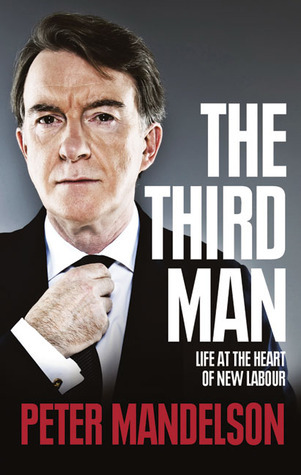
The revelatory memoir of one of New Labor’s three founding architects is devoted to the "soap opera" years of Labour government and the breakdown of relationships between Mandelson, Tony Blair, and Gordon Brown
Drawing heavily on detailed diary notes he took during the events that shaped the British government for more than 25 years. Peter Mandelson tells his story of a life played out in the back rooms and on the front lines of the Labour Party during its unprecedented three terms in government in this mixture of autobiography, personal reflection, and political history. He began writing the book while serving as European Commissioner and completed it since leaving office in May 2010. His revelations include that the relationship between Tony Blair and Gordon Brown became so hostile that Blair described his chancellor as "mad, bad, dangerous, and beyond redemption" and likened Brown's behaviour to that of a "mafioso" in his dealings with him. Much has been written about Mandelson as the person at the heart of the New Labour project, but here is the unvarnished truth from the man himself.
British Labour Party politician, who was the Member of Parliament (MP) for Hartlepool from 1992 to 2004, served in a number of Cabinet positions under both Tony Blair and Gordon Brown, and was a European Commissioner for Trade. He was a key architect in the rebranding of the Labour Party as "New Labour" and its subsequent landslide victory in the 1997 general election. He is President of the international think tank Policy Network. He is the High Steward of Hull since 2013.
I read Tony Blair's book a while back, and found it a reasonably interesting read that articulated his positions on the large decisions very well. Even if you didn't agree with them, at least they were clear.
Mandelson's book is a better written affair, has a pretty clear focus and puts over his personality pretty well. It's definitely insightful, it's fascinating to see how such a skilled political operator functions, and it's true that it slightly makes you feel like his potential was rather wasted, probably because he found himself more comfortable helping the powerful rather than fighting for power.
What it doesn't do is address the big emotional turmoil moments and the big decisions of someone like Blair. In fact many of those moments get fairly short shrift, mentioned in aside and moved on from rapidly. Possibly this is because he wasnt present for some of new labour's most difficult times, possibly it's because he didn't have that kind of responsibility. But it's definitely true that the passion and turmoil is missing a bit.
In fact that's the enigma for me at the heart of the book. He's definitely presenting a case for his importance in the new labour project. It may all be true, but it's difficult to know at times. And one of the reasons it's difficult to know is that there's something so rational and reasonable and calm and measured about everything he says that you actually start t wonder whether he's just skillfully spinning the whole thing. And then at other times you just such a sense of quiet wounding that it starts to feel like he actually has some trouble with outraged frustration.
Basically he moves between being touchingly vulnerable and efficient to being a bit stony faced and lacking in emotional affect. It's unclear which is truer, if indeed either are.
The lack of affect is also often present when he's trying to explain an epic moment, or indeed in the final pages of the book. The very last lines are nostalgic, emotional, stirring and honest. Or more specifically they're meant to be, but instead they're a little frail, empty, meaningless. It's like he doesn't know how to do It properly.
Still, that makes him 1000x times more appealing then the figure of Brown presented here, who is truculent, fickle, aggressive and unbelievably unpleasant a lot of the time.
All in all, it's a very worthwhile read and I learned a lot and enjoyed it considerably. But there's still something a bit off about the book, and maybe about mandelson himself.
This was an interesting read, albeit a long one. I found Mandelson a much more sympathetic character than I expected. One good thing - compared to the autobiography of another 'Labour' leader, he did not hold his constituents in complete contempt. Indeed, he respected them and was grateful for their votes. It's also extremely interesting to learn what goes on behind closed doors, and how policy is formulated.
OTOH this book reaffirmed my belief that politicians live in a totally different universe to normal human beings. They spend half their time feuding with and bitching over their rivals in their own party. If only they put that effort into progressing the country! Secondly, it's very clear that modern politics isn't about principles. It's about coming up with a package that will garner the votes to get you elected. For the Labour Party, this involves truckling to the petty prejudices of middle-class southerners, and basically taking their 'natural' supporters as a given. Call me Mr Idealist, but I find this depressing, though I can see the logic behind it.
Having said that, I would not be averse for going for a pint with Lord Mandelson, or going out for a meal, as long as he paid. At the end of the day, he comes over as a decent bloke. More than can be said for some politicians I could name - and I mean politicians of all parties.
A very interesting autobiography, but I found it hard to read without constantly thinking that it presented a good spin on the facts throughout - although I know most autobiographies do that to some degree. And full of spin doctor language like 'narrative'. And more than other books on New Labour, even Blair's autobiography, it highlights how bad the Brownite onslaught against Blair was.
I cannot be bothered to review an unremarkable book that hundreds of others have already reviewed before me. Unlike many people, I have always quite liked Peter Mandelson, but for such an engaging man the book is slightly disappointing in its ordinariness and lack of truly revelatory content.
I might have given it four stars for readability, but for the mind-numbingly dull 'extra chapter' included for the paperback version which is nothing but an ultra-wordy commentary on the coalition's first few months in power, and really ought to have been condensed down to a couple of pages.
I loved this book as it was something of a learning curve for me and a real insight into Labour politics and the Blair-Brown relationship. I couldn't put it down and was a great read. I would recommend it to anyone interested in British politics!
In some respects, this book is an enjoyable retelling of a tragic story - a man born into a Party he had worked for so long to change ground-up (or shall I use his shibboleth to "modernise"), a successful behind-the-scenes operator who so desperately wanted to be a successful Cabinet politician in his own right, yet repeatedly and very publicly failed in attempts to achieve it. And only when he finally achieved the position at the high table that he strived for so long, was at the very twilight of his position in government.
I must admit I have a soft spot for Peter Mandelson. Unlike Blair or Brown, I do not remember him from childhood and know his public persona only from documentaries and a few media appearances he did after the 2010 election defeat. But I always found him much more interesting than the average politician and was curious about what created his public persona of a spin doctor or "the Prince of Darkness". In this respect, this book falls short - sections about his time as Labour's Director of Communications and Campaigns are fairly short and without actual retellings of what made his name. Similar case is the election of 1997, that is presented only very briefly.
Mandelson's upbringing, childhood and early life, are all presented in the shadow of his grandfather Herbert Morrison (Labour Deputy PM in Attlee's government) and Labour's troubled 1970s. The most revealing chapters deal with his youth, his volunteering in Tanzania, his time at Oxford and his most notable work in youth politics, where he met a lot of important figures from later days. This, as well as his brief flirt with Communism, limits the extent to which he can be seen as an ideologically hollow politician, that wanted to destroy everything that Labour stood for.
The portrayal of Tony Blair in Mandelson's account is far from flattering. He emerges as a rather weak figure, exploiting Mandelson's goodwill for the New labour project, especially after his second resignation from the Cabinet in 2001, which was clearly unfair and an overreaction. So much of the book is spent on Brown's tumultuous behaviour, and constant fight with Blair, yet prior to 2003, the Brown persona does not feel rational enough to be believable. This is also when one considers accounts of other new labour figures, whose portrayals of Brown in the late 1990s are much more nuanced than Mandelson's.
Brown's anger feels more understandable when Mandelson reveals that Blair had, in fact, deceitfully misled his Chancellor about his intentions to step down before the 2005 election (if Brown agreed to fully support and continue Blair's policies, especially on public services), instructing Mandelson to "go along with" the false understanding by Brown.
When Brown brings Mandelson back, it’s quite difficult to understand his loyalties. With the repeated ‘almost-coups’ and upheaval among former Blairites, he tries to make a case that he wasn’t too stubborn in his defence of Brown, yet he stays close enough to him to protect him against a challenge by David Miliband or someone of similar stature.
Generally, Mandelson repeatedly states that he believes in the primacy of policy (and before the 2010 election tried a "policy-led recovery" which is just a wonderful phrase), yet we do not get a thorough account of what his or Blair's ideas in public service reform truly were and how they differed from Brown's. Fights and feuds are presented so much through the personalities that seeing it as more than a soap drama is rather difficult.
Mandelson succeeds in presenting the nature and spirit of European policymaking in that the chapter on his time in Brussels is the most boring of all of them. But I understood what it meant for him and it was also understandable, how it changed him into the politician most people remember from 2008-2010, that was more self-confident and self-assured. The interesting policies of "industrial activism" from his third time in government, unfortunately, do not get enough space.
The last chapter of the New Labour era, before the election of 2010 is presented as a combination of Labour’s running out of steam (and money, which is frankly surprising) and Brown’s indecisiveness about election strategy. This is, in light of the difficulties in working with all the personalities, a believable story.
Overall, I very much enjoyed the book, and while some parts are refreshingly honest (or they feel to be), it has to be understood as a "briefing" for him, that was among the first memoirs by New Labour figures after the 2010 defeat. While he makes sure that the Third Man is not implying his stature equal to Blair and Brown, I am left with an idea of how important he was to the overall New Labour project as both an idea and an organisation.
Where would Blair, Brown and the New Labour project have been without Peter Mandelson? This is the question that Peter Mandelson answers in his entertaining, self-centred and self-serving book about the Blair years. The Third Man? Only in the sense that the second man was Peter Mandelson, and the first man was Peter Mandelson too. He was the puppet master even if the puppets had often (inferior) minds of their own. Peter Mandelson is a big picture guy, so I’m giving the Big Picture overview of his book. Of course there are many, many times that Peter compares his shortcomings and weaknesses versus the superior strengths of Tony and Gordon but, the overall impression given is that both of these Prime Ministers were politically unsophisticated compared to Peter. Yes, Brown had a big brain and Tony had the charisma but Peter? He had it all. I admit though, that the strength of this book lies in the teller more than the tale. No doubt everyone in New Labour has their stories about the feuding between Blair and Brown, but I very much doubt anybody had a better ringside seat than Peter Mandelson. In fact, Mandelson was in the ring with them, sometimes referee, sometimes trainer, sometimes flitting from one corner to the other with the smelling salts and magic towel, but the best thing is that he brings you in to the ring with them. The impression is given that Mandelson, by the end of it all, was throughly sick of both Blair and Brown mostly because they both got in the way of the New Labour Project that was essentially his baby. His sympathy is very much with Tony though, and Brown comes across very badly in the book. It was somewhat of a revelation to me how bitter Brown was that Blair became leader when John Smith died, but the news for me was that this happened from almost the very first day that Blair entered Number Ten. Mandelson makes this clear. It didn’t explode when Blair went for a third term, it detonated long, long before that. I’ve read a few books on the Blair years, but I think this is the best one. It’s waspish, opinionated, interesting, educational and really does feel like you’re being given an inside track on how British politics was played in the Blair years. But the overall thing that struck me was how, in the end, all these “big beasts”, “movers and shakers”, “global statesmen” or “world leaders”, are essentially just people at the end of the day, with their undeniable strengths and personalities counterbalanced by weaknesses and flaws. This even applies to Peter Mandelson who, intentionally or not, has painted a political picture of who he is with this book that surpasses most political autobiographies that I've read.
Lord Voldermort, played in this novel by Peter Mandelson, takes over the muggle world and rules for 13 years before Harry Cameron's wizard and muggle coalition ousts him in a battle for control of the Ministry of Magic.
Ok - that is not what this book is about at all, but the self styled Dark Lord does manage to do the dirty on his former friends and blow the lid off the open secret about the breakdown and growing rivalry between Tony Blair and Gordon Brown during the New Labour years. Unsurprisingly, Tony Blair is reportedly livid at this expose, but perhaps moreso because the frank honesty here will dampen enthusiasm for his own political memoirs. Maybe Tony Blair is most annoyed that Mandelson beat him to it.
The book is well written, frank and attempts to be honest. It covers a whole lot more than the Tony/Gordon spats, starting earlier and ranging more widely. But it is also obviously (being a political memoir) heavily coloured by the experience and mind set of Peter Mandelson himself. The thrice disgraced politician styles himself as the Third Man in the New Labour marriage, and who can dispute that interpretation when Tony Blair and Gordon Brown felt it so important to keep landing him with plum jobs in Government at home and in Europe?
This book is self reflective too. Someone as politically astute as Peter Mandelson would be bound to write in a self effacing manner that ought to win over less cynical readers. More cynical ones might feel that he just wants to sell books and knows how not to annoy his readers.
But then it comes down to this: who buys these political memoirs? Who really cares? All the really salacious details are already appearing in newspapers, and do we really discover much about the man who is Peter Mandelson in this carefully crafted book?
I think the answer is yes - we do. A little. Also, even though so much of this book will appear in print elsewhere, it is an annoyingly addictive read. Annoying because we know that Mandelson is just out to make a quick buck. Better histories of New Labour will appear by less partisan political observers (although they will use this book as a primary source no doubt). But in some ways this story is almost as good as reading about the dark days of Lord Voldermort, even if - unlike Peter Mandelson - you will be cheering for Harry Cameron and Nick Weasley in the end.
Political memoirs are rarely as revealing as I'd like them to be. They also tend to view the author as a genius who creates all the good decisions and warns against all the bad decisions and Mandelson's book goes along on this well trodden road. And I think this is a real shame from Mandelson who is, let's be honest, quite a controversial character. The book really centres around his position as the 'third man' that being between the internal Labour Party war of Blair v Brown which in theory is a great idea but in reality the book lacked drama. It felt that Mandelson was attempting to be fair to all sides and not upset anyone. As a result the emotions have been removed. Was there really never moments when the stapler was thrown across the room? Phones slammed down? Faces turn the colour of beetroot? It's hard to believe given the pressure that must come from running the country.
My motivation for reading this was to discover more about why Labour had embarked on the constitutional changes that it did and whilst these changes were acknowledged in passing reference, no detail was given. This is maybe why I began to tire of this book towards the end. It's also wordy for little substance. If Mr Mandelson talks like he writes, donkeys would be well advised to stay well away from him. In the end it's all a bit boring.
And that's a shame, because I got to quite like Mandelson and honestly I can't believe I'm saying that. There's a warmth and sincerity here that is quite endearing, but it's also the problem. Mandelson made enemies. He admits this in the book. He often talks about events when he was brought to tears but I'd be much more interested in hearing from him about how he made his enemies and how he brought them to tears. We don't hear any of those stories. I wish we had, because without that context it hard to evaluate why he was such a useful and vital part of the Labour machine.
Overall, this book fails to give you the juicy inside story that you came for. A missed opportunity.
This book was published in 2010 and largely about the Blair/Brown relationship. Mandelson argues that he was pivotal in forging it (questionable I feel), and then goes on and on and on about how it broke up, largely because of Brown. I’m willing to believe that Brown was difficult to work with but honestly, does he have to mention it so often. John Prescott (whose autobiography admittedly covers a wider historical span) doesn’t. Even the chapter on his time in Europe which starts off on the topical theme of free trade, descends in to more moaning about Blair and Brown. It is interesting to reflect on the legacy of New Labour (which seems rather old these days). Peter Mandelson, personally responsible for the loss of the red wall, the fracture of the United Kingdom, PFI and the continued privatisation of public utilities and maybe even the introduction of the Horizon system to the Post Office. Maybe not but he doesn’t come across wonderfully well. There’s very little about his private life. Maybe he’s genuinely such a shadowy figure that he genuinely doesn’t have one.
A very interesting look at Mandelson's time in the Labour Party and then in government with Blair and Brown. He comes across very well here, more reasonable and responsible than either Brown or Blair to be honest. The Darth lord reputation seems wholly inaccurate when you read him in his own words. One striking thing was the similarity with Thatcher's autobiography. It paints New Labour as an ideologically based entity and I feel lacks attention to the real people politics and policy affects. Cult of personality rings strong with these sort of people, obsessed more about their legacy and how people view their time in government rather than telling stories of real people. Very much worth a read if you're interested in evaluating the party in this post-new labour era.
I cannot be bothered to review an unremarkable book that hundreds of others have already reviewed before me. Unlike many people, I have always quite liked Peter Mandelson, but for such an engaging man the book is slightly disappointing in its ordinariness and lack of truly revelatory content.
I might have given it four stars for readability, but for the mind-numbingly dull 'extra chapter' included for the paperback version which is nothing but an ultra-wordy commentary on the coalition's first few months in power, and really ought to have been condensed down to a couple of pages.
** I wrote this review on 10 April 2011 and am copying it here because GR won't give me access to my original account **
A very enjoyable book that is well written and edited. Lord Mandelson could have said a lot more but unlike many political biographers he's kept things succinct and to the point but also with some emotion. The Blair-Brown 'struggle' is a tragedy - think what they could have achieved if they worked together more. The book highlights we are all human and essentially self involved. It ends with Brown losing the election to Cameron when the Lib Dems sided with them - the sense of impending doom is palpable...
It's a really good read, he's a fabulous writer just as he is an excellent orator. It's a brilliant, if a little narcissistic, insight into one of the most fascinating periods of British political history and the messy interpersonal relationships at its core. It hasn't lessened my desire to trap Peter Mandelson in a jam jar and study him as if he were a rare bug. What a funky little freak of a man.
I have read numerous books on the ascent and collapse of New Labour, and it always strikes me how the project carried on even through the devastating differences of opinion and briefings against one another.
It's fascinating to see how Mandelson steered through these and was a prominent proprietor within the movement, happy to serve even when blighted by those around him.
A wonderful, mildly gossip-y account of Mandelson's rise through Labour and his perspective on his many dismissals from government. He's an efficient, unfussy writer who clearly feels a need to set the record straight. A must for anyone looking to access the interiority of the New Labour years.
Very well written and emotive tracking Mandy’s full life. Undoubtedly best part is from 97 onwards and the dying days of the New Labour govt. Does sort of seem like if Blair and Brown maybe just got on a bit better and Brown wasn’t such a baby maybe more could’ve been achieved
Early on he tells the anecdote of Osborne discovering him badmouthing Brown, then he devotes much of the rest of the book to doing just that. So much settling of scores. Most interesting in telling the inside stories of key turning points. Dullest in its repetition, and turgid detail on policy.
While Mandelson is clearly a pretty big hit for himself, he does do a good job of relating the aims of New Labour, its victories and, above all, the corrosive effect of the TB/GBs. It all seems like such a long time ago, but it didn't feel dated.
Those who knew me from my student days would undoubtedly be raising a quizzical eyebrow at the favorable review I am granting to Lord Mandelson's The Third Man. Such a review and realization is undoubtedly a sign of personal progress, and a re-examination of progressive politics, something the much maligned Third Man at the Heart of New Labour quintessentially embodies. The Third Man is not quite the kiss and tell memoir people may be expecting, but rather an expose and chronicle of the New Labour project, and a heartfelt autobiography of Lord Mandelson's early life and life in politics. Those who have followed, or are at least familiar with the cut throat world of British politics will find some interesting behind the scenes insights, not least of which are the supposed "betrayal" of Mandelson toward Brown in backing Blair for the party leadership in 1994, and the various workings of the Cabinet throughout the 13 years of New Labour's tenure in power. Lord Mandelson does not disparage or detract from various politicians, but rather gives a decent recollection of the personalities, and occasional abrasiveness of those in the highest echelons of government. Mandelson is not in anyway derisive of Gordon Brown in his recollections of his dealings with the former Prime Minister, but rather reflects the personality traits that have been regularly portrayed to us through the media, revealing Brown to be a focused, determined, but at times, difficult individual. Little can be traced into the personal insights of Tony Blair, however Mandelson reveals no trace of bitterness in his recollection of the two occasions he was relieved of his duties under Blair's watch. While the circumstances under which Mandelson was twice forced to resign during the first New Labour term in office have been a constant source of derision for the former Government Minister, Mandelson does provide a decent account and exoneration of his previous controversies, and does so within a fitting narrative that proceeds to tell of his appointment to the EU Commission, and his final, and unlikely, return to the top echelons of Westminster. While the chapter concerning his tenure in Brussels is somewhat short, and frequently intermixed with insights to the then domestic workings of British politics, it is nonetheless a decent insight into the role of EU Trade Commissioner, and covers an interesting account of his prime focus in office, to conclude the Doha Round of World Trade Talks. While a keen observer of the Global Economy such as myself would have preferred a deeper insight into the workings of the Trade Talks, there is nonetheless a decent account into the dynamics of the negotiations and the political realities of worldwide agricultural trade. The book begins and ends with Mandelson's highest role to date, Business Secretary, Lord President of the Council, and First Secretary of State during the troubled final years of Brown's Premiership. Both Mandelson's account of how Brown felt compelled to call on his services during the financial crisis, and Mandelson's handling of his new role should clear any doubts that Lord Mandelson is a highly capable political operator. While it may be the man's own account, there can be little detracting from his achievements as an architect of the New Labour project, or his stewardship of Britain's ailing economy. Indeed, if he is indeed tipped to be the next Director General of the WTO, I cannot conceive of a more qualified political veteran, regardless of my own political positions. The Kindle Edition is relatively faultless, complete with all the photographic inserts found within the book. The only complaint was the lack of a photographic cover. In all, perhaps the best political memoir I have read in the past year, and measures favorably in comparison to other such memoirs. A decent and enjoyable read, recommended to all, regardless of political persuasion.
A small item is a morally stunning discovery for all survivors of abusively pushy school work and the type of teachers who rave and bellow and scream. At a moment in Mandelson's early career before he was famous, he reveals he had a mini stress crack-up and got medical advice on it from his GP. He had been overworking in his efforts for the party. Needed to take a rest period of limiting what he did. Included in his doctor's orders for it, was: not to bring any work home. For an adult able freely without fear to go to the doctor about stress, the message was: don't bring any work home. Protect your health by not giving yourself, in fact, homework.
But this is New Labour, the most famously education crazed government of all. We remember, though revealingly Mandelson does not write about it, showing it did not have wonderful results, how the early Blair was manically in favour of homework. What the slave machine of school does to children has its unreasonability, its immoral destructiveness, most of all its enormity of double standard against the easier position of adults, shown up by an event in the life of New Labour's own top media man. All Blair era kids, all survivors from all eras, seize on this piece of gold dust.
It is an extreme Blairite conceit that Mandelson claims even Smith would not have won and had not done enough "modernising", implying he thinks the massive landslide of 1997 and reaction against the Tories only ever happened because of the personal chance that Smith died. Otherwise he imagines it taking yet another parliament, and still only happening if Blair then succeeded Smith. In real history the reaction against the Tories dated all the way back to the ERM crisis when Smith still Labour leader and New Labour not yet invented.
It's grippingly worth reading for the drama of the personal fights whose staggering trail all through a 3 term government really happened. It was more persistent and deeper than ever got across in the news. He received confidences he received mainly from Blair but Brown too on how they really felt, and Blair's growing paranoia about Brown and telling him what he wanted to hear to shut him up then not doing it. Did they expect their mate Mandelson to put into a book for all to read? They should have, when personal life in this very small top circle of New Labour was treacherous enough that Mandelson got sacked twice for appearances' sake. No wonder now he gives away every confidence he shared with both protagonists. So would anyone in his place.
Now this is a massive read. It's thick enough but then you realise how small the typeface is.
It is a book I'm glad I gave the time to though. It's a fascinating look at modern politics and New Labour. It's a no holds barred look at both those subjects. The big surprise was the lack of bitterness and bitchiness. The book is startlingly fair. I couldn't quite understand how he could be so fair but maybe the nasty environment of power grabbing they call politics gives you a thick skin.
No one comes out of this book all nice and shiny bur no one is shot down in flames either. Gordon Brown comes out the worst. Even more so because Mandelson doesn't attack him personally. Letting the acts speak for themselves.
Blair and Campbell don't shine all the time. Blair comes across as weak and Campbell as arrogant and unwilling to listen.
Mandelson tells an often complicated and dragged out story well. Some pieces took longer to read than others but I never wanted to put the book down. I would have liked to hear more about his work as an MP. That features very little. leading me to believe that 'career politicians' have a constituency merely to gain a cabinet position. What benefit that is to those constituencies is worrying.
Another question that raised its head persistently was who pays for all the back room staff? Next time the Labour party rings me for a donation at election time it will get short thrift. Politics seems to be about image rather than helping the masses. Thankfully we have limits on electioneering spending. So while we may waste considerably less than the US (think what their party spends could do in NASAs budget instead) we still could improve on how party's spend their donations.
I did feel that Mandelson had the urge to better the country and especially it's lower classes. However I think that is impossible if you also want to have a 'career' in Politics.
This is a fascinating but very long book. I'd recommend reading it in sections. Even the chapters were monstrously large. It would be interesting to read as candid a book as this from his opposite side of the House of Commons. I fear it would read very much the same though.
If you're only going to read one book on the rise and fall of New Labour, this probably shouldn't be it. I imagine that there are other books on the topic that are less biased and take a broader perspective. However, if you're a political junkie, this book does offer a vivid first-hand account of the reshaping of the Labour party in the late 80s and 90s, and the government's successes and later unravellings in the 00s. Particularly fascinating is the depiction of the relationship between Tony Blair and Gordon Brown, which partakes of both Shakespearean tragedy and farce.
I read this book in part, because as someone who takes an interest in British politics from afar, I've never quite understood exactly what Peter Mandelson did, or why he seemed to be so hated or even feared by some people. I now have a better understanding of both of those things, although Mandelson naturally portrays himself as a pretty likeable person.
One rather odd thing about the book is how seldom Mandelson discusses policy in terms other than the impression it made with the voters. (The telling exception is when he discusses his work as a European Trade Commissioner.) For example, Mandelson praises Tony Blair's "Tough on crime, tough on the causes of crime" slogan for connecting with voters in middle England, but never spends a moment examining whether New Labour's crime policies actually did anything to reduce crime or make Britons safer. Mandelson very specifically denies the oft-made assertion that New Labour was all spin and no substance, but his own narrative consistently focuses more on the spin. Although this may be partly because he judges that his audience doesn't want a lot of boring technocratic detail on policies that may now be irrelevant anyway.
Similarly, if you're looking for juicy revelations about the run-up to the Iraq war or about the 2010 election campaign, you won't find them here. Mandelson covers these topics, but doesn't offer any big surprises.
But if you want to know about the ins and outs of political infighting, and get a sense of the personalities that shaped the present-day Labour party, the book delivers on that.