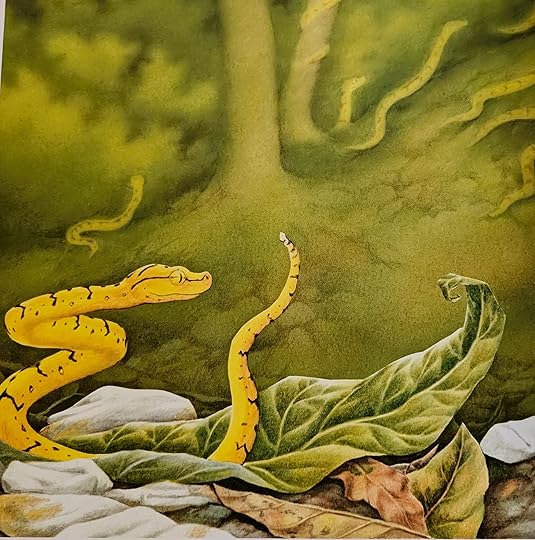
On a small tropical island, the sun rose high above the steamy jungle. A mother python was sending her hatchlings out into the forest the way all mother pythons do. "Grow up big and green - as green as the trees' leaves," she called to her little yellow babies as they happily scattered among the trees. But Verdi dawdled. The story of Verdi.
Verdi is a beautiful baby python who experiences many of life's lessons on the path to growing up, just as children do on the way to adulthood. The colorful illustrations matched the story perfectly. This children's book would make a great bedtime read. There is also a nice section in the back of the book that discusses snake facts. 🐍
Verdi by Janell Cannon is a book about a python snake named Verdi who doesn't want to turn green.
As a young snake, Verdi loves to slither fast across the forest floor and swing high into the sky. His fear is that as he starts to turn from yellow to green, he will become like the other older green pythons-slow and boring. As he notices the first tinge of green on his skin he decides to try everything in his power to stop it. Follow along in the story to see what Verdi will learn about aging and how it might not be as bad as he thought.
We loved this bright and colorful book about Verdi. The book sends a powerful message and can be enjoyed by children and adults. We enjoyed the two pages of snake notes at the end which explain facts about the python as well as other snakes.
We have probably all gone through the know-it-all phase that hits children, pre-teens, and young adults. Yeah, we know it all, so why listen to the elders? That’s what happens with Verdi the Snake. He thinks he’s pretty chill and he looks good, too, so sermons from them should just be ignored.
When Green Tree Pythons are born, mama sends them out into the big world immediately. It isn’t easy because the young ones are actually bright yellow with black stripes, so they stand out in the green jungle. Normal snakes want to grow up quickly because that way they will also change into green, which allows them to hide in plain sight. But Verdi the Snake loves his yellow coloring and wants to keep it forever. In other words, he just doesn’t want to become an adult. Sound familiar?
This book is a unique way to explain to children about becoming adults. It’s not something that can be put off and using a snake as the main character is a way to keep the younger reader interested. Plus, I like Verdi the Snake. Cool dude.
I read this book today to the Kindergarten class I am observing because it tied into the discussion they've been having for a while about the animals of the rainforest. My cooperating teacher thought this was an especially good time to read this book because it's about a python and they are studying the various types of snakes right now. Overall I thought the story was wonderful. The illustrations were beautiful and the kids were very engaged. The whole concept of a snake's point of view on molting and getting older seemed to appeal to them. After reading the story, I asked the class what lesson they might have learned from it. Little Caroline spoke up and said, "It shows that it doesn't matter how old you get, because you can still do the same fun things you did when you were little and still be yourself." Needless to say, I was thrilled. I gave this book a 4/5 though because I felt some of the language in it would go over the heads of the age group it says it's for (4 and above). Words such as 'antics' and a few others I feel could have been simplified for younger listeners. Nevertheless, the kids got the jist of the story and understood the plot which is a reasonable expectation of children at the Kindergarten level. And big words in a story always present an opportunity for children to learn new vocabulary, so this can be a positive aspect of reading this story to little ones. It's important to expose children to rich language and vocabulary so that they begin to break down the semantics of language, and this book may have some words which can aid in that.
I read this for my Children's Lit class, as I plan on becoming a librarian. The class isn't required but I see it coming in handy someday. For all the really frustrating, overly watered down and unimaginative children's books you find, there's always one or two jewels: this was one of those jewels.
Janell Cannon, the acclaimed author of Stellaluna, puts a new spin on the coming-of-age story by telling it through the eyes of Verdi the snake. When the mother snake sent her hatchlings out into the jungle, she wished for them to “Grow up big and green—as green as the trees’ leaves”. The young snakes were yellow with darker stripes, and they would eventually molt and become green when they are fully grown. Verdi, however, scoffed at the idea of turning green and being slow and old. He went in search of older snakes to ask them if there’s any real benefit to growing up. He ran across three of them, hanging on branches, moving very slowly and often not at all. They complained about indigestion, molting, and Verdi’s tendency to interrupt. Another adult snake snapped at the young eager Verdi, and proceeded to go right back to sleep afterwards. All of this seemed to prove to Verdi that adult snakes were slow, boring, and generally no fun at all. Despite all of his attempts to stay yellow, he slowly begins to turn green. In his distress, he fell back on one of his favorite childhood activities—flinging himself through the air using a vine. However, he was much bigger than when he was young, and the fall injured him. The older snakes he questioned earlier making a splint out of a branch and tying him to it until he recovered. When he did, he’d been still so long that he started to notice the beauty all around him if he’d only stop long enough to watch it. He realized he was completely green and that being a grown-up snake wasn’t so bad. However, when new hatchlings came and were convinced green snakes were old and lazy, Verdi did his old vine trick and proved them wrong. He accomplished his ultimate goal: he grew older, but he didn’t lose his lively personality because of it.
The illustrations are done in acrylic paint and colored pencil. Rich yellows and greens dominate. It is executed as realistically as possible in most aspects, although the snakes do have great expressions from time to time. When Verdi panics, his forked tongue shoots out of his mouth in a comical look of surprise. The illustrations are on the right-hand page with text filling the left. They have a thick white border are are perfectly square; however, parts of the picture occasionally overrun the edges of the illustration onto the border, creating a sense of depth that will make the reader feel as if he or she is immersed in the jungle setting. The animals are accurately illustrated, and there are a variety of jungle plants depicted realistically as well. On the pages filled with text, there is a woody vine border curled around the edges in a light neutral grey that will not distract from the text. There are smaller illustrations in black and white under the text that illustrate a moment not depicted in the full-color illustrations. The variety of colors and rich details will keep readers engaged, and they will come back to this book again and again.
While the book is technically about a snake who doesn't want to be green, children will recognize their own reluctance to grow up and sympathize with Verdi. This book will perhaps make the transition easier by proving that growing up doesn't mean losing yourself, and that you'll be okay on the other side.
Verdi was a high-spirited young tree python, one who enjoyed slithering along as fast as he could, launching himself from trees, and generally having adventures and fun. The elders in the snake community always seemed boring, lazy and rude to him, and he hoped to avoid shedding his own bright yellow skin and becoming green like them. As is so often the case, however, he couldn't really avoid growing up. Fortunately, he discovered that his elders weren't so different than he, and he managed to keep his essential character and personality, when he himself was grown.
Originally published in 1997, Verdi was author/illustrator Janell Cannon's third picture-book, following upon the now classic Stellaluna, and then Trupp: A Fuzzhead Tale. Like her first book, this tale of a little snake and his gradual realization that growing up doesn't have to be a bad thing manages to be both entertaining and educational. The story itself highlights some facts about snakes - the fact that they shed their skin, for instance - while the author's afterword gives more information about snakes in general. The artwork, done in acrylic paint and pencil, is vibrantly colorful, and quite beautiful. Verdi himself is gorgeous. Recommended to anyone looking for picture-books about animals in the wild, or children's stories about relations between the generations, and a child's potentially complicated feelings about getting older.
Another childhood favorite that I haven’t read in forever. This was excellent. Gorgeous, hilarious pictures. Verdi is scared to grow up because he feels so energetic and invincible in his youth, and the mature snakes seem bored and tired. I like the message that even inevitable fears are hard to face, AND that Verdi comes to realize he’ll still be himself no matter how old he is. Peter Pan should read this.
Verdi is a book that grown-ups and kids alike will love and relate to. Verdi is a young, yellow snake. He can move fast and do all sorts of neat tricks that the old and slow green snakes don't seem to be able to do. All they want to do is sit around and enjoy nature and talk, which is a young snakes's worst nightmare. Little Verdi's biggest fear in life is turning into a big green snake and becoming boring. When he sees the first signs of green in his skin he panics and does all sorts of crazy, daring tricks to prove that he's still young. When he falls and hurts himself, the older snakes help splint him up. As he has to sit still and let himself heal, he notices all the beauty in slowing down and appreciating the things around him. When he's all healed, he decides he's okay with being green. When some young yellow snakes come along though, he does some cool tricks to show them that even if you get older and like to take it slow, you don't have to lose who you are and can still do fun things.
Verdi, a young yellow snake with an adventurous attitude is going to do his best to not turn into an old green snake. The old green snakes are boring, lazy and rude, in Verdi’s opinion. Vowing that he will stay young forever he daringly explores the jungle. Verdi notices despite his efforts to stay yellow he starts to turn green, oh no! With one last daring attempt to stay yellow Verdi hurts himself and is forced to lay still and listen to the old green snakes, while doing so he turns green. Thinking that turning green made him old and slow it took some yellow snakes to remind Verdi that he was still a playful snake that likes to have fun no matter what color he is.
"From a distance the green snakes watched Verdi wondering if he was going to live to turn green". The illustrations show dimension by adding details to the snakes and not the jungle in the background. When you look at the pictures you know you are deep in the jungle, because the jungle is green and so are the snakes the illustrator has to separate the two. The majority of events in this book take place during the day, the illustrator also shows what night time in the jungle looks like to represents the passing of time.
The book was very detailed in the series of events that Verdi was going through and the illustrations worked well to bring the story to life. The writer's use of the green snakes was important to the plot because they knew what was going to happen to Verdi but just laid back to watch it all unfold. I enjoyed this book although it was a little long the pictures made the story fun, Verdi realizing he would always be young at heart made the ending enjoyable.
A story about not wanting to grow up and be a grumpy, boring adult. I'm afraid it comes for us all. :) But age is a state of mind, and Verdi still knows how to play after turning green. The illustrations are super cute and I enjoyed them more than the prose. The story is a bit choppy and time passes slowly sometimes and quickly others.
My husband and I read the together this evening. I loved the sweet story and the amazing illustrations as well as the interesting snake information at the end of the book.
This book seems to be beloved by many, so I'm glad I finally checked it out. My four-year-old liked it just fine, but I felt that the message was just as much for adults as it was for children.
I decided to bust out my childhood copy of “Verdi” to celebrate the first day of Lunar New Year, since 2025 is Year Of the Snake. 🐍 This sweet little story about a baby green tree python who is afraid to grow up into a boring, cynical adult still resonates with me now, at age 32, just as it did when I got my copy (that I still have) at my elementary school’s Scholastic Book Fair as a kindergartner. It’s a pacey story with a spunky protagonist, beautiful illustrations (Janell Cannon also wrote and illustrated “Stellaluna,” another beautiful children’s book and a lifelong favorite of mine), and an important life lesson: that growing up and maturing into an adult doesn’t mean you have to let go of what makes you you. My biggest fear as a child was that I would become one of those burned out, boring, bitter adults who settle for lives they never wanted and take out their resentment on the rest of the world, and this book was very special to me. I’m pleased to report to my child-self that her fears are unfounded, and that “Verdi” is still a book with a special place in my heart. Like Big Verdi says to himself at the story’s conclusion: “I’m still me!”
I think Verdi was an excellent book. The illustrations were wonderful and the stories message is just as great. This is a coming of age tale in which a snake is not looking forward to growing up. He eventually realizes that his perspective will also change with age.
I enjoyed that this book brought us on a journey with the main character. We understand the feelings and motivations of the character, and our views change alongside the character as the story progresses. The message is quite universal as well. We often times don't want to grow up for various reasons, but once we get there, it's hard to remember our perspective from our younger days.
The illustrations are wonderful. They both extend and support the text and offer a visual glimpse into Verdi's world. The colors are carefully chosen, as they change from the beginning to the end.
Verdi is a young python, he is yellow with stripes and has no desire to grow up and grow green. He wants nothing but to jump, climb and keep moving around the jungle, never growing old, growing lazy and green. He wanted to keep his yellow skin and his stripes, but slowly the green started. All the while the older green snakes and other animals watched. They knew the feelings that Verdi was having, they remembered, so they tried to tell him stories to sooth him. Then, after he really had turned to green, and was enjoying watching the jungle, two young, yellow snakes came to him and he had the chance to leap and laugh again, remembering his younger days.
Every animal has its way of growing up and growing wiser, even snakes. This is a great book with lots of large wonderful pictures for the smaller kids and a great story for kids of all ages. The young Verdi is full of life and determination while the older he gets, he learns he doesn't have to loose that life just because he is getting older and greener. This is a fun book for anyone who likes snakes.
The last pages are snake facts that are also very informative and remind us that just because they can sometimes scare us, snakes are an important part of our world and that most are more helpful than harmful.
Verdi is a hyper and happy yellow snake with dark stripes. He loves to climb around and do crazy things all of the time. Verdi always asks the older green snakes to do fun stuff but sadly they always say no. He has a fear of growing up and turning green because all the green snakes are rude, lazy and sassy. One day Verdi finds a light green stripe along his body and tries just about anything to get rid of it. He washed himself and even covered himself in mud, but nothing stopped the green, after getting himself into a bit of trouble he finds out that turning green doesn’t automatically make him boring and rude, as a matter of fact he can still have lots of fun. Overall I enjoyed reading this book, I think that it was cute because it had good illustrations of the snakes (making them seem cute not gross) the details of the forest and the creatures helped bring the book to life. I think that the lesson to this story is that no matter how scary it is growing up you can still have fun at any age.
This is a gorgeously illustrated book; the story is an interesting one and tells a fairly universal truth about youth fearing the onset of old age. Verdi is a very beautifully drawn snake and the illustrations in the book go a long way in cultivating a love for creatures who are often feared.
This beautifully illustrated book is just the thing for anyone you know who is finally settling down. Kids will enjoy the whimsical snake and will relate to the story on a basic level, but adults will find a little extra meaning.
1. I hate snakes. 2. I loved the illustrations. Illustrations get me every time with out fail. 3. Cute story. We are having a Snake program here at the Library, maybe we should make a special display!
Summary: Verdi, by Janell Cannon, is a cute, yet informal, story about the life of a small snake, Verdi. With all different aspects of a snake, we are able to see the growth of this young snake, going through the phases that all snakes endure: shedding, camouflage, color change, etc. With the fun story of Verdi and his phases, we are able to learn more about snakes than we think we are. Although it is difficult to determine whether this would be categorized as fiction or nonfiction, I definitely think it is filled with interesting facts about snakes, especially with all of the information located at the end. Analysis: This book has the most realistic and beautiful pieces of illustrations all throughout the book. They were detailed and filled with life. I absolutely loved this book. It is a great read for new readers, and a fun way to learn some new information about snakes. I definitely recommend this book to younger readers, but it could definitely be used all throughout elementary classes. How I could use this: I will definitely be keeping this book in my classroom library. I think it is such a fun book, and would definitely be something that I could use to draw my young boys in, although any kid would love this book.
I’ve always wanted to read this book, but never bought it. I never borrowed it from the library, either. My first first grader grew up to become a married woman living in Ireland, and I still had not read this book. So when the library was having a book sale, I picked it up. Finally! I can read it!
Then I didn’t touch it for a year.
That is in no way a reflection on whether I liked the book or not. I actually liked it quite a bit. It has a solid story, which is charming which fresh, whimsical twists, but the art is what sells the book for me. Cannon used Liquitex acrylics and prismacolor pencils to great effect. (Do they even make Liquitex paint anymore?) My only complaint is that the artwork tended to have flat contrast. However, most people will hardly notice.
Verdi was a fun coming of age story. I especially liked the informative information about snakes in the appendix. I’m glad I finally made time to read it.
Verdi is full of beautiful, lush, vibrant illustrations. It tells a story of a baby python. He and all his siblings are born yellow and his mother's wish for them all is that they grow up big and green. But Verdi doesn't want that. He thinks the green pythons are boring and lazy and does not want to be like them. Verdi is afraid of change. He does not want to grow up because he thinks he will not be him anymore. But the story is about Verdi learning that change isn't necessarily bad and who you are remains the same. It is a story about not being afraid of change or growing up, about not assuming your ideas and choices are always the best, about learning that (sometimes at least) your elders might actually know something you don't. It is beautifully told in a quiet voice so you are hearing the message without realizing there is a message. Children will learn the lessons but think they are just listening to a sweet story about a loveably baby python.
I am 100% biased. When I was growing up I would force my mom to read this book over and over again. I would sit on the floor just staring at it's beautiful pictures. I don't know when it happened but we got rid of the book. Throughout all my life I would have flashes about the book with the snake that I loved. My best friend told me that for her baby shower she wants books instead of cards so I had to find my beloved "Verdi." I only planned on getting one, but a week later I decided I needed one for me. I'm 27 years old and I'm watching the tracker for a children's book...
Something I took away from this book when I was younger was to be okay with yourself. If we internally know who we are, it doesn't matter what we appear. In the end, I think it is Verdi's inner peace that makes him a great protagonist. As some other reviewers have said, any one from any age can take something away from this.
Verdi is about a newly hatched Green tree Python who was born yellow. Verdi goes on an adventure to try and figure out a way to stay yellow, for he does not want to become green and boring like everyone else. On his quest he meets three "Greens" who shock him with their stories.
Growing up I loved this story, reason being is because I would read it with my grandmother. The idea of self identifying really hit me when I was growing up, for I myself didn't want to become old and boring. By seeing how Verdi made himself stand out with his personality it made me think that it doesn't matter how you lick on the outside because internally you can always be the kid you have always been.
Verdi is an interesting tale of a little snake coming of age. He has a big fear of growing up and losing himself after meeting some older snakes. As time goes on he learns change isn’t always a bad thing and you can always be yourself if you do what you love. He gets an opportunity to pass of his love to others and this provides him a chance to reconnect with himself. This book could be used in the classroom to do a character study on Verdi. He changes significantly throughout the story. Following his character changes could be a good way to discuss character development with a class. Verdi grows up throughout this book. This gives a unique look into a character for a picture book. This would also be good to develop a unit on dealing with change for a social skills group. This is a good book to help kids with facing their fears. I would recommend this book for anyone!