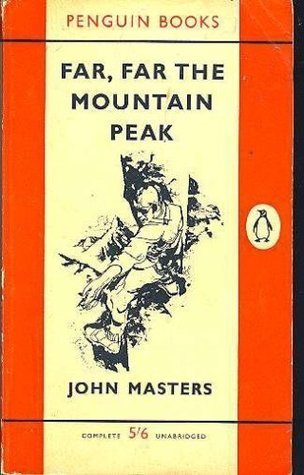
Far, Far the Mountain Peak is a portrayal of twenty years in the life of Peter Savage, British civil servant and mountaineer. A man of ruthless will and ambition from his Cambridge days to his time of near glory in India, Peter Savage is determined to reach the top and his motto is 'at all costs'. Talented, brilliant, lonely, he wins the love of a woman who both understands and fears him, and he enjoys the loyalty and friendship of an English peer and Indian patriot.But this life and career are cold-bloodedly plotted so that the people close to him are essential to his design for fame and greatness, and he is indifferent to his destructive effect on them as human beings.A tragic revelation of his own false values is the turning point of his own life, and how he finds his way to self-redemption is the magnificent climax of the novel.
Masters was the son of a lieutenant-colonel whose family had a long tradition of service in the Indian Army. He was educated at Wellington and Sandhurst. On graduating from Sandhurst in 1933, he was seconded to the Duke of Cornwall's Light Infantry (DCLI) for a year before applying to serve with the 4th Prince of Wales's Own Gurkha Rifles. He saw service on the North-West Frontier with the 2nd battalion of the regiment, and was rapidly given a variety of appointments within the battalion and the regimental depot, becoming the Adjutant of the 2nd battalion in early 1939.
During World War II his battalion was sent to Basra in Iraq, during the brief Anglo-Iraqi War. Masters subsequently served in Iraq, Syria and Persia. In early 1942, he attended the Indian Army Staff College at Quetta. Here he met the wife of a fellow officer and began an affair. They were later to marry. This caused a small scandal at the time.
After Staff College he first served as Brigade Major in 114th Indian Infantry Brigade before being "poached" by "Joe" Lentaigne, another officer from 4th Gurkhas, to be Brigade Major in 111th Indian Infantry Brigade, a Chindit formation. From March, 1944, the brigade served behind the Japanese lines in Burma. On the death of General Orde Wingate on 24 April, Lentaigne became the Chindits' overall commander and Masters commanded the main body of 111 Brigade.
In May, the brigade was ordered to hold a position code-named ‘Blackpool’ near Mogaung in northern Burma. The isolated position was attacked with great intensity for seventeen days and eventually the brigade was forced to withdraw. Masters had to order the medical orderlies to shoot 19 of his own men, casualties who had no hope of recovery or rescue. Masters later wrote about these events in the second volume of his autobiography, The Road Past Mandalay.
After briefly commanding the 3rd battalion of his regiment, Masters subsequently became GSO1 (the Chief of Staff) of Indian 19th Infantry Division, which was heavily involved in the later stages of the Burma Campaign, until the end of the war. After a spell as a staff officer in GHQ India in Delhi, he then served as an instructor at the British Army Staff College, Camberley. He left the army after this posting, and moved to the United States, where he attempted to set up a business promoting walking tours in the Himalayas, one of his hobbies. The business was not a success and, to make ends meet, he decided to write of his experiences in the army. When his novels proved popular, he became a full-time writer.
In later life, Masters and his wife Barbara moved to Santa Fe, New Mexico, USA. He died in 1983 from complications following heart surgery. His family and friends scattered his ashes from an aeroplane over the mountain trails he loved to hike. General Sir Michael Rose, the former UN commander in Bosnia, is a stepson of Masters.
It's a re-read. The first time around, in the early 90's, it spoke to me mostly about a love for mountains and about the sacrifices dedicated climbers have to make in order to get on top of the world. Thirty years later, it still speaks to me about the author's love of mountains, and I still consider the novel to be John Masters' best, yet my perceptions have subtly shifted towards more universal and personal issues: the concept of "will to power" , the role of the so-called "ubermensch" in shaping history, family and love as a counterweight to ambition, and so on... The novel is well worthy of multiple readings.
It's also worth noting that, while being by almost all objective criteria a standalone novel, the story is an integral part of a larger narrative cycle, spanning the whole of the British debacle in India, presented through the eyes of successive generations of Savage "ubermensch", as empire builders. Like M M Kaye, Masters is a scion of a family that has served in the subcontinent army for several generations, and this literary series is his attempt to rationalize the occupation and to 'whitewash' the historical record a little by presenting us with heroic Englishmen sacrificing themselves for the betterment of the native population, a population so backward and venal that they were incapable of governing itself without Imperial supervision.
A leader's no better than his followers, of course, but By God, followers without a leader are no good at all.
or, It's yours [fault], for being such a mess of corruption and civil war a hundred and fifty years ago. If it wasn't us dragging you around at the wheels of our chariot it would be the French or the Russians.
I could go on, since I have bookmarks about the Indian independence movement ("only the extremists talk like that now") or General Dyer's massacre at Amritsar ("I would not have stopped firing while even one of them was left alive. Then we would have peace for fifty years"), but I do want to find positive things to say about the novel, which I still love despite its imperial apology angle. The historical details, especially those dealing with India, is well worth the journey, especially for those readers who plan to try all of the Savage stories written by Masters.
The plot follows the exploits of three young men and three young women who meet at the turn of the century (the XX not the XXI) for the traditional Oxford graduation ball. It is a fateful night that foreshadows their climbing careers, their loves and their ambitions. We will follow them from scaling an imposing church wall to the steep crags of Wales, the high Alps in Switzerland, all the way to India and the highest, deadliest peaks in the world. A world war and personal drama marks for many of them a realignment of priorities from a gentleman's pursuit, to murderous to ambition and finally to a spiritual awakening.
To them climbing is a sort of game, like cricket, only played on steep mountains instead of leveled meadows – in which one displays skill, sportsmanship, and good manners, and does or does not get to the top as circumstances permit. But every now and then, even in cricket, someone comes along who does not really think of it as a game – at least, not once he gets out there with the ball in his hand. He wants to win, and because of that he usually does.
Throughout the novel the actual developments are framed in overarching metaphors, with climbing as a way to describe life in general and love in particular, and the three young men seen as avatars of the knights of the Round Table : Gerry as Galahad, Harry Walsh as King Arthur and Peter Savage as Sir Launcelot.
If life was a climb, marriage was another, going on within and yet separate from it. If every married couple was a cordee, did he want Peggy as his partner on that rope? Could she follow where he led? Could she lead?
It's not all about men and the will to power. Women more than hold their own in the economy of the novel, both in climbing and in spirituality. A spirituality that gets more central to the story as we get closer to the summit of the fictional Mount Meru – the equivalent of the white albino whale for the protagonist Peter Savage. According to wikipedia:
Mount Meru is the sacred five-peaked mountain of Hindu, Jain, and Buddhist cosmology and is considered to be the center of all the physical, metaphysical and spiritual universes.
This Peter Savage is not an easy character to root for, especially since the author gives him almost godlike powers of leadership and talent. Yet his journey is a most painful one (I'm trying very hard here to avoid spoilers) as in lessons that must be paid in blood before they are taken to heart:
But I have come to believe that the spirit of mountaineering and the spirit of the mountains lie in what we do for each other and in what we give to to the mountains (in the way of sacrifice, appreciation, and controlled passion) rather than in what we do on the mountains.
... a conclusion I can get 100 percent behind and a final note in my review that I hope will entice you to give this hefty tome a try.
This actually held up pretty well, though I don't think I found it as gripping as I did on early reading. Might be due to the fact that in spite of my last reading of it being some decades ago, I remembered it quite well.
I started hiking with my father when I was quite young and have climbed many mountains that were walkups. I also did some rock climbing in my teens. However, I have never attempted any ascents anywhere close to the difficulty described in this book while Peter Savage and others are attempting to climb Meru Mountain. Meru is a real mountain in the Himalayas, but it is not as high as the altitude given in the book. The chapters about climbing it are hair-raising and difficult to read. I think the book is best suited to people with a great interest in difficult climbs. The book locales shift back and forth between the United Kingdom and India in the early 1900s, and there is a segment that takes place during the first World War. I have enjoyed other books by John Masters more than this one. The parts I enjoyed most are about Zermatt, Switzerland and the Matterhorn. My son and I hiked up to the Matterhorn hut, but to go above the hut you need a guide unless you want to end up in the cemetery in Zermatt.
There are many things that influence whether I like a book and I may have liked this more if I had read it years ago. The main character, Peter Savage, is an arrogant, manipulative bully who enjoys his power over others, especially other men. And at this point in time, that is not something I want to read about.
I'm trying to finish the series so didn't put it down but was tempted to a few times. The descriptions of the mountain climbing seemed to go on too long and got a bit boring because of it. The last third of the book is the best and I'm glad I finished it.
What I liked about this book was the story of a man, ridiculed and scorned because of his indomitable will to win, to achieve. Gerry, always wants to win. People don’t like him but in the end they need him.
Centres on the British involvement in India as administrators and mountaineers in the late 1900's. Book is dated and I struggled to do it justice despite my interest in matters Indian.
I'm not sure this book deserves 5 stars in a literary sense, but I enjoyed it a lot. Peter Savage is a compelling character, extremely well drawn, and many of the other characters are also very well done.