

What do you think?
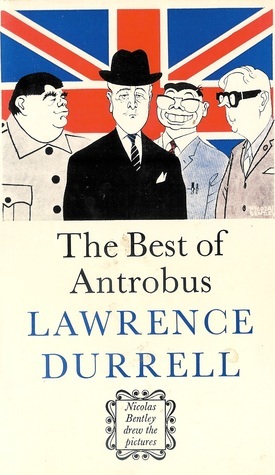
The Best of Antrobus
Twenty fictional stories about serving in the British diplomatic corps drawn from three earlier books (Esprit de Corps, Stiff Upper Lip, and Sauve Qui Peut." Illustrated by Nicolas Bentley. Some of the illustrations are new, others are drawn from the earlier books.
180 pages, Hardcover
First published January 1, 1974
About the author
Lawrence Durrell
327 books923 followersLawrence George Durrell was a critically hailed and beloved novelist, poet, humorist, and travel writer best known for The Alexandria Quartet novels, which were ranked by the Modern Library as among the greatest works of English literature in the twentieth century. A passionate and dedicated writer from an early age, Durrell’s prolific career also included the groundbreaking Avignon Quintet, whose first novel, Monsieur (1974), won the James Tait Black Memorial Prize, and whose third novel, Constance (1982), was nominated for the Booker Prize. He also penned the celebrated travel memoir Bitter Lemons of Cyprus (1957), which won the Duff Cooper Prize. Durrell corresponded with author Henry Miller for forty-five years, and Miller influenced much of his early work, including a provocative and controversial novel, The Black Book (1938). Durrell died in France in 1990.
The time Lawrence spent with his family, mother Louisa, siblings Leslie, Margaret Durrell, and Gerald Durrell, on the island of Corfu were the subject of Gerald's memoirs and have been filmed numerous times for TV.
The time Lawrence spent with his family, mother Louisa, siblings Leslie, Margaret Durrell, and Gerald Durrell, on the island of Corfu were the subject of Gerald's memoirs and have been filmed numerous times for TV.
Ratings & Reviews
Friends & Following
Create a free account to discover what your friends think of this book!
Community Reviews
Displaying 1 - 6 of 6 reviews
April 21, 2020
Always hilarious. Has such great fun mocking the British class system, the English language, and its mysterious subset, diplomatic language. Particularly funny, The Swami’s Secret. Great antidote to the stress of living in corona virus times.

December 8, 2020
El problema de este libro es que creo que a partir de cierto relato se vuelve muy repetitivo y predecible. Además, el humor que Durrell ejecuta no se sostiene tan bien literariamente como sí lo hace en cómics o en el cine (quizá el género slapstick).
February 15, 2020
In this book, Durrell is trying to be funny. Trying too hard for my taste. Good humor is subtle. This kind is anything but.
January 13, 2024
Durrell has a wonderful command of english and the English of a bygone age; some of his scenes will have you laughing out loud.

April 21, 2026
De lo mejor del ácido humor británico

December 17, 2012
A selection of (fictional, one hopes) short stories about life in the British diplomatic corps - "lying abroad for our country" as Durrell slyly puts it. Much of the humor comes from satirizing national stereotypes. Durrell paints the characters as boldly as he does in his serious novels and his brother Gerald does in his zoo-collecting novels.
Displaying 1 - 6 of 6 reviews