"It is my wish to come very close, strikingly close, to the times in which we live, without submitting to artistic dogma...I need the connection to the world of senses, the courage to portray ugliness, life as it comes." - Otto Dix
In the 1920s, Otto Dix was the artist of Neue Sachlichkeit, the New Objectivity, par excellence. Painting in a very realistic, almost photographic style, he chose as subjects the poverty, violence, death, and war that he experienced as a soldier in World War I. After this terrible experience, he painted the famous triptych The War.
Dix staged the world as a play, a grotesque farce. But the form he chose to do so was based on the classical canon of beauty. Dix lived his life and served art, for he adhered to the age-old rule that the American painter Ad Reinhardt put in a nutshell: "Life is life, and art is art."
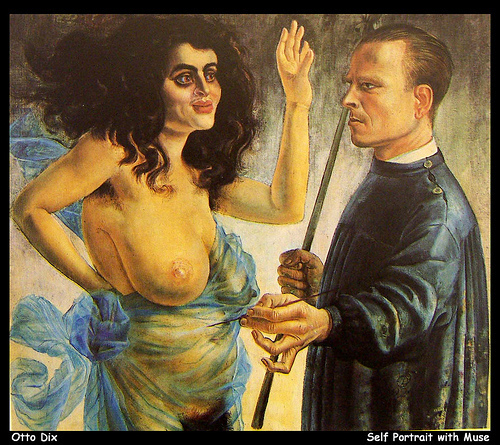
There is an astounding range in the paintings of Otto Dix – from self-portraits, brothel paintings, war paintings and family-style portraits. Also the paintings are raw and to the point (battle scenes, women with pendulous breasts...). In a sense Dix’s paintings do give a coarse sensuality to the unattractive and decadent side of life.
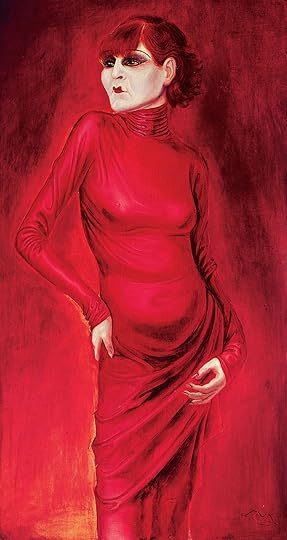
The main emphasis of this book is on the paintings and the reproductions are excellent (as we would expect from a Taschen book). We learn little of the relation of Dix to his wife and family, or to Nazism. Sometimes the author over-intellectualizes the paintings, like the “Big City (Tritych)”. However, there are revealing quotes of Dix on his paintings. And there is a lack of follow-through – it should have been mentioned that Anita Berber died at the age of thirty of alcohol abuse.
This large collection of paintings by Otto Dix demonstrates why he was accused, along a few other artists in Germany at the time, to be "decadent artists". There's an array of drunken naked fat ladies, tattooed sailors, mutilated WWI veterans selling buttons on the street, and even a few images showing sado-masochistic rituals in progress.
There's also a lot of beautiful Weimar Republic night club scenes, a sort of Toulouse-Lautrec of the Cabaret/Isherwood set, and many, many portraits, some very beautiful and others gleefully grotesque. I don't think there was such a thing as a Dix art style because his medium and stylistic choices were constantly shifting and in flux.
Before reading this biography of Otto Dix brought out by the innovative publisher TASCHEN GmbH, I was only familiar with his works depicting the trench warfare of WW I. He served on the front lines as a sergeant, and the experience of being surrounded by destruction, the dead, and the dying indelibly dyed his life with a preoccupation with the extremes of life. His unflinching realism is often mistaken for cynicism--but his attention to gory detail is simply rooted in his desire to describe what he saw and how he saw, or imagined it. His early work did not sell very well--the public was not ready for his frankness and his penchant for painting both the excesses of war and for illustrating his period's obsession with sex crimes. (Wait--his period? Read the daily paper or watch the news or go to the movies...) His technique began with loose expressionistic brushwork and color, evolved into the meticulous layering of glazes and varnishes and studied compositions of the German Rennaissance, and then, late in his life, a return to a more spontaneous and simple approach. Though pacifists championed his work and the Nazis condemned it, he was not particularly "political"; that is, he had no agenda in mind other than to portray the world as he saw it. With the exception of one arrest by the Gestapo, and incarceration in a POW camp after Germany's surrender (he had been forcibly drafted into the Volksturm), he survived WW II relatively unscathed. His work is not without feeling and compassion--see the beautifully rendered portraits of his hardworking parents, his children, and of the undernourished working class kids on the street. If you can stomach the subject matter of such works as "Sex Murder," the grotesque depictions of prostitutes and their clients (not unlike similar work by George Grosz), and the gruesome scenes of trench warfare, you will be rewarded by the head-on frankness of his portraiture, the elegance of his mid-career compositions, and the simplicity of his late work. My only quarrel with this review of his work is that relatively little attention is paid the the portfolio of etchings entitled "War", which rival Goya's "Disasters of War", but that suite does have its own book: Otto Dix: der Krieg."
Otto Dix es un pintor extraño. Yo sólo lo conocía por algunos grabados de la guerra y unas pinturas de la República de Weimar expuestos en el Palacio de Bellas Artes. Sin caer en el cliché del "pintor inclasificable", Dix pinta cuadros tan dispares en temática, estilo y objetivo. Siempre tan cambiante como la situación alemana durante la primera mitad del siglo XX.
La edición, en general es muy bella. Los libros de Taschen son estúpidamente sensuales. Lamentablemente, tiene algunos errores ortotipográficos que hacen pensar en un descuido de la edición en castellano. Por fortuna, las imágenes salvan tamaños errores.
Cinque stelle, ma potrebbero essere sei, sette, dodici... Conoscevo poco Dix e questo libro me l'ha fatto praticamente riscoprire. Straordinario. Un pittore fantastico che, oltre a saper dipingere benissimo, aveva un grandissimo senso dell'umorismo, sempre presente nei suoi quadri, e cercave di non prendersi troppo sul serio. Un plauso anche alla Taschen che continua a sfornare libri d'arte completi, ricchi di fotografie e di storie, a un prezzo accessibilissimo. Insomma, da sfogliare, leggere, apprezzare. Si è capito che mi piace Otto Dix? E la Taschen?