Jump to ratings and reviews
Rate this book

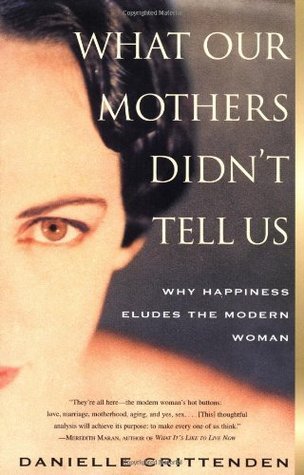
WHAT OUR MOTHERS DIDN'T TELL US: Why Happiness Eludes the Modern Woman

Rate this book
What Our Mothers Didn't Tell Us. To put things simply: If women today were happy, "Ally McBeal" would not be such a huge TV hit — a television phenomenon that not only provokes endless discussion nationwide but also has the distinction of mention in a Time Magazine cover story addressing the state of feminism.

The anxiety-riddled character "Ally McBeal" has tapped into something simmering beneath the surface of today's professional, "successful" women. It's called misery. Worse, it's called misery without a comprehensible origin. It is this odd, pervasive unhappiness that Danielle Crittenden confronts in her fascinating, enlightening book What Our Mothers Didn't Tell Us.

The premise of What Our Mothers Didn't Tell Us is that with all of the success of feminism — all of the doors that have been opened, all of the new freedoms women of this generation enjoy — "we may have inadvertently also smashed the foundations necessary for our happiness." Crittenden does not in any way suggest women revert back to the pre-Feminine Mystique days of suburban housewife malaise, but she does confront the possibility that there might have been some crucial good in many of the old patterns of living that women today reject entirely. Crittenden explains that women in the '90s have "heeded their mother's advice: Do something with your life; don't depend upon a man to take care of you; don't make the same mistakes I did. So they have made different mistakes. They are the women who postponed marriage and childbirth to pursue their careers only tofindthemselves at 35 still single and baby-crazy, with no husband in sight. They are the unwed mothers who now depend on the state to provide what the fathers of their children won't — a place to live and an income to raise their kids on. They are the eighteen-year-old girls who believed they could lead the unfettered sexual lives of men, only to have ended up in an abortion clinic or attending grade twelve English while eight months pregnant. They are the new brides who understand that when a couple promises to stay together 'forever,' they have little better than a 50-50 chance of sticking to it. They are the female partners at law firms who thought they'd made provisions for everything about their career — except for that sudden, unexpected moment when they find their insides shredding the first day they return from maternity leave, having placed their infants in a stranger's arms."

What Our Mothers Didn't Tell Us examines the new problems in today's society and outlines the erroneous ways of thinking that created these problems. With a lighthearted tone and good humor throughout, Crittenden intelligently leads readers through an exploration of love, marriage, motherhood, and even aging. Her examination of dating among women in their 20s and 30s is fascinating, harsh — and yes, depressing. She paints a stark portrait of women in their 20s who brush aside sincere suitors because they believe they're too young to consider marriage, only to discover in their mid-30s that the crowd beating down their door has thinned considerably — and perhaps irrevocably. There is perhaps no more salient truth in Crittenden's book than her statement, "It is usually at precisely this moment — when a single woman looks up from her work and realizes she's ready to take on family life — that men make themselves most absent." Further, it is impossible to deny that in terms of sexual appeal, men have a longer shelf life. A successful man can attract women of any age well into his 50s, 60s...or beyond. They can father children well into old age. And according to Crittenden, "this disparity in sexual staying power is something feminists rather recklessly overlooked when they urged women to abandon marriage and domesticity in favor of autonomy and self-fulfillment outside the home."

According to Crittenden, even when a young woman today manages to get married, she is most likely not headed down the path to wedded bliss. In striving so furiously not to be taken for granted as wives were in previous generations, women today often err too far in the opposite direction. Crittenden makes ironic mention of Gloria Steinem's remark that women have become "the husbands we wanted to marry"; Crittenden suggests that perhaps women today are more likely to resemble the husbands we left behind: "balky, self-absorbed, and supremely sure that our needs should come before anyone else's." Crittenden warns that a sense of entitlement devoid of compromise is not likely to lead women into enduring, happy unions.

But the most significant arena of mixed messages is the realm of motherhood. Crittenden is unflinching in her look at the tug of war between work responsibility and the job of motherhood. She explores the myriad decisions and conflicts that arise upon the birth of a child. Some women are eager to return to work but feel guil...

208 pages, Paperback

First published January 1, 1999

23 people are currently reading
890 people want to read

About the author

Danielle Crittenden

10 books10 followers

Ratings & Reviews

What do you think?
Rate this book

Friends & Following

Create a free account to discover what your friends think of this book!

Community Reviews

5 stars
126 (27%)
4 stars
170 (37%)
3 stars
78 (17%)
2 stars
57 (12%)
1 star
24 (5%)
Displaying 1 - 30 of 91 reviews
Profile Image for Emily.
933 reviews115 followers
September 15, 2011
I'm a bit conflicted about how to rate this book. The author irritated me frequently with her broad, sweeping statements, single-minded approach, and lack of documentation, and though I agree with several of her assertions, I disagree with plenty she said, too.

First of all, everything in this book seemed to boil down to "sexual power." Everything. Women shouldn't put off trying to find a mate when they're young and attractive because it's not always going to be so easy and you'll get older and suddenly no man is even going to look at you and your biological clock will be ticking, but you'll be up a creek without a paddle because you slavishly devoted yourself to your career instead of finding a man! "If women don't settle down at the same time as their friends...then we have to accept that there will be consequences to the long-term stability of all marriages, and even our own ability to marry." Here's another one: "If young, attractive women offer no-strings attached sex, then men will have no pressing reason to tie themselves down." Seriously? It's only about sex? Any single woman is a threat to all the marriages she comes in contact with? Men can't be convinced to commit if they can get free sex somewhere else? Few people I know truly believe in "sexually unconstrained lives," but Ms. Crittenden seems to have a very low opinion of men in general as simple creatures unable to think with anything above the belt. Ironic, since that's one of the sins she accuses feminists of.

Over and over, Ms. Crittenden seemed to blame feminists for all these terrible things that women do, which are actually signs of immaturity that are apparent in both sexes. For example, speaking of a study done of newly married women, she says, "What seemed to bother the women most, as they spelled it out, were the compromises inherent in the act of marriage itself--that they should be expected to adjust their behavior to suit another person in any way." I completely agree with Ms. Crittenden that that's a horrible attitude to have in a marriage and can certainly lead to problems in a relationship. However, I don't believe for a second that that attitude is limited to the female half of the population. (The study didn't interview the husbands, though, so we can't really know for sure.) Later in the book she states, "Alas, by withholding ourselves, or pieces of ourselves, instead of giving to our marriages wholeheartedly, we can't expect our husbands to do so, either." I couldn't agree more. But she seems to, again, place the onus on only one of the marriage partners, rather than both. I don't believe, as she does, that women have a "special responsibility" (emphasis hers) to restrain themselves from sex. I think that's part of being a mature individual, male or female, thank you very much.

The implication that 'date rape' isn't a real phenomenon is irresponsible and offensive to those who have been victims of that crime. Lamenting the loss of "the elaborate rituals that used to govern relations between the sexes" and "the little rules of daily life [that] protected a larger sexual order," Ms. Crittenden states, "Wholly new charges like 'date rape' have been devised, in which there may have been no actual crime committed but the woman is left feeling as abused as if there had been. She decides that she was too drunk to have given her consent to sex and that the man with whom she'd been flirting took advantage of her--if it wasn't rape, it was like rape." There's so much wrong with those sentences I don't even know where to start.

Ms. Crittenden mentions at one point how most men today are no longer the "certain kind of old-fashioned, sexist male" that they were in previous generations. The kind of man "who demands supper on the table, who tells the little woman to shut up until she's spoken to, who declares, while settling into his armchair and popping open a beer, that a woman's place is in the home" is now "an outdated caricature." Well, how does she think that sea-change happened if not for those darned feminists? Yes, some radical elements of feminism seem to "view all husbands as potential oppressors," but I certainly don't and neither do the women (some of whom are self-identifying feminists) that I know.

I agree with her assertion that politics shouldn't be the solution to personal problems and that men and women should have "mutual respect for each other's differences" as well as "mutual recognition of how much we need and desire each other." I also agree that "pushing every important decision--marriage, children--to the middle of our adult lives is not only impractical but self-defeating." But it's not like those decisions can really be made by a single person in a vacuum. A woman may desperately want from a young age to be married and have children and, despite her best efforts, not have that opportunity. And infertility is an increasingly frequent problem, even among younger women. Ms. Crittenden glibly suggests that women should settle down young - 22 or 23 - and start having babies. "By the time her second child is toddling off to nursery school, she'd still be only twenty-nine or thirty. She could have a third child if she liked; or she could enter the workforce or go to graduate school...with an easier conscience because her children would need her less than before." All I have to say to that is, if you want to hear God laugh, tell Him your plans...

Yes, there are "trade-off[s] of every action we take." And more people, both men and women, should give more thought to those trade-offs. But in the end, the problems Ms. Crittenden addresses in today's society are simply different problems than those from a couple of generations ago; that doesn't necessarily make them worse. She gives lip-service to a middle ground of "women can have it all, just not all at once," but, ironically, she presents a worldview that seems to allow for only one right way for women to approach life. The feminists I know are supportive of a woman's choice to stay home with her children or work outside the home or work from home or whatever else she (in concert with her spouse), as a mature, thoughtful individual, has determined is best for her and her family in their current circumstances.

For more book reviews, come visit my blog, Build Enough Bookshelves.
Profile Image for Merrilee.
15 reviews14 followers
February 28, 2008
my FAVORITE book on feminism...and why it's not all that it's cracked up to be. I would recommend this to ALL females and males.
Profile Image for Kaethe.
6,567 reviews536 followers
stricken
July 17, 2014
Another book that blames individual women and feminists collectively for all the problems of modern society, by an author who seems to believe that women who reach 35 unwed will be miserable forever.
Profile Image for Mattaca Warnick.
68 reviews8 followers
July 25, 2007
Though Crittendon can belabor her points, the arguments she makes are so quickly dismissed in our day that they need a little hammering home. Nothing revolutionary here; this is 1950s morality speaking and it rings true. After decades of striving for that which we can't obtain, Crittenton convincingly argues that maybe previous generations weren't so clueless after all.
Profile Image for Elise.
194 reviews4 followers
June 13, 2010
This book was published in 1999 so it's over a decade now, but I was completely captured by it - couldn't put it down. I've read a few other reviews of the books, and it seems to be either praised by right-wing conservative religious women or slammed by liberal working secular women....but to me it was actually a happy moderate in between the two. Granted she makes a few points that are absolutely conservative to a T, but the main take-away from her writings is that feminism is meant to give women CHOICE, and that in our liberal post-ERA generation, the pendulum has swung as far away from the 1950s housewife model of women's society as possible, leaving women in a place where they must work and must not rely on a man and must not have too many children - even if they want to be housewife or rely on a husband or have a lot of children while young - i.e. we're still in a place where we don't have choices, now what's chosen for us is simply different than what was chosen for us in the 1950s.

Granted she takes a lot of liberty to speak in large generalities, drawing on outdated and modern stereotypes alike, but at the end of the day, she has a point. Now I can kind of see both sides of the coin, because although I was raised in the 1980s (the exact generation Crittenden is addressing), I got mixed signals about womens' roles from the world vs. from my church.

Essentially, Crittenden describes this angst between career and family life and proposes several complex relationships between this paradox, and womens' decisions to be more sexually liberal, to pursue career first and family second, to delay marriage and children, and/or to remain completely single and independent their whole lives. She doesn't suggest returning to women being at home barefoot in the kitchen with no education, but rather suggests we have things out of order. That perhaps it is still best to marry younger and have kids younger, when we are less cynical and more energetic and able to keep up with kids. Have a couple kids by 25, their in school by 30, at which point we could return to grad school and start careers once our kids need us less. By 35 we'd be contribution to society like we want to be, with no need for interruptions and stress from having babies. As it is now, the trend seems to be to spend 5-10 years developing a career, dropping out or at least "off-ramping" for 5-6 years to have a couple of kids, and then trying to get back in the game, only finding our peers are now several years ahead of us - making more, bigger titles, etc etc.

Granted this is a rather weak analysis on my part of a 200 page book, and the book itself is based on ideals and stereotypes...but still, she has a point. Who is encouraging girls that if they want to grow up to be moms and wives first, and career women second, that it's ok (aside from mormons and evangelical christians, of course....)? Not that they HAVE TO feel that way, but that they have that choice.

On the one hand I fear that this book is really a more intelligent way of presenting ideas that are really Dr Laura in disguise (I can't stand Dr Laura), in which case I would want to profess to hate the book and find it offensive. Unfortunately for me, I actually related to it on a very emotional and surprisingly acute level. I'd like to say I wish I'd read it 5 years ago, but I wouldn't have understood it (didn't want a family yet, was totally career focused) and would have thrown it out. I know several female coworkers that would connect to the ideas presented as deeply as I did, so even if I am antifeminist in saying I loved this book, I know I'm not the only one!
Profile Image for Rebecca Newman.
42 reviews4 followers
March 28, 2015
Excellent book. It speaks out against all the ways in which womens' lib and feminism has negatively affected our society. Womens' libbers and feminists want what they want without thinking about how it affects those around themselves- or perhaps thinking wholly about how it affects those around them. Women like to see the good affects but do not consider any of the less desirable affects. Like putting off children when your body is most capable and then finding yourself struggling with fertility. Like giving over sex without commitment and then wondering why men won't commit.

Such a profound book for the modern woman.

It doesn't speak even one iota about religion- it is written from a completely irreligious standpoint which would allow for a greater audience. As a christian, however, I couldn't help but think right from the start how, if we returned to a biblical view of womanhood, all of these issues would be obsolete. It was only when we strayed from God's view of womanhood and family that we got ourselves into this mess.

Until we go back to it, we deserve the men treating women like sluts (that's kind of how we are acting), children (the ones that aren't prevented or aborted) abandoning the elderly just like they were abandoned-at the first opportunity (that's what we did), women paying infertility clinics after preventing conception for decades (when we we might actually want children after all) and feeling guilty when we decide that in order to be fulfilled, we need to go back to work and leave our young children in the hands of strangers (when there is nothing more fulfilling than raising up the next generation to be honorable, hard working and good.)
Profile Image for Elise.
390 reviews
August 25, 2014
I couldn't finish it. After being told that when I cash my paycheck, I don't have to worry about making less money than a man (merely days after seeing a report on Chronicle of Higher Education that refutes this claim with actual numbers), I was skeptical. After being told my husband doesn't help around the house and I am stuck raising our child, I was angry. After being told that the downfall of society was caused by sex ed in schools, I had to stop.

When I purchased this book, I was under the impression that a qualified writer, or at least one who provides stats and citations, would share the challenges women face today, and how we've grown up benefiting from our mothers' and grandmothers' struggles. I did not realize this is an anti-feminist opinion book that tells me my husband does only 20% of the housework. I shared that tidbit with him yesterday, after he took our child to the grocery store and cooked our dinner, as he does most days, while I only did the laundry and vacuumed the house. 20%? Maybe in HER house, but in mine, it's 50/50 with an open understanding of our skills. I can't cook, but I can clean. He can cook, and doesn't mind cleaning.

After reading only 50 pages, I think I can refute all of her claims with anecdotes--which is fair, as that all she bases her book on.
Profile Image for Erin.
11 reviews
August 27, 2008
This book is awesome. It talks about why the feminist movement was not such a good thing and how it has aided in the loss of values in our culture.
Profile Image for Niki Turner.
13 reviews4 followers
April 9, 2021
This is an essential book for one of the most important topics of our day. It contains such a valuable perspective of the implications of feminism on both men and women, and the nuclear family.
445 reviews198 followers
September 9, 2020
I really wanted to like this book, because I love The Femmsplainers. But I struggled with a love-hate relationship in every chapter, often switching from love to hate within the span of a few paragraphs.

I started out to write a point-by-point list of all the things I disagreed with in this book. But then I realized that to be fair, I'd also have to write a point-by-point list of all the things I agreed with. At that point, I'd be writing a book of my own.

So I'm just going to say that Crittendon gets a lot of things very right in this book. I think she also gets a lot of things very wrong too.

At times it feels like an ode to days of yore, but it isn't. Crittendon isn't say we need to return to the 1950s. She's saying that we've overcorrected and it's time to find a happy medium. And she's further saying that modern feminists are too self-absorbed to check themselves and back off in search of the happy medium. I think the line that summarizes her thesis best is that the women of today have become the men of yesterday: entitled, self-absorbed, unempathetic. And I think to some extent she's right.

This book is a tough read for women like me who are "strong and independent," yetd find ourselves married, hormonally tied to our kids, and feeling like we're being slowly strangled. I regularly wonder where the heck I went wrong. I'm living the life that everyone tells me I should love and desire. And yet I'm not loving it (and to be fair, I never desired it). Is the problem my life? Or is the problem my attitude?

Crittendon says it's my attitude. To some extent, I think she's right. I think it's possible for a strong, independent woman, with lots of strong and independent woman friends, to age happily without a husband and kids. However, that estrogen-infused dream life is as hard to realize as "having it all" as a mother. And ultimately, most women are biologically driven to want kids, and the best way to do that is with a husband. So it's time for us to figure out how to accomplish this feat without making ourselves miserable.

I only gave this three stars because I disagreed with a number of her arguments (example: I think women need an independent income not because of divorce, but because of death). Also her use of statistics is weak and non-critical. For example: she talks about anecdotally rising divorces, but actually, divorce has been dropping as dramatically as it once rose. All the miserably married 1950s couples are done splitting up, and the cautiously hitching younger generation are sticking with their more selectively chosen mates. Statistics in this book are not examined for their deeper meaning, but rather used superficially and at face value as adornment for an existing point.

If you're an unhappy modern woman, this book is worth a read. You don't have to love it, but you should at least think about it.
Profile Image for Yellow Rose.
38 reviews10 followers
August 21, 2012
This book I am using for my research and although it is very mellow for my taste because I believe women should be in the home and not seeking out careers. This author actually doesn't say right of the bat that careers are bad for women.

Happiness does allude the modern woman as the title says it all and this is because of feminism. Feminism has destroyed society and the relations between men and women. Men and women are not the same men do not have the same biological pull to protect their children as mothers do, thats why as the author discusses women often time feel guilty leaving the children home while they work and how stressful it is for a woman to work and go home and do all the child raising and housework.

These feminists that write about the 50/50 relationships usually have nannies and maids helping them out, because no way a an will do the same share of work that a woman ever does. He might do 20 percent but his diligence and aptitude will not be extended to the home he cares more about the outside. That is why the particular gender roles are so important for a healthy child, family, and in general the whole society. The wives of lower class men will do all the suffering because they might have a job, surely the job will not be a lawyer or a doctor it might be a cashier a secretary at best and most likely when this woman comes home her children await her and she must do all the cleaning and cooking. While her emasculated husband whose role as a provider was taken away sits on the coach and does absolutely nothing.

This is the true harm of feminism and their goal the destruction of the family and the creation of single headed households supported by the nanny state, absolutely disgusting.

The topics she discusses include Sex, Love, Marriage, Motherhood, and Aging and she outlines how distorted the current feminist view is. Men and women are not the same they have different biological and emotional needs. Surely the worlds was not perfect before feminism however it was not such a big mess that it is now, because the education system treats boys and girls as if there is no difference between them.

Read this book it is of great importance and make sure your daughters read it too so they know that feminism has nothing to do with improving womens rights.
Profile Image for Aishath Nadha.
56 reviews7 followers
May 24, 2015
Okay. I don't like abandoning books but this book was infuriating to say the least. While I agree that "modern feminism" DOES have a lot of flaws, and that differences between men and women should be appreciated and acknowledged, I do not agree that sex-ed being introduced into schools and curriculum has not prevented teenage pregnancies. Or that "The sexual revolution, from a male point of view, could be summed up as, “You mean I get to do whatever I want – and then leave? Great!”
The author alternates from talking about men as lustful, primal beings who cannot help themselves when it comes to young, attractive women: “If young attractive women offer no-strings-attached sex, then men will have no pressing reason to tie themselves down”, ( REALLY?!), to people who are simply the victim of "Extreme feminism" and goes as far as to suggest that sexual harassment has very little to do with how it makes a woman feel, and may have ( and I say may have because I will admit that after a few pages into this book the author made it very difficult for me to remain open to her ideas and opinions) written down the average woman as weak and powerless, forced to take the help of the law, and at times abusing the powers granted to women by the law, in cases involving sexual harassment, because why not?

Nope.
Recommended to nobody.
Profile Image for Deborah.
196 reviews9 followers
February 18, 2021
In a nutshell: Feminism is the cause of all our problems and we need to go back to the fifties. Women should marry and have babies in their early twenties when they are at the peak of their "sexual power" (read: most attractive). At one point, the author states that "by marrying earlier, a woman would probably make a better marriage". Excuse me, but where is the evidence for this? The author implies that if women as a group marry when we are young, there will be fewer available sexy young women to lure our husbands away from us when we start losing our looks. And that if divorce carried the stigma it did in the fifties, men would feel more pressure to stay married. All I can say is, she does not think much of men.
Profile Image for Sarah Mitchell.
117 reviews9 followers
July 26, 2022
This was a fascinating read, especially alongside Elisabeth Elliot’s Let Me Be a Woman. The author writes from a secular perspective, but her insights into how feminism has affected society meshed so well with Elliot’s Biblical perspective on womanhood.

I gained a deeper appreciation for God’s good design for femininity and a better understanding of present culture.

Content warning as she uses current events and news as illustration, some are quite crude and graphic. Some of these quotes include language as well.

Despite the warnings I’m glad I read it and haven’t stopped talking about it!
Profile Image for autumnatopoeia.
331 reviews12 followers
November 5, 2018
Interesting to read about hot topic women's issues from two decades ago, and startlingly realize their aftereffects in your own life. Danielle Crittenden's take on womanhood was, and still is, revolutionary. This one made me think.
Profile Image for Kareen Warnick.
68 reviews4 followers
July 18, 2008
Nice to know people outside of us backward hicks in fly over country support moms being Moms and can see the negative impact modern feminism has had on the lives of women.
10 reviews2 followers
November 22, 2008
Must read for any mom who thought they could have it all!
Profile Image for Elissa.
56 reviews8 followers
January 14, 2013
Sorry guys, really did not like this one. I'll leave it at that until the book club.
Profile Image for sincerely.
821 reviews48 followers
January 28, 2024
This is probably the most controversial book I'll ever post about. Not because there aren't more hot-button topics or because the content is vulgar, but specifically because of my following and because of the tone. I'll be honest with you - if you're a FT working mom (I was one), it will be tough to handle. Does that mean you shouldn't read it? Absolutely not. I hope every single person reads it. But I do also acknowledge that the content is...damning. It could be hurtful. But it's not harmful. There is a difference. It's precise and passionate and shocking and oh so not politically correct.

If you've ever found yourself describing your life as "juggling balls in the air and I'm afraid I might drop one," or lying awake at night wondering why in the world it is just SO DANG HARD to send your little one to daycare, or watching political commentary and just scratching your head at the barbs thrown between feminists and anti-feminists, this book is for you. How did we even get here, you wonder. How did my life get to be *this* crazy? Why is SO much expected of me?!, you think. Pick this up.

Primarily, if you have a daughter - this book is for you. When the promises of feminism have so clearly failed the modern woman, what are we supposed to tell girls today? How do they fit their professional aspirations into a life that reveres motherhood, respects manhood, and values childhood? Do you know the answer? Have you thought about the questions? I wish so desperately I had read this book in my late teens. I could have avoided so much heartache and stayed on a more focused track. I see young women today who understand the score from the jump, and they have such an advantage. I'm happy for them, and I think this book in the hands of mothers today could create more girls like that.

Quick notes- this was published in 1999. I would LOVE an updated version. It is secular. There is sexual content discussed. I would personally want to read it with my daughter before she graduated high-school, but that's just me. The author has a substack and a podcast (neither of which I've perused.)

Women, moms, daughters - we are worth SO MUCH MORE. Seriously, read this one.

⭐️⭐️⭐️⭐️⭐️+❤️

More ⬇️

One more thought, while reading The Toxic War on Masculinity, I came across the idea of the value-free society of the Industrial Age. Easily, one can see how men were completely transformed from caretakers to competitors, and consequently our world changed as well. I can't help but wonder if the same applies to the world in which women live - we are supposed to take stock of our lives as secular, scientific people...value-free. And this extends to modern motherhood. Our deep spiritual or moral values don't matter, seemingly. Keep your values out of it. Simply work. Not at home, though. Here, away from your family, your faith, your values. How is this different than the disruption of the industrial age? I venture to say it's the exact same.
Profile Image for Sallie Ferguson.
17 reviews
May 8, 2020
I love the concept but it was a little too wordy for me. Quick read, evidence based theories.
Profile Image for Dani.
203 reviews
May 5, 2009
I wish Crittenden had written two books -- one as a collection of her overwrought and hyperbolic metaphors, and another comprising only her spot-on observations about the impossible double standard that is modern (1990s, anyway) feminism.

She is dead right in most all her conclusions, and I was thrilled to find someone who could articulate my feelings so well. Unfortunately, her often in-your-face writing style and --really, this is what bugged me-- her ridiculous metaphors undermined her arguments. I'm no scholar, but her research didn't impress me either. The nature of men seems to vary from chapter to chapter -- in one chapter man is a sex-crazed animal, in another he is an emasculated wimp. While these characteristics may not be mutually exclusive, the image she paints is too over the top to be convincing.

Hopefully the reader can see through these style drawbacks to the meat of the matter, which is an exposition of why even now, when women have achieved all that feminism set out for and more, feminism leaves one ultimately unsatisfied. To me, her observations are the kind that are so obvious it makes you wonder how you missed them before.
Profile Image for Mara.
562 reviews
December 16, 2009
I found this to be a very interesting and eye-opening read. I had formed some of the beliefs Crittenden states prior to reading this book, but it really helped cement my own thoughts on marriage and children. I appreciate the unique points she states throughout the book, but Crittenden seems to rely more on anecdotes rather than facts and/or statistics.

Although I agree with most of what she writes, she fails to come up with valid solutions to our current "problems." (A large problem being that women and couples wait too long to have children) Most young married couples simply could not afford to raise a young child on one income even if they did "cut back" on luxuries.

Additionally, Crittenden is pretty critical when writing about this generation and our mother's generation. So I imagine readers who do not already share a view similar to hers will not appreciate this book.
121 reviews4 followers
March 15, 2008
This book was really good. It had a lot of really good points. I totally agreed with her about how women should appreciate & embrace their femininity & not try to be like guys so they can be "equal." Women & men are different & there are some things that women in general do better than men, & vice versa, & being a wife & mother is just as good as being the head of a company. If you want more detail read the book. It was really nice to read a book about women's happiness from a conservative perspective, & it's full of suggestions on how to be happier.
136 reviews7 followers
December 18, 2008
This anti-feminist screed for the upper-middle class woman has some salient points--however none that haven't been made elsewhere, often better: namely, that promiscuity is a dead end for women, that too-long delayed marriage may mean no marriage, and that 2nd wave feminism didn't recognize the importance of motherhood to a woman's happiness. It's written to an audience I don't recognize: super-successful women who delay marriage and childbearing too long. Perhaps there is such a demographic; it's just not mine.

I am sooo tired of the mommy wars.
Profile Image for Kristin.
312 reviews
March 29, 2015
I largely agree with many of the author's overarching points, but this books has a lot of issues which would preclude me from recommending it to others.

Crittenden isn't wrong that feminism sold women a utopic vision of working mother bliss that is reality for very few. But, she bases the book under the false assumption that equality has already been achieved. And, she says some horrifying things about date rape and domestic abuse.

I found myself agreeing one minute and ready to pitch the book across the room the next.
787 reviews6 followers
January 11, 2014
Read in 2000. See Emily's review. I couldn't relate to many of the author's premises. The idea that women should marry young while the pool of available men is wide was particularly offensive. Hardens back to the days when women were supposed to seek a Mrs. over a legitimate degree when in college.
Profile Image for Manda.
96 reviews
August 21, 2014
I tried to read this book all the way through, but her blanket statements and assumptions were just too much for me to handle. It wasn't that I disagreed with all of what she was saying. Sure, there were parts of it that I found to be valid... but I found the book to be written from a very small scope.
150 reviews
April 17, 2021
Terrible opinion book. I disagree with so much of her opinions. She is basically pushing there is a one type of archaic life women need to live in order to be happy.
Displaying 1 - 30 of 91 reviews

Can't find what you're looking for?

Get help and learn more about the design.