Arthur David Waley was an esteemed English orientalist and sinologist, renowned for his translations of Chinese and Japanese poetry. He received numerous honours, including the Commander of the Order of the British Empire (CBE) in 1952, the Queen's Gold Medal for Poetry in 1953, and was invested as a Member of the Order of the Companions of Honour (CH) in 1956. Waley was largely self-taught, and his translations brought Chinese and Japanese classical literature to a broad Western audience. He translated works such as A Hundred and Seventy Chinese Poems (1918), The Tale of Genji (1925–26), and Monkey (1942), making significant contributions to the understanding of East Asian literary traditions in the West. Despite his extensive knowledge, Waley never visited China or Japan, nor did he speak Mandarin or Japanese, focusing solely on written texts. Born in Tunbridge Wells, Kent, he attended Rugby School and briefly studied Classics at Cambridge University before leaving due to vision problems. In 1913, he became Assistant Keeper of Oriental Prints and Manuscripts at the British Museum, where he taught himself Classical Chinese and Japanese. Waley was also active during WWII, working for the Ministry of Information and running the Japanese Censorship Section. He maintained a close personal relationship with dancer and orientalist Beryl de Zoete, though they never married. Waley passed away in 1966, shortly after marrying poet Alison Grant Robinson. His work left an indelible mark on the field of translation and introduced the high literary cultures of China and Japan to the English-speaking world. His translations continue to be highly regarded and widely published, influencing generations of readers and scholars.
Pretty enjoyable if you have prior understanding of confucianism (i.e., Tao, Yi, Jen, spheres [natural, ego, moral, transcendental], T'ien, etc.) Otherwise, it could seem like mostly baseless aphorisms. However, there really are interesting ideas of Heaven and righteousness and filial love developed that makes for quite an encompassing worldview. The Analects, though the writings of Confucius, really won't give you the meat of Confucianism, in my opinion. More study would be required for that.
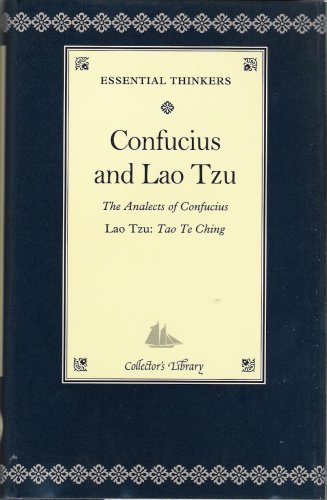
Where Confucianism is concerned with social relations—human behavior and human society—Taoism has a more individualistic and mystical character, and places stronger emphasis on what is natural. Confucius would probably have regarded Lao Tzu as a menace to custom and piety—central Confucian concepts on which the Tao Te Ching is entirely silent. And the stress laid by the Tao Te Ching on spontaneity is at odds with the Confucian emphasis on form and duty. Despite these differences, however, they share four fundamental values which we in the west have for the most part lost sight of. The first of these values is respect—of children for parents, of subjects for their rulers, and rulers for their subjects. The second is acceptance—of the world and of one's destiny. The third is right conduct—the idea that if what is right conflicts with what is profitable, we should do what is right. The fourth is wisdom.
For most Chinese… there was no question of choosing between Confucianism and Taoism. Most people practiced both. And the message of both was that the order and harmony of nature was more stable and enduring than the power of the state or the institutions constructed by human learning. Healthy human life could flourish only in accord with nature and simplicity.
In 1965 the structure and fabric of Chinese society was subjected to a violent and brutal assault. The so-called 'cultural revolution' was an overt encouragement to the young, the ignorant and the stupid to attack the old, the informed and the intelligent. Employees were encouraged to denounce their employers, pupils their teachers, and children their parents. The result, of course, was chaos. So what was Mao Zedong trying to do? Was he simply unhinged? Or did he have some reason for plunging the country into anarchy? There seems little doubt that Mao was to some degree unhinged, at least in his later years. But if we look at the targets of his assault, we find they are not random. The objects of attack were respect, hierarchy, and learning—which are the distinguishing features of Confucianism. It was at the same time an attack on Lao Tzu and Taoism, with its doctrines of acceptance and inaction. Mao wanted Chinese society to change, and change quickly. He saw Confucianism and Taoism as the twin guardians of tradition standing in his way.
Interesting. It's like a book of manners for Chinese gentleman. It mostly made me think that the emphasis on Ritual, respect for elders, filial love etc. were about controlling the population (the common people). It's a lot of rules and guidance that if followed would exert control, order, and obedience on the wider population. At the same time, we find in the Analects many roots of proverbs that are pervasive even today, like 'do unto others as you would have done unto you', and 'lead by example', etc. The text itself is not engaging at all, but it is an interesting time capsule of the morality of the day.