Jump to ratings and reviews
Rate this book

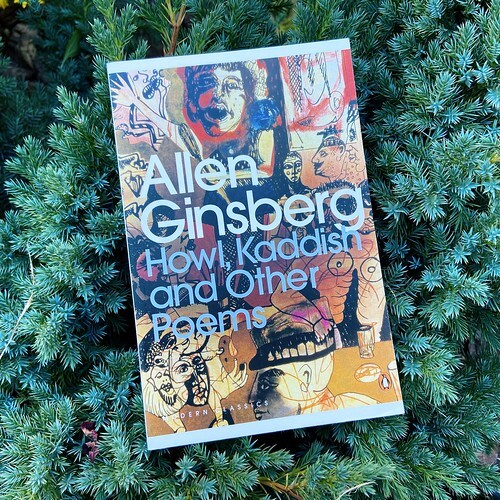
Howl, Kaddish and Other Poems

Rate this book
Uivo e Outros Poemas, de Allen Ginsberg, foi originalmente publicado em 1956 pela editora City Lights Books. Apreendido pelos serviços alfandegários dos Estados Unidos e pela polícia de São Francisco, foi sujeito a um longo julgamento, em que poetas e professores tentaram convencer o tribunal de que não se tratava de um livro obsceno.Mais tarde, Uivo acabou por se tornar o livro de poesia mais lido na história dos EUA, com cerca de um milhão de exemplares vendidos em relativamente pouco tempo.Carl Solomon, a quem Uivo é dedicado, foi um dadaísta do Bronx que escreveu poesia em prosa.

128 pages, Paperback

First published January 1, 1956

247 people are currently reading
2917 people want to read

About the author

Allen Ginsberg

489 books4,086 followers
Allen Ginsberg was a groundbreaking American poet and activist best known for his central role in the Beat Generation and for writing the landmark poem Howl. Born in 1926 in Newark, New Jersey, to Jewish parents, Ginsberg grew up in a household shaped by both intellectualism and psychological struggle. His father, Louis Ginsberg, was a published poet and a schoolteacher, while his mother, Naomi, suffered from severe mental illness, which deeply affected Ginsberg and later influenced his writing—most notably in his poem Kaddish.
As a young man, Ginsberg attended Columbia University, where he befriended other future Beat luminaries such as Jack Kerouac, William S. Burroughs, and Neal Cassady. These relationships formed the core of what became known as the Beat Generation—a loose-knit group of writers and artists who rejected mainstream American values in favor of personal liberation, spontaneity, spiritual exploration, and radical politics.
Ginsberg rose to national prominence in 1956 with the publication of Howl and Other Poems, released by City Lights Books in San Francisco. Howl, an emotionally charged and stylistically experimental poem, offered an unfiltered vision of America’s underbelly. It included candid references to homosexuality, drug use, and mental illness—subjects considered taboo at the time. The poem led to an obscenity trial, which ultimately concluded in Ginsberg’s favor, setting a precedent for freedom of speech in literature.
His work consistently challenged social norms and addressed themes of personal freedom, sexual identity, spirituality, and political dissent. Ginsberg was openly gay at a time when homosexuality was still criminalized in much of the United States, and he became a vocal advocate for LGBTQ+ rights throughout his life. His poetry often intertwined the personal with the political, blending confessional intimacy with a broader critique of American society.
Beyond his literary achievements, Ginsberg was also a dedicated activist. He protested against the Vietnam War, nuclear proliferation, and later, U.S. foreign policy in Latin America. He was present at many pivotal cultural and political moments of the 1960s and 1970s, including the 1968 Democratic National Convention and various countercultural gatherings. His spiritual journey led him to Buddhism, which deeply influenced his writing and worldview. He studied under Tibetan teacher Chögyam Trungpa and helped establish the Jack Kerouac School of Disembodied Poetics at Naropa University in Boulder, Colorado.
Ginsberg’s later years were marked by continued literary output and collaborations with musicians such as Bob Dylan and The Clash. His poetry collections, including Reality Sandwiches, Planet News, and The Fall of America, were widely read and respected. He received numerous honors for his work, including the National Book Award for Poetry in 1974.
He died of liver cancer in 1997 at the age of 70. Today, Allen Ginsberg is remembered not only as a pioneering poet, but also as a courageous voice for free expression, social justice, and spiritual inquiry. His influence on American literature and culture remains profound and enduring.

Ratings & Reviews

What do you think?
Rate this book

Friends & Following

Create a free account to discover what your friends think of this book!

Community Reviews

5 stars
1,208 (34%)
4 stars
1,342 (38%)
3 stars
724 (20%)
2 stars
191 (5%)
1 star
53 (1%)
Displaying 1 - 30 of 356 reviews
Profile Image for Reading .
496 reviews263 followers
April 8, 2021
I heard about Ginsberg via. a Jim Morrison biography and Jack Kerouac referencing him many times, I came across this particular book in Waterstones and decided to give it a try.

I absolutely loved it, his writing is full of obscene and surreal imagery; my favourite was 'Death to Van Gogh's Ear!' which was politically dated but still very relevant and I liked what he had to say about money - being an illusion.

His poems aren't your traditional poems, they don't rhyme or anything, they're like a stream of thought and I now can see why Allen Ginsberg was one of the most influential poets of the 20th century.
Profile Image for leynes.
1,316 reviews3,685 followers
May 9, 2018
Words cannot describe what I felt reading Ginsberg's poems. It's very rare that words manage to suck the air out of my lungs by punching me in my gut so fucking hard that I want to scream, cry and laugh at the same time. Ginsberg's poems are real. Ginsberg's poems are raw. Ginsberg's poems are a lot to handle; maybe even too much at times.

I am always fascinated by writers who break taboos; writers who are unapologeticly themselves. Writers who manage to capture split seconds and the zeitgeist of a whole generation within a few lines.

Ginsberg is one of the most gifted poets I ever had the pleasure of reading from. His lyrical style is unconventional and unpredictable. One never knows what'll come next. I'm usually not the biggest fan of 'stream of consciousness'/conversational poetry, yet Ginsberg blew my fucking socks off. He left me wanting more.

If you're looking for poetry that will make you think, that will make your skin crawl and, at times, will make you vomit, Ginsberg is for you. [I swear I'll stop being pretentious in a hot second but ya gurl was shook, so let me have my moment, thanks.]

Ginsberg really pulls no punches. His words are brutal, dirty and not for the faint of heart. He is a writer who is so clearly trapped and controlled by his time, and yet writes in such a timeless fashion. It makes my head spin. I wouldn't call his poetry effortless because one can really feel the strain – the blood, sweat and tears – that went into it.

Words are manifold. Writers like Ginsberg show how they can be put to use. His words will suck you in and make you feel like you're there with him, not just observing his pain but living it. The sensation he creates – the feeling of oppression, relief, and lack of self-care – are gripping and true-to-life. There's this fucked up part deep inside all of us that will connect with these words. For some that part may be buried and hidden away but Ginsberg will tease it out. There's no escape.
I saw the best minds of my generation destroyed by madness, starving hysterical naked,
dragging themselves through the negro streets at dawn looking for an angry fix,
angelheaded hipsters burning for the ancient heavenly connection to the starry dynamo in the machinery of night,
who poverty and tatters and hollow-eyed and high sat up smoking in the supernatural darkness of cold-water flats floating across the tops of cities contemplating jazz,
Profile Image for Paul.
2,778 reviews20 followers
October 12, 2020
Groundbreaking? Sure. Important? Quite possibly. A painful slog of a read? Absolutely.

I quite liked some of the shorter poems but, and I'm sorry Ginsberg fans, the longer works devolve into the semi-deranged ramblings of a man quite obviously off his tits on something and are a real chore to get through.

It's entirely possible these longer works would come to life when performed live but on the page... good grief... and I'm a fan of Kerouac and Burroughs, so I dread to think what somebody coming to this artistic movement with fresh eyes would make of these...
Profile Image for Steven Godin.
2,782 reviews3,373 followers
October 27, 2020

"Naomi, Naomi—sweating, bulge-eyed, fat, the dress unbuttoned at one side—hair over brow, her stocking hanging evilly on her legs—screaming for a blood transfusion—one righteous hand upraised—a shoe in it—barefoot in the Pharmacy—The enemies approach—what poisons? Tape recorders? FBI? Zhdanov hiding behind the counter? Trotsky mixing rat bacteria in the back of the store? Uncle Sam in Newark, plotting deathly perfumes in the Negro district? Uncle Ephraim, drunk with murder in the politician’s bar, scheming of Hague? Aunt Rose passing water thru the needles of the Spanish Civil War? till the hired $35 ambulance came from Red Bank——Grabbed her arms—strapped her on the stretcher—moaning, poisoned by imaginaries, vomiting chemicals thru Jersey, begging mercy from Essex County to Morristown—And back to Greystone where she lay three years—that was the last breakthrough, delivered her to Madhouse again—On what wards—I walked there later, oft—old catatonic ladies, gray as cloud or ash or walls—sit crooning over floorspace—Chairs—and the wrinkled hags acreep, accusing—begging my 13-year-old mercy"
Profile Image for Liz Janet.
583 reviews465 followers
July 15, 2016
Allen Ginsberg reads "Howl," (Big Table Chicago Reading, 1959)
(listen to him recite this on YouTube guys, go on, try it)
"I saw the best minds of my generation destroyed by madness, starving hysterical naked,dragging themselves through the negro streets at dawn looking for an angry fix..." I mean if this line doesn't catch your eye, there is something wrong.

Re-read: August 2015
Ginsberg is an amazing poet. Is it wrong that I see him as a sort of revolutionary in the poetry genre? He is my favourite of the Beat Generation (of which I have conflicted feelings). Poems like "Howl", "America", and "Europe, Europe" will remain with me for the rest of my life, as I analyse them over and over, as if on an endless loop. Are his poems not a mix of simplicity and complexity? Or am I imagining it?
Profile Image for Tara.
292 reviews395 followers
July 21, 2021
i either really enjoyed the poems or didn't really get any of the references, but here are my faves
howl (!!)
sunflower sutra (!!)
in the baggage room at greyhound
transcription of organ music (!!)
song
death to van gogh's ear!
laughing gaz (!!)
mescaline
lysergic acid
europe! europe!
Profile Image for reem.
124 reviews1 follower
April 20, 2017
I absolutely love reading Ginsberg out loud, mostly to myself, while facing a mirror or an empty wall. You definitely get a grander feeling when the words are vocalized. It's as if the entire thing becomes present and pleasantly melancholic. I don't know if it's true that that is how his poems were meant to be read - I mean, I've never heard of another group of people (or a generation) that have come together to bring out the most verbally beautiful sentences with such infinite writing, so who knows?

Ginsberg's words come alive in this one, the rhythm is absolutely brilliant, the lines as controversial and raw as you've always known them. Some of the poems in this collection were new to me (I will never forget that it took me two days to finish 'Kaddish' due to its sheer power) and some I've read before, but all in all, this is a book for the shelves.
Profile Image for James Tingle.
158 reviews10 followers
June 27, 2019

Read this about five years ago but saw it on my bookshelf and it got me thinking about it again. Howl, his most famous poem, is obviously amazing and is dark and thought provoking and surreal in places but I thought the poem Kaddish was somehow even better! It's even darker, is very sad and is about his Mum and her mental illness and her going in and out of asylums and his anguish over it all- bleak but brilliant. The rest of the poems don't come close to those two but are still very good and can be quite odd at times, not that I mind. I would like to read this again for sure and hope to do so one day and hope to read more Ginsberg in the future.
Profile Image for Auntie Terror.
476 reviews111 followers
April 23, 2020
Disturbing, intuitive in its imagery, extremely dense, and unfiltered to the level of brutality. It took me quite some time to get through these mere 120 pages. To say I enjoyed it would be not to the point. I was stirred by Ginsberg's poetry in corners of the mind I'm not wholly comfortable around - it was an... interesting journey.
Profile Image for Ruxandra (4fără15).
251 reviews7,152 followers
February 21, 2019
“I walked all over the cemetery and still couldn’t find your grave What did you mean by that fantastic cranial bandage in your poems O solemn stinking deathshead what’ve you got to say nothing and that’s barely an answer You can’t drive autos in a sixfoot grave tho the universe is mausoleum big enough for anything the universe is a graveyard and I walk around alone in here
knowing that Apollinaire was on the same street 50 years ago” (At Apollinaire’s Grave)
Profile Image for Žilvinas Gečiauskas.
36 reviews50 followers
June 7, 2023
Tai vizija, beprotystė - masturbuojanti tavo protą ir sielą. Kelianti ir pasišlykštėjimą ir žavesį vienu metu. Parodanti žmonijai jos kvailumą ir beprasmi žiaurumą. Priverčianti ieškot savęs. Kelianti žmogui nepatogius klausimus. Žinoma 21 amžiaus skaitytojui ji gali nepalikti tokio įspūdžio kai provokuojantys ir šokiruojantys tekstai yra mūsų kasdienybė. Kaip ir kūriniuose vaizduojami erotiškumas, homoseksualumas, meninei eksperimentai. Tačiau tais laikais Amerikos valdovai buvo policija kuri už bet kokį iškritimą iš normos galėjo tave pasodint į beprotnamį. Allen kaip ir kiti beat generation atstovai metė iššūkį tuometinei Amerikai ir jos materialistinėms vertybėms, todėl buvo nepatogus ir keliantis didžiulę grėsmę.
Profile Image for nadia | notabookshelf.
398 reviews195 followers
July 30, 2020
i am shelving this right now simply because i am writing an essay on Howl as we speak and my head is exploding i am tired although i should actually be happy because i finally got the chance to write about one of my favourite poems ever but alas my brain is fried and procrastination has reached the heights before unknown. i implore you to kick me in the face when you next see me because i keep doing the same thing to myself over and over again and i never seem to learn
Profile Image for Lör K..
Author 3 books94 followers
November 26, 2017
A lover of Beat Generation poetry, since the film Kill Your Darlings, I've held a love for Allen Ginsberg for quite a while now. This is a book I got a while ago, from Puffin Modern Classics, and is merely just a collection of what is considered some of his best works.

Allen Ginsberg is one of my all time favourite poets, ever since I saw Kill Your Darlings, ever since I read his poetry when I was much younger, ever since I read “Howl” for the first time that I could actually remember it. So, when I saw Howl, Kaddish ad Other Poems on my boyfriend’s book shelf, I wasted no time whatsoever in asking if I could borrow it.

I started reading it when I wasn’t really in the mood to read, and ended up chucking it down on my table with a snort of disgust and leaving it for a while, angry I couldn’t get into it. All it took was for me to settle down, a cup of hot chocolate, and read “Howl” again, the first poem in this small collection. I was hooked immediately, and, before I knew it, I had finished the book.

People say a lot about Ginsberg. That his poems are mismatched and make no sense, there’s no discernible meaning behind them. Others, that his poems are works of pure genius and more should write like him but none could ever. I fit into the latter. I have always loved Ginsberg’s poetry and writings; I love all of the poets from the start of the Beat Generation; they started a literary revolution and it changed so much.

It’s poems such as “Howl” and “America” that make me realise what I fell in love with Ginsberg for. He seems to have no filter. He just writes and writes, his feelings flowing on the pages, not seeming to care what anyone says or thinks of his poems. He works and he writes, and he blossoms on the pages of the book you hold, no matter which book it may be. It’s not hard to see why he is considering one of the most famous poets of the Beat Generation.

My only qualm was with “Kaddish”. I was enjoying this. I started it off and it flowed really well and I stopped half way through reading it because I had to go about college things. When I came to this I was horrified to find that “Kaddish” was so hard to get through. It became mere ramblings that could not be followed easily and it left me totally dismayed. It took me so long to get through the second half of “Kaddish” and it truly upset me to find this. This is the first poem of Ginsberg’s I have not liked and it really put me off reading the rest of the book. However, I still love Ginsberg so I carried on.

This book was a good start, a really good start, that just got confusing and seemed to ramble as the poems went on. “Kaddish” was this poem for me, as mentioned in qualms, and yet, after “Kaddish” the poems got much better again, weren’t as muddled and I got sucked back in really quickly. It has a disappointing middle, but it goes back up to perfect after this. I’m really glad that I didn’t let myself get put off by “Kaddish” as I would have missed out on the rest of the perfect poems that Ginsberg has written.

After rereading this - all my original opinions still stand, and I'm still in love with this collection, and with Ginsberg as a poet. It's still one of the best poetry collections I've read in a long, long time.
Profile Image for Anna Petruk.
900 reviews566 followers
July 29, 2023
Howl, Kaddish and Other Poems by Allen Ginsberg

This was... surprising to say the least. All I knew going in was that this poetry collection was written in the 1950-ies and is considered a classic. So, um, not what I expected. Lots of references to anal sex, incest, diarrhea, vomit, urine, communism, Russians, and China. Strange stream-of-consciousness kind of poetry that I honestly din't get. Also, funny to read an American in the 50-ies criticizing America and proclaiming himself a communist. He could have gone to USSR and seen how long he'd survive there. My family lived under communism, and I have little patience for such illusions.

But back to the poetry. Honestly, I wouldn't even call it that but well. Just a couple of representative excerpts:
...dress up round her hips, big slash of hair, scars of operations, pancreas, belly wounds, abortions, appendix, stitching of incisions pulling down in the fat like hideous thick zippers - ragged long lips between her legs - What, even, smell of asshole? I was cold - later revolted a little, not much - seemed perhaps a good idea to try - to know the Monster of the Beginning Womb - Perhaps - that way. Would she care? She needs a lover.


THIS. IS. ABOUT. HIS. MOTHER. Is this good poetry? A classic? Is it poetry at all?

...who bit detectives in the neck and shrieked with delight in policecars for committing no crime but their own wild cooking pederasty and intoxication,
who howled on their knees in the subway and were dragged off the roof waving genitals and manuscripts,
who let themselves be fucked in the ass by saintly motorcyclists, and screamed with joy,
who blew and were blown by those human seraphim, the sailors, caresses of Atlantic and Caribbean love,...


Just WTF did I read 🤷‍♀️


Profile Image for Tristan Stewart.
275 reviews8 followers
June 24, 2014
Ginsy can really spin a sentence... Wonderful prose. Easier to appreciate if one does background research of the times he lived in. Lots of cultural references, biblical allusions, mention of politics, Greek mythology, and much more. You have to be okay with not understanding every single reference. The point is to understand the all-encompassing feeling of the poems within this volume. Not a lot of punctuation or structure, extremely raw form of writing. Ginsberg lets it all hang out for the world to read, the good, the bad, and the ugly. It surprised me how comfortable he was with putting himself under a negative light. "Howl" and "Laughing Gas" are among my favorites. Definitely something I plan on revisiting.
Profile Image for Sarah.
60 reviews25 followers
September 30, 2021
Mixed feelings... The first poems were incredible... Howl was so so horrific, yet i couldn't help reading it again because i kept seeing something more every time i re-read a verse. I would say Transcription of Organ Music and Song are the highlights. The rest of this collection is political, humorous, more horrific, crazy, weird and genius. But what else is art? This is Allen Ginsberg, as he is. Its raw. I think you might even call it his path to some sort of spirituality.
But I think at the end of it all, we can all agree on this:
"The weight of the world
Is love
Under the burden of solitude,
Of dissatisfaction
The weight,
The weight we carry
Is love"
Profile Image for Andreea.
36 reviews5 followers
June 6, 2016
Poor dead flower? when did you forget you were a flower? when did you look at your skin and decide you were an impotent dirty old locomotive?
I need to read this again in a few years.
Profile Image for heidi ♡︎.
51 reviews6 followers
May 27, 2024
‘the kindly search for growth, the gracious desire to exist of the flowers, my near ecstasy at existing among them
the privilege to witness my existence—you too must seek the sun…’ - transcription of organ music

‘death which is the mother of the universe!—Now wear your nakedness forever, white flowers in your hair, your marriage sealed behind the sky—no revolution might destroy that maidenhood—‘ - kaddish

‘i doubt anyone will ever fall anymore except governments
fortunately all governments will fall
the only ones which won’t fall are the good ones
and the good ones don’t yet exist
But they have to begin existing they exist in my poems’ - death to van gogh’s ear


Profile Image for Tama.
386 reviews9 followers
May 8, 2021
‘A Supermarket in California’ was just a man walking around a supermarket with a book or two under his arm... I guess it got that across?

‘America’ was rough and I couldn’t completely agree with what he was saying.

‘In the Baggage Room at Greyhound’ by this point I have been told Ginsberg likes children and the first half was interested vibes, and then that worldview creeping in made me realise that these vibes are interesting and different because I’m listening to a child predator... ?

‘An Asphodel’ and ‘Song’ were well crafted and strong again, but in the latter I could definitely see the pedo lens and I was not for it.

Found the first few stanzas of ‘Lion for Real’ to be up my alley, it got weird but I still kind of liked it.

Gonna stop play by plays but this is such a strange experience reading a weirdos book and it’s taking ages to get in an okay mindset to push through, lol.

I just started getting the ever present feeling of the fact that pedophilia influenced this work in some way... so I took almost a month off looking in this book and hit upon ‘Europe! Europe!’ The last stanza was weaker than the rest which was blowing me away as I went. Well done.

With some of these I feel they are good to read. Pre-sleep because they clear the mind of anything active.

As I read a poem and pictured Ginsberg in this new location as with his other ones, it presented my amateur analysis of his train of thought. Then the thought of him thinking about a naked boy every ten seconds and, in so doing, inserting this paedophilic narrative over a poem which is written by a paedophile, but probably not about paedophilia, but how is it possible that a paedophile would think anything but children, and be interesting when they do so! It all started when an old buddy jumped into a peaceable conversation I was having one day and went: “Ginsberg was a fucking paedophile, never the same...” and I was like “dude, you know I just started reading his stuff” and he was in the wrong wasn’t he? And inevitably it became like watching a cursed tape but it’s just a cursed artist, consume their work and after 7 days you’re a paedophile now, sorry this is a joke referencing ‘Ringu.’ I guess that Ginsberg fan thought he was passing the paedophile baton over, as Ginsberg had started with his cursed poetry. Fuck the history of the world.

The first section of ‘Howl’ I would call essential Beat reading. All the other poems (having not yet read Kaddish) are boringly autobiographical, or pointlessly drug-trip-inspired. I don’t like many of the ideas that are attempted at being explored through this poetry. I appreciate the style of it, it’s totally brutal - hard to read, unconventional, wordy, generally unpleasant.

I read ‘Kaddish’ tomorrow when I wake up then I’m fuckin’ done. NOTE TO SELF: do re-read ‘Howl’s first section at a later date.

‘Kaddish’ is awesome. It’s that raw word choice and omission. And most importantly subject matter here.

I read it in order of shorter poems to longer, because I thought it’d be better to have a bigger picture of Ginsberg’s work before getting to his essential, major works. Here’s my reading order: p.14-28, 62-72, 29-35, 73-117, Howl, Kaddish. If I were to ever recommend reading this same collection I’d say start with Howl then follow this order, ending in ‘Kaddish.’ Though the order presented by Penguin seems good too!
Profile Image for Quiver.
1,134 reviews1,354 followers
May 10, 2020
Welcome to the Beat Generation. Welcome to America.

Little has changed since Ginsberg wrote some of his lines (much has also changed, but that is perhaps more to be expected). Here's a quote from his poem 'America':

'... It occurs to me that I am America.
I am talking to myself again.

Asia is rising against me.
I haven't got a chinaman's chance.
I'd better consider my national resources.
My national resources consist of two joints of marijuana
millions gentials and unpublishable private literature
that goes 1400 miles an hour and twenty-five-thousand
mental institutions.
[...]
America you don't really want to go to war.
America it's them bad Russians.
Them Russians them Russians and them Chinamen. And them Russians.'

'Howl' and 'Kaddish', the famous works, should be read of course, more for the feeling, for the era. Let yourself be saturated by their noise.

However, I am more interested in the delicate notes. There's the occasionally line that makes you want to cry: 'looking for a bus to rise us back home to Eternity where the heart was left and farewell tears began.' (from 'In the Baggage Room at Greyhound'); the one that raises serious existential issues within the capitalist system: 'Money against Eternity!' (from 'Death to Van Gogh's Ear!'); and the one that is almost a koan such as 'DEATH IS A LETTER THAT WAS NEVER SENT' (from 'Ignu') or even better: 'The sadness is, that every leaf // has fallen before—'.

Just think about that.
Profile Image for Laala Kashef Alghata.
Author 2 books67 followers
August 5, 2010
“I saw the best minds of my generation destroyed by madness, starving hysterical naked,
dragging themselves through the negro streets at dawn looking for an angry fix,
angelheaded hipsters burning for the ancient heavenly connection to the starry dynamo in the machinery of the night,” — Allen Ginsberg, Howl

I’ve read ‘Howl’ before, but just that poem, not this entire collection. I’ve always found poetry collections hard to review. With Ginsberg, you can see snatches of absolute genius, word phrasings you’d die to be able to conceive, a rush of emotion so vivid it gets you by the throat. But there’s also instances where you read lines and lines and wrinkle your forehead in confusion, and have to look up its meaning, and that detracts a little from the beat. There were several gems, including Howl, of course, Ignu and Song. In every poem, there was at least one line I loved.
Profile Image for Ross.
256 reviews3 followers
August 14, 2016
I was surprised to end up by giving this one a "five". Anguished, rhythmic stream of consciousness poetry of Ginsberg is transfixing, indeed confronting at times, but emanates his life long search for elusive fundamental truths, free of conventional structural impositions. Despite Allen's "in-your-face" linguistic unconventionality, the structure of some of the verses has an unmistakeable heritage in Hebrew rhythmic, repetitive poetry .... and both are concerned with great, impenetrable mysteries that are a challenge and a torture to any thinking person. A masterpiece that has lead me to read the other "beat generation" writers.
Profile Image for Monica.
22 reviews
May 1, 2021
E come la morte sia quel rimedio che tutti i cantori sognano, cantano, ricordano, profetizzano
Profile Image for o.
56 reviews
January 12, 2023
his ass saying whatever ALLEN GINSBERG WE LOVE YEW
Profile Image for Germaine.
204 reviews3 followers
August 1, 2020
Me gusta el aspecto de la Beat Poetry que es un vomito de palabras,y que entre esos enredos encuentras introspecciones y disecciones. En ocasiones como en el álbum de Bob Dylan “Highway 61 Revisited” puedes encontrar vivido storytelling entre el laberinto de palabras. Es como leer un rompecabezas. En este caso, se nota como Ginsberg está viviendo a través de enormes cambios generacionales y, después de Kaddish sus poemas se tornan más al rededor de la muerte y de su temor a la misma.
Profile Image for Elianne van Elderen.
Author 2 books82 followers
February 21, 2022
"Peter Orlovsky and I walked softly thru Père Lachaise we both knew we would die
and so held temporary hands tenderly in a citylike miniature eternity”

Came for Howl, stayed for the other poems. (Personally, I liked other poems (like Death to Van Gogh’s Ear, Kaddish and At Apollinaire's Grave) more than I liked Howl, but well, it's still all good)
Profile Image for Florence Salmon.
121 reviews
November 6, 2025
Ginsberg writes poetry by smashing William Carlos Williams and William Burroughs (Will on Will action, will they or willn't they?) together, the same way I used to smash my Barbies together to make them kiss lesbian style. However, he also introduces a third element, the outlier, the rogue Ken to complete the plastic polycule: a shitton of religious imagery. And let's just say. Papi likes.
Displaying 1 - 30 of 356 reviews

Can't find what you're looking for?

Get help and learn more about the design.