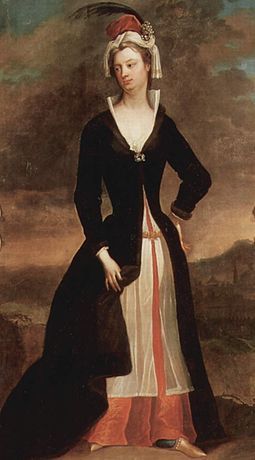
The critical and biographical introduction tells of Lady Wortley Montagu's travels through Europe to Turkey in 1716, where her husband had been appointed Ambassador. Her lively letters offer insights into the paradoxical freedoms conferred on Muslim women by the veil, the value of experimental work by Turkish doctors on inoculation, and the beauty of Arab poetry and culture.
The ability to study another culture according to its own values and to see herself through the eyes of others makes Lady Mary one of the most fascinating of early travel writers and commentators
The Lady Mary Wortley Montagu was an English aristocrat and writer. Montagu is today chiefly remembered for her letters, particularly her letters from Turkey, which have been described by Billie Melman as “the very first example of a secular work by a woman about the Muslim Orient”.
Ce livre est un ensemble de lettres écrites par Mary Wortley Montagu(1689-1762), une britannique fort bien instruite, qu’elle envoya en Angleterre lors d’un grand tour qu’elle fit en 1716-1718, avec son mari, un comte envoyé en mission à la sublime Porte.
A cette époque, l’Angleterre est en paix depuis le traité d’Utrecht(1713) qui mit fin à la guerre de succession d’Espagne. Louis XIV est décédé en 1715. Pour cette puissance déclinante, c’est la catastrophe : non seulement elle perd toutes ses possessions européennes, mais elle doit encore céder à l’Angleterre le rocher de Tariq (Gibraltar), et Minorque. C’est l’occasion pour l’Angleterre d’essayer d’ouvrir des routes commerciales en Méditerranée avec les Ottomans, lesquels entretiennent déjà des rapports amicaux séculaires avec la France. Si la mission du comte sera un échec, et qu’il devra rentrer à peine quelques mois après son arrivée, sa femme mettra à profit ce voyage pour se faire connaitre par sa correspondance.
Toutes les lettres de Mary visent à plaire au lecteur par un esprit de gaité, de légèreté et d’alacrité un peu railleur mais sans acrimonie. Elle n’hésite pas à étonner par des paradoxes, par le démontage d’idées reçues, parfois avec quelques petites hardiesses et autres traits piquants qu’elle tempère par une ironie tournée aussi bien vers soi-même que vers les autres. Tout devient bagatelle, les choses les plus graves sont traitées en plaisanteries, tandis que les sujets les plus vains acquièrent une importance capitale. Par ce côté, on est tout à fait dans l'esprit des maximes du Le Livre Du Courtisan de Baldassare Castiglione.
Une manière qu’elle a de se rendre sympathique, c’est, au milieu de qualités dont l’étalage pourrait blesser l’orgueil du prochain, d’afficher naturellement ses propres faiblesses : Mary se met complaisamment en scène avec les plus hauts personnages, dans le cadre le plus exotique, au milieu du luxe le plus raffiné, et ses petites marques de vanité, de coquetterie et de gourmandise achèvent de la rendre plaisante et agréable. Ses lettres sont de petites perles d’esprit, et on reconnait tout à fait la verve qui inspirera Voltaire, lequel louera ses qualités. C’est d’autant plus remarquable qu’elle ait réussi à leur donner ce tour joyeux qu’elle traverse en fait une bien mauvaise passe avec son mari, et qu’elle a toutes les raisons d’être chagrin.
Le livre est enrichi d’une introduction excellente qui permet de remettre cette œuvre dans le contexte ; on trouve également un appareil critique bien fourni qui permet de remettre efficacement tel ou tel personne qu’elle évoque.
When Lady Mary Wotley Montagu's husband was appointed Ambassador Extraordinary to the Court of Turkey in 1716, she traveled with him (and a considerable entourage) to Turkey, writing letters along the way and once she had arrived. I picked this up because of its connection to Turkey in my year of reading Turkey, not realizing how connected of a lady Mary truly was, or how important this published work is in the world of female travel literature. I'm not sure I'm the expert on that topic, so I'll just talk about what I think.
First of all, I was definitely impressed by how one woman's station could get her in the door of almost anywhere. Having lunch and playing games with the empress in Vienna, no big deal. Dinner with the sultana, twice! Princes! Kings! Letters to royalty and famous people all over, people who would write back. Pretty amazing. I had to keep reminding myself she was a real person.
Because Lady Mary (Mary Hanim in Turkish) writes letters to multiple people, I enjoyed seeing how her tone and focus would change based on who the letters were being sent to. To Alexander Pope, she is careful to be very intellectual, focusing on literary discoveries of Turkey. At the same time, her tone reveals their close relationship through a certain amount of antagonism. To her sister she is possibly most honest about the Turkish value on child-bearing. To the other women of a similar station, she might focus on fashion and art but also in correcting their inaccurate assumptions. To her husband, she is formal and passive aggressive at the same time (he spent most of their 13 Turkish months in military camps, and not at home with her.)
I loved this little comment about aging as a woman to Lady Rich (nothing to do with Turkey): "A woman till five and thirty is only looked upon as a raw girl, and can possibly make no noise in the world till about forty. I don't know what your ladyship may think of this matter, but 'tis a considerable comfort to me to know there is upon earth such a paradise for old women, and I am content to be insignificant at present, in the design of returning when I am fit to appear no where else." (Did I mention I am 35? Merely a raw girl.)
To Lady Mar, her sister: "...Knowing too much is very apt to make us troublesome to other people."
To the Abbe Conti, just one of many places defending the negative image the Turks had in English society: "These people are not so unpolished as we represent them..."
Upon leaving Constantinople: "There is no perfect enjoyment of this life out of Old England. I pray God I may think so for the rest of my life, and since I must be contented with our scanty allowance of daylight, that I may forget the enlivening sun of Constantinople."
If I have any criticism of Lady Mary, other than the obvious about her racism that I could argue is probably pretty embedded in 1716 England, it's how she only really interacted with the wealthiest, most important people in Turkish society. She was surrounded and protected, and while deriding the contemporary travel literature for its lies, she didn't exactly have an everyday experience.
On the other hand, she was a bit of a polyglot, and within 13 months was able to have full mealtime conversations in Turkish. Pretty impressive, and this got her closer into Turkish society than most British women would be able to do, particularly at the time!
Wow, what a woman Lady Mary was, such intelligence and wit in her writing, a woman living a life way ahead of her time. In a time where anything intellectual was the domain of men, the self taught Mary had a literally talent that put most writers to shame. There had been travel books written in the past but they were by writers passing through a place only seeing what their guide showed them, so things were briefly described and whole places unseen. Lady Mary lived in these places, explored them thoroughly, finding those places that had been missed, she fully included herself in the culture, learning the language and earning the respect of the people…you can’t help but feel proud of how she represented England.
I don’t think you can not help but notice how important these letters were to society back in England, Lady Mary’s opening words on the letters are all about placating the impatience from her friends demanding to know where she is, what she has seen, who she has met and demands for her to send them stuff. Also included are Lady Mary’s demands to know more about what is going on back at home, her words are sharp and amusing, you can see that any conversation with her could be quite daunting. Once she starts the main body of the letter it becomes more like travel writing, she takes care to go beyond what is written in traditional travel books, being a woman she was able to get insights into places never written about before, bath houses, places, harems and the private residences of princesses. I found what she saw fascinating, the details on fashion were very vivid and easy to picture in my mind. A few comments would have got her in trouble these days but you can see that what she wrote was innocent.
At the end of the book there is a biography about Lady Mary written by another mighty female travel writer, Dervla Murphy, and this insight into the life of Lady Mary was very good. This extra information gives an added dimension to the letters, I had wondered why the husband didn’t get mentioned much, almost a background character that she just happened to be travelling with. Most importantly was finding out about her work with smallpox inoculations, she had to deal with the same craziness as those trying to push covid vaccinations, the abuse, the bizarre theories about God not wanting this, but she was a strong woman who held her ground and eventually it was accepted and because of this one woman 1000’s of lives were saved…before this book I had never heard of her, she most certainly deserves far more recognition than she gets.
A book of two halves, first the unique views of a woman travelling across in the 1700’s and second the insightful biography of that woman…two very good reasons for getting yourself a copy of this book to read.
ETA: while I have not yet gotten my hands on the latest critical edition of Montagu's work, published by Broadview press, reviews state that it makes use of both the 1763 edition and Montagu's own manuscript.
The low rating reflects the edition of the text (Virago Press) rather than Montagu's work.
While easily accessible, this edition of the text is absolutely abysmal. Anyone studying Montagu or her letters must go to the so-called "unauthorized" 1763 editions to get the closest sense to what the author originally intended to be published, and in which order the letters should be arranged. Additionally, this edition is missing "The Original Preface, By a Lady. Written in 1724" and an Editor's Advertisement that were included in the original text and almost all subsequent editions. Malcolm Jack's editorial decision to base his text off of the 1965 Halsband edition, while considered the most complete edition of Montagu's letters, also glosses over Montagu's refusal to name addressees of her letters, which at times are based solely on conjuncture and without any evidence from the text's surviving manuscripts. Any scholar interested in Montagu's work would be well served to look at the 1861 edition edited by W. Moy Thomas in conjunction with the editions published in 1763.
Montagu's letters, on the other hand, are often held up as a classic piece of women's travel literature, often referenced in critical texts on travel in the 18th century. What is perhaps most impressive about her carefully crafted letters is her representations of the Ottoman women she encounters while traveling with her husband, the ambassador to Constantinople. These representations have been read by various critics as either engaging in the hegemonic, Orientalist gaze, or as an attempt to critique English and European social norms relating to women by celebrating a notion of Ottoman woman-hood that she herself might be creating. Either way, Montagu's text serves as a good comparison with the travel writing that would come later in the 19th century during the heyday of New Imperialism for anyone interested in British travel narratives.
رسائل السيدة ماري وورتلي مونتاغيو أثناء ترحالها عبر أوربا وصولا إلى تركيا حيث عين زوجها سفيرا
عرفت عن وجود هذه الرسائل من خلال كتاب كاثرين براننج " شاي تركي من فضلك.. تركيا من الماضي إلى الحاضر " والذي يحتوي على رسائل خيالية موجهة إلى السيدة ماري. لكن على خلاف تلك الرسائل الخيالية فإن رسائل السيدة ماري حقيقة إلى أشخاص حقيقين ولهذا جاءت نابضة بالحياة ومعبرة عن كاتبتها وعن المرسل لهم
السيدة ماري ذكية، ومتفتحة، يثير إهتمامها كل شئ ولا تمانع في استعمال قلمها الساخر للتعبير عن رأيها بكل حرية
أثار انتباهي - وحنقي بالطبع - الصورة التي أخذتها السيدة ماري عن الدولة العثمانية من أنهم قوم مسرفون لا يعرفون سوى حياة الراحة والملذات ومن أن علية القوم ومثقفيهم لا يختلفون عن هؤلاء في إنجلترا من أنهم يتعاملون مع الدين على أنه لا يطبق إلا على العامة للسيطرة عليهم والحد من شرورهم... لكن السيدة ماري -بالرغم من أنها تعتبر نفسها خبيرة في ما تكتب وتصف - لم تتنقل إلا بين علية القوم وحتى بين هؤلاء القوم من الطبيعي ألا تحظى بالترحاب والحوار إلا مع من هم على هذه الشاكلة..ومن الطبيعي أيضا أن تعمم حكمها على الكل من خلال أفراد.. مثل ذلك الأفندي الذي لم يمتنع عن شرب النبيذ وتحدث عن الدين بأنه للعامة
البذخ الشديد وحياة الترف والملذات جعلتني أشك بأن السيدة ماري ربما تواجدت في فترة لاله وهي فترة انتشر فيها تقليد أوروبا والبعد عن الدين والجري وراء الملذات إلى جانب الترف الشديد وهو ما يتناسب مع ما وصفته السيدة ماري. وبالفعل وجدت أن هذه الفترة تبدأ من عام 1718 فيما جاءت رسائل السيدة ماري عام 1717
بالرغم من أن السيدة ماري تعلمت التركية وأظهرت إهتماما بالأدب إلا أنها على ما يبدو لم تقرأ كتابا في الإسلام واكتفت بما وصل إلى أذنيها على أنه حقيقة مسلمه فجاءت بسخافات من مثل أن الرسول - صلى عليه وسلم - قد وعد النساء بفردوس منفصل عن فردوس الرجال شريطة أن يتزوجن وينجبن وأن من تموت غير متزوجة وبلا أطفال تموت على كبيرة ومصيرها إلى النار
كانت السيدة ماري -بالنسبة إلى زمنها - بالفعل منفتحة ومع هذا يبقى أي انفتاح مقيد بظروف النشأة والثقافة ولا يستطيع الهرب منها وهو ما أظهرته السيدة ماري فكل حدث يمر بقلمها يأخذ لونا وطابعا يكشف عنها قبل أن يكشف عن هذا الحدث.
To say these are a collection of the best letter writing of the eighteenth century really would be understating the importance and brilliance of The Turkish Embassy Letters. A collection of letters written during travels through Europe to Istanbul from 1716-18 by Lady Mary Wortley Montagu, her husband Sir Edward Wortley Montagu and their considerable entourage to take up the post as Turkish Ambassador in Istanbul.
Often considered as the first female travel writer, these letters provide not just many fascinating insights into the customs at the time, but also an important historical account of the social divide within many of the countries travelled and the religious and social customs of the time. Written with genuine candour, intelligence and wit. The Turkish Embassy letters show not the wonderful articulation of someone such as Mary Wortley Montagu’s position who, showing a keen interest in travel since a young age, but also a glimpse into society’s customs of the age.
Lady Mary’s life was as intriguing as her travel writing, and Eland has graciously included a very detailed and fascinating Biographical Afterword by Dervla Murphy who gives a very detailed account of Lady Mary’s life, which although tinged with loneliness and sadness is also inspiring and educational. Including such figures as Alexander Pope and early Feminist writer, Mary Astell, these are letters that are of considerable influence and importance.
Mary Wortley Montagu’s life certainly reads like a great adventure, her letters are filled with intrigue and detail that is rivalled by many travel writers to this day, her personal life saw her actively endorsing smallpox inoculations and romantic intrigues. Sadly her reputation was sullied by eighteenth-century gossip, of which she never really recovered. However, with this new edition of The Turkish Embassy Letters, hopefully, a new generation of readers can become inspired by her life and eradication the rumours of the past.
In 1716 Mary Wortley Montagu travelled across Europe to Istanbul. She was there as the wife of the British ambassador along with a sizeable entourage to represent Britain’s interests in Turkey. This position that she held meant that she could get to meet people in positions that normal travellers would not be able to entertain, such as empresses and sultans.
This book is a collection of her letters that were sent to a variety of people and were subsequently collected together to make this book up. I don’t know the name of the people that were the recipients of these letters, but I can guess with the number of nobility scattered amongst the names that these were the great and the good of the society of the time.
The thing that I liked most about the letters is the incredible detail of the places and people that she encounters on the way there and in court life. There are details of her seeing whirling dervishes for the first time, the description of a dress that was dripping in gems and diamonds as well as the mundane and the most recent gossip she is gathering and passing on to her friends.
I thought that this was a well-written insight into life at the beginning of the 1700s. She is an astute observer of life in the court as well as shining a light on the almost unknown lives of Turkish women at the time. Her views on life are refreshing too, given the time this was written, though she does carry the deeply held views of similar members of her class in society of the time. The afterword by the late great Dervla Murphy adds context to just who this lady was. Well worth reading, not just for its historical importance, but as a unique travel book of its time. 3.5 stars
I don’t think I’ve ever read something that made me more sleepy than this. Like I was wide awake every single time I picked this up, and then I would start reading, and like 15mins later I would be yawning and struggling to keep my eyes open. Truly, so dull.
I also don’t know if I’m missing something because this has a lot of good reviews, but I decidedly did NOT like it. Why is it SO boring??? and I… hate her? Like yeah, I guess at times she’s kinda feminist (?), but she also is so racist?? And constantly views everyone as objects?? I really hate her.
Maybe I’m just pissy because I have to do this on reading break, but don’t read this! It’s dull, bland, and racist!!!!! SO DULL!
There are a lot of inaccuracies about the Balkan countries she passed through, including wrong terminology and such but that’s okay. Despite that it was extremely interesting to read about her impressions of the lands under Ottoman rule at the time. I actually teared up a few times when she was describing the atrocities committed against my people and the harshness of the janizaries.
More excerpts for Lit class, very meh, very orientalist, very centred on Britain and Christianity Occasionally funny/entertaining, and I think it‘s fun that she is hating on male travel writers who are just making shit up But she is also being untruthful and weird in a different way 😬
Ein sehr sehr gutes Buch, was sich nach über 300 Jahren nach seiner Entstehung so unterhaltsam und flüssig lesen lässt, wie man es nicht erwarten würde.
Als Reisebericht einer englischen Frau des frühen 18. Jahrhunderts durch Deutschland, Ungarn, Wien und vor allem dem osmanischen Reiches sehr zu empfehlen.
I actually only thought this was mediocre at best until Lady Montagu reached Constantinople (for which descriptions, I'll admit, were really the only reason I was reading it in the first place), and then I truly enjoyed some of her observations.
I had to remind myself, however, that this epistolary style is actually non-fiction and, once I did this, saw what an extraordinary life Mary lived. Her experiences for a woman of that time were singular, and it didn't hurt that her friends were the upper-echelons of society; Voltaire applauds her letters and Alexander Pope and she send poetry and plot ideas back and forth. The historical information here is meager, but one does catch a glimmer of what life was for a woman traveling to "heathen" lands during the 18th Century.
Below are some favorite excerpts.
Regarding Islam: "He assured me that if I understood Arabic I should be very well pleased with reading the Alcoran [The Qur'an], which is so far from the nonsense we charge it with that 'tis the purest morality delivered in the very best language (p. 63)."
"...I begin with telling you that you have a true notion of the Alcoran, concerning which the Greek priests ... have invented out of their own heads a thousand ridiculous stories in order to decry the law of Mohammed; to run it down, I say, without any examination, or as much as letting the people read it, being afraid that if once they begin to sift the defects of the Alcoran they might not stop there but proceed to make use of their judgement about their own legends and fictions (p. 109)."
Regarding Women’s Rights: "'Tis very easy to see they [Turkish ladies] have more liberty than we have, no woman, of what rank so ever being permitted to go in the streets without two muslins, one that covers her face all but her eyes and another that hides the whole dress of her head, and hangs half way down her back and their shapes are also wholly concealed by a thing they call a ferace which no woman of any sort appears without... You may guess then how effectually this disguises them, that there is no distinguishing the great lady from her slave and 'tis impossible for the most jealous husband to know his wife when he meets her, and no man dare either touch or follow a woman in the street (p. 71)."
“…Turkish ladies…are, perhaps, freer than any ladies in the universe, and are the only women in the world that lead a life of uninterrupted pleasure, exempt from cares, their whole time being spent in visiting, bathing or the agreeable amusement of spending money and inventing new fashions… (p. 134). (Note: The Bridal Bathing scene was especially fun reading, but is too much to write down here. See pp. 134-135).
"You won't know what to make of this speech, but in this country it is more despicable to be married and not fruitful than it is with us to be fruitful before marriage (p. 107)."
"...I assure you 'tis certainly false...that Mohammed excludes women from any share in a future happy state. He was too much a gentleman and loved the fair sex too well to use them so barbarously. On the contrary he promises a very fine paradise to the Turkish women. He says indeed that this paradise will be a separate place from that of their husbands. But I fancy the most part of them won't like it the worse for that, and that the regret of this separation will not render their paradise the less agreeable (pp. 109-10)." I had to snicker at this one!
Regarding the introduction of the smallpox immunization: "The smallpox, so fatal and so general amongst us, is here entirely harmless by the invention of engrafting, which is the term they give it. There is a set of old women who make it their business to perform the operation. Every autumn in the month of September when the great heat is abated, people send one another to know if any of their family has a mind to have the smallpox. They make parties for this purpose and when they are met (commonly fifteen or sixteen together) the old woman comes with a nutshell full of the matter of the best sort of smallpox, and asks what veins you please to have opened. She immediately rips open that you offer to her with a large needle (which gives you no more pain than a common scratch) and puts into the vein as much venom as can lie upon the head of her needle, and after binds up the little wound with a hollow bit of shell, and in this manner opens four or five veins...Then the fever begins to seize them and they keep their beds two days, very seldom three. they have very rarely above twenty or thirty in their faces, which never mark, and in eight days time they are as well as before their illness... Every year thousands undergo this operation... (p. 81)."
2019: I was surprised by how much this made me miss Turkey. But also -- it's such a fantastic text to teach. From the opening section, when the students are surprised to find how much "culture shock" there is just in Continental Europe, to the fascinating dialectic between exoticism and normalization once she arrives in Turkey (the bathhouse! It's just like a coffeeshop! Yes, fully nude, but totally modest! But also: so many beautiful naked women omg), and the glimpse into women's lives, and the way she talks about slavery, and the poetry "translation" -- there's just so much here, and so much to do with it.
2015: I enjoyed this when I first read it two years ago; re-reading it with my Orientalism class was a treat. Such a fascinating book.
Lady Mary Montagu was ahead of her time in many ways. Essentially an auto-didact, her opinions on other cultures shows remarkable open-mindedness for her time period. While she was clearly a class-conscious snob who was preoccupied with dress and propriety, she capably described an Ottoman Empire that few Europeans were privileged to see. Her willingness to fully extend her claws added to the charm of the collection, and made me wish her daughter hadn't sacrificed her best writings for fear of gossip. Don't skip the excellent introduction by Anita Desai - it provides an essential biographical overview.
A fascinating, brilliant account of a witty, well-educated woman travelling east and living in the Ottoman Empire from 1716 to 1718. Lady Mary’s values and responses do not always align well with modern ones, but she is remarkably open to the value of difference, willing to see herself rather than the people she lives among as the alien other, and always interested in the lives of women (at least, of prosperous, elite women with whom she can in some way identify). Her descriptions of female spaces and lives are particularly valuable.
وسط وشرق أوروبا في القرن الثامن عشر بعيون أرستقراطية إنجليزية بدأتُ البارحة بقراءة كتاب «رسائل السفارة إلى تركيا» Turkish Embassy Letters للأرستقراطية والكاتبة الإنجليزية الليدي ماري وورتلي مونتاغيو، والتي شغل زوجها منصب السفير في القسطنطينية وتعد أول وثيقة غربية علمانية بقلم كاتبة عن المسلمين وشرق أوروبا. يضم الكتاب رسائل كُتبت بين عامي 1716 و1718، وتخلّد انطباعات الكاتبة عن المدن التي زارتها وعاشت فيها. عن روتردام الهولندية، تحدثت الكاتبة عن إكساء الشوارع بالحجارة وعن نظافتها، وكيف أنها سارت لمسافات طويلة من دون أن يتّسخ حذائها. تحدثت عن غياب المتسولين، بخلاف لندن، وعن تنوّع القبعات التي ارتدتها السيدات في الشوارع. تحدثت الكاتبة عن رخص البضائع عنها في لندن. وعن فيينا، تحدثت «مونتاغيو» عن جمال المدينة وضيق شوارعها ممّا يجعل المنازل مظلمة في الداخل. مع ذلك، أبدت إعجابها الكبير بالعمارة والأثاث والطعام وتنوّع النبيذ، وذكرت أن العديد من المنازل مؤلفة من خمس أو ست طوابق بسبب اكتظاظ السكّان، وأن الكثير من المنازل تسكنها أسر كثيرة ويفصلون الشقق بجدران داخلية. مع ذلك، بدت معجبة بالمدينة. كما تحدّثت الكاتبة عن ظاهرة الأقزام، التي تستهوي الشعوب الجرمانية، وأن أشكالهم مخيفة بسبب التشوهات، لكن الأمراء والأرستقراطيين يمنحون هؤلاء الأقزام حرية كبيرة في التحدث إليهم عن كل شيء. لم تبدُ معجبة شخصيًا بشغف الألمان هذا بهذه الشريحة السكانية. وعن براغ، نجدها تتحدّث عن مملكة بوهيميا وعن فقر الحال الواضح، وعن افتقار المنازل للمياه وأن مثل هذه الأمور تعد رفاهية بعيدة المنال لمعظم السكّان، وأن بعض معالم المدينة تحكي عن مجدٍ غابر. أثارت لديّ هذه المقارنات أسئلة حول الاستشراق: من الطبيعي أن يقارن الإنسان على الدوام بين ما يرصده وما يعرفه ويعيشه، وعليه لماذا تُتّهم هذه المقارنات بالاستعلاء أو المركزية الغربية عندما يكتب الغربيون عن الشرق؟ أليس هذا أمرًا طبيعي؟ ثم إنها لم تتوانَ عن الحديث عن كون روتردام تبدو أنظف وأجمل من لندن وعن خلوها من المتسولين الذين يملؤون شوارع بريطانيا. - حمام النساء: مقهى النساء في العهد العثماني في الرسائل التالية من كتاب «رسائل السفارة إلى تركيا» Turkish Embassy Letters للأرستقراطية والكاتبة الإنجليزية الليدي ماري وورتلي مونتاغيو، تحدثت الكاتبة عن رحلتها خلال هنغاريا وبلغراد في مطلع القرن الثامن عشر. أسهبت الكاتبة في الحديث عن الحروب التركية في شرق أوروبا في فترة السلطان سليمان القانوني والمدن التي أستعيدت من أيدي الأتراك، وتحدثت عن القرى المدمّرة نتيجة الحروب المتعاقبة. كما تطرقت لغابات المنطقة وكثرة الطيور والخنازير والذئاب البرية وفقر السكان (وكيف توفّر الطبيعة لهم احتياجاتهم)، وتحدثت عن استغراب السكّان من كرمها معهم، وإصرارهم على منحها بعض الهدايا. لفت نظري حديثها عن مدينة بودا (بودابست لاحقًا) وكأنها مدينة صغيرة فوق تل قرب ضفاف الدانوب، وتحدّثت عن هدايا من النبيذ الهنغاري، وعن جمال الهنغاريات الذي يفوق كثيرًا جمال النمساويات. تحدثت عن قرىً روسية في تلك النواحي، وعن ملابس القرويين البدائية المؤلفة من أغطية من الصوف. في الرسالة الثانية، بعد دخولهم الأراضي التركية، والحديث عن بلغاريا وأدريانوبوليس (أدرنه)، تحدثت الليدي «مونتاغيو» عن العربات الجميلة المغلفة لمنع الناس من رؤية النساء داخلها، ووصف رسوم سلاّت الأزهار والفواكه التي تزينها من الداخل وعن المقاعد الحريرية للعربة. ذكرت أن المشهد قد تغيّر تمامًا وكأنها تكتشف عالمًا جديدًا. تسهب بعد ذلك في الحديث عن حمام النساء الذي زارته، والذي تواجدت فيه أكثر من 200 امرأة محترمة وجميلة. قالت إنها دهشت لأنهن لم يبدين استغرابهن من كونها ترتدي ملابس تختلف عنهن، وتعاملن بلطف. وصفت قباب الحمام، عديم الشبابيك، وكيف يدخل الضوء عبر القباب المتصلة ببعضها، وتطرّقت لتفاصيل الحمام الساخن والبارد، وكيف كانت النساء عاريات تمامًا وهُن يتحرّكن بكل انسيابية، وقد اعتدن ذلك الأمر، مع خادماتهن. تصف النساء بأنهن بيضاوات ولهن شعورٍ منسدلة. تصف أيضًا تأثير العري الجسدي وكيف يجذب الإنسان بعيدًا عن ملامح الوجه، وكيف أن بعض النساء الجميلات من ناحية الجسد لم يكنّ الأجمل ملامحًا عند النظر إلى وجوههن. قالت إن النساء كُن يقلن عنها بالتركية «فاتنة، فاتنة جدًا» أثناء مرورها وسطهن. وصفت الحمّام بأنه مقهى النساء، حيث تُقال فيه كل الأسرار والفضائح، وأن النساء يقضين فيه أربع أو خمس ساعات كل أسبوع. وتحدثت عن فنانٍ إنجليزي وكيف سيتطوّر فنّه لو أتيحت له فرصة الدخول إلى الحمام وملاحظة كل هذا العدد من النساء العاريات بأوضاعٍ مختلفة: جالسات، يتحدثن، يعملن. وفي النهاية، أخبرت من كانت تراسلها، بأن هذه الرسالة وصفت لها مشهدًا لم تره في حياتها، ولا توفره حتى كتب الرحلات، إذ يستحيل على رجلٍ التواجد في مثل هذا الحمام من دون أن يكون الموت مصيره. ربما ألهب هذا الوصف مخيلة الفنانين الغربيين الذين أسرفوا في تصوير مشاهد من حمامات النساء في المشرق، وكلها من بنات خيالهم، إذ لم تتح لأيّ منهم فرصة الدخول إلى الحرملك، ناهيك عن الحمّام، وساهمت تلك اللوحات في بناء شرق متخيّل في العقلية الغربية في تلك العصور.
But I had rather lose the pleasure of reading several witty things, than be forced to write many stupid ones.
— i.
We travellers are in very hard circumstances. If we say nothing but what has been said before us, we are dull and we have observed nothing. If we tell anything new, we are laughed at as fabulous and romantic, not allowing for the difference of ranks, which afford difference of company, more curiosity, or the changes of customs that happen every twenty year in every country. But people judge of travellers exactly with the same candour, good nature, and impartiality, they judge of their neighbours upon all occasions. For my part, if I live to return amongst you, I am so well acquainted with the morals of all my dear friends and acquaintance that I am resolved to tell them nothing at all to avoid the imputation (which their charity would certainly incline them to) of my telling too much. But I depend upon your knowing me enough, to believe whatever I seriously assert for truth, though I give you leave to be surprised at an account so new to you.
So this book is another work of non-fiction, specifically in epistolary/letter format. Lady Mary Wortley Montagu follows her husband on his travels to Turkey, and writes to friends, colleagues, and family back home in England. This book is a collection of those letters. This review will also be a bit different than my usual review process, because it’s a collection of letters rather than one straight storyline. If you'd like to read the full review, please check it out on my book blog, here.
-
Always remember me, and be assured I can never forget you.
foppy faery frog lady cooks up beef w roman catholics and pervs on a bunch of turkish ladies.
My word his frock was of the finest golden lace! thrice spun on a web of moorish sandalstone! A bevy of frightful looking eunuchs waited on his majesty with diamond encrusted feather fans and ham sandwiches. The sultana's gentleman lover watched the scene with a sneaky grin.
An informative account of the travels of Mary Wortley Montagu. What interested me most was that many things that were around in her time were things that I had always believed were more modern.
Reading this book made me feel like an 18th century English noblewoman reading the letters of my very cosmopolitan and fashionable friend, Lady Mary Wortley Montagu. The letters are pretty orientalist but I don’t know that word because I’m an 18th century English noblewoman
The author had extraordinary experiences in the Turkish empire and on the way to it in early 18th century, which are well recorded and very demystifying. The letters show her as a writer of style and knowledge, and an impressively capable learner.
THE TURKISH EMBASSY LETTERS: LADY MARY WORTLEY MONTAGU
What a very clever and interesting book - that is, for those who are interested in early eighteenth century English customs and the Ottoman empire. Lady Mary was an English aristocrat who travelled to Constantinople in 1716 with her husband, Edward, who had been appointed Ambassador to the Turkish court in order to try to broker a peace deal between it and the Viennese court of the Habsburgs. He failed in this mission but, as a result of it, later generations of readers were treated to his wife’s observations of a culture that was so foreign to her own. In her letters to her friends and family back home, she enlightened them on subjects such as the treatment of Jews in the Turkish empire (they were a very powerful element in it); the brutal attitude shown by the Turkish army to the common people, who were often left destitute after soldiers had been through their lands; the position of women in Turkish society; and the wonders of Turkish architecture, so utterly different from that in her own country. She chose her topics according to whom she was writing to. When communicating with the poet, Alexander Pope, she regaled him with lengthy quotes from Arabian poetry. When writing to a clergyman, she explained to him the religious beliefs and rituals practiced in Turkey. And, when writing to her female friends, she took great pains to describe the clothes and hair styles of the local women. In fact, one of the subjects she dwells on the most in the Letters is the women she met. She gives lengthy descriptions of the public baths that women used as meeting places, of her visits to various harems, and her attendance at an all-women pre-marriage ceremony conducted in a public bath. She describes her meetings with the wives of sultans and other great Turkish leaders, and is positively glowing with praise for their great beauty and poise. The male readers’ imaginations will be set alight by her narratives! What makes the book so interesting, though, is that Lady Mary also gives her thoughtful opinions on what it is she is observing, whether it is the wearing of the veil, or her view of the practice of war, regularly indulged in by the Turks. It is obvious, reading the book, that Lady Mary was, at heart, an ardent romanticist. It is no wonder, then, that some years after her return to stuffy old England, she left again and spent most of the rest of her life in Italy and France. Just under two years spent under the Turkish sun had a profound effect on her. I would venture to say she was never the same woman again, and it’s a great pleasure to read about the influences which shaped that process.
Kitap iki bölümden oluşuyor. İlk kısımda 1717-1718 yıllarında İstanbul’a eşinin büyükelçilik görevi nedeniyle gelen Lady Montago’nun İngiltere’deki dostlarına Osmanlı hakkında yazdığı mektuplar yer alıyor. Lady Montago hem seçkin biri hem de kadın olması nedeniyle Saray’ın en mahrem yerlerine (kadınlar hamamı ve harem) girip buralar hakkında gerçek bilgiler veriyor. Yazılarında kendisinden önce seyyah olarak Osmanlı’ya gelen Avrupalı yazarların anlattıklarının yanlış olduğu üzerinde sık sık durarak buralar hakkında o kişilerin bilgi sahibi olmalarının imkansız olduğunu belirtiyor. Osmanlı hakkında tarafsız ve gerçek bilgiler elde etmek adına oldukça güzel metinler. Mektuplar başka yayın evleri tarafından Şark Mektupları ya da Doğu Mektupları adıyla da basılmış. İçeriklerinde bir kaç eksik ya da fazla mektup olabilir.
İkinci bölüm ise Osmanlı’ya sığınan bir Macar Beyinin maiyetinde bulunan Kelemen Mikes’ın (büyük ihtimal hayali olan) ablasına yazdığı mektuplardan oluşuyor. Bu bölümde daha çok Türk, Rum, Ermeni ve Yahudi bir arada yaşayan dört milletin adet ve yaşam biçimleri hakkında bilgi sahibi oluyoruz. Bu mektuplar Lady Montago’nunkiler ile kıyaslanamayacak kadar sığ ve ön yargılı. Yazarın bilgi ve görgüsü alenen yazdıklarına da yansıyor. Bu sebeple bana bu kısım çok doyurucu gelmedi.
A valuable source of info from a womens perspective , one of the few women of the era who would have entered the harem of the Ottomans therefore her description is rather important as it was a first hand account, unlike the Orientalists who could only fantasise or rely on second and third hand account of the Harem life which were usually sensationalised to attract attention form readers back home and were usually sleazy accounts of their own imagination.
Apart from that it goes on about the life of Lady Montagu which was just a life of an affluent woman of that era ..
Any early-18th century epistolary text documenting a European's impressions of the Ottoman Empire would be interesting in and of itself, but Lady Mary is the real star -observant, intelligent and caustic, an absolute joy to read. Her observations are fair and generally complimentary, and she displays an ability - rare even now, but considerably more so 300 years ago - to consider another culture on its own terms.